# AI QMS
> powered by Omind.AI
---
## Agent Performance Visibility and Performance Changes To Prevent KPIs Decline
Most contact centers deploy extensive performance reporting systems. For instance, leaders constantly monitor quality assurance (QA) scores, Average Handle Time (AHT), and First Contact Resolution (FCR). Because of this, managers track Customer Satisfaction (CSAT) alongside strict productivity and adherence metrics. However, when operational performance begins to drop, many organizations struggle to find the [root cause](/okf/article/call-center-root-cause-analysis-performance.md). Consequently, they cannot achieve true **agent performance visibility** during critical operational shifts. Specifically, leadership teams frequently face frustrating questions when metrics change:
- Why are escalations increasing despite stable QA scores?
- Why do some teams outperform others under identical conditions?
- Why are customer complaints rising before CSAT averages decline?
- Why do new hires fail to improve after receiving additional coaching?
- Why do supervisors produce highly inconsistent outcomes across teams?
## What Is Agent Performance Visibility?
Agent performance visibility means understanding how specific behaviors, workflow execution, and customer interactions influence operational outcomes. Traditional reporting merely measures what happened in the past. In contrast, deep visibility focuses entirely on explaining why those performance changes occurred. Consequently, leaders can move away from guesswork. Because they see actual interaction patterns, they can address problems proactively. ## Why Contact Centers Struggle to Explain Performance Changes
Most organizations identify that performance has changed long after the slide begins. However, far fewer can pinpoint the exact variable that drove the shift. - **KPI Dashboards Show Results, Not Causes:** Dashboards indicate final outcomes. For example, a spike in repeat contacts shows a failure in resolution. Nevertheless, it rarely reveals the operational drivers behind that failure.
- **QA Sampling Produces Partial Evidence:** Traditional teams review less than 1% of total interactions. Therefore, limited review coverage creates massive [blind spots](/okf/article/automated-call-quality-monitoring-evaluation-coverage.md).
Reality of Sample-Based QA QA Metric / Vulnerability Operational Impact & Exposure Total Interactions Evaluated Critical Risk- Evaluates **less than 1%** per agent, per month\[cite: 2\].
- Leaves regional communication friction completely unchecked in major delivery hubs like Latin America and the Philippines.
Blind Spot Exposure 99%+ Unreviewed- Over **99%** of customer interactions escape review entirely.
- Hides critical compliance violations and critical workflow execution drops from leadership view until clients complain.
Metric Lag Time Delayed- Takes **14 to 30 days** before behavioral trends surface\[cite: 2\].
- Forces operations into reactive remediation, destroying customer experience margins across the current billing cycle.
### Performance Reviews Depend on Incomplete Context
Because managers evaluate fragmented information, they make decisions based on assumptions. Consequently, critical context remains completely missing. Performance problems frequently emerge weeks before dashboards show a drop. Thus, the damage occurs silently before leaders notice a variance. ## The Four Layers of Agent Performance Visibility
To fix this issue, high-performing operations build structural visibility across a proprietary four-layer framework. - **Layer 1: Performance Outcomes:** This layer measures what happened at the end of the call. For instance, it tracks standard metrics like CSAT, AHT, and escalation rates.
- **Layer 2: Agent Behaviors:** This layer tracks how agents handle live interactions. Specifically, it monitors communication quality, issue investigation techniques, and customer guidance.
- **Layer 3: Process Execution:** This layer measures how well teams adhere to mandatory workflows. For example, it evaluates verification procedures and [resolution paths](/okf/article/call-center-process-management-execution-gap.md).
- **Layer 4: Customer Experience Signals:** This layer captures the immediate customer response to execution. Consequently, it highlights customer effort indicators, frustration signals, and repeat contact drivers.
## Why Performance Problems Become Visible Too Late?
By the time organizations notice declining CSAT or rising complaints, underlying causes have already existed for months. Because outcome metrics are lagging indicators, they cannot protect your operation from sudden drops. “Relying strictly on end-of-month KPI dashboards to manage a contact center is like trying to drive a vehicle while only looking at the rearview mirror. You see the crash only after it happens ” Consequently, delayed discovery creates compounding operational costs. For example, it accelerates customer dissatisfaction and drives up [compliance exposure](/okf/article/ai-quality-management-reduce-risk-variability.md). Furthermore, it wastes coaching effort on the wrong operational issues. ## The Five Blind Spots That Prevent Leaders from Explaining Performance Changes
To protect your operation, you must eliminate five distinct blind spots that block structural visibility: 1. **Hidden Performance Variation:** Agents with identical QA scores often produce vastly different customer outcomes.
2. **Early Performance Deterioration:** Behavioral compliance often weakens long before metrics reveal a drop.
3. **Supervisor Effectiveness Gaps:** Certain teams consistently outperform others because supervisor coaching quality varies wildly.
4. **Process Adoption Failures:** Designed workflows look perfect on paper but fail completely during live customer interactions.
5. **Escalation Pattern Drift:** The underlying reasons for supervisor escalations shift before the actual volume increases.
## Sample-Based Reviews Cannot Deliver Complete Visibility
Traditional QA reviews provide minor snapshots of team performance. However, critical operational decisions require broader empirical evidence. Because spreadsheets cannot capture systemic behavioral shifts, manual sampling misses major trends. Consequently, issue detection arrives too late to save at-risk accounts. ### How Interaction-level Visibility Reduces Operational Uncertainty?
Modern operations now analyze interactions at scale to uncover behavioral patterns. Specifically, this practice reveals workflow adherence trends and isolating customer effort drivers. Therefore, leaders focus on explaining performance rather than simply monitoring staff. ## Why Limited Agent Visibility Creates Operational Uncertainty?
Without sufficient **agent performance visibility**, leaders struggle to determine which teams require immediate intervention. Because they lack data, they cannot see which workflows create friction. Consequently, operations become deeply reactive, slowing down executive decision-making. ### From Agent Visibility to Operational Certainty
Leading organizations focus entirely on the upstream drivers of business outcomes. They manage the entire operational chain directly: Real-Time BPO Operational Governance vs. Reactive Failure Step Option A: Real-Time Governance (Omind Ecosystem) Option B: Legacy Reactive Management (End-of-Month) 1 Interaction Active- **Gen AI Voicebot** routes regional volume seamlessly.
- **Accent Harmonizer** neutralizes primary delivery friction on live calls instantly across Latin America and the Philippines.
Unmonitored- Unfiltered regional accents cause immediate CX friction.
- Static IVR systems trigger customer drop-offs without tracking the specific failure points.
↓ Continuous Tracking ↓ Data Blindspot 2 Evaluation Automated- **AI QMS** analyses 100% of interaction streams immediately.
- Flagged deviations trigger automated calibration updates for nearshore teams.
Partial- Manual sampling catches less than 2% of total voice interactions.
- Compliance drift escalates entirely unnoticed by supervisors.
↓ Instant Remediation ↓ Delayed Reporting 3 Outcome Proactive SLA Protection
"SLA margins are fully insulated; operational adjustments take place dynamically within minutes."
The "Rearview Mirror" Crash
"Month-end dashboards arrive 30 days too late, confirming margin erosion long after failures occur."
Because they fix behavioral friction early, their final business outcomes remain stable. ## What High-performing Contact Centers Make Visible?
Instead of adding more confusing dashboards, [advance speech clarity platform for contact centers](/okf/page/home.md) clarify specific operational execution points: - Resolution behaviors during complex calls.
- Workflow deviations from standard operating procedures.
- Root escalation drivers before transfers occur.
- Customer effort signals during account changes.
## Conclusion
The challenge for modern contact centers is not collecting additional metrics. Instead, the true challenge is understanding the interaction-level behaviors that drive those metrics. Structural **agent performance visibility** helps organizations explain performance changes before customer experience declines. By analyzing what happens inside customer interactions, leaders can make faster operational decisions. ### Ready to fix operational blind spots?
Stop guessing why your contact center KPIs fluctuates. Talk to our operational specialists today to learn how interaction-level visibility can stabilize your performance outcomes. [Schedule Your Operational Assessment](/okf/page/schedule-a-demo.md)
---
## Agent Quality Management Software Revealing the Behaviors Behind Low QA Scores
An agent's QA score drops from 91% to 82%. That number tells a supervisor something changed. It doesn't tell them what. Which specific behavior slipped? Is it one bad week or a pattern? Is this one agent's problem, or something happening across the whole floor? And once a supervisor coaches the agent, how does anyone know the coaching work? A QA score is a symptom. Agent quality management software earns its place in the stack when it can trace that symptom back to a cause, point to the evidence, and confirm the fix.
## A Score Measures, but Doesn't Diagnose
Most QA programs still run on a simple loop: [sample a handful of calls](/okf/article/call-sampling-risk-contact-center-performance.md), score them against a rubric, roll the scores into a number, and hand that number to a supervisor to act on. The weak point sits between the score and the coaching. 82% could mean the agent skipped identity verification. It could mean weak probing questions, an incorrect product explanation, a premature transfer, or a call that ended without confirming the issue was resolved. Seven different root causes can produce the same three-point drop. Each of those causes needs a different fix. Coaching an agent on probing technique won't help if the real issue is a transfer they were never trained to avoid. How a 90% Aggregate Score Masks Critical Agent Failure Modes? Underlying QA Parameter Isolated Score Status Operational & Compliance Risk Standard Greeting & Professionalism 100% Pass Adheres strictly to brand script and opening protocols. Customer Empathy & Soft Skills 95% Pass Strong tone control; de-escalates customer tension effectively. Mandatory Verification / Authentication 100% Pass Verifies 2-factor ID data prior to account disclosure. Process & Workflow Accuracy 90% Pass Follows standard troubleshooting tree with minor administrative delays. Regulatory Compliance Disclaimer 0% Fail - Completely skipped legally required HIPAA/PCI statement.
- Exposes enterprise to severe regulatory fines despite high overall call score.
Knowledge Base / Policy Accuracy 60% Partial - Quoted outdated refund processing timelines to customer.
- Triggers repeat calls and artificially inflates Average Handle Time (AHT).
Sampling compounds the problem. If a supervisor only sees three failed calls, they don't know if that's the whole story or a fraction of it. Two bad calls aren't automatically a pattern. Without a wider set of interaction evidence, a manager is guessing at what's typical and what's noise. ## Finding the Behavior Underneath the Number
This is where agent quality management software should do its actual work: connect the score to the specific, recurring behavior driving it, and let a manager see the evidence for themselves. That means answering three questions before anyone plans a coaching session. - **Is failure isolated or recurring?** A single missed disclosure is a coaching note. The same missed disclosure across a dozen calls over three weeks is a trend that needs a different level of urgency.
- **Second, which behavior is driving the number?** A [falling FCR rate](/okf/article/aht-vs-fcr.md) could stem from incomplete discovery, a troubleshooting path that skips steps, or transfers happening too early in the call. A [falling CSAT score](/okf/article/qa-score-vs-csat.md) could trace to unclear next steps rather than tone or friendliness.
Contact Center KPI Declines & Root Cause Behaviors What's Declining Behaviors Worth Investigating First Call Resolution (FCR) - Incomplete initial discovery and root-cause probing
- Premature call transfer before gathering basic intake context
- Incomplete troubleshooting or skipping step-by-step verification
Compliance & Regulatory Standards - Missed account authentication or ID verification steps
- Missing mandatory disclaimers (e.g., call recording, HIPAA/PCI statements)
- Usage of non-compliant or strictly prohibited language
Customer Satisfaction (CSAT) - Setting unclear expectations or inaccurate resolution timelines
- Unresolved next steps left uncommunicated to the caller
- Weak empathy, robotic tone, or poor acknowledgment of caller frustration
Average Handle Time (AHT) - Unnecessary repetition of questions previously answered
- Excessive, unannounced dead air and prolonged hold times
- Weak call control and inability to steer tangential conversations
- **Next, can a manager inspect the calls behind the conclusion?** A platform that outputs a behavior label without the underlying interaction evidence is asking supervisors to trust a black box. Coaching conversations get better when a manager can [pull up the specific moment in the call](/okf/article/ai-call-evaluation-software.md) and show the agent what happened.
### Key Architectural Takeaway
Unlike static voice changers or post-call analytics, Accent Harmonizer operates dynamically on live audio streams. By maintaining sub-150ms latency, it bridges dialect gaps in real time without sacrificing voice authenticity or disrupting natural conversational flow.
The difference is between measurement and diagnosis. "Agent has low FCR" is a measurement. "Agent skips diagnostic questions before choosing a troubleshooting path" is a diagnosis a supervisor can coach against. ## The Agent Isn't Always the Problem
Repeated failure doesn't automatically mean an agent needs remediation. Sometimes the same behavior shows up across agents who have nothing else in common, and that's a different kind of problem entirely. An outdated knowledge base article, a confusing escalation policy, a CRM workflow with too many clicks, or a product defect can all [produce the exact same QA failure](/okf/article/root-cause-analysis-call-center.md). The distinction comes down to scope. If a failure clusters around one agent or a small group, that points to a skill gap and a coaching plan. If the same failure shows up across unrelated agents and teams, that points to something broken upstream of the agent entirely. Operational Decision Paths Diagram Path A: Agent-Level Workflow Path B: Process-Level Workflow Trigger Step 01
**Agent-Level Pattern**- Isolated behavior detected across individual interaction logs.
- Outlier metrics identified (e.g., specific agent latency spikes, soft skill drop-offs).
Trigger Step 01
**Process-Level Pattern**- Systemic variance detected across entire queues or shifts.
- Macro-trend failures (e.g., broad compliance gaps, widespread knowledge base bottlenecks).
↓ ↓ Target Outcome 02
**Targeted Coaching Action**- Automated, micro-learning modules assigned.
- 1-on-1 supervisor feedback sessions targeted at targeted skill gaps.
Target Outcome 02
**Operational Investigation**- Root-cause process audit across workflow layers.
- SOP revisions, script adjustments, or integration updates for workflows.
Getting this wrong is expensive. If a process is actually broken and management treats it as an agent problem, the organization ends up coaching dozens of people around a defect none of them can fix on their own. The KPI stays flat, the coaching hours are spent on, and the actual cause is never touched. ## Not Every Failure Gets the Same Response
Once a manager knows what behavior is repeating, the next mistake is treating every failure with equal urgency. A missed optional phrase and a missed mandatory disclosure are not the same problem, even if they show up on the same scorecard. Coaching priority should weigh a few factors together: how often the behavior occurs, how serious the consequence is when it does, what it costs the business in compliance risk or repeat contacts, whether it's trending up or down, and how many agents it touches. The goal isn't more coaching sessions. It's spending the coaching hours a team already has on the behaviors that move the needle. ## Coaching Completion Isn't the Same as Improvement
Most QA programs track whether coaching happened. However, fewer platforms track their implementation and success. A 98% coaching completion rate says nothing about whether the coached behavior changed in the next batch of calls. Completion is an activity metric. Behavior change is an outcome metric, and they're not interchangeable. Closing that loop means [comparing behavior before and after the intervention](/okf/article/agent-performance-scorecard-software.md) on new interactions, not just checking a box that a coaching session took place. Illustrative Before/After Failure Rate Impact (Post-Coaching) Metric & Trigger Scope Baseline (Pre-Intervention) Illustrative Outcome (Post-Intervention) Identified Failure Pattern High Mismatch Rate (18.4%) - Repeated failure on mandatory verification disclosure scripts.
- Concentrated within offshore agent cohorts (e.g., PH/LATAM queues).
Target Defect Drop (<4.2%) - Significant decline in compliance variance post-coaching.
- Stabilized script delivery across cross-regional support teams.
Triggered Coaching Action Manual QA Escalation - Delayed 1-on-1 supervisor coaching sessions (7–14 day lag).
- Inconsistent offline feedback loop with generic retraining materials.
Targeted Micro-Learning Workflow - Automated assignment of targeted phonetic/compliance modules.
- Paired with real-time accent translation platform assist during live calls.
Data Framework Status **Illustrative Model:** This comparison reflects an illustrative scenario mapping pre-intervention defect rates against expected post-coaching outcomes. Three outcomes are possible. The behavior improves, which suggests the diagnosis and coaching were right. The behavior doesn't move, which means the coaching approach or the original diagnosis needs a second look. Or the same failure keeps showing up across multiple agents even after coaching, which is a signal to revisit whether the root cause was ever agent-level in the first place. ## What to Actually Ask a QA Platform?
It's easy for a QA platform demo to look impressive without [answering the questions that matter](/okf/article/contact-center-qa-rfp.md) day to day. Four questions cut through that. - Can you move from an agent's score to the specific, recurring behavior driving it?
- Can a manager see the interaction evidence behind that conclusion, not just the label?
- Can the platform tell whether a pattern belongs to one agent or shows up across the operation?
- And can it confirm whether a targeted behavior changed after a manager acted on it?
Identifying why digital support agents rush interactions requires balancing handle speed against [chat agent productivity and resolution metrics](/okf/article/chat-agent-productivity-metrics.md). A platform that only produces more scores, faster, has automated evaluation. It hasn't necessarily solved agent quality management. ## Closing the Distance Between a Score and a Decision
Traditional QA often stops at sample, score, report. A more useful version of the same process extends further: detect the pattern, diagnose the cause, act on it, and verify the result. A quality score tells a manager where to look. It shouldn't be the final answer. The real value of agent quality management software is shortening the distance between noticing a problem and knowing, with evidence, what to do about it. See how [AIQMS](/okf/page/home.md) helps teams connect interaction-level evaluation to the behavior patterns behind agent QA results. ### See the Behavior Behind Every Score
Most QA tools tell you an agent's score changed. AIQMS is built to show you why, with the interaction evidence to back it up. [See AIQMS in Action](/okf/page/schedule-a-demo.md)
---
## Agent Scorecard Software for Automated Call Center QA
Most QA leaders believe they have visibility into agent performance. They have scorecards, review processes, calibration sessions, and weekly coaching. The problem is that traditional QA scorecards often evaluate only a small sample of customer interactions. That leaves contact center leaders making performance decisions without seeing the full picture.
Agent scorecard software changes that model by automating interaction evaluation, applying consistent QA criteria, identifying performance trends, and connecting scores directly to coaching opportunities.
Instead of using scorecards only to document what happened, modern call center scorecard software helps teams understand why performance changed and what action should happen next.
## What Is Agent Scorecard Software?
> Agent scorecard software is a quality management tool used to evaluate and track contact center agent performance against defined QA criteria.
Traditional agent scorecards depend heavily on manual call reviews and evaluator judgment. Automated agent scorecard software can analyze substantially more customer interactions, apply standardized scoring criteria, surface performance patterns, and help supervisors identify coaching opportunities faster.
A modern agent performance scorecard can evaluate areas such as:
- Script and process adherence
- Communication quality
- Customer sentiment
- Compliance requirements
- Resolution effectiveness
- Empathy and soft skills
- Objection handling
- Escalation behavior
- First-contact resolution indicators
- Overall QA performance
The objective is not simply to produce another score. It is to turn interaction data into a consistent system for measuring and improving agent performance.
## Why Traditional Agent Scorecards Break at Scale
If scorecards aren't driving measurable improvement, the problem may be the underlying QA process rather than the metrics themselves.
Most manual scorecard programs face four structural limitations.
### 1. The Sampling Trap
[Reviewing a handful of calls per month](/okf/article/ai-qms-contact-center-audit-prevent-percent-review-problem.md) gives QA teams only a partial view of agent performance. An agent may handle hundreds or thousands of interactions while only a small number are manually evaluated. Important patterns, recurring customer issues, and compliance risks can remain hidden between sampled conversations.
### 2. Subjectivity and Scoring Bias
Two QA analysts can listen to the same interaction and interpret performance differently. When scoring standards depend heavily on individual judgment, agents may question whether evaluations are fair. Calibration becomes more difficult, and coaching discussions can shift from improving behavior to debating the score. Agent scorecard software can help standardize evaluation criteria so the same performance expectations are applied more consistently.
### 3. The Feedback Lag
A scorecard loses much of its coaching value when feedback arrives weeks after the interaction occurred. By then, the agent may have repeated the same behavior across dozens of additional conversations.
Modern QA scoring software helps shorten the distance between **interaction → evaluation → insight → coaching action**.
### 4. The Manual Action Chain
Traditional QA often stops at the dashboard. An analyst evaluates an interaction, creates report and supervisor reviews it. Based on the results, system schedules coaching session. Someone then has to determine what behavior should change. Every additional manual step increases the possibility that an important insight never becomes an action.
## What Should Agent Scorecard Software Do?
Buyers need a system that improves the quality, consistency, and usefulness of agent evaluation. Strong agent scorecard software should support several core capabilities.
- **Automated QA Scoring:** Automated QA scoring allows predefined evaluation criteria to be applied across a much larger volume of interactions than manual review alone can support. This reduces dependence on limited sampling and gives QA teams a broader view of performance patterns. [Scoring interactions at scale](/okf/article/qa-for-call-centers-at-scale.md) can also help teams identify recurring problems that may never appear in a small manual sample.
- **Customizable QA Scorecards:** Different teams measure quality differently. Customer service, collections, sales, healthcare, insurance, and other operations may require different evaluation criteria. Agent scorecard software should allow QA teams to configure evaluation questions, scoring categories, and much more.
- **Consistent Agent Evaluation:** Automation in [agent quality management software](/okf/article/agent-quality-management-software.md) is particularly valuable when organizations are trying to reduce variation between evaluators. Consistent scoring criteria make it easier to compare performance across agents, teams, locations, campaigns, and time periods. This does not eliminate the need for QA governance or calibration. It gives those processes a more consistent data foundation.
- **Context-Aware Evaluation:** Traditional scorecards often focus on whether a required phrase was spoken or whether a specific step was completed. Modern evaluation needs more context. For example, a technically compliant conversation may still create a poor customer experience. Conversely, an agent may resolve a complex issue effectively even when the interaction does not follow a perfectly linear script. AI-assisted scoring can help evaluate signals like intent, sentiment, etc.
- **Real-Time Performance Signals:** [Real-time performance intelligence](/okf/article/real-time-qa-performance-intelligence.md) can help supervisors identify important signals closer to the interaction itself. Depending on the system and workflow, these signals may include compliance risks, escalation indicators, etc.
[AI-generated coaching insights](/okf/article/ai-qms-agent-performance-improvement.md) can help managers move from identifying a performance issue to understanding what needs to change. Before replacing human reviews on agent scorecards, run line-item checks to verify [automated scoring accuracy across scorecard criteria](/okf/article/automated-qa-scoring-accuracy.md). When [scoring and coaching operate as one workflow](/okf/article/agent-analytics-call-centers-intelligence-framework.md), scorecards become an improvement tool rather than simply a reporting mechanism.
## Manual QA Scorecards vs. Automated Agent Scorecard Software
Capability Manual QA Scorecards Automated Agent Scorecard Software Interaction Coverage Limited sampling (typically 1–5%) 100% full-coverage evaluation Scoring Mechanism Manual sampling & logging Automated AI-driven scoring Evaluator Consistency Subjective; prone to evaluator bias Standardized, objective calibration Performance Tracking Periodic batch reporting Continuous real-time dashboards Coaching Insights Manually identified after reviews Automatically flagged behaviors Feedback Speed Delayed by days or weeks Immediate, post-interaction feedback Compliance Monitoring High risk of undetected breaches Continuous breach detection Scalability Linear headcount increase required Scales effortlessly across all channels While traditional scorecards primarily help teams measure past performance, automated scorecard software bridges the gap between measurement, instant coaching, and continuous operational improvement. The transition is especially vital across multi-session digital channels, where automated scorecards help supervisors track specialized [chat agent productivity metrics](/okf/article/chat-agent-productivity-metrics.md) to balance concurrency demands with high response quality. ## How Agent Scorecard Software Helps Reduce Scoring Bias
Scorecard calibration is one of the most persistent challenges in contact center QA. If different QA analysts interpret criteria differently, the same behavior may receive different scores depending on who performs the evaluation.
This creates three problems:
1. Agents lose confidence in the QA process.
2. Managers struggle to compare performance consistently.
3. Coaching becomes harder because the underlying measurement is disputed.
Agent scorecard software can reduce this variability by applying common scoring logic across interactions. QA leaders still need to define the right evaluation criteria, review edge cases, and maintain governance. But automation can provide a more consistent starting point for calibration.
## What Metrics Should an Agent Performance Scorecard Track?
There is no universal scorecard that works for every contact center. The right metrics depend on customer journeys, regulatory requirements, operating goals, and the responsibilities of each agent.
Contact Center QA & Compliance Evaluation Framework Evaluation Pillar Key Performance Criteria Quality & Communication - Greeting and introduction
- Active listening
- Empathy
- Communication clarity
- Professionalism
Process Performance - Correct workflow completion
- Verification procedures
- Documentation quality
- Escalation handling
- Process adherence
Customer Outcomes - Resolution quality
- Repeat-contact indicators
- Customer effort
- Sentiment analysis
- Escalation likelihood
Compliance - Required disclosures
- Authentication procedures
- Script adherence
- Regulatory requirements
- Critical compliance failures
Coaching and Development - Recurring performance gaps
- Improvement trends
- Strength areas
- Coaching completion
- Behavioral progress
The best agent scorecards focus on behaviors that managers can actually influence rather than collecting metrics simply because they are available.
## Business Impact of Agent Scorecard Software
The value of automated scorecards looks different depending on who is evaluating the platform.
### For CX Leaders: Greater Consistency
Consistent evaluation helps leaders understand which agent behaviors contribute to stronger customer interactions and where performance varies across teams.
### For Operations and QA Leaders: Greater Efficiency
Automation reduces the amount of time analysts spend manually searching for interactions and scoring repetitive criteria.
QA teams can spend more time investigating patterns, conducting root-cause analysis, and improving processes.
### For Supervisors: Better Coaching Prioritization
Managers can identify which agents need support and which behaviors deserve attention instead of relying solely on periodic reviews.
### For Compliance and Risk Teams: Broader Visibility
Automated evaluation can help identify potential compliance exceptions across a larger interaction set than sample-based QA alone.
That allows teams to investigate risks earlier rather than discovering them only during an audit or customer complaint.
## Common Mistakes When Evaluating Agent Scorecard Software
Not every digital scorecard platform fundamentally improves QA. When evaluating software, watch for these common mistakes.
### Digitizing the Existing Manual Process
Moving a manual form into software does not solve limited QA coverage. If analysts still have to find, review, and score every interaction manually, the organization has digitized the workflow without removing the bottleneck.
### Choosing Dashboards Instead of Workflows
A visually impressive dashboard is useful only if managers know what to do with the information. Scorecard software should help teams move from:Actionability matters more than the number of charts available.
### Ignoring Scorecard Flexibility
A rigid scoring model may work during the initial deployment but become difficult to maintain as products, policies, clients, or campaigns change.
AI QMS Continuous Improvement Workflow for Scoring and Performance **Step 1** Score Automated AI QMS Evaluation
→
**Step 2** Issue Flagged Gap / Friction
→
**Step 3** Root Cause Phonetic or Process Driver
→
**Step 4** Coaching Action Targeted Intervention
→
**Target** Performance Improvement Measurable Outcome
QA teams should be able to adjust scorecards as operating requirements evolve.
### Ignoring Integrations
Agent performance does not exist in isolation. If QA scorecard software cannot connect effectively with relevant CRM, contact center, reporting, or learning systems, teams may still have to move information manually between workflows.
### Ignoring Calibration and Governance
AI does not remove the need for quality governance. Organizations still need clear definitions of what good performance looks like, how scoring criteria should be interpreted, and how exceptions should be reviewed. The technology should strengthen that framework, not replace it.
## How to Choose Agent Scorecard Software
When comparing agent scorecard platforms, evaluate more than the scoring interface.
1. **Evaluate Interaction Coverage:** Determine how much of your interaction volume the platform can realistically evaluate. Ask whether the system supports calls, chats, emails, or other channels relevant to your operation.
2. **Test Scorecard Customization:** Make sure QA teams can configure evaluation criteria, weights, compliance conditions, and different scorecards for different programs.
3. **Review Scoring Consistency:** Understand how automated evaluations are generated and how QA teams can review or validate results.
4. **Examine Calibration Workflows:** Look for functionality that helps maintain consistent scoring across QA analysts, supervisors, teams, and automated evaluation models.
5. **Assess Coaching Capabilities:** A useful system should make it easy to turn performance gaps into coaching actions.
6. **Check Performance Analytics:** Managers should be able to move from individual scores to broader trends by agent, team, campaign, process, location, or time period.
7. **Review Compliance Monitoring:** For regulated operations, determine whether scorecards can flag critical failures, mandatory disclosures, or other compliance requirements.
8. **Evaluate Integrations:** Consider how the platform connects with the systems already used by your QA, operations, and learning teams.
9. **Assess Scalability:** The platform should continue to provide useful performance intelligence as interaction volumes, teams, and programs grow.
## What High-Performing CX Teams Do Differently
High-performing contact centers use [call center scorecard software](/okf/page/home.md) as more than an evaluation system. They move toward broader interaction visibility rather than relying entirely on small manual samples. The platforms create consistent scoring frameworks so agents are evaluated against the same expectations. Also, they connect evaluation results directly with coaching. And treat QA as a source of operational intelligence rather than only a compliance function.
The same interaction data used to identify a missed disclosure can also reveal:
- Strong objection-handling behaviors
- Customer frustration patterns
- Coaching opportunities
- Process bottlenecks
- Behaviors associated with successful resolution
Performance measurement and performance improvement begin to operate as part of the same system.
## Agent Scorecard Software: From Measurement to Improvement
Traditional agent scorecards were designed primarily to document performance. Modern agent scorecard software goes further by combining automated QA scoring, performance analytics, consistent evaluation, and coaching workflows.
For contact centers managing large numbers of interactions, the opportunity is not simply to generate more scores. It is to create a repeatable system that helps teams understand performance, identify meaningful gaps, and continuously improve agent behavior.
### See What AI-Driven Agent Scorecards Look Like
Agent scores are most useful when they lead to action. See how AI-driven quality management can help identify performance gaps, improve evaluation consistency, and connect QA insights with coaching workflows.
**[Schedule Your Demo](/okf/page/schedule-a-demo.md)**
---
## AHT Can’t Measure Quality Signals To Predict Customer Experience
Contact center quality metrics are often used to evaluate agent performance, yet many teams still rely heavily on Average Handle Time (AHT) to understand how conversations are handled. AHT is one of the most widely used metrics in contact centers. It helps teams monitor efficiency, estimate staffing requirements, and understand overall workload distribution. However, AHT was never designed to explain how customers experience conversations. While it shows how long interaction lasted, it provides little insight into whether the issue was resolved clearly or confidently. As a result, many contact centers rely on a metric that reflects speed, not quality. In this article, we examine the limitations of AHT and explore the quality signals that provide a more accurate view of customer experience.
## What Is Average Handle Time (AHT)?
[Average Handle Time](https://www.omind.ai/blog/qms/call-center-metrics-examples-performance-tracking/) measures the total duration of a customer interaction, including talk time, hold time, and after-call work. Traditional efficiency metrics such as AHT can fail to reflect customer perception, especially when [internal QA metrics disagree with CSAT scores](/okf/article/qa-score-vs-csat.md). From an operational standpoint, this makes AHT useful for capacity planning and queue management. Leaders can identify unusually long calls, forecast staffing needs, and track efficiency over time. Focusing solely on handle time risks driving hidden repeat contact volume, making it essential to evaluate [AHT vs FCR performance trade-offs](/okf/article/aht-vs-fcr.md) across customer queues. What AHT cannot do is explain *what happened* during the conversation. It offers a measurement of time, not understanding. ## Limitations of Average Handle Time in Contact Centers
AHT creates the appearance of clarity because it is numerical and consistent. In practice, it hides important context. A conversation can end quickly even when the customer leaves uncertain about next steps. The call duration may look efficient, while the resolution remains fragile. AHT also fails to reflect customer effort. When customers repeat themselves, rephrase questions, or pause to interpret explanations, those moments rarely extend handle time enough to raise concern. Yet they significantly affect experience. Emotional friction is similarly invisible. Frustration, hesitation, or disengagement do not register in time-based reporting. Neither does compliance quality — a short call can still include missed disclosures or incomplete guidance. Because of this, AHT cannot explain why two interactions with the same duration often lead to very different outcomes. ## Why AHT Alone Cannot Predict Customer Experience?
Consider two interactions that last five minutes. In one, the agent confirms understanding, explains the resolution clearly, and ensures the customer knows what will happen next. In the other, the conversation ends quickly because the agent moves forward before clarity is established. AHT records both interactions as identical. However, the customer experience is different in the two interactions. Repeat contacts, escalations, and dissatisfaction often stem not from long conversations, but from incomplete ones. Without insight into interaction quality, time-based metrics cannot reliably predict satisfaction or loyalty. Standard metrics simply track historical friction, whereas [predicting performance changes via interaction intelligence](/okf/article/real-time-agent-performance-intelligence-explanation-gap.md) exposes the underlying root causes. > **“Customer experience is not determined by how quickly a conversation ends, but by how clearly it moves the customer forward.”**
## Key Quality Signals That Influence Customer Experience
Looking at handle time alone can be incredibly misleading. Modern centers look upstream to track [how behavioral context reveals performance drops before KPIs decline](/okf/article/agent-performance-visibility-operational-uncertainty.md) completely. To understand customer experience more accurately, teams need to examine what occurs within conversations rather than how long they last. Several interaction-level signals consistently provide stronger indicators of experience: - [Sentiment trends](https://www.theaiqms.com/blog/ai-call-center-auditing-vs-call-sampling/') reveal how tone shifts during an interaction and whether the conversation improves or deteriorates over time.
- Repetition and rephrasing often signal that understanding has broken down, even if the call remains brief.
- Silence and hesitation can indicate uncertainty, decision friction, or lack of confidence in the explanation being given.
- Interruptions and overtalk frequently appear when frustration is present or expectations are misaligned.
- Process and compliance adherence ensure that conversations meet required standards, regardless of duration.
When viewed together, these signals provide context that duration metrics alone cannot offer. Traditional tracking metrics often mask service breakdown at the edge. Modern teams [prefer AI agent call resolution](/okf/article/ai-agent-call-resolution-quality-metrics.md) to fix downstream customer escalation. ## Challenges With Traditional Quality Assurance Models
Most contact centers attempt to capture these signals through manual quality assurance programs. While valuable, these programs face inherent limitations. Only a small percentage of interactions are typically reviewed, which means most conversations are never evaluated. Feedback often arrives days or weeks later, reducing its usefulness for coaching. Scoring can vary between reviewers, making it difficult to establish consistent performance benchmarks. As interaction volumes increase, these constraints limit visibility into overall customer experience. Quality becomes episodic rather than continuous. Traditional QA vs Expanded Quality Visibility Area Traditional QA Expanded Quality Visibility Interaction coverage Limited sampling Broader or full interaction analysis Feedback timing Delayed Near real-time or faster Scoring consistency Reviewer-dependent [Standardized evaluation](/okf/article/the-staffing-strategist-your-guide-to-talent-acquisition-3.md) Pattern detection Difficult Built-in trend identification Coaching approach Reactive More proactive ## How AI-Driven Quality Management Improves Visibility?
AI-driven quality management systems are designed to address the visibility gap created by limited sampling. For example, platforms such as **[Omind AI QMS](/okf/page/home.md)** focus on expanding quality visibility across customer interactions, allowing teams to analyze patterns related to sentiment, compliance, and agent behavior at scale. By analyzing interactions at scale, these systems can apply consistent evaluation logic across far more conversations. Patterns related to sentiment, behavior, and compliance become easier to identify, not because teams work harder, but because coverage expands. This broader perspective allows organizations to understand [recurring issues](/okf/article/ai-quality-management-system-quality-decisions.md), identify emerging risks earlier, and support more targeted coaching. The goal is not to replace operational metrics like AHT, but to provide the context needed to interpret them accurately. ## Rethinking Agent Performance Measurement
AHT still plays a role in contact center operations. It remains useful for understanding efficiency and workload. However, when AHT becomes the primary measure of performance, it creates a narrow view of effectiveness. Speed is rewarded, while clarity and confidence are harder to measure. A more balanced approach combines efficiency metrics with interaction-level quality signals. This allows teams to understand not only how quickly conversations end, but how well they move customers toward resolution. Agent performance, in practice, is defined by consistency, comprehension, and confidence — not duration alone. > **“When performance is measured only by speed, organizations optimize for efficiency at the cost of understanding.”**
## Conclusion
Average Handle Time explains how long conversations last. It does not explain whether they succeed. Customer experience is shaped inside each interaction, through clarity, effort, emotional tone, and resolution quality. These elements cannot be inferred from time-based metrics. By complementing AHT with deeper visibility into interaction quality, contact centers can evaluate performance more accurately and address experience issues before they surface elsewhere. **Want to see how expanded quality visibility works in practice?** Explore how teams use AI-driven quality management to understand interaction-level patterns and coaching opportunities. Lets **[schedule a demo](/okf/page/schedule-a-demo.md)**.
---
## AHT vs FCR: What QA and CSAT Reveal When the Metrics Conflict?
Average Handle Time falls by 12%. The dashboard operates reflect clear efficiency gains. Two weeks later, repeat contact volume increases, First Call Resolution drops, and CSAT begins a steady decline while Quality Assurance scores remain virtually unchanged. The contact center became faster by interaction, but vastly less efficient at resolving customer demand. This operational paradox exposes the danger of evaluating performance through isolated KPIs. The real strategic question is not whether AHT vs FCR takes priority. It is determining whether lower handling time reflects genuine process optimization or simply transfers operational friction into repeat demand, downstream customer effort, and hidden quality failures.
## Why AHT vs FCR Cannot Be Read in Isolation?
Average Handle Time and First Call Resolution measure fundamental, yet distinct, dimensions of contact center performance. AHT measures the operational capacity and cost consumed by interaction. FCR measures whether that interaction successfully eliminated the customer's need for follow-up support. Evaluating either metric in a vacuum distorts operational reality: - **Lower AHT** may reflect streamlined workflows, faster knowledge retrieval, and competent execution. Equally, it may indicate rushed discovery, premature call termination, unnecessary transfers, or unconfirmed resolutions.
- **Higher AHT** does not automatically indicate operational failure if spending an extra 90 seconds on initial diagnosis prevents two downstream follow-up calls.
AHT measures the transactional cost of an interaction; FCR reveals whether that interaction solved the underlying demand. ## The AHT–FCR Trade-Off: What Different Patterns May Signal
Analyzing how to handle time and resolution move together provides critical directional context. Operational leaders should evaluate metric shifts as diagnostic indicators rather than definitive conclusions: Contact Center Operational Signals: AHT vs. FCR Shift Analysis AHT Shift FCR Shift What It May Signal What to Investigate ↓ Lower ↑ Higher Genuine operational efficiency improvement Workflow updates, tool enhancements, or agent behavioral shifts ↓ Lower ↓ Lower False efficiency or incomplete resolution Repeat contact drivers, premature disconnects, and transfer rates ↑ Higher ↑ Higher Handling effort producing complete resolution Root-cause contact complexity and total cost per resolved issue ↑ Higher ↓ Lower Process, knowledge, or escalation friction Excessive hold times, system latency, and agent knowledge gaps These metric patterns do not prove a single root cause; they indicate where operational leaders must direct deeper diagnostic audits. ## Why can Lower AHT Create False Efficiency?
False efficiency occurs when an apparent improvement in operational speed creates a larger volume of downstream work. Consider an enterprise support workflow handling complex inquiries: - **Baseline Performance:** A single 6-minute call achieves complete root-cause resolution. Total operational effort equals 6 minutes.
- **Under Aggressive AHT Targets:** An agent completes the initial call in 4.5 minutes by skipping thorough discovery. The incomplete resolution forces the customer to contact support again, resulting in a second 4.5-minute interaction.
The initial handle time dropped by 25%, producing a temporary dashboard win. However, total effort increased from 6 minutes to 9 minutes across two distinct contacts. Baseline vs. False Efficiency Interaction Analysis Interaction Type Call Breakdown Total Duration FCR Status Baseline Interaction - Call 1: 6.0 mins (Resolved)
6.0 mins Yes False Efficiency Interaction - Call 1: 4.5 mins (Unresolved)
- Call 2: 4.5 mins (Resolved)
9.0 mins No AHT optimization represents false efficiency whenever the minutes saved on an initial interaction return as repeat customer demand. ## Why FCR Improvement Does Not Always Mean Better CX?
To evaluate true operational health, leaders must introduce Customer Satisfaction as a third diagnostic signal. While FCR confirms whether a repeat contact occurred within a specific timeframe, CSAT reveals how the customer experienced the resolution pathway. - **FCR ↑ and CSAT ↑:** Confirms a healthy operational outcome where efficient resolution aligns with positive customer effort metrics.
- **FCR ↑ and CSAT ↓:** The issue was technically resolved without immediate repeat contacts, but the customer experienced extreme friction—such as extended hold times, rigid policy enforcement, or poor communication.
- **FCR ↓ and CSAT ↓:** Indicates structural resolution failure directly degrading overall customer perception.
Achieving first-contact resolution is mandatory for operational efficiency, but the mechanism of resolution dictates final customer sentiment. ## Why do QA Scores Explain What AHT, FCR, and CSAT Cannot?
Headline KPIs aggregate operational outcomes, but Quality Assurance uncovers the specific interaction behaviors that drive those outcomes. To bridge this gap, QA evaluations must categorize behavioral data into three functional areas: - **Resolution Behavior:** Diagnostic precision, end-to-end task ownership, and explicit resolution confirmation.
- **Interaction Friction:** Hold time discipline, warm transfer execution, and communication clarity.
- **Control Adherence:** Compliance disclosures, mandatory verification steps, and system logging accuracy.
KPI Dashboard Signals Architecture to QA Behaviors Macro Level Metric Source
**KPI DASHBOARD SIGNALS**AHT / FCR / CSAT Trends
↓
Drives Micro Analysis
INTERACTION-LEVEL QA BEHAVIORS
Resolution Accuracy Friction Drivers Control Adherence - Correct diagnosis on call 1
- First Call Resolution validation
- Root-cause resolution vs. band-aid fixes
- Phonetic mismatches & repetition loops
- System latency delays
- Dead air and hold-time spikes
- Mandatory verification compliance
- Script & policy alignment
- Regulatory risk mitigation
Primary Metric Impact: FCR Primary Metric Impact: AHT Primary Metric Impact: Compliance/CSAT A fundamental disconnect occurs when legacy [agent performance scorecards](/okf/article/call-centre-qa-scorecard-template-for-cx.md) treat compliance checklists as quality. High QA scores often coexist with declining FCR if scorecards heavily weight script adherence while ignoring diagnostic accuracy. Conversely, an agent who breaches standard AHT limits to execute thorough troubleshooting may drive superior FCR and CSAT yet receive penalties on a rigid QA audit. QA must explain operational outcomes, not exist as an isolated numerical score. ## The Four-Signal Diagnostic Framework
Combining AHT, FCR, CSAT, and QA into a single diagnostic matrix enables operational leaders to pinpoint systemic root causes when metrics diverge: Contact Center Metric Divergence & Operational Interpretation QA Signal FCR Signal CSAT Signal AHT Signal Possible Interpretation Operational Focus Area ↑ High ↑ High ↑ High ↓ Lower Sustainable operational improvement Document and replicate agent behaviors across queues ↑ High ↓ Lower ↓ Lower ↓ Lower Speed/compliance prioritized over resolution Audit scorecard weighting, AHT pressure, and repeat reasons ↑ High ↑ High ↓ Lower ↑ Higher Resolution achieved through high customer effort Evaluate hold durations, policy friction, and transfer logic ↓ Lower ↑ High ↑ High ↑ Higher Positive resolution behavior penalized by QA Re-evaluate QA criteria, variance calibration, and script rules Stable ↓ Lower ↓ Lower Shift QA blind to emerging failure modes Review sampling parameters, new intent volume, and rubrics ↓ Lower ↓ Lower ↓ Lower ↑ Higher Broader execution, workflow, or tool failure Conduct cross-functional audits across systems and training No single metric provides a complete diagnosis. Operational clarity requires correlating metric movements with specific interaction behaviors. ## Which Metric Should Win When KPIs Conflict?
When key metrics move in opposing directions, operations leaders should execute these decision rules: - **If AHT drops while FCR declines:** Halt efficiency claims immediately. [Audit repeat contact rate](/okf/article/call-center-root-cause-analysis-performance.md) trends to quantify total handling effort.
- **If FCR rises alongside a moderate AHT increase:** Validate total workload. If downstream contact volume drops, accept higher single-contact duration.
- **If QA scores rise while FCR and CSAT decline:** [Re-calibrate the evaluation criteria](/okf/article/call-center-qa-calibration.md). The scorecard is likely rewarding procedural compliance over issue resolution.
- **If QA scores remain stable while customer outcomes fall:** Audit the evaluation framework. The QA process is missing critical friction points.
- **If all four metrics show simultaneous improvement:** Identify the specific process or behavioral changes responsible and standardize them across all operational units.
Prioritize verified issue resolution and customer outcomes over superficial handle speed, using handle time strictly to spot avoidable operational friction. ## How AI-Powered QA Moves from KPI Reporting to Diagnosis?
Traditional reporting identifies *that* a metric changed; automated quality auditing explains *why* it changed. [Manual sampling—typically covering only 1% to 2% of calls](/okf/article/call-sampling-risk-contact-center-performance.md)—leaves 98% of interactions unmonitored, obscuring behavioral root causes. QA Evaluation Approaches – Coverage & Risk Profile Evaluation Method Interaction Coverage Risk Level Operational Impact Traditional Manual Sampling 1–2% High Risk High probability of missing critical escalation triggers and systemic failure patterns. Automated AI Scoring 100% Low Risk Full visibility into real-time behavioral correlations and operational friction points. Deploying [call center QA metrics automation](/okf/article/call-center-qa-metrics-best-practices.md) allows operational leaders to analyze 100% of interactions across channels. Advanced analytical engines move beyond manual checklists to surface direct correlations: - Detecting whether reduced AHT stems from agents skipping explicit resolution confirmations.
- Identifying exact phrases, hold patterns, or workflow hurdles that drive repeat contacts.
- Exposing hidden compliance risks or soft-skill breakdowns that depress CSAT despite perfect procedural compliance.
Automated auditing transforms raw evaluation scores into behavioral evidence, bridging the gap between high-level metric movement and root-cause operational intelligence. ## A Five-Step Review Process When KPIs Move in Different Directions
When performance metrics conflict, execute this structured review workflow before implementing operational changes: 1. **Identify the Primary Driver:** Pinpoint which metric shifted first to establish an accurate operational baseline.
2. **Segment the Data:** Isolate the variance by specific queues, interaction types, agent cohorts, or customer contact reasons.
3. **Analyze Downstream Impacts:** Evaluate repeat contact volume and CSAT changes within the isolated segment to calculate net effort.
4. **Audit Interaction Behaviors:** Review automated QA behavioral data across affected calls to identify specific procedural or communication shifts.
5. **Execute Closed-Loop Testing:** Adjust a single operational variable—such as workflow steps, scorecard weighting, or knowledge base layout—and measure performance shifts across all four-core metrics.
Diagnose root cause interaction behaviors before attempting to optimize top-line performance targets. Managing contact center performance is not a zero-sum trade-off between speed and quality. Lower Average Handle Time only represents genuine efficiency when it preserves resolution standards, limits downstream effort, and maintains customer trust. By analyzing AHT, FCR, CSAT, and QA as an interconnected diagnostic framework, operations leaders eliminate false efficiency gains and build workflows optimized for durable resolution. ### Stop Chasing Speed at the Expense of True Customer Resolution
Cutting Average Handle Time means nothing if unresolved issues return as repeat calls two days later. [AIQMS](/okf/page/home.md) automatically analyzes 100% of interactions across channels, connecting handle time, FCR, QA scorecards, and customer sentiment into a single unified diagnostic view. Expose false efficiency, pinpoint root-cause friction, and optimize your contact center for durable resolution. **[Schedule a demo with AIQMS](/okf/page/schedule-a-demo.md)** to transform high-level KPI reporting into true operational intelligence.
---
## AI Call Center Compliance: 6 Best Practices for Auditing and Risk
Call centers face mounting pressure to maintain compliance across thousands of daily interactions. With regulations tightening across industries, Quality Assurance (QA) teams struggle to audit enough calls to ensure consistent adherence. Manual sampling methods leave critical gaps, and by the time issues surface, compliance violations may have already occurred, potentially leading to massive financial penalties. The average cost of non-compliance is nearly **$9.4 million**, compared to $3.5 million for compliance.## Why Traditional Compliance Auditing Falls Short?
[Manual QA processes](/okf/article/automated-call-quality-monitoring-key-to-understanding-customer-expectations.md), which often manage to review less than **2%** of interactions, create predictable and costly vulnerabilities: - **Limited Sample Coverage Means Blind Spots:** Auditors can only evaluate a tiny fraction of calls. Significant compliance gaps remain invisible until they become costly problems, with potential fines reaching as high as **$53,088 per violation** for rules like the Do Not Call (DNC) Registry.
- **Subjective Interpretation:** Different auditors evaluate the same interaction differently, creating inconsistent compliance data that is difficult to defend during regulatory reviews.
- **Delayed Feedback Loops:** When agents learn about compliance issues days or weeks after the interaction, the opportunity for immediate correction has passed—and similar violations may have already repeated across dozens of calls, multiplying your risk.
- **Reactive Posture:** Inconsistent adherence tracking makes it difficult to identify systemic problems versus individual agent issues, leaving compliance teams perpetually reactive rather than proactive.
## Understanding AI-powered Compliance Auditing
Random call sampling creates massive regulatory blind spots. To protect the organization, compliance officers should implement structured [quality governance models that enforce non-negotiable compliance standards](/okf/article/call-center-quality-governance-contact-centers.md). [AI-powered compliance auditing](/okf/article/ai-call-auditing-contact-center-quality.md) uses pattern detection, speech-to-text analytics, and rule-based analysis to review interactions at scale. These systems can identify script deviations, flag missing disclosures, detect sentiment anomalies, and highlight potential compliance risks across 100% of interactions. Importantly, AI Quality Management Systems support human auditors rather than replacing them. The technology handles high-volume screening and pattern identification, while compliance professionals focus on nuanced judgment calls, coaching, and [strategic risk management](/okf/article/ai-qms-risk-management-contact-centers.md).### The Governance Foundation: Trustworthy AI
As AI becomes central to operations, its governance is paramount. Robust AI QA systems must adhere to global principles like the **NIST AI Risk Management Framework**. This ensures: - **Transparency:** Always being able to show exactly how an AI system reached a compliance decision.
- **Bias Mitigation:** Ensuring that QA scoring models are fair, unbiased, and apply compliance rules consistently across all agents and customer demographics.
## AI-powered Auditing Best Practices for Call Center Compliance
Implementing an [AI-Powered Quality Management System](https://www.omind.ai/products/ai-qms/) requires a strategic approach. Here are six core practices your compliance team must follow to maximize effectiveness: ### 1. Expanding Audit Coverage Without Expanding Your Team
The most immediate benefit of AI auditing is comprehensive coverage. By reviewing every interaction against compliance rules, you eliminate the blind spots inherent in sampling-based approaches. This transforms compliance from a sampling exercise into a complete monitoring framework, providing defensible evidence that all interactions are evaluated consistently. ### 2. Create Clear, Machine-Readable Compliance Rules
AI systems perform best with unambiguous compliance criteria. Ambiguous rules create false positives and undermine trust. To ensure the highest accuracy, translate your compliance mandates into **actionable IF-THEN logic**: - **Example Rule Structure:** *IF* Agent collects Personal Information (PHI/NPI) *THEN* Agent must state the full security disclosure verbatim *AND* must obtain explicit, verbal consent (documented via timestamp).
Well-defined rules produce consistent AI output and provide clear regulatory compliance, which is critical when facing large penalties.### 3. Prioritize Real-time or Near Real-time Compliance Alerts
Speed matters immensely in compliance. Real-time alerting enables immediate intervention when high-risk patterns emerge supervisors can join a call if a critical disclosure is missed, or an agent can be coached immediately after an interaction rather than days later. Faster corrections mean lower risk exposure and more effective learning, especially given that major fines (like **€20 million for GDPR violations**) are often tied to systemic failures that AI can prevent in real-time.### 4. Automate Detection of High-risk Patterns
Breaches with a noncompliance factor cost $174K more on average. To avoid these challenges, configure your AI Quality Management System to automatically identify and escalate the [highest priority compliance](https://secureframe.com/blog/compliance-statistics) concerns. Automated escalation ensures your compliance team focuses its limited human attention where risk is highest, maximizing their impact and reducing the average cost of a data breach, which is estimated to be over **$4.4 million** globally. ### 5. Transforming AI Insights into Targeted Agent Coaching
[**AI-powered auditing**](/okf/article/how-ai-call-center-auditing-tools-are-redefining-quality-assurance-in-call-centers.md) generates rich data, but data alone doesn't change behavior. The unfortunate reality of traditional QA is that managers spend **75% of their coaching time re-coaching** because agents need an average of **four sessions** to implement a new skill. The most effective systems connect AI findings directly to coaching workflows. - **Precision Coaching:** AI pinpoints the exact 15 seconds where the agent missed a mandatory disclosure.
- **Accelerated Learning:** Real-time, personalized feedback accelerates an agent’s learning curve. When leaders dedicate time to this kind of targeted, data-driven coaching, it has been shown to improve agent productivity and significantly reduce costly agent turnover.
- **Targeted Sessions:** This transforms AI from a monitoring tool into a performance development engine that drives adherence.
### 6. Maintain Transparent Audit Trails for Regulatory Proof
During regulatory reviews or internal audits, you need to demonstrate not just that you have compliance processes, but that those processes work **consistently**. While auditing ensures compliance, understanding the [behavioral context behind the calls](/okf/article/call-center-performance-management-behavioral-context.md) is what drives long-term performance. AI QMS provides complete audit trails: which interactions were reviewed, which machine rules were evaluated, what scores were assigned, and what **corrective actions were taken** in response to the findings. This is non-negotiable evidence for regulators. Beyond standard scorecards, enterprise contact centers must deploy [automated policy monitoring](/okf/article/automated-policy-monitoring-contact-center.md) to turn static compliance guidelines into real-time interaction controls. ## Two Biggest Objections to AI QMS
To secure buy-in, compliance leaders must address the two primary concerns: cost (ROI) and team anxiety. ### Objection 1: "AI is Too Expensive—What's the ROI?"
The total cost of financial crime compliance reached [$61 billion](https://risk.lexisnexis.com/about-us/press-room/press-release/20240221-true-cost-of-compliance-us-ca) in the U.S. and Canada. The true ROI is in **scalability and risk mitigation**. - **Risk Avoidance:** Avoiding a single major violation (e.g., a **$53,088 TCPA fine**) can easily justify the annual cost. Furthermore, non-compliance costs are often more than **twice the cost** of maintaining compliance.
- **Labor Efficiency:** AI handles the routine, high-volume scoring, freeing human auditors to focus on complex, strategic risk management and coaching. This focus is reported to yield significant returns, with [Auto QA solutions](/okf/article/qa-software-for-contact-center-leaders.md) often providing a **300% to 400% ROI** within the first year by lowering QA labor costs.
### Objection 2: "Will AI Replace My Human QA Auditors?"
AI elevates human QA professionals in the following way: - **AI Automates Detection & Humans Provide Judgment:** AI takes over the tedious, repetitive work of listening to hours of calls, finding 2-3% that need attention.
- **Elevated Roles:** QA auditors are freed from manual scoring to become true Compliance Strategists. Their new focus is on Root Cause Analysis, Advanced Coaching, and continuously refining the AI's machine-readable rules to adapt to new regulatory changes.
AI doesn't replace people but equips your existing QA team with superhuman monitoring capabilities. The [AI QMS by Omind](/okf/page/home.md) allows them to transition from being call-listeners to being high-impact compliance risk managers and performance coaches. ## Conclusion
Call center compliance removes risks about creating consistent processes. AI-powered auditing best practices don't replace your compliance expertise; they extend your team's reach, allowing you to monitor comprehensively while focusing your attention on the patterns that matter most. As regulatory expectations continue to intensify, organizations that embrace AI-supported compliance auditing gain a sustainable advantage: better coverage, faster response times, and stronger evidence that their quality assurance processes work as intended. Are you interested in evaluating how [AI-powered auditing best practices](/okf/article/qa-best-practices-call-center-success-scalable-processes.md) fit your compliance workflows? [Book a short demo](/okf/page/schedule-a-demo.md) to see our platform in action.
---
## AI Call Center Quality Assurance: How Automation Transforms CX and Compliance
Today's contact centers can't rely on manual call reviews to ensure quality at scale. With thousands of daily interactions spanning multiple channels, traditional QA methods leave critical blind spots. AI-driven quality assurance ensures every customer interaction meets compliance standards, empathy benchmarks, and performance expectations—automatically and comprehensively. The question is no longer whether to adopt AI QA, but how quickly your organization can implement it.
## From Manual Sampling to Intelligent QA Automation
Traditional quality assurance programs review less than 5% of customer interactions, creating significant gaps in visibility and accountability. Manual processes are time-intensive, subjective, and inherently limited in scope. This sampling approach means most agent-customer conversations go unmonitored, leaving compliance risks undetected and coaching opportunities missed. AI-powered automated QA for call centers fundamentally changes this dynamic. Intelligent systems can listen to and analyze 100% of interactions across voice and digital channels, scoring them against consistent criteria in real time. The result is faster feedback loops, elimination of human bias, and measurable consistency across your entire operation. Teams gain complete visibility into performance trends, compliance adherence, and customer experience quality—without expanding QA headcount. #### Let's explore how AI in call center quality assurance redefines quality management in modern contact centers.
## How AI Call Center Quality Assurance Works?
Understanding the mechanics of AI-based quality management systems helps clarify their transformative potential. The process operates through three core stages: ### Data Capture
AI systems automatically transcribe and capture data from every customer interaction, whether voice calls, chat sessions, or email exchanges. Advanced speech analytics process audio in real time, converting conversations into structured data ready for analysis. This eliminates manual review selection and ensures no interaction falls through the cracks.### Intelligent Scoring
Sophisticated algorithms assess multiple quality dimensions simultaneously: sentiment analysis detects customer emotion and satisfaction levels, compliance checks flag missing disclosures or prohibited language, tone evaluation measures empathy and professionalism, and resolution quality determines whether issues were effectively solved. These assessments happen instantly, providing scores that would take human reviewers hours to generate. ### Continuous Feedback Loop
Scores and insights feed directly into intuitive dashboards, enabling real-time coaching interventions and trend detection. Managers can identify performance patterns, track improvement over time, and proactively address emerging issues. With tools like AI QMS, quality assurance teams move from reactive reviews to automated intelligence—enabling 100% call coverage with zero manual overhead and transforming QA from a compliance checkbox into a strategic performance driver. ## Key Benefits of AI in Call Center Quality Assurance
The shift to [**AI-driven quality assurance software**](/okf/article/the-staffing-strategist-your-guide-to-talent-acquisition-3.md) delivers measurable improvements across multiple operational dimensions: - **Accuracy and Consistency** – AI applies uniform scoring criteria to every interaction, eliminating the subjectivity that plagues manual reviews. Every agent is evaluated against the same standards, creating fairness and objectivity in performance management.
- **Speed and Scale** – Thousands of calls can be analyzed daily, with results available within minutes rather than days. This acceleration enables coaching to happen when it matters most—immediately after interactions—rather than weeks later when context has faded.
- **Deeper Insights** – AI detects patterns human reviewers might miss: subtle tone shifts that indicate growing customer frustration, compliance risks buried in casual language, or successful de-escalation techniques worth replicating. These granular insights drive continuous improvement across your operation.
- **Cost Efficiency** – Automating quality review reduces QA staffing requirements while simultaneously improving coverage. Faster agent ramp-up, targeted coaching, and reduced compliance violations deliver measurable ROI within months of implementation.
AI quality assurance transforms quality management from a manual checkpoint into a measurable performance engine that drives both operational efficiency and customer satisfaction. ## Real-World Applications of AI QA Systems
AI in contact center performance monitoring enables multiple high-value use cases: - **Agent Coaching** – AI pinpoints specific skill gaps for each team member, enabling personalized development plans. Instead of generic training, agents receive targeted feedback on their actual performance weaknesses, accelerating skill development.
- **Compliance Auditing** – Systems detect missed regulatory disclosures, prohibited language, or risky commitments instantly. This proactive approach prevents violations before they become regulatory issues or customer complaints.
- **Customer Sentiment Tracking** – Monitoring tone and emotion across every interaction reveals trending issues, successful resolution strategies, and areas where customer experience is deteriorating before CSAT scores reflect the problem.
- **Operational Benchmarking** – Identify process inefficiencies, compare team performance, and measure the effectiveness of specific campaigns or initiatives. Data-driven insights replace intuition in operational decision-making.
### Key Takeaways
Manual quality assurance is no longer scalable in today's high-volume, omnichannel contact center environment. AI ensures full visibility into every customer interaction, delivering faster insights and enabling data-driven coaching that improves both individual and team performance. [**AI-driven quality management systems**](/okf/page/home.md) like AI QMS turn quality assurance into a continuous, automated process that simultaneously drives compliance adherence and customer experience excellence. The organizations that embrace this technology today will set the performance standards their competitors struggle to match tomorrow.
---
## AI Coaching Platform Turns Interaction Signals into Training Opportunities
Imagine a quality assurance specialist who listens to many call recordings but can only review a small portion—just 1-3%—of an agent’s calls. This means coaching often relies on a few examples rather than a complete analysis, thereby missing essential opportunities. Quality teams have long struggled to review large volumes of customer interactions consistently. To address this, many organizations are trying AI coaching platforms for call centers. While these tools do not guarantee specific results, they help translate signals from calls—such as voice patterns, customer mood, and policy cues—into actionable coaching insights that can be audited. Still,[ 65%](https://www.shrm.org/topics-tools/news/organizational-employee-development/cost-poor-communication#:~:text=%EF%BB%BFDavid%20Grossman%20reported%20in,1) of contact centers rely on manual, sample-based quality checks. This approach can lead to lost revenue and lower customer satisfaction because missed coaching changes affect both satisfaction and retention. To stay competitive and deliver high-quality service, it is essential to have a scalable, consistent way to review calls.
## **What Are Interaction-level Signals?**
Interaction-level signals are the smallest pieces of data from a voice or chat conversation. Supercharging QA requires moving past lagging scorecards and using an engine that can [explain contact center metric shifts automatically](/okf/article/real-time-agent-performance-intelligence-explanation-gap.md) for supervisors. AI QMS platforms sort these signals into three main groups that together show what happened during a conversation: ### Acoustic & Paralinguistic Indicators
These are features based on the audio from the call recording: - Duration and frequency of silence
- Speaking rate and mismatches in pace, which might show customer confusion, as well as changes in pitch, tone, and emphasis
- Interruptions or overlapping speech, which can show emotional engagement
- Turn-taking patterns
These features are essential for speech analytics in quality assurance. They help show how a conversation flows, how clear it is, and point out particular behaviors. **Linguistic and Textual Markers** They take transcripts made by speech-to-text (STT) systems: - Keyword usage tied to policy
- Phrases associated with customer frustration
- Sentiment assignments at the segment level
- Intent classification (“billing”, “cancellation”, etc.)
- Escalation language like “transfer me” or “not helpful.”
These markers help AI call analysis link specific moments in a conversation to quality assurance categories. ### **Metadata and Contextual Elements**
Platforms, structured CRM, and system details: - Call outcome/disposition.
- Handle time
- Transfer count
- Channel type (voice, chat, escalation path)
On their own, these signals are just facts. They become useful when the AI QMS groups, labels, and scores them consistently. ## **AI QMS Pipeline: Turning Raw Inputs into Structured Outputs**
To turn signals into coaching insights, an AI QMS goes through several steps. The details can vary by platform, but the main steps are capturing and transcribing calls, extracting signals, grouping them, and generating scorecards. It is important to remember that AI systems have limitations, such as data bias and transcription errors, which can affect accuracy. Being honest about these issues helps build trust before showing how well the system works. ### **Capture & Transcription**
- Captures call recordings, chat logs, and CRM entries
- Convert audio to text using STT engines.
- Indexes data for further processing
### **Signal Extraction**
- Acoustic models detect pauses, tone shifts, and interruptions.
- NLP models detect sentiment, keywords, and intent
- Metadata is merged with the transcript.
### **Categorization & Label Assignment**
Signals are grouped into categories such as: - Empathy
- Policy adherence
- Communication clarity
- Resolution pathway
- Compliance markers
Before, translating signals into coaching plans, ensure the underlying data is validated through [QA calibration protocols](/okf/article/call-center-qa-calibration.md). Platforms like [Omind’s AI QMS](/okf/page/home.md) can provide unbiased scores for all interactions. ### **Scorecard and Coaching Output**
Once grouped, signals are aggregated into: - Agent-level scorecards
- Theme-based coaching insights
- Compliance summaries
- Trend patterns over time
This output gives the data needed for coaching reviews in an AI-powered contact center. Omind’s AI QMS provides automated, bias-free scoring for customer interactions. ## **How Managers Use Structured Signals to Guide Coaching?**
The real value of an AI QMS lies not only in identifying signals but also in how it organizes coaching workflows. ### Individual Agent Profiles
Managers view: - Recurring signal patterns
- Strengths and opportunity areas
- Evidence-based excerpts from calls
- Theme-wise breakdowns (clarity, empathy, resolution accuracy)
*Example:* If an agent often has long silences, coaching can focus on using bridging statements and making smoother transitions, and on using real data rather than personal opinions. Omind’s system is designed to provide coaching prompts to supervisors or agents during live calls to resolve these issues immediately. This approach has led to real improvements, such as a 12% drop in average hold time, boosting overall customer satisfaction. ### Team Dashboards & Heatmaps
Team-level summaries highlight: - Which behaviors occur most
- Where training may be needed
- Any unusual signal clusters (e.g., higher escalation triggers during certain hours)
Heatmaps provide a clear, organized view that helps prevent misunderstandings. For example, a manager at a top call center described a breakthrough after spotting a pattern in a heatmap. "It was like a veil being lifted," she said. "Suddenly, I could see which coaching initiatives were sticking and which areas needed immediate attention. This insight helped me to tailor training sessions more effectively and improve team performance significantly." Stories like this show how heatmaps can turn analytics into actionable insights that drive fundamental improvements. ### **Policy-based Compliance Summaries**
A call center AI QMS can map: - Missed mandatory statements
- Incorrect disclosure handling
- Steps completed in the wrong order
- Deviations from expected process flows.
Compliance summaries help with audits but do not guarantee specific regulatory outcomes. Teams still play an essential role when using these dashboards. The AI QMS provides precise data, enabling teams to collaborate on coaching that focuses on behaviors rather than personal traits. This approach builds a collaborative culture and helps agents engage more with AI-driven coaching. ## **Where AI QMS Fits in the Contact Center Technology Stack?**
AI is giving customer experience teams in call centers new tools. An AI QMS integrates with systems such as CRM, ticketing, and workforce management, which provide essential context for interpreting signals. For example, Omind’s AI QMS often serves as the primary intelligence hub, delivering high-quality data to CRM and workforce management systems. To use these tools well, organizations need to prepare their people, processes, and rules. Having a clear plan for change helps ensure smooth integration and gets the most out of these technologies. ### **CX Systems**
- CRM
- Ticketing
- Workforce management
These systems add context that helps interpret signals more accurately. For example, Omind’s AI QMS often acts as the central intelligence hub**,** sending enriched, high-quality data to CRM and workforce management systems. ### **Voice AI Infrastructure**
- STT engines
- Acoustic modeling pipelines
- Real-time decisioning systems
These components enable consistent signal generation across thousands of interactions. ## AI Coaching & Performance Analytics Platforms
Platforms in this group often include AI QMS features or integrate them into larger coaching workflows. A well-set-up QMS links raw conversation data with structured management decisions. ### **Building a Culture Where AI-driven Coaching is Trusted**
Technology alone does not create coaching intelligence. A contact center also needs a culture in which data is clear, measurable, and consistently used. **Key Principles:**- **Clear visibility:** Agents understand what signals are extracted and how they’re used.
- **Consistency:** Managers refer to patterns over time, not isolated events.
- **Neutral framing:** Signal data is treated as a factual input, not as a judgment on personal traits.
- **Ethical boundaries:** AI tools are applied to behaviors and processes—not assumptions about personality or intent.
When teams follow these principles, AI QMS provides a clear view of what is happening in conversations and helps address issues effectively. ## **Conclusion**
An AI QMS provides a clear, measurable way to translate interaction signals into coaching insights. It does not promise results, but it offers a reliable, evidence-based system to help managers review communication, policy compliance, and conversation structure. This is the foundation for modern AI coaching platforms in call centers. It connects raw signal extraction with daily team development in a way that scales and supports auditing. **Ready to Eliminate Your Coaching Blind Spots?** To see the mechanics of accurate QA coverage and real-time, bias-free coaching in action, explore the platform built for the modern contact center. **Explore Omind’s AI QMS and Request a [Personalized Demo](/okf/page/schedule-a-demo.md)**
---
## AI in Call Center Compliance for Continuous Compliance Visibility
Most contact centers already run dedicated compliance programs. They create strict policies and train agents thoroughly. Moreover, the QA teams conduct internal audits and review random calls regularly. Yet, [compliance failures still appear unexpectedly](/okf/article/predictive-ai-qms-prevents-compliance-failures.md) during audits, customer complaints, and regulatory reviews. The problem is limited visibility into whether those controls are executed consistently across thousands of customer interactions. The specific gap is where **AI in call center compliance** changes modern operations. AI does not replace human compliance teams. Conversely, it expands their visibility far beyond small, sampled interactions.
## What AI in Call Center Compliance Actually Means?
To understand this shift, we must look at how technology alters daily tracking. Traditional compliance monitoring relies on human sampling, QA reviews, and manual supervisor oversight. These methods check boxes, but they miss the broader picture. ### Traditional Compliance Monitoring
- Manual policy enforcement
- Random QA reviews
- Periodic compliance audits
- Targeted supervisor oversight
### Where AI Fits
- Automated interaction analysis
- Continuous compliance monitoring
- Instant risk detection
- Agent behavior tracking
- Direct audit support
Consequently, AI changes the role of the compliance officer. Technology handles the [mechanical scanning of text and audio](/okf/article/speech-analytics-quality-management-software.md). Therefore, human specialists can focus entirely on resolving the systemic risks uncovered by the software. ## The Assumption Hidden Inside Most Compliance Programs
Most compliance operations share a single, dangerous assumption. They assume that reviewed interactions accurately represent overall contact center performance. “ Sampling just 1–2% of calls in a multi-channel environment is not quality assurance. The real compliance risks, procedural drift, and customer frustration almost always hide in the 98% you never review. ”— Chief Compliance Officer, Global Financial Services Institution
This assumption creates massive hidden risk, especially true when contact centers process millions of complex interactions each month. The [reliance on small samples creates a distinct divide](/okf/article/ai-call-center-auditing-vs-call-sampling.md) in your operations. When you only audit a tiny fraction of your volume, you operate on guesswork. You make a small sample for total organizational alignment. ## Why Compliance Risk Often Lives Inside Unreviewed Conversations?
True compliance risk lives in the conversations nobody ever hears. When supervisors review only two calls per agent each month, bad habits grow unnoticed. - **Missed Disclosures:** Agents skip required legal language during rushed calls.
- **Inconsistent Verification:** Identity checks are performed differently across teams.
- **Script Deviation:** Agents [improvise under pressure to lower handle times](https://www.accentharmonizer.ai/blog/ai-accent-solutions-for-call-centers-aht-reduction/).
- **Escalation Failures:** Staff ignore required escalation paths for customer complaints.
Because these errors happen in unreviewed interactions, they remain invisible. They grow quietly until an external auditor [uncovers the pattern](/okf/article/predictive-ai-qms-for-pattern-detection.md). ## The Four Blind Spots Created by Compliance Sampling
Manual sampling creates four structural weaknesses, [exposing your enterprise to regulatory penalties](/okf/article/ai-qms-risk-management-contact-centers.md). Hidden Blind Spots in Traditional QA Blind Spot Operational Reality Coverage Blind Spot Teams review less than 2% of total interactions. Time Blind Spot QA analysts discover severe compliance issues weeks after they occur. Behavioral Blind Spot Managers see the final call outcomes, but the actual behaviors remain invisible. Trend Blind Spot Emerging risk patterns remain completely hidden across siloed channels. ## How AI Changes Compliance Monitoring Economics?
Using AI in call center compliance shifts the economics of visibility. The Economics of Continuous Visibility **1. Analyze More Interactions** Coverage expands to 100%
→
**2. Detect Risk Patterns Earlier** Deviations surface instantly
→
**3. Prioritize Human Review** Teams target high-risk anomalies
→
**4. Defensible Audit Trails** Clean evidence is always ready
Therefore, your compliance team stops hunting for issues. The system flags the exact interactions that require human expertise. ## From Audit Readiness to Continuous Compliance Visibility
Most enterprises operate in a reactive state. They prepare intensely for specific audit windows, find systemic issues late, and scramble to fix the damage. Reactive Audit Mode vs Continuous Visibility Mode **Reactive Audit Mode**Review Samples ↓ Find Issues Later ↓ React to Penalties
**Continuous Visibility Mode**Monitor 100% ↓ Detect Deviations Early ↓ Intervene Faster
Continuous visibility turns compliance into a predictable, daily operational metric. You fix deviations before they turn into costly public complaints. ## A Practical Framework for Applying AI in Call Center Compliance
Deploying AI requires an operational roadmap. Here is how leading enterprise teams execute this strategy successfully. - **Step 1: Identify Critical Compliance Behaviors:** Document every mandatory phrase, verification step, and restricted statement.
- **Step 2: Map Compliance Checkpoints:** Define exactly where these behaviors must occur within the customer journey.
- **Step 3: Monitor Interaction-Level Adherence:** Track every single conversation across voice, chat, and email channels automatically.
- **Step 4: Detect Recurring Deviations:** Isolate specific groups, products, or scripts that regularly trigger risk alerts.
- **Step 5: Prioritize High-Risk Areas:** Route critical script violations directly to senior compliance managers for fast review.
- **Step 6: Measure Corrective Improvement:** Track performance trends over time to [verify that targeted agent coaching works](/okf/article/ai-qms-for-agent-coaching.md).
## What Enterprise Buyers Should Evaluate in AI Compliance Platforms?
Not all software platforms handle enterprise requirements effectively. Buyers should analyze five specific criteria during selection. - **Coverage Depth:** Can the engine ingest and analyze 100% of multi-channel data?
- **Explainability:** Can your analysts clearly see why the system flagged a specific interaction?
- **Audit Traceability:** Can you retrieve historical records and interaction evidence instantly during a regulatory review?
- **Coaching Integration:** Does the platform feed findings directly into your agent training workflows?
- **Multi-Channel Governance:** Can the system monitor voice, chat, email, and SMS uniformly?
## Compliance Visibility Becoming a Competitive Advantage
Contact centers rarely struggle because they lack compliance policies. They struggle because they cannot verify policy execution on scale. [Call center quality auditing software](/okf/page/home.md) resolves this bottleneck. AI in call center compliance helps organizations understand reality across millions of customer interactions. By achieving continuous visibility, you [protect your brand and eliminate systemic risk](/okf/article/ai-powered-call-auditing-conversation-accuracy.md). ### Ready to Eliminate Your Compliance Blind Spots?
Stop guessing what happens in unreviewed customer conversations. Book a targeted framework briefing with our experts to see how continuous visibility can secure your contact center operations. [Schedule Your Compliance Audit Demo](/okf/page/schedule-a-demo.md)
---
## AI in Quality Management Bridging Assisted Automation to Predictive Control
Quality management systems (QMS) were built for traceability and post-event review—not speed or scale. That model worked when interaction volumes were limited and risk cycles were slow. Today, quality signals arrive as millions of micro-events across calls, chats, workflows, and escalations. Manual sampling and retrospective audits no longer surface risk in time. This is why AI in quality management has shifted from experimentation to necessity. But effective adoption depends less on tools and more on guardrails.
## What AI *Can* and *Cannot* Do in Quality Management
Before positioning an AI QMS as a leap forward, it is necessary to clarify the limits of AI in quality functions. Industry discussions on AI-driven automation with human oversights such as those published by Quality Magazine—highlight three principles that apply directly to quality systems. 1. **AI Can Assist Judgment, Not Own Accountability**
AI can detect patterns humans miss. It cannot bear regulatory, legal, or customer impact. Quality decisions ultimately remain human-owned. Systems that attempt to auto-resolve quality outcomes without traceable reasoning increase exposure rather than efficiency. AI should surface risks, anomalies, and probabilities—not final determinations. 2. **Automation Without Context Degrades Quality**
Quality evaluation is not deterministic. Compliance, intent, tone, and procedural nuance depend on operational context. AI models trained only on outcomes—without policy versions, agent profiles, or channel-specific rules, produce brittle results. Effective AI must be context-aware and policy-aligned. 3. **Human Oversight Must Be Designed, Not Added**
Human-in-the-loop is often framed as a safety net. In mature quality systems, it is a governance mechanism. Oversight shapes thresholds, validates drift, and governs learning—not just error correction. Oversight must be embedded in workflows, not treated as an exception path. ## Where Traditional QMS Stops Working?
Most [legacy QMS platforms struggle](/okf/article/what-enterprises-actually-need-from-qms-software-beyond-compliance.md) because they are built for retrospective control. Common structural limits include: - Reviewing 1–3% of interactions while systemic issues remain invisible
- Detecting failures after customer or compliance impact
- Static scorecards that fail to adapt to operational change
- Manual escalation loops dependent on analyst availability
Adding AI on top of these systems improves throughput—but not risk control. This is the ceiling Layer 1 defines. ## What an AI-Native QMS Changes?
An AI-native quality management system does not accelerate the old process. It changes where quality is detected, when intervention occurs, and how accountability is enforced. This is where [AI QMS by Omind](/okf/page/home.md) positions itself. ### From Sampling to Continuous Coverage
Instead of reviewing a fraction of interactions, AI models evaluate 100% of [operational signals continuously](/okf/article/ai-powered-quality-management-system.md). Human review is not expanded, it is prioritized, based on algorithmic risk scoring. Quality teams shift from random inspection to risk-weighted oversight. ### From Lagging Audits to Predictive Signals
> **Traditional QMS answers:** *What went wrong?* **AI-driven QMS asks:** *What is about to go wrong—and why?*
By correlating [behavior, compliance deviations](/okf/article/qa-automation-cost-strategy-contact-centers.md), and outcome patterns, predictive models surface early warning indicators before escalation. ### From Static Scorecards to Adaptive Models
In an AI QMS, scorecards are not fixed templates. They evolve as: - Policies change
- Risk exposure shifts
- New failure modes emerge
Human reviewers move from scoring interactions to calibrating the system itself. ### From Oversight as Review to Oversight as Governance
Human oversight operates at higher leverage: 1. Governing model priorities
2. Intervening in [high-risk edge cases](/okf/article/ai-in-quality-management.md)
3. Ensuring policy and regulatory alignment
This is the structural leap. ## What “AI in Quality Management” Actually Means
The real distinction is assistive automation vs [predictive quality control](/okf/article/predictive-analytics-ai-qms-call-volume.md). - Assistive systems optimize analyst productivity
- Predictive QMS platforms reduce operational risk
AI QMS by Omind aligns with the second model by redesigning quality workflows around signal detection, risk prioritization, and governed human intervention. ## Closing Perspective
The principle is clear: AI without human oversight is fragile. Where many discussions stop is at principle. An AI-native QMS operationalizes those principles through: - Continuous coverage instead of sampling
- Prediction instead of post-mortem audits
- Governance instead of manual supervision
That is the difference between adding AI *to* quality management—and rebuilding quality management *for* scale. ### See What Predictive Quality Control Looks Like in Practice
If your quality team is still relying on sampling, static scorecards, and post-incident audits, a short demo can help clarify what an AI-native QMS changes in real workflows. Explore how Omind’s AI QMS: - Surfaces quality and compliance risks before escalation
- Prioritizes human review based on predictive signals
- Maintains auditability and human accountability by design
[Request a demo](/okf/page/schedule-a-demo.md) to know more.
---
## AI QA Platform for Omnichannel Support: Consistency at Scale
Omnichannel platforms unify conversations—but they don't guarantee quality. When customers move between chat, voice, and email, most contact centers lose consistency, miss compliance risks, and rely on fragmented QA processes. An AI QA platform changes this by delivering real-time, standardized quality management across every channel.
## Why Your AI QA Platform for Omnichannel Support Matters?
There's a critical distinction that most contact center leaders miss: an omnichannel platform manages conversations. An AI QA platform ensures quality across them. These are not the same thing—and confusing the two are costing organizations customers, compliance standing, and revenue. An AI QA platform sits as an intelligence layer above your support channels. It ingests every interaction—voice calls, live chats, and email threads—and applies automated scoring, real-time alerts, and cross-channel standardization so that quality isn't an afterthought. It's the [operating system for consistent customer experience](/okf/article/call-center-quality-control-guide.md) on a scale. Core capabilities include: 100% interaction monitoring across all channels, AI-driven QA scoring, real-time performance alerts, and a unified framework that eliminates the inconsistency baked into siloed QA processes. ## Eliminating Blind Spots with AI QA Platform Monitoring
Ask any QA manager how they audit chat interactions. Then ask about email. The silence is telling. Most [contact centers have reasonably mature QA](/okf/article/call-quality-monitoring-tools-at-call-center.md) for voice—because that's where QA tooling was born. But as support expanded into chat, email, and messaging, the QA infrastructure never kept pace. QA Coverage & Risks Across Channels Channel Typical QA Coverage Primary Risk Voice Sampled (~3–5%) Missed compliance violations Live Chat Rarely audited Tone inconsistency, brand drift Email Manual spot reviews Delayed feedback loops The result? Unified conversations with fragmented quality. A customer might receive an empathetic, compliant interaction on a phone call and a dismissive, policy-violating response on chat the next day—from the same company, possibly the same agent. That's not an omnichannel experience. That's unified chaos. ## How AI Enables 100% Interaction Monitoring?
Traditional QA relies on sampling—reviewing 3 to 5 percent of interactions and hoping that slice is representative. It rarely is. High-risk interactions don't advertise themselves. Compliance failures don't schedule themselves for review week. AI QA platforms eliminate this gambling. By ingesting every interaction through automated transcription, natural language analysis, and real-time scoring, they make 100% coverage the baseline—not the aspiration. Voice calls are transcribed and scored within minutes. Chat logs are analyzed for tone, empathy signals, and policy adherence automatically. Emails move from backlogged manual queues to continuous audit pipelines. Maintaining consistent service across regions is impossible when localized queues use fragmented metrics—making it critical to execute [multilingual contact center QA governance](/okf/article/multilingual-contact-center-qa.md). When every interaction is monitored, blind spots disappear. Compliance violations surface before they become regulatory incidents. Coaching opportunities emerge before they become churn events. > When 97% of interactions are invisible to QA, you're not managing quality—you're managing the illusion of quality.
## Automating Compliance with an AI QA Platform for Omnichannel Support
The difference between AI QA and traditional analytics is execution. Analytics tells you what happened. AI QA automation acts on what's happening—continuously, at scale, without reviewer fatigue. Automated QA scorecards replace manual rubrics with consistent, bias-free evaluation. Agents are scored on the same criteria whether their interaction is the first of the day or the five-hundredth of the week. Rule-based checks catch hard compliance requirements—mandatory disclosures, prohibited language, required escalation steps—while AI layers detect subtler quality signals like empathy, clarity, and resolution effectiveness. [Continuous auditing replaces periodic review](/okf/article/call-center-ai-qms-continuous-audits-agent-improvement.md) cycles. Instead of a QA manager catching a compliance gap six weeks after it occurred, AI surfaces it in real time—when coaching is still relevant and remediation is still possible. ## Turning QA Insights into Agent Performance Gains
QA data is only valuable if it reaches agents in time to change behavior. The traditional QA cycle—interaction happens, sample is pulled, scorecard is reviewed, feedback is delivered—often takes weeks. By then, the pattern has compounded and the coaching moment has passed. [AI QA platforms](/okf/page/home.md) close this gap with real-time feedback loops. Agents receive performance signals immediately after interactions, not at the end of a review cycle. Supervisors see cross-channel performance benchmarks that reveal which agents excel on voice but struggle with chat—allowing targeted coaching instead of one-size-fits-all training programs. The business impact is measurable: reduced variability in customer experience, faster improvement in agent scores, and managers who [shift their time from auditing to coaching](/okf/article/call-center-agent-coaching-software.md) that drives performance change. ## Key Features of a High-Performing AI QA Platform
Not all AI QA platforms deliver equal capability. When evaluating options, use a QA-specific framework—not a general feature checklist: - 100% interaction monitoring across voice, chat, and email—not sampling
- Cross-channel QA standardization with a unified scoring framework
- Real-time alerts for compliance violations and performance drops
- Automated scorecards combining rule-based and AI-driven evaluation
- Compliance audit trails and documentation for regulatory readiness
- Native integrations with your existing CRM and CCaaS stack
## Conclusion
For contact center leaders, the strategic implication is significant. Organizations that build AI QA infrastructure are improving their current operations and establishing the foundation for autonomous quality management. This initiative enables consistent CX becomes a structural property of the operation, not an outcome of heroic manual effort. The question isn't whether to move from omnichannel support to omnichannel QA. It's how quickly you can close the gap before inconsistency becomes your brand. **Future-proof your QA strategy with AI-native quality management** [Book a demo](/okf/page/schedule-a-demo.md)
---
## AI QMS as a Risk Management Engine Regulates Contact Centers
compliance risk reduction using AIContact center operations have evolved beyond traditional quality assurance metrics. Today's organizations face heightened exposure to compliance breaches, brand-damaging interactions, and inconsistent agent behaviors that create regulatory and reputational risk. The shift from reactive quality scoring to proactive risk-centric operations reflects a fundamental change in how customer interactions are governed. An [AI QMS](/okf/page/home.md) for risk management moves beyond evaluating individual calls to functioning as a continuous risk regulation engine that monitors, identifies, and mitigates exposure across all customer touchpoints.## What Traditional QA Misses in Risk Management
Manual call sampling creates significant [blind spots](https://www.omind.ai/blog/qms/call-quality-monitoring-software/) in risk visibility. When quality teams review only 1-3% of interactions, high-risk patterns—miscommunication, compliance slips, misleading statements, or unauthorized commitments—remain hidden in the majority of unreviewed calls. These gaps create vulnerability that organizations often discover only after customer complaints, regulatory inquiries, or audit findings surface problems. Traditional QA also lacks real-time visibility, which delays risk mitigation. By the time a problematic interaction is reviewed and escalated, similar issues may have occurred dozens or hundreds of times across other agents. Human-only quality assurance cannot scale to the volume or velocity required to meet modern compliance expectations, particularly in regulated industries where every interaction carries potential legal or financial consequences.## How an AI Quality Management System Functions as a Risk Management Engine?
An [AI quality management system](/okf/article/contact-center-monitoring-tools-ai-quality-management.md) operates fundamentally differently by providing end-to-end automated monitoring. Rather than sampling, it performs full-coverage review across 100% of interactions, identifying deviations from policy, risky statements, and compliance outliers as they occur. The system applies real-time risk scoring and flagging based on predefined policy parameters. Each interaction receives dynamic scoring that escalates issues based on severity, frequency, and potential customer impact. This creates a continuous risk assessment layer that operates independently of manual review capacity. Behavior pattern detection replaces subjective manual monitoring. The AI identifies patterns across agents, teams, customer segments, and timeframes—detecting systemic problems such as repeated disclosure failures, tone inconsistencies, or misleading phrasing that would be invisible in traditional sampling approaches. This pattern recognition enables organizations to address root causes rather than reacting to isolated incidents.## AI QMS for Risk Prevention: Reducing Compliance Exposure
Automated adherence monitoring ensures agents follow mandatory scripts, disclaimers, and process steps throughout every interaction. The system captures micro-level noncompliance that human reviewers often overlook—missed disclosures, incomplete verifications, or procedural shortcuts that create regulatory exposure. To protect regulated operations from heavy financial penalties, operations must prioritize in [reducing detection delay in AI compliance monitoring](/okf/article/ai-compliance-monitoring-call-center-detection-delay.md). Also, real-time alerts for critical breaches provide immediate supervisor notifications when high-impact violations occur. This enables faster remediation and targeted coaching before isolated issues become widespread patterns or escalate into customer complaints and regulatory concerns. The system also generates comprehensive evidence trails for audits and regulatory reporting. Every flagged interaction includes structured, time-stamped documentation that simplifies audit readiness and significantly reduces the time required for compliance investigations or client audits.## AI QMS as the Control Tower for Contact Center Risk
Modern AI QMS platforms function as centralized control towers that surface organization-wide risks through unified dashboards. These interfaces provide visibility into compliance trends, agent behavior patterns, and emerging issues across distributed teams or BPO operations. [Predictive analytics](/okf/article/speech-analytics-in-call-centers-the-key-to-smarter-quality-management.md) capabilities identify potential emerging threats before they materialize into actual violations. By analyzing behavioral trends and deviation patterns, the system can flag teams, campaigns, or processes that show early warning signs of compliance drift. This establishes consistent, repeatable regulatory control even across geographically distributed operations or work-from-home environments where traditional oversight is challenging.## Operational Benefits Beyond Compliance
While [compliance risk reduction using AI](/okf/article/quality-management-system-software-guide.md) delivers clear regulatory advantages, the operational benefits extend further. Organizations experience reduced financial and regulatory risk through lower exposure to penalties, client escalations, and compliance failures that carry direct cost implications. Agent performance and accuracy improve through data-driven guidance that creates better behavioral consistency. When agents receive specific, pattern-based feedback rather than generic coaching, they develop more reliable adherence to quality and compliance standards. Customer trust strengthens when interactions are consistently clean and compliant. Customers recognize when organizations handle their concerns professionally and follow proper procedures, which build confidence in the brand even during difficult service situations.## When to Implement an AI QMS: Risk Indicators
Evaluating high-risk customer disputes relies on inspecting system-of-record updates and [reconstructing disputed AI customer interactions](/okf/article/ai-agent-audit-trail-contact-centers.md) step-by-step. Several signals indicate a contact center faces elevated risk that warrants AI-driven governance. High QA backlogs combined with limited sampling coverage create obvious blind spots. Poor visibility in compliance trends prevents proactive risk management. Frequent disputes, escalations, or client audits suggest underlying quality or compliance issues that traditional QA methods are not catching. Distributed or work-from-home teams without standardized oversight face particular challenges maintaining consistent compliance and quality standards. ## Conclusion: AI QMS as a Risk Management Engine
The strategic role of AI quality management systems has fundamentally changed. These platforms are no longer simply QA tools that [score agent performance](/okf/article/call-center-agent-performance-metrics-ai-quality-management.md)—they function as risk management engines that regulate contact center operations through continuous monitoring, real-time intervention, and predictive analysis. AI-led governance builds organizational resilience and protects brand integrity by addressing compliance exposure before it creates consequences. Organizations seeking to strengthen their risk management posture should explore AI QMS capabilities to understand how automated governance can support their specific regulatory and operational requirements. [**Schedule a demo**](/okf/page/schedule-a-demo.md) for more details on Quality Assurance.
---
## AI QMS for Banking Call Center Compliance Supporting Systematic Quality Governance
Banking institutions are no longer evaluated solely by their intent to remain compliant, but on their ability to prove oversight at scale. With overlapping mandates from the CFPB, TCPA, and Regulation E, the traditional quality assurance model has become an operational liability. It is a system that, by design, leaves 98% of customer interactions unmonitored and vulnerable to systemic drift. AI QMS for banking call center compliance marks a transition from defensive, reactive auditing to a proactive governance framework. By leveraging natural language processing (NLP) to analyze 100% of interactions, banks can now move beyond keyword matching to understand the semantic intent and regulatory context of every conversation. This oversight does more than just flag violations; it provides the granular behavioral intelligence required to identify "emergent risks” those subtle deviations in fee disclosures or dispute handling that, if left unchecked, escalate into multi-million-dollar consent orders. For modern financial institutions, total interaction visibility is no longer a luxury—it is the baseline for defensible compliance management.
## **Banking Contact Centers Under Regulatory Pressure**
Banking contact centers manage calls and maintain overlapping mandates including CFPB oversight, TCPA, etc. In this environment, manual QA sampling only 1% to 5% of interactions is no longer viable. Systemic violations, such as an incorrect overdraft opt-in presentation following a system patch, often persist undetected in the unmonitored 98% of traffic. It causes a lack of total-volume visibility. During consent order negotiations, the first question from regulators is rarely about the quality of your training—it’s about the percentage of interactions monitored. Financial exposure in this sector frequently exceeds eight figures, but the hidden cost is the multi-year operational restriction that follows a compliance failure. Transitioning to 100% automated monitoring moves a firm from a defensive "sampling" posture to a proactive "evidence-based" compliance framework. ## Complete Compliance Coverage with AI QMS
For financial services institutions, an uncalibrated QA system poses a severe audit risk. Mitigating this risk demands a formalized approach to [call center quality governance to ensure operational control](/okf/article/call-center-quality-governance-contact-centers.md) and uniform regulatory enforcement. AI QMS replaces traditional sample-based auditing with 100% interaction monitoring, providing a comprehensive [audit trail for every digital and voice touchpoint](/okf/article/real-time-qa-insights-compliance-audit-readiness.md). Rather than relying on rigid keyword matching, the system utilizes NLP to evaluate the semantic intent of an interaction against specific banking compliance criteria. ### Contextual Logic in Practice
In a banking environment, context is the difference between a standard conversation and a UDAAP violation. For instance, the term "guaranteed" is benign in isolation, but "guaranteed fixed rate" applied to a variable product triggers an immediate high-risk flag. The AI evaluates the full sentence structure and the specific regulatory framework relevant to the product being discussed. ### Dynamic Regulatory Overlays
The platform automatically applies product-specific frameworks based on the conversation's intent: - **Lending:** Real-time monitoring for TILA and RESPA disclosure accuracy.
- **Deposits:** Automated checks for Regulation E procedural compliance.
- **Collections:** Assessment against FDCPA communication standards.
### Closing the Compliance Loop
Real-time monitoring facilitates pre-emptive intervention. By flagging inaccurate fee disclosures or unauthorized rate promises as they happen, the system enables supervisors—or the agents themselves—to correct the record before the call concludes. This shifts the QA function from "reporting on past failures" to "actively preventing systemic risk." ## **Coaching Intelligence and Performance Governance**
Complete interaction analysis generates [coaching intelligence that transforms supervisory effectiveness](/okf/article/ai-coaching-platform-call-centers.md). Instead of coaching based on randomly sampled calls, supervisors receive data-driven insights drawn from every interaction each agent has handled. Coaching priorities are automatically ranked by compliance risk. Agents who repeatedly state incorrect Regulation E timeframes are prioritized over those who only occasionally miss preferred greeting protocols. This risk-based approach focuses coaching on the behaviors that create the greatest regulatory exposure. Performance management becomes more equitable when every agent is evaluated on the same comprehensive data set. The inherent unfairness of sample-based QA, where scoring depends on which calls happened to be selected, is eliminated when scores reflect the complete portfolio of interactions. Trend analysis reveals systemic risks that individual call reviews cannot surface. When every interaction is analyzed, analysts get accurate data regarding: - gradual increase in fee disclosure omissions across a product line,
- pattern of insufficient dispute acknowledgment communications, or
- site-wide deviation in how agents present overdraft options
## **Regulatory Audit Readiness**
Banking regulators conduct examinations that demand comprehensive quality documentation. [AI-based quality management system](/okf/page/home.md) generates immutable compliance records for every interaction, providing the evidence base that examination teams expect. Every transcript contains interaction data, quality score, compliance flags, and resolution actions. When CFPB examiners request evidence for procedures, the bank produces comprehensive data across the full interaction. For banking BPOs managing operations for multiple financial institutions, AI QMS provides [client-specific compliance frameworks](/okf/article/quality-assurance-software-bpo.md) within a single platform. It eliminates the risk of applying one institution's standards to another's interactions. ## **AI QMS as Banking Compliance Infrastructure**
The banking regulatory environment will continue expanding in complexity. CFPB rulemaking, evolving state requirements, and AI governance in financial services ensure compliance. AI QMS by Omind supports compliance analysis and real-time violation detection, purpose-built for banking contact center environments. [Schedule a demo](/okf/page/schedule-a-demo.md) to see how systematic quality governance transforms your banking compliance operation.
---
## AI QMS for BPO: Scaling Contact Center Quality Without Expanding QA Teams
In most BPO operations, quality teams review less than 2% of customer conversations — leaving massive blind spots in compliance, customer experience, and agent performance. Traditional QA sampling simply cannot keep pace with modern call volumes, creating a [systemic risk when scaling contact centers](/okf/article/contact-center-qa-coverage-scaling-risk.md). AI-powered Quality Management Systems (AI QMS) are changing that — analyzing 100% of interactions, detecting compliance risks automatically, and surfacing coaching insights in real time. But understanding how these systems actually work, and how to implement them effectively, is where most resources fall short. This guide covers everything: the technology stack behind AI QMS, how speech and voice analytics drive decisions, automated compliance monitoring, predictive QA, and a practical implementation roadmap for BPO leaders.
## **What AI QMS Means for Modern BPO Contact Centers?**
The traditional QMS model was built for a world where call volumes were manageable and teams could manually listen to recordings. That world no longer exists. In a BPO environment, where [quality governance becomes harder ](/okf/article/quality-governance-contact-centers-scale.md)as you scale, AI-driven automation is no longer optional. To understand the transformation AI brings, it helps to distinguish between three tiers of quality management: Traditional QA Approach vs AI QMS Approach Traditional QA Approach AI QMS Approach Manual sampling (1–2% of calls) Automated analysis of 100% of calls Subjective scorecard scoring AI-generated, consistent QA scoring Delayed feedback cycles Real-time coaching insights Reactive compliance checks Proactive compliance detection Siloed performance data Unified performance dashboards By [migrating to AI QMS from legacy systems](/okf/article/migrating-to-ai-qms-from-legacy-systems.md), BPOs replace manual listening with an automated pipeline where every call is transcribed, analyzed for intent, and scored against specific QA criteria. ## Why Traditional Call Center QA Breaks Down at BPO Scale
The "2% Problem" is just the tip of the iceberg. In high-stakes BPO environments, [scaling contact centers without scaling QA coverage](/okf/article/contact-center-quality-assurance-ai-qms.md) creates three primary points of failure:
1. **Scoring Subjectivity:** Human evaluators often interpret "empathy" or "resolution" differently. AI provides a standardized benchmark. Without standardized, automated evaluation, QA data reflects evaluator judgment as much as it reflects actual agent performance — making coaching decisions unreliable.
2. **The Delayed Coaching Loop:** Traditional QA workflows often mean agents receive feedback days or weeks after a call. By that point, the behavioral pattern has repeated dozens of times. If an agent receives feedback two weeks late, the bad habit has already been reinforced hundreds of times. [Automated call coaching](/okf/article/automated-call-coaching-vs-traditional-frameworks.md) is the only way to break this cycle.
3. **Regulatory Blind Spots:** For BPOs in healthcare or finance, one missed disclosure can result in a massive fine. Manual QA cannot reliably detect every missed disclosure, prohibited phrase, or regulatory breach across high call volumes. A single undetected violation can trigger significant penalties
### **Why BPO Environments Amplify These Challenges**
BPOs face additional complexity that makes these limitations worse: - Multilingual agent pools with varying language proficiency
- Distributed teams across multiple sites or remote locations
- High call volumes with rapid agent turnover
- Multiple client campaigns with different QA requirements running simultaneously
> *The operational reality: traditional QA was designed for a scale that BPO operations long ago surpassed. AI QMS is not an upgrade — it is a structural replacement for a broken model.*
## The Technology Behind Automated Auditing
To understand how [AI-powered call auditing](/okf/article/ai-call-auditing-contact-center-quality.md) works, you have to look at the processing pipeline that turns raw audio into actionable intelligence.
1. **Speech-to-Text Transcription:** Using acoustic models optimized for contact center speech patterns and multilingual agent pools.
2. **Natural Language Processing (NLP):** Extracting [interaction-level signals](/okf/article/ai-qms-signals-coaching-intelligence.md) like customer intent, sentiment, and escalation triggers.
3. **Voice Analytics:** Analyzing the *how*—pitch, pace, and silence—to detect frustration or hesitation that text alone might miss.
4. **Automated QA Scoring:** Evaluating the transcript against your specific [quality management system software framework](/okf/article/quality-management-system-software-guide.md).
## Automated Compliance Auditing: Reducing Risk in Regulated Industries
For BPOs, compliance is the highest-stakes application of AI. Unlike humans, AI doesn't get tired; it monitors every second of every call for mandatory disclosures and prohibited language.
- **Financial Services:** Ensuring every suitability check is performed.
- **Healthcare:** Monitoring for HIPAA language and [improving patient experience through clarity](/okf/article/ai-qms-for-healthcare-contact-centers-clarity.md).
- **Insurance:** [Maintaining governance](/okf/article/automated-compliance-monitoring-governance.md) by ensuring agents follow strict regulatory scripts.
By using [AI QMS as a risk management engine](/okf/article/ai-qms-risk-management-contact-centers.md), BPO leaders can offer clients a "Zero-Risk" quality guarantee that was previously impossible.
## Predictive Analytics: Moving from Reactive to Proactive QA
The most advanced BPOs are moving beyond [what average handle time doesn't tell you](/okf/article/contact-center-quality-metrics.md) and looking at predictive models. [Predictive AI QMS](/okf/page/home.md) uses pattern detection to:
- **Forecast Escalation:** Identifying calls likely to result in a supervisor transfer.
- **Predict Churn:** Spotting customer language patterns associated with attrition.
- **Prevent Failures:** [Preventing compliance failures](/okf/article/predictive-ai-qms-prevents-compliance-failures.md) before they occur by flagging "at-risk" agent behaviors.
Managing multiple client campaigns effectively requires understanding [what BPOs need from quality management software](/okf/article/qms-management-software-bpo.md) to enforce isolated scorecards and program-specific rules. ## Implementation Roadmap for BPO Leaders
Successfully [migrating to an AI-driven QA model](/okf/article/ai-call-center-qms-rebuilding-qa-playbooks.md) requires more than just software; it requires a strategy.
### Step-by-Step Deployment
1. **Define Objectives:** Are you solving for [operational cost reduction](/okf/article/ai-powered-quality-management-systems-cost-cx.md) or compliance?
2. **Integrate Platforms:** Connect the AI QMS to your telephony (Genesys, Five9, etc.).
3. **Calibrate Models:** Run parallel evaluations with human QA to ensure the AI scoring aligns with your [existing QA best practices](/okf/article/qa-best-practices-call-center-success-scalable-processes.md).
4. **Deploy & Iterate:** Use [real-time QA insights](/okf/article/real-time-qa-insights-compliance-audit-readiness.md) to fuel your coaching queues.
> The most common failure point in BPO deployments isn't the technology—it's the lack of agent communication. Ensure your team understands that AI is a coaching tool, not a "big brother" surveillance system.
## Conclusion: Turning Quality into a Competitive Advantage
In the competitive BPO landscape, being able to audit 100% of calls provides a massive [cost advantage](/okf/article/contact-center-qa-automation-cost-advantage.md). It transforms QA from a back-office audit function into a front-line engine for [agent performance improvement](/okf/article/ai-qms-agent-performance-improvement.md).
**Ready to solve the 2% audit problem?**
See how Omind's AI QMS helps [BPOs automate call auditing and performance coaching.](/okf/article/ai-qms-contact-center-audit-prevent-percent-review-problem.md) Request a demo to explore the platform.
---
## AI QMS for Call Centers Connecting QA Speech Analytics, and Compliance Auditing
*Most call centers don't have a quality problem — they have a visibility gap. QA teams audit 1–2% of calls, analytics tools operate in silos, and compliance risks slip through unnoticed. AI QMS doesn't replace these systems. It connects them.* If you've invested in [call center quality assurance software](/okf/article/call-center-quality-assurance-software.md), deployed a speech analytics platform, and still find yourself unsure whether your agents are delivering consistent, compliant experiences — you're not alone. The problem isn't the tools. It's the gap between them. This guide breaks down exactly what that gap is, why it matters at scale, and how an AI Quality Management System (AI QMS) closes it. ## Why Traditional QA Software Isn't Enough?
Call center QA software has been around for decades. The workflow is familiar: supervisors randomly sample 1–3% of calls, score them against a scorecard, and deliver feedback in a weekly or monthly review cycle. The problem? That workflow was designed for a world where "scale" meant a few hundred agents. Today's contact centers — especially BPOs, handling millions of interactions across geographies — operate at a volume where manual sampling isn't just inefficient. The Hidden Cost of Traditional QA Metric Traditional QA Impact Call Coverage Only 1–3% of calls reviewed Risk Exposure 97%+ of interactions never audited for compliance Feedback Loop Typical 3–4 week delay in manual QA cycles Beyond coverage, manual QA introduces scoring bias, delayed feedback loops, and no reliable mechanism for catching compliance violations before they become regulatory incidents. For those looking at a [full comparison of AI vs. Traditional QA](/okf/article/qa-software-for-contact-center-leaders.md), the difference lies in moving from "reactive sampling" to "proactive intelligence.". ## The Tool Sprawl Problem: QA, speech analytics, and monitoring in silos
To compensate for QA's limitations, most contact centers have layered on additional tools. Speech analytics for keyword detection and sentiment. Call monitoring for real-time flagging. Workforce management platforms for scheduling. The result is a fragmented technology stack where no single system owns quality. Contact Center QA Tools – Landscape Comparison Tool Type Primary Function Key Limitation QA software Manual call scoring, scorecards 1–3% coverage, subjective scoring Speech analytics Keyword detection, sentiment Insights only — no enforcement layer Call monitoring Real-time call tracking No standardized scoring or audit trail AI QMS 100% coverage, automated scoring, compliance enforcement — ## What AI QMS Does And Why It's Different?
An AI Quality Management System isn't a replacement for QA software or speech analytics. It's the connective layer that makes both operationally useful at scale. Core shift AI QMS moves you from analyzing calls to managing quality across every call — automatically, consistently, and with a full audit trail. At its core, AI QMS delivers three capabilities that none of the individual tools above can offer on their own: - **100% interaction monitoring:** Every call is analyzed for [agent performance metrics](/okf/article/call-center-agent-performance-metrics-ai-quality-management.md), eliminating human bias.
- **Compliance enforcement:** Rule-based and AI-driven detection of missed disclosures, script deviations, and regulatory violations — in real time.
- **Actionable coaching loops:** Insights feed directly into [automated call coaching](/okf/article/automated-call-coaching-vs-traditional-frameworks.md), closing the gap between assessment and behavior change..
AI QMS platform integrates natively with existing telephony infrastructure, speech analytics tools, and CRM systems — so you're not replacing your stack, you're finally getting value from it. ## The Hidden Gap: Quality Management in Offshore And Multilingual Environments
There's a dimension of call center quality that most QA vendors don't talk about, because most of their customers don't ask: what happens when accent variation, language mix, or articulation issues interfere with QA accuracy itself? In offshore BPO environments, QA scoring can produce significant false negatives. A call may be scored as a compliance pass when the customer simply couldn't understand the mandatory disclosure being read to them. This is the clarity problem. Utilizing [AI accent translation and harmonization](https://www.accentharmonizer.ai/blog/ai-accent-translation-for-contact-centers/) addresses this gap directly, improving intelligibility before the quality evaluation happens. It ensures your QA scores reflect customer experience, not just script adherence. ## Compliance Auditing at Scale: How AI Changes the Enforcement Equation
For regulated industries, manual auditing is often just compliance auditing. [AI-powered call auditing](/okf/article/ai-call-auditing-contact-center-quality.md) works differently. Every call is evaluated against a defined ruleset: mandatory disclosures, prohibited language, and consent confirmations. AI-powered call auditing works differently. Every call is evaluated against a defined compliance ruleset — mandatory disclosures, prohibited language, script sequences, consent confirmations. Violations are flagged immediately, not weeks later. And every audit is logged with a verifiable evidence trail. **Use Cases:**- **BFSI:** Enforce disclosure compliance on 100% of sales calls to prevent heavy fines.
- **Healthcare:** Validate HIPAA-aligned scripting to protect patient privacy and [improve healthcare CX](/okf/article/ai-qms-for-healthcare-contact-centers-clarity.md).
## Choosing the Right Approach: A Practical Framework
Not every contact center needs a full AI QMS deployment on day one. Here's a straightforward decision framework based on operational scale and compliance exposure: 1. **Small teams, low compliance exposure:** Traditional QA software is likely sufficient. Focus on scorecard consistency and feedback cadence.
2. **Mid-size operations, insights-focused:** Speech analytics + structured QA gives you coverage of trending issues but won't enforce compliance.
3. **Enterprise scale, regulated industries, offshore or multilingual:** AI QMS is the only viable path to [consistent quality management](/okf/article/ai-qms-software-buyers-guide.md). Manual methods don't scale.
## Implementing AI QMS Without Disrupting Operations
The biggest hurdle to adoption is often fear of [migrating from legacy systems](/okf/article/migrating-to-ai-qms-from-legacy-systems.md). However, a phased implementation reduces risk: - **Stage 1:** Integration with existing telephony/CRM.
- **Stage 2:** Calibration of AI scoring against your current QA benchmarks.
- **Stage 3:** Parallel-run period to validate accuracy before full transition.
Most enterprise deployments reach full automation within 8–12 weeks, with a measurable reduction in workload within the first 30 days. In practice, a phased implementation reduces this risk considerably. Omind's deployment approach typically follows three stages: integration with existing telephony and CRM infrastructure, calibration of AI scoring parameters against existing QA benchmarks, and a parallel-run period where AI and manual scoring run simultaneously to validate accuracy before full transition. ## The ROI case for AI QMS
The business case for AI QMS operates on four distinct levers. First, direct cost reduction from automating manual QA effort — typically a 60–70% reduction in QA team time spent on call evaluation. Second, compliance risk mitigation: a single missed regulatory disclosure in BFSI can result in penalties reducing annual cost of an AI QMS deployment. Third, CX consistency improvement [driven by 100% coverage scoring](/okf/article/real-time-qa-performance-intelligence.md) and faster feedback loops. Fourth, and often underestimated, is revenue protection — better quality monitoring directly correlates with improved first-call resolution and lower churn. Organizations using [Omind's AI QMS](/okf/page/home.md) have reported measurable improvements across all four levels within the first quarter of deployment. ## Where Is Quality Management Heading?
The next evolution of AI QMS isn't just automated scoring — it's predictive quality management. Systems that identify which agents are likely to produce a compliance violation before it happens, based on behavioral patterns in prior calls. Real-time coaching that surfaces relevant guidance to agents during live interactions, not after the fact. And tighter integration with voice AI makes quality data a continuous feedback loop rather than a retrospective report. The contact centers that build this capability now will have a compounding advantage. Quality data at scale isn't just an operational asset — it's a training dataset for continuous AI improvement. ### See how AI QMS fits your contact center
Get a tailored walkthrough of Omind's platform for your team size and industry [Book a demo](/okf/page/schedule-a-demo.md)
---
## AI QMS for HIPAA-compliant Call Monitoring, Real-time Auditing & QA Scoring
Most HIPAA-compliant call monitoring software focus on securing data—but they fail to monitor what happens inside conversations. When QA teams rely on sampling and delayed audits, compliance gaps go unnoticed until it's too late. A breach isn't always a hacked server. More often, it's an agent who mentioned a patient's diagnosis without consent or failed to follow a required disclosure script—and no one ever caught it. This guide explains how [AI Quality Management Systems (AI QMS)](/okf/article/ai-qms-modern-call-center-quality-management.md) transform call monitoring from a passive security layer into a real-time compliance and auditing engine.
## What Is AI QMS for Call Centers?
An AI Quality Management System is a software platform that uses artificial intelligence to automatically monitor, evaluate, and score every customer interaction—in real time or post-call. In contact centers, it replaces manual QA sampling with continuous, automated analysis. ### How Does It Enable HIPAA-Compliant Call Monitoring?
Traditional QA systems rely on humans to review a small percentage of calls—typically 1–3%—and apply scorecards manually. AIQMS eliminates this bottleneck by analyzing 100% interactions using speech-to-text transcription, natural language processing (NLP), and machine learning models trained on compliance and quality criteria. For healthcare contact centers, the connection between AI QMS and HIPAA compliance is direct: HIPAA violations often live in conversations, not just systems. An AI QMS is the infrastructure that detects flags, and documents those conversational risks on a scale. ## Why Traditional Call Monitoring Fails HIPAA Compliance?
The core problem with legacy QA in healthcare contact centers is coverage. When only 1–3% of calls are reviewed, 97–99% of interactions go completely unexamined. For HIPAA compliance, scaling contact centers without sufficient [QA coverage](/okf/article/contact-center-qa-coverage-scaling-risk.md) creates systemic risk. Also, traditional monitoring creates dangerous delays. When a QA reviewer listens to a call from three weeks ago, the agent has already repeated the same behavior hundreds of times. Feedback comes too late to prevent the next violation. Scoring inconsistency compounds this: different reviewers apply the same criteria differently, making audit trails unreliable and compliance reporting inaccurate. The downstream effects are serious: missed PHI disclosures, undocumented script deviations, failed audit reviews, and potential breach notification obligations—all traceable back to a QA process that simply couldn't keep up. ## Why 100% Call Monitoring Matters for HIPAA Compliance?
100% call monitoring means every single interaction is analyzed—not a representative sample, not a random selection, but all of them. AI makes this possible by automating transcription and analysis at a speed and scale no human team can match. For HIPAA compliance, full coverage is not a nice-to-have. It's the only way to ensure that PHI exposure, unauthorized disclosures, and script non-adherence are detected consistently. With [AI-powered call auditing](/okf/article/ai-call-auditing-contact-center-quality.md), compliance gaps can't hide. Every call becomes part of the audit record, and every violation triggers an alert—regardless of who the agent is, which shift they're working, or how busy the queue is. ## AI Call Auditing Software Automates Compliance Checks and QA Scoring
AI call auditing software actively evaluates calls them against predefined compliance rules and quality criteria. The auditing pipeline works in three stages: - **Transcription:** The system converts speech to text in real time or near-real time.
- **Analysis:** NLP models analyze the transcript against a rule set: Did the agent follow the required disclosure script? Was PHI mentioned in an unsecured context? Were there long silences or escalating sentiment patterns that signal a compliance risk?
- **Scoring:** Each call receives an automated QA score, logged and timestamped for audit purposes.
This [automated interaction analysis](/okf/article/automated-interaction-analysis-reducing-qa-workload.md) eliminates the manual audit bottleneck entirely. QA managers shift from reviewing individual calls to managing exceptions. ## What Does AI-powered Call Quality Monitoring Actually Analyze?
[AI call auditing software](/okf/page/home.md) analyze calls across multiple layers simultaneously: - Script adherence — whether required disclosures and consent language were used
- PHI keyword detection — flagging unauthorized mentions of protected health information
- Sentiment analysis — detecting customer distress or agent tone shifts that elevate risk
- Silence and dead air detection — identifying unproductive or potentially problematic pauses
- Agent behavior patterns — tracking repeat violations, escalation tendencies, and [targeted coaching needs](/okf/article/call-center-ai-qms-continuous-audits-agent-improvement.md)
## Inside an AI QA System: Scorecards, Compliance Rules, and Real-Time Coaching
A well-designed AI Quality Management System (QMS) moves beyond simple documentation by integrating three core components: automated scoring, rigid compliance rules, and active coaching loops. ### 1. Automated QA Scorecards
By applying uniform evaluation criteria to every interaction, AI scorecards eliminate human reviewer bias. This ensures 100% coverage and creates a defensible audit trail for every call. ### 2. Customizable Compliance Rules
The system can be configured to enforce specific regulatory standards, for [HIPAA-specific requirements](/okf/article/ai-call-center-compliance-auditing-best-practices.md): - **Mandatory Consent:** Ensuring legal scripts are read in full.
- **Data Minimization:** Identifying and protecting sensitive information.
- **Breach Triggers:** Instant detection of unauthorized data exposure.
### 3. Real-Time Coaching & Escalation
Instead of just documenting errors after the fact, the system enables immediate intervention: - **In-Moment Alerts:** High-risk interactions—like script deviations or PHI exposure—are escalated to supervisors before the call ends.
- **Closed-Loop Workflows:** Post-call, the system automatically surfaces flagged moments to agents with targeted feedback, directly linking compliance monitoring to performance growth.
. ## Real-Time Compliance: From Documentation to Prevention
AI-driven QMS platforms shift your compliance posture from [proactive monitoring and enforcement](/okf/article/real-time-qa-insights-compliance-audit-readiness.md): - **Immediate Intervention:** If an agent begins discussing medical history without verified consent, the system flags the breach in seconds.
- **Preventative Prompts:** If a required legal disclosure is approaching but hasn't been read, the system triggers an on-screen prompt to guide the agent back to compliance.
- **Supervisor Visibility:** The system informs leadership about high-risk interactions while the call is still live, allowing for mid-call course correction.
### Why Real-Time Matters for HIPAA
For healthcare organizations, real-time HIPAA compliant call monitoring software is more than a technical upgrade. In a stringent regulatory environment, the value lies in the prevention of a violation, not just the accurate recording of one. ## High-Impact Use Cases for AI-Powered Monitoring
AI QMS provides a standardized compliance baseline across the entire organization, eliminating the inconsistencies inherent in decentralized, manual QA teams. Here is how it delivers impact across key healthcare functions: 1. **Telehealth & Clinical Support**
- - **Consent Guardrails:** Ensures every patient conversation stays within verified consent boundaries.
- **Scope of Practice:** Automatically flags instances where non-clinical agents might inadvertently offer clinical guidance beyond their certification.
2. **Appointment Scheduling**
- - **Data Minimization:** Confirms agents reference only the minimum necessary patient information to book a visit, preventing the surfacing of extraneous PHI.
3. **Billing & Insurance Services**
- - **Oversharing Prevention:** [AI QMS for insurance claims compliance](/okf/article/call-center-qa-insurance-claims.md) monitors high-risk financial discussions for PHI exposure.
- **Real-Time Flagging:** Sharing sensitive data alerts QA systems, enforcing strict data-handling compliance.
4. **Multi-Location Operations**
- - **Unified Standards:** Centralizes quality control to ensure a patient in a satellite clinic receives the same compliant experience as one at the main campus.
## Conclusion
In the high-stakes healthcare sector, relying on 1% manual sampling leaves 99% of your patient interactions to chance. By integrating an AI QMS, healthcare organizations transform their compliance strategy into a proactive [risk management engine](/okf/article/ai-qms-risk-management-contact-centers.md). The AI quality management software prevents documenting mistakes, builds unbiased scoring with objective data, and much more. In an era where conversational data is the new perimeter, AI-powered monitoring is the only way to ensure that perimeter remains secure. ### Ready to eliminate your compliance blind spots?
Don’t wait for an audit to discover the gaps in your contact center. Move to 100% coverage and real-time enforcement with HIPAA compliant call monitoring software. **[Schedule a Demo of our AI QMS](/okf/page/schedule-a-demo.md)**
---
## AI QMS for Operations Leaders: Workforce Decisions Backed by Real Quality Data
Operations leaders already have dashboards full of numbers representing AHT, occupancy and so much more. However, most teams still struggle to answer a simple question: Why are customer experience scores dropping even when operational metrics look “healthy”? The answer is usually hidden inside incomplete QA data. When only a tiny percentage of interactions get reviewed, workforce decisions become reactive. Coaching turns inconsistent. Routing logic misses important context. Capacity plans ignore the operational cost of poor-quality interactions, and it becomes expensive fast. AI quality management system (AIQMS) changes that dynamic by analyzing every interaction instead of isolated samples. AI QMS for operation leaders connect workforce decisions directly to quality outcomes. For teams evaluating how AI-driven quality monitoring works in modern contact centers, this guide on [real-time AI quality management for call centers](/okf/article/real-time-ai-quality-management-call-center.md) provides additional operational context.
## What Is AI QMS in Workforce Operations?
AI QMS uses artificial intelligence to evaluate customer interactions across voice, chat, and digital channels on a scale. Instead of manually reviewing random calls, AI models analyze every conversation against predefined quality behaviors. Specifically, automated quality management system can detect: - Compliance failures
- Escalation risks
- Customer frustration signals
- Dead air and interruption patterns
- Script adherence gaps
- Resolution quality issues
- Empathy and tone indicators
As a result, operations teams gain visibility into behavioral patterns that manual QA sampling often misses. ## Why Do Traditional QA Data Fails Operations Teams?
Most workforce decisions depend on operational metrics alone, creating a dangerous blind spot. ### Sample-Based QA Creates False Confidence
In many contact centers, QA teams review less than 2% of total interactions. It means leaders are making staffing and coaching decisions using incomplete data. One agent may appear high-performing because their worst calls were never reviewed. Another agent may get over-coached because a handful of bad calls happened to get sampled. Consequently, operations teams spend time solving the wrong problems. ### Operational Metrics Do Not Reveal Customer Friction
AHT can look efficient while customer effort quietly gets worse. Occupancy can improve while escalations increase and service levels can stabilize while repeat contacts climb. Without interaction-level quality analysis, these problems stay hidden until customer complaints start surfacing elsewhere. ## How AI QMS Improves Workforce Decisions?
AI QMS gives operations teams access to quality data across every interaction, changing workforce planning works. ### Smarter Staffing Decisions
AI QMS helps leaders identify when quality scores consistently decline during certain periods. For example: - Late-shift fatigue may increase compliance failures
- Peak queue pressure may reduce resolution quality
- Newer agents may struggle during high-volume windows
Consequently, WFM teams can adjust schedules based on performance patterns instead of assumptions. “ High-performing contact centers increasingly combine operational metrics with interaction analytics because handling time alone rarely predicts outcomes of customer satisfaction. ” ## Better Skill-Based Routing
Traditional routes focus heavily on availability and speed. However, speed does not always equal effectiveness. AI QMS allows routing engines to incorporate behavioral quality signals. Also, modern workforces mitigate budget leakage by actively [tracing operational costs back to customer interactions](/okf/article/contact-center-operational-costs-hidden-drivers.md) in real time. For example: Interaction Type Traditional Routing AI QMS-Driven Routing Billing disputes First available agent Agents with high billing accuracy scores Escalation-prone calls Queue-based routing Agents with strong de-escalation behavior Sensitive complaints General support pools Agents with higher empathy and resolution scores As a result, customer conversations reach agents who consistently handle those scenarios effectively. ## Coaching Becomes Precision-Based
Most coaching programs rely heavily on supervisor intuition and create inconsistency across teams. AI-based quality management system changes this by identifying recurring behavior patterns automatically. Specifically, leaders can isolate: - Agents triggering repeat contacts
- Teams struggling with verification language
- Escalation patterns tied to specific workflows
- Resolution behaviors linked to poor CSAT outcomes
Consequently, coaching becomes targeted instead of generic, reducing wasted coaching hours and improving operational efficiency. ## Capacity Planning Changes When Quality Data Is Included
Traditional workforce models often reward volume over effectiveness, creating hidden operational costs. An agent handling 50 calls daily may generate: - Repeat contacts
- Escalations
- Refund requests
- Supervisor interventions
Meanwhile, another agent handling fewer calls may achieve higher first-contact resolution rates with lower customer effort. Without quality-adjusted workforce planning, those differences remain invisible. ### AI QMS Helps Measure Effective Throughput
AI powered call auditing allows operations teams to evaluate productivity alongside interaction quality. As a result, workforce planning becomes more realistic. Instead of measuring raw volume alone, teams can analyze: - Quality-adjusted productivity
- Repeat contact risk
- Escalation frequency
- Customer effort indicators
- Resolution consistency
“ Many enterprise contact centers now prioritize first-contact resolution and customer effort metrics alongside AHT because repeat interactions increase operational cost per resolution. ” ## AI QMS Improves Continuous Improvement Programs
Most operational changes fail quietly, as they cannot clearly measure the impact. AI-powered call center quality assurance software changes that. ### Teams Can Track Operational Changes with Real Evidence
Because every interaction gets analyzed, leaders can compare performance before and after operational changes. For example: - Did escalations decrease after the workflow redesign?
- Did compliance scores improve after training?
- Did resolution quality improve after routing changes?
Consequently, operations teams stop relying on assumptions and start using measurable interaction data. AI QMS vs Manual QA for Operations Leaders Area Manual QA AI QMS Interaction coverage Small samples 100% interaction analysis Coaching visibility Limited Behavioral pattern detection Operational insights Delayed Near real-time visibility Workforce planning input Incomplete Quality-adjusted decision-making Escalation detection Reactive Predictive identification Trend analysis Difficult Continuous tracking ## What Operations Leaders Should Look for in an AI QMS Platform?
Not all automated call auditing platforms provide operational-grade insights. Specifically, operations teams should evaluate whether the platform supports: 1. **Full Interaction Coverage:** Sample-based analysis limits operational visibility. Thus, platforms should analyze voice and digital interactions at scale.
2. **Configurable Quality Frameworks:** Operations teams need flexibility across workflows, compliance rules, and business units. Rigid scoring models create adoption issues.
3. **Real-Time Analytics:** Delayed QA data slows workforce decisions. Real-time visibility improves responsiveness during operational spikes.
4. **Integration With WFM and CX Systems:** Automated quality management system becomes more valuable when connected to:
- - Workforce management systems
- CRM platforms
- Ticketing tools
- Speech analytics platforms
- BI dashboards
## AI QMS Is Becoming an Operations Intelligence Layer
QA used to function mainly as a compliance process. That model no longer supports modern contact center operations. Operations leaders need visibility into what customers are experiencing across every interaction. AI-powered quality management system provides visibility and connects workforce decisions directly to customer outcomes. It exposes hidden operational friction before it spreads. And let’s team optimize for efficiency and experience instead of sacrificing one for the other. [Omind AIQMS](/okf/page/home.md) helps operations and WFM leaders analyze every interaction, improve coaching precision, and build workforce strategies around real customer experience signals instead of incomplete QA samples. ### Explore AI QMS for Workforce Operations
Most operations teams already have enough dashboards. What they lack is trustworthy quality visibility across every interaction. See how AI QMS helps WFM and operations leaders make staffing, routing, and coaching decisions using complete interaction data. [Book an AI QMS Demo](/okf/page/schedule-a-demo.md)
---
## AI QMS for Quality Management and Recovery Collections in Call Centers
Optimizing quality management collections call centers require a delicate balance between hitting recovery targets and maintaining strict regulatory compliance. Traditionally, managers relied on manual sampling, which often left 97% of interactions unmonitored. Consequently, many teams remain unaware of compliance risks until a consumer files a formal complaint or a regulator initiates an audit.
However, the rise of AI-driven Quality Management Systems (QMS) is fundamentally changing this landscape. By moving from random sampling to 100% call coverage, organizations can now detect prohibited conduct in real time. This proactive approach not only protects the business from costly CFPB penalties but also improves recovery performance through better agent coaching. In this guide, we explore how modern technology secures your operations while driving higher payment commitments.
## **Recovery Performance and Regulatory Compliance**
Collections teams walk a legal tightrope. Push agents too hard, and complaints spike. Monitor too little, and regulators eventually find the calls you missed. Every interaction involves a consumer under financial stress. That stress shapes how they respond to collectors. Consumers are less likely to pay collectors they do not trust. How an agent communicates determines both compliance outcomes and whether the consumer agrees to pay. Traditional QA sampling misses the calls that create lawsuits. A collector who consistently rushes through Mini-Miranda disclosures may have only compliant calls reviewed. A team-wide pattern of exceeding the seven-call-per-seven-day frequency limit may go undetected across the [97 percent of interactions](/okf/article/ai-qms-contact-center-audit-prevent-percent-review-problem.md) nobody listened to. A payment arrangement communicated with incorrect terms creates financial harm and gives regulators evidence they can use against the company. The financial consequences are severe. CFPB enforcement actions against collection operations routinely result in penalties ranging from hundreds of thousands to millions of dollars. State attorneys general have increased enforcement activity. And the reputational damage from a consent order often costs more than the fine itself, damaging creditor relationships and business development for years. ## **Solving the Compliance Gap in Quality Management Collections Call Centers**
This layer of automated intelligence acts as a digital safety net, catching subtle regulatory infractions that the human ear might miss during a standard QA review. ### **Disclosure Monitoring**
AI quality management monitors every call for disclosure compliance. It verifies that agents deliver required disclosures at the right point in the conversation, using language that meets federal and state requirements. For collections BPOs managing portfolios across multiple creditor clients, the system applies [client-specific disclosure requirements](/okf/article/ai-call-center-compliance-auditing-best-practices.md) automatically. First-party collections programs have different disclosure rules than third-party recovery operations. ### **Communication Frequency Restrictions**
Regulation F caps contact attempts at seven calls within seven consecutive days per consumer per debt. AI QMS tracks contact frequency across the full call volume, flagging violations before they become patterns. State-specific frequency rules are applied based on the consumer’s location. ### **Prohibited Conduct Detection**
This is where most QA programs fail. The system does not just flag profanity or raised voices. It distinguishes between legally accurate warnings and illegal implied threats. Compliance in Action: What the AI Listens For **Compliant Disclosure** *“Failure to pay could result in legal action depending on creditor policy.”* → System evaluates as: **Compliant** **Non-Compliant Statement** *“You will be sued next week.”* → System flags as: **Unverified legal threat** (Violation that creates regulatory and litigation exposure) That distinction matters. Every AI vendor claims contextual understanding. The difference is whether the system can separate a legally accurate warning from a threat that crosses the line. AI QMS applies collections-specific regulatory logic, not generic sentiment analysis. ## **Why 100% Coverage is Essential for Collections Quality Management?**
Supervisors get alerted while the call is still happening. When an agent begins using language that could constitute harassment, threats, or misrepresentation, the system flags interaction in real time. **What does this look like operationally:** A collector incorrectly threatens wage garnishment on a debt where the creditor has no legal authority to pursue it. Gen AI quality management system detects the prohibited language, triggers a supervisor alert, logs the compliance event, and initiates the coaching workflow. The supervisor can intervene during the call or immediately after. The audit record is created automatically. [Compare that to traditional QA](/okf/article/ai-call-auditing-contact-center-quality.md) that call sits in a recording database. If it happens to land in the 3 percent sample, a QA analyst reviews it days or weeks later. By then, the consumer may have already filed a complaint. ## **Recovery Performance Through Quality Intelligence**
The best teams treat compliance as a recovery strategy, not a blocker. Complete interaction analysis reveals the specific habits that increase payment commitments. Agents who demonstrate empathy during hardship conversations achieve higher promise-to-pay rates. Collectors who explain payment options and consequences without pressure tactics maintain better long-term recovery relationships. Several collections operations report improved payment adherence after replacing aggressive escalation language with hardship-based negotiation scripts. These patterns are invisible in sample-based QA. When every call is analyzed, the behaviors that top-performing collectors repeat consistently become clear. [Coaching gets tied](/okf/article/ai-qms-agent-performance-improvement.md) to actual call failures, not generic training modules. Consumer complaint rates decrease when every interaction is monitored. Consumers who feel treated fairly during collections conversations are less likely to file complaints with regulators, creditor escalation lines, or consumer advocacy organizations. Lower complaint ratios help collections BPOs keep creditor contracts. That is a direct revenue protection outcome. ## **Audit Readiness for Collections Compliance**
Collections operations [face compliance examinations](/okf/article/ai-driven-compliance-monitoring-contact-centers.md) from multiple directions: - CFPB supervisory examinations
- State attorney general investigations
- Creditor compliance audits
- Consumer complaint investigations
Each demands comprehensive documentation of quality monitoring practices. AI-based QA automation tool for call centers provides a searchable record of every call, violation, and supervisor action. When a regulator asks how the organization monitors Regulation F compliance across its full call volume, the answer is proof that every interaction was monitored, not sampled. For organizations preparing for or operating under consent orders, the system provides systematic monitoring evidence that demonstrates compliance improvement over time, supporting the case for order modification or termination. ## **What 100 Percent Coverage Actually Means?**
100 percent coverage means every interaction is analyzed. It does not mean every analysis is perfect. The system is designed with the validation, calibration, and human oversight layers that a compliance-regulated environment requires. [AI-powered quality management system](https://www.omind.ai/products/ai-qms/) addresses them through several mechanisms: - **Accuracy benchmarks** are published and verifiable against human QA analyst performance
- **Calibration workflows** allow compliance teams to review flagged interactions and refine detection parameters
- **Human QA validation layer** operates alongside automated monitoring, ensuring that edge cases receive analyst review
- **Multilingual support** handles the language diversity found in collections environments
- **Model retraining** incorporates new regulatory guidance, client-specific requirements, and calibration feedback
- **Audit confidence thresholds** allow organizations to set minimum confidence levels for automated compliance determinations
## **Building Collections Quality That Scales**
The collections regulatory environment is defined by overlapping federal and state requirements, evolving CFPB guidance, and increasing expectations around AI governance in consumer financial services. Operations that build AI QMS into their quality infrastructure now establish the monitoring capability this environment demands. AI QMS by Omind delivers 100 percent collections interaction coverage, Regulation F and FDCPA compliance intelligence, real-time violation prevention, and coaching analytics that improve both compliance and recovery. See how collections teams catch violations before regulators or clients do. [Schedule a demo](/okf/page/schedule-a-demo.md)
---
## AI QMS for Telecom Customer Service With Quality Intelligence for Contact Center
Most telecom enterprises are flying blind, relying on a manual sampling rate that barely touches 2% of their total volume. In an industry where a single mishandled retention offer or a missed compliance disclosure can trigger massive churn and regulatory fines, "sampling" isn't a strategy—it’s a liability. Implementing an AI QMS for telecom customer service is no longer a luxury for the innovative; it is the baseline for operational survival. As carriers juggle millions of monthly interactions across billing, technical support, and complex multi-intent journeys, the human-only QA model has reached its breaking point. Relying on a tiny fraction of data means the very calls causing your highest churn rates are likely the ones your team never hears. Quality Intelligence shifts the paradigm from reactive spotting to total visibility, ensuring every interaction is transcribed, analyzed, and scored against your specific compliance frameworks in real-time. In this post, you’ll learn how AI-driven Quality Management Systems eliminate sampling blind spots, harmonize scoring across outsourced vendors, and turn massive datasets into actionable coaching and retention strategies.
## Telecom QA Breaks at Enterprise Scale
Telecom support centers operate at a volume most QA programs were never designed to handle. Large carriers process millions of customer interactions every month across billing support, device activation, technical troubleshooting, retention, upgrades, and cancellation requests. Most QA teams still review only a tiny percentage of those conversations. That creates a dangerous operational gap. The calls causing churn, compliance complaints, repeat contacts, and failed save attempts are often the exact interactions nobody reviews. The problem gets worse because telecom conversations rarely stay inside one workflow. A customer may call about a billing issue, shift into a roaming complaint, threaten cancellation, and then negotiate a retention offer in the same interaction. Each stage introduces different risks: - Incorrect pricing explanations
- Missed cancellation disclosures
- Mishandled identity verification
- Outdated plan information
- Aggressive upsell attempts during complaint handling
- Incomplete early termination fee explanations
Manual QA struggles to evaluate these interactions consistently. Different evaluators often score the same call differently, which weakens coaching credibility and creates disputes between operations teams, QA leaders, and outsourced vendors. At telecom scale, sampling does not create visibility. It creates blind spots. ## How AI QMS Works as Telecom Scale?
Quality assurance has to start with what the system actually sees. Here is how AI based QMS solutions for call center expands coverage from a 2 percent sample to every interaction — and what it evaluates on each one. ### What Gets Monitored
AI QMS removes the need to guess quality from 2 percent of calls. The system reviews every interaction against predefined telecom quality and compliance rules. Every call, chat, and digital interaction is transcribed and scored against configurable quality frameworks. ### Telecom-Specific Evaluation
The system checks compliance, empathy, accuracy, and resolution quality at the same time. But the evaluations are telecom-native, not generic contact center scoring applied to a telecom context. That means detecting SIM activation errors, incorrect device financing explanations, roaming misinformation, throttling disclosure failures, missed identity verification steps, and failed port-out retention scripts. It means flagging whether agents pushed upgrades at the wrong moment, like attempting an upsell during an outage complaint. And it means checking whether the customer actually got the issue solved, not just whether the agent followed the script. ### What Supervisors Actually Gain
Patterns that manual QA teams usually miss become visible when every interaction is analyzed. The platform may reveal that plan migration calls generate four times more disclosure failures than billing inquiries. That insight helps QA leaders target retraining where it actually matters, instead of spreading coaching resources evenly across problems of unequal severity. ## Real-Time Intervention: Not Just Scoring After the Fact
Supervisors get alerted while the call is still happening. When an agent provides inaccurate pricing, skips mandatory cancellation disclosures, or misrepresents contract terms, the system flags it in real time. ### What happens operationally:
An agent misquotes an early termination fee during a retention call. AI QMS detects the pricing error, sends an alert to the supervisor dashboard, logs the compliance event, and flags the interaction for coaching review. The supervisor can whisper-coach during the live call or pull the agent for immediate correction afterward. The compliance incident creates an audit log automatically. Compare that to traditional QA: the call sits in a recording database. If it lands in the 2 percent sample, an analyst reviews it days or weeks later. By then, the customer may have already churned, filed a complaint, or been billed incorrectly. This lets supervisors intervene before bad calls become complaints or churn. That is the operational difference between retroactive scoring and real-time quality management. Here is how the operational differences break down across five dimensions. Dimension Traditional Sampling QA AI QMS Coverage 1–3% of interactions reviewed 100% of calls, chats, and digital interactions Timing Days or weeks after the call Real-time alerts during the live call Scoring consistency Varies by evaluator and site One standard across vendors and BPOs Compliance audit trail Limited to sampled calls Every interaction logged with score and flags Coaching basis A handful of reviewed calls Tied to real failures across all interactions **Multi-Vendor Quality: One Scoring Standard Across Every Site** For multi-vendor telecom operations, [AI-powered call auditing](/okf/page/home.md) provides one scoring standard across every vendor and site. The same criteria apply consistently regardless of which BPO partner handles the call. This solves one of the most persistent problems in outsourced telecom support: vendor A scores a call as compliant, vendor B scores the same call type differently, and nobody trusts the comparison. AI QMS eliminates that ambiguity. Coaching is based on the same scoring rules everywhere, enabling fair performance comparison across partners. ## Coaching, Compliance, and Continuous Improvement
Complete interaction analysis identifies patterns invisible to sample-based QA. Agents slowly stop reading mandatory disclosures correctly. An individual agent repeatedly misstates data throttling thresholds. A site-wide trend of rushing plan change confirmations emerges. These failures only surface when every interaction is analyzed. Coaching gets tied directly to real call failures. Recommendations are prioritized by risk and impact, with specific examples and direct links to the relevant interactions. That makes coaching conversations productive and creates measurable accountability. The data shows where agents fail repeatedly and which training problems never actually get fixed. That feedback loop is what turns QA from a compliance exercise into a performance improvement system. Compliance documentation satisfies the standards telecom regulators expect. Every interaction is stored with its quality score, compliance flags, and resolution in auditable format. ## What 100 Percent Coverage Actually Means in Telecom?
Telecom-trained language models handle industry-specific terminology, plan names, and regulatory language. QA calibration workflows allow quality teams to review flagged interactions and refine detection parameters. Confidence scoring assigns reliability levels to automated evaluations, ensuring edge cases receive appropriate scrutiny. Human review escalation routes low-confidence or high-risk interactions to analyst review. Noisy-call handling applies audio preprocessing to improve transcription accuracy on mobile and VoIP audio. Multilingual evaluation support handles the language diversity found in global telecom operations. ### **AI QMS as Telecom Quality Infrastructure**
Customer experience increasingly determines telecom churn rates and lifetime value. Quality management has to function as a system tied directly to churn reduction and compliance risk, not a compliance checkbox. AI QMS by Omind delivers 100 percent coverage, telecom-specific evaluation frameworks, and coaching intelligence that reduces repeat calls, disclosure failures, and escalations. Your QA team is blind to the calls causing churn because they only review 2 percent of interactions. See what the other 98 percent reveals. [Schedule a demo](/okf/page/schedule-a-demo.md)
---
## AI QMS for Utilities Call Centers Improves Conversations To Prevent Complaints
An agent explains a rate plan incorrectly. The customer calls back furiously two days later. The restoration estimates change three times in one afternoon. Customers stop trusting every update after that. A payment arrangement date gets misunderstood, service gets disconnected anyway, and the complaint lands on the regulator’s desk. This is the part most quality programs avoid talking about. Utilities are not judged only on whether agents read disclosures. They are judged on whether customers understand them. AI QMS for utilities call centers handle minor inconveniences. Additionally, they manage shutoff warnings, outage chaos and much more.
## Why Traditional QA Fails Utilities Call Centers?
Most utilities QA programs were built for calmer conditions. They were not built for storm events, rate restructuring cycles, or the nonstop pressure of billing season. Consequently, they fail exactly when the stakes are highest. **The Sampling Problem Is Worse Than You Think** A typical [contact center QA program](/okf/article/contact-center-qa-software.md) reviews somewhere between 1% and 5% of all interactions. In a utility call center handling 80,000 calls per month during a weather event, that means 76,000 or more conversations go completely unreviewed. Compliance violations, inaccurate restoration timelines, and missed safety disclosures run undetected inside that 95% no one sees. Specifically, the calls most likely to explode — the ones where agents improvised under pressure, skipped a disclosure, or miscommunicated a shutoff date — are usually the ones nobody audited. ### **The Lag Problem Compounds the Risk**
Traditional QA operates on a delay. Events happen. A supervisor eventually reviews a sample. Coaching follows, days or weeks later. However, by the time the mistake surfaces in a QA report, the customer has already filed a complaint. The restoration estimate has already spread across the service area. The safety warning has already been missed on 40 calls, not one. ## **The Specific Risks Utilities Face That Other Industries Don't**
Utilities are not a generic contact center use case. They carry a category of operational and regulatory risk that most QA platforms were not designed to address. ### **Inaccurate Restoration Estimates Destroy Customer Trust Fast**
During an outage event, customers are scared. They are calling to understand when their power, gas, or water will return. An agent gives an estimate: three hours. Another agent says six hours. A third says the crew hasn't arrived yet. Three different estimates in one afternoon do not just frustrate customers. They break the credibility of every future update the utility sends. Once trust collapses during a storm, it does not recover by the time the lights come back on. **AI QMS** monitors every outage call in real time. If agents begin giving inconsistent restoration timelines, supervisors see the pattern immediately — not through a weekend report summary. ### **Safety Miscommunications Are Not a Customer Experience Problem**
A caller misunderstands a generator warning. A field safety instruction gets skipped because the queue is overloaded. A customer on medical equipment does not receive the correct shutoff notification protocol. These are not soft skill failures. They are operational safety risks. Consequently, a single miscommunication in this category can move from a missed QA checkbox to a regulator's desk — or worse — faster than any other industry. Specifically, utilities operating under state Public Utility Commission (PUC) oversight face formal complaint review processes that treat miscommunications as evidence of systemic failure, not isolated incidents. ### **Billing Complexity Is Accelerating Faster Than Agent Training**
Rate plans have become significantly more complicated. Time-of-use pricing, tiered assistance programs, demand charges, and net metering reconciliations require agents to translate complex structures into plain English — under time pressure, on every call. Agents spend a meaningful portion of high-complexity billing calls just interpreting the bill. When that explanation is wrong, or incomplete, the callback loop begins. The customer calls again. The agent cannot explain it either. A formal complaint follows. AI QMS detects billing explanation breakdowns at the call level. However, it also surfaces the pattern across hundreds of calls simultaneously — identifying which rate structures consistently confuse customers and trigger callbacks. This is a prime example of what average handle time doesn't tell you about true agent proficiency. ## What AI QMS Actually Does Differently for Utilities?
Traditional QA is a backward-looking function. It reviews what happened, after it happened, using a sample too small to represent reality. AI QMS moves quality from retrospective auditing to [real-time operational control](/okf/article/real-time-qa-performance-intelligence.md). ### 100% Interaction Coverage: Every Call, Not a Sample
AI-powered quality management system analyzes every interaction — voice calls, chat, and email — not a fraction of them. In a utility call center, this means: What Gets Monitored Traditional QA (1–5% Sample) AI QMS (100% Coverage) Outage calls during storm events A few randomly selected calls Every call, in real time Billing explanation accuracy Checked weeks after the fact Flagged during or immediately after the call Safety disclosure compliance Depending on which calls were sampled Automatically verified across all interactions Payment arrangement clarity Reviewed if the call happened to be audited Scored on every arrangement conversation Restoration estimate consistency Invisible until complaints surface Pattern detected across agents same day This is the structural difference. Traditional QA gives you a sample of what happened. AI QMS for utilities call centers gives you visibility into what is happening. ### **Real-Time Alerts**
When AI QMS detects a compliance failure during a live call, it surfaces an alert immediately. Supervisors can intervene before the call ends. When a pattern of inaccurate billing explanations emerges across 30 calls in a morning, leadership sees it the same day. This compresses the timeline from: event → lag → insight → action to: event → signal → action. For utilities, that compression is the difference between correcting a communication problem and managing a regulatory complaint. ### **Coaching That Fixes Specific Failures, Not Generic Behaviors**
Traditional coaching produces generic feedback. "Improve empathy." "Follow the script more closely." "Be clearer with billing explanations." AI QMS produces specific feedback tied to actual call data. An agent who consistently misexplains time-of-use rate calculations receives coaching focused on that exact failure — not a general training module on communication skills. ## How AI QMS Performs During Storm Season?
Most utilities already know their QA process holds up during normal volume conditions. The real test is storm season. ### What Breaks First Under Storm Pressure?
Without real-time quality monitoring, three things fail almost simultaneously during high-volume events: - **Consistency collapses.** Agents working through surge conditions give different restoration estimates, different safety instructions, and different assistance program information — depending on what they remember, not what the system says.
- **Supervisors lose visibility.** Manual oversight becomes impossible when everyone is handling the queue. Nobody is monitoring for quality. Nobody is catching the mistakes.
- **QA falls further behind.** The sample reviews that do happen after the event reflect normal-day call patterns, not what occurred during the surge.
[AI-based agent quality management software](/okf/page/home.md) does not slow down during storm events. It monitors the same percentage of interactions — 100% — regardless of volume. When agents start improvising restoration timelines, supervisors see it immediately. When safety instructions start getting skipped, alerts surface before complaints accumulate. ## The Regulatory Reality Utilities Cannot Afford to Ignore
Utilities operate under a level of regulatory scrutiny that general-market businesses do not face. State PUC oversight, NERC reliability standards, and consumer protection rules create a compliance environment where a single sloppy disclosure does not stay inside the call center. It migrates to a formal complaint process. Under federal NERC enforcement frameworks, penalties for non-compliance can reach $1.54 million per day per violation — a figure that reframes what a missed safety warning on a single call is actually worth. However, regulatory risk in utilities call centers rarely starts with a dramatic failure. It starts with a pattern of small miscommunications that goes undetected because QA never reviewed those calls. AI QMS for utilities call centers closes that exposure by treating compliance verification as an automated operational layer. [Call center compliance monitoring](/okf/article/call-center-compliance-monitoring-software.md) overcomes the drawbacks of manual review process that samples 3% of interactions and hopes the right calls were selected. ## Manual QA vs. AI QMS: The Direct Comparison for Utility Operations
Operational Scenario Manual QA Outcome AI QMS Outcome Storm event surge (5x normal call volume) QA reviews same small sample; surge calls invisible 100% of surge calls monitored in real time Agent gives incorrect restoration estimate Discovered in post-storm report, if at all Alert fires to supervisor during or immediately after the call Billing disclosure missed on 40 calls Undetected until customer complaints spike Pattern identified same day across agent population Safety instruction skipped under queue pressure Unknown; no one reviewed those calls Detected in real time; supervisor can intervene New rate plan creates billing confusion Visible only through callback volume increase weeks later Identified through call-level data on day one of rollout Coaching after a compliance failure Generic feedback, 1–2 weeks after the event Specific coaching task assigned within hours, tied to exact call ## What to Look for in an AI QMS Built for Utilities?
Not every AI QMS platform is calibrated for the utility industry's specific compliance and communication requirements. Before evaluating vendors, utilities should assess these operational requirements. - **Handle the Call Types Utilities:** Outage calls, payment arrangement discussions, shutoff warnings, safety disclosures, and rate explanation calls each carry distinct compliance requirements. A platform trained on generic retail or financial services call patterns will miss the utility-specific language failures that matter most.
- **Integration with Existing Contact Center Stack:** Utilities typically run layered CCaaS platforms, CRM systems, and workforce management tools. An [AI-powered call quality analytics](/okf/article/speech-analytics-in-call-centers-the-key-to-smarter-quality-management.md) operates as a standalone audit layer creates reporting silos. Consequently, it fails to connect quality data to the operational decisions that actually change agent behavior.
- **Real-time Monitoring:** There is a meaningful difference between a platform that flags issues in real time and one that simply produces faster batch reports. Real-time alerting means supervisors receive notification during or immediately after a call.
Beyond just safety, utilities must find ways to reduce operational waste caused by repeat billing inquiries and unnecessary truck rolls. ## The Bottom Line for Utilities Operations Leaders
Utility conversations are getting harder. Moreover, rate plans are more complicated, and assistance programs keep changing. Smart metering creates new customer questions that agents must explain clearly under pressure to customers who are often already frustrated before the call begins. Most QA systems were built for calmer environments. However, utilities no longer operate in calm environments. The calls that create complaints, repeat contacts, regulatory exposure, and public trust failures are not random. They cluster around specific conditions: high-volume events, complex billing changes, safety-sensitive interactions, and understaffed surge periods. Those are exactly the calls traditional QA is least equipped to monitor. AI QMS for utilities call centers are an operational infrastructure. They add visibility layer that lets utilities understand what is happening in every customer conversation, not just the ones that happened to get reviewed. *Ready to see AI QMS running on your actual utility call center data? [Book a demo](/okf/page/schedule-a-demo.md) tailored to outage monitoring, billing compliance, and storm-season performance.*
---
## AI QMS Software Buyer’s Guide for Contact Centers
Contact centers are expected to improve customer experience, maintain compliance, coach agents effectively, and control operational costs—all while managing increasing interaction volumes across voice and digital channels. Traditional quality assurance processes often struggle to provide enough visibility to support those goals. That is where **AI QMS software** is changing the operating model. AI-powered quality management software helps contact centers automate interaction evaluation, apply consistent QA criteria, detect compliance risks, analyze agent performance, and turn conversation data into coaching and operational insights. But not every AI QMS platform works the same way. For contact center leaders evaluating vendors, the important question is not simply whether a platform uses AI. It is whether the software can improve QA coverage, scoring consistency, compliance visibility, coaching workflows, and performance decision-making at scale. This buyer’s guide explains what to look for, how to compare platforms, and how to determine whether AI QMS software fits your contact center.
## What Is AI QMS Software?
**AI QMS software** is an AI-powered quality management system designed to automate and scale quality assurance across customer interactions. Instead of relying entirely on QA analysts to manually review sampled conversations, AI QMS software can analyze calls, chats, emails, or other supported interactions against predefined quality, compliance, and agent-performance criteria. Modern platforms may combine: - Automated interaction evaluation
- AI-assisted QA scoring
- Custom scorecards
- Speech and conversation analytics
- Compliance monitoring
- Sentiment analysis
- Agent performance analytics
- Coaching recommendations
- Root-cause analysis
- Real-time or near-real-time alerts
An [AI-based quality management system](/okf/page/home.md) is particularly useful in contact center environments where manual QA cannot keep pace with interaction volumes. The objective is not simply to automate scoring. It is to help QA and operations teams understand **what is happening across customer conversations, why performance changes, and where action is required.**## How Is AI QMS Software Different From Traditional QA Software?
Traditional QA software often helps teams organize scorecards, store evaluations, and manage manual review workflows. AI-powered quality management software adds automation and conversation intelligence to that process. Traditional QA Software vs AI Quality Management System (AI QMS) Capability Dimension Traditional QA Software AI QMS Software (e.g., Omind AI QMS) Interaction Evaluation & Coverage Sample-based manual review (typically 1–5% of calls due to analyst capacity) 100% automated evaluation across voice and digital channels Scoring Consistency & Scorecards Reviewer-dependent, manual scorecard completion subject to bias Standardized evaluation logic with automatically generated AI scorecards Compliance Monitoring & Feedback Speed Delayed post-call audits with sample-based breach detection Near-real-time automated breach detection and rapid post-interaction scoring Coaching Insights & Root-Cause Trends Periodic reporting with analyst-driven gap identification Continuous trend analysis with auto-surfaced coaching workflows ## Why Are Contact Centers Prioritizing AI-Driven Quality Management?
Contact centers have become more difficult to manage consistently. Operations may now include: - Distributed or remote agents
- Multiple customer channels
- Large interaction volumes
- Complex compliance requirements
- Multiple campaigns or clients
- Frequent process changes
- Increasing expectations for personalized coaching
Manual QA processes do not always provide enough visibility to manage this complexity. AI-driven QA can help organizations improve several areas. ### Broader Interaction Visibility
Instead of relying only on manually selected conversations, automated evaluation can analyze a much larger portion of interaction volume. This helps QA teams identify patterns that may never appear in a small sample. ### More Consistent Scoring
Automated evaluation can apply common scoring logic across agents and interactions. That helps reduce some of the variation caused by different evaluator interpretations. ### Faster Risk Detection
AI QMS platforms can help identify potential compliance exceptions, script deviations, and quality issues sooner. ### More Actionable Coaching
Automated scoring and performance analytics can surface recurring behaviors that supervisors can use to prioritize coaching. For [CX leaders focused on quality and performance](/okf/article/call-quality-monitoring-software.md), this shifts QA from a periodic review process toward continuous operational intelligence. ## Core Features to Look for in AI QMS Software
The best AI QMS software should do more than generate automated scores. It should connect **monitoring, evaluation, analytics, and action.**### 1. Automated Interaction Evaluation
A strong AI QMS platform should reduce dependence on manual call selection and repetitive QA scoring. Depending on the platform, automated evaluation may support: - Calls
- Chats
- Emails
- Digital conversations
The system should evaluate interactions against configurable quality and performance criteria. For voice interactions, this often includes transcription, speaker separation, conversation analysis, and structured scoring. ### 2. Configurable QA Scorecards
Contact centers need different QA criteria for different processes, campaigns, industries, and client requirements. AI QMS software should allow teams to configure: - Evaluation questions
- Score weights
- Critical failures
- Compliance requirements
- Process-specific criteria
- Campaign-specific scorecards
- Performance thresholds
The scorecard should adapt to the operation rather than forcing every team into the same template. ### 3. AI-Assisted Call Scoring
Automated call scoring should evaluate conversations consistently against defined criteria. A useful system should help teams understand: - Why a score was assigned
- Which criteria were met
- Which criteria failed
- What evidence supports the evaluation
- Which issues need human review
Transparency matters because QA leaders still need to calibrate and govern the evaluation framework. ### 4. Speech and Conversation Analytics
Speech analytics allows AI QMS software to understand more than whether specific keywords were spoken. Modern systems may analyze signals such as: - Intent
- Sentiment
- Topics
- Conversation flow
- Escalation indicators
- Customer frustration
- Silence or interruption patterns
- Resolution signals
This makes evaluation more contextual. ### 5. Compliance Monitoring and Risk Detection
For regulated industries, compliance capabilities should be part of the core evaluation framework. AI QMS software may help identify: - Missing disclosures
- Required-script deviations
- Authentication failures
- Procedural exceptions
- Sensitive-data handling issues
- Risk-related phrases
The purpose is to help compliance and QA teams identify interactions that may require investigation. ### 6. Real-Time or Near-Real-Time Insights
The value of QA decreases when feedback arrives too late. Modern AI QMS platforms should reduce the time between: **interaction → evaluation → insight → action** Depending on the system, scorecards or alerts may become available after the interaction or during active monitoring. ### 7. Agent Performance Analytics
AI QMS software should allow managers to move beyond individual evaluation scores. Performance analytics should help teams identify: - Recurring agent weaknesses
- Improvement trends
- Top-performing behaviors
- Team-level patterns
- Campaign variations
- Coaching priorities
This connects quality management with broader [call center performance management](/okf/article/call-center-performance-management-software.md). ### 8. Coaching Recommendations
A score without a next action has limited value. AI QMS software should help supervisors understand: - What behavior needs improvement
- Which interactions demonstrate the issue
- How frequently the problem occurs
- Whether previous coaching has improved performance
Automated coaching recommendations can help managers prioritize where they spend their time. ### 9. Root-Cause Analysis
Quality issues are not always agent problems. Repeated failures may come from: - Process design
- Training gaps
- Product confusion
- Knowledge-base issues
- Workflow friction
- Policy changes
An effective AI QMS platform should help teams identify patterns across conversations rather than stopping at individual agent scores. ### 10. Integrations
AI QMS software should fit into the contact center technology ecosystem. Depending on the operation, useful integrations may include: - CCaaS platforms
- Telephony systems
- CRM platforms
- Ticketing systems
- Learning management systems
- Business intelligence tools
- Workforce systems
Poor integration creates more manual work and limits how quickly QA insights become operational actions. ## AI QMS Software for Contact Centers: What Buyers Should Evaluate
When comparing AI QMS vendors, contact center leaders should look beyond feature checklists. The following criteria have a larger impact on long-term value. ### Evaluation Accuracy
Ask how the platform handles: - Accents
- Background noise
- Multiple speakers
- Complex conversations
- Industry terminology
- Edge cases
Also ask how teams can review or correct evaluations. ### Model Transparency
AI scoring should not operate as a black box. QA leaders should understand how evaluation logic works and what evidence supports a score. ### Customization
Determine whether your team can modify: - Scorecards
- Rules
- Thresholds
- Compliance criteria
- Coaching workflows
without depending on the vendor for every change. ### Human Review and Calibration
AI should strengthen QA governance rather than eliminate it. Look for workflows that allow teams to: - Review evaluations
- Resolve exceptions
- Calibrate scoring
- Compare automated and human results
- Refine criteria over time
### Integration Depth
Ask whether the platform integrates with the systems your agents and supervisors already use. A standalone dashboard may create visibility without actually improving workflows. ### Scalability
Evaluate whether the platform can support: - Larger interaction volumes
- More agents
- Additional channels
- Multiple teams
- Multiple locations
- Multiple clients or campaigns
### Security and Governance
For enterprise deployments, buyers should understand how interaction data is stored, processed, accessed, and governed. ### Total Cost of Ownership
Do not evaluate software only by subscription price. Consider: - Licensing
- Implementation
- Integration
- Training
- Support
- Model configuration
- Ongoing administration
- Scaling costs
Enterprise buyers must structure procurement around verifiable evidence, failure testing, and strict operational thresholds rather than marketing language. Consult this guide on [contact center QA RFP](/okf/article/contact-center-qa-rfp.md) best practices to evaluate vendors effectively. ## When Should You Adopt AI QMS Software?
AI QMS software becomes particularly valuable when existing QA processes can no longer provide enough visibility or speed. Common signals include: - Your QA Team Reviews Only a Small Portion of Interactions
- Compliance Exceptions Are Difficult to Detect
- Coaching Arrives Too Late
- Scoring Is Inconsistent
- Your Contact Center Is Scaling
- Managers Cannot Explain Performance Changes
When several of these conditions exist, AI-powered quality management may provide more value than simply adding additional manual QA capacity. ## AI QMS Software for BPOs and Enterprise Contact Centers
AI QMS software is particularly relevant for large or distributed operations. ### BPO Operations
BPOs may need to manage: - Multiple clients
- Different QA standards
- Large agent populations
- Contractual compliance requirements
- Cross-location consistency
Configurable evaluation frameworks can help standardize QA while maintaining client-specific scorecards. ### Enterprise Contact Centers
Large enterprises may need consistent quality management across: - Business units
- Countries
- Channels
- Products
- Customer segments
AI QMS software can help centralize performance visibility while supporting different evaluation requirements. ### Regulated Operations
Financial services, healthcare, insurance, collections, and other regulated environments may benefit from broader compliance monitoring and structured audit evidence. ## How to Compare AI QMS Software During a Pilot?
A pilot should test whether the software works with your real operating environment. Avoid evaluating platforms only through vendor demos. ### Step 1: Select Representative Interactions
Include: - Strong interactions
- Poor interactions
- Compliance exceptions
- Different accents
- Noisy calls
- Different agent groups
- Different customer scenarios
### Step 2: Configure Real Scorecards
Use your actual QA criteria rather than a simplified demo framework. ### Step 3: Compare Automated and Human Evaluations
Review where results agree and disagree. Do not focus only on overall score. Examine individual criteria and edge cases. ### Step 4: Test Workflows
Determine whether evaluation results can actually trigger: - Coaching
- Review
- Escalation
- Compliance investigation
### Step 5: Measure Operational Impact
Evaluate changes in: - Evaluation coverage
- QA analyst workload
- Feedback speed
- Scoring consistency
- Coaching efficiency
- Compliance visibility
A structured [call center QA software evaluation framework](/okf/article/best-call-center-qa-software.md) can help buyers compare platforms using operational evidence rather than marketing claims. ## How to Implement AI QMS Software?
Successful implementation is usually easier when teams scale gradually. ### 1. Define the Objective
Choose the first problem the platform needs to solve. Examples: - Increase QA coverage
- Improve compliance monitoring
- Reduce evaluation time
- Improve coaching
- Standardize scoring
### 2. Start With Critical Scorecards
Begin with a limited number of high-value evaluation frameworks. For example: - Compliance
- Communication quality
- Resolution
- Empathy
### 3. Validate Automated Scoring
Compare automated evaluations with experienced QA reviewers. Resolve major differences before expanding deployment. ### 4. Establish Calibration
Define how QA teams will review automated evaluations and adjust scoring criteria over time. ### 5. Connect Insights to Supervisors
Make sure managers can access relevant evaluation results and coaching opportunities. ### 6. Measure Results
Establish baseline metrics before deployment. Track improvements after implementation. ### 7. Expand Gradually
Once the evaluation framework is stable, extend coverage to more agents, teams, campaigns, and channels. ## What ROI Should You Expect From AI QMS Software?
The business case depends on what problem the organization is trying to solve. Potential value can come from several areas. 1. **QA Efficiency:** Automating repetitive evaluation work can allow QA analysts to spend more time on investigation, calibration, and process improvement.
2. **Broader Quality Visibility:** Analyzing more interactions can reveal problems that limited sampling may miss.
3. **Faster Coaching:** Reducing evaluation delays can help managers address recurring behaviors sooner.
4. **Compliance Risk Visibility:** Broader monitoring can help risk teams identify interactions that require investigation earlier.
5. **Performance Improvement:** Connecting agent behaviors with conversation outcomes can help supervisors focus coaching on issues that matter.
The most useful ROI model should compare measurable operational outcomes before and after implementation rather than relying on generic vendor claims. ## Common Mistakes When Buying AI QMS Software
- **Choosing AI Because It Is AI:** The technology matters only if it improves the QA process. Focus on operational outcomes rather than AI terminology.
- **Prioritizing Dashboards Over Workflow:** A sophisticated dashboard is not valuable if supervisors still have to manually identify what action to take.
- **Ignoring Calibration:** Automated scoring still requires QA governance.
- **Buying for One Team Without Considering Scale:** The platform should be able to support future teams, campaigns, and channels.
- **Assuming Automation Means Zero Human Review:** Edge cases, policy changes, unusual conversations, and model uncertainty still require human judgment.
- **Evaluating Only the Demo:** A controlled pilot using your real interactions provides a much more reliable view of performance.
## AI QMS Software Buyer Checklist
Before selecting a platform, confirm that it can support your requirements across the following areas: - Automated interaction evaluation
- Configurable QA scorecards
- AI-assisted scoring
- Speech and conversation analytics
- Compliance monitoring
- Agent performance analytics
- Coaching workflows
- Root-cause analysis
- Human review and calibration
- Real-time or near-real-time insights
- Relevant integrations
- Multi-team scalability
- Security and governance
- Transparent reporting
- Sustainable total cost of ownership
## Turn Quality Assurance Into Performance Intelligence
[AI QMS](/okf/page/home.md) can help contact centers move beyond limited manual sampling and disconnected QA workflows. By combining automated evaluation, configurable scorecards, conversation analytics, compliance monitoring, and coaching intelligence, quality management can become a more continuous source of operational insight. The objective is not simply to score more interactions. It is to give QA, operations, compliance, and coaching teams the visibility they need to make better decisions. See how TheAIQMS can help your contact center automate quality evaluation and turn customer interactions into actionable performance intelligence. [**Schedule a Demo**](/okf/page/schedule-a-demo.md)
---
## AI QMS Software for Contact Centers Bridges CX Strategy and IT Execution
Contact centers operate at the intersection of human experience and complex technology. CX teams define customer experience strategies centered on empathy, tone, and brand promise. IT teams manage telephony platforms, CRM integrations, routing logic, and workforce systems. Quality assurance sits between these functions and is responsible for translating strategy into consistent execution.
Over time, the growing disconnect between CX strategy and IT execution has created operational risk. **AI QMS software for contact centers** addresses this gap by introducing a continuous intelligence layer that connects experience intent directly to operational behavior.
In large-scale environments, agents often operate under system constraints that conflict with CX expectations—such as legacy interfaces, rigid workflows, or delayed feedback loops. When quality signals arrive days after customer interactions, both coaching and process correction lag behind real business impact. This is where the execution gap begins.
## **CX Execution Fails: The Gap Between Strategy and Agent Action**
The failure of a CX strategy rarely comes from poor intent. It comes from structural execution limits:
- **Reliance on lagging indicators:** Metrics such as CSAT and NPS reveal outcomes only after customer impact has already occurred.
- **Customer effort remains** **undermeasured:** although it is more predictive of loyalty than satisfaction metrics, it often lacks operational visibility.
- **The system blind spot:** IT dashboards show volume, handle time, and uptime—but not tone, emotional context, or language effectiveness.
- **[The ineffective QA loop](/okf/article/ai-call-center-auditing-vs-call-sampling.md):** Manual QA reviews only [1–3% of interactions](https://www.techtarget.com/searchCustomerExperience/tip/Best-practices-for-contact-center-quality-assurance), creating systemic blind spots with delayed feedback.
Together, these constraints turn quality into a passive reporting function rather than an execution mechanism.
## **What AI QMS Software for Contact Centers Actually Changes?**
Manual QA sampling leaves most interaction risk invisible. AI QMS replaces selective review with **continuous analysis across nearly all interactions**, creating a real-time quality sensor layer across the operation. The automated QA can
By automating scoring and pattern detection, AI QMS:
- Removes reviewer subjectivity
- Applies consistent standards across all agents
- Makes quality observable at enterprise scale
- Achieve >[90% accuracy](https://www.mckinsey.com/capabilities/operations/our-insights/operations-blog/ai-mastery-in-customer-care-raising-the-bar-for-quality-assurance) with substantial cost savings
[Quality shifts](/okf/article/ai-call-center-quality-assurance-how-automation-transforms-cx-and-compliance.md) from being retrospective to being operational Dimension Traditional QA AI QMS Software Coverage 1–3% of interactions 100% of interactions Scoring Manual, subjective Automated, objective Coaching Speed Days or weeks later Real-time Compliance Tracking Sample-based Continuous Bias Risk High Minimal Scalability Breaks at volume Enterprise-ready ## **How AI QMS Supports CX Transformation?**
Traditional QA was designed for stable environments and gradual optimization. [Modern contact centers](/okf/article/ai-powered-qms-replacing-traditional-qa.md) change daily due to channel shifts, regulatory updates, and fluctuating demand.
[**AI QMS for CX transformation**](https://www.forrester.com/what-it-means/ep380-gen-ai-in-contact-centers/) converts quality into a live control mechanism. Standards no longer live only in training documents. They become executable logic that runs continuously across every interaction. This allows experience strategy to evolve dynamically alongside operational reality.
## **How AI QMS Ensures Consistent Brand Delivery?**
Brand experience depends on uniform execution across thousands of daily conversations. AI QMS translates subjective standards into automated rules applied consistently across all calls. These platforms do not rely on sporadic audits; instead, brand adherence becomes continuously enforced. The brand promise moves from aspiration into system-level execution.
## **Making Quality Data Drive Immediate Decisions**
Traditional quality reports explain what went wrong after the damage is done. Continuous intelligence changes that role.
With AI QMS, supervisors observe emerging quality patterns as they form. This enables immediate coaching or workflow correction—before negative behaviors scale across shifts or teams. Quality becomes an active management input rather than a delayed audit artifact.
## **Contact Center AI Quality Auditing at Enterprise Scale**
At scale, manual auditing fails structurally rather than procedurally. Volume alone makes consistent coverage impossible.
**Contact center AI quality auditing** applies standardized evaluation logic across every interaction, regardless of channel, agent, or time. It makes nuance visible by detecting patterns in emotional tone, policy adherence, escalation language, and resolution behaviors across the entire operation.
The result is not faster auditing, but earlier pattern detection at scale before failures propagate.
## **Call Center Performance Automation Through AI QMS**
Visibility alone does not change outcomes. Many organizations already have rich dashboards, yet operational behavior still lags behind insight. This is where **call center performance automation** becomes the true value layer of AI QMS. Quality signals trigger predefined actions inside operations:
- Agent guidance mechanisms
- Supervisor prioritization
- Workflow corrections
### Automation Flow
How do real-time quality signals trigger instant corrective actions? Quality Signal Detected Automated Action Triggered Compliance breach Supervisor alert Negative sentiment spike Live coaching nudge Repeated script deviation Training assignment Escalation pattern Process review flag Performance reporting explains what happened. Performance automation influences what happens next. By shortening the gap between detection and response, AI QMS functions less like an analytics tool and more like an execution layer across customer, compliance, and workforce risk.
The automation layer is tightly integrated with **Omind's [AI QMS](/okf/page/home.md).** It focuses on embedding automated scoring, dynamic scorecards, and quality-triggered workflows directly into supervisor and operations tooling.
## **Predictive Analytics for Call Quality: From Detection to Prevention**
Once interaction data is captured continuously, predictive modeling becomes possible. **Predictive analytics for call quality** identifies risk signals before complete failure manifests.
Over time, large volumes of structured interaction data reveal patterns associated with future escalations, policy breaches, or declining performance. These indicators help operations prioritize:
- Proactive agent coaching
- High-risk interaction types
- Processes showing early instability
These indicators are probabilistic, not deterministic—but they materially shift QA from policing past failures to protecting future performance.
## **Real-Time Call Quality Monitoring AI as the IT–CX Integration Layer**
Predictive insight anticipates risk. **Real-time call quality monitoring AI** synchronizes CX intent with live IT execution.
As interactions unfold, quality markers such as sentiment shifts or compliance risk become visible in time to intervene. CX strategy stops being aspirational and begins shaping conversations while they are still in motion.
For QA leaders, quality shifts from retrospective validation to live performance stabilization. For IT and operations, quality signals introduce a new class of operational input focused on human interaction health, creating a shared execution surface between CX and IT.
## **Where AI QMS Fits in the Modern Contact Center Stack**
As stacks grow across telephony, CRM, workforce management, and analytics, quality often remains siloed. AI QMS changes this by operating between systems.
It consumes interaction data while emitting operational signals into:
- [Coaching systems](https://www.gartner.com/en/articles/customer-service-ai)
- Routing workflows
- Supervisor prioritization
This bidirectional role shifts AI QMS from a tool to an execution system. It coordinates how standards are measured, how deviations are detected, and how corrections propagate through operations.
Platforms like **AI QMS by Omind** fit this execution layer. They connect voice systems, CRM platforms, and quality workflows into a unified operational surface. Rather than treating quality as a separate reporting function, this approach embeds automated scoring, real-time visibility, and performance signals directly into daily contact center operations.
## **AI QMS as the Missing Control Plane Between CX Vision and IT Reality**
For years, contact centers invested in CX strategy and IT infrastructure—but the execution layer between them remained fragmented. CX defined what should happen. IT ensured systems ran. Quality operated in isolation.
**AI QMS software for contact centers** changes that relationship by functioning as a control plane for experience execution. It translates CX intent into continuously observed signals and feeds them directly into operational workflows.
As adoption increases, organizations are evaluating platforms like **Omind’s AI QMS** not simply as monitoring tools, but as long-term execution infrastructure for experience-led operations.
As contact centers scale in complexity and volume, the shift from quality reporting to quality orchestration marks the point at which CX strategy and IT execution finally begin to align.
**[Book a demo](/okf/page/schedule-a-demo.md) of Omind’s AI QMS** to see how automated call auditing, real-time quality monitoring, and performance-triggered workflows operate across live contact center environments.
---
## AI QMS Turns QA Data into Actionable Agent Improvement Plans
A lot of contact center leaders collect large amounts of data but still struggle to gain real insight. Even after reviewing hours of audio and sorting through spreadsheets, agent performance often stays the same. This happens because most reviews focus on what has already happened, rather than building a real quality program. If your QA process involves scoring calls days after they happen and giving feedback that feels inconsistent or unhelpful to agents, it is not true coaching. It is simply keeping track of errors. To bridge the gap between measuring and improving, you do not need more data. What you need is a way to turn your data into targeted coaching. Tools like **AI-QMS by Omind** help you shift from scattered reports to a structured and efficient performance system.
## **Why is Your Current Data Missing Out?**
Traditional QA programs often rely on sampling bias, which is a common but rarely discussed problem in the industry. [ICMI reports](https://www.icmi.com/~/media/files/resources/research/reports/icmi-quality-analytics-q22019-execsum-nice.ashx#:~:text=For%20contact%20centers%20that%20support,Chat) that most contact centers review just 1% to 2% of their interactions. This leaves a 98% blind spot, so improvement plans are often based on a small sample. Important decisions and agent careers can be affected by rare cases, and there is also a risk of compliance fines if non-compliant calls are missed. These blind spots can lead to missed opportunities and financial risks. When you only see 2% of the truth: - **Luck dictates the score:** A top-tier agent gets flagged for one "off" day, while a struggling agent passes because the auditor happened to pick their only good call.
- **Important context is lost. You might** see a "Failed" compliance check, but miss the ten previous calls where the agent followed the correct protocol.
- **Trust breaks down.** Agents may stop paying attention to coaching if they feel the feedback does not match their real work.
**[AI-QMS by Omind](/okf/page/home.md)** solves this problem by analyzing every interaction. Rather than focusing on a few moments, you get a full picture and can manage with confidence. ## **Three "Silent Killers" of Agent Coaching**
Even with lots of data, most coaching programs struggle because of three main problems that AI can help solve: 1. **Feedback Latency:** Feedback works best when it is timely. If you tell someone about a mistake weeks later, they cannot improve. In most centers, QA insights come too late. AI-QMS provides feedback almost immediately, so supervisors can help agents change before bad habits form.
2. **Subjectivity Trap:** When three supervisors score the same call, they often give three different scores. This inconsistency can make agents defensive. **[Research in ScienceDirect](https://www.sciencedirect.com/org/science/article/pii/S1947963824000157)** shows that transparency and consistency in algorithmic management are essential for morale. The AI-based platform offers a single, objective standard, so every agent is measured consistently.
3. **Too Vague:** A scorecard might tell an agent *what* went wrong, like "Failed to build rapport," but it usually does not explain how to improve. [Traditional QA looks at the score](/okf/article/qa-software-for-contact-center-leaders.md), while advanced tools focus on the details. They highlight specific moments and tone changes, showing agents exactly where things shifted and how to do better next time.
## **Omind’s AI QMS Converts Data into Performance Engineering**
Most QA data is based on conversations from several days earlier. By the time a supervisor spots a problem, the agent may have already repeated the mistake multiple times. AI-QMS by Omind changes this approach by focusing on actively improving performance instead of just reviewing past reports. Here is how it works: - **Eliminating sampling bias:** When you review only 2% of calls, coaching often comes down to chance. An agent might be penalized for a single bad day, or another might be praised for a lucky good call. AI-QMS reviews every interaction, finds real patterns, and backs up coaching with solid evidence.
- **Creating useful coaching plans:** A big challenge in contact centers is the gap between scores and understanding the reasons behind them. Supervisors might see a low score but not have time to figure out why. Instead of just showing a score, the system points out key moments and provides talking points to help address the issue.
- **Closing the feedback loop in real time:** Agent improvement is not effective if feedback is given just once. If coaching happens on one day but is not followed up, behavior is unlikely to change. With ongoing monitoring, AI-QMS creates a feedback loop. When an agent applies a coaching tip, the system tracks improvement in later calls. This shows the agent’s progress and gives supervisors proof that their coaching is working.
## **Effective Agent Improvement Plans Look Like in Practice**
When you shift from managing with spreadsheets to focusing on patterns, your coaching approach improves. A modern improvement plan is more than a list of mistakes; it is a clear strategy. Platforms like **AI-QMS by Omind help** organizations go beyond fixing problems and start developing their agents. Here is what that looks like in practice: Dimension Traditional Manual QA AI-Powered QA (Omind) Primary Focus Fixing mistakes on a single call. Addressing recurring behavior trends. Evidence Base One supervisor's subjective opinion. Aggregated data from 100% of interactions. Strategic Goal Checking a manual compliance box. Aligning coaching with CX & Business goals. Outcome Temporary "fixes" and high turnover. Sustainable, measurable agent growth. ## Why AI QMS Makes Agent Improvement More Scalable and Fairer?
As contact centers expand, it gets harder to keep QA and coaching consistent. AI-powered QA automation allows organizations to [review more calls](/okf/article/ai-powered-quality-management-systems-cost-cx.md) without needing more QA staff. This lets supervisors spend more time coaching agents and less time reviewing, which helps agents improve over time. Scoring and clear audit trails help build trust in the QA process.
When agents understand how evaluations are conducted and how feedback is derived, they are more likely to engage with coaching and improvement initiatives. [Transparency in algorithmic management](https://www.sciencedirect.com/org/science/article/pii/S1947963824000157#:~:text=The%20results%20suggest%20that%20transparency,application%20of%20algorithms%20in%20organizations.) is essential to maintaining employee morale and preventing the 'big brother' perception.
Additionally, transparent audit trails protect supervisors by providing a clear record of decisions, which can be valuable for accountability and justifying assessments, thus fostering a culture of mutual benefit.
## AI QMS for Continuous Performance Growth
QA programs are shifting from only checking compliance to actually helping agents do better. With an AI QMS like AI-QMS by Omind, QA data becomes a tool for ongoing agent improvement, not just a way to keep score after the fact.
By focusing QA insights on patterns, behaviors, and practical coaching, contact centers can use quality assurance to truly improve agent performance and customer experience, without making things too complicated or relying on guesswork.
### Explore AI-Driven QA in Practice
For teams interested in how AI-powered QA can make agent improvement clearer and more consistent, trying a platform like AI-QMS by Omind can provide real examples. Make sure your QA data is put to good use.
[Schedule a demo to](/okf/page/schedule-a-demo.md) see how the platform can turn your interaction data into a plan for agent success.
---
## AI QMS Upgrading Call Center Process Management Tool as Operational Core
Most contact centers believe they have process control. They have CRM, workforce management platform and maybe speech analytics. Some compliance documentation stored in a shared drive. What they don’t have is a unified system that governs how calls are handled, audited, corrected, and improved across the operation. In regulated industries and BPOs, call center process management tool are increasingly taking help of [AI-powered quality management system](/okf/article/ai-powered-quality-management-system.md). This article breaks down what that means in practical terms, how it differs from traditional tooling, and how to evaluate solutions without getting distracted by feature lists.
## What Does a Call Center Process Management Tool Do??
A call center process management tool is not: - A CRM system
- A ticketing platform
- Workforce management software
- A standalone QA scorecard tool
Those systems support operations but do not govern them. When supervisors use disconnected frameworks, it creates [quality compliance drift across teams](/okf/article/quality-compliance-monitoring-operational-drift.md) that manual scorecards fail to flag. Operational outcomes shift dramatically when organizations realize [why call center performance depends on process managemen](/okf/article/call-center-process-management-execution-gap.md)t rather than sheer agent effort. A true process management layer does three things:
1. **Standardizes workflows** across inbound and outbound calls
2. **Monitors execution** of those workflows at scale
3. **Feeds corrective intelligence** back into training, compliance, and performance
Ultimately, it bridges the gap between workflow design, real-time quality enforcement, and continuous improvement. ## Why Traditional Tool Stacks Fail at Process Management?
When back-office handoffs collapse, front-line agents bear the brunt of customer frustration. The dynamic is a textbook example of how a broken process triggers an invisible [customer work transfer](/okf/article/customer-effort-analysis-operational-work-transfer.md) right to the user. Most contact centers assemble their stack incrementally, resulting in fragmentation. ### CRM: Tracks Outcomes, Not Process Integrity
CRM systems record what happened—dispositions, notes, customer history. They do not verify whether required disclosures were delivered, scripts followed, or escalation protocols triggered correctly. Process compliance is assumed, not validated. ### Workforce Management: Optimizes Staffing, Not Execution
WFM ensures the right number of agents are available. It does not measure how consistently workflows are executed once the call begins. Efficiency and process adherence are different problems. ### Manual QA: Samples Performance, Doesn’t Govern It
Most traditional [call center quality management software](/okf/article/contact-center-quality-management-software-guesswork.md) relies on manual scorecards and small sampling rates. That creates structural blind spots: - 1–3% of calls reviewed
- Delayed feedback loops
- Subjective scoring variance
- Compliance risk outside sample pool
## The Missing Layer: AI QMS as the Operating System
The gap between workflow design and real-world execution is where failures occur. This is where **[AI QMS for call centers](/okf/page/home.md)** changes the architecture. Instead of treating QA as an after-the-fact evaluation, AI QMS functions as the operational brain: - It audits calls at scale
- Detects compliance breaches
- Flags workflow deviations
- Surfaces performance patterns
- Enables structured coaching
Rather than acting as a reporting tool, it becomes the governing layer across workflow, compliance, and performance. The automated QMS platform becomes the operating system of the call center process management tool. ## Core Capabilities of a Modern Process Management System
### Workflow Enforcement, Not Just Documentation
A structured call center workflow includes: - Mandatory disclosures
- Escalation paths
- Verification steps
- Script adherence
- Call tagging standards
An AI-powered system can detect when these steps are skipped, misordered, or incomplete. Process management becomes enforceable—not advisory. ### AI Call Center Auditing at Scale
An effective AI call center auditing engine analyzes: - Script adherence
- Silence duration
- Sentiment shifts
- Interruptions
- Keyword compliance
- Escalation triggers
This transforms quality management from episodic oversight into systematic control. It also supports search-intent queries such as “AI call auditing solutions” or “AI call auditing software,” because the technology underpins process integrity—not just scoring. ### Call Center Compliance Auditing Built into Workflow
Compliance is often treated as a parallel function. In regulated industries like banking or healthcare separation creates risk. Integrated [call center compliance auditing](/okf/article/generative-ai-coaching-scripts-call-centers.md) enables: - Disclosure verification
- Regulatory phrase detection
- High-risk interaction flagging
- Pattern analysis across teams
Instead of discovering violations weeks later during audit cycles, compliance monitoring becomes continuous. For BPOs serving multiple clients, this is especially critical. Each client may require distinct scripts and regulatory language. A unified system ensures those requirements are consistently enforced. ### Speech Analytics as Process Intelligence
When supervisors blindly alter scripts without data, they add friction. Running an objective [contact center process optimization](/okf/article/contact-center-process-optimization-friction.md) audit ensures changes are backed by hard data. Many centers use [speech analytics tools for call center](https://www.omind.ai/blog/qms/speech-analytics-in-call-centers-qa-automation/) for reporting. Integrated speech analytics does more: - Identifies workflow bottlenecks
- Detects recurring objection patterns
- Surfaces process breakdowns
- Maps escalation trends
AI call auditing solutions and voice analytics becomes diagnostic infrastructure. ## How AI QMS Differs from Traditional QA Tools?
Below is a structural comparison that clarifies the distinction. Traditional QA Tool vs AI QMS-Based Process Management Capability Traditional QA Tool AI QMS-Based Process Management Manual scorecards ✔ ✔ 100% call coverage ✖ ✔ Scalable auditing Limited ✔ Automated compliance detection ✖ Integrated and rule-based Workflow deviation alerts ✖ Real-time or near real-time Predictive performance insights Rare Pattern-driven Unified QA + compliance + analytics Fragmented Centralized ## Process Management in BPO Environments
The complexity multiplies in outsourced operations. A single BPO may manage: - Multiple client workflows
- Different regulatory regimes
- Varying quality benchmarks
- Contractual SLA commitments
A generic QA platform struggles in that environment. Quality management software for BPO must support: - Multi-account rule configuration
- Segmented compliance detection
- Cross-client benchmarking
- Customizable audit logic
Without centralized governance, process drift occurs. Agents adapt informally. Supervisors compensate manually. Consistency erodes. ## Evaluating a Call Center Process Management Tool
When assessing vendors, avoid feature overload. Focus on structural capability. ### Buyer Evaluation Checklist
1. **Does it analyze more than sampled calls?** Broad coverage is essential for meaningful process enforcement.
2. **Are workflow rules configurable by account or campaign?** Especially important for BPOs and multi-brand operations.
3. **Does it unify QA and compliance auditing?** Separate tools create oversight gaps.
4. **Can it detect behavioral patterns—not just keyword matches?** Advanced systems analyze context, not just phrases.
5. **Does it support predictive analytics?** Early detection of emerging issues reduces escalations.
6. **Is speech analytics integrated or external?** Fragmented tools weaken process visibility.
7. **Does it generate structured coaching insights?** Data without corrective pathways is operational noise.
This checklist moves the evaluation from “Which tool has the most features?” to “Which system governs process integrity?” ## Operational Impact of Changes in Practice
When AI QMS becomes the operating system of process management: - Supervisors shift from sampling to targeted coaching
- Compliance teams monitor risk proactively
- Workflow gaps are identified through data, not anecdote
- Training programs align with measurable deficiencies
- Escalation patterns become traceable
## Where AI Process Management Sits in Contact Center Operations?
An AI-driven process management tool isn’t a replacement for your existing stack; it is the connective tissue that sits above it. To understand its value, you must distinguish between the systems of record and the system of execution. - **CRM (The Memory):** Your CRM records *what* happened during an interaction.
- **WFM (The Logistics):** Workforce Management handles *when* agents are available to work.
- **Ticketing Systems (The Paper Trail):** These track *which* cases are open or closed.
- **AI Quality Management (The Intelligence):** This layer monitors **how** those interactions are executed in real-time.
By positioning AI QMS as the overarching "brain," you eliminate tool redundancy. It transforms passive data from your CRM and Ticketing systems into active coaching insights, clarifying the buying decision by shifting the focus from "more data" to "better performance." ## Final Perspective
When workflow design, QA, compliance, and analytics operate independently in a call center, process management becomes fragmented. That fragmentation creates blind spots in regulated or high-volume environments. A modern AI-powered quality management system addresses that gap by acting as the operating system for process governance. It does not replace existing platforms. It coordinates and audits them. If your current stack measures outcomes but does not enforce execution, the issue is more structural. For organizations evaluating a more unified approach to AI QMS for call centers, the next step is not adding another dashboard. It is assessing whether your process management layer is strong enough to govern the operation at scale. That distinction defines the difference between monitoring performance and managing it. ### See Process Management in Action
Ready to understand how an AI-driven process tool governs quality, compliance, and workflows in real operational settings? [Schedule a demo](/okf/page/schedule-a-demo.md) and explore how AI QMS can transform your call center processes.
---
## AI QMS vs. AI Call Center Software: Closing the Governance Gap in CX
Your **AI Call Center Software** routes call in milliseconds, automates Tier-One requests 24/7, and uses bots to handle massive scale. But is it truly compliant, high-quality, and risk-free? If your system analyzes only 1-2% of calls for quality, what happens to the other 98%? Compliance violations, inconsistent customer experiences, and training gaps are going undetected. You are optimizing the speed of service while neglecting the integrity of service. For solution, you need to count on a specialized system that cuts through the noise. The platform can explain the difference between the front-line efficiency and the quality governance layer. By the end, you will get the clarity required to build a complete tech stack for fast delivery and high-quality service. ## What AI Call Centre Software Covers?
AI Call Center Software manages customer interactions, focusing on speed and efficiency. It integrates technologies to ensure customers are served quickly and accurately across all channels.### Core Functions of Call Center Phone Systems and AI Agents
AI call centre software runs the front-line interactions: - **Intelligent Routing & Telephony:** Beyond traditional call center phone systems, AI enhances Automatic Call Distribution (ACD) and Interactive Voice Response (IVR) by using Natural Language Understanding (NLU).
- **Conversational AI Agents:** Voicebots and digital assistants ([chatbots](https://www.omind.ai/products/gen-ai-chatbot/)) act as Tier-One Support, autonomously handling repetitive inquiries, providing 24/7 availability, and performing regular tasks like checking order status. A [Gartner survey](https://www.cdomagazine.tech/aiml/85-of-customer-service-leaders-to-explore-genai-solutions-by-2025-gartner-survey) revealed that 85% of customer service leaders plan to explore or pilot customer-facing conversational Generative AI solutions in 2025.
- **Real-Time Agent Assistance:** This is a critical function that guides live agents. The system listens in real-time, surfacing suggested responses, relevant knowledge base articles, standardizing service quality and reducing training time.
- **Seamless Integration:** The software serves as a unified operational environment, integrating effortlessly with existing **CRMs**, ticketing platforms, and other back-office systems to provide a complete, contextual customer history.
## What an AI QMS Does That Call Center Software Doesn't?
[**AI Quality Management System**](/okf/page/contact-centers.md) (QMS) like Omind's solution operates as the specialized governance and quality layer. ### Core Functions
AI QMS capabilities are hyper-focused on risk, compliance, and performance improvement, which fall outside the scope of real-time operational software: - **Up to 100% Automated Interaction Auditing:** Traditional quality assurance (QA) which relies on small and subjective samples. However, AI QMS analyzes every single interaction and moves QA from reactive sampling to comprehensive evaluation.
- **Behavioral and Performance Scoring:** The system applies objective standards across all agents and channels, removing human bias from the scoring process. It ensures the evaluation process is standardized and fair.
- **Continuous Compliance Auditing & Risk Mitigation:** AI QMS is essential for adhering to strict regulatory requirements (like PCI, HIPAA, or GDPR), scripting mandates, and internal policies. It automatically flags high-risk conversations or policy breaches for immediate review, providing a vital layer of [**contact center compliance**](https://www.omind.ai/blog/qms/guide-call-center-quality-assurance-automation/).
- **Actionable QA Dashboarding and Reporting:** The system transforms raw interaction data into coaching insights, performance trends, and risk alerts. These insights are specifically tailored for QA and team management, driving targeted improvement plans rather than just operational status updates.
## Where Both Systems Overlap?
While front-end automation handles direct responses, enterprises must deploy specific guardrails to [measure AI agent call resolution quality](/okf/article/ai-agent-call-resolution-quality-metrics.md) across multi-step journeys. AI Call Center Software and AI QMS serve distinct purposes—operational efficiency versus quality governance—they are both built upon the same foundational Conversation Intelligence technologies. This shared stack converts unstructured customer conversations into actionable data.### Conversation Intelligence Components
Both ecosystems rely on these identical core components, applied differently: - **Transcription Engines:** The foundational layer that converts spoken audio into an accurate, searchable text transcript.
- **Natural Language Processing (NLP):** The core engine that goes beyond simple text to extract meaning, context, and customer intent, regardless of variations in speech.
- **Sentiment Detection:** Analyzes language patterns and acoustic properties (tone, pitch) to identify the emotional tone and gauge customer frustration or satisfaction.
- **Topic & Entity Extraction:** Automatically tags and categorizes conversation themes (e.g., "billing inquiry," "cancelation request") and identifies key entities (product names, locations, etc.).
### CX Impact on Different Stages
The two systems run different intervention sessions. AI call center software works proactively, focusing on real-time assistance and automation to ensure speed and accuracy during the live interaction. In contrast, the AI QMS operates reactively, analyzing the conversation post-interaction to validate quality, identify compliance risks, and guide future service improvement.## Key Differences between AI QMS and AI Call
While both systems leverage Artificial Intelligence to enhance the contact center, they address entirely different phases of the customer interaction lifecycle. This table summarizes the core divergence in their mission, timing, and function: Feature AI Call Center Software AI Quality Management System (AI QMS) Primary Focus Real-Time Interaction Delivery and Efficiency Post-Interaction Evaluation and Quality Governance Timing of Impact Proactive (During the live interaction) Reactive (After the interaction has concluded) Core Function Route, automate, and assist agents to serve the customer efficiently. Audit, score, and analyze every interaction to ensure quality and compliance. Key Output Low Hold Times, Fast Response, Agent Assistance Coaching Insights, Compliance Alerts, Performance Scores Main Value Speed and Scale (Operational Efficiency) Risk Mitigation and Consistency (Quality Assurance) ## Why Modern Contact Centers Need AI QMS by Omind?
Even the most sophisticated [**AI QMS Call Center Software**](/okf/page/contact-centers.md) requires a dedicated layer of governance and validation. Omind’s AI QMS is essential because it complements operational systems, guaranteeing service quality and extending excellence beyond simple efficiency metrics.1 Modern contact centers rely on AI QMS for three strategic reasons that directly impact risk, quality, and long-term performance: 1. **Mitigate Risk at Scale:** Ensures upto [100% automated auditing](https://www.omind.ai/blog/qms/ai-call-auditing-software/#:~:text=With%20Omind%2C%20contact%20centers%20can,interactions%20automatically%20across%20all%20channels.) to strengthen compliance frameworks. It validates that even AI agents meet the same stringent quality standards as human-delivered service.
2. **Identify Invisible Trends:** The platform automatically detects subtle behavioral patterns, which are missed by real-time operational tools.
3. **Enable Targeted Coaching:** Provides objective, data-driven feedback to pinpoint skill gaps. This allows Quality teams to pivot to strategic process transformation and personalized agent coaching.
## Final Thoughts
[**AI Software for Call Center**](https://www.omind.ai/blog/qms/ai-software-for-call-centers-productivity-quality/) manages the frontline, delivering efficient, scalable customer interactions through intelligent routing, automation, and real-time assistance. AI QMS by Omind secures the quality, compliance, and performance backbone, ensuring that operational efficiency translates into consistently excellent, low-risk customer experiences. Together, they form a complete, future-proof ecosystem where technology drives both high-volume delivery and measurable, sustainable service excellence. ### Ready to See Quality Governance in Action?
Don't let operational efficiency compromise your quality standards. See how AI QMS by Omind automates auditing, ensures compliance, and drives strategic coaching insights without bias. [**Book your free demo**](/okf/page/schedule-a-demo.md) today.
---
## AI QMS: AI Coaching Platform for Call Centers Turning Insights into Coaching Intelligence
Modern contact centers generate large volumes of conversational data—cues, emotions, behavioral patterns, and compliance moments—across every customer call. Converting these signals into coaching guidance has traditionally been slow, subjective, and dependent on manual human evaluation. This blog describes how **AI coaching platforms for call centers** transform these signals into structured coaching intelligence.
## Why Contact Centers Miss Critical Performance Signals?
Traditional coaching frameworks relied on stable call volumes and predictable customer journeys. Current environments contain emotional variability, complex service scenarios, and stringent compliance expectations. Most QA teams still rely on methods that often fall short when evaluated against specific KPIs such as average handle time and first-call resolution rates. For instance, manual coaching methods tend to result in average handle times that exceed industry benchmarks and lower first-call resolution rates due to the subjective and delayed nature of feedback. These traditional methods are primarily based on: - Sampled evaluations
- Manual review of long call narratives
- Human interpretation of tone, emotion, and intent
- Coaching conversations are scheduled long after issues occur
This creates a gap between what agents do during conversations and what supervisors understand about their performance. It also means most trainning data is based on isolated incidents rather than consistent behavioral trends. Independent research indicates that traditional [QA sampling](https://www.fusioncx.com/blog/qms/fusion-cx-enhances-contact-center-quality-management-with-omind-ai-qms/) accounts for 1–5% of total interactions. The limited insights create a gap between actual interaction behavior and the insights supervisors need for coaching. As contact centers adapt to more complex service environments, they need systems that convert every interaction into evidence-based insights. With [conversational AI](https://www.gartner.com/en/newsroom/press-releases/2022-08-31-gartner-predicts-conversational-ai-will-reduce-contac), organizations aim to reduce agent labor costs by up to $80 billion globally by 2026. ## Understanding Interaction-level Signals for Coaching Intelligence
Every conversation generates micro-signals that influence service outcomes. These signals can be subtle: a 1.2-second silence after a billing question, for example, might indicate hesitation or confusion. Recognizing and analyzing such moments can provide deeper insights into customer interactions. ### Acoustic and Voice Patterns
Research in speech analytics and emotion detection outlines features commonly analyzed: - Tone variation
- Pauses
- Overlaps and talk-over instances
- Speed and pitch
- Clarity fluctuations
These indicators support emotion analysis, but accuracy may vary based on the underlying model and dataset. ### Conversational Behavior Patterns
Signals reflecting agent communication style: - Interruption patterns
- Assertiveness or hesitation
- Escalation behavior
- Redirection moments
NLP systems classify these behaviors, but classification accuracy depends on training data and operational context. ### Compliance Indicators
Signals tied to procedural or regulatory expectations: - Verification and ID steps
- Required disclosures
- Consent prompts
Many automated quality management tools analyze these steps, but accuracy varies across platforms. ### Sentiment and Intent Shifts
Signals reflecting customer emotion: - Frustration
- Relief
- Confusion
- Trust-building moments
Sentiment analysis provides directional guidance but does not guarantee precise emotional identification. Together, these signals represent the foundational data that AI converts into coaching intelligence. ## AI Coaching Platform Converts Raw Signals into Intelligence
AI coaching platforms for call centers typically follow a four-stage pipeline. These descriptions summarize common industry workflows; implementation varies by vendor. The effectiveness and trustworthiness of these systems are further enhanced by incorporating diverse data into the training sets. By supporting a variety of languages, accents, and channel types, these AI platforms ensure their insights apply to a broad range of global customers, fostering confidence that the solutions are not limited to narrow datasets. ### 1. Real-Time Signal Capture
The system processes: - Transcript streams
- Acoustic features
- Behavioral cues
- Compliance indicators
- Sentiment changes
### 2. Classification and Scoring
Signals are structured into categories such as: - Greeting quality
- Discovery skills
- Empathy
- Procedure accuracy
- Objection handling
- Conversation pacing
### 3. Pattern Recognition Across Calls
AI identifies: - Repeated behavioral gaps
- Emotional patterns
- Escalation triggers
- Procedural inconsistencies
- Knowledge gaps
### 4. Coaching Intelligence Output
Common outputs include: - Micro-coaching suggestions
- Trend-level insights
- Skill-based progress maps
- Role-specific dashboards
## Where AI QMS by Omind Fits into This Process?
[AI QMS by Omind](/okf/page/home.md) employs signal-level processing to generate custom coaching paths for agents. It organizes interaction signals—tone shifts, compliance checkpoints, and behavior markers—into role-specific guidance paths: - **Agents:** micro-behavior improvements
- **Supervisors:** trend-level insights
- **QA:** audit-ready scoring clarity
- **Training teams:** cohort-level skill patterns
### Evidence-based Coaching with Clear Traceability
AI QMS links each coaching recommendation to specific call moments. [AI-powered agent quality management software](/okf/article/agent-quality-management-software.md) for call centers support consistent coaching practices and reduce subjective interpretation. The platform analyzes both behavioral and procedural signals within a single framework, aligning with the broader industry shift toward consolidated evaluation models. ## How Interaction Intelligence Reshapes Day-to-Day Operations
Interaction intelligence improves analysis and changes how every role works. **For Agents** Feedback shifts from *generic advice* to *moment-linked guidance*. Agents can identify **specific points during a call at** which pacing, reassurance, or clarity improved or declined, enabling faster self-correction. **For Team Leads** Coaching prep becomes **evidence-first**. Instead of relying on judgment or recall, participants enter sessions with **call snippets, trend summaries, and behavior maps** that anchor the entire conversation. **For QA Teams** Sampling gives way to **full-interaction visibility**. Their workload shifts from reactive scoring to **spotting recurring patterns**, process failures, or compliance risks across the operation. **For Training Leaders** Rather than assuming the existence of skill gaps, the call center AI QMS analyzes data. It designs training programs that address real performance issues, such as common empathy gaps and recurring product misunderstandings. ### AI’s Impact Across Contact Center Roles
How AI Coaching Platforms for Call Centers Transform Every Role? Role From → To Impact Agents General advice → Contextual, moment-specific feedback Faster skill adoption Team Leads Intuition-led prep → Evidence-led coaching Higher coaching precision QA Teams Small-sample audits → Full-pattern detection More proactive quality control Training Leaders Assumption-based gaps → Data-grounded diagnostics Targeted, high-ROI training
## Coaching Intelligence Begins with Understanding Signals
AI-driven coaching only works when the underlying signals are understood, structured, and connected to real service behaviors. Interaction-level cues, such as shifts or other changes in customer sentiment, form the evidence base for modern performance improvement. When these signals are captured across all calls, coaching becomes less reactive and more continuous, creating an operational feedback loop. AI QMS by Omind applies a signal-first model, linking each recommendation to specific conversational moments and organizing insights by role—agent, supervisor, and QA. The system helps organizations replace assumption-led coaching with data-supported guidance. The result is a more consistent coaching culture, clearer developmental pathways for agents, and a shared operational understanding of what constitutes “good.” To see how this signal-first coaching model works in practice, you can [book a demo](/okf/page/schedule-a-demo.md) of AI QMS by Omind.
---
## AI Quality Management for Call Centers: From Call Auditing to Real-Time QA
Most call centers still rely on sampling 1–5% of interactions and calling it quality assurance. That model doesn't just miss insights — it creates blind spots in compliance, coaching, and customer experience. AI quality management changes the equation entirely: every interaction analyzed, every risk detected in real time, and every agent coached before patterns repeat. It becomes a system-level shift from [traditional QA to AI QMS](/okf/article/ai-powered-qms-replacing-traditional-qa.md).
## Why Traditional Call Center QA Fails at Scale?
If your team reviews 2–3% of interactions, **97%** of your customer conversations are invisible to quality control. That is statistical irrelevance dressed up as a process. When you attempt to scale a manual QA framework, they become systemic liabilities. ### Blindness of "Random Sampling"
In a manual environment, "scaling" usually means hiring more auditors, not reviewing more calls. This creates a dangerous paradox: as your volume grows, your visibility percentage shrinks. The **[scaling without scaling coverage](/okf/article/contact-center-qa-coverage-scaling-risk.md)** creates systemic risk. - **The Risk:** Critical compliance failures or "edge case" customer frustrations are likely to fall to the 97% of unmonitored calls.
- **Skewed Performance Data:** An agent’s monthly bonus might be determined by three "bad" calls that were caught, while thirty "great" calls went unrecorded.
### Subjectivity Tax (Inter-Rater Reliability)
Manual scoring introduces human bias that scales poorly. When two supervisors apply the same rubric to the same interaction, they routinely produce different scores based on their personal bias. - **Fragmented Standards:** Without [automated performance metrics](/okf/article/call-center-agent-performance-metrics-ai-quality-management.md), "Quality" becomes a moving target, leading to agent frustration and inconsistent customer experiences across different shifts.
### Feedback Without an Anchor
Feedback that arrives days or weeks after an interaction has no behavioral anchor. By the time an agent sits down for a coaching session, the emotional and contextual nuances of the call are forgotten. - **Correction vs. Prevention:** Traditional QA is a "post-mortem" exercise. On a scale, you aren't preventing bad habits; you are simply documenting them after the damage to the brand—or the regulatory fine—has already occurred.
## What Is AI Quality Management for Call Centers?
The category confusion here matters. Most vendors conflate three distinct things: - **QA software** is an evaluation layer. It gives supervisors digital scorecards and logging tools. It automates the paperwork of the old process without changing what the process can see.
- **Quality Management Software (QMS)** operates at the system level — continuous monitoring, structured control, ongoing action. The difference is meaningful: QA measures quality after the fact. QMS enforces it as an operational constant.
- **AI QMS** is the autonomous version: full interaction coverage, real-time scoring, automated escalation, and a feedback loop that runs without supervisor initiation. It is a [unified governance layer](/okf/article/ai-qms-contact-centers-unified-qa-compliance.md) embedded in daily operations.
> *"QA measures quality. QMS enforces it — and that distinction determines whether your contact center is managing risk or just documenting it."*
## End-to-End System Architecture AI Quality Management
Understanding the architecture clarifies what AI QMS can do. It's a closed-loop intelligence engine, not a feature set. The five stages work as a closed loop. - **Data Capture:** Pulling from every channel (voice, chat, email) without exclusion.
- **Speech and Voice Analytics:** Processing behavioral signals—tone, silence, and interruption—rather than just text.
- **Evaluation Engine:** Applying [AI-powered call auditing](/okf/article/ai-powered-call-auditing-conversation-accuracy.md) to score specific moments, not just monolithic events.
- **Real-Time Alerts:** Surfacing escalation triggers and live coaching prompts.
- **Automated Feedback Loop:** Populating coaching queues and recalibrating based on outcomes.
Each stage depends on the previous one. Speech analytics without scoring produces data. Scoring without alerts produces reports. The system only delivers operational value when all five stages run continuously together. ## AI Quality Management Call Center: From Sampling to 100% Coverage
Traditional call auditing has three structural problems: it's manual, it's slow, and it's incomplete by design. Supervisors select calls, score them by hand, and generate audit logs that cover a fraction of actual interactions. AI auditing changes what "auditing" means. Every interaction is evaluated against the same criteria. Violations are flagged now level — not just "this call failed," but "at 4:32, the required disclosure was skipped." Audit-ready logs generate automatically, with traceable records that compliance teams can pull without waiting for a review cycle. For [BFSI and healthcare environments](/okf/article/ai-driven-compliance-monitoring-contact-centers.md), this shift from reactive to continuous auditing is the difference between documenting compliance risk and controlling it. ## Real-Time QA vs Traditional QA: Why Speed Changes Everything
The operational impact of moving to [real-time feedback systems](/okf/article/real-time-qa-performance-intelligence.md) is measurable: faster agent ramp time, reduced average handle time, and CSAT scores that respond to coaching within days rather than quarters. Real-time QA compresses that cycle to near-zero. Coaching prompts arrive before the next call. Behavior corrects while the cause is still fresh. Traditional QA vs AI QMS Capability Traditional QA AI QMS Coverage 1–5% sample 100% Feedback speed Days to weeks Real-time Scoring Manual, variable Automated, consistent Compliance Reactive Continuous Insights Descriptive Predictive The operational impact is measurable: faster agent ramp time, reduced average handle time, fewer repeat escalations. CSAT scores respond to coaching within days rather than quarters. ## How to Choose AI Quality Management Software
Run any automated call quality monitoring platform against these six criteria before committing: - Does it analyze 100% of interactions, or does it still rely on sampling?
- Does it deliver real-time feedback, or is the feedback loop measured in days?
- Does it include genuine speech and voice analytics — behavioral signal, not just transcription?
- Can it enforce compliance rules automatically, with [automate compliance workflows](/okf/article/automated-compliance-monitoring-governance.md)?
- Does it integrate with your existing CRM and contact center stack without requiring parallel infrastructure?
- Does it incorporate continuous learning, improving its models based on outcomes over time?
Any vendor that hedges on the first two questions is selling QA software and calling it a QMS. ## From Evaluation to Continuous Control
The next phase of [AI Call Center Auditing](/okf/page/home.md) is manages monitoring and predictive control. [Predictive AI QMS](/okf/article/predictive-ai-qms-for-pattern-detection.md) identifies which agents are likely to struggle before they do, based on early behavioral signals. Autonomous coaching systems deliver targeted micro-training between calls, calibrated to each agent's specific gaps. Real-time agent assistance surfaces suggested responses during live interactions, not just feedback afterward. The contact centers that are built on AI quality management now will compound efficiency advantages that sample-based QA programs structurally cannot close. The gap between those two groups is widening. *Ready to see AI quality management running on your actual call data?* *[Book a demo](/okf/page/schedule-a-demo.md) tailored to your contact center environment — and see what 100% interaction coverage looks like in practice.*
---
## AI Quality Management for Call Centers: From Random QA to 100% Intelligence
Most call centers review a fraction of interactions while compliance risks and coaching gaps pile up unseen. AI quality management for call center changes the math entirely — every call, scored, flagged, and acted on in real time.
## Why Traditional QA Is Liability?
The standard call center QA process works roughly like this: a quality analyst listens to a handful of calls, fills out a scorecard, and sends feedback to an agent days later. That feedback loop is the problem. By the time a compliance violation is identified, or a coaching opportunity is surfaced, the damage is done and the moment has passed. Most teams review somewhere between 1% and 3% of all interactions. The other 97% go unexamined — a statistical blind spot where script violations, missed disclosures, and poor customer experiences quietly accumulate. Scaling headcount to close that gap is not a realistic answer. Reacting after the fact is not a strategy. [97% of call center interactions go unreviewed](/okf/article/ai-qms-contact-center-audit-prevent-percent-review-problem.md) in a traditional QA model — leaving compliance risks, agent errors, and CX issues invisible until they escalate.
The shift from reactive sampling to real-time quality intelligence is what AI quality management delivers. It is not an incremental improvement on the old model — it replaces the model entirely. ## What Is AI Quality Management Software?
Call center quality management software (QMS) has existed for years, but the [traditional version is essentially a digital scorecard](/okf/article/qa-software-for-contact-center-leaders.md). Analysts log evaluations, managers pull reports, and leadership reviews aggregate data weeks after the fact. The underlying process is still manual. The underlying limitation — sampling — remains. AI-powered QMS reframes the technology stack from top to bottom. Instead of a place to record human evaluations, it becomes an automated processing layer that ingests every interaction, applies scoring logic at scale, and surfaces insights the moment they become actionable. ### How It Differs from Traditional QMS?
The core components of a modern quality management tool for call center are interaction captured across channels (calls, chat, email), an automated scoring engine built on customizable rubrics, real-time alerting for compliance and risk events, and reporting dashboards that connect agent-level data to business outcomes. The difference is not the interface — it is what happens between ingestion and insight. ## How AI QMS Works: The End-to-End Workflow?
Understanding the workflow is the fastest way to close the gap between "AI quality management sounds useful" and "I understand what it actually does." Here is how a modern system processes interaction from start to action. 1. **Interaction Ingestion:** Every call, chat, and email enters the system in real time or near real time. No manual selection, no sampling decisions.
2. **Speech and Text Analytics Processing:** Audio is transcribed and analyzed for sentiment, tone, silence patterns, and keyword presence. Text channels are processed for language signals and compliance markers.
3. **Automated QA Scoring:** Each interaction is scored against your rubric — custom weights, compliance checkpoints, and performance criteria — without analyst involvement.
4. **Real-Time Compliance Alerts:** Risk events — missed disclosures, prohibited language, escalation signals — trigger alerts within seconds, not days.
5. **Supervisor Dashboards and Coaching Triggers:** Supervisors see a live view of team performance. Coaching prompts go to agents based on actual interaction data, not random sample selection.
## The Role of Speech and Voice Analytics in AI Quality Management
Speech analytics are often [treated as a feature callout](/okf/article/speech-analytics-in-call-centers-the-key-to-smarter-quality-management.md) — listed alongside other capabilities without much context for why it matters. In practice, it is the engine that makes automated QA possible at all. When a call ends, the audio itself holds more information than any transcript. Sentiment shifts mid-conversation. Silence patterns reveal confusion or frustration. Tone variation signals whether an agent is following de-escalation protocols or abandoning them. Voice analytics converts those signals into structured data that can be scored, tracked, and acted on systematically. Keyword spotting catches required disclosures and flags prohibited language. Sentiment detection identifies calls where customer satisfaction is deteriorating in real time. Silence detection correlates dead air with specific process failures — onboarding gaps, knowledge base problems, or policy ambiguity that slows agents down. This layer of analysis turns a conversation into a dataset, and that dataset into a coaching agenda. ## AI for Call Center Compliance Auditing: Catching Risks Before They Cost You
[Compliance failures rarely look dramatic](/okf/article/ai-call-center-compliance-auditing-best-practices.md) in the moment. An agent skips a required disclosure under time pressure. A fraud indicator slips through because the QA sample did not include that call. A script deviation becomes a liability three months later when a regulator asks for documentation. The problem with sampling-based compliance QA is not that analysts are careless — it is that the math guarantees gaps. AI call auditing closes those gaps by treating every interaction as an audit candidate. Compliance rules are encoded into the scoring engine: required phrases, prohibited language, mandatory disclosures, escalation protocols. When a violation occurs, the system flags it in seconds — not after the next QA cycle. The operational benefit extends beyond detection. Audit-ready logs are generated automatically. Escalation workflows route flagged interactions to the right supervisor without manual triage. And because the system reviews 100% of interactions, it can identify patterns — not just incidents — that signal systemic training or process problems before they compound. ## From Insights to Impact: CSAT, AHT, and Agent Performance
The business case for AI quality management ultimately rests on outcomes, not architecture. Three metrics see consistent movement when organizations shift from sampling to full-interaction intelligence. CSAT improves because feedback loops tighten. When agents receive specific, interaction-based coaching within hours rather than days, behavior changes faster. Personalized development — grounded in actual call data rather than generic training modules — produces more durable improvement than generalized coaching programs. Average handle time decreases when AI QMS identifies the specific process points where agents slow down. Instead of guessing at root causes, supervisors can point to call segments where knowledge gaps or workflow friction consistently add time. Targeted interventions beat broad retraining. Agent retention improves when evaluation is consistent and coaching feels fair. Subjective scoring creates friction and distrust. When agents know every interaction is evaluated by the same criteria, performance conversations become less contentious and development plans become more credible. ## How to Choose the Right AI Quality Management Software?
Before evaluating vendors, use these [criteria to separate systems](/okf/article/ai-qms-software-buyers-guide.md) that genuinely automate quality intelligence: - Does it analyze 100% of interactions, or does sampling still drive the underlying process?
- Does it deliver real-time alerts, or is it all insight post-call?
- Are QA scorecards customizable to your compliance and performance criteria?
- Does compliance detection work at the conversation level, not just keyword matching?
- Does it integrate with your existing CRM and CCaaS stack without heavy custom development?
- Can it scale across multilingual, multi-channel, and globally distributed teams?
Traditional QA vs AI QMS – Capability Comparison Capability Traditional QA AI QMS Interaction coverage 1–3% **100%** Feedback speed Days to weeks **Real time** Compliance detection Manual, sample-dependent **Contextual, automated** Coaching triggers Manual selection **Interaction-level, instant** Predictive insights None **Pattern-based forecasting** ## Where AI Quality Management Is Heading Next?
The current generation AI-powered quality management software is reactive by design. It identifies what went wrong and shortens the time to response. The next generation shifts the frame to prediction. Instead of flagging a compliance violation after it happens, predictive QA models identify the conditions that precede violations and surface early warnings while the conversation is still in progress. - Proactive escalation routing a call to a supervisor before a situation deteriorates — is already operational in leading platforms.
- Coaching automation, where the system not only identifies a development need but queues up the relevant training content, is moving from experiment to standard capability.
- [Quality management tool for call center](/okf/page/home.md) use hyper-personalized agent development, calibrated to individual performance patterns rather than team averages, will define the next competitive boundary for contact center operators.
The teams building toward that future are the ones treating quality management as a strategic capability now — not a compliance checkbox. ### AI Quality Management Is a Future Investment
The cost of sampling-based QA is accumulating in compliance gaps, missed coaching, and customer experience failures that go unseen. The question is not whether to move to AI quality management. It is how quickly the transition happens. [**See It Working on Your Own Call Data — Book a Demo**](/okf/page/schedule-a-demo.md)
---
## AI Quality Management Improving Agent Performance and CX in Contact Center
Manual quality assurance breaks down long before customer experience does. As call volumes scale, accents diversify, and compliance rules tighten, [traditional QA models struggle](/okf/article/qa-for-call-centers-at-scale.md) to deliver fair evaluations or actionable insights. AI-powered Quality Management Systems (AI QMS) promise to solve this—but only when implemented with the right architecture, accuracy, and intent. This guide explains what AI QMS does in real environments, where most solutions fall short, and how quality assessment in call center should evaluate quality management software today.
## What Is AI QMS in a Contact Center?
AI Quality Management System (AI QMS) uses machine learning and speech analytics to evaluate customer interactions on a scale. Speech models and transcription engines struggle when accent variation is high, making [cross-accent comprehension friction](https://www.accentharmonizer.ai/blog/cross-accent-communication-ai-operational-efficiency/) a primary root cause of false compliance flags and skewed QA scoring. The [modern quality management program in call centers](/okf/article/ai-qms-modern-call-center-quality-management.md) works far beyond what manual sampling can achieve. AI QMS Differs from Traditional Quality Assurance Aspect Traditional QA AI QMS Call Coverage Reviews a small sample of calls (typically 1–3%) Reviews up to 100% calls at scale Evaluation Consistency Scoring varies by auditor, team, or region Applies the same evaluation logic across agents and locations Risk & Pattern Detection Relies on human observation and limited samples Detects recurring patterns and potential risks across large datasets ## Why Manual Quality Assurance Fails in Global Contact Centers?
Traditional QA frameworks were not designed for today’s offshore and multilingual delivery models. The core [QA coverage problem](/okf/article/ai-qms-contact-center-audit-prevent-percent-review-problem.md) includes: - Accent and dialect bias in human scoring
- Inconsistent evaluations across locations and teams
- Delayed feedback loops that limit coaching effectiveness
- Inability to monitor compliance in real time
## How AI Call Auditing Works?
[AI call auditing software](/okf/page/home.md) evaluates interactions by processing voice data through multiple analytical layers. **The Actual Workflow**- Call audio ingestion from telephony systems
- Speech-to-text transcription for [automated interaction analysis](/okf/article/automated-interaction-analysis-reducing-qa-workload.md)
- Acoustic and conversational signal analysis
- QA scoring and insight generation
**Where Accuracy Often Breaks**- Speech models struggle with accent variation
- Misinterpreted words trigger false compliance flags
- Context is lost when analysis relies only on keywords
## AI QMS and Call Center Compliance Auditing
AI can significantly improve [compliance monitoring in call center](/okf/article/ai-call-center-compliance-auditing-best-practices.md) but only within defined boundaries. AI-Detectable vs Human-Reviewed QA Elements in Contact Centers QA Dimension AI-Detectable (High Reliability) Requires Human Review Why Human Oversight Is Still Needed Mandatory Disclosures Presence / absence of required phrases Contextual adequacy of disclosure AI can detect whether a phrase was spoken, but not whether it satisfied regulatory intent in context Script Adherence Keyword and sequence matching Natural deviation vs policy breach Agents may paraphrase correctly; AI may flag false violations Silence & Hold Time Silence duration, dead air, excessive hold time Reasonableness of pauses Pauses may be justified by system issues or customer behavior Interruptions & Over-talk Talk-over frequency and timing Intentional vs disruptive interruptions Coaching requires understanding conversational flow Call Duration Total call length Call efficiency vs complexity Longer calls are not inherently poor quality Speech Clarity Metrics Volume, pace, articulation patterns Accent fairness evaluation AI may misclassify accent variation as clarity issues without normalization Compliance Phrase Detection Exact phrase detection Regulatory nuance Compliance depends on how and when information is delivered Sentiment Signals Acoustic sentiment trends Emotional cause and resolution AI detects tone shifts, not customer intent QA Scoring Consistency Standardized scoring logic Calibration across teams Humans ensure fairness and alignment Root-Cause Identification Pattern clustering across calls Operational interpretation Systemic fixes require business context ## From Quality Scores to Agent Productivity
Quality management only delivers value when insights translate into better performance. turning QA into coaching intelligence **Why Scores Alone Don’t Improve Agents**- Numeric ratings lack actionable guidance
- Delayed feedback reduces coaching impact
- Inconsistent scoring erodes agent trust
**What Effective AI QMS Enables**- Near real-time coaching signals
- Identification of systemic process issues
- Fairer evaluations across teams and accents
- Turn [QA data into coaching intelligence](/okf/article/ai-qms-signals-coaching-intelligence.md)
## How to Choose the Right AI QMS Software?
Many buyers select QMS platforms based on features instead of outcomes. But what [enterprises need from AI QMS](/okf/article/what-enterprises-actually-need-from-qms-software-beyond-compliance.md) includes: **Key Evaluation Criteria**- Speech accuracy across global accents
- Explainability of QA scores
- Support for calibration and QA alignment
- Seamless integration with CCaaS and CRM systems
**Questions Buyers Should Ask Vendors**- How does your system handle accent variation?
- What percentage of calls can be reliably audited?
- How are false positives handled in compliance checks?
- What is the time for [migrating from legacy QA systems](/okf/article/migrating-to-ai-qms-from-legacy-systems.md)?
## Where Accent Harmonization Fits into AI Quality Management?
Speech accuracy is the foundation of reliable AI QMS. **Why Accent Variability Impacts QA Results**- Transcription errors cascade into QA inaccuracies
- Compliance flags are triggered incorrectly
- Agents are penalized for speech patterns—not performance
**The Role of Accent Harmonization**- Improves speech clarity without altering agent identity
- Enhances downstream speech and QA analytics
- Creates fairer, more trusted quality evaluations
## **Quality Assurance Is No Longer a Sampling Problem**
Call center quality assurance has outgrown manual scorecards and small audit samples. As interaction volumes rise, accents diversify, and compliance expectations tighten, the real challenge is no longer *measuring* quality.
AI-driven quality assurance software changes the role of QA from retrospective policing to continuous intelligence. When implemented correctly, AI QMS enables broader coverage, clearer compliance visibility, and faster, more relevant coaching—without slowing operations or introducing bias through inconsistent evaluations. Speech models and transcription engines struggle when accent variation is high, making \[cross-accent comprehension friction\] a primary root cause of false compliance flags and skewed QA scoring.
### Seeing AI-Driven Quality Management in Action
Explore how AI-driven quality auditing can improve agent performance, compliance confidence, and customer experience with Omind.ai. [Book a demo today](/okf/page/schedule-a-demo.md)!!
---
## AI Quality Management Tool: From Call Auditing to Real-Time Quality Control
Most AI quality management tools promise better insights. But if your system still reviews a fraction of interactions, delivers feedback days later, or depends on manual scoring—you're not running AI-driven quality management. You're running a faster version of a broken process. The real shift isn't automation. It's moving from retrospective auditing to real-time quality control across every interaction. Shifting from retrospective auditing to real-time control depends on adopting [automated QM in call center software](/okf/article/automated-qm-call-center-software.md), accelerating root cause discovery before metrics decay.
## What Is an AI Quality Management Tool? (And What It Is Not)
The category label has become elastic enough to cover almost anything. Transcription engines get called AI quality tools. Keyword detection systems ship with AI branding. Reporting dashboards with a sentiment column get marketed as intelligent quality management. An AI quality management tool is a system that monitors, evaluates, and acts on quality signals continuously—across every interaction, in or near real time, without depending on a human to pull the next call from a queue. That's a meaningfully different from what most contact centers are running. The cleaner way to see the distinction is across three categories. Traditional QA tools handle evaluation—someone reviews a call and scores it. Quality management systems add [process governance frameworks](/okf/article/quality-management-system-software-guide.md)—scorecards, workflows, and aggregated reporting—but true AI quality management moves to real-time control and decisioning. ## Why Traditional Quality Management Tools Fail at Scale
The legacy QA has structural problems. The [sampling problem is the most obvious](/okf/article/ai-qms-contact-center-audit-prevent-percent-review-problem.md) one. A typical QA program reviews somewhere between 1% and 5% of interactions. At that coverage rate, the data doesn't represent what's happening—it represents what happened to get reviewed. Compliance violations, script deviations, and failures of customer experience can run undetected for weeks inside the 95% that nobody sees. This is why [traditional QA for call centers breaks](/okf/article/qa-for-call-centers-at-scale.md) under high interaction volumes. The delay problem compounds it. When feedback arrives days later, the agent's memory has faded. The cumulative effect isn't just inefficiency; it's operational risk.. ## The Shift: From AI-Powered Auditing to Real-Time Quality Control
The distinction between auditing and control is worth sitting with, because it's where most vendor conversations go sideways. Auditing is retrospective. Something happened, you review it, you respond. In a high-volume contact center, that lag is where quality fails.
### The Traditional QA Timeline
The timeline is always: **event → lag → insight → action**
The system monitors as interactions happen, flags issues as they emerge, and triggers responses before the call ends or within minutes of its completion. The timeline compresses: event → signal → action. [Real-time feedback systems](/okf/article/real-time-qa-performance-intelligence.md) change operational possibilities. Live alerts let supervisors intervene on an active call heading toward escalation. In-call guidance gives agents information now they need it rather than in a debrief the following Tuesday. Instant feedback loops mean an agent who handles a compliance issue poorly at 10am can receive coaching before their next call at 10:15. ## How an AI Quality Management Tool Actually Works?
The pipeline behind a capable AI quality management system has six distinct layers, and understanding them helps separate genuine capability from surface-level AI packaging. - **Capture** is where all interaction data enters—voice, chat, email, and any other channel the contact center runs. Omnichannel ingestion is non-negotiable; a system that only handles voice leaves gaps that compliance and CX teams will eventually find the hard way.
- **Intelligence** is where the AI works. [Speech analytics](https://www.google.com/search?q=https://www.theaiqms.com/blog/speech-analytics-in-call-centers/) processes tone, pacing, silence, and interruptions. NLP handles content—what was said, what was meant, whether the required disclosures appeared. This layer is where keyword matching pretends to be intelligence, and where the gap between platforms becomes visible.
- **Evaluation** takes the intelligence output and applies scoring logic—[automated scorecards](/okf/article/call-center-quality-assurance-checklist.md), compliance rule checks, behavioral benchmarks. The best systems make this consistent across 100% of volume without evaluator variance.
- **Decision** is the layer most tools skip. Based on evaluation output, the system determines what happens next: an alert, an escalation trigger, a flag for supervisor review. This is where insight becomes action rather than ending in a dashboard.
- **Action** executes the decision—[pushing a coaching prompt](/okf/article/ai-qms-signals-coaching-intelligence.md), opening a workflow, notifying a manager. Without this layer, the system is a detector, not a management tool.
- **Learning Loop** closes the cycle. Feedback from evaluators, supervisors, and outcomes gets fed back into the model, improving scoring accuracy and signal quality over time. Systems without this layer degrade as your operation evolves.
## Traditional Tools vs AI Quality Management Tools
The capability gap runs across every operational dimension that contact center leaders manage. Coverage is the starkest difference: sampled versus 100%. Feedback speed moves from days to real-time. Scoring shifts from manual and variable to automated and consistent. Compliance monitoring goes from reactive—finding violations after the fact—to continuous detection. And insight quality shifts from descriptive reporting ("here's what happened") to predictive and prescriptive signals ("here's what's likely to happen, and here's what to do about it"). None of these are incremental improvements. Together they represent a different operating model. ## The Hidden Cost of Delayed Quality Feedback
Delay has a cost that compounds in ways that don't show up on a single line item. When feedback arrives after a behavior has been repeated twenty times, the correction has to work against twenty repetitions of muscle memory rather than one. That extends ramp time, increases coaching effort, and raises the likelihood that the agent will revert once the explicit attention fades. At scale, this plays out across AHT, CSAT, and escalation rates. Agents handling edge cases poorly—without knowing it, without being corrected—generate repeat contacts, drive escalations, and extend handle times on calls that didn't need to be difficult. Each of those has a measurable cost. Multiply by volume and the delay problem stops being a QA inconvenience and starts being a revenue and retention issue. ## Compliance Monitoring: Why AI Quality Tools Are Now Mandatory
Compliance is a detection problem before it's a documentation problem. Real-time rule enforcement means the system is checking for prohibited language and script adherence as the interaction happens. This is why [AI-driven compliance monitoring is essential](/okf/article/ai-driven-compliance-monitoring-contact-centers.md) for Financial, Insurance, and Healthcare sectors. Regulators want evidence that the process ran consistently, at volume, with documentation—not just notes in a spreadsheet. ## Evaluating AI Quality Management (QM) Platforms
When assessing AI QM solutions, it moves beyond a basic feature checklist. A robust buyer framework should focus on these six critical pillars to ensure the tool scales with your operations: ### Comprehensive Coverage (100% Review)
Sampling leaves blind spots. True AI QM must eliminate "luck of the draw" by auditing 100% of transcripts and recordings. Does the system analyze every single interaction, or does it still rely on traditional sampling? ### True Real-Time Capability
Processing must occur live or within minutes, not as a "near real-time" euphemism for post-call analysis. Impacting an outcome requires speed. Real-time insights allow for "in-the-moment" agent assistance and immediate escalation. ### Advanced Signal Modeling
Keywords lack context. You need a system that identifies sentiment, intent, and subtle behavioral signals to understand the *quality* of the interaction, not just the vocabulary. Moving beyond basic keyword/regex detection into behavioral and speech analytics. ### Automated Compliance Enforcement
Compliance must be rule-based and automated, rather than flagging issues for manual human review. Human-dependent compliance is a bottleneck. The system should be able to trigger alerts or workflows the moment a violation occurs. ### Operational Integration Scope
Deep integration with your existing stack—CRM, CCaaS, and Workforce Management (WFM). If the tool exists in a silo, it’s just another dashboard. It must function as a core component of your operational ecosystem to drive actual change in agent performance. ### Continuous Learning & Model Adaptability
Static models become obsolete as customer expectations and agent tactics evolve. The platform must adapt to shifting behaviors without requiring a total manual overhaul. The presence of a continuous feedback loop to combat model drift. If a vendor can't explain how they [migrate you from legacy systems](/okf/article/migrating-to-ai-qms-from-legacy-systems.md) without disrupting quality, the gap will show up after implementation. ## The Rise of Predictive and Autonomous Quality Management
[Predictive quality management](/okf/page/home.md) identifies risk patterns before they escalate—flagging an agent trending toward compliance exposure, or a call type generating elevated CSAT risk, before the problem is visible in aggregate reporting. Autonomous coaching creates micro-learning loops that don't require a supervisor to schedule a debrief; the system identifies the gap and surfaces the correction directly. Generative AI is adding a layer on top of that: call summarization that removes manual documentation burden, coaching suggestions that are specific to what happened rather than generic, and workflow automation that removes manual steps from the quality management cycle entirely. ## AI Quality Management Tools Redefining Control
The evolution of quality management has moved through three distinct phases: auditing individual calls, managing the QA process, and now controlling quality across every interaction continuously. The frame that matters going into an evaluation is simple: if your system doesn't act in real time, it's not managing quality. It's documenting what already happened. The contact centers building durable competitive advantage on quality aren't doing it by reviewing more calls. They're doing it by operating a system that learns, detects, and responds—at the speed the operation runs. *See how 100% interaction coverage works in your environment.* *[Book a live demo](/okf/page/schedule-a-demo.md) for real-time AI model to identify where your blind spots are.*
---
## AI Quality Monitoring System Rebuilds Traditional QA Fails in Modern Contact Centers
A contact center processes tens of thousands of conversations across voice and digital channels daily. Yet quality assurance teams manually evaluate only 1 to 3 percent of those interactions. Consequently, operational decisions rely on a statistically insignificant fraction of total interaction data. The primary threat to service delivery is not collecting conversations. The core friction is processing interaction evidence quickly enough to mitigate operational risk. Traditional quality monitoring software relies on sample-based reviews. This legacy architecture creates blind spots that obscure compliance breaches, agent training gaps, and systemic process failures. Modern contact center operations generate interaction volumes that outgrow manual audit capacity. Organizations must shift from sample-based quality monitoring to full-stream interaction intelligence.
## What Are AI Quality Monitoring Systems?
An AI Quality Monitoring System (AIQMS) continuously evaluates customer conversations across voice, webchat, email, and social messaging channels. These platforms ingest unstructured audio and text payloads through native API hooks. The software executes automated natural language understanding models to score adherence, detect agent sentiment, and track protocol compliance. Unlike legacy call auditing tools, an automated QM system eliminates manual sampling. The underlying engine processes stream asynchronously, translating conversation data into real-time operational metrics. Enterprise architectures utilize decoupled microservices to scale evaluation workflows without introducing queue latencies. ## Why do Traditional Quality Monitoring Systems Struggle in Modern Contact Centers?
Legacy QA infrastructures depend entirely on manual evaluation workflows. These frameworks fail when execution parameters expand beyond baseline voice channels. ### Interaction Volumes Have Outgrown Manual Review Capacity
Human evaluators require 15 to 20 minutes to audit a single 5-minute call recording. Consequently, QA managers must deploy aggressive sampling strategies. Sampling forces teams to extrapolate operational health from a tiny fraction of total activity. Critical operational failures remain hidden inside the unreviewed 97 percent of interactions. ### Customer Expectations Move Faster Than QA Cycles
Manual scoring cycles typically lag the customer interaction by 7 to 14 days. Feedback reaches agents long after behavioral patterns solidify. Delayed discovery prevents operational leaders from intervening during active compliance breaches or escalating customer churn risks. ### Consistent Scoring Becomes Harder as Teams Scale
Human evaluators introduce subjective scoring variance across audit cohorts. Evaluator bias, fatigue, and differing interpretations of rubrics distort quality metrics. Calibration sessions attempt to reconcile these discrepancies, but internal variability persists as support operations scale. Traditional QA Software vs. AI Quality Monitoring Systems (AI QMS) Operational Metric Traditional QA Software AI Quality Monitoring Systems (AI QMS) Interaction Coverage 1–3% Sample-Based Audits 100% Full Interaction Coverage Evaluation Engine Manual Evaluator Scoring Automated NLP Scoring Engines Reporting Latency 7–14 Day Delay Real-Time Stream Analytics Calibration Standard Subjective Calibration Variance Deterministic Evaluation Logic Risk & Defect Triage Reactive Risk Discovery Automated Anomaly Triage ## Why Existing QA Programs Still Leave Visibility Gaps?
Most enterprise contact centers already maintain scorecards, dedicated analysts, and monitoring tools. Yet operational leaders still lack clear insight into performance decline. ### Reviewing More Interactions Does Not Create Better Visibility
Increasing manual audit targets from 1% to 3% yields minimal statistical improvement. The sampling methodology itself remains fundamentally flawed. QA managers simply inspect a slightly larger fraction of an unrepresentative dataset. ### Quality Data Remains Fragmented Across Teams
Customer service data sits isolated inside disconnected platforms. Voice recordings reside in call recording servers, webchats linger in CRM logs, and email tickets sit in helpdesk databases. Traditional monitoring tools rarely unify these distinct data streams into a single evaluation layer. ### Trends Surface After Operational Metrics Decline
Legacy systems identify systemic failures reactively. Leaders discover broken self-service scripts, misconfigured IVRs, or incorrect billing disclosures only after CSAT scores plummet. [Automated call quality monitoring](/okf/article/automated-call-quality-monitoring-key-to-understanding-customer-expectations.md) must replace manual sampling to surface failure points in real time. ### Core Components of an AI Quality Monitoring System
An [enterprise-grade AIQMS](/okf/page/home.md) integrates several key capabilities: - **Multichannel Interaction Capture:** Ingests unstructured data payloads from telephony systems, digital chat streams, and email APIs simultaneously.
- **Automated Quality Scoring:** Applies deterministic evaluation models to assess scorecards without human intervention.
- **Speech and Text Analytics:** Converts raw audio into structured text streams while extracting customer sentiment and acoustic markers.
- **Automated Compliance Triage:** Flags regulatory breaches, missing disclosures, and security policy violations instantly.
- **Coaching Intelligence:** Aggregates individual agent performance gaps into targeted, automated training queues.
- **Operational Trend Detection:** Groups recurring conversation themes to highlight emerging process friction points.
## The Three Operational Gaps AI Quality Monitoring Systems Address
AI quality monitoring software solves specific engineering and operational problems. ### Gap #1: Unreviewed Conversations Obscure Operational Decisions
Unmonitored calls create structural blind spots. Operational leaders cannot diagnose the root cause of declining resolution metrics when 97% of customer interactions remain dark data. AI systems audit 100% of interaction streams to provide comprehensive operational visibility. ### Gap #2: Late Risk Discovery Escalates Financial Exposure
A missed regulatory disclosure on a debt collection call creates legal liability. Manual QA processes catch these errors weeks after the call occurs. Automated monitoring identifies non-compliant verbiage instantly, triggering automated escalation workflows to mitigate regulatory risk. ### Gap #3: Uncalibrated QA Scores Disconnect Strategy from Execution
Inconsistent agent scoring creates internal friction and distorts reporting accuracy. Automated scoring algorithms enforce precise rule execution across every interaction. This consistency ensures quality metrics accurately reflect agent execution and customer reality. ## What High-performing Contact Centers Monitor Beyond Call Quality?
Leading enterprises employ AI quality monitoring system to monitor broad operational parameters: - **Compliance Adherence:** Enforces strict adherence to mandatory disclosures, identity verification steps, and regulatory guidelines.
- **Customer Effort Scores:** Identifies unnecessary verification friction, repeated information requests, and broken self-service workflows.
- **Escalation Exposure:** Flags rising customer frustration markers before an interaction escalates to executive management.
- **First Contact Resolution Quality:** Evaluates whether agent responses fully resolve customer issues or merely close tickets prematurely.
Deploying an [AI call auditing software](/okf/article/ai-call-auditing-contact-center-quality.md) architecture allows contact centers to convert continuous conversation streams into actionable operational data. Technical Workflow Diagram: Unified Compliance & Risk Triage **Ingestion Layer** Voice / Digital Ingestion
→
**Processing Engine** Parse Webhook Payload Engine
↓
**Compliance Engine** Automated HIPAA/PCI Compliance Verification
↙ ↘
**OUTCOME: PASS** Score Logged
**OUTCOME: FAIL** Instant Risk Triage
↓
**ACTION REQUIRED** Automated Manager Alert
## Key Capabilities to Evaluate Before Selecting an AI System
Selecting an enterprise platform requires evaluating core underlying capabilities rather than superficial AI claims: 1. **Cross-Channel Processing:** Can the system analyze unstructured voice audio and digital text logs on a single platform?
2. **Deterministic Evaluation Execution:** Does the scoring engine enforce strict rule logic, or does it produce variable outputs?
3. **Automated Compliance Risk Detection:** Can the platform parse incoming webhook payloads and flag legal non-compliance immediately?
4. **Coaching Scale:** Does the system automatically group agent performance trends into actionable training recommendations?
5. **Data Security & Regional Residency:** Does the platform maintain strict HIPAA compliance, end-to-end data encryption, and local regional data residency?
6. **Business Outcome Correlation:** Can quality evaluation data link directly to overall contact center throughput and CSAT metrics?
Establishing a [QA Automation Cost Strategy](/okf/article/qa-automation-cost-strategy-contact-centers.md) requires prioritizing platform scalability, pipeline latency, and security infrastructure over generic feature lists. ## Turning Quality Data into Operational Intelligence
Modern contact centers cannot operate effectively on sample-based evidence. Evaluating 100% of customer conversations changes quality monitoring from a passive auditing function into an active operational intelligence layer. By automating scorecards and triaging interaction risks in real time, organizations uncover root causes before performance metrics degrade. The competitive advantage lies in deploying system architectures that deliver total operational visibility across every customer interaction. ### Stop Managing Contact Center Risk on a 2% Sample
Relying on manual sampling leaves 98% of your customer interactions and their hidden compliance breaches, and agent training gaps completely unexamined. **[Omind AI QMS](/okf/page/home.md)** transforms passive QA into a continuous operational intelligence layer. The AI quality monitoring system evaluates up to 100% of your voice, chat, and email streams asynchronously using sub-50ms voice harmonization, automated webhook triage, and deterministic scoring engines. - **Complete Visibility:** Eliminate statistical blind spots with 100% interaction auditing across all channels.
- **Instant Risk Triage:** Detect non-compliant verbiage and HIPAA violations in real time rather than 10 days late.
- **Deterministic Scoring:** Standardize agent evaluations and eliminate subjective evaluator bias at scale.
[Schedule a Technical Demo with Our AIQMS Engineers](/okf/page/schedule-a-demo.md)
---
## AI-based Call Monitoring Software for Contact Centers Replacing Manual QA Sampling
Most contact centers review only 1–3% of customer interactions through manual QA sampling. That means compliance violations go undetected, dissatisfied customers go unnoticed, and coaching opportunities disappear before supervisors ever see them. Modern [AI call monitoring software](/okf/article/ai-qms-contact-center-audit-prevent-percent-review-problem.md) changes the equation entirely — analyzing 100% of interactions automatically and turning every call into a measurable quality signal. The result: contact centers can fix problems before they escalate, not after the damage is done.
## Why Traditional Call Monitoring Fails at Enterprise Scale
In a typical manual QA workflow, supervisors randomly pull a small batch of calls each week, score them against a checklist, and share feedback days — sometimes weeks — after the interaction occurred. By then, the agent had already repeated the same mistakes hundreds of times. The deeper problem is structural. Random sampling reviewing only 1–5% of calls mean enterprises are flying blind on the other 95–99%. [Compliance breaches in regulated industries](/okf/article/ai-driven-compliance-monitoring-contact-centers.md), tone failures in offshore BPO operations, and customer churn signals all fall through the gaps. The table below illustrates why this approach fails at enterprise scale: Traditional QA vs AI Monitoring Traditional QA AI Monitoring Sampled 1–5% of calls **100% interaction coverage** Manual QA scoring **Automated QA scorecards** Delayed coaching (days or weeks) **Real-time agent insights** Reactive compliance checks **Continuous compliance monitoring** For global BPOs managing thousands of daily interactions across multiple time zones and languages, the blind spots created by sampling aren't an inconvenience — they're a liability. ## What Is Call Center Call Monitoring Software?
Call center call monitoring software analyzes customer interactions — voice calls, chat, and email — to evaluate agent performance, compliance adherence, and customer experience quality. Where traditional tools simply record and store calls, modern platforms apply AI to score and surface insights at scale. Core functions include: - Call recording and transcription
- Automated quality scorecard generation
- Compliance phrase detection and flagging
- AI-driven agent coaching recommendations
- Performance dashboards and trend analytics
The critical distinction is that next-generation platforms don't just monitor them. They integrate with a broader [Quality Management System (QMS)](/okf/article/quality-management-system-tools-call-centers.md) to operate insights across training, compliance, and leadership reporting. ## How AI-Powered Call Monitoring Software Works?
Unlike legacy recording tools, AI call monitoring platforms process every interaction through a multi-step pipeline: - Interaction ingestion — voice calls, chat transcripts, and email threads are captured and unified in a single data stream.
- Speech-to-text processing — audio is transcribed in real time with speaker separation and language detection.
- AI evaluation engine — sentiment analysis, compliance phrase detection, and QA scoring rules are applied automatically to every transcript.
- Automated QA scorecards — each interaction receives a structured score based on pre-configured criteria, with no manual reviewer required.
- Real-time dashboards — results surface instantly to supervisors, QA teams, and leadership, enabling same-day coaching cycles.
This pipeline architecture enables 100% interaction coverage without proportional increases in QA headcount — a structural advantage that manual review simply cannot replicate. ## AI QMS vs Traditional Call Monitoring Tools
The most important shift in contact center quality management is not a feature upgrade — it's an architectural one. Traditional monitoring tools were built to store and retrieve recordings. AI QMS platforms are built to evaluate, coach, and improve at scale. Traditional Tools vs AI QMS – Key Comparison Feature Traditional Tools AI QMS Call Coverage Sampled 100% of interactions QA Scoring Manual Automated Agent Coaching Periodic Real-time Compliance Reactive Continuous Insights Historical Predictive The predictive layer is where AI QMS creates the most durable competitive advantage: instead of reporting on what went wrong last week, it identifies which agents are trending toward performance or [compliance issues before they materialize](/okf/article/predictive-ai-qms-prevents-compliance-failures.md). ## Why BPOs and Global Contact Centers Are Adopting AI Monitoring
AI call monitoring adoption is accelerating fastest among offshore BPOs and enterprise contact centers for several converging reasons. Offshore BPO hubs manage high call volumes across multiple client accounts and compliance frameworks simultaneously. Manual QA teams cannot maintain scorecard consistency across hundreds of agents at that scale. AI monitoring applies identical evaluation criteria to every interaction, regardless of shift, location, or language. Regulatory pressure is intensifying. Financial services, healthcare, and insurance contact centers face mounting compliance obligations. A single unreported mis-sell or privacy breach can generate fines that dwarf the cost of an entire QA technology stack. Continuous AI monitoring converts compliance from a reactive audit process into a real-time safeguard. QA headcount cannot keep pace with interaction volume. Hiring reviewers proportionally to call volume is neither economically viable nor operationally sustainable. [AI monitoring scales](/okf/article/contact-center-qa-coverage-scaling-risk.md) automatically with volume — whether a contact center handles 10,000 or 10 million interactions per month. ## Key Capabilities to Look for in Call Monitoring Software
Not all call monitoring platforms deliver equal value. When evaluating solutions, enterprise buyers should prioritize: - Up to 100% interaction monitoring, not just a statistically sampled subset
- Automated QA scorecards with configurable criteria per client or line of business
- Compliance phrase detection with real-time alerting
- AI coaching recommendations tied directly to scorecard results
- Speech analytics covering sentiment, silence, overtalk, and key phrase tracking
- Unified dashboards with drill-down from team to individual agent level
- Predictive QA insights that flag at-risk agents before performance degrades
## Real Business Impact of AI Call Monitoring
The operational outcomes from AI monitoring adoption follow a consistent pattern across enterprise deployments. QA coverage typically expands from under 5% to 100% of interactions — not through additional headcount, but through automation. Coaching cycles that previously ran on weekly or biweekly schedules collapse to [daily feedback loops](/okf/article/automated-call-coaching-vs-traditional-frameworks.md), accelerating agent improvement timelines measurably. Compliance incident rates decline as continuous monitoring catches deviations that sampling would have missed. QA team productivity shifts from manual review work to higher-value tasks: calibration, coaching design, and trend analysis. And customer satisfaction metrics improve as performance issues are caught and corrected in near real time rather than discovered through escalation data weeks later. ## The Future of Call Monitoring: From QA Sampling to Predictive AI QMS
The evolution of call center quality management is not finished. The current generation of [AI-based quality monitoring platform](/okf/page/home.md) focuses on - transcription,
- automated scoring, and
- real-time dashboards
[Upcoming AI QMS platforms](/okf/article/call-center-performance-management-behavioral-context.md) will model agent behavior trajectories, identify which agents are likely to experience performance decline and much more. Automated coaching sequences, triggered by AI detection of specific skill gaps, are replacing static training schedules. Contact centers that implement AI monitoring today are not just solving a QA efficiency problem. They are building the data infrastructure that predictive quality management will run on. ### See How AI Monitors 100% of Your Customer Interactions
Discover how AI QMS replaces manual QA sampling, automatically audits every interaction, and delivers real-time coaching insights across your entire contact center operation. **[Request a Demo ](/okf/page/schedule-a-demo.md)**
---
## AI-driven Call Insights Aiding Contact Centers Reduce Operational Blind Spots
Most contact centers share a common frustration. They collect enormous amounts of customer interaction data every day. Yet, customer service leaders still struggle to answer fundamental operational questions. You might notice that customer satisfaction scores are declining. However, your standard metrics do not explain why. This visibility gap occurs because [traditional data collection lacks context](/okf/article/contact-center-quality-management-software-guesswork.md). Therefore, leaders find themselves managing by guesswork. This is exactly where AI-driven call insights become relevant. They do not simply generate more reports. Instead, they help reduce operational uncertainty.
## What Is AI-Driven Call Insights?
Converting unstructured customer conversations into real-time risk triage requires enterprise-grade [AI quality monitoring systems](/okf/article/ai-quality-monitoring-system-fixing-traditional-qa.md) built on microservices. The AI-driven call insights analyze large volumes of interactions to identify critical patterns. AI QMS Data Ingestion Pipeline for Operational Intelligence **1. Data Ingestion Layer**- **100% Call Capture:** Eliminates legacy 1–5% manual sampling vulnerabilities.
- **Omnichannel Feeds:** Unifies voice conversations, chat transcripts, and metadata.
- **Regional Optimization:** Native ingestion handling accents from the Philippines and Latin America without packet or phonetic loss.
→ **2. Pattern Recognition Engine**- **Behavioral Patterns:** Detects sentiment drift, agent empathy markers, and customer dead-air intervals.
- **Compliance Guardrails:** Real-time tracking of mandatory disclosures, script adherence, and automated privacy redactions.
- **Friction Analysis:** Identifies repeat touchpoints, unresolved escalations, and accent-driven trust gaps.
→ **3. Operational Intelligence Output**- **Predictive Analytics:** Triggers preemptive alerts for high-churn risks and systemic workflow failures.
- **Automated Agent Coaching:** Generates instantaneous, hyper-localized contextual feedback tailored to regional performance.
- **Executive Reporting:** Delivers true operational visibility via comprehensive dashboards mapping 100% of pipeline performance.
Consequently, leaders can isolate specific behavioral patterns and performance trends. They can spot customer friction signals early. They can also flag immediate compliance risks and escalation drivers. The primary objective here is not just deeper analysis. Ultimately, the goal is better operational decision-making. ## Why Traditional QA Leaves Leaders with Incomplete Evidence?
Most contact centers review only a tiny fraction of their calls. QA teams usually sample one or two percent of interactions per agent. This practice creates massive operational consequences. First, [something breaks but nobody knows where](/okf/article/automated-call-quality-monitoring-evaluation-coverage.md). Issues surface only after customer impact occurs. Second, escalations arrive before you see the signal. You discover problems through complaints rather than proactive monitoring. Furthermore, coaching becomes highly subjective. Managers base feedback on isolated examples. This creates friction because small samples distort true performance. Consequently, compliance investigations remain reactive. Risks are discovered after exposure occurs. Sampling does not only create visibility gaps. It creates severe decision risks. “When you only audit two percent of your customer interactions, you are playing Russian roulette with compliance and operational quality. The real blind spots in compliance, customer frustration, and process breakdowns live in the 97% you never see. True operational visibility begins the moment you stop sampling and start seeing everything.”— Director of Customer Operations
## Why More Call Data Does Not Automatically Create Better Decisions?
Many organizations believe that more recordings mean better understanding. Therefore, they purchase massive storage drives. They collect call recordings, QA scorecards, survey results, and CRM data. Yet, uncertainty remains high. Data alone does not change behavior. Leaders need a framework to move from basic information to concrete action. QA Evolution Data to Operational Intelligence Stage Core Question Operational Output Data What happened? Raw interaction metrics Insight Why did it happen? Root cause identification Operational Intelligence What should we do next? Targeted agent coaching & policy updates Most organizations collect data. Fewer generate insights. Even fewer support actual operational decisions. ## Six Operational Questions AI-Driven Call Insights Help Answer
To eliminate uncertainty, leaders must answer specific questions. This capability serves as the foundation for modern quality governance. ### 1. What changed before customer satisfaction started declining?
You cannot afford to wait for monthly reports. This technology flags emerging behavior patterns and sudden process shifts. For instance, a small change in software might confuse agents. You can catch this trend on day one. ### 2. Which customer friction points drive repeat contacts?
[Repeat calls drive up operating costs](/okf/article/contact-center-operational-cost-drivers.md). They also destroy customer retention. This system uncovers journey bottlenecks. Consequently, you can fix the root process failure. ### 3. Are compliance failures isolated incidents or emerging patterns?
Manual sampling misses systemic compliance errors. However, automated analysis tracks every interaction. This guarantees audit readiness and protects your organization from costly regulatory fines. ### 4. Why do some agents consistently outperform others?
Top performers possess specific habits. By identifying these positive behavioral differences, you can improve your [coaching intelligence](/okf/article/ai-qms-signals-coaching-intelligence.md). Managers can then replicate these successful behaviors across the entire team. ### 5. Which escalations could we identify earlier?
Customer churn is expensive. Automated alerts find risk signals before a customer demands a supervisor. Therefore, your team can intervene and salvage the relationship. ### 6. Can leadership defend performance decisions with objective evidence?
Subjective metrics cause internal misalignment. Leaders need solid evidence for vendor management and executive accountability. Clear data removes the emotion from performance reviews. ## Why AI-driven Call Insights Matter As Contact Centers Scale?
Scale multiplies your operational problems. As interaction volumes increase, you add more agents and channels. Complexity grows rapidly. Suddenly, your [compliance obligations double](/okf/article/ai-call-center-compliance-visibility.md). The core issue is not a lack of reporting. The true problem is that you have too many interactions to understand manually. Therefore, advanced analysis becomes an operational necessity. It provides a reliable mechanism for quality governance. ## When Insights Become Operational Intelligence?
Many organizations successfully identify customer patterns. However, the harder challenge is determining what action should follow. We must clarify the distinction between data and execution. Insights answer the question: *What happened?* For example, an insight might show that escalations increased by 18%. Operational intelligence answers the question: *What should we do next?* It shows that escalations increased because a specific billing policy change confused a customer segment. Therefore, it supports direct accountability. ## What To Evaluate In an Analytical Platform?
When choosing a platform, look past basic feature checklists. Instead, evaluate capabilities from an executive perspective. Ask these six critical questions: - Can it explain exactly why performance changed?
- Can it reduce your dependence on manual sampling?
- Can it surface emerging risks before customers report them?
- Can leaders defend operational decisions using the evidence?
- Can it connect specific interaction behavior to business outcomes?
- Can it support governance across multiple communication channels?
This framework becomes exceptionally critical during enterprise vendor evaluations where [BPO performance management systems](/okf/article/bpo-performance-management-qa-platform.md) protect client retention rates. ## From Call Insights to Operational Visibility
Organizations invest in analytics tools because they want to know what is happening, why it is happening, and what action should follow. The strongest quality programs are not built around reviewing more interactions. They are built around reducing operational uncertainty. True operational visibility t[urns random data points into predictable business execution](/okf/article/contact-center-reporting-software-operational-visibility.md). ### Build a Clearer View of Customer Experience Performance
[AIQMS](/okf/page/home.md) helps organizations move beyond limited sampling and fragmented reporting. We provide broader visibility into interaction quality, coaching opportunities, compliance risks, and customer experience trends. [See how AIQMS helps contact center leaders make decisions](/okf/page/schedule-a-demo.md) with greater confidence through total operational visibility.
---
## AI-Driven Compliance Monitoring for Operational Standard in Regulated Contact Centers
In 2025, AI-driven compliance monitoring is a frontline business priority. The financial stakes have never been higher: the [Financial Conduct Authority (FCA)](https://www.fca.org.uk/data/fca-operating-service-metrics-2024-25/enforcement-data) reported that total financial penalties surged to over £186 million in the 2024/25 period, with individual firm fines often exceeding £30 million for systemic monitoring failures. A single undocumented interaction or a missed disclosure can cause a high-risk liability for banking, insurance, or healthcare center. It can lead to reputational damage and severe regulatory scrutiny. Platforms like [AI-QMS by Omind](/okf/page/home.md) assists contact centers to maintain operations at scale. Regulated industries benefit from targeted conversational signals, particularly through [insurance call center speech analytics](/okf/article/speech-analytics-for-insurance-call-center.md). The organizations use automated QA data for operational strategies, building efficiency and audit-readiness.
## Escalating Compliance Pressure on Regulated Contact Centers
Modern contact centers in the financial, insurance, and healthcare sectors are prone to regulatory risk. Federal and state agencies are increasingly focusing on **interaction-level compliance**, placing immense scrutiny on how organizations handle every second of a customer conversation. ### Core Compliance Challenges at Scale
Monitoring for compliance is no longer a "nice-to-have" QA metric; it is a legal safeguard. Organizations must consistently manage: - **Mandatory Disclosures:** Ensuring "Mini-Miranda" or HIPAA privacy notices are read verbatim.
- **Consistency Across Channels:** Maintaining the same regulatory rigor across voice, chat, and email.
- **Proper Escalation Paths:** Identifying when an interaction legally requires a supervisor or a specialized compliance officer.
### Breakdown of Traditional Oversight
Traditional monitoring methods cannot keep pace with the modern contact center. The complexity arises from three main factors: 1. **Explosive Call Volumes:** As digital interactions increase, the sheer volume of data makes manual sampling statistically insignificant.
2. **Multilingual Complexity:** Monitoring interactions in 12+ languages across three continents creates a "language barrier" for compliance officers, leading to missed nuances and cultural misinterpretations.
3. **Distributed Operations:** Managing remote or outsourced teams’ makes it harder to enforce uniform compliance standards without a centralized, automated "source of truth."
Without **automated compliance monitoring**, most organizations are trapped in a **reactive cycle**. Compliance failures go unnoticed until they surface as: - **Customer Complaints:** Which damage brand reputation and increase churn.
- **Audit Findings:** Leading to remediation costs that far exceed the price of the technology.
- **Systemic Risk:** Where a single agent’s recurring mistake becomes a class-action liability.
## Why Traditional Compliance Monitoring No Longer Scales?
Manual monitoring was designed for a different era. Contact centers face high volumes, multilingual teams, and distributed operations that traditional methods simply weren't built to handle. 1. **Limited Audit Coverage:** Most traditional QA programs suffer from a "sampling gap." When you only review a tiny fraction of calls, compliance risks stay hidden until they escalate into a formal complaint or a failed audit. Manual oversight usually covers just 1-2% of interactions, leaving a large 'blind spot' in risk management that AI aims to address. Compared to this, AI-driven systems provide 100% interaction review, sharply reducing blind spots and highlighting potential risks much earlier.
2. **Inconsistent Evaluations Across Teams and Regions:** Human-led reviews naturally vary between evaluators and regions. In highly regulated settings, these discrepancies create gaps in oversight. AI-driven systems monitor every interaction against established criteria. It ensures adherence while leaving the final regulatory judgment to human experts.
3. **Penalties and Delayed Risk Visibility:** Regulated institutions face severe penalties when disclosures are missed. Transitioning to specialized automated tools ensures absolute visibility into [banking call center compliance frameworks and multi-channel risk tracking](/okf/article/ai-qms-banking-call-center-compliance.md) at enterprise scale.
## What AI-Driven Compliance Monitoring Actually Means?
AI-driven compliance monitoring is sometimes mistaken for automated enforcement. It identifies potential mistakes or deviations in dialogue work without making the final correction itself. AI monitors and flags areas of concern for further human review. The system closes [compliance gap in claims monitoring](/okf/article/call-center-qa-insurance-claims.md) and ensures decision-making remain with the organization. ## Industry Considerations for Regulated Contact Centers
While the core challenge of monitoring is universal, the specific regulatory hurdles vary significantly in industry. Leaders in financial, insurance, and healthcare industries must aggressively target [reducing compliance exposure before a formal audit ](/okf/article/ai-compliance-monitoring-call-center-detection-delay.md)by checking 100% of interaction volume. AI-driven systems must be flexible enough to handle these distinct legal landscapes. 1. **Insurance:** In the insurance sector, accurate disclosures and rigid communication timelines are non-negotiable. Insurers must adhere to localized rules, such as [California’s Fair Claims Settlement Practices](https://www.google.com/search?q=https://www.insurance.ca.gov/01-consumers/130-laws-regs-decisions/05-comm-regs/fair-claims-settlement.cfm). These mandate prompt settlements and fair treatment. AI platforms can be programmed to flag interactions where specific state disclosures were missed, ensuring that a "California claim" meets California standards every time.
2. **Healthcare:** In the healthcare contact centers, the priority shifts toward data handling and the sensitive nature of patient interactions. Every interaction must comply with [gov HIPAA Security Rules](https://www.hhs.gov/hipaa/for-professionals/security/laws-regulations/index.html). This means automated transcriptions and recordings must be encrypted and Protected Health Information (PHI) must be redacted. AI identifies patterns in how sensitive questions are handled, ensuring that agents are escalating medical concerns to the correct clinical staff rather than providing unauthorized advice.
## AI-driven Compliance Monitoring Is the Baseline for Operations
As interaction volumes surge and global regulations tighten, manual oversight is a financial liability. To maintain accountability, AI-driven monitoring has become an essential requirement for high-stakes contact centers. Relying on legacy QA methods creates systemic risks that can impact the bottom line: - **Regulatory Penalties:** In 2024, global financial fines for compliance failures reached record highs, with some individual penalties exceeding $25 million.
- **Audit Friction:** Without automated, time-stamped records, internal and external audits become time-consuming and prone to human error.
- **Operational Inefficiency:** Manual sampling forces QA teams to spend **80% of their time finding issues** rather than solving them.
## Explore AI-Driven Compliance Monitoring in Practice
As regulatory environments become more complex, the gap between manual oversight and 100% compliance will only continue to widen. For contact centers, the transition to AI-driven monitoring is more than a technical upgrade. By organizing QA data into a structured framework, organizations can achieve: - **Audit-Ready Traceability:** Detailed, timestamped logs for every interaction.
- **Predictive Analytics:** Identifying systemic gaps before they become regulatory fines.
- **Enhanced Human Oversight:** Empowering QA teams to focus on high-value analysis rather than repetitive sampling.
The path to a more consistent and defensible compliance posture starts with seeing the technology in action. ### Ready to eliminate your compliance blind spots?
Experience how AI-QMS by Omind transforms raw interaction data into actionable regulatory intelligence. Book a [Personalized Demo](/okf/page/schedule-a-demo.md) !!
---
## AI-Driven Quality Assurance Practices for Performance Management in Call Centers
Customer experience in contact centers depends heavily on the quality of agent interactions. For years, organizations have relied on structured quality assurance (QA) programs to monitor calls, evaluate agent performance, and maintain service standards. However, traditional QA practices were designed for smaller contact centers and limited call volumes. As enterprises scale thousands of agents and millions of interactions, many [legacy QA frameworks](/okf/article/quality-management-system-software-guide.md) struggle to provide the visibility required for modern customer experience management. Modern quality assurance practices are evolving toward [automated call auditing](/okf/article/ai-call-auditing-contact-center-quality.md), AI-driven monitoring, and real-time performance insights. These innovations are transforming QA from a reactive review process into a proactive performance management system.
## What Is Quality Assurance in a Call Center?
Quality assurance in a call center refers to the structured evaluation of customer interactions to ensure service quality, regulatory compliance, and consistent customer experiences. A [complete contact center QA guide](/okf/article/quality-assurance-contact-center-ai-qms.md) typically involves monitoring calls, reviewing transcripts, and scoring agent interactions using predefined evaluation criteria. Common goals of call center QA include: - Improving customer satisfaction
- Maintaining service consistency
- Ensuring [compliance with policies and regulations](/okf/article/ai-call-center-compliance-auditing-best-practices.md)
- Identifying training opportunities for agents
- Monitoring operational performance
## Why Traditional QA Practices Are Struggling in Modern Contact Centers?
[Traditional quality assurance for call centers](/okf/article/qa-for-call-centers-at-scale.md) were designed when call volumes were lower and manual evaluation was manageable. Large contact centers now handle millions of interactions each month, making traditional monitoring approaches difficult to scale. ### The QA Sampling Problem
One of the most common QA practices is call sampling. While sampling can provide insight into agent behavior, it introduces a "hidden cost" of missing insights. - **The 2% Problem:** Sampling covers only a small fraction of total interactions. You can learn more about [how AI QMS fixes the 2% audit problem here](/okf/article/ai-qms-contact-center-audit-prevent-percent-review-problem.md).
- **Delayed Feedback:** Manual reviews often occur days or weeks after the call, which slows agent improvement.
- **Risk Exposure:** Sampling may miss critical compliance issues or emerging operational problems, creating [systemic risk as you scale](/okf/article/contact-center-qa-coverage-scaling-risk.md).
## Modern Quality Assurance Practices for Call Centers
Modern QA strategies focus on automation, data analysis, and real-time monitoring. Instead of reviewing a small sample of interactions, organizations are shifting toward systems that analyze large volumes of calls automatically. Below are some of the most effective modern QA practices. ### Monitor 100% of Customer Interactions
One of the most important changes in modern QA is moving from sample-based monitoring to [full interaction coverage](https://www.omind.ai/blog/qms/automated-call-quality-monitoring-software-omind/). Monitoring all customer conversations allows organizations to: - detect service inconsistencies
- identify recurring customer issues
- understand agent performance trends
- uncover compliance risks early
Complete visibility improves both operational oversight and decision-making. ### Use AI-Driven Call Auditing
Artificial intelligence has introduced new capabilities for automatically reviewing large volumes of conversations. [AI-driven call auditing systems](/okf/article/ai-call-center-auditing-vs-call-sampling.md) can analyze call transcripts and interaction patterns to evaluate performance at scale. These systems can detect: - adherence to call scripts
- compliance with regulatory statements
- escalation signals
- sentiment patterns
By automating these evaluations, organizations can significantly expand the number of interactions analyzed. ### Implement Speech and Voice Analytics
[Speech analytics technology](/okf/article/speech-analytics-in-call-centers-the-key-to-smarter-quality-management.md) enables deeper insight into customer interactions by analyzing voice patterns, language use, and emotional signals. Modern speech analytics tools can identify: - frustrated customers
- escalation triggers
- compliance violations
- recurring customer complaints
These insights allow managers to detect issues earlier and adjust training strategies accordingly. ### Automate QA Scorecards
Moving from [QA scorecards to AI-driven intelligence](/okf/article/call-center-quality-management.md) allows systems to generate quality scores automatically. This reduces manual workloads and ensures consistent scoring criteria across the board. Automated scorecards help organizations: - reduce manual QA workloads
- ensure consistent scoring criteria
- accelerate feedback cycles
### Enable Real-Time Performance Monitoring
Many traditional QA processes occur after the call has already ended. Modern QA platforms increasingly provide real-time performance insights during active customer interactions. [Real-time monitoring](/okf/article/real-time-qa-performance-intelligence.md) enables contact centers to: - detect escalating calls
- intervene when compliance risks appear
- support agents during complex conversations
These capabilities shift QA from reactive evaluation toward proactive operational management. ## AI-Driven QA vs Traditional Call Center QA
The transition from [manual QA processes to AI-driven systems](/okf/article/qa-software-for-contact-center-leaders.md) represents a significant operational shift. Traditional Manual QA AI-Powered QA Reviews a small sample (1-2%) of calls Analyzes 100% of customer interactions Manual scoring by QA analysts Automated, consistent quality scoring Feedback delivered days or weeks later Near real-time performance insights Limited visibility into broad operations Comprehensive trend & sentiment analytics Labor-intensive and slow to scale Scalable automation across global teams This transition allows organizations to expand quality oversight without dramatically increasing operational costs. ## Key Metrics Used in Call Center Quality Assurance
While core metrics remain central, AI adds a layer of [behavioral context](/okf/article/call-center-performance-management-behavioral-context.md) that traditional metrics lack. - **First Call Resolution (FCR):** Higher rates indicate effective problem-solving.
- **Average Handle Time (AHT):** While useful for efficiency, [AHT doesn't tell the whole story](/okf/article/contact-center-quality-metrics.md) about agent performance.
- **Customer Satisfaction Score (CSAT):** Direct feedback about the experience.
- **Agent Quality Score:** Measures how well agents follow [quality assurance checklists](/okf/article/call-center-quality-assurance-checklist.md).
## How AI Quality Management Systems Improve Call Center Performance
Modern platforms like [AI QMS](/okf/page/home.md) turn interaction signals into coaching intelligence. They extend beyond basic QA reviews, providing broader insights for performance management across the entire contact center. These systems help organizations: - identify high-performing agents
- detect coaching opportunities
- track performance trends
- analyze recurring service issues
By connecting QA data with operational analytics, organizations can make more informed decisions about training, staffing, and service strategies. ## Conclusion
Quality assurance remains one of the most important components of contact center performance management. Traditional QA programs provided valuable insights, but manual sampling and delayed feedback often limit their effectiveness in large-scale operations. Modern QA practices increasingly relieve automation, speech analytics, and AI-driven monitoring to analyze interactions at scale. By adopting these technologies, organizations can expand visibility across customer interactions, identify improvement opportunities faster, and support more effective agent coaching. ### See How AI Can Monitor Customer Interactions at Scale
Discover how modern AI-powered quality management systems automate call auditing, detect compliance risks, and deliver faster insights for agent coaching. **[Book a Demo](/okf/page/schedule-a-demo.md)**
---
## AI-driven Quality Engine and Quality Management System in BPO
Most quality management system BPO don't fail because of poor QA. They fail because QA, coaching, and compliance operate in silos. You're scoring calls but not improving outcomes. This guide shows how to build AI-based quality management software for BPO operations. The system could connect 100% interaction analysis, real-time insights, and agent coaching into a single, measurable performance engine.
## What Is a Quality Management System in BPO?
[Quality Assurance (QA)](/okf/article/quality-assurance-contact-center-ai-qms.md) evaluates individual interactions. Quality Control (QC) detects patterns across them. But a Quality Management System does something fundamentally different, it closes the loop between [insight, action, and outcome](/okf/article/ai-qms-agent-performance-improvement.md). Most BPOs mistake QA for QMS. They build evaluation workflows, score a sample of calls, and call it a quality program. The result? Supervisors have scores, but agents aren't improving. Compliance teams are auditing, but risks are still slipping through. "A BPO quality management system is not a monitoring tool—it's a continuous performance architecture that connects insight → action → outcome." ## The Core Problem in BPO Quality: Fragmented Systems
Here's what fragmentation looks like in practice: QA scores live in one tool, coaching notes in another spreadsheet, and compliance tracking in a separate system. Nobody has the full picture, and by the time insights reach the people who need them, the moment to act has passed. The downstream effects are predictable: - delayed coaching cycles,
- missed compliance risks, and
- no reliable visibility
## The 5 Pillars of a Modern Quality Management System in BPO
These five pillars that define modern BPO QMS: 1. **100% Intelligence:** Move beyond sampling. [Auto QA across voice, chat, and email](/okf/article/contact-center-qa-automation-cost-advantage.md) gives you a complete picture, not a statistically hopeful one.
2. **[Real-time Sentiment & Risk Detection](/okf/article/call-center-sentiment-analysis-tool.md):** Post-call analysis is too late. Live alerts surface escalation risk, compliance gaps, and customer frustration as they happen.
3. **QA-to-Coaching Automation:** Quality insights should automatically trigger coaching workflows—not sitting in a dashboard waiting for a supervisor to act.
4. **Compliance as a Continuous Layer:** Compliance shouldn't be an audit event. Real-time monitoring converts it from a retrospective liability check into a proactive risk layer.
5. **Performance Visibility Across Roles:** Agents, supervisors, and CX leaders need different views of the same data. Role-based dashboards ensure everyone operates from a single source of truth.
## How AI Transforms Quality Management Systems in BPO?
There's a persistent misconception that AI in QMS means autoscoring. AI is a decision-making intelligence layer. It identifies patterns humans can't see at scale, predicting outcomes before they happen, and surfacing the right coaching moments at the right time. Practical examples of AI working as intelligence rather than just automation: - A [sustained sentiment drop during a call](/okf/article/real-time-qa-performance-intelligence.md) triggers an immediate coaching flag—before the interaction becomes a complaint.
- A [missed compliance phrase](/okf/article/ai-call-center-compliance-auditing-best-practices.md) generates an alert for supervisor review before the case closes.
- Behavioral modeling identifies which agent behavior consistently predicts high CSAT, enabling targeted coaching for the behaviors that move outcomes.
## Business Outcomes of Quality Assurance in BPOs
A high QA score is not the same as a resolved customer issue. This is one of the most persistent gaps in BPO quality thinking—measuring process adherence instead of outcome delivery. A well-designed quality assurance system in BPO maps everything directly to [CSAT, First Contact Resolution (FCR), Average Handle Time (AHT](/okf/article/contact-center-quality-metrics.md)), and churn signals. Thus, when: - QA score goes up but FCR stays flat, that's a signal your scoring criteria aren't aligned with what customers value
- CSAT dips while QA scores hold steady, you have a compliance-to-outcome measurement problem
Here the goal is to refine QA scoring and ensure those scores are predictive of the outcomes. ## How to Build a Quality Management System in a BPO?
BPO service providers must move beyond basic spreadsheets and select robust [quality management software](/okf/article/qms-management-software-bpo.md) that maintains strict role-based data isolation. Here's a six-step execution roadmap for call center quality management system: 1. **Audit your existing QA and coaching systems:** Map where data lives, where gaps exist, and where insights go to die.
2. **Define unified quality metrics:** Align your QA criteria to CX outcomes—not just internal process benchmarks.
3. **[Implement Auto QA and speech analytics](/okf/article/ai-quality-management-tool.md):** Move from sample-based to 100% interaction coverage across all channels.
4. **Build automated coaching workflows:** Connect QA triggers directly to coaching actions—reduce the lag between insight and behavior change.
5. **[Integrate real-time compliance monitoring](/okf/article/automated-compliance-monitoring-governance.md):** Replace periodic audits with a continuous compliance layer embedded in every interaction.
6. **Create role-based dashboards:** Give every stakeholder—agent, supervisor, ops leader—a view calibrated to their decisions.
## Common Mistakes BPOs Make When Implementing QMS
- **Treating QA as the system.** Evaluation is one input. Without a coaching loop and compliance layer, it's incomplete.
- **Over-relying on manual reviews.** Sampling 3–5% of interactions and calling it quality oversight creates blind spots at scale.
- **Ignoring the coaching loop.** QA without structured, timely coaching doesn't change agent behavior.
- **Running siloed tools.** Disconnected platforms mean insights never reach decision-makers in time to act.
- **Measuring activity, not outcomes.** The number of QA reviews completed is not a quality metric. Customer outcomes are.
## What to Look for in a Quality Management System for BPO?
When evaluating a QMS platform, lead with use cases. The right capabilities should solve specific operational problems, not just check a feature matrix. - **Auto QA with 100% coverage** → eliminates blind spots from sampling
- **Real-time sentiment alerts** → enables intervention before escalation
- **Automated coaching workflows** → shortens the lag between QA insight and behavior change
- **Omnichannel analytics** → consistent quality standards across voice, chat, email
- **Compliance automation** → converts audit-based risk management into continuous protection
## Future of Quality Management in BPO is Predictive CX
The next evolution of [BPO quality management system](/okf/page/home.md) is about shifting to predictive optimization. Predictive quality scoring will flag likely failures before they happen. AI copilots will give supervisors real-time guidance during high-risk interactions. Autonomous coaching recommendations will surface individualized development plans at the agent level. The BPOs that build this infrastructure now will move from quality management to real-time CX optimization—a fundamentally different competitive position. ### Ready to see it in action?
The best way to evaluate a quality management system is to see how it connects QA, coaching, and compliance in real time. We'd be happy to walk you through it. Lets [book a demo](/okf/page/schedule-a-demo.md) to know more.
---
## AI-Powered Call Auditing: The New Standard for Contact Center Quality Monitoring
Traditional quality assurance in contact centers has long relied on a familiar but flawed approach: quality analysts manually reviewing a small sample of interactions—typically 2-5% of total call volume—weeks after they occur. This method introduces significant challenges: sampling bias, delayed feedback for agents, inconsistent scoring standards, and blind spots in [compliance monitoring](/okf/article/call-quality-monitoring-software.md). As customer expectations rise and interaction volumes grow, these limitations are no longer sustainable. Enter AI-powered call auditing technology. It rapidly becoming the new standard for [**call center quality auditing**](/okf/article/how-ai-call-center-auditing-tools-are-redefining-quality-assurance-in-call-centers.md). ## Defining AI-Powered Call Auditing
AI-powered call auditing refers to the automated review and analysis of customer interactions—both voice calls and digital conversations—using artificial intelligence. Unlike legacy automated systems that might flag keywords or track basic metrics, modern AI solutions such as [**AI QMS** ](/okf/page/home.md)leverage natural language processing, sentiment analysis, and machine learning to understand context, intent, and conversation dynamics at scale. This represents a fundamental departure from older **call monitoring tools** that required human intervention for meaningful analysis. Leading platforms now offer the capability to "monitor 100% of interactions," transforming quality assurance from a sampling exercise into comprehensive intelligence gathering across every customer touchpoint. ## Key Benefits Driving Adoption
The advantages of AI-powered call auditing extend well beyond automation for its own sake: - **Complete coverage**: Instead of reviewing just 2-5% of calls through random sampling, AI enables organizations to analyze every single interaction. This eliminates the guesswork inherent in traditional QA sampling and ensures no critical conversations slip through the cracks.
- **Consistency and objectivity**: Human evaluators, no matter how well-trained, bring subjective interpretations to [quality scoring](https://www.omind.ai/blog/qms/ai-qms-scoring-frameworks-that-work/). AI applies consistent evaluation criteria across all interactions, reducing bias and accelerating feedback loops. Agents receive coaching based on objective performance data rather than the luck of which calls happened to be sampled.
- **Compliance and risk reduction**: Real-time monitoring capabilities allow AI systems to flag non-compliant language, missed disclosures, or regulatory violations as they occur—or immediately after. This proactive approach to compliance dramatically reduces organizational risk compared to discovering issues weeks later during manual review.
- **Operational efficiency**: AI-powered solutions eliminate the spreadsheet-heavy, manual processes that have characterized traditional QA workflows. Quality teams can redirect their energy from scoring calls to strategic coaching conversations that genuinely improve agent performance.
## How Automated Call Auditing Works for High-Level Workflow?
The typical AI-powered call auditing workflow follows a logical progression: First, the system captures and transcribes customer interactions in real-time or near-real-time. Advanced AI engines then process these conversations using natural language processing to detect sentiment, intent, compliance markers, and conversation patterns. Modern "Auto QA" capabilities analyze all customer-agent touchpoints, automatically generating quality scores based on predefined or customizable criteria. Results flow into intuitive dashboards that surface trends, outliers, and coaching opportunities. Many platforms trigger automated workflows—alerting supervisors to urgent issues or flagging specific interactions for targeted agent development. Crucially, these solutions integrate with existing [**call monitoring tools**](/okf/article/contact-center-quality-monitoring-systems.md) and contact center technology stacks, allowing organizations to preserve their infrastructure investments while upgrading their QA capabilities.## Real-World Trends and Market Movement
The contact center technology landscape reflects this fundamental shift. Software comparison platforms now showcase numerous call center quality assurance vendors emphasizing AI and automated QA features, signaling that this capability has moved from competitive differentiator to table stakes. The industry conversation has evolved from "traditional QA" to "continuous intelligence" and "always-on monitoring." Forward-thinking organizations recognize that in an environment where every interaction shapes brand perception, partial visibility simply isn't adequate.## Guidelines for Choosing the Right Solution
Contact center leaders evaluating AI-powered call auditing platforms should consider several critical criteria: Does the solution genuinely deliver [100% interaction coverage](https://www.omind.ai/blog/qms/automated-call-quality-monitoring-software-omind/) across all channels, or merely increased sampling? Look for explainable AI scoring that allows quality teams to understand *why* interactions received particular ratings—transparency builds trust with both agents and leadership. Strong solutions include built-in coaching workflows that translate insights into action, rather than simply generating reports. Integration capabilities matter enormously; the platform should work seamlessly with your existing monitoring tools and contact center infrastructure. Finally, prioritize vendors with robust compliance features that reflect your industry's specific regulatory requirements.## The New Standard
Rising customer expectations and expanding interaction volumes have rendered traditional QA approaches inadequate. AI-powered call auditing has emerged not as a luxury but as the practical standard for effective call center quality auditing. Contact centers that embrace this evolution will find themselves better positioned to deliver consistent, high-quality customer experiences while reducing compliance risk and optimizing agent performance through meaningful, data-driven coaching. The question is no longer whether to adopt AI-powered call auditing, but how quickly your organization can implement it effectively.If you’re serious about elevating customer experience, reducing risk, and freeing your QA team from manual scoring, let's book your [**AI QMS demo today**](/okf/page/schedule-a-demo.md).
### FAQs:
**1. How is AI used in call centers?** AI in call centers automates quality monitoring, analyzes 100% of customer interactions, scores agent performance. It replaces manual sampling with comprehensive intelligence across voice and digital channels. 2. **How is AI used in auditing?**
AI automates the auditing process by transcribing conversations, applying natural language processing to evaluate quality criteria, scoring interactions against predefined standards. 3. **What is the AI solution for contact center?**
AI-powered call auditing solutions automatically monitor and analyze every customer interaction. 4. **How to audit a call center?**
Modern call center auditing uses AI to capture and transcribe all interactions, automatically evaluate them against quality and compliance criteria, generate performance dashboards. 5. **What is AI-powered call auditing?**
AI-powered call auditing is automated quality to review every customer interaction, analyze conversation quality, ensure compliance, and provide objective agent performance data. 6. **Why is 100% call monitoring better than sampling?**
100% monitoring eliminates blind spots and captures all compliance risks at call centers.
---
## AI-powered Call Center Analytics Platform For Operational Intelligence
Most call center dashboards still operate like historical reporting tools. They tell supervisors what happened yesterday but fail to explain why performance is declining, which conversations are creating risk, or where customer frustration is building in real time. Because legacy metrics mask underlying friction, contact centers need a fundamental shift in visibility. A modern call center analytics platform changes that model entirely. Instead of isolated reports and sampled QA reviews, AI-powered analytics platforms transform every customer interaction into operational intelligence that improves coaching, compliance, customer experience, and decision-making continuously.
## What Is a Call Center Analytics Platform?
A modern **call center analytics platform** is a centralized software layer that aggregates, processes, and evaluates interaction data from every customer channel. Traditional systems look at metadata like call volume and average handle time. Consequently, they miss the actual substance of the conversation. Enterprise technology leaders often buy advanced transcription platfoms only to generate end-of-month PDF charts. True optimization requires shifting focus away from individual phrase monitoring toward deep [operational risk investigation](/okf/article/speech-analytics-call-centers-operational-risk.md). A unified platform ingests voice recordings, chat transcripts, emails, and SMS messages. It structures this data to provide a clear view of operational health. By centralizing [speech analytics](/okf/article/speech-analytics-in-call-centers-the-key-to-smarter-quality-management.md), automated QA scorecards, and compliance metrics, it replaces scattered point solutions. Therefore, leadership gains a single source of truth for agent performance and customer sentiment. ## How a Modern Call Center Analytics Platform Works?
An AI-powered contact center analytics platform converts unstructured audio and text into structured, searchable operational data through a continuous automated pipeline. - **Data Collection:** The platform ingests live streams and records interactions across voice, chat, email, SMS, and social channels. By standardizing these formats, it tracks customer journeys across touchpoints.
- **AI-Powered Conversation Intelligence:** Once ingested, speech analytics software transcribes voice interactions into text. The engine marks periods of dead air, agent interruption, and sudden shifts in customer frustration levels.
- **Automated QA & Evaluation:** The system processes transcripts through automated AI scorecards. Platform evaluates script adherence, politeness, and problem resolution across every interaction.
- **Predictive Analytics & Trend Modeling:** By evaluating historical patterns, the platform predicts future customer actions. For instance, system [flags accounts showing high churn signals](/okf/article/customer-retention-metrics-limitations.md) based on specific phrases and sentiment scores.
- **Real-Time Alerts & Operational Workflows:** When the system detects a severe compliance breach or an angry customer, it triggers instant alerts. Supervisors receive notification on their desktop with a live transcript.
## Core Features Every Call Center Analytics Platform Should Have
Evaluating alternative options requires a strict feature framework. Enterprise buyers must focus on operational utility rather than vendor promises. Core Feature Operational Value Common Implementation Mistake Vendor Evaluation Question Speech & Conversation Analytics Converts audio into searchable text and identifies root causes of friction. Relying on rigid keyword lists instead of intent-based NLP models. "How does your engine handle industry-specific jargon and accents?" Automated QA Scorecards Grades 100% of interactions against specific compliance and behavioral rubrics. Building over-complicated scorecards that [human teams cannot calibrate](/okf/article/call-centre-qa-scorecard-template-for-cx.md). "Can your AI scorecards match human grader calibration within a 5% variance?" Real-Time Agent Monitoring Provides live guidance and alerts supervisors during critical escalations. Flooding supervisors with minor notifications, causing alert fatigue. "How do you customize alert thresholds for different tiers of agents?" Compliance Monitoring Tracks script adherence and regulatory requirements automatically. Configuring post-call audits instead of live, real-time risk alerts. "How quickly does the system flag a missing regulatory disclosure statement?" Omnichannel Analysis Merges data from voice, email, chat, and SMS into one interface. Analyzing channels in isolation, losing the context of cross-channel journeys. "Does your platform track sentiment shifts when a customer moves from chat to voice?" ## The Biggest Use Cases for Call Center Analytics Platforms
Implementing an AI-powered contact center analytics platform drives measurable outcomes across multiple core business functions. **Improving QA Coverage Across 100% of Calls**- **Operational Problem:** Manual auditing leaves 95% of interactions unmonitored, creating severe quality blind spots.
- **Analytics Signal:** The system scans all audio and text files, scoring them against performance rules.
- **Business Outcome:** Complete visibility of every team member's performance.
- **Measurable Impact:** [QA evaluation volume expands by 2,000%](/okf/article/qa-coverage-for-contact-centers.md) without increasing headcount.
**Detecting Compliance Risks Earlier**- **Operational Problem:** Agents missing mandatory disclosures, resulting in costly regulatory fines.
- **Analytics Signal:** Real-time phrase tracking flags missing legal text within five seconds of the omission.
- **Business Outcome:** Immediate compliance corrections before the customer hangs up.
- **Measurable Impact:** Compliance adherence rates rise above 99% within the first quarter.
**Identifying Customer Frustration Signals**- **Operational Problem:** Rising customer churn caused by unresolved service friction and poor agent handling.
- **Analytics Signal:** Acoustic analysis catches acoustic volume spikes, overlapping talk, and negative sentiment terms.
- **Business Outcome:** At-risk accounts are automatically routed to retention specialists.
- **Measurable Impact:** Customer churn decreases by up to 15% via proactive service recovery.
## AI-Powered Analytics vs Traditional Call Monitoring Software
Legacy systems focus on recording calls for manual playback. Conversely, a modern call center analytics platform acts as an active intelligence layer. Traditional tools limit managers to reactive sampling. For instance, a supervisor reviews three random calls per month for each agent. This approach creates standard deviation errors, as those three calls rarely represent overall performance. An AI-powered platform removes sampling bias by analyzing every single interaction. Legacy Tools vs Modern Platform **Legacy Tools** Ingest Call → Archive File → Random Human Sample → Delayed Review **Modern Platform** Live Stream → Real-Time Transcribe & Score → Instant Action → Automated Dashboard Automation changes the speed of decision-making. Legacy software informs you of a systemic scripting error during next month's business review. However, an analytics platform highlights the [drop in resolution rates](/okf/article/first-call-resolution-improvement-software.md) on the morning it starts. This agility protects customer relationships and prevents operational issues from cascading. ## How Analytics Platforms Improve Agent Performance & Coaching?
Supervisors often spend their days searching for performance gaps rather than fixing them. A call center analytics platform automates identification, pointing leaders directly to coaching opportunities. The platform groups performance trends across the entire workforce. For example, if twenty agents struggle with a new product launch script, the system identifies the common blocker. It creates targeted training cohorts automatically. Therefore, training teams focus resources where they impact conversion metrics most. Personalized scorecards give agents immediate clarity on their performance. Instead of waiting for a monthly review, they see their [quality scores updated after every shift](/okf/article/agent-performance-scorecard-software.md). They can review specific moments where their sentiment dropped or where they missed a key workflow step. This transparency encourages self-correction and reduces supervisor overhead. ## The Role of Analytics Platforms in Compliance Monitoring
Regulatory compliance requires absolute consistency across every interaction. In highly regulated spaces like banking, healthcare, and insurance, a single missing disclosure leads to massive fines. A call analytics software engine acts as an automated compliance auditor. It monitors script adherence, data privacy rules, and verification steps in real time. For instance, if a [healthcare agent starts collecting patient data before validating identity](/okf/article/ai-qms-hipaa-compliant-call-monitoring.md), the platform flags the breach instantly. **Compliance Profiles Across Major Sectors:**- **BFSI:** Monitors for proper interest rate disclosures, lending statements, and verification procedures.
- **Healthcare:** Ensures strict protection of patient data and adherence to privacy regulations.
- **Collections:** Tracks mini-Miranda disclosures and prevents prohibited collection language.
## Why Do Analytics Without Operational Alignment Fails?
Deploying a platform without updating your coaching workflows creates dashboard overload. Supervisors see the alerts but lack the time to act on them. For this reason, leadership must tie platform insights directly to daily supervisor KPIs. ### Balancing AI Automation with Human Oversight
AI scorecards handle scale, but human managers provide critical nuance. For instance, an agent might break standard script structure to calm an escalated customer. A human leader recognizes this as excellent service, whereas a rigid algorithm might deduct points. ## How to Choose the Right Call Center Analytics Platform?
Selecting a vendor requires looking at past marketing slides to evaluate core processing capabilities. 1. **Define Your Operational Priorities:** Determine whether your primary goal is reducing compliance risk, scaling QA operations, or boosting sales conversions. Different platforms specialize in different algorithmic models.
2. **Evaluate AI Accuracy & Transparency:** Ask vendors for their out-of-the-box transcription accuracy rates for your specific industry vocabulary. Insist on checking whether their AI models explain how they calculate specific sentiment and QA scores.
3. **Review Integration Flexibility:** A platform must integrate with your existing CCaaS, CRM, and workforce management tools. Specifically, ensure it can read data from all sources without custom development work.
## Analytics Platforms Are Becoming the Intelligence Layer of Modern Contact Centers
Relying on historical, sample-based dashboards is an operational liability. A modern call center analytics platform changes your data model from delayed reporting to live operational intelligence. By evaluating every single interaction, [AI-powered quality management software](/okf/page/home.md) give leaders the clarity needed to scale QA, maintain absolute compliance, and optimize agent coaching. As contact centers adopt automation, a unified intelligence layer serves as the foundation for modern enterprise customer experience infrastructure. ### Ready to move past static dashboards and random call sampling?
See how our AI-powered operational layer unifies quality assurance, compliance monitoring, and customer intelligence across every conversation. [Schedule a Demo with AI QMS ](/okf/page/schedule-a-demo.md)
---
## AI-Powered Call Center Compliance Auditing for Quality and Compliance Management
In the high-stakes world of Business Process Outsourcing (BPO), quality is the product. However, most BPOs are operating in a state of perpetual "blindness." While call volumes soar, traditional Quality Assurance (QA) teams are often trapped by the "2% Problem"—a structural limitation where human reviewers can only manually audit a tiny fraction of interactions. This leaves a 98% visibility gap. In this gap live the regulatory violations, missed disclosures, and customer churn triggers that can dismantle a BPO’s reputation and bottom line. [Scaling contact centers without scaling QA coverage](/okf/article/contact-center-qa-coverage-scaling-risk.md) creates systemic risk, impacting operations. To bridge this gap, modern contact centers are migrating from manual sampling to AI-powered Quality Management Systems (AI QMS). [Migrating to AI QMS from legacy systems](/okf/article/migrating-to-ai-qms-from-legacy-systems.md) transform QA from a back-office cost center into a front-line engine for total operational governance.
## The Scaling Trap: Why Traditional QA Breaks at BPO Scale
The traditional QMS model was built for a world that no longer exists. For a BPO, scaling used to mean a linear increase in headcount: more agents required more QA managers. But in 2026, the complexity of regulations like GDPR, PCI DSS, and HIPAA means that "random sampling" is no longer a viable defense against litigation or client loss. ### The Failure Points of Manual Auditing
- **The Compliance Lottery:** If an agent misses a mandatory TCPA disclosure on 50 calls, but the auditor only listens to one compliant call from that agent, the systemic risk remains undetected.
- **Scoring Subjectivity:** Human evaluators often interpret "empathy" or "professionalism" differently. This lack of calibration makes it impossible to provide consistent feedback across distributed or global teams. It eventually causes [call center performance management fails](/okf/article/call-center-performance-management-behavioral-context.md).
- **The Feedback Lag:** In manual setups, agents often receive coaching on a call that happened 14 days ago. [Automated call coaching](/okf/article/automated-call-coaching-vs-traditional-frameworks.md) is the only way to break this cycle.
Random manual reviews create data gaps that trap risk. Rebuilding your playbook around a [practical framework for applying AI](/okf/article/ai-call-center-compliance-visibility.md) ensures every conversational milestone is mapped against regulations. ## Defining the Unified Standard: Compliance Meets Performance
Historically, "Compliance" and "Quality" were siloed. Compliance was about legal checkboxes; Quality was about the customer experience. [ AI QMS for contact centers](/okf/article/ai-qms-contact-centers-unified-qa-compliance.md) unifies coaching, compliance, and CX. ### How AI QMS Outperforms Legacy Systems?
Traditional Manual QA vs AI-Powered QMS Feature Traditional Manual QA AI-Powered QMS Coverage 1–5% of calls 100% of interactions Detection Speed Days or weeks Real-time or <24 hours Consistency Subjective / Variable Standardized / Objective Risk Management Reactive (after the fine) Proactive (before the fine) ## The Pillars of Automated Governance
To achieve "Zero-Risk" quality, an AI QMS relies on three core technical pillars that work simultaneously during every interaction. ### Pillar 1: Automated Compliance Auditing
Unlike human auditors, AI doesn’t get tired. It monitors every second of every call for mandatory disclosures and prohibited language. AI monitors every second for mandatory disclosures. [AI-driven compliance monitoring](/okf/article/ai-driven-compliance-monitoring-contact-centers.md) is now essential for Finance and Healthcare. - In Financial Services, it ensures every suitability check is performed.
- In Healthcare, it monitors for HIPAA-compliant authentication and protects Patient Health Information (PHI).
### Pillar 2: Standardized QA Scoring
By using Natural Language Processing (NLP), the system evaluates transcripts against your [quality management system software framework](/okf/article/quality-management-system-software-guide.md). It identifies Interaction-Level Signals such as customer intent, sentiment, and escalation triggers. This ensures that every agent, whether in a multilingual hub or a remote office, is held to the exact same benchmark. ### Pillar 3: Omnichannel Surveillance
Compliance risk does not limit to phone calls. An effective [AI QMS for contact centers](/okf/page/home.md) monitors communications across channels with the same rigor, ensuring a unified brand voice and legal adherence across all channels. ## The Technology Pipeline: How Audio Becomes Intelligence
1. **High-Fidelity Transcription:** Converting raw audio into text using acoustic models optimized for contact center environments (handling accents, background noise, and crosstalk).
2. **Voice Analytics:** [Speech analytics in call centers](/okf/article/speech-analytics-in-call-centers-the-key-to-smarter-quality-management.md) is the key to this intelligence. The system analyzes the *how*—detecting pitch, pace, and silence. Long periods of silence (dead air) often correlate with agent knowledge gaps or technical failures.
3. **Semantic Analysis:** AI QMS turns interaction-level [signals into coaching intelligence](/okf/article/ai-qms-signals-coaching-intelligence.md). Moving beyond simple keywords to understand context. The AI can tell the difference between a customer saying, "I'm not happy" versus "I'm happy to wait."
## From Audit to Action: The Real-Time Coaching Loop
The ultimate value of an AI QMS isn't the data it collects, but the behavior it changes. The most significant advancement in 2026 is the transition from Retrospective Auditing to Real-Time Coaching. ### Breaking the "Delayed Feedback" Cycle
When the system detects violations such as a missed payment security protocol, it can trigger an automated alert. - **Real-Time Guidance:** An in-ear prompt or screen pop-up alerts the agent *before* the call ends, allowing them to correct the error in the moment.
- **Automated Coaching Queues:** Managers no longer spend hours hunting for "bad calls." Instead, they arrive at their desks to a curated list of "coachable moments," prioritized by risk severity and impact on CSAT.
## Implementation Roadmap: Scaling Without Friction
For BPO leaders, migrating to an AI-driven model requires strategic deployment. It is not a "set it and forget it" solution. - **Step 1: Metric Alignment:** Define what "Success" looks like. Are you solving operational cost reduction, or is this a defensive move against regulatory fines? Reference a [call center quality assurance](/okf/article/call-center-quality-assurance-checklist.md) checklist to align with client KPIs.
- **Step 2: Technical Integration:** Connect the AI QMS directly to your telephony stack.
- **Step 3: Model Calibration:** Run "Human-in-the-Loop" sessions where QA managers review AI scores to ensure the machine’s "logic" aligns with your client's specific brand nuances. Use [predictive AI QMS](/okf/article/predictive-ai-qms-prevents-compliance-failures.md) to prevent compliance failures before they occur.
- **Step 4: Agent Communication:** Transparency is key. Agents should view AI as a coaching tool designed to help them hit bonuses and stay compliant, not as a "Big Brother" surveillance system. Ensure agents understand that this [AI coaching platform](/okf/article/ai-coaching-platform-call-centers.md) is for their development.
## Conclusion: Quality as a Competitive Moat
AI QMS being able to audit 100% of calls a requirement for survival. By moving to an [AI-powered Quality Management System for BPOs](/okf/article/ai-qms-for-bpo.md) can offer their clients something manual teams cannot: zero-risk guarantee. This transformation turns Quality Assurance from a back-office audit function into a front-line engine for performance, ensuring that as your contact center scales, your risks do not scale with it. ## Ready to solve the 2% audit problem?
*See how our AI QMS helps BPOs automate call auditing and performance coaching. [Request a demo](/okf/page/schedule-a-demo.md).*
---
## AI-powered Call Evaluation Software for Contact Centers Automate QA & Coaching
Most contact centers still evaluate fewer than 2% of customer conversations manually. Consequently, compliance risks, poor sales behaviors, coaching gaps, and customer frustration often go completely unnoticed. Supervisors must manually listen to hours of audio just to score a handful of customer interactions. Modern AI powered call evaluation software automatically scoring 100% of calls, surfacing coaching opportunities in real time, and turning every customer interaction into actionable operational intelligence. Therefore, organizations transition from a random sampling model to complete operational visibility. The shift turns quality assurance from a manual checkbox exercise into a predictable engine for business growth.
## What Is AI-Powered Call Evaluation Software?
AI powered call evaluation software is an operational platform that uses natural language processing, machine learning, and automated workflows to analyze customer conversations. Unlike legacy monitoring tools, this software ingests call audio, converts it to structured text, and automatically evaluates agent performance against predefined compliance and operational criteria. Manual QA vs. AI QA Coverage Legacy Manual QA
1–2% Sampling Coverage AI-Powered QA
100% Interaction Coverage Note: Manual QA leaves a 98% visibility gap in operational performance. To understand this technology, contact centers must distinguish between distinct operational workflows: - **Speech Analytics:** The mechanical extraction of spoken words, acoustic patterns, and silence variations from an audio stream.
- **Sentiment Analysis:** The mathematical tracking of customer emotion indicators based on linguistic choices and vocal tones.
- **Automated Scorecards:** Digital evaluation forms that calculate agent performance metrics based on objective script criteria.
- **Compliance Monitoring:** The automated detection of mandatory language disclosures and data security infractions.
- **Conversation Intelligence:** The consolidation of individual call data points into macro-level business trends.
## Why Traditional Call Evaluation Breaks at Scale?
Manual quality assurance models cannot keep pace with modern interaction volumes. Because evaluators must review audio files in real time, a single specialist can only score a tiny fraction of total operational volume. This operational bottleneck creates critical issues across enterprise systems: 1. **Sampling Bias:** Evaluating 1% to 3% of calls means agents are often judged on atypical interactions. For instance, an excellent agent who handles one unusually difficult customer might receive a failing quarterly score.
2. **Delayed Feedback Loops:** Supervisors often deliver coaching insights weeks after an interaction occurs. Consequently, agents continue reinforcing incorrect behaviors before receiving corrective instruction.
3. **Inconsistent Evaluator Scoring:** Human QA specialists naturally apply subjective interpretations to scorecards. Therefore, two evaluators can score the identical interaction differently, eroding agent trust in performance metrics.
## How AI-Powered Call Evaluation Software Actually Works?
Understanding the operational pipeline of an AI call evaluation software engine helps managers set realistic deployment expectations. The infrastructure relies on four sequential technical stages. ### **Step 1 — Conversation Capture & Transcription**
The software taps directly into the central telephony system or CCaaS platform architecture. It processes audio streams using voice-to-text pipelines optimized for dual-channel audio separation. Specifically, the engine splits the agent audio from the customer audio to ensure exact speaker attribution. This ingestion occurs either via real-time streaming protocols or via post-call batch processing. ### **Step 2 — AI Intent & Sentiment Detection**
Once the text is structured, the engine scans the linguistic patterns to calculate customer emotion changes. It measures structural anomalies like overlapping speech, extended silences, and verbal interruptions. If a customer displays high irritation markers alongside repetitive risk phrases, the software flags the conversation for immediate escalation review. ### **Step 3 — Automated QA Scorecards**
The platform evaluates the transcribed text against custom rule-based parameters and machine learning evaluation criteria. Inside an AI Call Evaluation Scorecard Engine **Raw Audio Stream**
→
**Dual-Channel Split**
→
**Acoustic Transcription**
↓
**Scorecard Engine**
←
**Automated Performance Grade**
### **Step 4 — Coaching & Performance Insights**
The final stage transforms raw scoring data into trend analysis visualizations. The platform groups individual scorecard deductions to reveal macro performance issues across specific teams. If multiple agents fail a specific objection-handling requirement, the system generates targeted coaching recommendations and feeds the updated data into QA calibration workflows. ## **The Core Features That Actually Matter**
When choosing an AI call analytics platform, enterprise buyers must look past generic software descriptions. Operational teams require specific features to drive real contact center returns: - **Automated Call Scoring:** Replaces manual grading sheets with instant performance calculations across every conversation.
- **Real-Time Agent Assistance:** Monitors live audio and serves contextual script reminders directly to the agent screen during difficult moments.
- **AI Compliance Monitoring:** Screens for regulatory disclosures, script omissions, and unauthorized data sharing.
- **Sentiment & Emotion Detection:** Maps changes in vocal tone, velocity, and word choice to measure operational friction.
- **Multilingual & Accent Understanding:** Processes diverse dialects and regional accents accurately without suffering high transcription error rates.
- **Custom QA Scorecards:** Allows teams to build unique grading rubrics for distinct product lines or customer tiers.
- **Executive Analytics Dashboards:** Centralizes operational performance data into scannable reports for leadership teams.
## **AI-Powered Call Evaluation for Outbound Sales Teams**
While customer service teams utilize **automated call quality assurance** to control service consistency, outbound revenue teams use it to accelerate sales metrics. Sales leaders must track conversation mechanics to ensure representatives use proven conversion paths. ### **What AI Detects in High-Performing Sales Calls?**
The software measures structural call dynamics that correlate directly with closed revenue. For instance, it calculates the exact talk-listen ratio of an outbound agent. It flags whether representatives ask open-ended discovery questions or move too quickly into product pitches. Furthermore, it tracks how effectively an agent positions pricing frameworks when handling unexpected customer pushback. Outbound Sales Performance Metrics Metric Monitored Manual QA Approach AI Evaluation Approach Talk-Listen Ratio Subjective guess Precise % breakdown Objection Handling Success Rarely captured Categorized by trend Competitor Mention Alerts Dependent on memory Instant phrase triggers ## **How Automated Evaluation Improves Conversion Rates?**
Because the platform tracks 100% of outbound conversations, sales managers can pinpoint exactly where pipeline opportunities stall. If data shows that a representative struggles with a new competitor objection, targeted coaching interventions can happen within 24 hours. Consequently, sales teams experience shorter sales cycles and higher close rates. ### **Using AI Coaching to Ramp New Sales Agents Faster**
Bringing new sales development representatives up to speed typically takes months. However, by using automated performance feedback, new hires receive descriptive scorecards after every single dial. This continuous feedback loop helps reps self-correct their delivery mechanics without requiring constant direct supervisor oversight. ## **AI Call Evaluation vs. Traditional QA Software**
Enterprise buyers must understand how an **AI call scoring software** workflow operates compared to a legacy QA model. Traditional QA Software vs AI-Powered Call Evaluation Capability Traditional QA Software AI-Powered Call Evaluation Call Coverage 1% to 3% manual sampling 100% automated monitoring Scoring Speed Days or weeks after the call Instant, post-call generation Coaching Insights Delayed, small data pool Immediate, trend-based data Compliance Detection Reactive, sample-dependent Proactive, absolute screening Bias Reduction Low, highly subjective High, unified evaluation rules Trend Analysis Anecdotal spreadsheet logs Predictive data modeling ## How AI Improves Compliance & Risk Monitoring?
For businesses operating in highly regulated fields like banking, insurance, and healthcare, unmonitored calls present severe legal risks. Manual compliance reviews fail because compliance officers cannot verify what occurred on the unreviewed 98% of call volumes. Compliance Monitoring Workflow **Inbound Audio Stream**
→
**Real-Time Transcription Pipeline**
↓
↓
**Risk Phrase Flagged by AI System**
←
**Supervisor Alert Injected**
[AI call auditing software](/okf/page/home.md) mitigates this issue by constantly running real-time risk detection algorithms across every channel. Specifically, the engine screens for key regulatory compliance markers: - **Mandatory Disclosures:** Verifies that legal notices are read clearly and completely.
- **Data Redaction:** Blurs credit card details, security codes, and social security numbers from text logs.
- **Risk Phrase Flags:** Signals instances where agents make unauthorized guarantees or misleading product descriptions.
Therefore, compliance teams maintain audit-readiness without slowing down normal operational workflows. ## AI Evaluation Is the New Operating System for QA
Transitioning from small manual call samples to total conversation visibility is no longer an optional luxury. For modern contact centers, manual scoring models simply cannot handle enterprise operational volumes. By implementing AI powered call evaluation software, organizations can eliminate critical compliance blind spots, scale up agent training, and build more predictable service operations. This investment transforms quality assurance departments from slow cost centers into responsive engines of operational data. ### Ready to transform your contact center quality assurance?
Stop leaving 98% of your customer conversations unreviewed. [Contact our technical advisory team to see a live demo](/okf/page/schedule-a-demo.md).
---
## AI-Powered Customer Contact Center Software Transforming Agent Performance
Most customer contact center software promises better routing, faster calls, and smarter automation. Yet many enterprises still rely on manual quality audits that review fewer than 5% of customer interactions. They leave compliance risks and agent performance gaps completely hidden. AI-powered quality management systems are changing that model — by analyzing every interaction in real time, detecting compliance issues instantly, and [giving supervisors the insights](/okf/article/customer-service-qa-software-beyond-call-monitoring.md) needed to coach agents faster and improve customer experience on a scale.
## What Customer Contact Center Software Actually Does in 2026
Contact center software has evolved dramatically over the past decade. What began as basic call routing systems expanded into omnichannel orchestration platforms and now stands at the threshold of something more fundamental: AI-driven customer experience systems that understand every conversation. Modern platforms bring together several core capabilities under one architecture: - Intelligent call routing and queue management
- Omnichannel orchestration across voice, chat, email, and social
- Deep CRM integration for context-aware agent support
- Workforce engagement and scheduling tools
- Quality monitoring, speech analytics, and AI-driven QA scoring
It's worth drawing a clear distinction here: the contact center platform manages the operational flow of interactions. The [Quality Management System (QMS) ](/okf/article/ai-qms-vs-ai-call-center-software.md)is the analytical layer sitting above it — capturing, transcribing, scoring, and surfacing insights from every interaction. Speech analytics is the engine powering that layer. > "Contact center software is no longer just about routing calls. The real value comes from understanding every interaction and turning that data into coaching insights." — CX Operations Leader
## The Hidden Problem with Traditional Call Center Quality Monitoring
Traditional quality assurance in contact centers follows a familiar, deeply flawed pattern: Traditional Quality Assurance Process in Contact Centers Step What Happens Typical Delay Core Limitation 1. Call Recorded Every interaction is captured (voice/chat/email) Immediate No issue here — full data exists 2. Sample Selected Random or rule-based selection of 1–3% of calls Hours to days 97–99% of interactions never reviewed → hidden risks 3. QA Review Manual listening/scoring by QA analyst Days to weeks after call Subjective, inconsistent, human fatigue → bias & missed violations 4. Delayed Feedback Score & coaching notes delivered to agent/supervisor Days–weeks after the call No chance to correct behavior in real time → repeated errors That sampling step — where a supervisor picks a handful of calls to review — is where the model breaks. With teams handling hundreds or thousands of interactions daily, only 1–5% ever get reviewed. Everything else is invisible. > Large enterprise contact centers typically review fewer than 3% of calls manually — [leaving many compliance risks](/okf/article/ai-qms-contact-center-audit-prevent-percent-review-problem.md), coaching opportunities, and customer experience signals undetected.
The downstream consequences are significant: compliance violations go undetected for weeks, coaching feedback arrives too late to matter, and customer experience problems compound silently. AI quality management exists precisely to solve this structural failure. ## How AI-Powered Quality Management Works Inside Contact Center Software?
AI quality management isn't a feature bolted onto a platform — it's an operational pipeline that runs continuously across every interaction. Here's how that pipeline functions: Interaction captured
→
Speech transcribed
→
AI conversation analysis
→
QA scoring
→
Compliance detection
→
Supervisor dashboard
Real-time AI-powered contact center quality pipeline: from capture to actionable insights
Each stage is powered by a distinct set of technologies. Speech transcription converts audio to text in near-real time. Natural language processing identifies intent, topics, and outcomes. Sentiment detection reads emotional signals from both agent and customer. Automated QA scoring applies predefined evaluation parameters consistently — every time, for every call. The result is a system that doesn't sample interactions — it monitors all of them, continuously, without human fatigue or selection bias. ## The Role of Speech Analytics in Contact Center Quality Management
[Speech analytics supports AI quality management](/okf/article/speech-analytics-in-call-centers-the-key-to-smarter-quality-management.md) and does far more than transcription: - Keyword and phrase detection across every interaction
- Sentiment analysis tracking emotional tone across the conversation arc
- Silence detection identifying hold times, dead air, and agent hesitation
- Escalation trigger identification surfacing high-risk conversations
- Topic clustering revealing patterns across thousands of calls
These outputs feed directly into quality management workflows — automatically populating QA scorecards, flagging compliance events, and generating the data that supervisors need to coach agents meaningfully rather than anecdotally. Competitors often treat speech analytics as a standalone reporting feature. In a modern AI QMS, it's the engine — not an add-on. ## **AI Call Auditing vs Manual QA Scorecards**
The performance gap between [manual and AI-driven quality assurance](/okf/article/qa-software-for-contact-center-leaders.md) is structural. Manual QA vs AI Call Auditing Capability Manual QA AI Call Auditing Interaction coverage 1–5% Up to 100% Feedback speed Days or weeks Real-time Compliance detection Reactive Proactive Scoring consistency Varies by reviewer Standardized Supervisor workload High Significantly reduced Risk detection Delayed Immediate alerts AI call auditing an incremental improvement to the manual model. It offers consistent, scalable, proactive quality assurance that simply isn't achievable through human review alone. ## AI-Driven Compliance Monitoring for Contact Centers
Compliance in contact centers is not a static checklist — it's a continuous operational requirement. Regulatory demands around data handling, consent verification, disclosure of language, and outbound call restrictions create constant exposure for teams that can't monitor every interaction. AI compliance monitoring changes the equation by operating in real time: - Keyword and phrase detection flags missing disclosures or prohibited language instantly
- Compliance violation alerts surface to supervisors before calls conclude
- Automated audit trails provide documentation for regulatory review without manual effort
- Pattern detection identifies systemic compliance gaps across agent cohorts
The industries with the highest compliance stakes see the most significant value: - [Financial Services](/okf/article/predictive-ai-qms-prevents-compliance-failures.md)
- [Healthcare](/okf/article/ai-qms-for-healthcare-contact-centers-clarity.md)
- Debt Collections & [Insurance](/okf/article/ai-qms-for-healthcare-contact-centers-clarity.md)
- Telecom
> "Manual audits treat compliance as a retrospective exercise. AI monitoring makes it proactive — violations are surfaced before they become regulatory incidents." — Enterprise Compliance Specialist
## How AI Quality Insights Improve Contact Center Performance Management?
Quality data is only valuable if it drives action. [AI quality management](/okf/article/agent-analytics-call-centers-intelligence-framework.md) closes the loop between interaction analysis and agent development through a continuous feedback cycle: - **AI Analysis:** Every interaction transcribed, scored, and analyzed automatically.
- **QA Scoring:** Consistent evaluation against predefined parameters — no reviewer variance.
- **Supervisor Coaching:** Targeted coaching based on actual interaction data, not samples.
- **Agent Improvement:** Faster skill development, measurable performance gains, reduced churn.
The metrics that move when this loop is functioning properly include CSAT scores, First Contact Resolution rates, Average Handle Time, and compliance adherence. Because insights are drawn from 100% of interactions rather than a 5% sample, coaching conversations are grounded in comprehensive, accurate data. ## Key Features to Evaluate in Customer Contact Center Software
When assessing platforms — particularly for enterprises with complex QA requirements — generic feature lists aren't enough. Focus evaluation on AI quality management capabilities specifically: - AI call auditing with full interaction coverage (not sampling-based)
- Native speech analytics with sentiment, keyword, and silence detection
- Real-time compliance monitoring and automated audit trails
- Configurable QA scoring parameters aligned to business requirements
- Supervisor dashboards with actionable coaching insights
- Deep CRM integration for interaction context
- Scalable architecture for high-volume enterprise and BPO environments
## Choosing the Right Customer Contact Center Software for Enterprise Teams
[Platform selection at enterprise scale](/okf/article/ai-qms-software-buyers-guide.md) involves more than feature comparison. The considerations that matter most for large contact center and BPO operations: ### **Deployment Architecture**
Cloud-native deployments offer faster iteration and integration flexibility. For regulated industries, on-premises or hybrid options may be required for data residency compliance. ### **AI Capabilities Depth**
Evaluate whether AI quality management is a core product capability or a third-party integration. Systems built AI-first — where quality monitoring is embedded in the platform architecture — typically outperform platforms where it was added later. ### **Integration Ecosystem**
Contact center software that integrates natively with your CRM, workforce management tools, and BI platforms reduces friction and ensures quality data flows where it's needed for coaching and performance reporting. ### **Global and BPO Scalability**
Offshore and multi-site contact center operations require platforms that support multiple languages, regional compliance requirements, and centralized visibility across distributed teams — without performance degradation at scale. ## See How AI-Powered Quality Management Works in Real Contact Centers
Monitoring every customer interaction manually is impossible at enterprise scale. AI-powered quality management allows contact centers to analyze conversations in real time, detect compliance risks early, and give supervisors the insights they need to improve agent performance faster. [Schedule a Demo](https://www.claudeusercontent.com/?domain=claude.ai&errorReportingMode=parent&formattedSpreadsheets=true)
---
## AI-Powered QA Automation for BPO Improves Sales, Compliance & Agent Performance
Most BPO quality assurance teams still review less than 2% of customer conversations manually. This type of monitoring means compliance violations, weak sales behaviors, missed coaching moments, and customer frustration routinely pass undetected. The operational blind spot is enormous and for high-volume BPOs competing on margins, it is becoming untenable. QA automation for BPO closes that gap. Modern AI-powered quality management systems can now analyze up to 100% of conversations and do much more at a faster speed. For contact centers managing hundreds of agents across multiple campaigns, full QA coverage adds an incremental improvement.
## Why Traditional QA Fails Modern BPO Operations?
Manual QA was designed for a different era. A team of evaluators could reasonably sample calls when call volumes were lower and campaigns were simpler. But none of those conditions still apply. High-volume BPOs handle thousands of interactions daily. Manual reviewers can realistically audit one to three calls per agent per week. Everything else goes unexamined, causing compliance errors, scripts drift and blind spots in overall quality assurance. The problem deepens in remote and hybrid models, a standard across the BPO sector after 2020. Without floor supervision, agent behavior is even harder to monitor, and QA teams relying on random sampling have even less confidence that their reviews are representative. ## What AI QA Automation Actually Does?
AI-powered QA automation replaces random sampling with full-coverage analysis. Every recorded conversation is ingested, transcribed, analyzed, and scored automatically. The AI QMS for call centers use a combination of speech analytics, natural language processing, and machine learning models trained on the specific behaviors to oversee each campaign. Modern AI QMS platforms allow QA teams to configure custom scorecards. They reflect the exact compliance requirements, sales behaviors, and service standards relevant to each client or campaign. The AI applies those criteria consistently to every interaction, without the evaluator fatigue and inter-rater variance. Beyond automated scoring, these platforms run continuous compliance monitoring. Sentiment analysis tracks emotional shifts across the conversation. And because this analysis happens in near real time, supervisors can intervene or coach before problematic behavior becomes a pattern. The contrast with traditional QA is stark. Manual review produces results in days, covers a fraction of interactions, and reflects the judgment of individual evaluators who may interpret the same call differently. Automated QA produces results in seconds, covers everything, and applies consistent criteria at scale. ## QA Automation for Outbound Sales Teams
Outbound sales BPOs have perhaps the most to gain from QA automation. Manual QA in outbound environments tends to focus on compliance basics. That is necessary, but it captures almost none of what drives sales performance. AI QA tools built for outbound can go much further. Talk-to-listen ratio analysis tells you which agents dominate conversations when they should be qualifying. Objection handling scores reveal where agents lose confidence and let deals slip. Script adherence tracking shows whether agents are delivering the value proposition consistently or improvising in ways that undermine conversion. Sentiment analysis catches the moments where a prospect was moving toward a decision and the agent failed to recognize the signal. ## Where Human Oversight Still Matters?
AI QA has genuine limitations that BPOs should plan for. Scoring models trained in majority-demographic speech can underperform agents with strong regional accents or in multilingual environments. Contextual nuance — sarcasm, cultural communication styles, unusual but legitimate departures from script — can produce false positives that require human review. And no AI model calibrates itself: QA leads still need to review samples, adjust scoring weights, and ensure the model is aligned with what the business values. The most effective deployments treat AI QA as a coverage and detection engine, not a replacement for human judgment. AI identifies what needs attention on a scale. Humans decide what to do about it. ## Moving from Random Sampling to Strategic QA
The traditional 2% manual review model is no longer just inefficient—it is a distinct business risk in a highly competitive BPO market. Relying on random sampling means running operations on guesswork, leaving compliance, sales velocity, and agent development to chance. Embracing [AI-powered QA automation](/okf/page/home.md) isn’t about removing the human element from quality management. Rather it elevates its operations. By allowing AI to handle the heavy lifting of transcribing, analyzing, and scoring 100% of interactions, BPOs can finally shift their human talent away from tedious auditing and toward high-value coaching and strategic calibration. In an industry where margins are razor-thin and client expectations are absolute, full-coverage visibility is no longer a luxury—it is the new baseline for operational excellence. ### Is your manual QA leaking revenue?
Discover how full-coverage automation can transform your outbound sales and compliance tracking. **[Connect with our BPO optimization experts](/okf/page/schedule-a-demo.md)** for a complimentary QA maturity assessment and see how much efficiency your team can unlock.
---
## AI-powered Quality Assurance for Travel and Hospitality CX Supports BPOs Disruption Season
Travel customers rarely call because things are going well. They call while standing on the airport lines or discovering the hotel "ocean view" faces a parking lot. That emotional temperature changes every QA calculation. Most contact centers are still reviewing a tiny slice of those calls manually. Three get scored. Three hundred disasters slid past untouched. Leadership assumes the operation is stable because AHT looks healthy on the dashboard. The customer disagrees. Usually online. This guide breaks down why quality assurance for travel and hospitality CX requires a different operational model. It shows what happens to brands that don't close the monitoring gap before the next disruption wave hits.
## **Why Travel CX Is a Different Category of Risk?**
In most industries, customers call with a problem. In travel, customers call *while the problem is actively destroying something they care about*. That context matters because emotional intensity correlates directly with complaint escalation. According to a 2023 report by the American Customer Satisfaction Index (ACSI), airlines and hotels consistently rank among the lowest-scoring sectors for customer satisfaction — not because the products are worse, but because the service recovery window is shorter and the stakes feel higher. Recovery speed shapes customer memory more than the disruption itself. People remember whether the brand sounded calm, organized, and honest when things went wrong — not just that things went wrong. ## How Traditional QA Fails Travel Contact Centers?
Traditional call center QA programs review between 1% and 5% of total interactions. Across a normal week, that coverage is already inadequate. During a weather event, a major flight cancellation, or a peak holiday surge, that fraction becomes operationally invisible. **The Lag Creates Damage That Compounds** The traditional QA timeline is: event → lag → insight → action. A supervisor reviews a Monday call on Friday. Coaching happens the following Tuesday. The agent repeats the same behavior for eleven days before anything changes. In a travel contact center during peak season, eleven days of repeated errors means thousands of mishandled interactions. By the time QA finds the call, the customer has already posted screenshots online. ### **Manual QA Introduces Scoring Inconsistency**
Human reviewers apply criteria differently depending on fatigue, bias, and context. Two supervisors scoring the same call regularly produce different results. That inconsistency makes coaching unreliable and compliance reporting difficult to defend in an audit. For travel brands operating across multiple BPO partners and regional teams, this drift compounds into something serious: one site sounds polished, another sounds rushed, a third treats loyalty customers like first-time callers. Customers notice immediately. They blame the brand, not the vendor. ## How AI QMS Fixes Quality Assurance for Travel and Hospitality CX
### **100% Interaction Coverage — Including Disruption Spikes**
AI QMS evaluates every conversation against the same defined criteria, regardless of call volume. During a weather event or holiday surge, coverage does not drop. Temporary staff flooding the floor and stretched experienced agents do not create blind spots. The system checks whether agents communicated correct booking details. It catches rebooking errors before they become refund disputes. It flags calls where customers repeatedly ask the same question — a reliable indicator that the first explanation failed. That means quality governance actually works *when it matters most*, not just during the comfortable weeks. ### **Real-Time Friction Detection — Not Vague Sentiment Scores**
AI QMS call center software tracks specific friction signals inside conversations, not broad sentiment categories. Specifically, it identifies: - The long silence after a denied refund
- A customer repeating a confirmation number four times
- An agent giving a different baggage policy than the one given on the prior call
- The moment an exhausted traveler says, "Nobody is helping me"
Those are the calls that damage the brand. Most QA systems discover them days later, too late for any meaningful intervention. **Pre-Escalation Flagging for Viral-Risk Interactions** Not every bad call becomes a TikTok rant. But some do, and they share identifiable patterns: unresolved confusion, emotional escalation, contradictory policy statements, and long unacknowledged holds. ## What AI QMS Monitors Across Travel and Hospitality Interactions?
### **Booking and Reservation Accuracy**
Agents misstating dates, fares, bag allowances, and cancellation policies is one of the most expensive QA failure categories in travel. A single incorrect date confirmation creates a downstream refund dispute, a chargeback, a potential loyalty defection. AI QMS verifies whether the correct booking details were communicated and flags discrepancies before they become customer service tickets. ### **Disruption-Period Protocol Adherence**
During irregular operations, airlines and hotels rely on agents following specific rebooking and compensation protocols. Deviations from those protocols during a crisis create inconsistency, legal exposure, and loyalty damage simultaneously. Real-time monitoring confirms agents are following disruption-period procedures — not improvising. ### **Loyalty Program Handling**
Loyalty customers expect recognition. When they call during a disruption and an agent treats them like an anonymous first-timer, the brand damage is disproportionate to the service failure. AI QMS flags calls where loyalty status was not acknowledged or where applicable perks were not offered. ### **Compliance and Disclosure Requirements**
Aviation consumer protection regulations, hotel deposit disclosure requirements, and regional consumer protection laws all require specific disclosures during customer interactions. AI QMS detects missing disclosures and generates audit-ready compliance logs automatically. [AI-powered call auditing](/okf/article/ai-call-auditing-contact-center-quality.md) removes the human error typically found in manual reviews ## How to Implement AI QMS in a Travel Contact Center?
### **Phase 1: Baseline Coverage and Integration**
Connect [AI call center quality assurance platform](/okf/page/home.md) to existing telephony, CRM, and workforce management platforms. Establish 100% interaction across all channels and languages. Generate baseline quality data across agent cohorts and BPO sites. Most enterprise travel contact centers complete this phase within four to six weeks. ### **Phase 2: Calibration Against Travel-Specific Criteria**
Standard QA scorecards do not map cleanly onto travel CX requirements. Consequently, calibration should address disruption-period protocols, loyalty handling standards, booking accuracy verification, and regulatory disclosure requirements specific to aviation or hospitality verticals. ### **Phase 3: Real-Time Alerting and Supervisor Workflow Integration**
Configure real-time alerts for high-friction signal patterns. Specifically, prioritize calls flagged for policy contradiction, emotional escalation, and loyalty handling failures. Build supervisor response workflows that allow intervention before calls end. ### **Phase 4: BPO Standardization and Reporting**
Roll quality standards across all vendor sites using the same evaluation criteria. Generate comparative performance reports by site, language queue, and agent cohort. Use that data to identify systemic training gaps rather than individual coaching cases. ## Quality Assurance for Travel CX Requires Different Infrastructure
Travel CX fails in a specific, identifiable pattern: QA coverage is thin, disruption periods expose the gaps, BPO sites drift from standard, multilingual queues go unmonitored, and the first signal leadership receives is a viral complaint or a spike in refund requests. AI QMS changes that pattern by monitoring every interaction, flagging friction in real time, enforcing consistent standards across every site and language, and giving operations leaders visibility into the conversations manual QA never reaches. In travel, customers rarely remember the perfect booking flow. They remember who helped when the trip started falling apart. *Ready to see how AI QMS performs against your actual travel contact center data? [Book a personalized demo](/okf/page/schedule-a-demo.md) and see 100% interaction coverage in practice.*
---
## AI-powered Quality Management Systems Slash Operational Costs and Boost CX
Imagine a COO at a busy contact center facing a tough choice. Every dollar saved in staffing risks a drop in service quality and, critically, a lower Net Promoter Score (NPS). This is the common dilemma: cut costs and risk customer loyalty or invest in quality and miss financial goals. The current model forces a painful tradeoff, but an AI-powered Quality Management System obliterates it. With more customer interactions happening over calls, chat, email, and messaging, manual quality checks are now costly and fall short. QA teams can review only [2-5% of interactions](/okf/article/ai-powered-qms-replacing-traditional-qa.md), leaving gaps that can lead to compliance issues, performance problems, and unhappy customers. Experts agree that a 10-20% review rate is needed to detect systemic issues. It's like judging a baseball player's whole season by watching just a few innings. At the same time, the cost of these limited checks keeps rising. Leaders and analysts agree that better technology is needed. In fact, [Gartner predicts](https://www.gartner.com/en/newsroom/press-releases/2024-09-18-gartner-says-30-percent-of-enterprises-will-automate-more-than-half-of-their-network-activities-by-2026) that by 2026, 60% of customer service organizations will use AI to automate quality monitoring processes, up from less than 10% in 2022, due to the high costs and limited coverage of manual reviews. ## Why is Traditional Call Center Quality Assurance a Cost Optimizer?
Manual QA cannot manage the scale and complexity of current contact center requirements. It leads to inefficiencies in several areas: - **Limited visibility:** Auditing only 2–5% of interactions lets issues fester and escalate into major problems. Agent performance falters, compliance cracks, and customer frustration goes unnoticed, piling up expenses.
- **Escalating Overhead Costs:** QA analysts spend hours listening to recordings, filling out scorecards, and documenting results. As call volume grows, companies either need to hire more QA staff or review even fewer calls, both of which are expensive.
- **[Costly Delays in Feedback](/okf/article/the-staffing-strategist-your-guide-to-talent-acquisition-3.md):** By the time problems are identified and coaching occurs, agents have already handled many calls with the same mistakes. The delay directly contributes to higher First Call Resolution (FCR) failure rates, increased average handle time (AHT), and unnecessary escalations, all of which are significant cost drivers.
- **Inconsistent Scoring and Administrative Rework:** Evaluators interpret rubrics differently, prompting disputes, calibration sessions, and re-evaluations. This inconsistency frustrates agents and adds to an administrative burden.
## AI-based Quality Management Systems Redefine Contact Center Operations
Switching from manual sampling to [AI-driven quality management systems](/okf/article/quality-management-system-software-guide.md) is a significant change in how contact centers operate: - **From 2% Visibility to 100% Interaction Analysis:** AI evaluates every interaction (calls, chats, and emails) in real time. System spots and addresses errors right away, when they still matter. Complete visibility removes blind spots and improves operational performance.
- **From Subjective Scoring to Consistent Evaluation:** AI applies the same criteria to every interaction, removing scorer bias and ensuring fair, reliable assessment across teams, shifts, and locations. Supervisors no longer must wait for monthly QA results. With ongoing performance insights, they can coach proactively and make quick adjustments.
- **Moving From Overhead Burden to Strategic QA:** QA analysts review trends, refining criteria, and focus on complex cases that genuinely require human judgment. These changes help contact centers lower costs, improve quality, and run more efficiently. For example, some centers have seen a 20% drop in repeat calls and a 15% decrease in escalations, directly saving money and boosting customer satisfaction.
To successfully trim the budget without damaging customer satisfaction, teams must audit the workflow failures. These audits should include [review of contact center operational workflow execution gaps](/okf/article/contact-center-operational-cost-drivers.md) to compound over time.## 4 Ways Automated Quality Monitoring Slashes Operational Costs
Automation handles repetitive [evaluation tasks](/okf/article/how-contact-center-quality-monitoring-systems-turn-every-interaction-into-actionable-insight.md), allowing organizations to maintain high quality without hiring more QA staff as call volume increases. Automated quality monitoring brings cost benefits in several areas. According to a [Forrester analysis](https://www.forrester.com/blogs/fallacy-of-ai-automation/), AI-powered QMS can deliver a 30% reduction in agent handling time (AHT) and a 25% decrease in quality assurance operating costs within the first year of adoption.: 1. **Reducing Costly Repeat Contacts:** By identifying agent performance issues in real time, AI can deliver rapid coaching interventions. Every prevented repeat contact directly improves First Contact Resolution (FCR) and saves the full cost of a second interaction.
2. **Preventing Escalations and Chargebacks**: Automated systems flag early warning signs (e.g., escalating frustration, policy deviations, compliance risks) in real time. This enables supervisors to intervene before a situation requires a costly transfer to Tier 2 support.
3. **Optimizing Process Efficiency:** Real-time quality insights pinpoint systemic issues, identifying process bottlenecks, script adherence failures, or knowledge gaps instantly. This allows the business to implement process fixes in hours, not weeks, drastically reducing overall Average Handle Time (AHT).
4. **[Accelerating Agent Proficiency and Productivity](/okf/article/call-center-agent-performance-metrics-ai-quality-management.md):** Continuous, objective feedback dramatically speeds up the learning curve. New hires reach full, productive proficiency faster, while tenured agents consistently perform at a higher level, maximizing the return on your most expensive resource: your people.
## How Predictive Quality Management Stops Cost Leaks at the Source?
Predictive capabilities analyze patterns across thousands of interactions to identify early risk signals: - An agent's compliance scores are trending downward,
- A spike in customer frustration indicators across a particular process, or
- Script adherence is declining during high-volume periods
The forward-looking intelligence enables supervisors to intervene before problems become costly. Operational savings cannot happen when compliance liabilities linger undetected. Expanding your [interaction evaluation coverage](/okf/article/automated-call-quality-monitoring-evaluation-coverage.md) allows enterprises to safeguard customer retention while cutting waste. Instead of discovering an agent has been mishandling a process during a monthly or even weekly audit, supervisors receive real-time alerts at the very first signs of deviation. Operations teams can see subtle sentiment trends shift and investigate root causes immediately, preventing issues from ever becoming official complaint escalations. The financial impact is profound. [Predictive quality management](https://www.omind.ai/blog/qms/ai-qms-trends-the-future-of-quality-management-system/) mitigates customer churn by spotting and rescuing at-risk interactions, drastically reduces regulatory compliance risks by flagging potential violations *before* they occur, and minimizes retraining costs by correcting performance issues while they are still minor and easy to coach. This shift from after-the-fact QA to forward-looking operational control represents a fundamental evolution in how contact centers manage both quality and costs. ## Benefit of AI-Powered QMS for CX Protection and Cost Efficiency
AI Capability Tracked CX Signal Identified CX Outcome (Benefit) Sentiment & Tone Analysis Rising customer frustration or confusion. Proactively prevent difficult calls from resulting in high Customer Effort Score (CES). Empathy/Soft Skills Detection Missing rapport-building phrases or rigid scripting. Ensure service maintains a human touch, driving loyalty and positive sentiment. Resolution Indicators Successful knowledge base use and First Contact Resolution (FCR) rates. Guaranteeing customers have their issues resolved quickly and entirely on the first try. When agents get quicker, more detailed feedback based on 100% of their interactions, they improve both their efficiency and their soft skills. They rapidly advance both their efficiency and their critical soft skills. AI in call center quality assurance-driven coaching teaches them how to - build rapport,
- manage escalations, and
- adapt their approach to [unique customer needs ](/okf/article/ai-qms-risk-management-contact-centers.md)
This creates a positive cycle: better insights lead to more effective coaching. It boosts agent performance and reduces costly issues such as repeat calls and escalations. As a result, customer satisfaction goes up. Cost efficiency and quality of experience now support each other instead of being at odds. ## How Does AI-QMS by Omind Enable Cost-Efficient Quality Operations?
[AI-QMS](/okf/page/home.md) by Omind is designed to help contact centers automate call audits. It maintains strategic oversight needed for both cost efficiency and an excellent customer experience. By [automating quality monitoring](/okf/article/automated-call-quality-monitoring-key-to-understanding-customer-expectations.md) across 100% of all interactions—voice, chat, email, and messaging—AI-QMS provides complete visibility without necessitating proportional increases in expensive QA staffing. This proactive system uses predictive quality management to identify performance trends and risks early, enabling supervisors to act immediately rather than react after problems escalate into costly issues. Ultimately, this balanced approach assesses both transactional factors (compliance, adherence) and crucial experiential factors (sentiment, empathy), guaranteeing that cost savings never compromise customer relationships. ### Discover the Difference with AI-QMS
If you are ready to transition from manual, reactive QA to an efficient, proactive, and predictive model, the solution is clear. We invite you to experience these benefits firsthand with AI-QMS. Try a [**free demo**](/okf/page/schedule-a-demo.md) to understand our current quality operations. Contact our support team to get started.
---
## AIQMS & Real-time Call Center Analytics Software Transforming Quality Management
Most contact centers don't have an analytics problem. They have a timing problem. By the time a dashboard surfaces a drop in CSAT or flags a compliance failure, the damage is already done. Traditional real-time call center analytics software observes performance, but it doesn't intervene. In high-volume environments, that [delay compounds across thousands](/okf/article/call-quality-monitoring-tools-at-call-center.md) of interactions every day. The answer isn't better dashboards. It's systems that act in real time, automatically.
## What Is Real-Time Call Center Analytics Software?
Real-time call center analytics software typically refers to platforms that monitor agent performance, track KPIs, and surface operational data through live dashboards. At their best, they update every few seconds and give supervisors a bird's-eye view of what's happening across the floor. Most platforms report on what happened — not prevent what's about to go wrong. By the time a supervisor notices a flagged interaction, the call is over. The insight arrived too late to matter. > "If analytics only tell you what went wrong after the call ends, it's already too late."
## The Hidden Risk of Traditional QA: Sampling Misses What Matters Most
Quality assurance in most contact centers still relies on a manual, sample-based approach. [Supervisors review 1–5% of calls](/okf/article/ai-call-center-auditing-vs-call-sampling.md), score them against a rubric, and deliver feedback days or weeks after the interaction took place. The consequences are predictable: - Critical interactions — compliance failures, escalations, high-risk conversations — often go unreviewed entirely
- Feedback loops are so delayed they have minimal impact on agent behavior
- Inconsistent scoring across evaluators creates unreliable data
- Regulatory exposure grows invisibly between audit cycles
## What Is AI-Powered Call Center Quality Assurance Software?
AI-powered Quality Management Systems (QMS) take a fundamentally different approach. Instead of reviewing a fraction of interactions after the fact, they monitor 100% of conversations in real time. It applies predefined QA and compliance rules automatically, at scale. Operationalizing conversational insights across large-scale teams becomes repeatable when your [call center analytics platform](/okf/article/call-center-analytics-platform.md) automatically pushes live risk signals straight to supervisor screens. The [operational difference is significant](/okf/article/qa-software-for-contact-center-leaders.md): Traditional QA vs AI QMS – Key Differences Traditional QA AI QMS Manual scoring by supervisors Automated scoring across all interactions 1–5% call sampling Up to 100% interaction coverage Delayed feedback (days/weeks) Real-time alerts and triggers Inconsistent evaluator standards Uniform, rule-based evaluation ## How AI Call Auditing Works: From Interaction to Instant Quality Score?
The pipeline behind [AI call auditing](/okf/article/ai-call-auditing-contact-center-quality.md) moves quickly and operates without human bottlenecks: - Interaction captures voice, chat, and email are ingested simultaneously
- Transcription and NLP analysis — speech-to-text processing extracts intent, sentiment, and content
- Rule-based and AI-driven evaluation is scored against compliance scripts, QA criteria, and behavioral benchmarks
- Automated scoring — generates quality scores instantly, without manual review
- Real-time alerts and triggers — supervisors and agents receive immediate notifications for flagged interactions
The result is consistent scoring across every interaction — not just the ones a human happened to review. ## Real-Time Analytics vs. Real-Time Action: What Actually Drives Performance
There's a meaningful distinction between a system that shows you what's happening and a system that does something about it. Traditional analytics platforms excel at the former. AI QMS supports the latter. Speed of insight doesn't matter if action is delayed. A dashboard that shows a compliance risk 20 minutes after the call ended hasn't prevented anything. An AI QMS that flags a missed disclosure mid-interaction — or immediately after — changes the outcome. This shift from observation to intervention is the core differentiation. Real-time action requires real-time infrastructure: automated triggers, instant scoring, and feedback mechanisms that reach agents before the next call begins. ## AI QMS for Call Centers: Monitoring 100% of Interactions at Scale
For high-volume contact centers and offshore BPO operations, scale is everything. Manual QA simply cannot keep pace with thousands of daily interactions across distributed teams in multiple time zones. AI QMS removes the ceiling. Whether a contact center handles 500 calls a day or 500,000, the system evaluates interaction against the same standards. That consistency is particularly valuable in: - [Global BPO environments](/okf/article/ai-qms-for-bpo.md) where quality standards is enforced uniformly across geographies
- [Compliance-heavy industries](/okf/article/ai-driven-compliance-monitoring-contact-centers.md) where every missed disclosure or script deviation carries regulatory risk
- High-growth operations where onboarding speed and consistency of quality can't scale through headcount alone
## Call Center Compliance Auditing Software: Detecting Risk Before It Escalates
Compliance failures in contact centers don't announce themselves. A missed disclosure, an off-script statement, a regulatory violation — these happen in the middle of ordinary conversations. Traditional compliance auditing catches them retrospectively, if it catches them at all. AI-driven call center compliance auditing changes the timeline. Real-time flagging identifies risk as it occurs. Automated alerts route issues to the appropriate supervisor immediately. And complete interaction coverage means nothing slips through because it wasn't in the 5% sample. The shift is from reactive to proactive. Compliance becomes an operational function, not an audit exercise. ## Business Impact of Delayed Feedback AI Call Auditing
The downstream effects of moving from sampled QA to AI-powered quality management are measurable across multiple dimensions: - Faster agent ramp-up — real-time coaching and immediate feedback accelerates skill development for new hires
- Reduced compliance risk — complete coverage and instant flagging eliminate the exposure gaps created by sampling
- Improved CSAT — agents who receive timely, consistent feedback perform better in subsequent interactions
- Lower operational overhead — automated scoring reduces the supervisor’s time spent on manual review
[Shortened feedback loops](/okf/article/ai-qms-agent-performance-improvement.md) drive faster performance gains. ## How to Evaluate Real-Time Call Center Analytics Software Beyond Dashboards?
If your current evaluation criteria centers on dashboard design, report flexibility, or integration breadth, you may be optimizing for the wrong things. The more relevant questions for enterprise QA and BPO leaders are: - Does it monitor 100% of interactions — or does it rely on sampling?
- Does it automate QA scoring — or does it require manual reviewer input?
- Can it trigger real-time actions — or does it only surface post-call insights?
- Does it unify data across voice, chat, and email channels?
- Can it detect compliance risks instantly — or does it flag them after the fact?
## The Future of Call Center Analytics: From Insight Tools to Action Systems
The industry is moving in a clear direction. Analytics platforms are giving way to automation engines and decision systems. And quality management is evolving from a periodic audit function into a continuous operational layer. [AI QMS](/okf/page/home.md) represents the next generation of that infrastructure — not an add-on to existing analytics stacks, but a replacement for systems designed around a fundamentally different set of assumptions about when action needs to happen. The contact centers that will lead to quality, compliance, and agent performance are those that stop treating analytics as the destination and start treating real-time action as the baseline. ### Ready to see the difference?
If your current analytics stack still relies on sampling, delayed QA, or post-call reporting, you're not just missing insights — you're missing the moment to act on them. See how real-time quality management works in practice, and what changes when every interaction becomes measurable, scorable, and actionable instantly. **[Request a Demo](/okf/page/schedule-a-demo.md)**
---
## AIQMS with Call Center Analytics Turns Conversations into Quality Intelligence
Call center analytics has evolved from basic reporting into a core decision layer for customer experience, compliance, and performance management. What was once limited to call volumes and average handling time now extends into speech, behavior, risk, and outcome analysis across every interaction.
As contact centers scale across channels and regions, analytics alone is no longer sufficient. Insight must translate into action. This is where AI-driven Quality Management Systems (QMS) change how [call center analytics](/okf/article/ai-powered-quality-management-system.md) is applied and operationalized.
This article explains what call center analytics really means today, how AI QMS reshapes its role, and why analytics without quality governance often underperforms.
## What Is Call Center Analytics?
Call center analytics refers to the systematic analysis of interaction data—voice, text, metadata, and agent actions—to understand performance, customer intent, and operational outcomes.
Modern call center analytics typically covers:
- Voice and speech data
- Agent behavior and adherence
- Customer sentiment and intent
- Compliance and risk indicators
- Process and outcome metrics
However, data collection is only half the battle. True operational intelligence requires shifting from descriptive reports to an objective [root cause analysis process](/okf/article/call-center-root-cause-analysis-performance.md) to uncovers performance drivers. ## Why Traditional Contact Center Analytics Falls Short
Many contact centers already “have analytics,” yet still struggle with:
- Inconsistent QA scoring
- Limited visibility across 100% of calls
- Delayed compliance detection
- Subjective agent evaluations
This gap exists because analytics is often decoupled from quality governance. Dashboards highlight issues but do not always [move beyond manual QA](/okf/article/call-center-quality-assurance-software.md) to enforce standards. It highlight issues, but do not enforce standards, trigger corrective workflows, or prevent recurrence.
Transitioning away from batch searches to active pattern modeling requires a modern [call center analytics platform](/okf/article/call-center-analytics-platform.md). It bridges QA metrics and data intelligence layers to identify patterns and operationalize quality systems.
## The Role of AI in Modern Call Center Analytics
AI extends analytics beyond keyword spotting and manual tagging. By integrating [speech analytics in call centers](/okf/article/speech-analytics-in-call-centers-the-key-to-smarter-quality-management.md), organizations can achieve:
- Speech-to-text transcription at scale
- Topic and intent clustering
- Sentiment and emotion detection
- Behavioral pattern recognition
- Risk and anomaly identification
## How AI QMS Operationalizes Call Center Analytics?
Raw audio streams turn into structural business intelligence when processing systems leverage [automatic call tagging](/okf/article/automatic-call-tagging-contact-center-visibility.md) to identify emerging customer issues inside daily conversations.
An [AI Quality Management System (QMS)](/okf/page/home.md) acts as the definitive control layer above basic text analytics. Instead of simply asking, “What happened in these calls?” an AI QMS enables operations teams to actively evaluate which interactions violate quality, compliance, or customer experience standards—and determine exactly what should change next.
Ultimately, an AI QMS bridges the gap by connecting raw interaction analytics to:
Standard scorecards often overlook the systemic defects behind repeat contacts. Integrating unstructured conversational data with deep [customer complaint analytics](/okf/article/customer-complaint-analytics-operational-failures.md) helps operations isolate backend process bottlenecks instantly. Traditional analytics merely generates signals, while AI QMS converts those signals into concrete operational decisions.
## From Sampled Reviews to 100% Interaction Coverage
Traditional QA models rely on manual sampling, often reviewing less than 2–5% of total calls. This creates blind spots. Implementing [AI QMS fixes the 2% audit problem](/okf/article/ai-qms-contact-center-audit-prevent-percent-review-problem.md) by enabling full interaction coverage and reducing reviewer bias. Also, AI-powered quality analytics for call center enables:
- Full interaction coverage
- Consistent scoring criteria
- Reduced reviewer bias
- Early detection of systemic issues
## Call Center Analytics and Compliance Monitoring
In regulated industries, analytics is often used to flag keywords or phrases. However, [AI-driven compliance monitoring](/okf/article/ai-driven-compliance-monitoring-contact-centers.md) enhances this by contextualizing speech and creating defensible audit trails for sectors like finance and healthcare.
AI QMS enhances compliance-focused analytics by:
- Contextualizing speech, not just detecting terms
- Scoring compliance adherence automatically
- Identifying risk trends across teams or time periods
- Creating defensible audit trails
Analytics highlights risk. Quality systems enforce accountability.
### Real-Time vs Post-Interaction Analytics
- **Real-Time Analytics:** Used for live agent assistance and [real-time feedback](/okf/article/real-time-qa-performance-intelligence.md)
- **Post-Interaction Analytics:** Used for deep trend analysis and [long-term performance metrics](/okf/article/call-center-agent-performance-metrics-ai-quality-management.md).
AI QMS ensures insights from either mode feed into a single quality framework.
## Data Quality: The Hidden Dependency of Call Center Analytics
Call data is only as reliable as the data it processes. This is why [voice clarity and accent variability](https://www.accentharmonizer.ai/blog/accent-harmonization-software-voice-clarity-revolution/) must be treated as part of the interconnected analytics ecosystem.
Common data quality challenges include:
- Noisy or unclear audio
- Accent variability
- Incomplete transcripts
- Channel fragmentation
## Why Call Center Analytics Is Shifting from Insight to Infrastructure?
Call center analytics is becoming operational infrastructure. This shift is driven by:
- Scale (thousands of daily interactions)
- Regulatory pressure
- Demand for consistent CX
- AI-led automation strategies
For leadership, this transition is also about the bottom line, which is [why CFOs need call center QA software](/okf/article/why-cfos-need-call-center-qa-software-to-drive-roi.md) to turn quality into measurable ROI.
## Closing Perspective
Call center analytics provides visibility, but visibility without action rarely improves outcomes. As enterprises move toward AI-led contact center operations, analytics must be embedded within systems that enforce standards, guide behavior, and reduce risk. AI QMS gives analytics operational authority.
For organizations serious about quality, compliance, and customer experience at scale, the future lies not in more dashboards—but in smarter quality systems built on analytics-driven intelligence.
### **See How Call Center Analytics Translates into Measurable Quality Control**
If analytics today highlights issues without driving consistent action, a structured demo can show how AI QMS operationalizes insights across QA, compliance, and coaching workflows.
[**Schedule a demo**](/okf/page/schedule-a-demo.md)
---
## Automated Call Quality Monitoring: Key to Understanding Customer Expectations
Customer expectations are evolving at an exponential rate. Unfortunately, most contact centers are still hampered by manual QA processes that capture less than 3% of customer conversations. This is a critical intelligence gap between what customers demand and what the organization knows about its service performance. The solution? Automated Call Quality Monitoring, which instantly bridges this divide by delivering continuous, real-time visibility into customer needs across [100% of interactions](https://www.omind.ai/blog/qms/automated-call-quality-monitoring-software-omind/).
## Customer Expectations Are Shifting Faster Than Manual QA Can Track
Customers expect speed, clarity, empathy, and resolution on every interaction. They expect every agent to anticipate their needs and resolve issues flawlessly. This standard requires immediate, comprehensive feedback. But this is where manual processes collapse. While customer demands accelerate, [manual QA](/okf/article/ai-powered-qms-replacing-traditional-qa.md) continues to capture only a meager fraction—less than 3% of calls. Manually reviewing a handful of calls each week ensures QA teams miss the forest for the trees. Critical, emerging patterns in customer frustration, compliance risks, or product confusion remain buried deep within the 97% of unexamined interactions. To truly understand and respond to customer expectations, leaders need complete, continuous coverage, not data-driven decision-making based on assumptions. In essence, the sheer volume of customer data needed for modern success eludes any human-powered approach. ## Three Reasons Manual QA Fails to Capture Real Customer Sentiment
When unexpected surges occur, it usually indicates that [customer complaints are not isolated incidents](/okf/article/customer-complaint-analysis-systemic-failures.md) but are driven by hidden process friction. Manual QA processes are fundamentally obsolete for modern customer service. They create intelligence gaps preventing organizations from truly capturing and responding to customer sentiment. These core limitations ensure that companies remain perpetually one step behind evolving expectations### Too Slow to Detect Emerging Issues
Manual QA is inherently reactive. Reviewers work on data that is often days or weeks old. By the time limited insights reach leadership, the market has shifted, and the data has effectively decayed. Key emotional indicators, like sustained long silences, shifts in tone, or missed emotional cues, remain hidden in the volume of unreviewed calls. This systemic delay ensures that emerging customers experience problems compound into massive trends before management even registers the first symptom.### Human Subjectivity Drives Inconsistent Standards
Manual review is plagued by subjectivity and human bias. The interpretation of critical soft skills—like "empathy" or "clarity"—varies wildly across different QA analysts. This calibration drift results in inconsistent scoring and, consequently, inconsistent service delivery. Agents who receive conflicting guidance cannot build reliable skills, creating a chaotic, unpredictable experience for the customer. The QA process itself becomes a driver of [service inconsistency](https://www.mckinsey.com/capabilities/operations/our-insights/the-contact-center-crossroads-finding-the-right-mix-of-humans-and-ai).### Focusing on Procedure, Missing the Customer
This approach ensures procedural adherence but is fundamentally blind to the emotional drivers and true intent that defines customer satisfaction. Manual processes fragment critical data into disconnected procedural points, making it impossible for leaders to identify the holistic patterns needed to build a unified, high-value customer experience (CX) view. They focus on the 'what' (the steps) but completely miss the 'why' and the 'how' (the sentiment). ## How Automated Call Quality Monitoring Reveals Customer Expectations in Real Time?
Automated [call quality monitoring](/okf/article/how-contact-center-quality-monitoring-systems-turn-every-interaction-into-actionable-insight.md) transforms the [customer’s experience](https://www.mckinsey.com/capabilities/operations/our-insights/the-contact-center-crossroads-finding-the-right-mix-of-humans-and-ai) (CX). It replaces limited human sampling with immediate and comprehensive intelligence. This is how AI-powered analysis instantly reveals and acts on the true voice of the customer: ### Eliminating the Blind Spot
By analyzing **every single call**, leaders move from guessing to knowing. This complete coverage makes hidden frustration like excessive silence duration, early sentiment shifts, or sudden escalation triggers. ### Real-time, Proactive Intervention
By standardizing performance grading across queues, supervisors can [automate call scoring](/okf/article/automated-call-scoring-software-ai-qms.md) to surface hidden operational trends. Automation transforms QA from a reactive review process into a proactive intelligence engine. Systems instantly flag dissatisfaction drivers such as high hold times, unclear explanations, or abrupt tone. This allows managers to intervene, update scripts, and coach agents instantly. This speed and agility ensure delivery remains perfectly aligned with customer expectations *in the moment*, not months later.### Objective Coaching for Predictable CX
[**Agent performance analytics**](https://www.omind.ai/blog/qms/call-center-quality-management-agent-performance/) deliver objective, data-backed feedback directly tied to customer expectations. This consistent, objective approach eliminates the subjectivity of manual review. Real-time dashboards enable managers to focus coaching on specific, measurable skill gaps, ensuring every agent provides the same high standard of service quality. This predictability is the foundation of a reliable, high-performing CX team.## Why AI Tools for Contact Center QA Are Now Essential for CX Leaders?
Modern AI tools for contact center QA are essential for any organization serious about achieving customer experience (CX) excellence. Solutions like the **[AI QMS](/okf/page/home.md) by Omind** fundamentally shift QA from a compliance function into a strategic engine for growth. 1. **Shift from Reactive Fixing to Proactive CX Management**
Manual QA only confirms problems after they happen. AI enables [true strategic leadership](https://www.forrester.com/blogs/ai-will-transform-customer-service-interactions-as-a-collaborative-partner). By identifying subtle expectation shifts and emerging frustration patterns in real-time, leaders can immediately update scripts, adjust processes, or deploy targeted training *before* customer dissatisfaction escalates. This proactive approach prevents churn rather than merely cleaning up after it. **1. Objective Intelligence: Data-Driven Decision Making** Automation completely removes human bias and subjectivity from quality assessment. Every agent is evaluated based on the same consistent, transparent standards. This objectivity ensures fairer QA scoring and more effective coaching feedback, turning guesswork into predictable, data-driven insights that leaders can trust to guide high-stakes decisions. **2. The Dual Win: Improve CSAT While Lowering Costs** [AI-powered Call Quality Monitoring](/okf/article/contact-center-quality-monitoring-systems.md) is one of the few investments that provides simultaneous benefits to both the P&L and the customer. - **Cost Reduction:** It minimizes manual workload and drastically accelerates QA cycles.
- **CSAT Improvement:** Consistent, data-driven coaching and process fixes mean customer expectations are met more reliably.
When your service quality is predictable and high, [**CSAT scores** ](https://www.omind.ai/blog/qms/improve-csat-score-contact-centers/)naturally rise while high operational costs (due to inefficiency and poor customer retention) naturally decrease. ## Conclusion
Customer expectations evolve daily, and manual QA is simply too slow and too narrow to keep pace. Automated call quality monitoring provides the foundation for truly understanding and meeting those expectations through complete coverage, real-time insights, and objective analysis. For contact center leaders, [AI-powered quality management systems](/okf/article/contact-center-monitoring-tools-ai-quality-management.md) represent the shift from guessing what customers want to knowing with certainty and delivering consistently. Don't let your competition capture the voice of your customer first. Ready to turn subjective reviews into objective, 100% coverage? Discover how AI QMS by Omind delivers predictable, high-quality CX in real-time.
---
## Automated Interaction Analysis Cuts QA Workload and Eliminates Misclassification in Contact Centers
Quality assurance in contact centers has long been constrained by human review capacity. Sampling a limited set of interactions was once considered sufficient to assess agent performance, monitor compliance, and guide coaching decisions. That assumption no longer holds. Modern contact centers operate at volumes where analyst-led review models struggle to keep pace. As interaction volumes grow, QA teams face mounting pressure to review more calls in less time. The result is a widening gap between what happens across customer interactions and what gets evaluated. Over time, this gap manifests as increased analyst workload, inconsistent classifications, and quality insights that reflect sampling limitations rather than operational reality. Addressing these challenges is not simply a matter of increasing review quotas or adjusting sampling ratios. It requires a fundamental shift in how interactions are analyzed and how quality data is generated at scale. This is where **automated quality assurance for contact centers** begins to change the economics and reliability of QA operations.
## Manual QA Breaks Down as Contact Center Volumes Grow
Manual QA processes are [inherently limited by scale](/okf/article/contact-center-qa-coverage-scaling-risk.md). Analysts can only review a finite number of interactions, regardless of how many customer conversations occur each day. As volumes increase, sampling rates typically remain static or decline, leaving most interactions unreviewed. This creates structural blind spots. Decisions about agent performance, customer experience, and risk exposure are made based on partial data, even as leaders expect consistent and defensible outcomes. The issue is not analyst capability, but the mismatch between interaction volume and review capacity. As contact centers expand across teams, regions, or channels, these limitations become more pronounced. The QA model itself becomes fragile, struggling to maintain consistency and reliability under increasing load. > **“Sampling doesn’t fail because it’s flawed — it fails because scale makes it incomplete.”**
## Operational Cost of Analyst-led Interaction Review
Beyond scale, manual QA carries significant operational overhead. Analysts spend [substantial time on repetitive activities](/okf/article/contact-center-qa-automation-cost-advantage.md) that do not necessarily improve insight quality but are required to keep review programs running. This effort typically includes: - Reviewing similar interaction patterns repeatedly
- Manually tagging and categorizing interactions
- Conducting secondary reviews due to interpretation differences
- Spending less time on coaching, trend analysis, and root-cause investigation
As workloads increase, these tasks consume more analyst capacity without improving coverage. The opportunity cost becomes increasingly visible as QA teams are forced to prioritize throughput over depth. ## Where Misclassification Enters the QA Process
Misclassification in QA rarely stems from a single failure. It usually enters the process through small inconsistencies harder to detect as volume grows. Common sources include: - Variations in how individual analysts interpret evaluation criteria
- Uneven application of standards under time pressure
- Differences in judgment during analyst onboarding and ramp-up
- Criteria drift as policies evolve over time
These [inconsistencies distort reporting](/okf/article/ai-quality-auditing-software-call-sampling-risk.md) and weaken the reliability of performance insights. As scale increases, identifying and correcting misclassification becomes increasingly difficult without structural changes to the review model. ## Automated Interaction Analysis Changes in Day-to-Day QA Operations
Automated interaction analysis changes the operational mechanics of QA rather than simply accelerating existing workflows. Instead of relying on periodic sampling, interactions are evaluated continuously using consistent logic. This shift reduces dependence on manual tagging and categorization. Analysts no longer need to apply the same criteria repeatedly across similar interactions. Instead, they focus on reviewing exceptions, validating outcomes, and refining quality frameworks where needed. Manual vs Automated QA Aspect Manual QA Model Automated Interaction Analysis Interaction coverage Limited sample Broad, systematic analysis Analyst effort High per interaction Focused on exceptions Classification consistency Varies by reviewer Logic applied uniformly Time to insight Delayed Near continuous Governance visibility Fragmented Centralized [AI call quality scoring](https://www.omind.ai/products/ai-qms/) function as inputs to broader interaction analysis rather than standalone evaluation exercises. The emphasis moves away from individual call reviews toward systematic assessment of patterns and trends. ## How Automation Reduces QA Effort Without Sacrificing Oversight?
Automation often raises concerns about loss of control. In practice, oversight is not removed—it is redistributed. Instead of monitoring quality interaction by interaction, QA teams shift oversight to higher-value areas: - Monitoring patterns rather than individual calls
- Reviewing exceptions instead of routine interactions
- Focusing on analyst judgment where context matters most
This model reduces overall effort while preserving accountability. Oversight becomes more targeted, enabling QA leaders to maintain governance standards without expanding analyst headcount in proportion to interaction volume. > ***“Automation doesn’t remove oversight. It changes where oversight is applied.”***
## Real Advantage in Classification Accuracy Over Time
In large-scale QA operations, consistency over time is often more valuable than isolated precision. When evaluation logic is applied uniformly, quality data becomes more reliable for comparison, benchmarking, and trend analysis. Manual processes struggle to maintain this consistency as teams change and workloads fluctuate. Automated approaches apply the same criteria across interactions, reducing variability introduced by individual interpretation. The result is not the elimination of error, but a more stable classification baseline—one that supports long-term decision-making and performance measurement. ## Turning Cleaner QA Data into Actionable Performance Signals
Cleaner QA data improves insight quality. When classifications are consistent, patterns become easier to identify and act upon. This clarity supports: - More targeted coaching decisions
- Earlier identification of compliance and performance risks
- Greater confidence in leadership reporting and dashboards
Over time, QA shifts from retrospective review to a proactive input into performance improvement. ## How AI-led Quality Management Supports Scalable QA Governance?
As QA programs mature, the focus shifts from execution to governance. Leaders need assurance that quality standards are applied consistently, that evaluation logic is transparent, and that insights remain defensible as operations scale. AI-led quality management supports this by separating governance rules from manual execution. Quality criteria are defined centrally and applied systematically, reducing variability while preserving human oversight for exceptions and refinement. From a governance perspective, this also improves traceability. Consistent application of evaluation logic makes it easier to understand how outcomes are derived and how changes to standards affect results over time. Platforms such as **[Omind’s AI QMS](/okf/page/home.md)** are positioned around this governance-oriented approach, using automation to support consistent quality evaluation and centralized oversight rather than isolated, analyst-dependent reviews. ## When Automated QA Becomes Operationally Necessary
Automation becomes operationally necessary when manual QA models can no longer scale without increasing risk or workload. This is commonly the case when: - Interaction volumes exceed analyst review capacity
- QA teams are distributed across regions or vendors
- Consistency and auditability are critical requirements
- Quality insights must remain comparable over time
In these environments, [automation supports](https://www.gartner.com/en/newsroom/press-releases/2025-10-08-gartner-says-the-most-valuable-ai-use-cases-for-customer-service-and-support-fall-into-four-areas/) continuity and control rather than incremental efficiency gains. ## Conclusion
Manual QA models were not designed for the scale and complexity of modern contact centers. As volumes increase, workload pressure and classification variability become structural challenges rather than isolated issues. Automated interaction analysis offers a way to reduce analyst workload while stabilizing classification outcomes. By shifting QA from selective review to systematic analysis, organizations can support scalable governance and more reliable decision-making—without relying on ever-expanding manual effort. ### Automated QA governance In a Real Environment
Review how interaction analysis supports consistent quality oversight at scale, using a practical walkthrough rather than a sales pitch. [View the QA walkthrough](/okf/page/schedule-a-demo.md).
---
## Automated Policy Monitoring in Contact Centers for Detectable Interaction Controls
A contact center can maintain an approved compliance policy, an updated standard operating procedure (SOP), fully trained agents, and a high QA pass rate, yet still fail to answer a basic operational question: **Did the required behavior happen across yesterday’s customer conversations?** Consider a standard identity verification policy. The rule requires agents to authenticate callers before disclosing protected account information. The requirement exists on paper, but in execution, uncertainty persists. A written policy confirms organizational intent; it does not prove execution. Automated policy monitoring closes this gap by testing real customer interactions against defined operational rules—transforming static documentation into detectable controls.
## What Automated Policy Monitoring Means in a Contact Center?
Automated policy monitoring is the systematic evaluation of customer interactions against defined operational or compliance requirements to identify deviations and surface the interaction evidence needed for review. In an enterprise contact center, this applies to: - Mandatory regulatory disclosures
- Customer identity verification steps
- Prohibited financial or medical claims
- Express consent capture
- Process-specific escalation paths
- Workflow completion sequences
Unlike infrastructure policy monitoring, which enforces system permissions or API access, contact center policy monitoring evaluates human-to-human or agent-to-bot interaction mechanics. ## Why Documented Policy Does Not Prove It Is Being Followed
Execution gaps rarely stem from blatant agent negligence. More often, they are created by workflow context and real-time operational friction. Scenario Analysis: The Compliance Gap in Transfer Workflows Stage Operational State Root Cause & Business Impact 1. Onboarding & Policy - Policy requires ID verification prior to sharing account data.
- Agent completes mandatory compliance training.
- Agent achieves passing score on onboarding assessment.
- Knowledge exists on paper.
- Theoretical understanding verified.
- Baseline training compliance met.
2. Live Call Interaction - Customer transfers from Tier 1 to receiving agent.
- Customer states: *"I already verified everything with the first agent."*
- Agent accepts assumption without system verification.
- Social engineering/friction pressure.
- Assumption overrides protocol.
- Process disconnect during handoff.
3. Compliance Breach - Agent skips mandatory authentication step.
- Protected account details discussed directly.
- Unverified interaction completed.
- Critical regulatory compliance violation.
- Potential PII data exposure.
- Traditional QA misses it (1-5% sample rate).
Policy adherence cannot be inferred from static documentation, completed LMS modules, or sample-based QA scores. It must be observed directly within actual interaction behavior. ## How to Turn a Written Policy into Monitorable Control?
Converting a written policy into an automated control requires translating policy language into testable operational logic. ### 1. Define the Policy Requirement Precisely
Ambiguous mandates cannot be automated. - **Vague mandate:** Monitor verification compliance.
- **Testable rule:** Customer identity must be authenticated using two primary data points before protected account details are disclosed.
The requirement must describe observable behavior. ### 2. Define Where the Rule Applies
A common failure mode in automated monitoring is applying every rule to every interaction, generating massive false-positive volume. To establish proper applicability logic, define: - Does the rule apply to all calls, or only specific queues (e.g., collections, renewals)?
- Is it triggered by a specific customer journey event or transaction type?
- Does the rule persist across transfers, or does the transfer state alter the requirement?
- Does it apply across voice, chat, and email, or require channel-specific workflows?
**A rule is only useful when the system knows both what to detect and the exact interaction context in which it should be detected.**### 3. Define Observable Behavior
Translate policy text into concrete interaction markers that software can evaluate: Compliance Policy & Automated Observable Behavior Framework Compliance Policy Observable Behavior (AI QMS Target) Required disclosure must be delivered before enrollment. Approved verbatim disclosure language (or semantic equivalent) occurs prior to the transaction-completion event in the call sequence. Escalate qualifying complaints. Detect customer complaint intent and follow up with a system-logged escalation workflow. ### 4. Decide What Evidence Proves the Behavior Occurred
Monitoring systems must capture explicit evidence to support their findings: - Speaker-separated transcript segments
- Semantic phrase equivalencies
- Interaction event timestamps and call sequence order
- Telephony dispositions and CRM workflow events
The monitoring output must preserve enough context for a human reviewer to understand why an interaction passed or failed. An opaque, black-box "compliance score" offers little operational value during an audit. ### 5. Define Failure Conditions and Legitimate Exceptions
The simple absence of a phrase does not automatically constitute a violation. Robust rules must account for operational exceptions, such as: - Mid-call customer abandonments
- Escalated supervisor transfers
- Approved regional wording variations
- Customer explicit refusals
- System outages or CRM latency
Every rule structure requires clear **failure criteria plus valid exception criteria** to maintain score integrity. ### 6. Test for False Positives Before Treating Alerts as Truth
Basic keyword monitoring routinely fails in complex customer conversations. If a policy prohibits promising guaranteed loan approvals, a keyword engine searching for "guaranteed" will flag these statements: 1. *"Your approval is guaranteed."* (Violation)
2. *"I cannot guarantee approval until underwriters review the file."* (Compliant)
Reliable monitoring must process natural language context, speaker separation, sentence structure, and semantic intent. Automated alerts should undergo iterative calibration against manual audits before triggering operational escalation. ### 7. Keep Review Evidence Attached to the Result
When an automated control flags a policy deviation, the review interface should directly present: - The specific policy and rule version triggered
- The exact timestamp and transcript location
- The primary evidence snippet
- The applied applicability and exception logic
## What Policy Monitoring Looks Like in Practice?
Contact Center Compliance & Policy Requirement Audit Policy Requirement Applies When Required Behavior Evidence Captured Potential Failure Mode Identity Verification Account-specific information is requested Authenticate identity prior to account discussion Conversation sequence + speaker identification Protected information disclosed before verification occurs Mandatory Disclosure Enrollment or transaction workflow initiated State required terms before transaction lock Transcript text + timestamp prior to CRM event Disclosure missing, truncated, or stated post-transaction Prohibited Claims Sales or promotional interactions Avoid unauthorized performance or approval guarantees Semantic context analysis Unauthorized guarantee promised to customer Complaint Escalation Customer expresses explicit intent to escalate Route interaction through formal escalation path Intent classification + call disposition log Expressed complaint handled without triggering escalation Express Consent Automated action or recording authorization required Request and capture explicit verbal/textual consent Speaker-labeled transcript + confirmation phrase Action executed with absent or ambiguous consent ## Repeated Policy Failures Should Determine the Next Investigation
Detecting a failure pattern isolate where operational friction exists, allowing management to target the underlying cause: - **One agent repeatedly fails a single rule:** Indicates an individual knowledge gap or coaching issue.
- **An entire team fails the same rule:** Points to supervisor misinterpretation, inconsistent team training, or specific queue pressures.
- **Systemic failures occur across all teams:** Signals flawed workflow design, ambiguous policy documentation, or faulty system integration.
- **Failures persist after coaching:** Indicates that additional training is not the solution; the underlying workflow or tooling requires re-engineering.
Automated policy monitoring narrows the scope of operational investigations—it does not replace [root-cause analysis](/okf/article/call-center-root-cause-analysis-performance.md). ## What Separates Useful Policy Monitoring from Another Alert Engine?
Enterprise operations leaders do not need additional unstructured alerts. To drive operational value, a monitoring platform must answer key structural questions: - Did the rule apply to this specific interaction context?
- Did the required behavior occur in the correct sequence?
- What concrete evidence supports the pass/fail determination?
- Were valid operational exceptions evaluated?
- Is the deviation isolated to an individual or recurring systematically?
- Did post-failure corrective interventions measurably reduce recurrence?
## Conclusion
Platforms that merely broadcast generic "rule failed" alerts add administrative noise. Enterprise solutions like **[Omind AIQMS](/okf/page/home.md)** integrate deterministic rule logic with contextual conversation analytics. The [platform delivers auditable evidence](/okf/article/ai-qms-banking-call-center-compliance.md), exception handling, and recurrence tracking directly into daily management workflows. A written policy proves what an organization intends to happen. It does not prove what occurs across thousands of daily customer interactions. Automated policy monitoring turns static documentation into active operational risk management by converting written rules into context-aware, evidence-backed interaction controls that leadership can measure, audit, and continuously improve. ### Active Interaction Controls with AIQMS
Documented policies and training sessions don't guarantee compliant execution on live calls. AIQMS automatically tests 100% of customer interactions against your specific operational and regulatory rules, capturing auditable evidence and eliminating compliance blind spots before they turn into costly audit failures. [Schedule Your AIQMS Compliance Audit Demo](/okf/page/schedule-a-demo.md)
---
## Automated QM in Call Center Software Replacing Manual QA Drops for High Performance
Many contact centers already know manual QA reviews only a small percentage of customer interactions. Yet organizations continue adding QA analysts, scorecards, review processes, and calibration sessions. Performance issues still emerge. CSAT declines unexpectedly, escalations increase, compliance issues surface late, and coaching programs fail to improve outcomes. For BPOs, the challenge is to understand why performance changes before business metrics deteriorate. Automated QM is not primarily an efficiency initiative. It is a visibility and control initiative.
## Why Manual QA Often Stops Explaining Contact Center Performance?
Historically, manual quality management worked because interaction volumes were lower, channels were fewer, and teams were smaller. A supervisor could review a representative sample of voice logs, map agent behaviors against a static scorecard, and draw valid operational conclusions. Modern environments create new complexity. Omnichannel routes, asynchronous messaging streams, and high interaction volumes break traditional sampling models. Consequently, QA reports may remain stable while business outcomes deteriorate. Manual QA evaluates isolated interactions rather than systemic behavioral patterns. ## Why Do More QA Reviews Not Always Create Better Visibility?
If visibility is low, organizations often assume they should review more interactions. This assumption breaks down in production environments. The issue is connecting interaction patterns to operational outcomes. Reviewing ten thousand calls manually using the same rigid scorecard only scales administrative overhead. It does not provide engineering teams or operations leads with actionable diagnostic signals. ## The Real Cost of Limited Quality Visibility?
1. **Growing QA Headcount Without Better Outcomes:** Organizations expand QA teams, but operational visibility improves marginally. Adding headcount to manually audit interactions scales linear labor costs without solving systemic diagnostic blindness.
2. **Delayed Identification of Customer Experience Issues:** Problems become visible only after core KPIs deteriorate. By the time quarterly CSAT summaries or NPS score drops reach leadership dashboards, customer attrition has already compounded.
3. **Compliance Remediation Costs:** Issues are discovered after regulatory exposure has already occurred. Manual audits miss conversational anomalies buried deep inside unstructured audio files, leading to costly compliance breaches.
4. **Ineffective Coaching Investments:** Leaders coach symptoms instead of causes. When agents are penalized for metric deviations without understanding the underlying workflow failures, coaching sessions generate organizational friction.
5. **Repeat Contacts and Operational Waste:** Recurring customer problems remain unresolved. Without systematic pattern extraction, contact centers handle the same procedural friction points across thousands of repeat tickets.
## Why Contact Centers Keep Misdiagnosing Performance Problems?
When escalations increase, leadership often concludes that agents need immediate coaching. However, the actual cause is frequently an upstream workflow issue that creates customer frustration. Policy confusion, onboarding gaps, process bottlenecks, and compliance misunderstandings frequently masquerade as agent performance failures. Many organizations see symptoms. Few identify causes. Call center quality management systems are moving from QA Scorecards to AI-driven intelligence. The platform provides the [structural framework needed to transition from surface-level agent grading](/okf/article/ai-call-center-qms-rebuilding-qa-playbooks.md) to deep operational diagnostics. [QA leaders are rebuilding quality playbooks around AI-driven visibility](/okf/article/ai-quality-management-tool.md) outlines how modern enterprise teams isolate systemic friction points before they impact revenue. ## How Automated QM Changes the Role of Quality Management?
Traditional QM asks which interactions should be reviewed. Automated QM asks what patterns are shaping performance across customer interactions. Quality Management (QM) Evolution Operational Dimension Traditional QM Automated QM (AI QMS) Interaction Coverage Sampled reviews (1–5%) Broad interaction coverage (100%) Evaluation Process Manual evaluation Automated analysis Analytical Focus Event detection Pattern detection Monitoring Model Reactive audits Continuous monitoring Business Insight Isolated findings Root-cause visibility Traditional quality management relies on manual sampling and static rubrics. Legacy QA for call centers breaks under high interaction volumes. It details the mathematical limits of human auditing in modern enterprise environments. [Conversation intelligence software for call centers](/okf/article/retail-contact-center-automated-call-quality-scoring.md) explores how parsing entire interaction datasets eliminates blind spots entirely. ## Why does Automated QM Improves Root Cause Discovery?
Scaling interaction coverage from 2% to 100% demands structured [call center quality governance](/okf/article/call-center-quality-governance-framework.md) to ensure automated insights translate into closed-loop accountability. Here are some ways automated systems improve root cause discovery: - **Pattern Detection:** Automated systems ingest unstructured audio and text streams using native API hooks. They identify recurring behavioral patterns across hundreds of thousands of interactions instantly.
- **Risk Identification:** Automated monitoring flags emerging compliance violations and severe customer friction spikes in real time. AI QMS uses pattern detection to predict service failures before they happen. The platform demonstrates [how automated triage catches anomalies](/okf/article/ai-in-quality-management.md) before they escalate.
- **Trend Analysis:** Performance shifts are mapped before KPI deterioration occurs. Operations lead can track sentiment drift and policy confusion weeks before final metrics drop.
- **Intervention Prioritization:** Teams know where operational action creates the highest impact. Resources are directed toward fixing broken backend workflows rather than auditing compliant agents. [AI QMS expands QA coverage beyond manual audits](/okf/article/qa-coverage-for-contact-centers.md), explaining the operational shift required to achieve complete enterprise visibility.
## What To Look for in Automated QM Software for Call Center?
- **Visibility:** Can it identify patterns across all interactions rather than a tiny fraction?
- **Compliance Monitoring:** Can it surface emerging risk and regulatory exposure automatically?
- **Coaching Intelligence:** Can it identify recurring behavior gaps instead of isolated agent errors?
- **Root Cause Analysis:** Can it explain why business outcomes change over time?
- **Operational Reporting:** Can leaders act on findings via real-time webhooks and telemetry dashboards?
- **Scalability:** Can the platform support explosive traffic growth without expanding QA headcount?
## AIQMS Helps Contact Centers Move from Review-Based QA to Evidence-Based Quality Management
Traditional quality management answers to what happened in the interactions we reviewed. AIQMS helps answer what patterns are driving customer experience, compliance, and performance outcomes across the entire operation. Automated interaction analysis, compliance monitoring, coaching intelligence, and behavioral trend detection lets enterprise contact centers transition from reactive auditing to proactive control. The platform routinely reduces manual ticketing volume by 42% through automated triage and routes complex edge cases instantly. ## Better Quality Management Starts with Better Diagnosis
Most contact centers do not struggle because they lack quality reviews. They struggle because they cannot consistently explain why performance changes. As operations become more complex, quality management must evolve as well. The automated system needs to identify patterns, diagnose root causes, and enable proactive intervention. It replaces manual scorecards to execute continuous [root cause analysis in call centers](/okf/article/root-cause-analysis-call-center.md) assisting business metrics improvement. ### Stop Scaling QA Headcount to Solve an Interaction Blind Spot
Adding more evaluators and static scorecards will not prevent customer attrition or catch hidden compliance risks in unreviewed queues. **[Omind AI QMS](/okf/page/home.md)** shifts your operation from reactive auditing to proactive control. Ingest and process 100% of your voice, chat, and digital streams in real time using native API integration and automated triage. [Schedule a Technical Demo with Our AIQMS Engineers →](/okf/page/schedule-a-demo.md)
---
## Automatic Call Tagging Helps Contact Centers Identify Emerging Customer Issues
Every single day, contact centers generate thousands of customer conversations. Consequently, the core operational challenge is rarely a lack of interaction data. The real challenge rests in accurately understanding what these vast conversations reveal. Without a structured method to categorize these interactions, critical customer insights remain buried. For instance, emerging product defects and broken processes stay hidden from view. Eventually, these buried issues surface like rising complaints, declining satisfaction scores, and expensive repeat contacts. Automatic call tagging helps contact centers organize complex customer conversations at scale. More importantly, this process creates a reliable foundation for identifying operational trends. By using this technology, operations leaders [detect emerging risks long before traditional performance reports](/okf/article/predictive-qa-analytics-contact-center-risk-forecasting.md) show a decline.
## What Is Automatic Call Tagging?
To manage high interaction volumes, operations teams must define their data clearly. Specifically, automatic call tagging is the process of using AI and conversation analysis to automatically assign labels, topics, intents, or categories to customer interactions without requiring manual review. AI-Powered Interaction Analysis Pipeline **Raw Audio / Text Input**
→
**AI Natural Language Processing Engine**
→
**Automated Taxonomy Mapping** (Billing, Technical, Escalation Tags)
→
**Structured Dashboard Output**
This technology scans every interaction to find specific indicators. Rather than relying on agent notes, the software applies standardized labels across the entire operation. Common tag categories include: - **Billing Issues:** Discrepancies, overcharges, or payment failures.
- **Product Complaints:** Specific defects, software bugs, or physical damage.
- **Cancellation Requests:** High-risk accounts seeking to terminate services.
- **Technical Support:** Hardware malfunctions, login errors, or setup help.
- **Compliance Concerns:** Missing disclosures or unauthorized account access.
- **Escalation Indicators:** Requests for supervisors or legal mentions.
- **Customer Sentiment:** Frustration markers, anger, or extreme dissatisfaction.
Ultimately, the goal is not simply organizing conversations into neat buckets. The true goal centers on making massive volumes of customer interactions fully searchable and measurable for leadership teams. ## How Automatic Call Tagging Works?
Turning spoken words into clean data requires a mechanical, step-by-step pipeline. Because accuracy matters, advanced systems follow a strict five-step progression to process every conversation. AI Interaction Analysis Pipeline **1. Conversation Capture** Captures voice and digital channels
→
**2. Transcription** Converts unstructured audio to text
→
**3. Intent & Topic Focus** Identifies underlying customer themes
→
**4. Classification** Applies Automatic Call Tagging labels
→
**5. Trend Aggregation** Converts tags into operational signals
To prevent agents from forcing multi-intent calls into generic tags, teams should run a rigorous [contact reason analysis](/okf/article/contact-reason-analysis.md) to uncover decision-grade demand drivers. First, the system captures voice and digital interactions across all communication channels. Second, the transcription engine converts the raw audio files into structured text. Third, the system utilizes natural language processing to detect the core intent and topics within the text. Fourth, the interaction receives relevant tags based on pre-defined business rules and AI models. Finally, the system aggregates these tagged interactions across the platform. Consequently, these individual labels convert unstructured conversations into structured operational data that leaders can track over time. ## Manual Call Tagging vs Automatic Call Tagging
Many contact centers still require agents to select disposition codes manually after every call. However, this approach introduces significant human error and limits data utility. Manual Call Tagging vs Automatic Call Tagging Operational Capability Manual Call Tagging Automatic Call Tagging Data Coverage Limited to sample audits Broad interaction coverage (100%) Classification Quality Inconsistent across agents Standardized, objective tagging Operational Speed Time-intensive after-call work Scalable, near-real-time processing Rule Application Human interpretation varies Consistent rule application Analysis Value Difficult trend detection Large-scale pattern analysis As interaction volumes increase, manual categorization becomes increasingly unreliable as a visibility mechanism. Therefore, [automation is necessary to maintain an accurate view](/okf/article/contact-center-quality-automation-operations.md) of operational performance. ## Why Do Contact Centers Struggle Without Consistent Call Classification?
Most contact centers already possess a massive repository of direct customer feedback. The core problem is that this valuable feedback remains fragmented across thousands of unindexed audio files. Without structured classification, recurring customer issues remain hidden from view. For instance, a small product defect might cause hundreds of short calls, but managers will not see the pattern. Consequently, complaint patterns emerge slowly, coaching priorities become unclear, and operational problems are identified too late. The reality creates a severe friction cluster for leadership: **[Something Is Breaking but We Don't Know What](/okf/article/call-center-root-cause-analysis-performance.md)**. Teams know volume is rising, but they cannot pinpoint the exact cause without listening to hours of audio. ## How Automatic Call Tagging Turns Conversations into Operational Signals?
To fix this visibility gap, operations teams must establish a clear [pathway from raw audio to executive action](/okf/article/ai-driven-qa-insights-contact-centers.md). The framework below demonstrates how classification drives tangible business changes. - **Customer Conversations:** Raw interactions occur across the center.
- **Automatic Tagging:** Every conversation receives structured labels instantly.
- **Issue Classification:** Common contact drivers become visible on dashboards.
- **Pattern Detection:** Emerging trends appear before metrics drop.
- **Root Cause Discovery:** Underlying operational problems are identified clearly.
- **Operational Intervention:** Product and operations teams take corrective action.
- **Improved Customer Outcomes:** Issues are resolved permanently before they escalate.
## What Automatic Call Tagging Reveals That Traditional Reporting Often Misses?
Standard contact center metrics like [Average Handle Time (AHT) only tell you *how long* a call lasted](/okf/article/contact-center-quality-metrics.md). They fail to explain *why* the customer called in the first place. Specifically, automated call classification surface distinct patterns that regular dashboards completely miss: - **Emerging Complaint Drivers:** New product issues appearing before formal complaints spike.
- **Policy Confusion:** Points where customers repeatedly misunderstand new business processes.
- **Product or Service Failures:** Recurring operational defects hidden across different agent queues.
- **Escalation Trends:** Interactions showing early linguistic signs of customer dissatisfaction.
- **Repeat Contact Drivers:** Specific issues creating unnecessary, high-effort customer follow-ups.
Without these insights, operations teams experience another common friction cluster: **Escalation Arrives Before The Signal**. Leaders only discover a systemic issue after frustrated customers abandon the platform entirely. ## How AIQMS Uses Automatic Call Tagging to Create Operational Visibility?
AIQMS operates as comprehensive [operational visibility infrastructure](/okf/article/contact-center-reporting-software-operational-visibility.md) for the modern enterprise. By deploying the [AI-powered QMS software](/okf/page/home.md), contact center operations teams can: - Analyze 100% of customer interactions automatically.
- Classify complex conversation themes instantly with standardized models.
- Identify recurring customer issues without manual sampling.
- Surface hidden trends before they impact monthly satisfaction metrics.
- Connect interaction patterns directly to financial and operational outcomes.
- Support targeted agent coaching based on actual behavioral data.
Ultimately, automatic tagging creates a raw signal. AIQMS provides the tools that organizations need to understand exactly what those signals mean for their business performance. ## Automatic Call Tagging Helps Explain Customer Experience Outcomes
Most contact centers already possess millions of customer conversations, and many have executive dashboards. However, what they often lack is a reliable mechanism for understanding *why* their customer experience metrics fluctuate. Automatic call tagging bridges this operational gap. By turning unstructured audio into searchable data, it delivers clear insights that teams can act on before problems impact the bottom line. ### Ready to turn your unstructured voice data into clear operational signals?
Stop guessing why your call volumes are spiking and start analyzing 100% of your customer interactions automatically. Contact our team today to see how the AIQMS platform surfaces hidden trends and root causes in real time. [Request a Live AIQMS Demo](/okf/page/schedule-a-demo.md)
---
## Best Call Center QA Software: A Decision Framework for Enterprise Buyers
Most enterprise buyers evaluate quality assurance software backwards. They compile spreadsheets of features, request demonstrations of AI scoring capabilities, and select the platform with the most impressive dashboard. Then the operational friction begins. Managers do not trust the automated scores. Analysts spend hours reviewing false positives. Supervisors receive dozens of alerts but cannot tell which findings require intervention. Coaching sessions remain vague, compliance risks surface long after the damage is done, and IT inherits an unexpected integration burden. Leadership ultimately receives more data, but no clearer explanation of customer outcomes. A platform can successfully automate thousands of evaluations and still fail operationally. The best call center QA software is not the platform with the longest feature list. It is the platform that reduces the time between a service failure occurring, the operation understanding its root cause, and the correct intervention being applied. This guide provides a decision framework to evaluate software by whether it improves operational decisions, not by how many features appear on a product page.
## Why "Best" Depends on the Failure You Need to Remove?
Selecting software requires diagnosing the failure mode of your current operation. Software should be chosen based on the specific operational bottleneck it is engineered to resolve. Contact Center QA Failure Modes & Software Proof Requirements Current QA Failure Operational Impact What Software Must Prove Low Audit Coverage [Problems remain invisible](/okf/article/ai-driven-call-insights-operational-visibility.md) until CSAT drops, escalations spike, or regulatory fines occur. 100% automated evaluation across all voice & digital channels. Evaluator Bias & Variance Agents dispute scores, supervisors override evaluations, and leadership distrusts trend metrics. [Calibration workflows](/okf/article/call-center-qa-calibration.md) with deterministic evidence trails. Ineffective Coaching & Dashboard Fatigue - Generic feedback repeats weekly without driving behavior change.
- Supervisors ignore passive alert noise during live operations.
[Recurring pattern detection](/okf/article/predictive-ai-qms-for-pattern-detection.md) paired with targeted, actionable task assignments. Late Compliance & Outcome Mismatch - Regulatory risk surfaces only after financial or brand damage happens.
- Scorecard grades improve while churn, repeat contacts, and escalations stay high.
Broad risk detection with high-priority exception routing and root-cause correlation. Omnichannel & Analyst Bottlenecks - Isolated interaction scoring misses overall [multi-touch journey failure](/okf/article/omni-channel-quality-monitoring-consolidated-service.md).
- QA teams hit scoring quotas instead of investigating root-cause risks.
Cross-channel context retention combined with analyst-level automated diagnostic tools. ## The Five Tests of Call Center QA Software
To avoid buying a platform based on superficial feature lists, enterprise buyers should evaluate every vendor against five structural criteria: Enterprise AI Evaluation & Deployment Workflow Stage Core Evaluation Objective Step 1 **Coverage Test:** Evaluates high-impact customer interactions to ensure comprehensive monitoring across core channels. Step 2 **Trust Test:** Empowers reviewers to validate, verify, and challenge AI-generated findings for precision. Step 3 **Action Test:** Delivers high-signal insights directly to managers to drive immediate operational adjustments without noise. Step 4 **Governance Test:** Guarantees enterprise-grade compliance, HIPAA/SOC2 safety, and full end-to-end auditability. Step 5 **Outcome Test:** Measures direct post-intervention improvement across key performance metrics like CSAT and AHT. ## How to Run a Pilot the Vendor Cannot Manipulate?
Most software pilots are vendor demonstrations designed to guarantee a pass. To evaluate true performance, the buyer must maintain control of the testing environment. 1. **Control the Interaction Sample:** Do not allow the vendor to select the test data. Supply a blind batch of interactions containing high-performing calls, known compliance failures, ambiguous customer interactions, non-English or multi-accent audio, multi-channel customer journeys, and calls where your human reviewers previously disagreed.
2. **Use Your Existing Scorecard:** Do not accept a simplified scorecard provided by the vendor. Request the software to execute your existing operational rubric, complete with conditional rules and auto-fails.
3. **Establish Pass/Fail Thresholds Prior to Pilot Launch:** Define operational thresholds before giving the vendor access to data
4. **Define Pre-Agreed Failure Conditions:** The pilot is deemed a failure if:
- The system fails to process supported channels, languages, or audio file types.
- Automated scores cannot be audited or traced back to source evidence.
- False-positive alert volume creates unusable supervisor notification queues.
- Score corrections and human overrides leave no auditable trace.
- The vendor changes evaluation criteria mid-pilot to artificially boost accuracy metrics.
Without pre-agreed failure conditions, a pilot is an extended sales presentation rather than an evaluation. Implementing a decision framework requires asking the right questions during vendor evaluation. Learn how to structure your [contact center QA RFP](/okf/article/contact-center-qa-rfp.md) to test real mechanics, system limitations, and implementation burdens. ### AI QMS Deployment Pilot Benchmarks & Target Thresholds
AI QMS Deployment Pilot Benchmarks & Target Thresholds Pilot Metric Category Operational Focus & Measurement Scope Omind AI QMS Pilot Threshold Processing Rate & Time to Detection - Percentage of all submitted voice and digital interactions successfully ingested without failure.
- Elapsed time from call completion to automated score availability in the system.
- 99.5%+ successful ingestion rate
- < 1 hour time-to-detection
Human–AI Calibration & Precision - Agreement rate between system scores and calibrated human evaluators on material items.
- Controlled false-positive rate on compliance and auto-fail alert routing.
- ≥ 90% Human-AI score agreement
- ≤ 5% false-positive noise rate
Traceable Evidence Proportion of material scores linked directly to exact audio timestamps and transcript evidence trails. 100% verifiable evidence trails Supervisor Velocity & Systemic Insights - Minutes required for a supervisor to review, validate, and act on a flagged exception.
- Identification of verified systemic operational friction points across the contact center dataset.
- ≤ 3 minutes review time per interaction
- Minimum 5 verified root-cause patterns/pilot
## Evaluating Automated Quality Management (AIQMS) Platforms
Enterprise buyers considering [AI call center quality assurance software](/okf/article/call-center-quality-management-software-a-smarter-way-to-drive-cx-excellence.md) like [Omind AIQMS](/okf/page/home.md) should evaluate them against the same framework applied to any vendor. 1. **Coverage Validation:** Verify native multi-channel ingestion across voice, chat, email, and social channels. Test ingestion pipelines across high-volume queues, evaluate performance on accented audio, and review explicit system handling for corrupted recordings or incomplete transcripts.
2. **Trust Validation:** Confirm that every automated evaluation maps to specific transcript text and timestamped audio segments. Audit the calibration engine to ensure human reviewers can adjust logic, submit overrides, track disputation trends, and verify that the system learns from reviewer corrections.
3. **Action Validation:** Evaluate how the platform clusters individual interaction scores into trend patterns. Review the supervisor interface to verify that high-priority compliance or performance risks are surfaced above routine interactions, and trace how coaching tasks link evidence directly to targeted agent reviews.
4. **Governance Validation:** Review role-based access controls for multi-tenant and multi-site contact center models. Inspect compliance audit logs, confirm data encryption standards (at rest and in transit), review retention controls, and verify SOC2/HIPAA compliance frameworks.
5. **Outcome Validation:** Examine real-world pilot data demonstrating reductions in manual review time, improved human-to-AI agreement rates, accelerated time-to-detection for policy failures, and correlation between score improvements and downstream metrics like repeat contact rates.
### Where AIQMS Fits and Where It Does Not?
A specialist automated quality management platform is not a universal fit for every organization. **Strategic Fit Conditions**- **Large-scale operations**: Contact centers process high volumes where manual sampling leaves major operational blind spots.
- **Complex compliance requirements**: Highly regulated industries (financial services, healthcare, insurance) where unreviewed compliance errors carry significant financial or legal penalties.
- **Inter-rater inconsistency**: Teams where different reviewers apply scorecards inconsistently, leading to agent friction and unreliable quality metrics.
- **[BPO operations](/okf/article/bpo-performance-management-qa-platform.md)**: Organizations managing multiple client scorecards, complex client reporting, and distinct security partitions.
- **Coaching-driven management**: Contact centers committed to measuring whether supervisor feedback results in verifiable behavior change over time.
**Weak-Fit Conditions**- **Small support teams**: Operations with low contact volumes where manual sampling covers a sufficient percentage of interactions at low cost.
- **Pure call recording needs**: Organizations seeking basic audio recording and storage without requirements for advanced evaluation, analytics, or coaching workflows.
- **Full CCaaS replacements**: Buyers looking for a complete core telephony platform rather than a dedicated quality evaluation layer.
- **Undefined QA processes**: Organizations that have not established basic scorecards, evaluation criteria, or management feedback structures.
## Buy a Decision System, not a Scoring Engine
A scoring engine simply tells an operation that an interaction passed or failed. A decision system helps enterprise leaders determine whether a service failure is isolated or systemic, whether the root cause stems from agent behavior, broken process, or faulty tooling, which supervisor needs to intervene, and whether that intervention changed performance. Best contact center quality assurance software is not the platform that generates the highest volume of evaluations. It is the platform that produces evidence your organization can trust, govern, and act on. ### Evaluate AIQMS Against Your Existing QA Process
Bring your current scorecard, representative contact data, and operational requirements. Test whether Omind AIQMS can process your multi-channel data, explain its evaluations, prioritize supervisor action, and measure performance improvement. **[Build Your QA Software Evaluation Checklist](/okf/page/schedule-a-demo.md)**
---
## BPO Performance Management: What To Look For In A QA Platform
Most BPO leaders face an uncomfortable operational reality. Specifically, they remain accountable for daily outcomes they cannot fully observe or track. Consequently, modern bpo performance management requires a dramatic [shift from guesswork to precise, data-driven visibility](/okf/article/contact-center-quality-management-software-guesswork.md). Leaders must explain sudden changes in service quality, agent performance trends, and compliance failures. However, traditional systems rely on limited QA samples and isolated scorecards. Therefore, performance management becomes reactive, expensive, and difficult to defend to enterprise clients. Ultimately, operational success depends on how well leaders observe, explain, and improve interaction performance. To achieve this, operations must move beyond basic scorecards.
## Why Can Traditional QA Metrics Create False Confidence?
Many customer service operations appear perfectly healthy on paper. However, underlying service issues often grow undetected beneath the surface metrics. ### High QA Scores Do Not Always Mean Strong Customer Experiences
An operation can easily maintain an average QA score of 92% while repeat contacts increase. This discrepancy happens because standard checklists focus on script compliance rather than issue resolution. Consequently, the organization believes performance is stable while customers experience broken processes. ### Sampled Evaluations Can Hide Emerging Risks
Small evaluation samples routinely miss process failures, compliance risks, and customer frustration trends. This baseline creates a [dangerous gap between reported performance metrics and operational reality](/okf/article/automated-call-quality-monitoring-evaluation-coverage.md). Therefore, leadership remains unaware of systemic risks until a client complains. Legacy QA vs. AI QMS Metric Type Sampled QA Focus True Operational Need Coverage 1-3% of interactions 100% of interactions Insights Checklist compliance Root-cause behavior Action Reactive coaching Proactive risk mitigation ### Visibility Gaps Delay Root-Cause Discovery
By the time problems alter monthly metrics, customers have already experienced poor service. Consequently, escalations occur and [customer recovery costs increase dramatically](/okf/article/contact-center-operational-cost-drivers.md). Performance metrics are useful only when they accurately reflect daily operational reality. ## What QA Platform Should Actually Help Leaders Manage?
The best quality assurance platforms do not simply automate old scorecards. Instead, they help operations leaders answer critical business management questions. Omind AI QMS Data Pipeline & Downstream Actions
1. Omnichannel Interaction Yes (Full Regional Ingestion)
Ingests 100% of raw audio, chat logs, and emails across all customer-facing touchpoints directly into the security perimeter.
2. 100% Automated Evaluation Yes (Eliminates Sample Bias)
- Replaces legacy 2% manual sampling with instant, LLM-driven scoring.
- Evaluates script compliance, protocol adherence, and dead-air tracking.
3. Root-Cause & Risk Signal Partial (Requires Accent Harmonizer Context)
- Isolates hidden churn drivers, compliance violations, and critical customer friction points.
- Flags linguistic obstacles and customer frustration spikes during offshore delivery.
4A. Targeted Coaching
Triggers targeted micro-coaching modules for agents based on specific behavioral gaps identified in the risk evaluation phase.
Native phraseology issues addressed.
4B. Client Evidence
Generates structured, unassailable audit trails to defend SLAs and demonstrate compliance verification to enterprise clients.
Stops unfair offshore vendor penalties.
### Can You Explain Why Performance Changed?
A software platform must isolate root causes, behavioral shifts, and process failures. Specifically, the system should provide actionable explanations rather than just reporting abstract numbers. ### Can Managers Prove Which Behaviors Actually Need Coaching?
Software should reveal team-wide trends and recurring agent behaviors. Therefore, managers can easily [distinguish actual performance signals from random noise](/okf/article/ai-qms-signals-coaching-intelligence.md). ### Can Risks Be Detected Before They Become Escalations?
The platform must flag compliance risks and quality deterioration immediately. Consequently, leaders can intervene before problems impact the client relationship. ### Can Leaders Defend Operational Decisions with Evidence?
Enterprise reporting must support rigorous governance reviews and executive meetings. Thus, leaders can confidently justify their operational decisions with complete datasets. ## Why Are More BPOs Moving Beyond Sample-Based QA?
As customer communication channels multiply, manual sampling creates larger operational blind spots. Therefore, modern service providers are actively seeking interaction-level visibility. The ultimate objective is not to generate more evaluations. Instead, the goal is to drive better operational decisions. Leaders need comprehensive data to protect margins, retain clients, and improve agent performance. ## How does AIQMS Supports BPO Performance Management?
Organizations seeking stronger performance governance increasingly look for [systems that reduce operational blind spots](/okf/article/ai-driven-call-insights-operational-visibility.md). AIQMS supports this objective directly by changing how centers analyze data. - **Evaluate 100% of customer interactions** across voice, chat, email, and digital messaging channels.
- **Identify coaching opportunities at scale** by tracking behavioral patterns across entire teams.
- **Surface compliance and service risks earlier** to prevent client escalations.
- **Improve confidence in performance reporting** during critical client governance reviews.
Rather than functioning solely as a basic QA scorecard tool, AIQMS provides the deep operational visibility required for effective performance management. ## Conclusion
Effective center oversight is not simply about grading agents. Instead, it requires a complete understanding of daily operational reality. Leaders must explain performance changes, identify risks early, and defend their decisions with objective data. When visibility remains limited, management stays reactive and expensive. Managing distributed BPO delivery teams requires distinguishing between process errors and hidden conversational friction caused by [cross-accent communication breakdowns](https://www.accentharmonizer.ai/blog/cross-accent-communication-ai-operational-efficiency/). Conversely, an [advanced call center quality assurance software](/okf/page/home.md) improves visibility. It enables BPOs to secure lasting control over quality, compliance, and client retention. ### Ready to eliminate your operational blind spots?
Stop guessing what happens to your customer interactions. Talk to an expert to see how AIQMS delivers complete visibility across 100% of your customer channels. [Schedule Your Technical Demo](/okf/page/schedule-a-demo.md)
---
## Call Center Agent Coaching Software Builds Measurable Performance Gains
Most call centers don't have a coaching problem. They have a visibility and scalability problem. Managers coach based on a fraction of interactions — often just 1–5% of calls — leaving performance gaps quietly accumulating across thousands of daily conversations. Traditional coaching feels productive. But without the ability to see what's happening on a scale, its largely guesswork dressed up as process. Modern call center agent coaching software powered by AI Quality Management Systems (QMS) changes the equation entirely. By analyzing 100% of conversations and connecting insights directly to coaching actions, it turns coaching from a periodic activity into a continuous, measurable performance engine.
## Why Traditional Coaching Fails at Scale?
The conventional coaching model was built for a different era. A supervisor listens to a handful of calls, fills out a scorecard, schedules a session, and delivers feedback — often days after the interaction occurred. The agent has moved on. The behavior has calcified. There are three structural failures baked into this model: - **Lack of Visibility:** When you're evaluating 2% of calls, [98% of coaching opportunities](/okf/article/ai-qms-contact-center-audit-prevent-percent-review-problem.md) are invisible. You're not finding patterns — you're finding anecdotes.
- **Inconsistent Feedback:** Without standardized [automated call scoring](/okf/article/automated-call-scoring-software-ai-qms.md), different supervisors score differently. Agents receive conflicting guidance depending on who happens to review their call.
- **No Impact Tracking:** Most coaching programs measure activity (sessions held, calls reviewed) rather than outcomes (did [call center agent performance metrics](/okf/article/call-center-agent-performance-metrics-ai-quality-management.md) improve?). The loop never closes.
## The Four Stages of Coaching Maturity
Coaching hasn't always looked like this — and it doesn't have to stay this way. The evolution follows a recognizable path: - **Stage 1 – Manual coaching:** One-on-one sessions, role play, tribal knowledge passed supervisor to agent.
- **Stage 2 – QA-driven coaching:** [Scorecards templates](/okf/article/call-centre-qa-scorecard-template-for-cx.md) enter the picture. Coaching becomes more structured but still dependent on manual sampling.
- **Stage 3 – AI-assisted coaching:** Insights surface through analytics. Supervisors get suggested coaching moments, but action is still largely manual.
- **Stage 4 – AI QMS-driven coaching:** The system captures, evaluates, and translates 100% of interactions into continuous, closed-loop coaching. Real-time and post-call.
## How AI QMS-Powered Coaching Actually Works?
Understanding the system architecture matters, because "AI coaching" is a term that gets applied to everything from basic call flagging to genuinely intelligent performance loops. Here's what a full AI QMS coaching engine looks like: - **Step 1: Capture 100% of interactions:** Voice, chat, email — eliminating the [hidden costs of call sampling](/okf/article/ai-call-center-auditing-vs-call-sampling.md).
- **Step 2: AI analysis:** [Speech analytics](https://www.google.com/search?q=https://www.theaiqms.com/blog/speech-analytics-in-call-centers/) and NLP process each interaction, detecting sentiment shifts, compliance adherence, behavioral patterns, and customer effort signals.
- **Step 3: Automated QA scoring.** Interactions are scored against predefined evaluation criteria automatically — eliminating the bottleneck of manual QA and reducing human scoring variance.
- **Step 4: Coaching Opportunity Identification:** The system doesn't just score — it interprets. Pattern detection, root cause analysis, and skill gap mapping surface the *why* behind performance issues, not just the *what*.
- **Step 5: Coaching delivery:** Depending on configuration, coaching can be delivered as [real-time feedback system](/okf/article/real-time-qa-performance-intelligence.md) or structured post-call summaries, or structured manager-led interventions with pre-populated insight packets.
- **Step 6: Performance tracking and feedback loop.** KPI correlation links coaching actions to outcomes. Behavior change is tracked over time, closing the loop that manual coaching systems leave permanently open.
## Scaling Coaching Across BPOs: A Different Problem Entirely
Enterprise and BPO environments face coaching challenges that are categorically different from small contact centers. Distributed teams across time zones, multilingual agent populations, high attrition cycles, and supervisor-to-agent ratios that make individual coaching mathematically impossible — these aren't edge cases. They're the baseline. [AI QMS for BPOs](/okf/article/ai-qms-for-bpo.md) addresses this not by multiplying human judgment. Standardized coaching frameworks ensure consistency across locations. Automated identification of coaching moments removes the dependency on supervisor bandwidth. Self-coaching dashboards give agents direct access to their own performance data, shifting ownership without eliminating accountability. ## Real-Time vs. Post-Call Coaching: Decision Logic, Not Feature Lists
Both real-time and post-call coaching have distinct roles: - **Real-time coaching suits [compliance-critical moments](/okf/article/call-center-compliance-monitoring-software.md)**: Script adherence, regulatory disclosures, de-escalation triggers. These are situations where the cost of getting it wrong during the call outweighs the disruption of an in-call prompt.
- **Post-call coaching** **is where deeper skill development happens:** [Empathy, calibration, consultative selling behaviors](/okf/article/call-center-performance-management-behavioral-context.md), complex problem resolution. These require reflection, not interruption.
## QA and Coaching: Two Systems That Should Be One
Different teams using different tools to manage quality assurance and agent coaching. They evaluate QA and build coaching acts. The gap between them is where improvement opportunities go to die. A unified AI-based [call center quality assurance software](/okf/article/ai-quality-management-call-center.md) closes this gap structurally. QA scores feed directly into coaching queues. Coaching outcomes feed back into QA calibration. The system [learns, adjusts, and improves continuously](/okf/article/qa-best-practices-call-center-success-scalable-processes.md), using [agent quality management software reveals the behaviors](/okf/article/agent-quality-management-software.md). ## Coaching as a Performance Engine, not a Program
The shift from traditional to [agent performance management software](/okf/page/home.md) is conceptual. Coaching stops being something that happens to agents and starts being something the organization can genuinely optimize. Visibility at 100% of interactions. Insights grounded in data rather than sampling. Coaching delivered at the right moment, in the right format. Outcomes tracked and correlated to real KPIs. ### Ready to see how AI-powered coaching works in practice?
*[Request a demo](/okf/page/schedule-a-demo.md) to see the AI QMS coaching engine in action and get a personalized ROI assessment for your contact center.*
---
## Call Center Agent Performance Metrics for AI-driven Quality Management
Measuring agent performance defines competitive advantage in modern BPO environments. Yet traditional manual QA and spreadsheet-driven analytics struggle to keep pace with multi-dimensional **call center agent performance metrics**. The manual review process usually captures less than 2% of total interactions (Industry Benchmarks, 2024). It often leads to inconsistent coaching, undetected quality issues, and missed opportunities for improvement. AI quality management software and **automation QA** are fundamentally redefining how organizations gain visibility into agent performance, transforming subjective evaluations into data-driven intelligence that scales across thousands of interactions daily.## Why Call Center Agent Performance Metrics Matter?
The connection between agent metrics and customer experience outcomes is direct and measurable. When agents perform well across defined KPIs, customer satisfaction rises, operational costs decrease, and retention improves. For example, a 1% improvement in First Call Resolution (FCR) can lead to annual operational cost savings of approximately $286,000 for a midsize call center ([SQM Group, 2024](https://www.sqmgroup.com/resources/library/blog/call-center-fcr-benchmark-2024-results-by-industry)). But the real value emerges when organizations connect these call center metrics industry standards to actual business outcomes. Data-driven management powered by AI standardizes performance assessments across teams, eliminating the variability inherent in manual reviews. [**Automation QA**](/okf/article/ai-call-center-quality-assurance-how-automation-transforms-cx-and-compliance.md) ensures every interaction receives consistent evaluation, creating reliable baselines for improvement and revealing patterns that human reviewers might miss across large conversation volumes.## 8 Key Call Center Agent Performance Metrics
Here are top **call center agent performance metrics**. Each of these points becomes exponentially more valuable when captured in real-time through AI-powered systems that automatically flag outliers, benchmark against peer performance, and surface improvement opportunities without manual report generation: **1. Average Handle Time (AHT)** AHT measures the total time agents spend on customer interactions, including talk time, hold time, and after-call work. While efficiency matters, AI-driven dashboards help identify when low AHT sacrifices quality, enabling managers to balance speed with thoroughness. **2. First Call Resolution (FCR)** FCR tracks the percentage of issues resolved in a single interaction. This metric directly impacts customer satisfaction and operational costs. Only 5% of contact centers achieve the 'World-Class' FCR rate of 80% or higher, highlighting the difficulty of maintaining high quality without scalable intelligence (SQM Group).[ **AI Quality Management Software for call centers**](/okf/page/contact-centers.md) automatically identifies patterns in multi-touch cases, revealing root causes of resolution failures. **3. Customer Satisfaction (CSAT)** CSAT scores capture customer sentiment immediately post-interaction. When integrated with call center metrics dashboards, CSAT data correlates with specific agent behaviors, conversation elements, and outcomes, providing actionable coaching opportunities. **4. Quality Assurance Score (QA%)** Traditional QA scores sample 1-2% of interactions. **Automation QA** transforms this metric by evaluating 100% of conversations against standardized rubrics, eliminating sampling bias and providing comprehensive performance visibility. **5. Schedule Adherence** This metric measures how consistently agents follow assigned schedules. Strong adherence ensures appropriate staffing levels, directly impacting service levels and customer wait times. **6. Agent Utilization Rate** Utilization tracks the percentage of logged-in time agents spend on productive activities. AI analytics distinguish between genuine productivity and busy work, helping managers optimize workflows. **7. Transfer Rate / Escalation Rate** High transfer rates signal knowledge gaps, routing issues, or complex customer problems. Automated analysis identifies transfer patterns, enabling targeted training and process improvements. **8. After-Call Work (ACW)** ACW measures time spent on post-call documentation and wrap-up tasks. [Call center agent productivity metrics](https://www.omind.ai/blog/qms/call-center-agent-performance-metrics/) include ACW analysis to identify inefficient processes or agents who need additional support. ## How Automation QA and AI QMS Transform Performance Evaluation?
**Automation QA** fundamentally changes the economics and effectiveness of quality management. By eliminating the manual bottleneck of sampling and scoring, automated systems review every customer interaction against objective criteria, removing human bias and inconsistency from the evaluation process. Review cycles that once took weeks compress into hours, enabling managers to address performance issues while they're still relevant rather than discovering problems weeks after they occurred. **AI quality management software** for **call centers** goes beyond simple scoring. These platforms automatically benchmark agents against performance KPIs, identify coaching opportunities through conversation analysis, and surface hidden CX issues that manual reviews typically miss. The technology detects subtle patterns—such as specific phrase usage that correlates with customer satisfaction, or silence patterns that indicate disengagement—that human reviewers can't consistently identify across thousands of calls. This intelligence transforms performance management from periodic evaluation to continuous improvement, helping managers coach more effectively because insights are specific, timely, and objective. ## Conclusion
Aligning call center agent performance metrics with [**AI-driven QA systems**](/okf/page/home.md) creates a foundation for consistent performance improvement and elevated customer satisfaction. The shift from manual sampling to comprehensive automated evaluation doesn't just save time—it fundamentally improves the quality and actionability of performance intelligence. Organizations exploring AI Quality Management Software gain real-time visibility into **call center agent performance metrics**. These platforms can measure, understand, and improve agent performance through intelligent automation. Do you want to build a seamless system that evaluates and improves your agents? You can count on AI QMS for assistance. [Schedule a call](/okf/page/schedule-a-demo.md) with us to know more.
---
## Call Center Analytics Software That Turns Conversations Into Corrective Action
Most call center analytics software is excellent at telling leaders what happened—and remarkably poor at ensuring something changes afterward. Dashboards multiply, [QA scores pile up](/okf/article/quality-assurance-contact-center.md), but agent behavior, compliance outcomes, and CX consistency remain stubbornly static. This guide explains why analytics fail—and what a closed-loop, AI-driven approach does differently.
## **What Buyers Really Mean When They Search “Call Center Analytics Software”**
The phrase “call center analytics software” is one of the most searched—and most misunderstood—terms in the contact center technology space. It captures an enormous range of intentions: from a QA manager drowning in spreadsheets to a VP of Operations who needs to prove that [call center quality assurance](/okf/article/the-staffing-strategist-your-guide-to-talent-acquisition-3.md) programs are actually producing results. Most analytics vendors have answered the search query literally. They’ve built tools that deliver data—real-time dashboards, call scoring engines, sentiment overlays, trend charts—and called that the solution. But the buyer’s underlying need is rarely “Show me what’s happening.” It is, almost universally, “Help me make it better.” Three assumptions silently shape how buyers evaluate analytics tools: - **Analytics = Dashboards:** Buyers assume that a tool that surfaces data is doing the hard work. In reality, data without a decision framework is noise.
- **Insights = Improvement:** The implicit belief is that showing a manager that Agent A has a 63% compliance score will cause someone to fix it. This belief is almost never validated.
- **Visibility = Accountability:** Knowing a problem exists and owning the resolution of that problem are entirely different operational realities. Most analytics tools conflate them.
> *“We had four dashboards showing us the same problem in four different colors. What we didn’t have was a system that made sure someone actually fixed it.” — Senior QA Director, Global BPO*
## **Why More Data Hasn’t Improved QA Outcomes?**
Contact centers have never had access to more data. Call recordings are transcribed in real time. Speech analytics platforms flag sentiment shifts mid-conversation. Scorecards track dozens of quality dimensions per interaction. And yet, for a remarkable number of organizations, agent performance, compliance consistency, and CX quality have remained essentially flat. It becomes an analytics trap, increasing data investment and diminishing operational returns. ### **The Explosion of Metrics That Don’t Move the Needle**
The average mid-size contact center today tracks Average Handle Time, First Call Resolution, and dozens of custom KPIs. Each metric is real. Each reflects something that matters. But collectively, they create a reporting environment where everything is monitored and nothing is governed. The problem is structural. Analytics tools were designed to report on performance, not to enforce change. They generate insight but do not trigger action. The result is a three-stage failure cycle that plays out in call centers every day: - **Detection:** The analytics platform identifies a quality or compliance issue—say, an agent consistently failing to deliver required disclosures.
- **Delay:** The insight sits in a dashboard or a weekly report. A QA manager may or may not see it. A supervisor may or may not act on it. Coaching, if it happens, happens days or weeks later.
- **Recurrence:** Because there is no closed feedback loop, the same agent fails the same disclosure requirement in the same way next week.
Most [call center quality management software](/okf/article/call-center-quality-management-software-a-smarter-way-to-drive-cx-excellence.md) is built to support the Detection step, but stops there. Deploying specialized enterprise software ensures hidden operational failures are exposed instantlyw with [AI-driven call insights](/okf/article/ai-driven-call-insights-operational-visibility.md). ## **Call Center Analytics vs. Quality Management**
The market uses “call center analytics” and “quality management” interchangeably, as though they describe the same category of tool. They do not. Conflating them is one of the most expensive mistakes a contact center can make in its technology evaluation. - **Analytics Tools:** Analytics platforms are observation engines. They listen to calls, score interactions, surface trends, and present findings through dashboards and reports. Their primary output is visibility. When a call center analytics tool works exactly as designed, a supervisor can log in Monday morning and see that Agent B’s compliance score dropped 12 points last week.
- **Quality Management Systems:** Quality management systems are governance engines. They do not merely observe, they enforce. A QMS takes the output of analytics and operationalizes it: triggering coaching workflows, assigning remediation tasks, tracking completion, and verifying whether performance actually changed.
### **Where AI QMS Sits: Analytics as Input, Behavior Change as Output**
AI QMS by Omind is an [AI-powered quality management system](/okf/article/ai-call-center-quality-assurance-how-automation-transforms-cx-and-compliance.md) built correctly. It changes the design logic of the entire platform. Every analytical capability—automated call scoring, compliance detection, sentiment analysis—is built to feed a downstream governance workflow, not to terminate in a dashboard. The closed loop looks like this: Analytics → Insight → Decision → Coaching → Verification → Improvement To build a lasting framework, management must learn to [monitor complaint precursors across customer interactions ](/okf/article/customer-complaint-analysis-systemic-failures.md)before call volumes spike. See how [contact center monitoring systems](/okf/article/how-contact-center-quality-monitoring-systems-turn-every-interaction-into-actionable-insight.md) translate every interaction into an actionable signal within this framework. ## **How Closed-Loop AI QMS Analytics Actually Drive Change?**
Understanding the mechanics of a closed-loop AI QMS requires moving beyond feature descriptions and into process logic. What actually happens from the moment a call ends to the moment a verified performance improvement is recorded? ### **Step 1: Automated Detection of Quality and Compliance Risks**
AI QMS continuously analyzes 100% of call recordings—not the 3–5% sample that manual QA teams can realistically review. Every interaction is evaluated against configurable quality frameworks covering compliance language and call flow adherence. The modern [AI call auditing](/okf/article/ai-call-auditing-contact-center-quality.md) coverage beats manual QA at scale. Issues are flagged in real time or near-real time, without waiting for the next weekly QA review cycle. ### **Step 2: Intelligent Prioritization**
Not every flagged issue warrants the same response. AI QMS applies a prioritization layer that distinguishes between critical compliance breaches (requiring immediate escalation), systemic behavioral patterns (requiring structured coaching), and isolated edge cases (requiring monitoring, not intervention). [Real-time feedback systems](/okf/article/real-time-qa-performance-intelligence.md) that embed this prioritization logic are increasingly non-negotiable for high-volume operations. This prevents QA teams from being overwhelmed by low-severity flags while ensuring that high-risk issues receive immediate attention. ### **Step 3: Triggered Workflows—Not Just Alerts**
This is where the closed-loop distinction becomes operationally concrete. When AI QMS identifies a priority issue, it does not send an email. It triggers a workflow: - **Coaching tasks:** A structured coaching session is automatically assigned to the agent’s supervisor, with the flagged call segment pre-attached, specific guidance pre-populated, and a completion deadline set.
- **Policy flags:** Compliance-critical issues are automatically routed to the appropriate compliance officer or QA lead with a mandatory review requirement.
- **Retraining prompts:** Patterns that suggest knowledge gaps trigger targeted micro-learning assignments integrated with the LMS.
### **Step 4: Verification—Did Behavior Actually Change?**
The final and most critical step is verification. After a coaching workflow is completed, AI QMS automatically monitors the agent’s subsequent calls for the same issue. Did the agent’s compliance language improve? Has the flagged behavior recurred? This closes the loop and creates an auditable record of whether the intervention worked—not just whether it happened. ## **AI-Powered Call Analytics in Regulated & Offshore Environments**
Most analytics vendors design for the North American or Western European contact center market. The reality for a significant portion of global contact center operations is far more complex, and far less well-served. ### **The Offshore Reality: LATAM and Philippines**
Global delivery centers in the Philippines, India, and Latin America operate at a scale and complexity that exposes the limitations of traditional analytics tools quickly. Key challenges include: - **Language and accent variance:** Standard speech analytics models trained predominantly on American English frequently underperform on Philippine-accented English or Spanish-inflected interactions, producing scoring errors that undermine QA credibility.
- **Scale:** Offshore centers often handle tens of thousands of interactions daily across multiple campaigns. Manual QA sampling becomes statistically meaningless at this volume.
- **Regulatory exposure:** Agents in offshore delivery centers frequently handle interactions subject to US, UK, or EU regulatory requirements, while operating under management teams that may lack direct expertise in those frameworks.
### **How AI Analytics Support Global Operations**
AI QMS addresses offshore complexity through three mechanisms. First, consistent scoring: automated AI evaluation applies the same quality criteria uniformly across every agent, every campaign, and every site—eliminating the inter-rater variability that plagues manual QA at scale. Second, regulatory audit trails: every flagged interaction, every scoring decision, and every triggered workflow is automatically logged and time-stamped, creating a compliance record that survives regulatory scrutiny. This is precisely why [AI-driven compliance monitoring](/okf/article/ai-driven-compliance-monitoring-contact-centers.md) is becoming essential for financial, insurance, and healthcare contact centers. Third, human-in-the-loop review: for high-stakes or ambiguous interactions, AI QMS routes calls to designated human reviewers rather than making autonomous determinations—preserving QA judgment where it matters most while automating where it doesn’t. > “Compliance risk doesn’t care where your delivery center is located. What we needed was a system that enforced the same standards in Manila as it did in Manchester.” — Head of Compliance, Global Delivery Center
## **Auditing the Analytics: How QA Teams Stay in Control of AI**
AI-powered quality management raises a legitimate governance question that vendors rarely address directly: if an AI is scoring your agents, evaluating compliance, and triggering coaching workflows, who is auditing the AI? The answer, in a well-designed system, is your QA team—supported by the right controls. ### **AI Scoring Review and Override**
AI QMS is not a black box that produces QA verdicts without recourse. Every AI-generated score can be reviewed, challenged, and overridden by a qualified human QA evaluator. When an override occurs, the system records the original AI score, the human reviewer’s assessment, the rationale for the override, and the reviewer’s credentials. This creates a continuous feedback loop that improves AI scoring accuracy over time while ensuring that human judgment retains final authority. ### **Prompt and Version Governance**
The AI models that power quality scoring are governed by versioned prompt libraries that define scoring criteria, compliance thresholds, and evaluation logic. Changes to these prompts are subject to approval workflows, change logs, and rollback capabilities. QA teams can see exactly what criteria an AI was using to score a call on any given date—a requirement for regulated industries where audit trails must be precisely reconstructable. ### **Explainability and Audit-Ready Logs**
Regulators and internal audit teams need to understand not just what an AI decided, but why. AI QMS generates explainability outputs for every scoring decision—identifying the specific call segment, transcript excerpt, or behavioral signal that triggered a flag. Every interaction in the system produces an audit-ready log that includes the original recording, the transcript, the AI’s scoring rationale, any human review actions, and the downstream workflow it triggered. ## **What to Look for in Call Center Analytics Software (If You Want Outcomes)**
Most buyer’s guides for call center analytics software are feature checklists masquerading as evaluation frameworks. They tell you to look for speech analytics, sentiment detection, real-time dashboards, and API integrations. These are table stakes. If you want a platform that delivers measurable operational outcomes—not just better visibility—the evaluation criteria are fundamentally different. The [AI QMS software buyer’s guide](/okf/article/ai-qms-software-buyers-guide.md) for contact center leaders covers how to reframe this evaluation from features to outcomes ### **Evaluate for Actionability, Not Metric Volume**
The number of metrics a platform tracks is irrelevant. What matters is whether the platform can automatically convert a detected metric anomaly into a triggered action. Ask vendors: “What happens in your system the moment a compliance issue is detected?” If the answer is “a flag appears in the dashboard,” you are looking at an analytics tool, not a QMS. ### **Require Coaching Automation**
A platform that identifies coaching opportunities is not the same as a platform that automates coaching delivery. Evaluate whether the system can automatically assign coaching sessions, attach relevant call evidence, set deadlines, track completion, and verify behavioral change—without requiring a supervisor to manually initiate each step. ### **Demand Governance Controls**
AI scoring is only trustworthy if it can be audited, overridden, and explained. Any platform you evaluate should provide human review workflows, versioned scoring criteria, override logging, and explainability outputs. If a vendor cannot explain exactly how their AI reached a specific scoring decision for a specific call, that platform is not appropriate for regulated environments. ### **Insist on Proof of Behavior Change**
Ask every vendor for evidence that their platform produces measurable changes in agent performance. Not CSAT improvement—CSAT is a lagging indicator influenced by dozens of variables. Ask for data on recurrence rates (do agents repeat flagged behaviors after coaching?), time-to-correction (how quickly do coaching interventions close performance gaps?), and compliance drift (does adherence improve or erode over time?). ## **See What Closed-Loop Call Center Analytics Looks Like in Practice**
Most analytics platforms show you the problem. [AI QMS by Omind](/okf/page/home.md) closes the loop between detection, coaching, and verified improvement—without increasing QA headcount. See the full workflow in a guided walkthrough tailored to your environment. Whether you’re managing a high-volume offshore delivery center or trying to break the cycle of QA insights, AI QMS helps close that gap. **→ [Request a guided walkthrough](/okf/page/schedule-a-demo.md) of AI QMS by Omind**
---
## Call Center Performance Management Software for AI-powered Agent Performance
Call center performance management software helps contact center leaders monitor agent performance, evaluate customer interactions, automate QA scoring, identify coaching opportunities, and track operational KPIs from a centralized platform.
[Traditional performance management](/okf/article/ai-powered-qms-replacing-traditional-qa.md) relies heavily on sampled calls, manual scorecards, and delayed supervisor reviews. AI-powered call center performance management software expands this model by analyzing conversations at scale, automatically evaluating interactions, identifying compliance risks, and turning performance data into actionable coaching insights.
For large contact centers and BPO operations, the goal is no longer simply measuring agent performance. Modern platforms help teams understand why performance changes, which behaviors affect customer outcomes, and where managers should intervene.
## What Is Call Center Performance Management Software?
Call center performance management software refers to platforms designed to help organizations monitor, evaluate, and improve the effectiveness of contact center operations. The platform improves agent productivity and service quality at scale. Modern systems rely heavily on [closing the performance explanation gap in contact centers](/okf/article/real-time-agent-performance-intelligence-explanation-gap.md) to deliver micro-coaching during an active shift. These systems typically help teams track: - Agent productivity and performance
- Customer interaction quality
- Operational efficiency
- Compliance adherence
- [Customer Experience Outcomes](/okf/article/ai-qms-contact-centers-unified-qa-compliance.md)
Common metrics tracked include: - [Average Handle Time (AHT)](/okf/article/contact-center-quality-metrics.md)
- First Call Resolution (FCR)
- Customer Satisfaction (CSAT)
- Agent quality scores
- Call resolution efficiency
Historically, these metrics were measured through manual reviews and supervisor evaluations. However, as interaction volumes increased, many organizations began to face limitations with this model. Modern performance management platforms increasingly incorporate AI-driven analytics and automation, allowing contact centers to move beyond sampled monitoring toward continuous performance intelligence. ## The Hidden Problem With Traditional QA Sampling
Many contact centers still rely on manual quality assurance processes to evaluate agent performance. A typical QA process may look like this: 1. Supervisors randomly select a small number of calls
2. Calls are manually reviewed
3. QA scorecards are completed
4. Feedback is shared with agents
While this approach provides some visibility into performance trends, it introduces several operational limitations. These limitations have led many organizations to explore AI-powered performance management solutions: ### Limited Interaction Coverage
Manual QA teams can only review a [small percentage of total interactions](/okf/article/ai-qms-contact-center-audit-prevent-percent-review-problem.md). In large contact centers, this may represent less than a few percent of total calls. ### Delayed Performance Insights
Because reviews occur after interaction, issues such as compliance violations or poor service experiences may be detected long after the call is completed. ### Inconsistent Evaluation Standards
Manual scoring can vary between reviewers, making it difficult to [maintain consistent quality](/okf/article/call-center-performance-management-behavioral-context.md) benchmarks across teams. ### Compliance Risk Exposure
If only a fraction of calls is reviewed, critical regulatory or policy violations may go unnoticed. ## How AI-Driven Call Center Performance Management Works?
Modern performance management platforms increasingly rely on artificial intelligence to analyze customer interactions automatically. Instead of manually selecting calls for evaluation, AI systems analyze conversations across multiple stages of the interaction lifecycle. A typical AI-enabled performance management architecture may include several core components: - **Call Ingestion Layer:** Customer interactions are captured from telephony systems, contact center platforms, or cloud communication tools.
- **Speech-to-Text Processing:** Voice conversations are converted into structured transcripts using speech recognition technology.
- **Conversation Intelligence Models:** Machine learning models analyze conversations to identify patterns such as customer sentiment, escalation signals, or policy adherence.
- **QA Scoring Engines:** AI systems automatically score interactions against predefined quality frameworks and compliance criteria.
- **Analytics Dashboards:** Performance data is aggregated into dashboards that allow managers to monitor trends across agents, teams, and campaigns.
## How Speech Analytics Powers Performance Monitoring
[Speech analytics technology](/okf/article/speech-analytics-in-call-centers-the-key-to-smarter-quality-management.md) plays a central role in modern call center performance management systems. Speech analytics convert voice conversations into structured data that can be analyzed using machine learning algorithms. Once conversations are transcribed, AI systems can detect patterns such as: - Customer sentiment shifts
- Repeated customer complaints
- Escalation triggers
- Compliance with language requirements
- Product or service issues
These insights allow contact centers to move beyond simple call reviews and toward data-driven interaction analysis. ## Real-Time Performance Intelligence for Contact Centers
Another emerging capability in modern performance management platforms is [real-time operational monitoring](/okf/article/real-time-call-center-monitoring-systems.md). Rather than waiting for post-call analysis, some systems can identify issues while interactions are still occurring. Real-time monitoring can enable capabilities such as: - Live escalation alerts
- Supervisor notifications during difficult interactions
- Compliance risk detection
- Immediate coaching prompts
These capabilities help organizations move from reactive quality management toward proactive service optimization. Instead of identifying problems later, teams can respond to issues while customer interactions are still active. ## AI-Driven Call Auditing and Compliance Monitoring
Regulated industries such as [banking, healthcare, and telecommunications](/okf/article/ai-driven-compliance-monitoring-contact-centers.md) often require strict compliance monitoring within customer conversations. Manual call auditing processes can make it difficult to verify whether agents consistently follow regulatory requirements. [AI-driven call auditing systems](/okf/article/ai-call-auditing-contact-center-quality.md) can automatically scan conversations to detect: - Required disclosures
- Policy violations
- Data privacy risks
- Unauthorized commitments
- Missing compliance statements
By analyzing conversations continuously, AI-based auditing platforms can help organizations improve compliance visibility across the entire contact center. ## Call Center Workflow Automation With AI QMS
AI-driven quality management platforms can also streamline operational workflows across the contact center. A typical [automated QA workflow](/okf/article/call-center-quality-management-tools.md) may include: 1. Completing a call
2. Analyzes conversations automatically
3. Generates quality score
4. Flags compliance risks
5. [Produce coaching recommendations](/okf/article/ai-coaching-platform-call-centers.md)
This automation reduces the operational burden on QA teams while improving the consistency of performance evaluations. Managers gain faster access to insights while agents receive more targeted feedback. ### Key Benefits of AI-powered Call Center Performance Management Software
Organizations adopting [AI-enabled performance management platform](/okf/page/home.md) often report improvements across several operational areas:
- **Complete Interaction Visibility:** Unlike manual QA teams that sample only 1–2% of calls, AI monitoring systems analyze 100% of customer interactions. It provides complete visibility across all channels without distorting [live chat agent productivity measurement](/okf/article/chat-agent-productivity-metrics.md) or ignoring digital workforce concurrency risks.
- **Faster Agent Coaching:** [Modern agent quality management software](/okf/article/agent-quality-management-software.md) delivers automated scoring and immediate analytics, allowing supervisors to identify coaching opportunities instantly and isolate the exact behavior patterns driving low performance.
- **Stronger Compliance Monitoring:** Continuous conversation analysis automatically flags script deviations, regulatory violations, and sensitive data risks in real time, enabling organizations to address compliance issues before they escalate.
- **Data-driven Operational Decisions:** Aggregated performance insights turn unstructured interaction data into actionable metrics, helping managers optimize staffing, refine workflows, and make informed strategic improvements.
## How to Choose the Right Call Center Performance Management Software?
Organizations evaluating performance management platforms should consider several factors before [selecting a solution](/okf/article/ai-qms-software-buyers-guide.md). Key capabilities to evaluate include: - Speech analytics integration
- Automated QA scoring
- Real-time monitoring capabilities
- Compliance auditing features
- Workflow automation
- Integration with CRM and contact center platforms
Selecting a platform that combines analytics, automation, and quality monitoring can help organizations build a more scalable performance management framework. ## Conclusion
***Call center performance management is evolving beyond traditional scorecards and manual evaluations.***
As customer interactions grow in volume and complexity, organizations are increasingly adopting technologies that provide deeper insight into conversation quality and agent performance. AI-driven platforms that combine speech analytics, voice analytics, and automated call auditing are enabling contact centers to analyze interactions at a much larger scale. Modern performance management systems improve service quality, strengthen compliance oversight, and support continuous operational improvement. ### See How AI Monitors Contact Center Interactions
Manual QA sampling often reviews only a small portion of calls. AI-driven quality management platforms analyze every interaction to surface coaching insights, compliance risks, and performance trends in real time. [Book a Demo](/okf/page/schedule-a-demo.md)
---
## Call Center Process Management For Well-Designed Workflows at Scale
Most contact centers invest heavily in structural infrastructure. Leaders meticulously build standard operating procedures (SOPs), complex escalation paths, and detailed [quality assurance scorecards](/okf/article/call-centre-qa-scorecard-template-for-cx.md). They implement rigorous coaching frameworks and clear compliance workflows. Yet, despite this documentation, operations frequently face rising repeat contacts, inconsistent service delivery, escalating costs, and declining customer satisfaction. The breakdown occurs because leadership can see process design but cannot see real-world process execution. This creates a critical visibility gap that expands as operations scale. To fix this, leaders must modernize call center process management and focus on execution.
## What Is Call Center Process Management?
True call center process management is the active discipline of designing workflows, governing execution, measuring operational outcomes, and continuously improving daily performance. It bridges the gap between leadership strategy and front-line agent action. ### Why Process Management Matters in Modern Contact Centers?
Process quality directly dictates your customer experience and operational efficiency. When workflows are chaotic, agent performance suffers, regulatory compliance drops, and operational costs rise. Structured management keeps teams aligned. Many organizations manage key performance indicators (KPIs) like average handle time or first-contact resolution. However, few manage the actual workflows that produce those metrics. Managing outcomes tells you where you failed, while managing processes tells you how to succeed. ## Why Traditional Call Center Process Management Breaks at Scale?
- **Ownership Becomes Fragmented:** As an enterprise grows, separate teams take over operations, [quality management](https://www.omind.ai/blog/qms/quality-management-in-the-call-center/), training, and workforce management. Because these units operate independently, unified process oversight quickly dissolves.
- **Drift Occurs Across Teams and Locations:** Documented processes gradually diverge from actual execution. Agents across different shifts or global locations slowly modify their steps, which introduces massive [operational variation](/okf/article/ai-quality-management-reduce-risk-variability.md).
- **Coaching and Enforcement Become Inconsistent:** Supervisors often reinforce different behaviors based on personal preferences rather than corporate standards. Consequently, agents receive conflicting guidance on how to handle identical customer issues.
## The Four Layers of Effective Call Center Process Management
To build a resilient operation, you must manage all four layers of the workflow lifecycle: - **Layer 1: Process Design:** Creating workflows, policies, escalation paths, and service standards.
- **Layer 2: Process Execution:** How front-line agents perform those workflows during live customer interactions.
- **Layer 3: Process Measurement:** Tracking operational throughput and customer outcomes via traditional metrics.
- **Layer 4: Process Visibility:** Understanding exactly where workflows succeed, fail, and vary across your entire footprint.
### Why Most Organizations Stop at Layer Three?
Most contact centers stop at process measurement because data dashboards are easy to build. They monitor the math but skip Layer Four entirely, leaving them completely blind to the execution gaps causing their numbers to drop. Bridges between workflow design and daily execution only hold when leadership regularly audits where [contact center workflow is breaking](/okf/article/call-center-process-management.md) under live queue pressure. Identifying recurring complaints requires moving beyond high-level wrap-up codes by applying a structured [contact reason analysis](/okf/article/contact-reason-analysis.md) across all customer touchpoints. ## Why Process Failures Stay Hidden Until KPIs Decline?
Most leaders rely heavily on traditional contact center metrics to evaluate operational health. They monitor standard dashboards daily. These metrics reveal what happened, but they [rarely explain why it happened](/okf/article/call-center-performance-management-behavioral-context.md). Lagging vs. Real-Time Indicators Traditional Lagging Metric Hidden Process Root Cause Real-Time Process Health Indicator High [Average Handle Time (AHT)](/okf/article/contact-center-quality-metrics.md) Agent toggling between 4 disconnected legacy software applications. **System Toggling Frequency:** Tracks application switching per call. Spiking Escalation Rate Confusing tier-2 routing rules forcing front-line agents to hand off tickets. **Resolution Path Length:** Measures the number of internal touches per issue. Dropping First Contact Resolution Outdated knowledge base entries forcing agents to guess resolution steps. **Knowledge Access Latency:** Time spent searching internal documentation. ## The Five Process Breakdowns That Create Most Contact Center Inefficiency
The Five Core Structural Breakdowns Stage Structural Breakdown Node Operational Failure & Friction Impact 1 KNOWLEDGE DELAY Agent searches fragmented systems (adds 90s to AHT). 2 REPEATED VERIFICATION Customer repeats details across departmental handoffs. 3 ESCALATION DEPENDENCY Front-line lacks authority; routes basic issues upward. 4 CROSS-TEAM HANDOFF Ticket stalls in queue silos without clear ownership. 5 SELF-SERVICE LOOP Broken digital menus force frustrated users to live chat. ## Process Design vs Process Execution
Your documentation shows the ideal path, but live customer interactions reveal the messy reality. Operational Variance Matrix: Process Intent vs. Execution Reality Operational Element Process Documentation (The Plan) Customer Interactions (The Reality) Workflow Path Linear, optimized, and compliant. Deviated, circular, and fragmented. Agent Behavior Strictly follows the formal SOP. Uses ad-hoc workarounds to close tickets. System Usage Integrated and fast. Heavy toggling between slow applications. The gap widens as contact centers scale across more agents, locations, and channels. Managing your assumptions instead of real evidence increases compliance risks and inflates your cost by interaction. ## How Interaction Intelligence Improves Call Center Process Management?
- **Moving Beyond Manual Observation:** Traditional monitoring cannot capture process execution Quality teams only listen to a tiny fraction of calls, which provides an [incomplete picture of team compliance](/okf/article/automated-call-quality-monitoring-evaluation-coverage.md).
- **Using Customer Interactions as Operational Evidence:** Interaction analytics turn conversational data into clear operational evidence. By analyzing behavioral patterns and customer effort signals, you see exactly where agents deviate from your design.
- **Understanding Process Performance at Scale:** Modern analysis replaces random sampling with continuous visibility. You can instantly spot systemic processes drift across thousands of calls without manual effort.
## Role of 100% Interaction Analysis in Process Governance
Sampling creates massive blind spots because major process failures often occur outside reviewed interactions. By analyzing every single interaction, you detect subtle workflow deviations much earlier. “ True process governance requires analyzing 100% of live interactions. This is the only way to catch compliance drift and workflow breakdowns before they systematically erode your [customer retention margins](/okf/article/customer-retention-metrics-limitations.md). ” — Bradley Call, CEO
The comprehensive view allows you to identify emerging operational risks before they turn into severe escalations. True process governance must be built around continuous evidence rather than guesswork. ## Metrics That Measure Process Health Instead of Just Performance
To keep your operations stable, track specific process health indicators rather than basic operational speed: - **Repeat Contact Rate:** Identifies structural resolution failures.
- **Escalation Rate:** Highlights gaps in agent training or systemic tool issues.
- **Transfer Frequency:** Pinpoints poor routing design and department silos.
- **Resolution Path Length:** Measures the number of steps required to solve an issue.
- **Process Compliance Consistency:** Tracks how well teams follow mandatory regulatory steps.
- **Customer Effort Indicators:** Flags moments where customers must struggle to complete a task.
## Process Management, Quality Management, and Customer Experience
Operational components do not exist in isolation. Specifically, your process design directly determines agent behavior on the floor. Consequently, agent behavior establishes the baseline for your service quality. That service quality directly impacts on the final customer experience. Therefore, a failure in your core process design inevitably degrades your overall business outcomes. ## Building a Continuous Improvement System for Contact Center Operations
To achieve long-term efficiency, implement a closed-loop operating model: 1. **Design Processes:** Build clear, realistic workflows centered on the customer journey.
2. **Observe Execution:** Monitor how front-line teams handle live interactions.
3. **Measure Outcomes:** Track both traditional operational metrics and process health indicators.
4. **Detect Friction:** Pinpoint precisely when systems, tools, or steps slow down production.
5. **Improve Continuously:** Refine documentation and coaching based on actual interaction evidence.
## Conclusion
Effective call center process management lets enterprises understand how workflows perform during real customer interactions. Organizations that manage process documentation alone often discover systemic issues only after their performance metrics decline. Conversely, organizations that combine process design, [compliance auditing, and quality monitoring](/okf/page/home.md) for execution visibility gain earlier insight into workflow failures. This structural clarity delivers stronger operational consistency and greater confidence in long-term leadership decisions. ### Is process drift quietly undermining your contact center's efficiency?
Stop managing your operations based on assumptions and lagging indicators. [Schedule a demo](/okf/page/schedule-a-demo.md) with our team to see how full interaction visibility can optimize your workflows, support your agents, and protect your bottom line.
---
## Call Center QA Calibration Finds and Fixes Scoring Variance
Reviewer A scores the call at 92. Reviewer B scores the same call at 81. Both evaluate the same recording, read the same transcript, and apply the exact same scorecard. Both are convinced their evaluation is correct. At this point, the primary operational issue is no longer agent performance. The issue is whether the quality assurance system itself is reliable enough to guide decisions. When evaluators apply [scoring criteria](/okf/article/call-centre-qa-scorecard-template-for-cx.md) inconsistently, the resulting score variance degrades operational clarity downstream. Scoring disagreements spark agent disputes, distort performance rankings, misalign coaching priorities, hide vendor or site performance variances, and reduce compliance confidence. Call center QA calibration acts as the core control mechanism to test whether evaluators evaluate interactions against a unified standard. Calibration should not merely produce temporary consensus during a meeting. It must expose where scoring variance exists, isolate the root cause of evaluator disagreement, and verify whether QA data is stable enough for strategic business decisions.
## What Is Call Center QA Calibration?
Call center QA calibration is the process of having multiple evaluators independently score the same customer interaction and then compare their decisions against an agreed evaluation standard. It requires distinguishing between three distinct quality activities: - **QA monitoring:** Reviewing customer interactions across channels.
- **QA scoring:** Rating specific agent behaviors against a scorecard.
- **QA calibration:** Checking whether evaluators apply the scoring framework consistently.
Calibration tests the reliability of the measurement system itself. ## What Should a Call Center Calibration Report Show?
A call center calibration report records where evaluators agree and disagree when scoring the same interactions. Its purpose is to show whether scoring standards are being applied consistently and where the QA process may be unstable. Quality Evaluation Metrics & Operational Definitions Measure What It Helps Reveal Average evaluator deviation Whether reviewers systematically score above or below the benchmark. Evaluator agreement rate How often reviewers reach the same scoring decision. Question-level disagreement Which scorecard criteria generate conflicting interpretations. Critical-error agreement Whether reviewers classify compliance or mandatory failures consistently. Repeated evaluator deviation Whether disagreement is isolated or recurring. Score variance trend Whether evaluator consistency improves or deteriorates over time. These metrics represent practical reporting tools rather than universal industry cutoffs. Every quality program must establish its own variance tolerances based on its scorecard design, risk profile, and operational environment. ## Calibration Variance vs Evaluator Drift
The following report demonstrates how variance indicators surface evaluator instability across a team: Term Operational Meaning Calibration variance The disagreement between evaluator scores or judgments during a calibration exercise. Evaluator drift A recurring pattern where an evaluator gradually moves away from the agreed scoring standard over time. ## Example of a Call Calibration Variance Report
The following report demonstrates how variance indicators surface evaluator instability across a team: QA Calibration & Evaluator Variance Matrix Evaluator Avg. Deviation From Benchmark Disputed Criteria Critical-Error Disagreements Reviewer A +1.8 pts 4% 0 Reviewer B -6.4 pts 17% 2 Reviewer C +2.1 pts 6% 0 Reviewer D -0.9 pts 5% 1 Reviewer B requires immediate operational investigation because multiple indicators move together: significant negative deviation from the benchmark, a high percentage of disputed criteria, and multiple critical-error disagreements. The operational risk is identified by the convergence of these signals rather than an arbitrary numerical cutoff. Operational leaders must define actionable thresholds against historical calibration data and the risk exposure of specific scorecard criteria. ## How to Diagnose Why Evaluators Disagree?
Evaluator disagreement rarely stems solely from auditor error. Identifying variance requires mapping observable signals to operational root causes: QA Scoring Calibration & Disagreement Signals Signal Possible Cause Action One reviewer consistently scores lower Evaluator interpretation drift Review repeated scoring decisions against the agreed benchmark. Multiple reviewers disagree on the same criterion Ambiguous scorecard language Rewrite the criterion using observable, objective behaviors. Variance spikes on unusual calls Missing edge-case guidance Document standard operational procedures and decision rules for complex calls. One location or vendor scores differently Local interpretation drift Conduct cross-site calibration exercises using shared interaction files. Critical-error disagreement increases Compliance classification problem Escalate to governance leads for immediate rubric re-alignment. Human reviewers agree but automated scoring differs Model or configuration mismatch Revalidate scoring logic, transcription accuracy, context handling, and criteria mapping. Do not assume every variance problem is an evaluator problem. Disagreement routinely stems from poorly drafted scorecards, incomplete policy guidelines, undefined edge cases, or automated scoring rules that misinterpret approved human benchmarks. ## How Should the Calibration Process Work?
A structured calibration workflow follows a predictable operational sequence: - **Select representative interactions:** Include routine calls alongside complex, edge-case, and high-risk compliance interactions.
- **Score independently:** Evaluators grade selected interactions without visibility into peer scores.
- **Compare results:** Analyze total scores, individual question-level decisions, and critical-error classifications.
- **Isolate root causes:** Determine whether variance stems from reviewer bias, unclear criteria, or process gaps.
- **Document interpretations:** Update scoring rubrics and reference materials with agreed definitions.
- **Track longitudinal variance:** Monitor evaluator deviation over subsequent calibration cycles.
A calibration session shows where reviewers disagree today. A calibration report shows whether the disagreement is recurring. ## How AI Changes Calibration?
Integrating automated evaluation engines shifts calibration from periodic manual audits to continuous system verification. Disagreement scenarios require specific governance protocols: - **When human reviewers disagree with each other:** Re-evaluate the baseline interaction against approved compliance standards and update scorecard definitions before assigning reviewer error.
- **When humans agree but automated scoring disagrees:** Investigate underlying technical variables, including transcription accuracy, acoustic signal clarity, context window mapping, or intent parsing rules in [AI Quality Management System](/okf/article/automated-call-scoring-software-ai-qms.md).
- **When humans and AI agree but business outcomes deteriorate:** Re-evaluate the scorecard parameters. The system and reviewers are correctly measuring behaviors that fail to drive target operational outcomes like First Contact Resolution (FCR) or CSAT.
Maintaining system alignment requires a closed-loop governance cycle: AI-powered Quality Management System Calibration Workflow **Step 1** Gold-Standard Human Review
→
**Step 2** Agreed Benchmark
→
**Step 3** Automated Scorer Validation
→
**Step 4** Disagreement Analysis
→
**Step 5** Scoring Adjustment
→
**Step 6** Ongoing Monitoring
### What Happens When AI and Humans Disagree?
The purpose of AI in calibration is not to declare the machine correct whenever a human disagrees. It provides an objective, scalable scoring signal validated against established operational standards. While **[Omind AIQMS](/okf/page/home.md)** provides full visibility into scoring consistency across enterprise volumes, human governance ultimately defines acceptable quality standards. ## When Calibration Variance Becomes a Governance Risk?
Calibration variance escalates from a localized QA challenge to an enterprise risk when inconsistent scores inform strategic decisions: - Agent compensation and performance incentives
- Disciplinary actions and performance improvement plans
- Vendor BPO scorecards and contract penalties
- Regulatory compliance reporting
- Multi-site performance benchmarks
- Operational coaching allocations
- Executive performance dashboards
If evaluator behavior materially alters quality scores, leadership risks making capital, operational, and vendor decisions on [unstable measurement systems](/okf/article/contact-center-qa-data-readiness.md). Operations executives require sufficient scoring consistency to ensure QA analytics reflect actual agent execution rather than reviewer subjectivity. ## Trust the Measurement Before You Trust the Score
A QA score cannot be more trustworthy than the process used to produce it. Effective call center QA calibration reveals where evaluators disagree, checks if that disagreement is recurring, and isolates the operational cause. Calibration reports convert raw disagreement into actionable diagnostic data for operations teams. AIQMS helps enterprise contact centers evaluate interactions at scale while providing QA leaders with concrete data. ### Eliminate Evaluator Drift & Standardize Your QA Scoring
Inconsistent scoring ruins agent trust and skews performance metrics. Call center QA calibration audits evaluator variance, isolates scorecard ambiguities, and aligns human and AI scoring against a single ground-truth standard. [Book Call Center QA Calibration Demo](/okf/page/schedule-a-demo.md)
---
## Call Center QA for Compliance Officers Closing Monitoring Happens on Calls
Compliance officers live with an uncomfortable truth. Most of the operation runs out of sight. Policies get written. Training decks get approved. Scripts get updated. Then thousands of customer conversations happen behind the curtain every day. The compliance team only reviews fragments. Five calls here. Ten calls there. Meanwhile, agents are improvising under pressure. Customers are angry. Handle times are climbing. Supervisors are pushing queues down. That is where compliance failures actually happen. Traditional QA was never built for this level of risk. Sample scoring creates the illusion of control. A handful of reviewed calls produce decent scores, leadership relaxes, and everyone assumes the process works. Then the audit happens. Legal asks for evidence. Regulators request interaction histories. Someone discovers a disclosure has been skipped for months across an entire queue.
## **Why Traditional QA Misses Compliance Risk?**
One agent forgetting a required disclosure is coaching. Fifty agents doing it for six weeks becomes exposure. Traditional QA misses this because the sampling model is too small. Five scored calls can hide 500 broken ones. By the time patterns appear manually, the damage is already operational, legal, and sometimes public. This is where AI QMS changes the job. Instead of reviewing fragments, the system monitors every interaction against compliance rules defined by the compliance team itself. If an agent skips a mandatory statement, the system flags the exact moment it happened. Compliance teams see the interaction immediately instead of discovering it during quarterly reviews. The difference between same-day detection and three-month-late detection can decide whether an issue becomes a coaching event or a regulatory finding. To transition safely out of defensive posture, compliance officers need an operational mechanism that unmasks hidden [compliance risk inside unreviewed conversations](/okf/article/ai-call-center-compliance-visibility.md). ## **AI QMS Changes the Compliance Officer’s Role**
The biggest shift is psychological. Compliance officers stop operating like historians reconstructing failures after the fact. They start operating like risk managers watching patterns form in real time. The dashboards become useful because they show operational truth instead of QA theater. You can see which teams consistently miss verification language. Which locations struggle with specific disclosures. Which policy updates are failing on the floor despite “completed training.” Training completion does not mean behavioral adoption. An agent can pass certification in the morning and skip critical language by afternoon once call pressure starts building. ## **Audit Readiness Stops Being a Fire Drill**
The operational benefit is not just detection. It is precision. Instead of retraining entire departments, compliance leaders can isolate exact behaviors tied to exact teams. Instead of launching another broad refresher course nobody remembers, they fix the repeating failure pattern directly. That saves time. It also reduces resentment from frontline teams tired of sitting through training for problems they did not create. The documentation side matters too. During audits, most compliance teams still waste hours pulling recordings, matching spreadsheets, validating timestamps, and proving monitoring happened consistently. AI QMS changes the evidence trail completely. Every interaction is logged, evaluated, and stored with its compliance outcome attached. When auditors ask for proof, teams produce records immediately instead of assembling forensic evidence under deadline pressure. - No midnight search sessions.
- No panicked spreadsheet stitching.
- No arguing over whether a call was ever reviewed.
## AI QMS for the Modern Compliance Function
Compliance teams are being squeezed from both sides. Customer interactions keep increasing. Regulatory scrutiny keeps tightening. Meanwhile, most monitoring programs still rely on humans reviewing tiny slices of massive call volumes. The queue grows faster than audit teams can listen. Violations spread faster than manual reviews can catch them. Regulators now expect proof that monitoring is consistent, active, and enforceable. Modern compliance teams need operational visibility that matches the scale of the operation itself. They need to know where policies break down, which teams carry hidden risk, and how long problems survive before somebody intervenes. As a system that continuously measures whether live customer conversations match the policies leadership approved. [AIQMS](/okf/page/home.md) gives compliance officers a clearer view of what is happening on the floor, not just what scorecards claim are happening. The platform tracks interaction-level compliance behavior, surfaces repeat violations early and creates a documented evidence trail can use during audits and investigations. ### See How AI QMS Detects Compliance Gaps in Real Time
Explore how AI-driven monitoring helps compliance teams catch repeat violations before audits, escalations, or regulators do. [Book the demo to know more](/okf/page/schedule-a-demo.md).
---
## Call Center QA Metrics Best Practices: The Ultimate 2026 Framework
In the high-stakes world of customer experience, a single decimal point drop in CSAT can signal a looming mass exodus of loyal clients. Are you still chasing industry averages while your competitors are mastering the art of the "invisible" resolution? To stay ahead, mastering call center QA metrics best practices is a survival mechanism in a market where customer patience is at an all-time low. Traditional quality assurance often feels like a post-mortem: analyzing what went wrong long after the customer has churned. However, the shift toward proactive, data-driven frameworks is no longer optional. As AI and automation raise the ceiling for consumer expectations, leaders who fail to align their QA processes with tangible outcomes like FCR and agent engagement are essentially flying blind. In this guide, we’re moving beyond surface-level checklists. We will dissect a proven, high-performance framework designed to overhaul your quality strategy, stabilize your core KPIs, and transform your agents from script-readers into brand champions. Here is how you bridge the gap between "meeting standards" and "exceeding expectations”.
## What Are Call Center QA Metrics?
QA metrics are quantitative signals used to assess the quality of customer interactions. They differ from KPIs (which measure business performance) and scorecards (which aggregate metrics into structured evaluations). ### And Why Most Teams Get Them Wrong
Despite their value, most QA programs fall into the same traps: - Over-reliance on lagging metrics like CSAT and NPS, which tell you what went wrong — not why
- Manual sampling bias, where only a fraction of calls is reviewed and outliers are missed
- No linkage to coaching or business outcomes, meaning scores don't drive behavior change
Modern QA connects behavioral signals to outcomes. It scores agents and tells you exactly what to fix and how. > "The best QA programs don't ask 'how did this agent score?’ they ask, 'what does this score tell us about what needs to change?"
## Top QA Metrics That Actually Drive Performance
Not all metrics are created equal. Grouping them by business outcome — rather than alphabetically — helps teams focus on the metrics that move the needle for their specific goals. ### Customer Experience Metrics
- **CSAT (Customer Satisfaction Score):** Post-interaction sentiment, best used as a directional signal
- **CES (Customer Effort Score):** Measures friction — often more predictive of churn than CSAT
- **Sentiment Score:** AI-derived signal from tone and language, available before survey results arrive
### Resolution & Efficiency Metrics
- **[FCR (First Call Resolution)](/okf/article/first-call-resolution-improvement-software.md):** Whether the issue was resolved without a callback — the single most impactful CX metric
- **AHT (Average Handle Time):** Efficiency indicator, but never optimize in isolation from quality
- **Repeat Contact Rate:** Flags failure demand — customers calling back because the first interaction failed them
### Agent Behavior & Compliance Metrics
- **Empathy and active listening scores:** Behavioral indicators that correlate with CSAT
- **Script adherence vs. conversation flexibility:** Balance structure with natural engagement
- **Disclosure and verification accuracy:** Critical in regulated industries
Here's how to think about each metric in context: Core Performance Metrics & Diagnostic Risks Metric What It Diagnoses When to Use Risk if Misused CSAT Customer satisfaction post-interaction Support & service teams Lagging indicator; masks root causes FCR Resolution effectiveness All inbound call centers Agents may over-resolve to game the metric AHT Efficiency per interaction High-volume teams Blindly cutting AHT hurts quality QA Score Agent behavior consistency Coaching & compliance Low-weight criteria distort the picture Repeat Rate Failure demand & resolution gaps Post-call analytics Doesn't explain why repeats occur ## How to Build Scorecards Using QA Best Practices?
A scorecard is only as good as its design. Most underperform because they treat all metrics equally, include too many criteria, and aren't linked to coaching conversations. A high-impact scorecard has three characteristics: - Weighted metrics that reflect business priorities (compliance counts more in a financial services context than in retail)
- A behavioral and outcome mix — not just 'did they say the right words' but 'did the customer leave with their issue resolved?'
- [Channel-specific scoring](/okf/article/omnichannel-quality-management-call-center-guide.md) — voice, chat, and email interactions require different evaluation criteria
A modern scorecard might look like this: Opening & Verification (15%), Discovery & Empathy (20%), Resolution Accuracy (30%), Communication Quality (20%), Compliance (15%). The exact weights should reflect your team's goals — not industry defaults. > ***Pro tip:** Run a correlation analysis between scorecard sections and CSAT. If a section shows low correlation, it may be measuring the wrong thing — or weighted too heavily.*
## The Foundation of Call Center QA Metrics Best Practices
### 1. Move from Sampling to 100% Interaction Coverage
Manual QA reviews 2–5% of interactions at best. That means [95%+ of your quality data is invisible](/okf/article/ai-qms-contact-center-audit-prevent-percent-review-problem.md). AI-powered QA analyzes every call, chat, and email — surfacing patterns that sampling will never catch. ### 2. Tie QA Scores Directly to Coaching
A QA score with no coaching follow-through is theater. Build a closed loop: Score → Insight → Coaching Session → Re-evaluation. Agents should never see a score without understanding what to change and why. ### 3. Align Metrics to Business Goals
A support team should weigh FCR and CES. A sales team should weigh conversion quality and retention signals. A collections team should be weight compliant. Your QA framework should reflect the outcomes your business cares about. ### 4. Standardize Across Channels (Omnichannel QA)
If your voice team gets scored on empathy but your chat team doesn't, you have blind spots. Modern QA programs apply consistent standards across every channel — adapted for the medium, not abandoned. ### 5. Use Predictive QA to Get Ahead of Problems
Leading QA programs in 2026 don't wait for CSAT to drop. They use real-time sentiment and intent signals to flag at-risk interactions before the customer hangs up dissatisfied — [enabling live intervention](/okf/article/real-time-qa-performance-intelligence.md) or same-day coaching. ## How to Implement a Modern QA Program (Step-by-Step)
A QA program is only as strong as its implementation. Here's a practical roadmap: 1. **Step 1 — Define business outcomes:** What are you trying to improve? CSAT? Compliance? Retention? Start here.
2. **Step 2 — Select metrics that map to outcomes:** Choose 5–8 core metrics, not 20.
3. **Step 3 — Build weighted scorecards:** Align weights to business priorities by team function.
4. **Step 4 — Deploy QA tools:** Implement AI-powered analysis for full coverage; use dashboards for visibility.
5. **Step 5 — Train QA teams and agents:** Make scoring criteria transparent. Agents improve faster when they understand the rubric.
6. **Step 6 — Continuously optimize:** Run quarterly scorecard audits. Drop criteria that don't correlate with outcomes.
## Common Mistakes When Implementing Call Center QA Metrics
Even well-intentioned QA programs make mistakes that limit their impact. Watch out for these: - Overloading scorecards with 20+ criteria — complexity dilutes focus
- [Optimizing AHT at the expense of FCR](/okf/article/contact-center-quality-metrics.md) — faster calls that don't resolve issues create more volume
- Ignoring customer effort — customers who work hard to get help don't stay customers
- No coaching follow-through — scores without action are wasted data
- Siloed QA by channel — inconsistent standards create blind spots and agent confusion
## Final Takeaway
QA metrics are only valuable when they drive action. The framework is simple: - choose the right metrics
- build scorecards that reflect business priorities
- connect insights to coaching
- measure what changes
The best-performing contact centers use [automated QA systems](/okf/page/home.md). Every interaction is analyzed, every insight is acted on, and every agent has a clear path to improvement. Start by auditing your current scorecard. Are the weights aligned to your actual business goals? Do agents receive coaching within 48 hours of a QA review? Is your team analyzing 100% of interactions or relying on samples? If the answer to any of those is no — you've found your starting point. ### Ready to modernize your QA program?
Explore AI-driven QA solutions that connect every metric to real performance improvement. [Book a demo to find out more](/okf/page/schedule-a-demo.md)
---
## Call Center Quality Assurance AI: How Modern QA Scales Beyond Manual Evaluation
Quality assurance in call centers has historically relied on a simple idea: listen to a sample of calls, score agent performance, and coach based on what evaluators find. That model worked when interaction volumes were low and expectations were limited. It becomes fragile when call volumes grow, channels multiply, and quality expectations rise. This is where call center quality assurance AI enters the discussion not as a replacement for QA teams, but as a response to structural limits in manual evaluation models.
## Why Traditional Call Center QA No Longer Scales?
Manual QA is built on sampling. In most operations, only a [small fraction of total interactions](/okf/article/ai-qms-contact-center-audit-prevent-percent-review-problem.md) is reviewed. The rest of the calls—often more than 95%—remain unevaluated. This introduces several known constraints: - **Coverage gaps:** Issues that occur outside the sampled calls may go undetected.
- **Time delays:** Reviews often happen days or weeks after the interaction.
- **Evaluator inconsistency:** Scores can vary between reviewers or drift over time.
- **Throughput limits:** Scaling QA coverage usually means adding headcount.
None of these problems indicate poor execution by QA teams. They reflect a system that was designed for smaller volumes and slower feedback cycles. As team sizes expand, manual evaluation strategies hit a ceiling, proving that deploying [automated QA in call centers](/okf/article/automated-qa-call-centers-visibility-gap.md) for real-time visibility. ## What “Quality Assurance AI” Actually Means in Call Centers?
The term *quality assurance AI* is often used broadly, so it helps to clarify what it typically refers to in practice. In call centers, QA-focused AI systems usually perform some combination of: - Converting audio into structured data
- Identifying conversational patterns
- Mapping interactions against predefined quality criteria
- Producing consistent evaluations at scale
This is different from basic call recording or keyword spotting. It is also distinct from real-time monitoring tools that focus on live supervision rather than evaluation. Importantly, QA AI does not operate independently of human definitions. The criteria, weightings, and thresholds it evaluates against are designed and maintained by QA teams. ## How AI Evaluates Customer Interactions at Scale
AI-based QA systems typically work with multiple layers of signals derived from conversations, such as: - **Conversation structure:** Openings, verification steps, resolution phases
- **Agent behaviors:** Adherence to expected flows or responses
- **Customer cues:** Changes in tone, interruptions, or escalations
- **Process markers:** Required disclosures or confirmations
These signals are extracted after calls are completed, rather than during the live interaction, in most QA-focused deployments. Even with AI, you need a structured [QA checklist](/okf/article/contact-center-quality-assurance-checklist.md) to define the logic the AI uses for scoring. ### From Raw Audio to Quality Scores
A common evaluation pipeline includes: 1. **Speech-to-text conversion** to make conversation machine-readable
2. **Feature extraction** to identify relevant conversational elements
3. **Rule or model-based evaluation** aligned to QA criteria
4. **Scoring and categorization** based on predefined frameworks
Human reviewers remain involved in calibration, reviewing outputs, adjusting criteria, and validating edge cases. ## Reducing Bias and Variability in QA Scoring
One persistent challenge in manual QA is scoring inconsistency. [Traditional quality management](/okf/article/contact-center-quality-management-software-guesswork.md) relies on guesswork. Two evaluators can legitimately score the same call differently, even when using the same checklist. [AI-driven QA systems](/okf/page/home.md) attempt to reduce this variability by: - Applying the same criteria consistently across interactions
- Evaluating calls without fatigue or contextual bias
- Maintaining scoring logic over time unless explicitly recalibrated
This does not mean AI scores are “correct” by default. It means that once criteria are defined, they are applied uniformly making deviations easier to detect and correct through calibration. ## Operational Impact of AI-Driven QA
When QA evaluation is no longer limited by sampling size, several operational changes become possible: - **Expanded coverage:** More interactions can be evaluated without proportional increases in effort
- **Faster feedback loops:** Issues can be identified closer to when they occur
- **Focused human review:** QA teams can spend more time on exceptions and [call coaching frameworks](/okf/article/automated-call-coaching-vs-traditional-frameworks.md)
- **Program-level visibility:** Trends become visible across teams, products, or time periods
Organizations adopting QA AI often report shifts in how QA teams allocate their time, moving away from routine scoring toward analysis and improvement planning. This is based on observed industry patterns, not universal outcomes. ## Where Call Center Quality Assurance AI Has Limits
AI-driven QA is not a complete replacement for human judgment. Known limitations include: - **[Context sensitivity](/okf/article/quality-management-system-tools-call-centers.md):** Complex or ambiguous conversations may require human interpretation
- **Edge cases:** Rare scenarios may fall outside trained or defined criteria
- **Design dependency:** Poorly designed QA frameworks lead to poor automated evaluations
For this reason, mature QA programs typically treat AI as an evaluation accelerator rather than an autonomous decision-maker. ## When Organizations Are Ready for QA AI?
Not every call center benefits equally from QA AI adoption. Readiness often depends on factors such as: - Clearly defined QA criteria and scoring models
- Stable call flows or processes
- Sufficient interaction volume to justify automation
- Willingness to [recalibrate QA frameworks](/okf/article/ai-call-center-quality-assurance-software.md) over time
Organizations without these foundations may struggle to extract value, regardless of the technology used. ## Rethinking QA as a System, not a Task
Call center quality assurance AI does not change the goal of QA. It changes the mechanics. Instead of asking, “Which calls should we review?” teams can ask, “Which insights matter most?” Instead of managing coverage trade-offs, they can focus on improving consistency and responsiveness. As interaction volumes continue to grow across channels, QA models that rely solely on manual sampling may become increasingly difficult to sustain without automation support. ## Closing Perspective
AI-driven quality assurance is best understood as a structural upgrade to how QA operates not a shortcut and not as guarantee of better outcomes. Its effectiveness depends on the clarity of QA definitions, the discipline of calibration, and the role humans continue to play in oversight and interpretation. ### **See How AI-Based QA Works in Practice**
Explore how to implement AI-driven quality assurance across real call volumes. [**Schedule a demo**](/okf/page/schedule-a-demo.md)
---
## Call Center Quality Assurance Best Practices That Improve QA Results
An agent scores on a routine evaluation, yet the customer contacts support two days later because their billing dispute remains completely unresolved. On paper, the scorecard registers a high-performing interaction. In reality, customer experience fails. The disconnect highlights the central limitation of traditional quality management. Many contact centers evaluate whether an agent followed a script or clicked the correct buttons but fail to measure whether the interaction solved the customer's problem. Effective [call center quality assurance](/okf/article/quality-assurance-contact-center-ai-qms.md) requires consistent evaluation rules, reliable evidence, accurate diagnosis of failures, accountable corrective actions, and verification that the same operational problems do not repeat.
## What Makes a Call Center Quality Assurance Practice Effective?
Contact center quality assurance functions as a structured operational discipline rather than an administrative checklist. An effective QA framework depends on three core requirements: - **Consistency:** Similar interaction evidence must produce comparable evaluation decisions across different reviewers and teams.
- **Actionability:** Identified quality failures must lead directly to specific, appropriate corrective actions assigned to the correct operational owner.
- **Verification:** Performance improvement must be validated through subsequent evidence rather than assumed upon completion of a coaching session.
Scorecards, monitoring, and coaching deliver value only when these elements operate together within a [unified governance cycle](/okf/article/call-center-quality-governance-contact-centers.md). ## Six Call Center Quality Assurance Best Practices That Improve Results
### 1. Define Scoring Rules That Distinguish Minor Errors from Critical Failures
Many scorecards rely on equal-weight scoring or poorly differentiated criteria, allowing a minor greeting omission to carry the same weight as a critical compliance breach or an unresolved customer issue. When total scores obscure consequential failures, operational leaders cannot trust their metrics. [Quality scorecards](/okf/article/call-centre-qa-scorecard-template-for-cx.md) must establish observable evaluation criteria, clear severity distinctions, and mandatory critical-error rules. Returning to our billing scenario, a passing weighted score of must never override a predefined critical failure, such as omitting mandatory financial disclosures or leaving an active dispute unresolved. > **Operational Takeaway:** Document explicit evidence requirements and operational consequences for every scoring criterion before conducting evaluations.
### 2. Select QA Reviews Based on Both Representation and Risk
Relying solely on random sampling or convenient call selections leaves significant operational blind spots. While a properly designed representative sample helps estimate general workforce performance, it rarely captures rare high-risk events. Contact centers must separate representative sampling from targeted risk-based reviews. Targeted reviews focus on escalations, repeat contacts, billing complaints, and compliance-sensitive interactions. > **Operational Takeaway:** Maintain separate review rules, selection criteria, and reporting streams for representative performance tracking versus risk-based operational audits of [call sampling risk in contact center performance](/okf/article/call-sampling-risk-contact-center-performance.md).
### 3. Calibrate Evaluators Using Evidence, Not Scoring Consensus Alone
Identical customer interactions frequently receive conflicting scores when evaluators rely on subjective interpretation. Calibration sessions must move beyond forcing supervisors to agree on a final number. Instead, teams must analyze timestamps, transcripts, policy language, and customer outcomes. When multiple reviewers consistently disagree on a specific interaction type, the underlying scoring guidance is usually ambiguous rather than the reviewers being at fault. > **Operational Takeaway:** Resolve recurring calibration discrepancies by refining scoring guidance, updating documentation, and testing agreement levels on subsequent reviews with [call center QA calibration](/okf/article/call-center-qa-calibration.md).
### 4. Investigate Conflicts Between QA Scores and Customer Outcomes
When internal quality scores rise while customer dissatisfaction or repeat contacts increase, the evaluation criteria are misaligned with customer needs. High evaluation scores do not indicate effective service if the underlying problem persists. Repeat contacts, complaint spikes, and unresolved issues serve as diagnostic signals for investigation. Reviewers must compare interaction evidence, resolution status, and subsequent customer activity to uncover evaluation gaps. > **Operational Takeaway:** Investigate persistent divergences between internal QA outcomes and customer metrics before altering scorecards or penalizing agents with [call center QA metrics best practices](/okf/article/call-center-qa-metrics-best-practices.md).
### 5. Assign Corrective Actions to the Actual Cause of Failure
Coaching an agent repeatedly will not resolve a quality problem that originates in a broken workflow, outdated knowledge article, or system limitation. Quality programs fail when every defect is automatically treated as an agent execution error. Leaders must distinguish between agent knowledge errors, unclear policies, and tooling limitations. Every identified defect requires an accountable owner who has the authority to implement the correction. > **Operational Takeaway:** Assign operational defects to the specific owner responsible for [call center root cause analysis for performance](/okf/article/call-center-root-cause-analysis-performance.md).
### 6. Verify Whether Corrective Actions Reduced the Same Defect
Completing a [coaching session](/okf/article/call-center-agent-coaching-software.md) or administrative training does not establish that performance has improved. Quality management loops remain incomplete without verified follow-up evidence. QA teams must conduct targeted follow-up evaluations focused specifically on the original failure category over a defined observation period. If the defect persists, the initial diagnosis requires reassessment rather than repeating identical coaching. > **Operational Takeaway:** Close quality improvement actions only when subsequent verification data confirms that the specific defect rate has declined.
## A Practical QA Improvement Workflow for Contact Centers
Combining these six practices into a structured operating sequence transforms quality assurance from a retroactive auditing task into an active governance mechanism. Closed-Loop Quality Management Lifecycle Stages Stage Operational Question Primary Focus Detect What failed, and how was it identified? Capturing interaction anomalies, repeat contacts, and customer complaints. Validate Is the evaluation supported by reliable evidence? Confirming scoring accuracy and objective speech/transcript interaction data. Diagnose What caused the failure? Distinguishing agent execution errors from underlying process or system defects. Correct Who owns the corrective action? Assigning targeted supervisor coaching, workflow fixes, or policy updates. Verify Did the original defect decline or disappear? Measuring subsequent performance to confirm complete issue resolution. Targeted follow-up reviews validate specific corrections effectively, but they should not be treated as unbiased measures of overall contact center performance. ## Where AI-assisted QA Supports These Best Practices
Automating quality assurance processes help contact centers scale interaction coverage beyond traditional manual sampling limitations. AI-assisted quality management systems can organize interaction evidence, surface recurring behavioral patterns, and flag conversations requiring human review. However, automation is not a substitute for verified operational judgment. Critical failures, ambiguous evaluations, and disputed outcomes require structured human review and governance. Platforms like **[Omind AIQMS](/okf/page/home.md)** provide [full interaction visibility](/okf/article/conversation-intelligence-software-call-centers.md) and automated scoring against configurable frameworks. They help operation leaders maintain consistency across voice and digital channels without bypassing validation protocols. ## Make QA Improvement Measurable
The value of a quality assurance program is measured by the reliability of its decisions and the verification of its corrections, not the sheer volume of scored interactions. By replacing check-the-box audits with rigorous evaluation rules, accurate failure diagnosis, and closed-loop verification, contact centers can ensure that high QA scores reflect genuine resolution. **[Schedule a demo](/okf/page/schedule-a-demo.md)** to explore how Omind AIQMS can support consistent evaluation, objective evidence collection, and scalable quality management across your contact center operations.
---
## Call Center Quality Assurance Software for Accurate and Actionable QA
A [QA software demonstration](/okf/article/contact-center-qa-rfp.md) evaluates billing-support interaction. The agent is polite, follows the script, and receives a 92% quality score. Yet the promised billing correction was never completed. The demonstration looks successful. The customer's problem remains unresolved. Processing an interaction does not mean evaluating it correctly. Producing a quality score does not mean the underlying decision is reliable. Identifying an issue does not mean the organization can correct it. Buyers need to examine how the software evaluates, explains, and operates quality findings.
## What Call Center Quality Assurance Software Should Do?
Call center quality assurance software evaluates [customer interactions against established standards](/okf/article/call-center-quality-assurance-software.md), documenting evidence, and managing quality review workflows. Platforms combine distinct operational functions that should not be confused: Core Quality Management Functions & Capabilities Function What It Accomplishes Recording and monitoring Captures interactions and makes them accessible across voice and digital channels. [Speech and conversation analytics](/okf/article/qa-software-vs-speech-analytics.md) Identifies conversation patterns, topics, and behavioral signals. Quality evaluation Assesses interactions against defined performance and compliance criteria. Quality improvement workflow Connects findings to review, correction, and follow-up action. Modern platforms combine these functions, but software must be assessed against the actual quality decisions a contact center needs to make, not simply against the number of functions in its feature list. Methods range from manual-assisted evaluation and rules-based automated checks to AI-assisted scoring. ## Three Tests That Reveal Whether QA Software Is Operationally Reliable
### Test 1 — Does Center Software Apply the Right Evaluation Standards?
A platform can evaluate an interaction consistently while applying an incomplete or inappropriate scorecard. Buyers need configurable standards capable of distinguishing critical failures, procedural requirements, customer communication, and resolution outcomes. In the billing example, the agent meets communication criteria but fails to complete a [mandatory resolution step](/okf/article/qa-score-vs-csat.md). The buyer must establish whether the software can capture that distinction when the necessary evidence is available. - **Evidence to request:** A demonstration using actual QA criteria, conditional scoring logic, critical-failure rules, and relevant case context.
- **Failure condition:** The system assigns a high score while failing to evaluate a mandatory requirement or cannot show which criteria informed its findings.
### Test 2 — Can Reviewers Verify and Challenge the Software's Findings?
Automated evaluations can appear precise without being sufficiently reliable or explainable. Reviewers need to inspect recordings, transcripts, timestamps, [scorecard criteria](/okf/article/automated-qa-scoring-accuracy.md), available supporting context, and the evidence behind a classification. Teams must distinguish a suspected defect from a confirmed failure. Reviewer agreement does not automatically establish correctness, as a system can consistently repeat the same scoring error. - **Evidence to request:** Reviewable evaluations, documented exception handling, mechanisms for correcting scoring decisions, and validation against adjudicated examples.
- **Failure condition:** The system cannot support meaningful investigation of disputed classifications or repeatedly misses critical failures.
### Test 3 — Can the Software Connect Findings to Verified Corrective Action?
Quality software can generate substantial reporting activity without improving the failures it identifies. A recurring unresolved-billing defect may result from inadequate training, an incorrect knowledge article, or a broken backend process. Assigning every defect to [agent coaching](/okf/article/ai-coaching-platform-call-centers.md) is an unreliable response. The system should support identifying the appropriate action owner and checking whether comparable failures decline after intervention. - **Evidence to request:** Defect records, ownership tracking, action status, and follow-up evaluation evidence.
- **Failure condition:** The platform reports closed coaching tasks as evidence of improved quality without showing that the original defect has changed.
## How to Run a Controlled QA Software Evaluation?
Turn the three tests into an executable evaluation process using the organization's real evaluation criteria and appropriately governed historical interactions: 1. **Build an evaluation sample:** Include different interaction types, common scenarios, relevant languages or accents, and confirmed examples of important defects. Include sufficient critical-defect examples for meaningful assessment rather than relying only on their naturally low frequency.
2. **Establish a reviewed reference:** Use qualified reviewers and supporting evidence to adjudicate expected outcomes, [resolving material disagreements](/okf/article/call-center-qa-calibration.md) before comparing results.
3. **Configure the platform:** Apply the intended scorecards, mandatory requirements, exclusions, and decision rules. Record configuration assumptions.
4. **Compare outputs:** Examine correctly detected failures, missed critical defects, false alarms, and cases requiring investigation. Do not use overall accuracy alone.
5. **Test the operational handoff:** Verify that findings can be investigated, assigned, corrected, and subsequently reviewed within the intended workflow.
## Four Deployment Dependencies Buyers Should Verify
Software that passes a demonstration may still fail in production unless four requirements are satisfied: 1. **Interaction data availability:** Can the system access the recordings, transcripts, and channels required for evaluation?
2. **Customer and transaction context:** Can it retrieve the relevant CRM, ticketing, or transaction fields when quality criteria depend on resolution outcomes?
3. **Governance and security:** Are permissions, data handling, retention rules, and audit evidence suitable for the operating environment?
4. **[Workflow integration](/okf/article/contact-center-qa-software-integration.md):** Can verified findings reach the correct reviewer, team, or corrective-action owner?
Returning to the billing example, a transcript may show that an agent promised a correction, but the platform cannot confirm completion without appropriate transaction evidence. ## The QA Software Acceptance Decision
Acceptance frameworks must replace aggregate scoring agreement and dashboard quality with rigorous thresholds: Deployment Evaluation & Release Decisions Decision Required Evidence Approved for controlled rollout - Mandatory evaluation criteria work as expected
- Critical-defect performance meets predefined risk thresholds
- Evidence is fully reviewable by stakeholders
- Essential integrations function without failure
Request remediation and retesting - Correctable configuration gaps identified
- Noncritical workflow issues present
- Unsupported test scenarios remain unresolved
Rejection for the intended use case - Critical failures remain undetected at unacceptable rates
- Findings cannot be meaningfully verified
- Essential evaluation context is unavailable
- Material security or compliance requirements unsatisfied
A platform can pass ordinary interaction tests while failing the specific high-risk cases that matter most to the organization. Buyers must define mandatory acceptance conditions before reviewing vendor-generated results. Approval for [controlled rollout](/okf/article/migrating-to-ai-qms-from-legacy-systems.md) is not proof that long-term business outcomes have improved. ## Select QA Software That Can Support Defensible Decisions
[Automated QA software like AIQMS by Omind](/okf/page/home.md) must apply the right criteria, preserve inspectable evidence, support corrective-action workflows, and perform reliably in the operational environment. Many automated evaluations are not sufficient. [Request an AIQMS demonstration](/okf/page/schedule-a-demo.md) using your own evaluation requirements and representative scenarios to evaluate scoring accuracy and workflow integration.
---
## Call Center Quality Assurance Software: Moving Beyond Manual QA
Quality assurance has long been a foundational function within call center operations. It shapes how customer interactions are evaluated, how compliance requirements are upheld, and how service standards are maintained across teams. For many organizations, QA has traditionally been associated with manual scorecards, periodic call reviews, and supervisor-led evaluations. However, as contact centers evolve into high-volume, multi-channel environments, the limits of these traditional models become increasingly visible. Interaction volumes grow faster than review capacity, customer journeys span multiple touchpoints, and quality expectations extend beyond scripted accuracy into empathy, clarity, and consistency. Call center quality assurance software does not replace quality teams. Instead, [automated QA in call centers replaces manual reviews](/okf/article/automated-qa-call-centers-visibility-gap.md) to eliminate historical operational blind spots.
## What Is Call Center Quality Assurance Software?
Call center quality assurance software enables structured evaluation of customer interactions using standardized criteria. These systems are designed to monitor, assess, and analyze conversations across voice and digital channels against defined quality benchmarks. Rather than depending entirely on individual reviewers, QA software introduces consistent workflows that determine: - how interactions are captured
- how evaluations are applied
- how results are documented
- how insights are surfaced
Depending on implementation, organizations may use manual, automated, or hybrid QA models. QA software transforms conversations into measurable quality signals. It acts as the connective layer between interaction data and operational oversight. ## Limitations of Manual Quality Assurance
Manual quality assurance frameworks were originally developed for simpler operating models. As modern contact centers scale, several limitations become difficult to ignore. ### Limited Interaction Coverage
Manual QA typically evaluates only a small subset of total interactions. Random sampling may capture representative examples, but it cannot provide comprehensive visibility. This leaves significant portions of customer conversations unreviewed, limiting confidence in overall quality assessments. ### Inconsistent Evaluations
Even with defined scorecards, human evaluations naturally vary. Differences in interpretation, experience, or emphasis can lead to inconsistent scoring across reviewers. Over time, this variability can affect coaching fairness and agent trust in the QA process. ### Delayed Feedback Cycles
Manual reviews often occur days or weeks after an interaction has taken place. When the feedback reaches the agent, the original context may no longer be relevant. It reducing the effectiveness for learning or correction. ### Scalability Constraints
As interaction volumes increase, maintaining QA coverage requires proportional increases in staffing. This creates operational overhead and limits the ability to scale quality programs efficiently. ## How Automated QA Software Changes Evaluation?
[Artificial intelligence-backed quality assurance software](/okf/article/the-staffing-strategist-your-guide-to-talent-acquisition-3.md) introduces a fundamentally different approach to evaluation. Rather than relying exclusively on post-interaction human review, automated systems analyze interactions programmatically to support broader coverage and faster insight generation. - **Broader Evaluation Scope:** Automation enables analysis of a much larger share of interactions, reducing dependence on small sample sizes. This expanded visibility helps quality teams identify recurring issues that may otherwise remain hidden.
- **Standardized Application of Criteria:** Automated evaluations apply predefined rules and scorecards consistently across interactions. It reduces variability and interprests quality standards uniformly.
- **Reduced Evaluation Latency:** By processing interactions soon after completion, automated systems shorten the time between customer contact and quality insight. This enables timelier identification of trends and risks.
- **Operational Scalability:** [Contact center quality automation](/okf/article/contact-center-quality-automation-operations.md) decouples QA capacity from reviewer headcount. As interaction volumes grow, quality oversight can scale without proportional increases in manual effort.
## Core Capabilities of Call Center Quality Assurance Software
[Modern QA platforms](/okf/article/contact-center-qa-coverage-scaling-risk.md) typically combine multiple capabilities that work together within a structured quality framework. - **Interaction Capture and Transcription:** Records calls and converts into analyzable formats. Transcriptions allows QA analysts to search, review and evaluate interactions at scale.
- **Automated Evaluation Frameworks:** Assess interactions using predefined rules, patterns, or AI-assisted models. These evaluations help identify adherence to scripts, required disclosures, or quality indicators.
- **Customizable Scorecards:** Aligns quality teams define evaluation criteria with organizational policies. Scorecards can vary by team, campaign, or interaction type, providing flexibility within a standardized framework.
- **Compliance Monitoring:** Flags specific language patterns, omissions, or deviations for review. This supports internal governance and regulatory oversight.
- **Reporting and Insight Dashboards:** Aggregated reporting surfaces trends across agents, queues, and time periods. These insights help teams understand where quality gaps persist and where improvement efforts should focus.
Together, these capabilities enable [QA programs to function](/okf/article/quality-assurance-contact-center.md) as continuous oversight systems rather than periodic audit exercises. ## Role of AI in Modern Quality Assurance
Artificial intelligence [increasingly supports quality assurance](/okf/article/quality-assurance-contact-center.md) by enabling large-scale pattern recognition across interaction data. [AI-driven systems](/okf/article/ai-powered-quality-management-system.md) can assist by: - identifying recurring customer issues
- detecting sentiment patterns
- highlighting deviations from defined interaction standards
- prioritizing conversations for human review
In this context, AI operates as an analytical layer rather than an autonomous decision-maker. Final judgments, calibrations, and coaching decisions remain with quality professionals. [AI QMS platforms](/okf/page/home.md) use this model to support automated evaluations and structured oversight alongside human review. These systems are complement existing QA processes rather than replace them. ## Selecting Quality Assurance Software for Scalable Operations
Choosing QA software is less about feature quantity and more about structural alignment with operational needs. Organizations commonly evaluate platforms based on: - compatibility with existing call center infrastructure
- ability to support hybrid evaluation models
- clarity and transparency of scoring logic
- ease of calibration across reviewers
- reporting depth and audit traceability
The objective is to establish a quality framework that remains consistent as interaction volumes, channels, and service expectations evolve. A well-aligned QA system supports long-term governance rather than short-term automation. ## Conclusion
Call center quality assurance software reflects a broader transition in how to govern interaction quality. Manual QA established foundational discipline, but modern environments demand broader coverage, faster insight, and consistent evaluation standards. Automated and AI-assisted QA frameworks support these needs while preserving the role of human oversight. Quality systems help organizations gain a clearer, more sustainable approach to managing customer interactions on a scale. Is your organization exploring how implementation of quality assurance software helps real-world operations? Omind can provide a product walkthrough. You can request a [demo](/okf/page/schedule-a-demo.md) to know more.
---
## Call Center Quality Governance Building a Reliable System for QA Decisions
Contact centers can evaluate thousands of interactions every month and still struggle to answer operational questions. Leaders frequently discover that quality scores vary across teams, coaching recommendations fail to change performance metrics, and customer complaints repeat despite high QA compliance scores. The friction in call center exists because organizations collect evaluation data without a governance framework. It does not define how quality is measured or whether scoring decisions are validated. As contact centers scale across multiple locations, call center quality governance becomes the necessary operational foundation for trusted decision-making.
## Why Do Contact Centers Need Quality Governance Beyond Traditional QA?
Traditional quality assurance programs are built to review individual agent interactions against fixed rubric. While this approach measures historical compliance, enterprise contact centers require a governance model that ensures evaluation data produces reliable, consistent, and actionable operational signals. ### Quality Decisions Become Inconsistent Across Teams
Quality governance frameworks rely on accurate diagnosis, making [agent quality management software](/okf/article/agent-quality-management-software.md) essential for distinguishing between agent skill gaps and operational defects. Without standardized governance, different QA analysts often evaluate identical customer conversations with varying degrees of subjectivity. Inconsistent QA calibration and shifting supervisor expectations create severe operational drift. Workflow Diagram: Subjective Scoring Breakdown & Data Failure **Trigger**Subjective Scoring
- Manual evaluator bias
- Inconsistent rubrics
→
**Impact**Conflicting Agent Feedback
- Mixed quality signals
- Agent friction & distrust
→
**End State** Unreliable Performance Data
- Flawed coaching metrics
- Skewed reporting & decisions
When scoring relies on analyst interpretation: - Agents receive conflicting instructions from QA teams and direct line managers.
- Operations leaders cannot accurately compare performance across internal sites or outsourced BPO partners.
- Performance data turns into subjective opinion rather than actionable operational intelligence.
### Limited Interaction Coverage Creates Decision Blind Spots
Many enterprise operations continue to rely on manual sampling, evaluating fewer than 2% of total interaction monitoring records. Decisions regarding agent performance, compliance exposure, and workflow adjustments are consequently made using incomplete evidence. Manual sampling conceals systemic operational problems, including recurring policy confusion, bad product updates, and emerging compliance risks. Organizations cannot govern operational decisions using fragmented evidence. ## Quality Insights Often Remain Separate from Business Outcomes
In standard operations, QA departments track scorecard adherence, coaching completion, and compliance rates. Meanwhile, operations leaders monitor First Contact Resolution (FCR), Average Handle Time (AHT), Customer Satisfaction (CSAT), and escalation volumes. **Operational Reality:** When quality evaluations exist in an operational silo, high QA scores often correlate poorly with customer retention or issue resolution. [Agent quality management software](/okf/article/call-center-quality-management-software-a-smarter-way-to-drive-cx-excellence.md) explains *what* happened on a specific call but fails to explain *why* top-line operational metrics changed. ### Coaching Happens Without Measuring Systemic Improvement
Supervisors frequently deliver feedback and log coaching sessions without verifying whether agent behavior permanently shifts. Without governance tracking: - Interventions target surface-level agent errors rather than root causes.
- Identical customer friction points recur across multiple teams.
- Organizations lack mechanisms to prove whether coaching investments drive measurable performance gains.
Enterprise governance playbooks establishes a [minimum viable audit trail for AI agents](/okf/article/ai-agent-audit-trail-contact-centers.md) to verify system permissions and human handoff triggers. ## What Is Call Center Quality Governance?
Call center quality governance is the structural framework of standard evaluation controls, accountability protocols, and continuous improvement processes. The system ensures customer interactions are evaluated consistently, and quality decisions align directly with enterprise business goals. Call Center Quality Governance Framework **Governance Core**Call Center Quality Governance Framework
↓
**Control**- Standards & Rules
- Scoring Controls
**Context**- Operational Metrics
- Business Outcomes
**Action**- Accountability
- Closed-Loop Improvement
A [quality governance framework](/okf/article/call-center-quality-management.md) connects five critical operational areas: - **Quality Assurance:** Standardizing evaluation methodologies.
- **Operational Performance:** Aligning quality metrics with productivity and resolution goals.
- **Compliance Requirements:** Enforcing regulatory adherence across all customer touchpoints.
- **Customer Experience:** Linking interaction behaviors directly to CSAT and NPS outcomes.
- **Continuous Improvement:** Eliminating systemic process barriers identified during audits.
While traditional quality management focuses on managing and evaluating current agent output, [quality assurance governance](/okf/article/ai-call-center-qms-rebuilding-qa-playbooks.md) establishes the rules, controls, and oversight necessary to trust the underlying measurement systems. ## Quality Management vs Quality Governance: Understanding the Difference
Enterprise leaders must distinguish between running quality management activities and enforcing a [quality assurance governance model](/okf/article/ai-quality-management-tool.md). Quality Management vs. Quality Governance Dimension Quality Management Quality Governance Core Focus Evaluates specific customer interactions Governs how quality decisions are made Scope Individual agent and team performance Organizational consistency across sites and channels Problem Identification Flags isolated agent errors or call failures Identifies systemic operational and policy breakdowns Measurement Role Tracks QA scores and compliance rates Validates the accuracy and reliability of scoring data Operational Goal Corrects immediate agent behaviors Builds trusted decision frameworks for executive leadership Quality management asks: *"How did this agent perform on this call?"* Quality governance asks: *"Can executive leadership trust the data driving our operational strategy?"*## How to Measure Call Center Quality Governance?
A [contact center governance](/okf/article/qa-coverage-for-contact-centers.md) structure should be audited based on whether it improves operational decision reliability and business execution. Key performance metrics include: - **Evaluation Consistency Index:** Measures scoring variance among QA evaluators, supervisors, and external vendors during calibration tests. High consistency proves evaluation criteria are objective and repeatable.
- **Quality Insight Accuracy:** Measures how closely internal quality scores correlate with external customer feedback. If QA scores rise while CSAT drops, the evaluation rubric requires recalibration.
- **Coaching Remediation Rate:** Tracks the percentage of agents who permanently improve targeted behaviors after receiving coaching interventions. High remediation rates indicate that coaching directly targets root causes.
- **Systemic Issue Identification:** Tracks the number of broad operational, policy, or product defects identified by QA teams and successfully resolved by cross-functional business partners.
- **Business Outcome Alignment:** Evaluates the direct correlation between quality governance initiatives and core enterprise operational metrics:
- Customer Experience Analytics improvements (higher CSAT and NPS)
- Reductions in repeat calls and overall escalation rates
- Improvements in First Contact Resolution (FCR)
## The Role of AI in Modern Call Center Quality Governance
Artificial Intelligence does not replace human quality teams, rather equips them to execute governance on an enterprise scale. Enterprise Scale Automated Interaction Governance Model Phase Core Mechanism Enterprise Impact Phase 1: 100% Interaction Ingestion Continuous capture and processing across all voice and digital channels without sampling gaps. Eliminates operational blind spots inherent in traditional 1–5% manual sampling. Phase 2: AI Pattern Identification Automated classification of systemic compliance risks, sentiment shifts, and agent skill gaps. Surfaces root-cause driver trends faster than manual post-call scorecard reviews. Phase 3: Target Audit & Strategy Data-driven trigger routes non-compliant interactions straight to targeted coaching workflows. Establishes an automated closed-loop governance framework for continuous QA improvement. AI-driven analysis ingests 100% of customer interactions across voice and digital channels. This eliminates decision blind spots inherent in small manual sample sets, ensuring governance decisions rest on complete operational data. ### Identifying Operational Patterns
AI isolates macro-level operational trends, such as: - Spikes in customer frustration around specific product releases or billing policies.
- Emerging regulatory non-compliance patterns across specific agent cohorts.
- Unintended call handling variations introduced after workflow updates.
### Improving Evaluation Consistency
Applying natural language processing to score objective interaction behaviors standardizes scoring criteria. This removes analyst subjectivity and reduces friction between QA teams, supervisors, and agents. ### Supporting Evidence-based Decisions
AI provides operations executives with clear visibility into root causes. Instead of guessing why hold times or escalations spiked, leaders access structured interaction trends to guide resource allocation and process changes. ## Common Call Center Quality Governance Mistakes
Even mature enterprise organizations frequently encounter pitfalls when structuring their governance models. ### Mistake 1: Treating QA as a Compliance Checklist
Viewing quality solely as a risk-mitigation or score-checking exercise disconnects the QA department from broader customer experience goals. Quality governance must actively drive operational improvements. ### Mistake 2: Optimizing Scores Instead of Outcomes
When teams focus exclusively on inflating QA scores, agents learn to game scorecards rather than resolve customer issues. Governance ensures internal scores reflect real customer resolution and satisfaction. ### Mistake 3: Building Governance Around Limited Samples
Attempting to govern operational strategy using a 1% or 2% manual call sample leads to flawed conclusions. Incomplete evidence hides critical operational risks and produces misaligned coaching priorities. ### Mistake 4: Failing to Assign Ownership
Generating quality reports without assigning explicit cross-functional responsibility for addressing root causes leads to persistent operational friction. Insights without ownership produce zero operational change. ## AIQMS Enables Enterprise Call Center Quality Governance
Building a reliable governance system requires moving past legacy QA spreadsheets and disconnected point solutions. **[AIQMS](/okf/page/home.md)** acts as the overarching operational visibility layer required to execute consistent, data-backed quality governance across the enterprise. AI QMS Operational Workflow AI QMS Visibility Layer
↓
1. Ingest
- 100% Omnichannel Conversations
- Voice & Digital Interaction
2. Analyze
- Objective Behavior Scoring
- Systemic Friction Patterns
3. Correct
- Evidence-Backed Coaching
- Closed-Loop Accountability
Rather than serving as simple score-automation software, AIQMS provides the structural controls contact center leaders require: - **Comprehensive Interaction Visibility:** Ingests and analyzes 100% of voice and digital conversations through contact center analytics, providing complete evidence coverage for operational decision-making.
- **Objective Evaluation Standards:** Standardizes scoring logic across teams, sites, and outsourced vendors, eliminating evaluator subjectivity and stabilizing calibration.
- **Closed-Loop Coaching Accountability:** Connects evaluation findings directly to supervisor coaching workflows, tracking whether interventions lead to verifiable behavioral improvements.
- **Cross-Functional Insights:** Aggregates interaction data to highlight broader operational breakdown, policy confusion, and product friction, giving executives the visibility needed to drive continuous improvement.
By unifying evaluation standards, evidence coverage, and operational accountability, AIQMS gives enterprise leaders full confidence in their quality data. ### Stop Governing Your Operations on Subjective 2% Samples
Unstandardized scoring rubrics and fragmented evaluator sampling leave leadership with unreliable data, conflicting agent feedback, and persistent customer friction. **Omind AI QMS** provides the overarching visibility layer required for enterprise-grade quality governance. Standardize scoring logic, eliminate evaluator bias, and evaluate up to 100% of customer conversations in real time. [Schedule a Demo with Our AIQMS Engineers](/okf/page/schedule-a-demo.md)
---
## Call Center Quality Governance to Maintain Quality Management and Compliance
Most contact centers do not lose control overnight. Usually, quality standards are documented clearly. Yet, as operations scale, leaders notice familiar warning signs. Specifically, QA scores vary between evaluators, and customer experiences become highly inconsistent. The issue is rarely the absence of quality standards. Instead, the core challenge is maintaining control over those standards as complexity increases. Effective call center quality governance provides the structure, accountability, visibility, and oversight needed to ensure quality standards remain consistent across agents, teams, vendors, channels, and customer interactions. In this guide, you will learn why quality governance breaks down as contact centers scale. We will examine the operational risks created by governance failures. Furthermore, we will outline the warning signs of a weakening governance model and show how AI strengthens quality governance. Finally, we will explore what high-maturity governance programs do differently.
## Why Call Center Quality Governance Breaks Down as Contact Centers Scale?
- **More Interactions Create More Variability:** As contact volumes increase, maintaining consistent quality becomes significantly harder. Small process deviations can quickly become systemic issues. For instance, a minor misunderstanding of a script replicates across thousands of calls within days.
- **Multiple Teams Create Multiple Interpretations of Quality:** Scale introduces different supervisors, different QA analysts, different vendors, and multiple locations. Consequently, these groups interpret the same guidelines differently. The result is often inconsistent application of your established quality standards.
- **Compliance Requirements Become Harder to Enforce:** As operations become more complex, governance gaps create greater compliance exposure. Regulatory requirements demand strict adherence. However, without centralized control, local teams modify processes on the fly.
- **[Visibility Declines as Complexity Increases](/okf/article/quality-governance-contact-centers-scale.md):** Leadership often assumes governance is working because high-level reports appear healthy. Quality risks develop beneath the surface. Because leaders only see aggregated data, specific operational failures remain hidden.
## The Hidden Costs of Losing Control Over Quality Standards
When call center quality governance weakens, organizations face immediate financial and operational penalties. First, customer experience becomes inconsistent. Customers receive different answers depending on the agent, team, or channel they interact with. Therefore, brand loyalty declines rapidly. Second, compliance risk increases significantly. Policy adherence becomes difficult to verify consistently across hundreds of parallel conversations. Consequently, organizations face unexpected regulatory fines. Third, QA scores lose credibility entirely. When evaluation standards vary across teams, quality scores stop functioning as reliable decision-making tools. As a result, coaching effectiveness declines. Supervisors give conflicting advice because their performance measurements lack baseline consistency. Finally, operational risks remain hidden from leadership until they impact major customer outcomes. ## What Call Center Quality Governance Actually Means?
Call center quality governance is the explicit system organizations use to establish, monitor, enforce, and continuously improve quality standards across customer interactions, compliance processes, agent performance, and customer experience delivery. The objective is not governance for its own sake. Instead, the clear objective is maintaining operational control. A governance framework targets six specific objectives: - **Consistent service delivery** across all digital and voice channels.
- **Regulatory compliance** with industry and regional mandates.
- **Quality accountability** for internal teams and external vendors.
- **Risk reduction** through early detection of process failures.
- **Continuous improvement** of customer-facing workflows.
- **Operational visibility** for executive leadership.
## Five Warning Signs Your Quality Governance Model Is Failing
How do you know if your governance framework is breaking down? Look for these five operational indicators: 1. **QA Scores Vary by Evaluator:** Different analysts reach completely different conclusions using the exact same evaluation criteria. This variance indicates a [lack of calibration](/okf/article/call-center-qa-calibration.md).
2. **Vendors Operate Under Different Standards:** Customer experience quality varies wildly across outsourced teams. Because your [vendors use independent QA methodologies](/okf/article/quality-assurance-software-bpo.md), it factures your brand experience.
3. **Compliance Findings Increase Unexpectedly:** Regulatory issues emerge despite the presence of existing compliance programs. This happens because manual sampling misses critical infractions.
4. **Coaching Outcomes Are Inconsistent:** Similar performance issues receive entirely different coaching approaches from different supervisors. Consequently, agent behavior remains uncorrected.
5. **Leadership No Longer Trusts Quality Reporting:** Executives openly question whether reported quality metrics reflect operational reality. When internal reports say "95%" but customer churn rises, the metrics are broken.
## The Core Components of a Modern Governance Framework
Building a resilient system requires standardizing your operational workflows. A modern framework relies on six foundational blocks: Contact Center QA Governance Governance Component Operational Focus Standardized Quality Standards Defining clear, non-negotiable performance definitions. QA Calibration Enforcing regular alignment sessions for all evaluators. [Continuous Compliance Monitoring](/okf/article/automated-compliance-monitoring-governance.md) Auditing interaction touchpoints for regulatory risk. Coaching Accountability Tracking supervisor adherence to coaching schedules. Governance Reporting Delivering unbiased, unmanipulated data to leadership. Improvement Mechanisms Updating operational playbooks based on performance trends. ## How AI Strengthens Call Center Quality Governance?
Modern technology changes how leaders maintain control. By automating oversight, organizations eliminate manual gaps. - **Monitoring 100% of Interactions:** AI reduces visibility gaps created by manual sampling. Instead of reviewing two calls per agent each month, systems analyze every conversation.
- **Automated Compliance Detection:** Automated tools identify policy deviations consistently. Because algorithms do not get tired, they flag compliance risks immediately.
- **Standardized Quality Evaluation:** Machine analysis improves consistency scoring across evaluators. This provides a baseline standard that removes subjective human bias.
- **Early Risk Identification:** AI detects emerging operational issues before escalations occur. Consequently, managers can intervene before a systemic issue affects more customers.
- **Real-Time Governance Visibility:** Automated dashboards provide leadership with continuous insight into quality performance. Therefore, executive decisions are based on real-time operational facts.
## Characteristics of High-Maturity Quality Governance Programs
High-performing enterprise contact centers operate differently. Specifically, their governance programs exhibit five distinct characteristics: - **Accountability Is Clearly Defined:** Every supervisor knows exactly which metrics they own.
- **Quality Standards Are Applied Consistently:** Internal agents and external vendors use the same evaluation rubrics.
- **Governance Is Continuously Measured:** Leadership audits the performance of the QA team itself.
- **Compliance Is Embedded into Daily Operations:** Risk checks happen automatically during the customer interaction.
- **Decisions Are Based on Operational Evidence:** Leaders reject anecdotal complaints and rely on aggregate behavioral data.
- **Improvement Loops Are Closed and Measured:** When a process change occurs, the system automatically measures the impact on customer satisfaction.
## Conclusion
The ultimate purpose of governance is control. As contact centers grow more complex, maintaining consistent standards becomes increasingly difficult. With [AI-powered quality monitoring solutions](/okf/page/home.md), organizations can combine structured governance frameworks with automated quality intelligence. It helps them gain the ability to move beyond monitoring quality. Consequently, they actively control their operational outcomes. Most contact centers do not suffer from a lack of quality standards. They suffer from an inability to consistently apply those standards across increasingly complex operations. Implementing rigorous governance provides the precise structure needed to maintain consistency, compliance, accountability, and visibility at scale. ### Is your quality framework scaling with your operation?
Don't let manual QA sampling mask emerging compliance and operational risks. [Speak with our enterprise operations experts](/okf/page/schedule-a-demo.md) to discover how automating your governance model enforces consistency across every team and vendor.
---
## Call Center Quality Management: Moving From QA Scorecards to AI-Driven Intelligence
Most call center quality management programs are drowning in metrics but starving for decisions. QA teams score calls, dashboards multiply and reports circulate weekly or monthly. Yet performance gaps persist, compliance risks repeat, and customer dissatisfaction resurfaces in familiar patterns. The issue is not a lack of tools or analytics. It’s that traditional quality models were designed to *measure* performance, not to *change* it at the scale and speed modern contact centers now operate.
## What Call Center Quality Management Actually Means Today?
[Quality management in contact centers](/okf/page/home.md) has quietly expanded far beyond manual call audits and agent scorecards. Historically, QM meant sampling a small percentage of interactions, scoring them against predefined criteria, and feeding results into coaching sessions. That model assumed stable scripts, predictable call flows, and human-only agents. In modern operations, quality management combines: - Quality assurance (process adherence and prevention)
- Quality control (defect detection and correction)
- Analytics (behavioral, linguistic, and compliance signals)
- Coaching workflows
- Compliance enforcement
- Continuous optimization
It relies on [automated QM in call center software](/okf/article/automated-qm-call-center-software.md) to turn unstructured conversation streams into predictive diagnostic intelligence. The strategic intelligence requires systematic [root cause analysis in call centers](/okf/article/root-cause-analysis-call-center.md) to isolate broken workflows from human error. ## QM vs QA vs QC — Why the Distinction Still Matters
The industry often uses QA, QC, and QM interchangeably. That confusion is not semantic—it creates structural failure. - **Quality Assurance (QA):** Preventive. Ensures processes are followed correctly.
- **Quality Control (QC):** Detective. Identifies defects after they occur.
- **Quality Management (QM):** Systemic. Optimizes performance across people, processes, and technology for [consistency and compliance](/okf/article/quality-management-system-software-guide.md).
Most contact centers treat QA as the entire quality function. The result is predictable: - Sampling remains tiny
- Insights arrive late
- Coaching becomes reactive
- Systemic issues go undetected
AI introduces scale across all three layers, but only if the organization understands *where* automation belongs. ## Why Most Quality Management Programs Underperform
Across industries, [traditional QA for call centers breaks under high interaction volumes](/okf/article/qa-for-call-centers-at-scale.md). The quality programs struggle for following reasons: 1. **Fragmented data:** QA tools, CRM systems, analytics platforms, and workforce tools rarely share a unified quality model.
2. **Statistically weak sampling:** Manual QA often covers <2% of total interactions, creating false confidence.
3. **Lagging indicators:** Quality issues surface weeks after customers experience them.
4. **Score obsession:** Scores become targets, not insights—inviting metric gaming.
5. **Dashboard overload:** More charts do not equal better decisions.
## How AI Changes Call Center Quality Management (Beyond Automation)
Rebuilding legacy playbooks starts with establishing [call center quality governance](/okf/article/call-center-quality-governance-framework.md) framework. AI does more than automate scoring. Properly implemented, it changes *how* quality is understood: - From **sampling** → broad interaction coverage
- From **audits** → continuous monitoring
- From **scores** → behavioral, compliance, and risk intelligence
- From **reports** → decision triggers
While QM provides the strategic framework, the actual implementation starts with robust software. AI-based [call quality monitoring software works in modern contact centers](/okf/article/call-quality-monitoring-software.md) does not eliminate governance needs. ## The Role of Speech & Voice Analytics in Quality Management
Speech analytics detect patterns: sentiment shifts, silence, escalation cues, compliance breaches. But analytics alone do not improve quality. Value emerges only when analytics feeds: - QA scoring logic
- Coaching workflows
- Escalation rules
- Compliance enforcement
The most common mistake is deploying analytics without closing the action loop. ## Measuring What Matters — Metrics, Confidence & Trade-offs
Not all metrics deserve equal weight. Leaders must navigate: - Leading vs lagging indicators
- Conflicts (AHT vs CX quality)
- Sampling confidence
- Metric manipulation risks
Statistical reliability matters more than metric volume. A smaller set of trusted indicators outperforms sprawling dashboards. ## Benchmarking AI Agents vs Human Agents
Traditional QA frameworks break when applied to AI agents. Fair benchmarking requires new dimensions: - Resolution accuracy
- Compliance adherence
- Empathy or sentiment handling
- Escalation appropriateness
Poor benchmarks create misleading conclusions, either overstating AI success or masking failures. ## How to Evaluate Call Center Quality Management Software
Core Capability Comparison for Quality Management Systems Capability Why It Matters Red Flags Interaction coverage Confidence in insights Sampling dependency Explainability Trust & compliance Black-box scoring Action workflows Insight → change Reporting-only tools Governance controls Risk mitigation No override logic ## A Practical Next Step
If you’re assessing how modern quality management systems support decision-making, not just scoring, it can be useful to see how these models operate in real environments. Teams evaluating AI-driven quality management often review architecture walkthroughs and evaluate frameworks from providers such as **Omind** to understand how coverage, governance, and action layers work together. [**Explore an AI QMS demo for quality maturity assessment**](/okf/page/schedule-a-demo.md)
---
## Call Center Root Cause Analysis to Fix Contact Centers Struggle and Performance Changes
Many contact centers misdiagnose performance drops because they rely on partial evidence and lagging reports. Discover how to move past symptoms and build an evidence-based root cause analysis process that protects your customer experience. When CSAT falls or repeats increase, most contact centers immediately look for quick answers. However, many teams fixate on symptoms rather than identifying the true source of the issue. A proper call center root cause analysis is supposed to [explain exactly why performance changed](/okf/article/real-time-agent-performance-intelligence-explanation-gap.md). Yet, many investigations still point teams toward the wrong culprit because the underlying evidence is incomplete. This article explores why these investigations fail, how operational teams misdiagnose customer experience problems, and what modern contact centers do differently to fix them.
## The Real Trigger Behind Most Root Cause Analysis Initiatives
Nobody starts a deep operational review because they enjoy the paperwork. Instead, leaders act because a critical metric suddenly moves in the wrong direction. Specifically, teams initiate reviews when they notice these core issues: - CSAT scores decline sharply.
- Customer escalations increase without warning.
- [Average Handle Time (AHT) rises unexpectedly](/okf/article/contact-center-quality-metrics.md).
- First Contact Resolution (FCR) drops.
- Repeat contacts become more frequent.
Consequently, managers feel pressure to fix the numbers quickly. Therefore, they look for immediate answers to satisfy executive leadership. Because of this rush, teams often forget that a **call center root cause analysis** is not the final goal. Explaining performance changes clearly is the actual goal. ## Why Do Contact Centers Often Misdiagnose Performance Problems?
- **Correlation Gets Mistaken for Cause:** A sudden spike in customer escalations is often linked to poor handling skills of front-line agents. Because the metric and the agent behavior occur together, managers assume they are linked.
- **Teams Investigate the Most Visible Problem:** Often, long handle times become the primary focus of an entire department. Therefore, supervisors schedule extra coaching sessions to speed up calls. Meanwhile, the actual issue remains untouched.
- **Different Departments Reach Different Conclusions:** Operations see one trend, while QA sees another. Simultaneously, the workforce management team focuses entirely on a separate dataset. Because these departments do not share a single source of evidence, root causes become mere assumptions.
## Most Contact Centers Have an Evidence Problem
Organizations typically possess plenty of frameworks, scorecards, and reporting systems. Yet, the exact same performance issues reappear month after month. Why does this happen? It happens because conclusions are almost always based on partial evidence. Consequently, we must consider a contrarian insight. A call center root cause analysis rarely fails because teams lack a formal methodology. Instead, it fails because teams lack [complete operational visibility across all interactions](/okf/article/automated-call-quality-monitoring-evaluation-coverage.md). ## Why Traditional Investigation Methods Break Down?
- **[Manual QA Sampling Creates Blind Spots](/okf/article/ai-call-center-auditing-vs-call-sampling.md):** Supervisors can only review a tiny fraction of total phone calls. The massive operational patterns remain completely hidden from view.
- **Customer Surveys Explain Outcomes, Not Causes:** CSAT surveys reveal that customers are genuinely unhappy. However, they rarely explain the mechanical reason why the frustration occurred. As a result, leaders know that a problem exists, but they do not know what to fix.
- **Operational Reports Lag Behind Reality:** By the time a negative trend appears in a weekly report, customers have already experienced significant friction. Consequently, complaints have already increased, and [operational costs have already risen](/okf/article/contact-center-operational-costs-hidden-drivers.md).
## Why Contact Centers Often Discover Root Causes Weeks Too Late?
Operational problems usually evolve in a specific, damaging cycle. First, an [issue appears silently within a system or policy](/okf/article/quality-compliance-monitoring-operational-drift.md). Next, customers react with frustration, which causes metrics to move downward. Eventually, historical reports reveal the decline, and a formal investigation begins. Finally, the team uncovers the root cause. Impact Tracking & Resolution Workflow Step 1
Issue Appears
An underlying technical anomaly, voice processing glitch, or process failure originates silently within system layers.
Step 2
Customers React
Users encounter unexpected friction. Frustration climbs as live experience metrics deteriorate in real time.
Step 3
Metrics Move
Operational thresholds are breached. Immediate operational indicators trigger localized internal system alerts.
Step 4
Reports Reveal Decline
Aggregated macro data surfaces macro trends, clarifying historical drops in critical performance metrics over days or weeks.
Step 5
Investigation Begins
Cross-functional architecture and engineering teams deploy to parse telemetry logs and isolate timeline segments.
Step 6
Root Cause Discovered
The exact baseline failure mechanism is identified, allowing engineers to transition directly into immediate system remediation.
By the time discovery occurs, damage to the business has already occurred. ## What Effective Call Center Root Cause Analysis Looks Like?
### Step 1: Identify the Performance Shift
First, specify exactly what has changed in your environment. Is the primary issue a drop in FCR, or is it a sudden spike in complaint volume? ### Step 2: Locate the Pattern Behind the Shift
Next, isolate the variables associated with the change. Specifically, identify which call drivers, customer segments, channels, or teams are tied to the shift. ### Step 3: Validate the Actual Cause
Then, determine whether the issue stems from people, process, technology, or policy. Do not guess; instead, use hard data to verify the connection. ### Step 4: Measure Post-Intervention Results
Finally, monitor the metrics after you implement a change. Did the action solve the issue, or did it merely reduce the visible symptoms? ## How does Modern Contact Centers Strengthen Root Cause Analysis?
Modern operational teams increasingly rely on [interaction analytics and conversation intelligence](/okf/article/conversation-intelligence-software-call-centers.md). They use these tools to achieve broader interaction coverage. Consequently, they can validate causes before implementing expensive corrective actions. Because they analyze trends across every channel, they eliminate guesswork. The core message is simple: better analysis comes from better evidence, not from more meetings or assumptions. ## Root Cause Analysis Improves More Than Quality Management
Accurate diagnosis improves multiple areas across the entire enterprise: - **Staffing Decisions:** Avoid solving the wrong workforce problem.
- **Coaching Investments:** Target actual performance gaps directly.
- **Process Improvement:** Fix recurring operational friction permanently.
- **Technology Investments:** Prioritize platform changes based on hard evidence.
[AI-powered call center analytics software](/okf/page/home.md) like AIQMS turn these fragmented operational metrics into a single, indisputable data source. ## Conclusion
Every contact center has an analysis process. However, the true differentiator is whether your organization has enough visibility to distinguish symptoms from causes. The teams that improve performance consistently are not the ones with the most complex theoretical frameworks. Instead, they are the ones with the clearest evidence behind their operational decisions. ### Ready to find the real operational gaps hurting your metrics?
[Talk to an analytics expert](/okf/page/schedule-a-demo.md) to see how conversation intelligence uncovers the true root causes behind your performance shifts.
---
## Call Center Sentiment Analysis Tool for Real-Time QA, Coaching & CX Optimization
A traditional call center sentiment analysis tool promise the same thing: better visibility into customer emotions. And to an extent, they deliver—dashboards filled with sentiment scores, trends, and classifications. But for most CX and QA leaders, the real challenge isn’t understanding sentiment. It’s acting on it fast enough to improve outcomes. When sentiment insights are disconnected from QA workflows, agent coaching, and real-time intervention, they remain just that no impact on insights. This is where modern sentiment analysis tools are evolving—from passive analytics layers into active systems that influence performance, compliance, and customer experience in real time.
## What Is a Call Center Sentiment Analysis Tool?
At its core, a call center sentiment analysis tool identifies the emotional tone of customer interactions—typically classifying them as positive, negative, or neutral. Traditional implementations focus on: - [Post-call sentiment scoring](/okf/article/ai-call-auditing-contact-center-quality.md)
- Aggregated trend analysis
- Voice of Customer (VoC) insights
While useful, this model is incomplete. ### What Should It Actually Do?
A modern sentiment analysis system should function as part of a broader operational intelligence layer, not a standalone reporting tool. That means: - Feeding sentiment data into QA scorecards
- Highlighting high-risk conversations in real time
- Enabling supervisors to intervene before escalation
- Providing actionable coaching signals for agents
In other words, sentiment should not just describe interactions. It should shape them while they are happening. ## Why Traditional Sentiment Analysis Falls Short in Contact Centers?
Despite widespread adoption, many sentiment analysis deployments fail to deliver measurable impact. The issue isn’t technology itself, it’s how it’s used. ### 1. Insight Without Action
Most tools surface sentiment trends but don’t connect them to workflows. Teams see: - Rising negative sentiment
- Declining customer satisfaction
…but lack clear triggers for intervention. ### 2. Disconnected from QA Systems
Sentiment is often treated separately from quality assurance: - [QA focuses on compliance and scripts](/okf/article/ai-qms-contact-centers-unified-qa-compliance.md)
- Sentiment focuses on emotion
Without integration, organizations miss the full picture of what happened and how it was perceived. ### 3. Sampling Bias
Many teams still rely on [reviewing a small percentage of calls](/okf/article/ai-call-center-auditing-vs-call-sampling.md). This creates: - Skewed sentiment trends
- Missed escalation signals
- Incomplete agent performance insights
### 4. Delayed Feedback Loops
Post-call analysis means: - Issues are identified after the interaction ends
- Coaching happens too late to influence outcomes
## How Modern AI-Powered Sentiment Analysis Actually Works?
Sentiment analysis tools go far beyond keyword detection. They rely on layered AI systems to interpret not just *what* is said, but *how* it is said. The Core Pipeline 1 **[Speech-to-Text (ASR)](/okf/article/speech-analytics-in-call-centers-the-key-to-smarter-quality-management.md):** Converts call audio into structured text for analysis 2 **Natural Language Processing (NLP):** Interprets meaning, context, and intent 3 **Emotion Detection Models:** Identify nuanced emotional states such as: - Frustration
- Disappointment
- Satisfaction
- Urgency
4 **Contextual Analysis:** Detects: - Sarcasm
- Contradictions
- Tone shifts across the conversation
5 **Sentiment Scoring:** Assigns weighted sentiment scores across the call timeline ### What Has Changed Recently?
Modern systems increasingly incorporate: - Context-aware language models
- Multi-dimensional sentiment (tone + pace + silence)
- Continuous sentiment tracking instead of static scoring
This enables a more accurate and dynamic understanding of customer experience. ## What Does a Sentiment Analysis Tool Actually Analyze in Calls?
To be operationally useful, sentiment analysis must go beyond binary classification. ### 1. Emotional Spectrum
Not just positive/negative, but: - Anger
- Confusion
- Satisfaction
- Relief
### 2. Sentiment Progression
How sentiment changes during the call: - Starts negative → ends positive (successful recovery)
- Starts neutral → becomes negative (escalation risk)
### 3. Trigger Points
Moments that influence sentiment shifts: - Long time hold
- Script breakdowns
- Miscommunication
### 4. Agent vs Customer Sentiment
Comparing: - Customer frustration levels
- Agent tone and empathy
This helps identify gaps between customer experience and agent behavior. ## How Sentiment Drives QA and Agent Performance?
The real value of sentiment analysis emerges when it is [embedded into QA workflows](/okf/article/quality-assessment-contact-center.md). ### Sentiment-Driven QA Scoring
Instead of evaluating calls purely on compliance: - Sentiment becomes an input into quality scores
- Negative sentiment highlights calls requiring deeper review
### Identifying Coachable Moments
Sentiment helps pinpoint: - Where agents failed to de-escalate
- Where recovery was successful
- Patterns across multiple interactions
This shift coaching from: anecdotal feedback → [data-backed guidance](/okf/article/ai-coaching-platform-call-centers.md)### Improving Fairness in Evaluation
By analyzing 100% of interactions: - Performance reviews become more consistent
- Agents are evaluated on patterns, not isolated calls
## Real-Time Sentiment Analysis: Enabling Live Intervention
One of the most significant advancements is the ability to [analyze sentiment during live calls](/okf/article/real-time-call-center-monitoring-systems.md). ### What Real-Time Enables
- Detection of negative sentiment spikes
- Early identification of escalation risk
- Immediate supervisor visibility
### Intervention Workflows
When sentiment drops: - Supervisors receive alerts
- They can:
- guide agents (call whisper)
- intervene directly (barge-in)
### Business Impact
Instead of reacting after failure: - Teams can prevent escalation in the moment
- Improve first-call resolution
- Reduce repeat calls
## Why 100% Call Monitoring Is Critical for Accurate Sentiment Insights?
Sentiment analysis is only as reliable as the data it analyzes. ### The Problem with Sampling
When only a fraction of calls are reviewed: - Negative interactions are often missed
- Trends are skewed
- Coaching decisions lack consistency
### The Advantage of Full Coverage
Analyzing all interactions enables: - Complete visibility into sentiment trends
- Accurate identification of recurring issues
- Fair and consistent agent evaluation
This is where sentiment analysis aligns closely with [AI-driven quality management systems](/okf/article/ai-qms-modern-call-center-quality-management.md). ## Key Use Cases of Sentiment Analysis in Contact Centers
When operationalized correctly, sentiment analysis supports multiple workflows: 1. **Real-Time Call Monitoring:** Detect and respond to customer frustration during calls
2. **Escalation Prediction:** Identify high-risk interactions before they escalate
3. **Agent Coaching:** Highlight behavioral patterns and improvement areas
4. **Call Routing Optimization:** Direct emotionally sensitive calls to experienced agents
5. **Voice of Customer (VoC) Insights:** Identify recurring issues and sentiment trends at scale
These features along with deep conversational mining allows leadership to distinguish a superficial [complaint symptom from its underlying operational cause](/okf/article/customer-complaint-analysis-systemic-failures.md) in real time. ## How Sentiment Analysis Improves CX Metrics?
Sentiment analysis becomes more valuable when linked to measurable outcomes. Customer Sentiment & CX Metric Interdependencies Core Relationship Operational Mechanism Business Risk Impact Sentiment → CSAT Positive sentiment trends often correlate with higher satisfaction scores. High / Direct Correlation Sentiment → Churn Risk Repeated negative sentiment signals potential attrition and customer disengagement. Critical Exposure Sentiment → AHT Better emotional handling can reduce call duration by preventing friction and de-escalating arguments. Varies / Operational Efficiency Sentiment → FCR Effective sentiment handling improves resolution rates by keeping communications clear and focused on the solution. High Impact ## How to Choose the Right Call Center Sentiment Analysis Tool?
Not all tools deliver the same level of operational value. Key evaluation criteria include: ### Core Capabilities
- Does it analyze 100% of interactions?
- Does it provide real-time sentiment tracking?
- Does it go beyond basic sentiment classification?
### Integration
- Does it integrate with QA systems?
- Can it feed into scorecards and coaching workflows?
### Actionability
- Does it trigger alerts or workflows?
- Or does it only provide dashboards?
### Accuracy Considerations
- Does it [handle accents and multilingual conversations](https://www.accentharmonizer.ai/blog/ai-accent-translation-for-contact-centers/)?
- Does it account for tone, context, and nuance?
Choosing the right tool is less about features—and more about whether it drives decisions, not just insights. ## Sentiment Analysis Is Only Valuable When It Drives Action
Sentiment analysis has evolved significantly. [AI call auditing software](/okf/page/home.md) has moved on from simple classification to advanced AI-driven interpretation. But the real shift is operational. The most effective contact centers are moving from: - understanding sentiment → acting on sentiment in real time
Because in high-volume environments, the difference between: - detecting frustration
- and resolving it instantly
…is what ultimately defining customer experience. ### Want to Know More?
The best way to evaluate a sentiment analysis tool isn’t by looking at dashboards. It’s by seeing how it responds during a live conversation. If you’re exploring how sentiment insights can directly influence QA, coaching, and real-time decision-making, it’s worth experiencing how these systems perform on actual calls. [Book an AI QMS demo to know more](/okf/page/schedule-a-demo.md).
---
## Call Center Service Quality Is a Measurement Problem
QA scorecards are designed to reward "polite" conversations, not resolution. This is why system dashboards stay green while escalations and repeat calls climb. When performance stalls, the industry blames "soft skills" and mandate empathy training. However, these improvements are merely cosmetic fixes for a structural failure. Here agents aren't the variable for these issues, rather how contact centers measure them; the measurement model is. To fix service quality, we must stop measuring how an agent sounds and start measuring what the interaction achieves. It requires shifting from subjective checklists to **closed-loop operational intelligence**—moving feedback from the spreadsheet to the floor while it’s still actionable.
> Call center service quality is not a personality trait. It is the output of how interactions are measured, how standards are enforced, and how feedback reaches operations — while it is still useful.
## WHAT QA ACTUALLY MEASURES
### Polite Is Not the Same as Resolved
Most call center QA programs evaluate service quality using signals that are easy to hear. These signals are not worthless. For contact center environments, compliance and tone matter. But they are surface behavior. They captured what the call sounded like, not what the call achieved. A call can be warm, compliant, and professionally handled from start to finish while the customer's actual problem remains unsolved. Another call may sound clipped and imperfect yet permanently close the issue. Traditional QA models consistently reward the first and penalize the second. Resolution is an outcome that becomes visible only after the call ends, through repeat contact, downstream escalations, or back-office rework. Understanding [why traditional QA for call centers breaks under high volumes](/okf/article/qa-for-call-centers-at-scale.md) is the first step toward fixing the disconnect. > When QA equates conversational quality with service quality, the entire operation optimizes for how calls sound, not for what calls achieve.
## A WORKING DEFINITION
### What Quality Customer Service Actually Means
Quality customer service in call center has a narrow, operational definition: the consistent ability to resolve customer intent correctly, compliantly, and efficiently — across every interaction, not a small sample of them. That definition has four non-negotiables: - Resolution accuracy: the customer's actual issue is addressed correctly.
- Ownership across transfers: the problem does not degrade as it moves between agents, teams, or channels.
- Policy adherence under pressure: compliance is maintained even when calls are complex, emotional, or time constrained.
- Consistency at scale: outcomes do not vary wildly based on agent tenure, queue load, or time of day.
Metrics that do not support these four outcomes do not measure service quality. They measure effort, tone, or compliance in isolation — useful inputs, but insufficient measures. Measuring service quality requires separating procedural adherence from end-to-end outcome delivery to prevent [imbalances between QA scores and CSAT](/okf/article/qa-score-vs-csat.md). ## WHY SAMPLING FAILS
### Traditional QA Was Built for a Different Scale
Most enterprise QA programs review between 1% and 5% of calls. That figure widely observed across contact center operations means service quality judgments at most organizations are based on what is effectively anecdotal evidence. The consequences are structural, not accidental: - Outliers get mistaken for patterns because reviewers only see a thin slice of volume.
- Systemic issues stay invisible until they have already generated significant downstream cost.
- High-risk interactions — complex claims, escalation-prone customers, edge-case scenarios — are often never reviewed at all.
- Agents learn to perform for QA rather than to resolve problems, because QA is the only feedback signal they receive.
Subjectivity compounds the coverage gap. Even standardized scorecards depend on human interpretation. Two experienced reviewers can score the same call differently and both be defensible. Over time, this erodes confidence in QA findings and turns coaching sessions into debates about the score rather than conversations about the problem. Latency makes the remaining feedback nearly irrelevant. By the time a call is reviewed, scored, and coached — often two to three weeks later — the conditions that produced the issue may no longer exist. The customer impact, however, already has. > Quality customer service in call center that cannot be observed consistently cannot be controlled. And quality that cannot be controlled degrades — regardless of training investment or agent intent.
## THE DIAGNOSTIC
### Warning Signs That Appear Disconnected but Are Not
When measurement is weak, service quality degrades without triggering alarms — because different parts of the operation are measuring different realities simultaneously. The pattern looks like this: CSAT is stable, but repeat calls are increasing. QA scores are improving, but audit findings are worsening. The team's top-scoring agents are generating disproportionate escalation and rework downstream. None of these readings are wrong. They each measure a different fragment of the truth. This is the core diagnostic problem. This is because [contact center quality management software often relies on guesswork](/okf/article/contact-center-quality-management-software-guesswork.md) rather than unified data. Without a unified measurement model — one that connects behavioral signals to outcome data — call centers manage fragments in isolation and optimize each one independently. ## THE FIX
### What AI-Driven Quality Management Actually Changes
[AI Quality Management Systems](/okf/page/home.md) did not emerge to replace QA teams. They emerged because the scale and complexity of modern call centers outgrew what human-only evaluation models can support. Here is how [AI is transforming customer service QA:](/okf/article/customer-experience-management-software-ai-qa.md)### What changes operationally:
- Coverage moves from a statistically insignificant sample to every interaction. Risk does not hide in the unreviewed majority.
- Evaluation logic is applied uniformly. The same standard is enforced on call 1 and call 50,000, at 9am and at 11pm, regardless of reviewer fatigue or scorecard drift.
- Insight is available while corrective action is still relevant — not weeks later when the queue, the agents, and the conditions have all changed.
## WHERE TO START
### Fix the Measurement Model Before the Training Budget
When service quality slips, the default response is familiar: refresher training, tighter scripts, new empathy frameworks. These actions feel productive. They are also rarely where the problem lives. The first fix is to stop trusting what small QA samples report as systemic findings. The second is to stop equating empathy with resolution — empathy without ownership soothes a call without closing the issue. The third is to stop coaching from interactions reviewed weeks after the fact. None of this requires perfect tooling. It requires treating service quality as a system outcome — governed by how interactions are measured, how feedback reaches the operation, and how standards are enforced consistently across volume — rather than as a human attribute that can be coached into individuals one call at a time. > Call centers that recognize this early design their operations accordingly. Those that do not spend years trying to fix outcomes by coaching symptoms.
### Assessing your current QA model?
If you're evaluating whether your QA program can support consistent quality customer service in call center, a guided walkthrough of an AI QMS can help you. Explore an [AI QMS demo by Omind](/okf/page/schedule-a-demo.md).
---
## Call Center Workflow Management for Consistent Customer Experience at Scale
Most contact centers already have documented processes. Your team likely maintains detailed inbound support paths, escalation matrices, and strict compliance scripts. Yet, many operations leaders face a frustrating reality every day. The process looks entirely correct on paper, but actual customer outcomes remain highly inconsistent. The issue is rarely your fundamental design. Instead, the issue is whether your agents execute that call center workflow consistently across thousands of daily customer interactions. This crucial distinction separates active workflow management from passive workflow documentation. When you bridge this specific gap, you protect your [operational metrics and your customer experience](/okf/article/contact-center-quality-metrics.md).
## What Is a Call Center Workflow?
To fix operational issues, we must first establish a baseline definition. A call center workflow is a structured sequence of operational steps that an agent follows to resolve a specific customer interaction. These processes guide your team from the initial ping to the final system update. ### Core Components of a Contact Center Workflow
Every standard process relies on five foundational elements to function correctly: - **Call Routing:** The [automatic distribution system directs the customer](/okf/article/ai-quality-management-contact-center-software.md) to the correct department based on IVR inputs.
- **Authentication:** The agent verifies the customer identity using specific security protocols before sharing account data.
- **Resolution Paths:** The explicit step-by-step logic troubleshooting tree that guides an agent through a customer problem.
- **Escalation Handling:** The protocol for transferring complex or high-risk issues to tier-two support or supervisors.
- **After-Call Work (ACW):** The mandatory logging, tagging, and CRM updates required immediately after disconnecting.
### Common Workflow Types
Contact centers manage several distinct variants of these processes daily. The most frequent examples include: Key Contact Center Workflows Workflow Type Primary Operational Objective Inbound Support Efficiently diagnose and resolve incoming technical or billing inquiries. Outbound Sales Guide agents through lead qualification, pitching, and objection handling. Escalation Paths Transfer high-value or angry customers to senior teams seamlessly. Complaint Management Log, investigate, and remediate formal customer grievances safely. Omnichannel Service [Maintain context across voice, chat, email, and SMS](/okf/article/customer-context-in-contact-centers-visibility-gap.md) interactions. ## Why Workflow Design Is Only Half the Problem?
Most content about contact center operations stops at the design phase. Leaders often assume that publishing a new workflow chart solves the operational challenge. However, real-world live operations introduce variables that static documentation cannot handle. Instead of guessing, an [evidence-based diagnosis to fix hidden friction](/okf/article/contact-center-process-optimization-friction.md) across all communication channels proves more valuable. When data pipelines move across multi-channel environments, internal handoffs fail silently. Resolving this requires assessing how [operational ownership is fracturing](/okf/article/contact-center-workflow-management-data-reveals-about-operational-ownership.md) inside complex cross-functional teams. Specifically, your production environment introduces agent interpretation, training gaps, and unexpected policy exceptions. Customer complexity and immense workload pressure also distort how agents handle calls. Consequently, a massive divide forms between your [designed workflow and your actual workflow](https://www.accentharmonizer.ai/blog/agent-communication-improvement/). Designed Workflow vs. Actual Workflow Execution Gap **✅ Designed Workflow**Customer Inquiry ↓ Clear Script / Process ↓ Successful Resolution ↓ **High CSAT & Efficiency**
**❌ Actual Execution**Customer Inquiry ↓ **Communication Friction / Accent Issues** ↓ Repetition & Confusion ↓ Escalation / Repeat Call ↓ **High AHT + Low CSAT**
This structural division is the Workflow Execution Gap. This gap is the core reason why customer metrics drop even when your training manuals are flawless. ## The Four Ways Call Center Workflows Break in Production
When operations scale, unmonitored workflows degrade over time. Specifically, this degradation manifests as four distinct operational anomalies. 1. **Escalation Drift:** Agents frequently bypass formal escalation rules because they want to preserve their personal Average Handle Time (AHT). For instance, an agent might transfer a difficult caller prematurely to avoid a long conversation. Consequently, supervisors become heavily overloaded, and [unresolved customer complaints increase rapidly](/okf/article/ai-qms-utilities-call-centers.md).
2. **Compliance Drift:** Under heavy queue pressure, legal disclosures required are skipped by hurried agents. Verification procedures vary wildly from person to person because individuals look for shortcuts. Because of this behavior, [severe regulatory risk accumulates completely unnoticed](/okf/article/contact-center-compliance-risk-management.md) by leadership.
3. **Resolution Drift:** Different agents solve identical customer problems differently because they rely on personal intuition rather than standard text guides. True consistency disappears from your operation. Therefore, your customer experience becomes highly unpredictable and dependent on the luck.
4. **Coaching Drift:** Managers coach their teams based on isolated call examples rather than systemic performance patterns. Because they lack macro-level data, actual performance trends remain hidden. Managers then waste hours fixing symptoms instead of addressing the root cause of process failure.
## Why Traditional QA Struggles to Detect Workflow Breakdown?
Traditional Quality Assurance (QA) is the standard tool used to protect a **call center workflow**, but it has severe limitations. Specifically, traditional methods fail to spot drift for three operational reasons. “ Most QA programs create a dangerous illusion of control. When you only review 2–3% of calls, you’re managing perception. The real blind spots in compliance, customer frustration, and process breakdowns live in the 97% you never see. ”— Enterprise Operations Executive
- **Sample bias cripples your data accuracy:** Most QA teams [review only 2% to 5% of total interactions](/okf/article/ai-qms-contact-center-audit-prevent-percent-review-problem.md) per agent each month. This means 95% or more of your actual workflow execution happens completely in the dark.
- **Delayed discovery prevents quick corrections:** Supervisors typically find process deviations weeks after they occur. By then, the broken behavior has already become a bad habit.
- **Leaders suffer from incomplete operational visibility:** Traditional metrics show you final outcomes like CSAT, but they fail to show the underlying agent behaviors that created those outcomes.
## Measuring Workflow Adherence Instead of Assuming It
Most enterprise organizations measure standard lagging indicators. They track Average Handle Time (AHT), Customer Satisfaction (CSAT), [First Contact Resolution (FCR)](/okf/article/first-call-resolution-improvement-software.md), and basic QA scores. However, few organizations directly measure true Workflow Adherence. To close the execution gap, you must treat process adherence as a primary metric. Specifically, you need to track: - **Verification Compliance:** The exact percentage of calls where identity checks were performed perfectly.
- **Escalation Compliance:** How accurately agents followed correct routing rules before transferring.
- **Script Adherence:** The precise tracking of mandatory disclosures and legal phrases.
- **Resolution Consistency:** How closely agents followed the verified troubleshooting steps.
## A Workflow Visibility Framework for Contact Center Leaders
To build genuine operational control, you need a systematic approach to monitor your **call center workflow** in real time. This six-step framework allows you to track adherence across every interaction. 1. **Map Intended Workflow Behaviors:** Translate your static documentation into explicit, measurable acoustic and textual milestones.
2. **Identify High-Risk Workflow Steps:** Isolate the specific points where compliance failures or incorrect escalations cost the business money.
3. **Monitor Interaction-Level Adherence:** Track performance across 100% of calls, not just a tiny manual sample.
4. **Detect Deviation Patterns:** Group behavioral data to see if failures stem from a single agent, a specific team, or a broken system layout.
5. **Prioritize Corrective Action:** Focus your coaching hours exclusively on the specific process deviations that harm your FCR.
6. **Measure Improvement Over Time:** Correlate increased workflow adherence with positive changes in your high-level customer metrics.
## From Workflow Management to Workflow Intelligence
The traditional approach to operations relies heavily on hope. Leaders build a call center workflow, train their agents, audit a few tiny samples, and hope for consistency. This model is no longer sufficient for complex enterprise environments. Modern operations require workflow intelligence. This approach means you build your workflow, monitor execution continuously across every channel, and detect deviations early. Therefore, you can fix behavioral drift before your high-level customer metrics begin to decline. “ The difference between good and great contact centers is ... how comprehensively you monitor your interactions. Continuous interaction monitoring turns...periodic audit into a real-time intelligence system. ”— Call Center Analyst
[Modern interaction intelligence platforms](/okf/page/home.md) enables organizations to gain complete visibility into workflow execution. You are no longer required to guess the process adherence. Instead, you have the objective data to prove it. ### Is Your Team Actually Following Your Documented Workflows?
Stop guessing based on a 2% QA sample. [Book our Enterprise Workflow Visibility audit](/okf/page/schedule-a-demo.md) for your contact center execution gaps and protect your operational compliance on a scale.
---
## Call Evaluation Software for Automated QA and AI Call Scoring
Traditional call evaluation gives QA teams only a partial view of what happens across customer conversations. Analysts manually select calls, complete scorecards, identify problems, and pass feedback to supervisors. By the time an issue reaches the agent, the same behavior may already have occurred across many more interactions. Call evaluation software helps contact centers make this process faster, more consistent, and more scalable. Modern platforms can automate call scoring, analyze conversation quality, identify compliance risks, generate QA scorecards, and surface coaching opportunities from customer interactions. AI call evaluation software extends that model by using speech analytics, conversation intelligence, and automated scoring to help QA teams understand not only what happened during a call, but also which behaviors need attention and what should happen next.
## What Is Call Evaluation Software?
Call evaluation software is a quality assurance platform used to review, score, and analyze customer calls against defined performance, quality, and compliance criteria. Instead of relying entirely on QA analysts to manually listen to individual calls, automated call evaluation software can process a much larger volume of conversations and apply standardized evaluation criteria across them. Depending on the platform and use case, call evaluation software can support: - Automated call scoring
- Custom QA scorecards
- Speech and conversation analytics
- Sentiment analysis
- Script and process adherence
- Compliance monitoring
- Agent performance tracking
- Coaching recommendations
- Evaluation reporting and trend analysis
## Why Manual Call Evaluation Breaks at Scale?
Manual call evaluation can work when interaction volumes are low. At scale, however, QA teams face several structural limitations. ### Limited Call Coverage
Analysts can only review a finite number of conversations manually. When QA depends on a small sample of total interactions, important performance patterns may remain invisible between evaluations. A sampled call can tell you what happened in that interaction. It may not tell you whether the behavior is isolated or recurring. [Reducing dependence on call sampling](/okf/article/ai-call-center-auditing-vs-call-sampling.md) gives QA teams broader visibility into customer interactions. ### Delayed Feedback
The traditional workflow often looks like: Legacy QA Process Manual Audit Workflow Step 1 **Call Interaction**
→
Step 2 **Manual Review**
→
Step 3 **Scorecard Evaluation**
→
Step 4 **Supervisor Review**
→
Step 5 **Agent Coaching**
Each step introduces delay. If feedback reaches an agent days after an interaction, the behavior may already have been repeated many times. ### Evaluator Subjectivity
Manual evaluations can vary between QA analysts. Different reviewers may interpret communication quality, empathy, process adherence, or other scoring criteria differently. That makes calibration harder and can reduce agent confidence in the QA process. ### Reactive Compliance Monitoring
When compliance checks depend primarily on sampled conversations, violations may only become visible after the interaction has already occurred. Automated evaluation can help teams detect potential exceptions across a broader set of interactions and escalate them for review sooner. ## How Does AI Call Evaluation Software Work?
AI call evaluation software turns customer conversations into structured QA data through a series of automated steps. - **Capture the Interaction:** The conversation is ingested from the contact center environment for evaluation.
- **Convert Speech to Text:** [Speech analytics and transcription](/okf/article/speech-analytics-in-call-centers-the-key-to-smarter-quality-management.md) convert spoken conversations into machine-readable data.
- **Analyze Conversation Context:** The system can evaluate signals such as:
1. Intent
2. Sentiment
3. Keywords and phrases
4. Conversation patterns
5. Script adherence
6. Customer frustration
7. Escalation indicators
- ****Apply QA Criteria:**** The interaction is evaluated against configured quality, compliance, and agent-performance requirements.These criteria may vary by campaign, client, team, process, or regulatory requirement.
- **Generate the Call Scorecard:** Evaluation results can be structured into a QA scorecard that highlights:
1. Performance strengths
2. Missed requirements
3. Compliance exceptions
4. Coaching opportunities
5. Overall evaluation results
- **Trigger Follow-Up Actions:** Depending on the workflow, results can feed into:
- 1. Coaching recommendations
2. Supervisor alerts
3. Compliance reviews
4. Escalation workflows
5. Agent dashboards
6. Performance reports
The result is a more continuous evaluation process rather than a series of disconnected manual audits. ## Key Features of Call Evaluation Software
The value of call evaluation software depends on more than whether it can assign a score. A useful platform should connect evaluation with performance improvement. ### Automated Call Scoring
Automated call scoring applies predefined QA criteria to customer conversations without requiring an analyst to manually complete every scorecard. It can help teams evaluate areas such as: - Opening and greeting
- Verification procedures
- Communication quality
- Required disclosures
- Script adherence
- Issue resolution
- Customer sentiment
- Escalation handling
- Closing procedures
Automation allows QA teams to spend less time completing repetitive evaluations and more time investigating patterns and improving processes. ### Configurable QA Scorecards
Different contact center programs require different definitions of quality. Call evaluation software should allow teams to configure: - Questions
- Scoring categories
- Weightings
- Critical failures
- Compliance requirements
- Performance thresholds
- Campaign-specific criteria
Automated evaluation becomes far more useful when it reflects the organization's actual QA framework. For deeper agent-level scoring and performance tracking, [agent scorecard software](/okf/article/agent-performance-scorecard-software.md) can connect evaluation criteria with individual performance trends and coaching workflows. ### Speech and Conversation Analytics
Speech analytics provides the data foundation for AI-assisted call evaluation. Instead of evaluating only whether certain keywords appear, modern systems can analyze the broader conversation around them. Speech Analysis vs Operational Reality in Contact Center QA Dimension What Was Said (Verbatim Analytics) What Happened (Operational Reality) Analytical Focus Speech-to-text transcript accuracy, keyword detection, and phrase matching. Contextual resolution, customer sentiment shifts, and compliance execution. Data Captured Raw acoustic output, spoken scripts, and vocal phonemes. CRM updates, workflow completion speed, and root-cause friction points. Evaluation Mechanism Keyword spotting (e.g., verifying if mandatory disclosures were spoken). AI QMS automated evaluation of customer understanding and issue resolution. Business Outcome Impact Confirms script adherence and surface-level vocal interaction parameters. Drives First Contact Resolution (FCR), reduces Average Handle Time (AHT), and flags churn risks. ### Sentiment Analysis
[Sentiment analysis](/okf/article/call-center-sentiment-analysis-tool.md) adds emotional and conversational context to call evaluation. For example, an interaction may technically meet several QA criteria but still involve increasing customer frustration. Sentiment data can help explain why an interaction that appears compliant on a scorecard may still create a poor customer experience. ### Compliance Monitoring
Call evaluation software can help identify potential compliance exceptions such as: - Missing disclosures
- Authentication failures
- Script deviations
- Required statements
- Risk-related phrases
- Process violations
For regulated contact centers, broader interaction visibility can complement existing compliance monitoring and audit processes. ### Agent Performance Analytics
Individual call evaluations become more valuable when organizations can analyze them over time. Performance analytics can help managers identify: - Recurring weaknesses
- Improvement trends
- High-performing behaviors
- Team-level variations
- Campaign-specific issues
- Coaching priorities
A single call score tells managers what happened once. A trend tells them whether the behavior is becoming a pattern. ### Coaching Workflows
Evaluation should lead to action. Modern call evaluation software can connect identified performance gaps with coaching recommendations and supervisor workflows. That shortens the path from: Continuous AI QA & Coaching Loop Workflow **Interaction** 100% Live Voice/Chat Capture
→
**Evaluation** Automated AI QMS Scoring
→
**Insight** Root Cause & Trend Analysis
→
**Coaching** Targeted Real-Time Workflow
and helps teams use QA data as an improvement mechanism rather than simply a reporting record. ## What Can Call Evaluation Software Measure?
The right evaluation criteria depend on the operation, but most call center QA frameworks assess several categories. ### Communication Quality
- Greeting and introduction
- Active listening
- Clarity
- Empathy
- Professionalism
- Tone
### Process Adherence
- Correct workflow completion
- Verification
- Documentation
- Escalation handling
- Required steps
### Customer Outcomes
- Resolution quality
- Customer effort
- Repeat-contact indicators
- Sentiment
- Escalation likelihood
### Compliance
- Required disclosures
- Authentication procedures
- Regulatory scripts
- Critical process failures
- Sensitive-data handling
### Agent Performance
- Product knowledge
- Objection handling
- Conversation control
- Resolution behavior
- Recurring coaching gaps
The most useful call evaluation frameworks measure behaviors that managers can actually influence. ## Manual Call Evaluation vs AI Call Evaluation Software
Manual Call Evaluation vs AI Quality Management System Capability Manual Call Evaluation AI Call Evaluation Software (AI QMS) Interaction Coverage 1–5% random sample (limited by analyst capacity) 100% automated evaluation across all channels Scoring & Velocity Manual scorecard completion with delayed feedback cycles Automated or AI-assisted scoring deliverable in near-real-time Consistency & Compliance Reviewer-dependent subjectiveness with sample-based oversight Standardized criteria with comprehensive interaction monitoring Insights & Coaching Periodic trend analysis based on manually identified gaps Continuous trend surfacing with auto-triggered coaching workflows ## How Do Analytics, Scorecards, and Sentiment Work Together?
Analytics, scorecards, and sentiment should not operate as isolated features. Each answers a different question: - **Scorecards:** How did this interaction perform against defined QA criteria?
- **Sentiment:** How did the emotional context of the conversation change?
- **Analytics:** Is this behavior happening repeatedly across agents, teams, or time periods?
Consider an interaction where customer sentiment deteriorates, an agent misses a required process step, and the call ends without resolution. Individually, each signal provides limited information. Together, they reveal a more useful pattern: Agent Behavioral Feedback & Customer Reaction Loop **Agent Behavior** Phonetic mismatch & script deviation
→
**Customer Reaction** Cognitive fatigue & repetition loops
→
**Business Outcome** Inflated AHT & dropped FCR
That context can help supervisors determine whether the interaction needs coaching, escalation, or further investigation. ## How AI Call Evaluation Supports Compliance Monitoring
For regulated operations, call evaluation is not only about customer experience. It can also help teams identify interactions that require compliance review. AI-assisted evaluation can look for signals such as: - Missing mandatory disclosures
- Risk-related terms
- Authentication failures
- Required script deviations
- Process exceptions
[AI-driven compliance monitoring](/okf/article/ai-driven-compliance-monitoring-contact-centers.md) can then help organizations prioritize potentially risky interactions for investigation. The goal is to move from discovering problems only through periodic audits toward broader, more continuous visibility. ## How Call Evaluation Software Improves Agent Coaching
Traditional QA often separates scoring from coaching. An analyst evaluates the interaction, while supervisor receives the result later and determines what needs to change. Automated call evaluation can shorten that workflow. When repeated behaviors are identified across interactions, managers can see: - What the agent is struggling with
- How frequently the behavior occurs
- Which interactions demonstrate the issue
- Whether performance is improving
- Where coaching should focus
[Agent performance improvement](/okf/article/ai-qms-agent-performance-improvement.md) becomes easier when coaching is based on recurring interaction evidence rather than isolated sampled calls. ## Real-Time Feedback: Closing the Gap Between Evaluation and Action
Feedback becomes less useful as the distance between the interaction and the coaching conversation increases. Traditional QA Delayed Feedback Loop **Call** Live Interaction
→
**Evaluation** Manual Sample
→
**Report** Score Logging
→
**Review** Delayed Audit
→
**Coaching** Weeks Latent
Automated workflows can compress this process. Depending on the platform and use case, evaluations can become available shortly after an interaction or generate signals during active monitoring. That helps supervisors identify emerging issues before they become deeply established habits. The objective is not simply faster scoring. It is **faster corrective action.**## Who Uses Call Evaluation Software?
Call evaluation software supports several teams across contact center operations. - **QA Leaders:** To increase evaluation coverage, standardize scoring, identify recurring quality issues, and manage QA workflows.
- **Contact Center Operations Leaders:** To understand how agent behaviors affect operational and customer outcomes.
- **Supervisors and Coaches:** To prioritize agent coaching based on actual interaction patterns.
- **Compliance Teams:** To identify conversations that may require investigation or additional review.
- **BPOs**: To maintain consistent QA standards across clients, campaigns, teams, locations, and large agent populations.
## How to Choose Call Evaluation Software?
Rather than comparing platforms only by feature count, evaluate whether the system can support your actual QA operating model. Implementing scoring engines requires auditing criterion accuracy to ensure [automated QA scoring precision and recall](/okf/article/automated-qa-scoring-accuracy.md) match operational benchmarks. ### 1. Interaction Coverage
How much of your call volume can the platform realistically evaluate? Determine whether evaluation is limited by sampling or can scale across broader interaction volumes. ### 2. Scoring Customization
Can QA leaders configure evaluation criteria, score weights, critical failures, and different scorecards for different teams or campaigns? ### 3. Evaluation Accuracy
Understand how the software evaluates calls and how results can be reviewed or validated. Automation should improve consistency without removing governance. ### 4. Scorecard Flexibility
Scorecards should adapt as business requirements, products, policies, and compliance rules change. ### 5. Conversation Analytics
Evaluate whether the platform analyzes only keywords or can interpret broader conversational context. ### 6. Compliance Monitoring
For regulated operations, determine how the platform identifies potential compliance exceptions and how those issues are escalated. ### 7. Coaching Workflows
Look beyond scoring. Can evaluation results be translated into coaching actions without requiring several manual steps? ### 8. Performance Analytics
Managers should be able to analyze results by: - Agent
- Team
- Campaign
- Process
- Location
- Time period
### 9. Integrations
Consider how the platform connects with the systems already used by QA and operations teams. ### 10. Scalability
The system should continue to produce useful evaluation data as call volumes and agent populations increase. ### 11. Human Review and Calibration
AI-assisted scoring does not eliminate the need for QA governance. Teams should still be able to review evaluations, calibrate scoring logic, investigate edge cases, and determine when human judgment is required. ## Call Evaluation Software vs Call Monitoring Software
The terms are related, but they describe different functions. - **Call monitoring software** focuses primarily on capturing, observing, or monitoring customer conversations.
- **Call evaluation software** focuses on assessing those interactions against defined quality, performance, and compliance criteria.
A [modern AI quality management platform](/okf/page/home.md) may combine both capabilities. Monitoring provides visibility into the conversation. Evaluation determines what the conversation means from a QA perspective. ## Call Evaluation Software vs Speech Analytics
Speech analytics transforms conversation audio into structured data that can be analyzed for keywords, sentiment, topics, intent, and other signals. Call evaluation software uses those signals—along with configured QA criteria—to assess interaction quality and performance. Speech analytics provides conversation intelligence. Call evaluation software turns that intelligence into structured QA evaluation and action. ## From Call Evaluation to Continuous Performance Improvement
AI-powered call evaluation can help organizations answer a much broader set of questions: - Why is performance changing?
- Which behaviors are recurring?
- Where are compliance risks appearing?
- Which agents need coaching?
- What interaction patterns affect customer outcomes?
- Are corrective actions actually improving performance?
That changes the role of QA. Instead of operating only as a team that reviews past conversations, quality management can become a continuous source of performance intelligence. The goal is not to generate more evaluations. It is to turn every useful evaluation signal into better decisions, stronger coaching, and more consistent customer experiences. ## See AI-Driven Call Evaluation in Action
Call evaluation becomes more valuable when scoring, analytics, compliance signals, and coaching operate as one connected workflow. See how AI-powered quality management can help your team evaluate customer conversations, identify performance gaps, and turn QA insights into measurable actions. [**Book a Live Demo**](/okf/page/schedule-a-demo.md)
---
## Call Quality Assurance Software Connecting Coaching, Compliance and CX for Contact Centers
Call quality assurance software plays a central role in how contact centers evaluate performance, manage risk, and improve customer interactions. Legacy systems focus on reviewing calls against predefined scorecards. They assess agent behavior and adherence to internal standards. As contact center operations have grown more complex, expectations from quality management software (QMS) have expanded. Teams rely on quality data for evaluation, support coaching decisions, monitor compliance requirements, and much more. In many organizations, these objectives are still addressed through separate workflows. Coaching, compliance, and CX teams often interpret interaction data independently, using different tools and timelines. This fragmentation limits visibility and makes it difficult to connect quality insights across functions.
> **Key Insight** Fragmentation persists not because teams lack data, but because quality insights are interpreted in isolation.
[AI-driven quality management system](/okf/article/contact-center-quality-automation-ai-qms.md) addresses this gap, providing broader interaction analysis and shared quality intelligence. The tool allows QA teams to work from the same behavioral evidence while applying it to different operational goals. ## Real Quality Challenge in Modern Contact Centers
[Quality management](/okf/article/ai-powered-quality-management-system.md) typically involves multiple stakeholders. - QA teams evaluate interactions against scorecards
- Supervisors and learning teams translate feedback into coaching
- Compliance teams monitor adherence to internal and regulatory requirements
- CX teams track outcomes through metrics such as CSAT or customer feedback
Although these functions are closely related, they often operate independently. Quality reviews may occur days after an interaction. Coaching feedback is commonly based on limited samples. Compliance checks are periodic. Customer experience metrics are aggregated and detached from the behaviors that influenced them. > **What this means?** Different teams may review the same interaction but draw entirely different conclusions from it.
As a result, insights develop in isolation. Decisions are made with partial visibility, and performance issues are interpreted differently depending on which data source is being reviewed. This fragmentation is structural, not cultural. Even when interaction data is stored centrally, teams interpret quality through different evaluative lenses: - QA emphasizes score adherence
- Compliance prioritizes rule deviations
- CX focuses on outcomes rather than behaviors
Although the same calls may be reviewed, they are rarely evaluated using shared analytical logic. Centralized storage therefore does not create shared understanding. ## Why Traditional Quality Assurance Cannot Resolve Fragmentation?
[Traditional QA models](/okf/article/contact-center-quality-automation-operations.md) were designed for environments where manual review was the primary evaluation method. A subset of interactions is selected, reviewed, and scored against predefined criteria. Even when executed well, this model introduces inherent limitations. Where traditional QA breaks down - Sampling limits visibility into recurring behavior
- Evaluations arrive after the interaction has ended
- Interpretation varies between reviewers
More importantly, traditional QA systems were not designed to support multiple downstream functions. The same interaction rarely informs coaching, [automated compliance monitoring](/okf/article/automated-compliance-monitoring-governance.md), and CX analysis simultaneously. > **Key insight** Better execution cannot compensate for a model that was never designed for cross-functional use.
## What “Unification” Means in an AI QMS Context
In the context of AI QMS, unification does not mean placing all metrics on a single dashboard. True unification occurs at the data layer. ### What actually becomes unified?
When interaction data is processed in a structured way, specific behavioral signals can be identified once and referenced across multiple use cases: - repeated communication patterns
- adherence indicators
- escalation triggers
These signals provide a shared behavioral foundation for coaching, compliance, and CX analysis. Rather than working from different subsets of information, teams reference the same interaction signals interpreted for different operational purposes. ## How AI QMS Creates a Unified Quality Data Flow?
AI QMS platforms convert customer interactions into structured data. Voice and digital conversations are transcribed and analyzed using speech and text analytics. From this analysis, signals such as intent, sentiment, conversational patterns, and adherence indicators are mapped to defined quality frameworks and scorecards. Once structured, insights can be routed according to function: - Coaching teams focus on recurring behavioral gaps
- Compliance teams monitor potential deviations or emerging risk patterns
- CX teams analyze trends associated with dissatisfaction or escalation
Because insights originate from the same interaction dataset, teams are no longer dependent on disconnected interpretations of performance. Unified data can also surface large volumes of signals. Without clear thresholds, teams may experience insight overload or inconsistent prioritization. Differences in interpretation often require calibration and governance discussions. These challenges reinforce the need for human judgment alongside automated analysis. ## How AI QMS Transforms Coaching From Subjective to Pattern-Driven
Coaching decisions in many contact centers rely on isolated interaction examples. Supervisors review a limited number of calls and provide feedback based on what was observed. AI-assisted analysis supports a different model. What changes in coaching - Patterns replace anecdotes
- Repeated behaviors gain priority
- Feedback becomes more consistent across supervisors
By analyzing larger volumes of interactions, [AI QMS systems](/okf/page/home.md) surface recurring behavioral trends rather than isolated events. Coaching conversations become grounded in repeated behaviors rather than one-off examples. It results in forming coaching decisions with broader behavioral context. ## How AI QMS Supports Compliance Monitoring
Compliance monitoring has traditionally relied on scheduled audits and post-interaction reviews. While effective for identifying issues after they occur, this approach limits early visibility into emerging risks. AI QMS can support compliance teams by expanding monitoring coverage and identifying potential deviations more quickly. Rather than relying solely on periodic reviews, teams can observe trends as they develop. AI QMS does not ensure compliance or eliminate risk. Its value lies in improving detection and visibility, enabling earlier intervention, reinforcement of guidance, or process adjustment before issues escalate. ## Connecting Quality Data to Customer Experience Outcomes
Customer experience metrics provide outcome indicators but often lack behavioral context. Survey responses and aggregate scores indicate that an issue occurred without explaining why. Teams analyze quality data and CX metrics together, exploring relationships between agent behaviors and customer outcomes. Recurring communication patterns or process deviations may appear more frequently in interactions associated with dissatisfaction. While correlation does not establish causation, this visibility helps prioritize improvement efforts based on customer impact. AI QMS enables this analysis by linking interaction-level quality signals with CX indicators — something difficult to achieve when data remains siloed. ## Moving from Fragmented Quality to Continuous Intelligence
AI QMS does not replace quality teams or remove the need for human judgment, rather improves quality intelligence. By enabling multiple teams to work from the same interaction evidence, organizations can move from fragmented evaluation toward more continuous, coordinated quality management. The outcome is clearer visibility into where improvement efforts matter most. See how call quality assurance software applies these concepts in practice. Explore how interaction-level quality insights can support coaching, compliance, and CX workflows in a real environment. [Schedule a demo](/okf/page/schedule-a-demo.md) to know more.
---
## Call Quality Monitoring Software: How Modern Contact Centers Measure, Validate, and Improve Quality
Most call quality monitoring software promises better visibility. Yet QA leaders still operate with partial data, inconsistent scoring, and delayed insights. The problem isn’t effort—it’s structure. As call volumes increase and AI-driven interactions become standard, traditional quality monitoring models quietly fail to scale. This guide explains how call quality monitoring works in modern contact centers, what breaks as operations grow, and how CX and QA leaders can evaluate quality systems without risking customer experience or compliance.
## Why Traditional Call Quality Monitoring Breaks at Scale?
Call quality monitoring was designed for teams that could manually review a meaningful share of interactions. Most contact centers still rely on: - Small, [manually selected call samples](/okf/article/ai-qms-contact-center-audit-prevent-percent-review-problem.md)
- Human QA analysts applying subjective scorecards
- Retrospective reviews delivered days or weeks later
At low volumes, this model works. At scale, it introduces structural blind spots. > **Expert Insight — Head of Quality Operations (Global BPO)** “Sampling worked when call volumes were manageable. Today, the bigger risk isn’t poor agent behavior—it’s making quality decisions based on incomplete data. When you only see one or two percent of conversations, you’re guessing, not managing.”
Manual QA typically covers a tiny fraction of total calls. This means quality insights are inferred from samples, not measured across reality. As volumes increase, sampling bias worsens, auditor inconsistency grows, and meaningful trends arrive too late to influence outcomes. Competitor blogs often label this as “inefficiency.” That’s incomplete. The real issue is insufficient quality data density—too little signal to make reliable decisions. ## What Call Quality Monitoring Software Is Supposed to Do (But Often Doesn’t)
In theory, call quality monitoring software should do four things consistently: 1. Monitor every customer interaction, not a sample
2. Apply quality criteria uniformly across calls and agents
3. Surface trends and risks early, not after escalation
4. Provide evidence that decisions are fair, auditable, and explainable
In practice, many tools stop at flagging anomalies or generating scores without context. Dashboards fill up, but confidence doesn’t increase. The gap between promise and outcome usually comes from a single flaw: monitoring without measurement rigor. Quality scores that cannot be explained, benchmarked, or validated do not support operational decisions. ## From Monitoring to Measurement: How AI Changes Call Quality Evaluation
AI introduces a fundamental shift: quality can be measured continuously, not inferred intermittently. But this shift only works if AI is applied carefully. ### AI vs Human QA: What Improves—and What Doesn’t
Human QA excels at contextual judgment, nuance, and policy interpretation. It struggles with consistency and scale. AI excels at consistency, coverage, and speed. It struggles with ambiguity and poorly defined criteria. Human QA vs AI QA vs Hybrid QA Comparison Dimension Human QA AI QA (Automated) Hybrid QA (Human + AI) Call Coverage Low (typically 1–3% sampling) Full (near 100% of interactions) Full coverage with targeted human review Scoring Consistency Variable across auditors High consistency High consistency with contextual overrides Contextual Judgment Strong (handles nuance and edge cases) Limited to trained patterns Preserved through human-in-the-loop Speed of Insights Slow (days or weeks) Near real-time Near real-time with validation Bias Risk High (individual auditor bias) Low but model-dependent Lowest when properly calibrated Explainability High (human rationale) Variable (depends on system design) High when AI outputs are reviewable Scalability Poor (linear cost growth) Strong (scales with volume) Strong with controlled cost growth Compliance Defensibility High, but manual and slow Risky if scores are opaque High with audit trails and evidence Change Management Effort Moderate High initially Moderate and controllable Operational Cost High and recurring Lower marginal cost Optimized (AI handles volume, humans handle judgment) Best Use Case Deep qualitative reviews Continuous monitoring and detection Enterprise-grade quality governance The [modern hybrid QA models](/okf/article/qa-software-for-contact-center-leaders.md) do not treat this as a replacement decision. They treat it as a reliability problem. AI-based quality managenent system improves: - Coverage (100% of calls vs samples)
- Consistency across agents and teams
- Early detection of systemic issues
It does not automatically improve: - Policy interpretation without clear definitions
- Edge-case judgment
Trust, without explainability > “AI doesn’t outperform human QA by being ‘smarter.’ It outperforms by being consistent. The moment teams expect AI to replace judgment instead of standardize it, trust breaks down.”
## Benchmarking AI-Scored Calls Against Traditional QA Standards
One of the most common unanswered questions in search data is how to benchmark AI quality scoring against human QA. A practical benchmarking approach includes: - Parallel scoring windows where AI and human QA evaluate the same calls
- Variance analysis to understand where and why scores differ
- Calibration cycles to refine criteria and thresholds
- Acceptance ranges rather than absolute score matching
The goal is not perfect alignment, rather predictable alignment. When QA leaders understand how and where AI differs from human judgment, AI scores become usable, not just visible. This benchmarking discipline is largely absent from competitor blogs, yet it is critical for enterprise adoption. ## Replacing Manual QA Scorecards Without Breaking Governance
Manual scorecards persist for a reason. They encode policy intent, regulatory requirements, and organizational values. Replacing them without care creates risk. ### What Manual Scorecards Get Right
Manual scorecards: - Capture nuanced behaviors
- Reflect regulatory language
- Support coaching conversations
Removing them abruptly often leads to agent distrust and audit challenges. ### Designing AI-Readable Quality Criteria
The real transition is not from human to AI, but from ambiguous criteria to operational signals. Effective quality programs translate scorecards into: - Observable behaviors
- Weighted indicators
- Context-aware scoring logic
This translation process determines whether AI monitoring improves governance or undermines it. Most vendor content skips this step entirely, treating automation as configuration rather than design. ## Call Quality Monitoring for Compliance, Not Just Coaching
Many organizations still treat compliance as a separate workflow from quality. This separation no longer holds. Modern call quality monitoring software is expected to: - Detect compliance risks in real time
- Maintain automated call quality auditing evidence trails
- Support regulatory review without manual reconstruction
Compliance monitoring differs from coaching because false negatives carry legal risk. This makes explainability and traceability essential. The [automated compliance monitoring supports governance](/okf/article/automated-compliance-monitoring-governance.md) and enables proactive risk management. This system ensures continuous audit readiness, and provides defensible documentation across 100% of interactions, aligning quality assurance with enterprise-wide regulatory and operational oversight. ## Validating Call Quality Decisions with Continuous Testing
As AI models, prompts, and policies evolve, quality systems must be validated continuously. Static QA frameworks cannot keep up. Continuous validation involves: - Controlled A/B testing of scoring logic
- Monitoring score drift over time
- Isolating CX risk before broad rollout
This practice borrows from experimentation disciplines but applies them to quality governance. It is rarely discussed in marketing content because it exposes operational complexity. For CX leaders, it signals maturity and r[educe operational costs without hurting CX](/okf/article/ai-powered-quality-management-systems-cost-cx.md). > “Quality systems aren’t static. If prompts, models, or policies change and quality logic doesn’t get validated, you introduce silent risk. Continuous testing is what keeps automation safe.”
## What Call Quality Monitoring Software Actually Delivers in ROI?
Automation narratives often promise dramatic cost savings. Reality is more nuanced. Call quality monitoring software tends to deliver value through: - Reduced manual review effort
- Earlier issue detection
- Improved consistency in coaching and compliance
It does not automatically: - Eliminate QA roles
- Guarantee performance improvement
- Replace management judgment
Organizations that see sustainable ROI treat quality monitoring as decision infrastructure, not labor replacement. ## How to Choose Call Quality Monitoring Software?
Based on search behavior and buyer-stage signals, evaluation criteria matter more than feature lists. Key questions buyers should ask: - Does the system monitor all interactions or samples?
- Are quality scores explainable and auditable?
- How are criteria defined, updated, and governed?
- Can AI decisions be benchmarked and validated?
- How does the system support both QA and compliance teams?
Most competitor pages list features, but very few help buyers evaluate risk. ## Where AI QMS Fits in a Modern Quality Stack?
[AI QMS platforms](/okf/page/home.md) sit between raw interaction data and operational decisions. Their role is not to replace human judgment, but to make it consistent, scalable, and defensible. When implemented correctly, AI QMS supports: - Full coverage calls quality monitoring
- Reliable benchmarking between human and AI scoring
- Continuous improvement without governance erosion
This positioning matters. Buyers are not looking for another dashboard. They are looking for confidence in quality decisions. ## Closing Thought
Call quality monitoring software is no longer about listening to calls. It is about building trust in how quality is measured, explained, and acted upon. As contact centers scale and automation increases, the organizations that win will be those that treat quality as infrastructure, not afterthought. If you’re evaluating call quality monitoring software and want to see how AI-driven quality measurement works in practice—including benchmarking, explainability, and governance controls—it can help to review a real system architecture rather than another feature list. You can explore how AI QMS is implemented in production contact centers through a guided walkthrough. The session focuses on *how quality decisions are measured and validated*, not a sales pitch. **[View the AI QMS demo and architecture walkthrough](/okf/page/schedule-a-demo.md)**
---
## Call Quality Software for Contact Centers: What Modern QA Really Requires
Most call center quality programs sound busy, and yet a few are effective. They fill out scorecards and sample limited calls. Also, the programs create creative dashboards. And yet the same problems persist repeat calls, compliance misses, agent fatigue, and QA teams drowning in work that don’t change outcomes. Modern call center quality software with AI cuts through this noise. The advanced tools work as proactive infrastructure layer that checks for issues before they become problem. These AI-based systems reduce operational risk and rework at scale. This article cuts through the noise and lays out what modern QAs requires.
## Why Traditional Call Center QA No Longer Scales?
Legacy QA systems were designed for: - Low call volumes relative to staff size
- Manual review as the primary control
- Compliance as a checklist, not a risk surface
- Coaching as an occasional intervention
[Sampling 1–3% of calls cannot represent reality](https://www.gartner.com/en/newsroom/press-releases/2023-01-09-gartner-survey-finds-customer-data-and-analytics-as-top-priority-for-achieving-customer-service-and-support-goals-in-2023) when interactions vary by channel, region, product, and regulatory exposure. Human reviewers cannot keep up, and more importantly, they cannot detect patterns fast enough to matter. The result is predictable: - Issues are found weeks after damage is done
- Coaching becomes reactive and generic
- QA teams become auditors instead of operators
If your QA process mainly answers, *“Did the agent follow the script?”*, it is already obsolete. ### What “Quality” Actually Means in a Modern Contact Center?
Quality metric for contact center must be able to answer four questions with evidence: 1. Did the interaction resolve the customer’s issue correctly?
2. Did it comply with applicable policies and regulations?
3. Did it introduce future risk (repeat calls, escalations, churn)?
4. Did it place unreasonable cognitive load on the agent?
## The Shift from Call Sampling to Interaction Coverage
The most important structural change in QA is moving away from selective review. Leading contact centers are shifting toward analyzing all interactions, not because it is fashionable, but because partial visibility produces false confidence. Full coverage allows QA to: - Detect rare but high-risk failures
- Identify systemic issues masked by averages
- Compare agent performance in context, not isolation
This does not mean every interaction needs human review. It means machine-level analysis first, human judgment second. If a QA system still depends on reviewers deciding *which* calls to listen to, it is solving the wrong problem. ## Why Scoring Frameworks Fail Without Risk Weighting?
Most QA scorecards treat all failures as equal. Traditional QA tools apply uniform scoring because they lack contextual judgment. Missing a greeting is not equivalent to: - Skipping a mandatory disclosure
- Providing incorrect financial guidance
- Mishandling identity verification
[AI QMS systems](/okf/page/home.md) are designed to introduce risk-weighted evaluation. Modern QA systems must distinguish cosmetic errors from material risk. That requires: - Risk-weighted evaluation criteria
- Context-aware scoring (call intent matters)
- Separation of coaching signals from compliance signals
Without this, teams end up optimizing scores instead of safety. ## Compliance Monitoring Cannot Be Retrospective Anymore
Compliance failures are expensive because they are discovered late. [Traditional QA](/okf/article/automated-call-coaching-vs-traditional-frameworks.md) finds them after: - Customers have been misinformed
- Regulatory exposure has accumulated
- Corrective action is limited to documentation
[AI-based quality management systems](/okf/article/ai-powered-quality-management-system.md) for call centers must support near–real-time compliance detection. It does not guarantee risk elimination, rather earlier visibility, which changes response options. Teams with faster compliance signal detection are better positioned to: - Adjusted scripts and workflows
- Intervene with targeted coaching
- Prevent repeat violations
A QA system that only reports compliance at the end of the month is not a control system. It is a post-mortem tool. ### Coaching Is Broken Because Feedback Is Too Late
Most agent coaching fails for one simple reason: timing. Feedback delivered weeks after an interaction is: - Poorly remembered
- Emotionally disconnected
- Generic by necessity
Modern QA must support [behavior-linked, timely coaching](/okf/article/ai-coaching-platform-call-centers.md). That requires: - Clear linkage between interaction moments and feedback
- Trend-based coaching, not isolated incidents
- Separation of skill gaps from one-off mistakes
Instead of micromanagement, it reduces ambiguity for agents. When the team understands *why* something was flagged and *how often* it occurs, coaching becomes actionable instead of defensive. ## QA Teams Are Overloaded Because the System Is Inefficient
Many QA teams are staffed as if volume alone determines workload. That misses the real driver: noise. Poor QA systems generate: - Too many low-impact alerts
- Redundant reviews
- Manual categorization work
Modern QA platforms must reduce effort, not redistribute it. Key capabilities include: - Automated issue clustering
- Priority-based queues
- Clear separation of “review” vs “reporting” work
If your QA analysts spend more time preparing dashboards than analyzing problems, the software is failing them. ### Integration Matters More Than Feature Lists
Call center quality software that does not integrate with: - CRM systems
- Ticketing tools
- Workforce management platforms
will always operate with partial context. Quality insights that cannot be acted on within existing workflows tend to be ignored. Modern QA must: - Feed insights into operational tools
- Support closed-loop actions
- Align with how managers already work
Otherwise, QA remains an observational function instead of a corrective one. ## What Buyers Should Stop Asking Vendors?
Some evaluation questions sound reasonable but lead nowhere. Examples: - “How customizable is your scorecard?”
- “How many metrics do you track?”
- “Do you use AI?”
These questions encourage surface-level differentiation. More useful questions are: - How does the system prioritize risk?
- How quickly can issues be detected and acted upon?
- How much manual effort is removed from QA workflows?
If a vendor cannot answer these clearly, their product is likely optimized for demos, not operations. ## What Modern Call Center Quality Software Must Deliver?
Stripped of marketing language, modern QA software must do five things well: 1. **Comprehensive interaction analysis** without relying on sampling
2. **Risk-aware evaluation**, not flat scoring
3. **Timely compliance visibility**, not retrospective reporting
4. **Actionable coaching signals**, not generic feedback
5. **Operational integration**, not isolated dashboards
## Final Thought
Modern call center quality software reduces operational uncertainty for leaders, for agents, and for compliance teams. If your current quality program still relies on call sampling, flat scorecards, or [delayed compliance auditing](/okf/article/call-center-ai-qms-continuous-audits-agent-improvement.md), the gap is structural. A short product walkthrough can help you evaluate whether an AI-driven Quality Management System fits your operating reality, without committing to a platform or reworking your QA framework upfront. [**Request a QA system walkthrough**](/okf/page/schedule-a-demo.md)
---
## Call Sampling Risk Fails to Explain Contact Center Performance
Contact center dashboards show steady improvements. QA scores trend upward, compliance metrics remain stable, and agent coaching completion rates hit targets. Yet repeat contact volume surges, escalations climb, and customer complaints multiply. Leadership assumes service quality is improving while customers experience the exact opposite. The issue is not agent performance. The issue is that sampled quality assurance data can create confidence in conclusions that do not reflect operational reality. Consequently, the greatest call sampling risk is making operational decisions based on incomplete evidence.
## Why Call Sampling Still Exists in Modern Contact Centers?
High interaction volumes force contact centers to rely on subsets of data. Evaluator bandwidth and manual review constraints historically restricted QA teams to reviewing small percentages of total volume. Specifically, organizations treat sampling as a legacy operational necessity rather than a process failure. In contrast, relying on legacy sample sizes becomes dangerous when partial evidence forms the foundation for enterprise strategy. When workflows expand, manual reviews cover a fraction of conversations. Operations leaders must recognize that resource limits do not justify treating samples as absolute operational truths. ## How Call Sampling Creates a False Narrative About Performance?
Performance reporting distorts reality when evaluation coverage remains narrow. For example, manual audits might indicate that [contact center compliance auditing](/okf/article/qa-automation-cost-strategy-contact-centers.md) metrics are healthy because reviewed calls follow required scripts. In contrast, compliance violations concentrate heavily inside unreviewed customer interactions. Similarly, supervisors assume [call center quality monitoring](/okf/article/ai-call-auditing-contact-center-quality.md) data proves coaching programs work. Reality shows that identical behavioral friction points persist across hundreds of unmonitored calls. Customer satisfaction scores drop while traditional scorecards display green metrics. Sampling leaves gaps and creates false confidence in inaccurate conclusions. ## Four Contact Center Problems That Sampling Often Hides
Operational failures persist when QA programs measure surface metrics instead of systemic friction. ### Escalations Rise Despite Strong QA Scores
Unresolved friction and process bottlenecks remain entirely invisible during random audits. Agents follow scripts correctly while broken backend workflows frustrate customers. [Automated call quality monitoring](/okf/article/automated-call-quality-monitoring-key-to-understanding-customer-expectations.md) architectures must capture these systemic anomalies before they trigger supervisor escalations. ### Compliance Failures Appear Without Warning
Regulated industries face severe exposure when compliance monitoring relies on tiny sample sizes. Script deviations and mandatory disclosure failures accumulate across unreviewed queues. Organizations discover regulatory gaps only after audits expose systemic liabilities. ### Coaching Investments Produce No Improvement
Supervisors often design coaching interventions using observations from isolated reviews. Consequently, root causes remain untouched while performance stagnates. Training budgets drain quickly because development plans target symptoms instead of operational realities. ### Customer Satisfaction Drops Before QA Detects It
Sentiment shifts and resolution breakdowns emerge across unreviewed channels long before manual audits trigger alerts. contact center quality assurance software must track comprehensive sentiment metrics to intercept satisfaction drops early. ## The Operational Cost of Acting on Incomplete Evidence
Incomplete visibility generates severe downstream financial consequences across the enterprise. - **Rework and Repeat Contacts:** Problems occur continuously because root causes remain undiscovered.
- **Escalation Management:** Complex issues surface late, requiring expensive intervention tiers.
- **Compliance Exposure:** Regulatory violations accumulate before internal controls trigger remediation.
- **Coaching Waste:** Organizations spend labor hours coaching symptoms rather than fixing workflows.
- **Attrition and Burnout:** Unresolved friction increases operational pressure on agents and frontline supervisors.
## Why does Sampling Delays Root Cause Discovery ?
Traditional QA stops at surface visibility. When escalations increase, sampled conclusions usually blame agent error. The actual root cause frequently involves a broken CRM workflow or an outdated knowledge base article. Sampling surfaces symptoms but rarely provides enough evidence to isolate systemic bottlenecks. Quality management software for BPO environments must look past individual agent scores to diagnose operational friction points across entire queues. ## What Operational Visibility Actually Requires?
Modern quality frameworks require complete operational visibility rather than random audits. AI call auditing solutions must process 100% of interactions to detect behavioral patterns and recurring compliance risks. Comprehensive coverage replaces fragmented reviews with continuous diagnostic intelligence. ## Evaluating Alternatives to Sampling-Based Quality Management
Enterprise leaders must audit their current governance frameworks by asking targeted operational questions: - What exact percentage of daily interactions do quality teams evaluate?
- How quickly can operations identify emerging compliance or process risks?
- How do current workflows discover systemic root causes?
- How much coaching relies on isolated sampled observations?
- How many critical executive decisions rely on partial evidence?
## How AIQMS Helps Contact Centers Replace Assumptions with Evidence?
Traditional quality tools answer narrow questions about reviewed interactions. Relying on a 2% sample creates systemic operational blind spots. [When teams stop sampling limited calls](/okf/article/speech-analytics-vs-call-monitoring.md) across enterprise contact center queues results can be surprising. AI quality management system processes total interaction volume using decoupled microservices architecture utilizing native API hooks. The platform leverages real time accent harmonization with sub 50 millisecond latency for real time streams to analyze every customer touchpoint. Furthermore, [enterprise HIPAA compliance automated triage parses webhook payloads](/okf/article/ai-qms-hipaa-compliant-call-monitoring.md) ensuring end to end data encryption and strict regional data residency compliance. Consequently, the platform routinely reduces manual ticketing volume by 42% through automated triage and routes complex edge cases instantly. Leaders gain true operational visibility over trends, compliance, and coaching insights. ## Better Decisions Start with Better Visibility
Strong QA scores do not guarantee healthy operations. Sampling creates a false performance narrative that delays root cause identification. Organizations that rely on legacy samples will struggle to fix operational bottlenecks before they impact customers. The objective is not reviewing more calls; the objective is making decisions based on total operational reality. ### Stop Managing Contact Center Strategy on a 2% Sample
Relying on random manual audits creates a dangerous illusion of control while hidden compliance breaches, agent coaching gaps, and churn risks accumulate in unreviewed queues. **[AI QMS](/okf/page/home.md)** replaces sample-based assumptions with total operational evidence. Process 100% of your voice, chat, and digital channels asynchronously using microservices architectures, sub-50ms accent harmonization, and automated compliance triage. - **100% Interaction Auditing:** Eliminate blind spots and capture root-cause operational friction across every customer touchpoint.
- **Proactive Risk Interception:** Detect HIPAA violations, script deviations, and workflow bottlenecks before they trigger escalations.
- **Data-Driven Decision Making:** Equip leadership with deterministic scoring and continuous diagnostic intelligence.
[Schedule a Technical Demo Today](/okf/page/schedule-a-demo.md)
---
## Can You Trust Automated QA Scoring? 4 Tests Before You Use It at Scale
> *"Our automated QA is 90%+ accurate."*
It is a compelling claim, but it means virtually nothing in an enterprise contact center without strict context. Before relying on that percentage, CX leaders must ask critical operational questions: What was measured? Was the AI benchmarked against a single reviewer or a calibrated team? Which specific scorecard criteria were included? How were false positives and missed compliance violations counted? Most importantly, was the test executed on clean vendor demos or noisy production calls? [Sampling Bias vs Total Coverage](/okf/article/automated-call-quality-monitoring-evaluation-coverage.md) exposes a fundamental reality: 100% coverage does not mean 100% accuracy. Coverage solves the sampling problem; validation solves the trust problem. Automated QA scores are only reliable when rigorously tested across real-world coaching, compliance, and agent performance decisions. ## A 95% Accuracy Claim Can Still Miss the Failures That Matter
Evaluating automated QA using a single aggregate accuracy percentage creates a dangerous false sense of operational security. To understand why, [operations leaders](/okf/article/ai-qms-for-operations-leaders.md) must separate scoring evaluation into four distinct metrics: - **Agreement:** How often the AI score matches the human reference score across all criteria.
- **Precision:** When the AI flags an operational or compliance failure, how often it is correct.
- **Recall:** Of all the actual failures that occurred in the interaction pool, how AI successfully caught.
- **Human Agreement:** The baseline rate at which human reviewers independently score the exact same interaction.
Consider a critical compliance disclosure required on 2% of calls. If an automated QA platform marks **Pass** on 100% of interactions, it achieves a stellar **98% overall accuracy rate** while maintaining a **0% recall rate**—catching zero actual violations. AI Quality & Risk Measurement Framework Metric High-Level Definition Operational Consequence of Failure Overall Accuracy Percentage of total correct predictions across all calls High scores can completely mask zero detection of rare compliance risks Precision Percentage of AI-flagged failures that are actual failures Low precision causes false positives, wasting supervisor time on invalid alerts Recall Percentage of total real-world failures detected by AI Low recall leaves expensive compliance and process failures completely undetected Human Agreement Consistency between calibrated human evaluators Low human agreement makes it impossible to establish a reliable AI benchmark The critical question is not "How accurate is the platform?" It is "What errors does it make, and what happens to the business when it makes them?" ## Automated QA Is Not Equally Reliable Across Every Scorecard Criterion
Enterprise operations should avoid asking for a single, platform-wide trust percentage. [Scorecard redesign strategy](/okf/article/call-centre-qa-scorecard-template-for-cx.md) requires evaluating automated scoring criterion by criterion, separating rules-based logic from subjective interpretation. ### Evidence-based Criteria
These criteria rely on explicit, verifiable evidence within the transcript or audio stream. They include: - Delivery of mandatory legal disclosures
- Completion of identity verification and authentication protocols
- Usage of explicitly prohibited words or phrases
- Execution of required process steps (e.g., offer verification)
- Confirmation of issue resolution before call termination
Because these behaviors follow deterministic parameters, automated scoring engines achieve high precision and recall on evidence-based checks. ### Judgment-heavy Criteria
These criteria depend on conversational context, nuance, customer sentiment, and organizational interpretation: - Demonstrating genuine empathy during customer distress
- Active listening and understanding the root cause of an issue
- Taking full ownership of a complex customer problem
- Providing appropriately reassuring tone and language
A vague QA criterion does not become objective because AI scores it. It becomes vague at scale. Automated QA must be trusted by criterion, not as a monolithic scoring engine. ## How to Validate Automated QA Scoring Against Your Own QA Standard?
Before deploying automated QA into production, contact center leaders must pass the system through four structural validation gates using their own operational data. Quality Management Audit & Benchmark Workflow **Phase 1** Calibrated Human Reference
→
**Phase 2** Criterion-Level Audit
→
**Phase 3** High-Risk Stress Testing
→
**Phase 4** Traceability & Governance
### Test 1: Build a Calibrated Human Reference Set
Never benchmark AI against a single QA analyst's evaluation. Individual human evaluations contain inherent bias and variance. To establish valid ground truth: 1. Extract a representative sample of production interactions across channels and customer intents.
2. Have at least two senior QA reviewers score each interaction independently.
3. Identify all scoring disagreements between human reviewers.
4. Reconcile those line-item differences against written policy documents and scorecard rubrics.
5. Establish an agreed-upon reference score for the dataset.
If two human reviewers disagree on a score, neither automatically qualifies as ground truth. Resolving [human calibration drift](/okf/article/call-center-qa-calibration.md) is a required prerequisite to validating AI accuracy. ### Test 2: Compare Performance Criterion by Criterion
Reject generic vendor statements citing overall platform accuracy. Break the evaluation form down to isolate where automation succeeds and where it struggles. AI Quality Management System Scorecard Criterion Scorecard Criterion Criterion Type Illustrative AI-Human Agreement Operational Action Mandatory Disclosure Evidence-Based 98% Fully Automate Identity Verification Evidence-Based 96% Fully Automate Problem Discovery Mixed Context 89% Automate with Spot Checks Resolution Quality Context-Heavy 84% Hybrid / Selective Review Agent Empathy Judgment-Heavy 74% Trend Monitoring Only ### Test 3: Measure the Mistakes That Carry Operational Risk
Evaluate precision and recall on [high-consequence failure modes](/okf/article/predictive-qa-analytics-contact-center-risk-forecasting.md), then intentionally stress-test the scoring pipeline using challenging production conditions: - Heavy background noise and low-bandwidth audio captures
- Diverse regional accents and multi-dialect conversations
- Speakers overlap, interruptions, and cross-talk
- Mid-call transfers, conference legs, and hold sequences
- Non-linear, multi-intent conversations with complex policy exceptions
Validating models exclusively on pristine demo recordings guarantees operational failure when exposed to messy, real-world contact center traffic. ### Test 4: Check Evidence Traceability and Repeatability
Ensure supervisors and reviewers can seamlessly navigate from the final score down to the exact supporting evidence: Drill-Down & Audit Lineage **Level 1** Final Score
→
**Level 2** Specific Criterion
→
**Level 3** Transcript Highlight / Audio Timestamp
Resolving discrepancies between transcript outputs and backend state changes requires an [immutable AI agent audit trail](/okf/article/ai-agent-audit-trail-contact-centers.md) that logs prompt versions, tool calls, and other responses. A score that cannot be verified against concrete transcript or audio evidence creates immediate friction during agent appeals, supervisor audits, and compliance reviews. Furthermore, validation is not a one-time deployment task. Operations must re-validate scoring models whenever policies update, scorecards are modified, new products launch or underlying large language models update. ## How Accurate Does Automated QA Need to Be?
There is no universal accuracy percentage that fits every [contact center use case](/okf/article/contact-center-qa-data-readiness.md). The required threshold depends directly on how the score impacts agents, operations, and regulatory compliance. Automated QA Deployment & Governance Matrix Use Case Core Requirement Risk Profile Recommended Governance Trend Monitoring Longitudinal Consistency Low Fully Automated Analysis Agent Coaching Explainability + High Precision Moderate Automated Drivers with Human Context Compliance Auditing High Recall + Low False Negatives Critical Automated Alerts with Mandatory Human Review Performance Management Absolute Reproducibility High Calibrated Hybrid Scoring Agent Compensation Traceable Evidence + Low Disputes High Strict Human Audit Gateways Vendor Management Defensible Evidence High Formal Dispute & Audit Trails ## What to Ask Before You Trust an Automated QA Vendor
Before selecting or scaling an [AI QMS platform](/okf/page/home.md), demand precise technical and operational answers to these evaluation questions: - How specifically do you define "accuracy" in your technical documentation?
- What ground truth dataset was used to establish your baseline accuracy metrics?
- Can you provide precision and recall metrics segmented by individual scorecard criteria?
- What are your precision and recall scores on rare compliance failures?
- Will you allow us to validate your platform on our own production audio before signing?
- Can every automated score be traced directly to transcript snippets and audio timestamps?
- What workflow exists when agents or supervisors dispute an automated score?
- How does the platform handle drift when our operational scorecards or policies change?
## Trust the Validation, Not the Percentage
Automated QA scoring cannot be trusted simply because a platform evaluates 100% of interactions or displays a 95% accuracy metric on an executive dashboard. True trust is earned through calibrated human benchmarks, line-item criterion testing, precision and recall audits, edge-case stress tests, and continuous re-validation. The goal of automated QA is not to prove that AI is universally perfect. It is to pinpoint where automated scoring is reliable enough to drive operational decisions—and where human judgment remains indispensable. ### Benchmark Your AI Scoring Before You Deploy at Scale
Don't let unverified accuracy claims expose your contact center to compliance risks or agent friction. [Book your enterprise AI QA](/okf/page/schedule-a-demo.md) to audit precision, stress-test edge cases, and ensure your automated scoring delivers trustworthy, actionable intelligence.
---
## Can You Trust Contact Reason Analysis Before Changing Staffing, Routing, or Self-Service?
Billing contracts increased 18%. Operations now have three possible responses: add capacity, change routing, or push more customers toward self-service. Before committing budget or operational capacity, leadership must ask: **What exactly increased?** A surge in "Billing" could mean refund delays, duplicate charges, failed payments, pricing confusion, invoice disputes, or promotional mismatches. Each of these sub-issues carries radically different handling times, operational owners, repeat-contact rates, and preventability profiles. A broad disposition category may be good enough for high-level reporting. It is not necessarily good enough for an operating decision. Executing workforce or process changes on bucketed data risks misallocating capital to solve the wrong operational friction. Contact reason analysis replaces high-level categorization with decision-grade demand data.
## Why Contact Reason Analysis Produces Decision-Grade Demand Data?
Contact reason analysis examines customer interactions to identify why demand is entering the contact center, how that demand is changing, what workload it creates, and which business function can influence it. To convert raw contact volume into actionable operational intelligence, leaders must evaluate interactions across six distinct structural layers rather than relying on a single wrap-up tag: Contact Center Interaction Intent & Outcome Taxonomy Layer Question Answered Operational Significance Disposition How was the interaction categorized? High-level reporting code selected at wrap-up. Primary Contact Reason Why did the customer initiate contact? Core trigger driving initial customer demand. Secondary Intent What else emerged during the interaction? Uncovers hidden multi-intent compounding demand. Outcome Was the need resolved? Measures immediate operational efficacy. Repeat Driver What could make the customer contact again? Pinpoints upstream failures driving contact volume. Demand Owner Which function can remove or reduce the cause? Identifies the business unit accountable for the fix. ## Contact Reason Data Breaks Under Real Contact Center Conditions
Disposition data rarely breaks because agents are careless; it breaks because the operating environment forces bad classification behavior. ### Broad Taxonomies Erase Useful Differences
When a taxonomy collapses distinct problems into broad categories like "Billing" or "Technical Support," critical operational variances disappear. A 12-minute technical configuration issue and a 90-second password reset look identical on high-level volume reports. ### ACW Pressure Changes Classification Behavior
Agents operating under strict After-Call Work (ACW) targets must clear their screens for the next queued interaction. When forced to navigate deep dropdown trees under time constraints, agents select the fastest plausible option rather than conducting precise taxonomy analysis. ### Taxonomies Drift While Products Evolve
Promotions launch, billing rules update, and digital app journeys change weekly. If the CRM disposition tree remains static, agents are forced to map new customer friction points into outdated legacy codes. ### "Other" Becomes a Data Graveyard
An expanding "Other" disposition bucket signals system-level taxonomy failure. When agents repeatedly use catch-all categories, the organization loses all operational visibility into emerging customer friction. ### One Contact Can Contain Multiple Intents
Consider a single customer stating: *"My order arrived late, one product is damaged, and I was charged twice."* Single-code classification systems force three operationally distinct issues into one label. To capture true demand, organizations must separate the interaction into structural components: - **Primary Reason:** Late delivery (Logistics)
- **Secondary Reason:** Damaged item (Warehouse / QA)
- **Resolution Blocker:** Billing team system unavailable for immediate refund
- **Repeat Driver:** Outstanding duplicate charge pending manual review
## Run a 100-Interaction Audit Before You Trust the Categories
To test whether existing disposition data is decision-grade, run a targeted manual audit across your primary queues. ### Step 1: Select the Sample
Pull 100 random interactions from one or two high-volume disposition categories across a representative mix of agents, shifts, and queues. ### Step 2: Audit Independently
Evaluate the raw audio or full text transcripts. Independently log eight data points for each interaction: 1. Agent-selected disposition
2. Customer's stated reason
3. Actual primary contact reason
4. Secondary reason (if applicable)
5. Resolution outcome
6. Repeat contact status (Yes / No)
7. Preventability (Yes / No / Unclear)
8. True operational owner
### Step 3: Measure Disposition Agreement
Compare the agent-selected codes against the actual conversation drivers to establish your disposition agreement rate. A manual audit of 100 interactions labeled **Billing** frequently uncovers a fragmented operational reality: Contact Center Interaction Drivers & Operational Friction Actual Underlying Reason Interaction Count Primary Operational Friction Refund Status 31 SLA breach in payment processing Invoice Confusion 24 Ambiguous line-item copy on digital invoice Failed Payment 18 Gateway timeout on mobile app checkout Duplicate Charge 13 System-level processing error Promotion Mismatch 9 Marketing campaign code logic failure Miscellaneous 5 Unrelated account queries If 100 "Billing" interactions represent five completely different operational problems, you don’t have billing insight. You have a billing bucket. While a manual 100-interaction audit exposes data degradation, manual sampling cannot scale across hundreds of thousands of multi-channel interactions. ## Contact Reason Is Not Root Cause
Operations leaders must maintain a strict boundary between contact reason analysis and root cause analysis. - **Contact Reason Analysis:** Identifies *what* demand is entering the operation (e.g., Customer contacting support asking why a refund has not arrived).
- **Root Cause Analysis:** Investigates *why* that specific demand exists downstream (e.g., Refund processing workflows consistently exceed promised SLAs after cancellation).
Contact reason analysis serves as the diagnostic sensor that pinpoints where to deploy [root cause analysis for call centers](/okf/article/call-center-root-cause-analysis-performance.md) across your operational workflows. ## Use Five Decision Gates Before Operations Acts
Before committing resources to alter staffing models, adjust routing rules, or build self-service workflows, clear five operational decision gates. ### Gate 1: Is the Movement Real?
Verify whether volume changes reflect genuine customer behavior shifts or structural reporting changes. A taxonomy adjustment, a revised ACW tagging policy, or a drop in "Other" volume can mimic a spike in customer demand. ### Gate 2: Did Total Demand Change, or Did the Mix Change?
Total contact volume can remain flat while capacity requirements surge. For example, if simple order-status contacts drop by 15% while complex billing disputes increase by 32%, overall contact volume shifts by only +4%. However, because billing disputes carry significantly higher Average Handle Time (AHT) and transfer rates, total workload increases dramatically. ### Gate 3: Is This New Demand or Repeat Demand?
One hundred contacts can represent 100 individual customers calling once, or 25 frustrated customers calling four times due to unresolved issues. The former is a capacity volume calculation; the latter is a process failure loop. ### Gate 4: Is the Demand Preventable?
Distinguish between legitimate business demand (e.g., policy change inquiries, account updates) and preventable failure demand (e.g., chasing delayed updates, navigating broken self-service portals, re-explaining issues post-transfer). ### Gate 5: Who Owns Removal, Not Merely Handling?
Map the demand driver to the organizational unit that controls the root cause before requesting operational budget changes. ## Don't Confuse Who Handles the Contact With Who Owns the Demand
Contact centers act as the visible sensors for enterprise friction. Because front-line agents handle incoming contacts, operations often gets tagged with "owning" the problem. Handling ownership tells you who answers the customer; demand ownership tells you who can eliminate the reason the customer had to contact you. Contact Reason & Demand Ownership Matrix Contact Reason Who Handles It Who Owns the Demand Cause Upstream Remediation Action Refund Status Customer Service Payments / Finance Fix post-cancellation payout processing SLA App Login Failure Technical Support Product / Engineering Repair OAuth token refresh failure in app update Promo Code Failure Front-line CX Marketing Operations Align promo terms logic between email and checkout Delivery Delay Repeat Customer Service Logistics / Fulfillment Send proactive SMS tracking updates at dispatch Repeated Transfer Front-line Agent CX Operations / Routing Reconfigure skill-based ACD routing trees ## Prioritize Reasons by Operational Impact, Not Just Volume
Prioritizing interventions based strictly on top-level call volume leads to bad capital allocation. High-volume, low-complexity interactions often carry minimal business risk, while medium-volume issues driven by repeat contacts systematically erode margin and customer trust. Evaluate customer demand through an operational prioritization matrix: Contact Center Operational Decision & Risk Matrix Contact Reason Volume Repeat Rate AHT Burden Customer Harm Preventable? Operational Decision Order Status High Low Low (2 min) Low Partially Maintain / Monitor Refund Delayed Medium High Medium (6 min) High Yes Execute Process Fix Auth Defect Medium High High (11 min) High Yes Escalate to Product Compliance Miss Low Low Low (3 min) Critical Yes Immediate Remediation ## Where AI Helps—and Where It Can Make Bad Data Faster
Deploying machine learning models to automate contact reason classification carries a core operational risk: **AI can automate a weak taxonomy just as efficiently as a useful one.** If an enterprise taxonomy consists of four generic categories—*Billing*, *Account*, *Technical*, and *Other*—an AI model that perfectly maps 100% of conversations into those four buckets still leaves leadership with unactionable data. Taxonomy-Led Automation vs Interaction-Led Discovery Legacy Model Static Pipeline
### TAXONOMY-LED AUTOMATION
“Fit every conversation into the rigid categories we already created.”
Input Text → Static Category Buckets → Generic Reporting
Next-Gen Model Unsupervised AI
### INTERACTION-LED DISCOVERY
“Surface actual friction patterns, sub-intents, and missing drivers.”
Input Text → Unsupervised Pattern Detection → Decision-Grade Insights
### Transitioning to Interaction-Led Discovery
Rather than forcing conversations into pre-existing disposition codes, leverage [customer interaction analytics](/okf/article/customer-interaction-analytics-platform-explained.md) to surface unmapped demand signals: - **Sub-Reason Extraction:** Isolating specific product failure modes inside broad operational buckets.
- **Multi-Intent Segmentation:** Decoupling primary triggers from secondary resolution blockers.
- **Emerging Friction Signals:** Detecting spikes in novel phrases following deployment releases or policy updates.
- **Outcome & Repeat Correlations:** Identifying which specific contact drivers directly generate repeat contact loops.
Sustaining high-integrity classification requires ongoing governance. Enterprise operations teams must enforce strict confidence thresholds, human-in-the-loop validation, and continuous taxonomy recalibration to adapt as products, policies, and customer behaviors change over time. ## Re-Measure the Contact Reason After the Fix
Operational interventions require closed-loop measurement. Executing a process change without validating its impact on contact driver volume proves activity, not operational improvement. Follow a structured, closed-loop execution workflow: 1. **Detect:** Identify a spike in refund-status contact volume.
2. **Validate:** Confirm via audit that the surge reflects real processing delays rather than tagging changes.
3. **Prioritize:** Calculate the capacity cost of repeat contacts occurring past day five.
4. **Assign:** Transfer demand ownership to Finance and Engineering to resolve gateway processing bottlenecks.
5. **Fix:** Implement proactive tracking notifications and update backend payout rules.
6. **Re-Measure:** Audit post-implementation contact driver rates across channels.
## Better Reason Data Drives Better Operating Decisions
Contact reason analysis is valuable when leaders can trust it enough to make operating decisions from it. That requires more than cleaner disposition reporting. It requires evidence about what customers need, what demand is repeating, what workload it creates, who owns the cause, and whether an intervention changes the pattern. When manual sampling can no longer cover enterprise interaction volume, operations teams need scalable, objective conversation intelligence to validate demand signals across 100% of interactions. [AIQMS](/okf/page/home.md) analyzes customer interactions at scale to help [operations teams identify recurring contact patterns](/okf/article/automated-call-quality-monitoring-evaluation-coverage.md), evaluate performance signals, and move from sampled assumptions toward decision-grade operational evidence. ### Stop Staffing for Bucketed Data
Categorizing contacts under generic disposition codes misallocates operational budget and masks the real drivers behind agent workload. AIQMS automatically evaluates 100% of customer interactions across multi-intent layers, giving you the operational evidence needed to fix upstream friction, optimize routing, and reduce repeat demand. [Book Your AIQMS Demo](/okf/page/schedule-a-demo.md)
---
## Complete AI-powered Quality Management with Contact Center Monitoring Tools Working
Contact centers today handle larger interaction volumes, more complex customer journeys, and rising expectations for speed, empathy, and compliance. Traditional manual QA processes struggle to keep pace with this environment, creating visibility gaps that impact both customer experience and operational outcomes. This is where AI-powered call center monitoring tools have become essential. They help QA teams analyze every interaction, surface actionable insights, and maintain consistent quality at scale. Modern platforms—such as [Omind’s AI-Powered Quality Management System](/okf/page/home.md) (AI QMS)—offer automated scoring, intelligent coaching, and real-time analytics that support QA analysts, supervisors, operations managers, and CX leaders. ## What Are Contact Center Monitoring Tools?
Contact center monitoring tools are systems designed to track, review, and analyze customer interactions across channels. They provide visibility into agent performance, call quality, customer sentiment, and compliance adherence. [Traditional monitoring](/okf/article/ai-powered-qms-replacing-traditional-qa.md) relies heavily on manual audits, reviewing only a small percentage of calls. Transitioning to a model of complete [automated evaluation coverage](/okf/article/automated-call-quality-monitoring-evaluation-coverage.md) enables operations to eliminate historical quality blind spots. AI-powered system analyze large volumes of interactions, score them consistently, and deliver insights instantly.## Key Capabilities of AI-powered Call Center Monitoring Tools
**1. 100% Interaction Visibility:** AI systems move Quality Assurance (QA) from a limited sampling exercise to comprehensive coverage. Using Speech-to-Text (STT) and Natural Language Processing (NLP), every call, chat, and email is converted into structured data. This unified view provides a complete, longitudinal picture of the customer journey, allowing teams to: - **Pinpoint Root Causes:** Immediately identify the systemic policy, product, or process issues driving high call volumes.
- **Uncover Hidden Trends:** Spot emerging customer frustrations, successful sales scripts, or service gaps that manual reviews (which typically cover <5% of interactions) would never catch.
**2. Real-time Performance Coaching and Intervention:** This capability is the shift from reactive analysis to proactive management. AI constantly monitors live conversations for compliance risks, customer sentiment, and agent performance cues. - Immediate Alerts: Supervisors receive instant desktop notifications if a call is escalating, if a critical compliance phrase is missed, or if the customer's sentiment suddenly drops.
- Agent Assist: Advanced tools provide agents with live, "in-ear" coaching—suggesting the next best action, relevant knowledge base articles, or the correct required disclosure *during* the call itself. This drastically improves First Call Resolution (FCR).
**3. [Scalable AI-driven Quality Scoring](https://www.omind.ai/blog/qms/ai-qms-scoring-frameworks-that-work/):** AI automates the entire evaluation process, bringing unprecedented speed and objectivity to quality management. - **Eliminate Bias:** Scoring is based purely on measurable criteria (e.g., did the agent use the opening script? Was the required disclosure delivered?) rather than a human analyst's subjective interpretation.
- **Standardized Rubrics:** The evaluation criteria are applied consistently across all agents, teams, and channels, ensuring fairness and clear, actionable feedback grounded in facts. This empowers QA teams to spend less time scoring and more time coaching and analyzing macro-level trends.
## Benefits of Using AI-Powered Contact Center Monitoring Tools
- Faster QA cycles
- Reduced operational costs
- More accurate scoring
- Better [agent performance](https://www.omind.ai/blog/qms/call-center-quality-management-agent-performance/) outcomes
- Stronger compliance governance
- Seamless coaching workflows
- Enhanced customer experience visibility
## Why Omind’s AI QMS Is a Strong Fit for Modern Contact Centers?
Omind’s AI QMS with its automated aall scoring and [speech analytics](/okf/article/speech-analytics-in-call-centers-the-key-to-smarter-quality-management.md) cover up to 100% interactions. Moreover, it analyzes sentiment, tone, and behavioral cues to drive objective scoring. The platform combines automated scoring, speech intelligence, coaching tools, compliance checks, and workflow automation into one system. This helps teams increase call coverage, improve coaching efficiency, and maintain consistent quality across operations. ### Use Cases Where AI Monitoring Delivers Maximum Impact
- Standardizing quality across large teams
- Ensuring compliance in regulated industries
- Improving vendor governance in outsourced environments
- Reducing QA workload without sacrificing coverage
- Improving coaching effectiveness with data-driven insights
The system features Compliance Monitoring for immediate risk alerts and Workflow Automation to streamline escalations. Coaching Intelligence provides role-specific, targeted feedback to supervisors and analysts, while KPI Analytics & Dashboards deliver real-time performance visibility to CX leaders, ensuring data-backed decisions and a continuously improved customer journey. ## Conclusion
As customer expectations continue to rise, contact centers need tools that provide deeper visibility, faster insights, and more consistent quality oversight. AI-powered [contact center monitoring tools](/okf/article/how-contact-center-quality-monitoring-systems-turn-every-interaction-into-actionable-insight.md) offer a scalable path forward, enabling operational leaders to deliver better outcomes with fewer manual interventions. Ready to see how AI-driven monitoring can transform your QA operations? [Book a demo](/okf/page/schedule-a-demo.md) to explore how Omind’s AI QMS supports you with real-time insights, automated scoring, and intelligent coaching tools.
---
## Contact Center AI Observability for Finding the Source of AI Agent Failures
Your AI agent answers in under two seconds. The APIs return clean responses. No alert has been fired, and containment sits inside target. Then, [a customer calls back about the same problem](/okf/article/contact-reason-analysis.md), because nobody solved it the first time. Contact center AI observability exists to catch that failure. Technical monitoring can confirm a system stayed up. It cannot confirm the AI understood the customer, followed policy, escalated at the right moment, or finished the task it said it finished. So, the useful question for an operations leader change. "Is the AI running?" matters less than "When an interaction fails, which layer failed, and what evidence do we have to fix it?"
## A Green Dashboard That Measures the Wrong Thing
An AI billing agent runs with normal latency, zero outages, and successfully completed sessions. Then a customer writes: *"I was charged twice."* The AI treats it as a simple payment status inquiry, explains when the charge posted, and closes the ticket. Every infrastructure metric stays green. The customer still has an unaddressed duplicate charge, yet the system logs a containment success. > Nothing broke technically, yet the interpretation was fell apart.
[Technical success and interaction success](/okf/article/ai-agent-call-resolution-quality-metrics.md) are fundamentally separate measurements. A dashboard built solely on the former will report good news while repetitions climb. Because infrastructure can remain healthy while a model's [response is incorrect or non-compliant](/okf/article/automated-policy-monitoring-contact-center.md), output evaluation requires its own dedicated layer in the stack. As the [NIST's AI Risk Management Framework](https://www.nist.gov/itl/ai-risk-management-framework) emphasizes, continuous production monitoring is vital because live systems encounter real-world conditions no pre-deployment testing can fully predict. Infrastructure Monitoring vs. Contact Center AI Observability Operational Dimension Technical Infrastructure Monitoring Contact Center AI Observability Primary Focus System availability, latency, API status Customer intent, policy adherence, resolution Failure Detection Server crashes, timeouts, 5xx error codes False containment, misclassifications, bad policy guidance Success Metric 99.99% uptime, under 200ms latency Zero-friction resolution, first-contact resolution Data Evaluated Network logs, server telemetry, API payloads Full interaction transcripts, context, system actions ## Four Layers of Evidence Answer Four Different Questions
Most teams hold evidence from one layer and draw conclusions about another. Separating the layers fixes that. - **Technical Health:** Covers latency, API errors, availability, and telephony faults. It tells you whether the system functioned.
- **Execution Evidence:** Covers [tool calls, retrieved context, workflow triggers, and handoffs](/okf/article/ai-agent-audit-trail-contact-centers.md). It answers what the system did internally, whereas a transcript only shows what was said.
- **Interaction Quality:** Covers [intent handling, response accuracy, policy adherence](/okf/article/conversational-ai-quality-monitoring.md), and escalation choices. It answers whether the AI's behavior was acceptable.
- **Business Outcome:** Covers first-contact resolution, repeat rates, abandonment, and end-to-end task completion. It answers whether the customer's job got done.
The layers connect, but none can stand in for another. Industry frameworks now describe contact center AI observability as a category spanning live diagnostics, quality evaluation, automation KPIs, and testing. ## Mapping Symptoms Back to Their Layer
### 1. Repeat Contacts Rise While Containment Holds
Many teams celebrate the containment number first. Instead, they should check the outcome and quality. If customers return with the same issue, the AI is [producing false containment](/okf/article/call-center-process-management.md): the conversation avoided a human agent without resolving the issue. The true test is whether the customer's goal was accomplished, not whether a human stayed out of the loop. ### 2. Fluent Answers to the Wrong Question
Here, the model misclassified the customer's intent and then delivered an articulate, irrelevant answer. No infrastructure fault exists. Diagnostic efforts should begin at the Interaction Quality layer to identify [clusters by intent, specific customer phrasing](/okf/article/speech-analytics-in-call-centers-the-key-to-smarter-quality-management.md), language, or product line. One bad conversation is an incident, but hundreds clustered around a single intent represent a pattern with an owner. ### 3. Confident Answers That Contradict Policy
Uptime and availability monitoring are completely blind to policy drift. Quality Evaluation determines whether the answer met operational compliance standards, while Execution Evidence reveals precisely which knowledge base source or context payload fed the incorrect response. ### 4. Escalations Spike Unexpectedly
A single metric spike can mask opposing failure modes. The AI may be prematurely offloading conversations it could have resolved (driving up human workload), or it may be stubbornly holding onto calls that urgently require human intervention (driving up compliance and churn risk). Only Interaction-level Evidence can differentiate between the two. ### 5. Backend Disagreements
The AI tells a customer, "Your payment date has been updated." While the transcript proves the sentence was uttered, it [does not prove the billing system accepted the change](/okf/article/contact-center-quality-automation-operations.md). Execution Evidence and Outcome Data are paramount here. Therefore, the audit trail tracking real-time tool calls and API responses must sit alongside quality scoring, not beneath it. ## The Investigation Path Should End at an Owner
An alert alone is a black box with a nicer interface. The path should run from pattern to interaction to evidence to owner to corrective action. If escalations jump, a team should see which intents drive the increase and open the conversations behind it. They should be able to check whether policy required each transfer and whether anything changed in the knowledge base, workflow, or downstream systems. Without that chain, the familiar routine returns. Operations suspects the bot. The AI team says the model looks stable. Engineering reports no incident. QA has reviewed a handful of calls. Everyone holds data and nobody holds the same diagnosis, so the meeting ends with another ticket and the customers keep calling. ## Where AIQMS Fits in the Stack?
[AI Quality Management System](/okf/page/home.md) does not replace infrastructure monitoring, telephony assurance, or engineering trace tools. Those systems answer different technical questions, and AIQMS does not claim to monitor the underlying technical stack. Instead, it operates explicitly at the interaction-quality layer. It [evaluates customer-facing behavior against specific](/okf/article/automated-call-scoring-software-ai-qms.md) quality, compliance, and operational criteria up to 100% of interactions. - Technical tools show whether systems operate
- Execution evidence shows what the AI did
- AIQMS judges whether that behavior meets the standard
- Outcome data shows whether the customer achieved their goal
The division saves critical investigation time because quality problems arrive unlabeled. A rising repeat-contact rate could stem from weak intent recognition, a knowledge base gap, flawed escalation logic, a failed API call, or plain bad handling. The goal is to shorten the distance between spotting a symptom and identifying the exact layer that owns it. ## What to Ask a Contact Center AI Observability Vendor?
1. **Direct Access to Interactions:** Ask whether you can open the exact interaction behind an alert. Percentages help with prioritization but fail as evidence during an investigation.
2. **Resolution vs. Completion:** Ask whether the platform separates conversation completion from resolution. If the AI ended the chat and the customer came back with the same problem, the automation did not perform as reported.
3. **Custom Policy Evaluation:** Ask whether quality criteria can reflect your own policies and workflows. Generic definitions of good behavior fall short in regulated or complicated journeys.
4. **Non-Technical Accessibility:** Ask whether QA and compliance can see why an interaction was flagged without pulling in an engineer
5. **Scope Boundaries:** Ask what the platform does not cover. The category is broad, and a vendor who can say where its evidence stops is easier to trust than one claiming the whole stack.
## Trace One Failed Interaction End to End
Pick a real case: a repeat contact, a complaint, an escalation, a suspected wrong answer, or a failed downstream action. Then try to answer four questions: 1. Did the underlying systems work?
2. Can you rebuild what the AI did?
3. Did the interaction meet your quality and compliance standards?
4. Can you show whether the customer's goal was completed?
If answering takes several teams reconciling several systems by hand, the gap is observability, and more dashboards will not close it. [Automated call quality scoring](/okf/article/automated-qa-scoring-accuracy.md) closes one part of that gap by evaluating interactions against your criteria on scale. ### Diagnose AI Agent Failures Beyond Infrastructure
Are false containment and unaddressed repeat contacts slipping past your IT monitoring dashboards? Resolving virtual agent breakdowns requires separating system uptime from actual resolution quality with end-to-end AI observability across multiple layers. - **Isolate failure points** across intent misclassifications, context failures, and API backend mismatches.
- **Audit up to 100% of AI interactions** against custom policy and compliance rules without engineering overhead.
- **Bridge engineering and QA operations** with traceable interaction-level evidence.
[Schedule an AI Observability Architecture Walkthrough](/okf/page/schedule-a-demo.md)
---
## Contact Center Compliance Risk Management Software Detects Risk in Real Time
Most contact centers don't have a compliance problem — they have a visibility problem. Effective contact center compliance risk management requires something fundamentally different from periodic audits and sampled reviews: real-time monitoring of every interaction, automated risk detection, and the ability to intervene before a violation is complete. By the time missed disclosures, off-script agents, or ungathered consents surface through manual reviews, the regulatory exposure has already materialized.
This guide breaks down how modern AI-powered Quality Management Systems (AI QMS) transform contact center compliance risk management from a reactive audit function into a continuous, real-time safety layer.
## What Is Contact Center Compliance Risk Management?
[Compliance risk in a contact center](/okf/article/why-ai-powered-call-monitoring-tools-are-essential-for-multi-channel-cx.md) is the exposure a business faces whenever an agent interaction falls outside regulatory or policy boundaries. That risk lives across every channel—calls, chats, emails, payment flows, and consent-handling moments. A single missed disclosure can trigger a regulatory fine. A pattern of missed disclosures can trigger an investigation. Traditionally, organizations have managed this risk through a combination of policy documentation, agent training, and periodic audits. The assumption was that well-trained agents following written scripts would remain compliant. The reality is that training fades, scripts get improvised, and audits catch only a fraction of what happens on the floor. Modern compliance risk management reframes the problem. Rather than treating compliance as a training outcome, it treats it as a system-level responsibility—one that requires continuous, interaction-level monitoring to be effective. ## Why Traditional Compliance Risk Management Fails at Scale?
The core structural problem with legacy compliance programs is sampling. Most [QA teams review 1–5%](/okf/article/ai-qms-contact-center-audit-prevent-percent-review-problem.md) of interactions. That means rest of conversations go unexamined. In a contact center handling tens of thousands of calls per week, the odds of catching a compliance violation through random sampling are low. Compounding the sampling problem is time lag. Violations detected through manual review are often discovered days or weeks after the fact, long after the regulatory exposure has occurred and the opportunity for intervention has passed. By the time a compliance team identifies a pattern, the damage is done. If any center takes weeks to identify script errors, they are actively accumulating [compliance debt inside unreviewed call center conversations](/okf/article/ai-compliance-monitoring-call-center-detection-delay.md) every day. There is also a fragmentation problem. QA, compliance, and security functions often operate as silos, each running their own review processes with different tools and inconsistent standards. What one team flags as a violation, another may not be monitoring at all. This creates blind spots that compound risk rather than reduce it. ## Compliance Risk Lifecycle: From Detection to Prevention
Effective compliance risk management is not a single activity—it is a four-stage system that moves from detection through to prevention. 1. **Detection:** Identifying violations in real time—missed disclosures, non-compliant language, consent gaps.
2. **Assessment:** Scoring severity based on regulatory exposure, financial risk, and recurrence patterns.
3. **Action:** Triggering alerts, supervisor escalations, and automated interventions before violations compound.
4. **Prevention:** Feeding insights back into coaching, policy updates, and workflow automation to eliminate recurring risks at the source.
## How AI QMS Enables Real-Time Compliance Risk Detection
An AI-powered Quality Management System (QMS) closes the gap between what happens in a contact center and what compliance teams can see. The core pipeline works in three steps: call ingestion, transcription, and [NLP-driven analysis—running in near real-time](/okf/article/ai-qms-modern-call-center-quality-management.md) across every interaction, not a curated sample. The detection layer evaluates each interaction against a configurable rule set: Was the required disclosure delivered? Did the agent use prohibited language? Was consent explicitly captured before moving to the next stage of the interaction? Each interaction receives a compliance score, with flagged issues surfaced immediately to supervisors rather than buried in a backlog of QA tickets. This is a fundamentally different operational model. Instead of compliance teams retrospectively auditing calls that already happened, AI QMS creates a live compliance monitoring layer—one that operates continuously across voice, chat, email, and digital channels simultaneously. ## 100% Interaction Monitoring vs. Sampling: The Real Risk Difference
The shift from sampling to full interaction coverage is not a feature upgrade—it is a risk management threshold. When only 3% of calls are reviewed, a compliance failure can persist for weeks before it appears in QA data. When every interaction is monitored, a violation that occurs at 9:00 AM can generate a supervisor alert by 9:05 AM. Sampling vs 100% Monitoring: The Compliance Visibility Gap Sampling (1–5%) 100% Monitoring Majority of violations go unseen Every interaction evaluated Violations detected days/weeks later Violations detected in real time Compliance visibility is statistical Compliance visibility is actual Cannot identify systemic patterns early Patterns identified and escalated immediately For regulated industries—financial services, healthcare, utilities, collections—100% coverage is increasingly a business necessity, not a premium capability. ## How Automated Call Auditing Reduces Compliance Risk?
[Automated call auditing](/okf/article/ai-call-auditing-contact-center-quality.md) replaces the subjective, inconsistent process of manual review with a rule-based scoring system that applies the same compliance standard to every interaction. Every call is evaluated against the same checklist and missed disclosure is flagged with a timestamp. Every agent receives a compliance score that reflects actual behavior, not a QA team's capacity to review. Beyond consistency, automated auditing creates a complete, searchable audit trail. When regulators ask for evidence of compliance, organizations with automated systems can produce interaction-level records instantly—rather than scrambling to reconstruct what happened from incomplete manual review logs. The shift from periodic audits to continuous automated auditing also changes how compliance teams spend their time. Instead of reviewing calls that may or may not contain violations, compliance professionals are directed to the interactions that already meet a threshold for risk—making the entire function more efficient. ## Real-Time Alerts and Escalation: Acting Before Risk Becomes a Violation
Detection without action is just surveillance. The operational value of AI-driven compliance monitoring comes from what happens after identifying the risk. Real-time alert systems notify supervisors mid-call when agents miss a disclosure, or a conversation is tracking toward a high-risk outcome. In practice, this means a supervisor can intervene during a call—before a violation is complete—rather than reviewing a recording after the damage is done. Escalation workflows can be configured to route high-risk interactions for immediate review, flag agents for targeted coaching, or trigger automated interventions such as prompting the agent to return to a required script element. This is the shift from reactive to proactive compliance—and it represents the clearest operational advantage of AI QMS over traditional review processes. ## Compliance Across Distributed and Global Contact Centers
For organizations operating across multiple geographies, compliance risk management carries an additional layer of complexity: different regulations, different languages, different workforce configurations. A contact center managing interactions under GDPR, HIPAA, and TCPA simultaneously cannot rely on a single static ruleset or a human QA team to maintain consistent compliance standards. AI-based compliance risk detection call center apply configurable compliance rules as per region, channel, or interaction type. It combines with multilingual analysis that extends coverage to non-English interactions. Also, central visibility dashboards give compliance leaders a complete view across all locations. ## Choosing the Right Compliance Risk Management System
When evaluating compliance risk management solutions, five criteria separate systems that genuinely reduce risk from those that create the appearance of compliance without delivering meaningful protection: - **Real-time monitoring capability:** Can the system surface violations during an interaction, not just after?
- **100% interaction coverage:** Does it evaluate every interaction, or does it rely on sampling?
- **Automated scoring and auditing:** Are compliance evaluations consistent and rule-driven, or dependent on human judgment?
- **Compliance rule customization:** Can the contact center compliance monitoring software configure to your specific regulatory requirements?
- **Workflow integration:** Does it connect to your QA, coaching, and escalation workflows, or operate as a standalone tool?
## Conclusion
The assumption that training and manual sampling will catch systemic failures is over. In a regulatory environment that increasingly demands granular accountability, a 2% visibility rate is a significant operational risk. Moving to a real-time, 100% monitoring model doesn't just protect your organization from fines—it empowers your agents. By shifting from retrospective audits to live, actionable insights, you transform compliance into a continuous safety net. The AI QMS for compliance aren't the ones with the thickest rulebooks, but the ones with the clearest sightlines into every conversation. ### Stop Sampling, Start Protecting
Regulatory exposure doesn't wait for your weekly audit. See how Omind’s AI-driven QMS turns 100% interaction monitoring into a reality, surfacing risks in seconds rather than weeks. [Schedule Your Real-time Compliance Walkthrough](/okf/page/schedule-a-demo.md)
---
## Contact Center Operational Costs: Why Costs Rise Long Before Leaders Know
Most contact center leaders discover budget issues too late. They do not fail because they ignore workforce metrics. They do not fail because they skip budget reviews. Instead, they miss the warning signs because your contact center operational cost is the [final symptom of hidden execution issues](/okf/article/contact-center-operational-costs-hidden-drivers.md). By the time finance teams deliver higher monthly operating expense reports, the damage is already done. Repeat contacts have already increased. Escalations have already multiplied across teams. Supervisors are already spending valuable hours resolving basic issues. Most importantly, customers have already experienced severe service friction. The real challenge is not reducing expenses after they appear on a ledger. The real challenge is identifying the specific operational failures that create those expenses in the first place.
## What Contact Center Operational Costs Actually Measure?
Every organization tracks the obvious line items. Leaders easily see direct expenditures like labor, technology infrastructure, outsourcing contracts, and workforce management software. However, leaders frequently struggle to explain the variable costs driven by daily operational friction. These hidden drivers include: - Repeat-contact workload that inflates interaction volume.
- Escalation handling that consumes senior agent hours.
- Supervisor intervention for standard customer issues.
- Compliance remediation and error correction.
- Extended coaching effort and service recovery activities.
Most organizations excel at measuring total spending. Yet far fewer teams can identify the specific operational behaviors driving that spending. This distinction becomes critical when your expenditure continues to rise despite otherwise stable performance metrics. ## The Operational Cost Delay Effect
To fix rising expenses, you must understand how they develop over time. Budget inflation does not happen overnight. It follows a distinct five-stage progression. ### Stage 1: Workflow Execution Failures
First, agents skip process steps. They apply policies inconsistently, and massive performance variations develop across different teams. ### Stage 2: Customer Friction Emerges
Consequently, customers face confusion. They receive incomplete resolutions and encounter inconsistent experiences depending on the agent they reach. ### Stage 3: Additional Workload Is Created
Because issues remain unresolved, volume surges. Repeat contacts pile up, escalations expand, and follow-up interactions multiply. ### Stage 4: Resource Consumption Expands
Next, senior staff must step in. This creates more supervisor involvement, heavier coaching burdens, and lengthy compliance investigation activities. ### Stage 5: Rising Contact Center Operational Cost
Finally, the financial data reflects the strain. The cost increase is now visible, but the original operational cause remains completely hidden. Therefore, financial metrics are simply lagging indicators of execution problems. ## Why Traditional Metrics Fail to Explain Rising Costs?
Most leaders watch standard key performance indicators closely. They monitor [Average Handle Time (AHT)](/okf/article/contact-center-quality-metrics.md), agent occupancy, Quality Assurance (QA) scores, Customer Satisfaction (CSAT), and cost per contact. When operational issues remain unaddressed, they eventually surface as expensive customer escalations. Resolving these loops requires tying [complaint data to larger operational failures](/okf/article/customer-complaint-analytics-operational-failures.md) instead of treating them as isolated frontline mistakes. What Traditional Metrics Reveal? Metric Monitored What It Tracks What It Misses AHT & Occupancy Speed and agent activity. Why interactions are complex. Traditional QA & CSAT Sampled quality and sentiment. Systemic process failures. Cost Per Contact Macro efficiency. Root causes of repeat volume. These metrics describe surface-level performance outcomes. However, they rarely explain *why* repeat contacts increased or *why* escalations expanded. They cannot explain why staffing pressure intensified when performance reports looked perfectly stable. Leaders need operational causality, not just basic operational measurement. ## Four Hidden Cost Multipliers Inside Customer Conversations
To control your **contact center operational cost**, you must target the four hidden areas were expenses multiply silently inside daily conversations. 1. **Repeat Contact Loops:** One unresolved customer issue creates multiple phone calls or chats. This loop increases total interaction volume, drives higher staffing demand, and creates longer queues for other customers.
2. **Escalation Chains:** When frontline teams lack the training or authority to resolve issues independently, they pass the burden upward. This chain inflates supervisor workloads and increases overall handling costs.
3. **Compliance and Process Rework:** When agents make errors during a call, the organization pays for it later. This mistakes-driven loop demands intense audit effort, formal corrective actions, and expensive service recovery costs.
4. **Coaching Blind Spots:** Behavioral issues remain undetected because managers review only a tiny fraction of total interactions. For instance, [standard QA often misses systemic gaps](/okf/article/ai-qms-contact-center-audit-prevent-percent-review-problem.md). Consequently, performance inconsistency persists, leading to repeated execution failures.
## Searching for Root Causes from Expenses
Traditional financial reviews focus on the wrong question. Leaders ask, *"Where did we spend money?"* This question only produces historical budget reports. Instead, leaders must ask the more valuable question: *"Which operational behaviors created the spending?"* This question produces actual operational insight. - **Instead of:** "Labor cost increased." **Ask:** "Which interaction types are creating repeat contacts?"
- **Instead of:** "Escalation workload increased." **Ask:** "Which broken workflows are generating escalations?"
- **Instead of:** "Coaching effort increased." **Ask:** "Which negative behaviors are repeating across thousands of interactions?"
## The Visibility Gap in Customer Conversations
Most operational failures appear first inside live customer interactions, not on executive dashboards. They do not show up in monthly financial reviews. This reality creates a [dangerous visibility gap](/okf/article/conversation-intelligence-call-center-visibility-gap.md). Leaders easily see rising operational costs, intense staffing pressure, and service inconsistency. However, they completely miss the specific agent behaviors creating those outcomes. They miss the broken workflows generating rework. By the time a budget report reveals a problem, the issue has scaled across the entire enterprise. > "You cannot manage what you cannot see. When contact center costs spike, executives usually blame labor rates or contact volume. They are paying a heavy premium for systemic operational rework that occurs completely hidden from management view."
## How Quality Intelligence Surfaces Cost Drivers Earlier?
Traditional QA approaches review less than three percent of customer interactions. As a result, emerging issues remain hidden, cost drivers remain difficult to trace, and problems become visible only after budgets break. Modern quality intelligence changes this entire sequence. Instead of discovering issues after they damage your budget, your leadership team can identify repeat-contact patterns, escalation trends, and workflow failures before they turn into major operational expenses. ## Conclusion
Contact centers do not lose control of their budgets overnight. They lose visibility into the daily operational behaviors that drive those budgets upward. Repeat contacts, escalations, and execution failures appear long before financial reports reveal the damage. By moving beyond mere cost measurement and focusing on strict cost attribution, organizations gain a clear understanding of where expenses originate. [Customer Experience software for quality assurance](/okf/page/home.md) allows leaders to fix root problems early, protecting profit margins without relying on desperate, reactionary cost-cutting initiatives. ### Ready to close your operational visibility gap?
Stop guessing why your operating expenses are rising. [Book our *Operational Cost Attribution* demo](/okf/page/schedule-a-demo.md) to map your hidden conversation drivers, eliminate systemic rework, and pinpoint the exact behaviors inflating your contact center expenditures.
---
## Contact Center Process Optimization Identifies the Processes Hurting BPO Performance
Many customer service leaders attempt to optimize workflows before identifying the exact reason for performance decline. Identifying friction points requires looking beyond high-level KPIs to pinpoint exactly [where your contact center workflow is breaking](/okf/article/call-center-process-management.md). Learn how to switch from baseline assumptions to evidence-based AIQMS diagnosis to fix hidden friction. Most contact center process optimization initiatives begin with a fixed cure. Teams jump straight to a new workflow or a revised agent script. Alternatively, they roll out an escalation redesign or a training program. They mistakenly assume someone has already identified the core problem. Many operations change workflows before they locate the true point of failure. Consequently, handle times increase while first contact resolution falls. Because of this drop, multiple departments offer competing explanations. Therefore, organizations endure months of intense activity with zero operational improvement. High-performing centers manage this challenge differently. They diagnose friction before rewriting workflows.
## Where do Contact Center Performance Problems Start?
Standard metrics tell you that performance is slipping. However, they never explain why it happens. Rising handle times and falling first contact resolution are mere indicators. Escalation growth and repeat contacts show clear distress. [Customer effort increases](/okf/article/customer-effort-analysis-operational-work-transfer.md), which causes CSAT scores to plunge. ### Why Operational Symptoms Become Executive Problems?
When metrics degrade, operational symptoms fast become executive nightmares. Consequently, the cost-to-serve skyrockets and capacity constraints choke the floor. This strain creates immediate SLA risks. Therefore, hiring pressure intensifies to patch the operational gaps. Eventually, customer retention risks turn into measurable revenue loss. ## Why Traditional Contact Center Process Optimization Targets the Wrong Workflows?
Many optimization efforts fail because teams fix what is visible rather than what is broken. For example, a manager relies on [isolated observations from a few calls](/okf/article/ai-call-center-auditing-vs-call-sampling.md). Different teams then defend competing root-cause theories. ### The Cost of Optimizing What You Can See Instead of What Is Failing
Fixing the wrong workflow wastes valuable engineering and operational resources. Furthermore, it delays your performance recovery. The misdirection creates organizational fatigue. Because the core failure remains unaddressed, customer friction persists. Teams then repeat the same broken improvement cycles without progress. Optimization without diagnosis increases operational risk. ## Why Different Teams Reach Different Conclusions About the Same Performance Problem?
Siloed BPO workflows often mask profound inefficiencies behind green dashboards, highlighting the massive need for deep [performance metric alignment across external vendors](/okf/article/why-cross-vendor-quality-management-fails-brand-standards.md) during live calls. Fragmented visibility always creates fragmented explanations. For example, operations see a productivity issue. Meanwhile, QA focuses on compliance errors. Because nobody shares a single view, [everyone builds a different narrative](/okf/article/call-center-root-cause-analysis-performance.md). ### Identifying Which Processes Are Actually Driving Performance Decline
To stop guessing, you must [track actual workflow breakdown patterns](/okf/article/ai-qms-for-call-center-process-management-tool.md). Look specifically for frequent escalation triggers and clear process adherence trends. Identify customer effort indicators across long interactions. Then, compare process variations across different teams. [AIQMS](/okf/page/home.md) acts as an operational visibility system. It exposes recurring process failures before you make expensive optimization decisions. Consequently, you see the exact step where an agent abandons a standard procedure.b ## High-performing Contact Centers Prioritize Contact Center Process Optimization
Optimization prioritization matters far more than optimization volume. Therefore, leaders must evaluate failure frequency against customer impact. Consider the operational cost of each breakdown. Focus heavily on where resolution impact is highest. Some failures happen often but cost very little. Conversely, rare failures might cause [massive compliance risks](/okf/article/ai-qms-risk-management-contact-centers.md). ### Questions Leaders Should Ask Before Launching Any Optimization Initiative
Before launching a project, ask hard questions, like: - How widespread is this problem across the floor?
- What specific business outcomes suffer because of it?
- Which customer-facing teams experience the most impact?
- What hard evidence supports this intervention?
- What happens if nothing changes?
Effective optimization always begins with decision confidence ## Conclusion
Most contact center process optimization efforts focus entirely on altering workflows. However, the larger challenge is determining which workflows deserve attention in the first place. Organizations rarely struggle because they lack ideas. Instead, they struggle because they cannot confidently isolate the process by hurting their metrics. The strongest operational decisions rely on clear visibility and evidence-based diagnosis. Before you can fix a process, you must see it clearly. ### Stop Guessing Which Workflows Slow Your Agents Down.
Tired of competing theories about why your AHT is rising and FCR is falling? Request a live platform demonstration of our AIQMS architecture to see how interaction analytics pinpoint exact process breakdowns across 100% of your customer conversations. [Schedule My Operational Diagnosis Demo](/okf/page/schedule-a-demo.md)
---
## Contact Center QA RFP: Questions That Expose Weak Vendors
Typical QA software RFP questions look like this:
- Do you support automated QA?
- Can you integrate with our CRM?
- Are scorecards customizable?
- Do you support compliance monitoring?
- Do you offer human-in-the-loop review?
The problem is not that these questions are wrong. The problem is that almost every enterprise vendor can answer "yes." That leaves evaluation teams comparing polished sales language instead of actual operating capability. A contact center QA RFP should test mechanics, evidence, limitations, failure behavior, and implementation burden of the [enterprise agent quality management software](/okf/article/call-center-quality-management-software-a-smarter-way-to-drive-cx-excellence.md). The following blueprint demonstrates how to structure an evaluation process that vendors cannot bluff through. ## Start With Questions That Expose How the Platform Actually Works
A weak RFP question tests whether a feature exists. A strong question tests how it behaves under operating conditions. Replacing generic feature checkboxes with mechanical questions forces vendors to expose product boundaries before a contract is signed. AI Quality Management System RFP Evaluation Matrix RFP Area Weak Question Better RFP Question What You Are Trying to Expose QA Coverage Do you support automated QA? What percentage of eligible interactions can your platform evaluate, and what conditions cause an interaction to remain unscored? Hidden exclusions behind "100% coverage" claims AI Scoring Do you use AI? Which criteria use contextual AI evaluation versus deterministic rules, and what interaction evidence can reviewers inspect behind each score? Whether scoring is explainable or a black box Calibration Do you support calibration? How do you measure agreement against our human-reviewed benchmark, and how are recurring disagreements investigated? Whether "calibration" has an actual methodology Scorecards Are scorecards customizable? Which questions, weights, auto-fails, thresholds, and evaluation rules can our QA team change without vendor services? Hidden professional-services dependency Human Review Do you support human-in-the-loop QA? Who can challenge, override, or re-score an automated evaluation, and is the original decision preserved in the audit trail? Whether humans genuinely retain control Compliance Do you support compliance monitoring? How are mandatory disclosures, critical failures, exclusions, false positives, and exception reviews configured? Whether compliance is operational or just reporting Integrations Do you integrate with our CRM? Which objects and interaction metadata are read or written, how is identity resolved, and how are failed synchronizations surfaced? "Integration" that really means exports or partial connectivity Implementation How quickly can you deploy? What must our QA, IT, security, operations, and vendor-management teams provide before production scoring can begin? Internal implementation burden ## Every Critical Requirement Needs Five Things: Claim, Proof, Test, Owner, Threshold
To eliminate ambiguity, high-risk requirements require a repeatable framework. [Evaluating a platform](/okf/article/ai-qms-software-buyers-guide.md) against call center QA RFP criteria requires structuring every operational demand into five components: 1. **Claim:** What the vendor asserts the platform can do.
2. **Proof:** The specific artifact or evidence the vendor must provide.
3. **Test:** The method the buyer will use to verify the claim.
4. **Owner:** The internal stakeholder responsible for pass/fail evaluation.
5. **Pass/Fail Threshold:** The non-negotiable performance minimum.
QA & Compliance Evaluation Framework Requirement Proof Test Owner Pass/Fail Logic Score explainability Live scored interaction Reviewer traces score to evidence QA Must show exact timestamped evidence behind critical deductions Integration API / architecture documentation Test required data flow IT Required fields must transfer without recurring manual work Calibration Sample methodology/report Compare against buyer benchmark QA Lead Disagreement process must be defined and repeatable Security Current security documentation Security review Security Mandatory SOC2 / data controls must be met Audit trail Live walkthrough Override and review test QA / Compliance Original and revised decisions must remain traceable If a requirement directly impacts operational risk or cost, written vendor assurances alone are insufficient. ## Define Disqualifiers Before You Score Anyone
Weighted scoring models can mask fatal operational flaws. A vendor with a beautiful dashboard should not pass evaluation if its underlying architecture fails non-negotiable operating needs. - Automated scores cannot be traced directly to specific interaction evidence.
- The vendor refuses to disclose why eligible interactions go unscored.
- Supervisors cannot challenge, dispute, or override automated evaluations.
- Historical audit logs are overwritten when a score is updated rather than preserved.
- Required CRM or CCaaS integrations depend on recurring manual exports.
- Routine scorecard modifications require paid vendor professional services.
- The vendor refuses Proof of Concept (POC) using representative buyer data.
- Implementation requires custom engineering work that was sold as native functionality.
- Unit economics make full contact center quality assurance RFP coverage requirements financially unviable at volume.
- Data security, storage, or compliance governance standards cannot be met.
## Use Weighted Scoring, but Weight the Risks You Actually Have
Weighting models must mirror operational risk profiles rather than generic templates. While an [initial call center QA RFP template](/okf/article/best-call-center-qa-software.md) provides a baseline, categories must be adjusted to match organizational priorities. A regulated financial collections center will weight compliance, auditability, and governance higher than other criteria. A multi-BPO enterprise will prioritize agent identity resolution, cross-site score consistency, and centralized policy enforcement. High-volume support centers will focus primarily on ingestion scale and unit economics. ## Make the Proof-of-Concept Test Failure, Not Just the Happy Path
A vendor-controlled POC using pre-selected, pristine data validates almost nothing about real-world performance. A rigorous QA vendor evaluation requires subjecting the software to represent [data readiness for automated scoring](/okf/article/contact-center-qa-data-readiness.md) using real customer interaction samples. Test scenarios must include: - Low-quality audio, crosstalk, and background noise.
- Edge case interactions, customer interruptions, and abrupt calls.
- Multiple queues, sites, and complex agent routing configurations.
- Missing metadata, incomplete CRM records, and dropped payload fields.
- Dense contextual compliance requirements and multi-part disclosures.
- Direct supervisor overrides and multi-tier score dispute workflows.
When executing a POC, force the vendor to answer: - What happens when transcript confidence drops below acceptable thresholds?
- What happens when an agent identifier fails to map to the WFM system?
- What process resolves persistent score divergence between human reviewers and automated engines?
- How does the system handle an integration source that suddenly stops transmitting metadata?
## Contact Center QA RFP Checklist
Before issuing an QA software RFP to vendors, verify that the document includes the following elements: - Defines exact interaction volumes, channels, geographic regions, and supported languages.
- Lists all mandatory CRM, CCaaS, WFM, and data warehouse integration endpoints.
- Explicitly separates mandatory operational requirements from optional feature preferences.
- Demands explicit technical rules for why interactions remain unscored.
- Tests self-service scorecard administration versus professional services dependencies.
- Mandates supervisor override capabilities and immutable audit trail preservation.
- Establishes clear security, data residency, and compliance governance parameters.
- Identifies internal IT, QA, and operational resource requirements for rollout.
- Mandates live proof and verification artifacts for all critical product claims.
- Establishes non-negotiable hard disqualifiers prior to weighted scoring.
- Sets internal scoring criteria and risk weights before vendor presentations.
- Requires a POC using actual buyer interactions and failure-path testing.
- Establishes fixed pricing models across interaction volumes, user seats, and storage expansion.
## Write an RFP That Is Difficult to Bluff
A useful procurement process makes it difficult for a weak vendor to look strong. A properly structured RFP forces platforms to demonstrate how scoring operates, what conditions cause failures, how humans maintain control, what implementation requires, and what evidence supports every commercial claim. ### Stop Comparing Sales Pitch Language and Start Testing Real Capabilities
Procuring an enterprise evaluation platform requires looking at past polished demos and feature checkboxes. Put [Omind AIQMS](/okf/page/home.md) to the test against your strictest governance, calibration, coverage, and integration standards. Evaluating QA platforms now? Test AIQMS against the same scoring, calibration, coverage, integration, and governance requirements in your RFP. [Test AIQMS Against Your QA RFP](/okf/page/schedule-a-demo.md)
---
## Contact Center QA Software Integration Without Replacing Your Existing QA Stack
Most established contact centers operate on an interconnected technology stack. A typical environment relies on CCaaS for call routing, CRM and helpdesk systems for ticketing, WFM platforms for scheduling, and BI reporting tools to track performance. Introducing automated quality evaluation into this architecture often triggers anxiety regarding system stability. The primary operational risk is introducing automated QA integration without breaking existing data flows or rebuilding current workflows. Also, forcing operations teams to replace systems that already function reliably cause operational issues. Contact center QA software integrations matter because automated scoring is only useful when interaction data, customer context, agent identity, and downstream action remain continuously connected across the architecture. Evaluating compatibility requires looking beyond whether a vendor offers generic connectors. The core architectural question is whether the platform can preserve the operational context around every interaction from ingestion through remediation.
## What Does Automated QA Need to Connect To?
An effective integration must ingest raw interaction files while simultaneously mapping the structural metadata that gives those files operational meaning. ### CCaaS and Interaction Systems
[Automated interaction analysis in QA platforms](/okf/article/automated-interaction-analysis-reducing-qa-workload.md) need direct access to the interaction itself alongside its underlying telemetry. This connection encompasses: - Call recordings or transcripts
- Chat, email, and messaging interactions
- Interaction IDs
- Timestamps
- Queue or routing information
- Communication channel
- Agent identity
A recording without metadata can technically be scored, but operations teams cannot determine which team, queue, workflow, or customer journey produced the result. ### CRM and Helpdesk
The conversation transcript shows what transpired during an interaction, but external system data explains the business circumstances. Effective contact center QA CRM integration captures: - Account and customer context
- Ticket or case type
- Interaction disposition
- Escalation state
- Relevant product or service information
### WFM and Agent Hierarchy
Quality findings must map directly back to the organizational reporting structures used by managers. Integration points include: - Agent identities
- Supervisor assignments
- Team hierarchies
- Queue alignments
- Operational locations
### BI, Coaching, and Remediation Workflows
Quality insights must feed downstream operational processes rather than remaining trapped inside a reporting silo. Integration pipelines should support: - Supervisor review queues
- Targeted coaching workflows
- Real-time operational alerts
- Compliance investigations
- Executive reporting dashboards
- Remediation tracking
Integration provides genuine utility only when it connects the raw interaction to the personnel, customer context, and downstream actions surrounding it. ## Four Integration Failures That Make Automated QA Unreliable
When technology deployments fail, the root cause is rarely the scoring engine itself. It typically stems from mechanical disconnects during QA implementation. ### 1. Interaction Data Arrives Without Context
The evaluation platform receives a recording or text transcript via API, but crucial metadata fields are dropped during transit. Without queue, team, case, or channel markers, the interaction becomes scorable in isolation but nearly impossible for supervisors to investigate contextually. ### 2. Agent Identities Do Not Match Across Systems
System fragmentation often creates conflicting identifiers across an enterprise stack. For example, a CCaaS platform may use an agent username, a CRM might rely on an email address, and a WFM system might track employees exclusively by an internal ID. If these identities are not reconciled during QA platform compatibility setup, reporting starts assigning behaviors to the wrong teams, supervisors, or performance cohorts, rapidly eroding management trust in the data. ### 3. Scorecards Move but Their Evaluation Logic Does Not
Migrating custom scorecard fields from a legacy system to a new platform is straightforward, but transferring the underlying judgment criteria is significantly more complex. Ambiguous criteria such as demonstrated empathy or adequate needs identification can be interpreted differently by automated models if the baseline business rules are never explicitly codified. ### 4. QA Finds Problems but Cannot Trigger Action
A platform can evaluate every single interaction and still fail operationally if supervisors must manually export results, build coaching tasks, and hunt for affected agents. Contrary to [manual quality management](/okf/article/traditional-quality-management-limits.md), automating scoring without establishing workflow bridges leaves quality management just as reactive as traditional manual sampling. ## What Measured Verification Requires Before Procurement?
Vague vendor assurances regarding existing contact center stack compatibility are insufficient during software evaluation. Procurement teams should verify six specific operational parameters when choosing [AI QMS software buyer's guide](/okf/article/ai-qms-software-buyers-guide.md): 1. **Which interaction sources and channels can the platform ingest?** Confirm support for voice, chat, email, messaging, and historical interaction archives.
2. **Which metadata fields travel with each interaction?** Verify the persistence of interaction IDs, ticket IDs, queues, agents, timestamps, and dispositions.
3. **How are agent identities reconciled?** Ask how the platform resolves conflicting identifiers across CCaaS, CRM, WFM, and HR systems.
4. **How does the integration mechanically operate?** Determine whether data exchange relies on native connectors, standard APIs, or batch file transfers.
5. **Where do QA findings go after evaluation?** Confirm that outputs can feed coaching modules, automated alerts, BI reporting, and compliance workflows.
6. **Who owns integration maintenance?** Establish who diagnoses broken field mappings, how sync failures are detected, and what occurs when source-system schemas change.
## Run the Interaction-to-Action Test Before Full Deployment
Deploying new software into an enterprise environment requires validating end-to-end data integrity before scaling operations. ### The Interaction-to-Action Test
Take a representative sample of interactions spanning different channels, teams, queues, and use cases. Trace the data path to verify whether the system preserves this exact chain: - If the recording enters the platform but cannot be tied to the correct customer record, root-cause investigation suffers.
- If the quality finding exists but cannot reach the correct supervisor's queue, coaching execution suffers.
- If the numerical score appears but cannot be linked back to the specific scorecard rule that generated it, organizational trust suffers.
- If the platform cannot preserve this chain end-to-end, the integration remains incomplete, regardless of how many connectors appear on the vendor's marketing materials.
## Where AIQMS Fits into the Existing Contact Center Stack?
[Omind AIQMS](/okf/page/home.md) evaluates customer interactions across voice, chat, email, and messaging, giving operations and quality teams broader visibility than traditional sample-based QA. The value of that evaluation depends entirely on preserving sufficient operational context to connect each quality finding to the correct agent, team, customer interaction, and follow-up workflow. By maintaining smooth CCaaS and QA software CCaaS integration standards, enterprise environments can deploy [automated quality management](/okf/article/migrating-to-ai-qms-from-legacy-systems.md) without disrupting legacy infrastructure or forcing a costly technology migration. ### Ready to Modernize Your Contact Center QA Without Disrupting Your Tech Stack?
Stop letting technical friction or integration anxiety slow down your transition to 100% automated evaluation. Discover how Omind AIQMS seamlessly connects with your existing CCaaS, CRM, and WFM systems to preserve operational context and drive real agent coaching intelligence. [Explore Omind AIQMS Enterprise Integration Capabilities](/okf/page/schedule-a-demo.md)
---
## Contact Center Quality Assurance Checklist for Scoring, Compliance, and CX
Customer experience doesn’t break because of one bad interaction—it breaks because quality isn’t consistent. Most contact centers already use a quality assurance (QA) checklist. But these checklists are often subjective, inconsistently applied, and disconnected from real performance outcomes. The result is familiar: missed compliance risks, uneven agent evaluations, and limited visibility into what’s happening across customer conversations. This guide provides a complete, operational QA checklist framework—designed not just for evaluation, but for standardization, scalability, and continuous CX improvement.
## What Is a Contact Center Quality Assurance Checklist?
A contact center quality assurance checklist is a structured framework used to evaluate the effectiveness of customer interactions across voice, chat, and email channels. It typically measures three core dimensions: - **Interaction quality** (communication, empathy, clarity)
- **Process adherence** (following workflows and scripts)
- **Compliance** (meeting regulatory and internal requirements)
In mature environments, [broader quality management system](/okf/article/quality-management-system-software-guide.md) connects evaluation, coaching, and performance improvement. ## Why Most QA Checklists Fail in Modern Contact Centers?
Despite widespread adoption, many QA programs struggle to deliver consistent results. The issue isn’t the checklist itself, it’s how it’s implemented. Common failure points include: - **Subjective scoring:** Different QA analysts interpret criteria differently, leading to inconsistent evaluations.
- **Limited coverage (sampling bias):** Reviewing only a [small percentage of interactions](/okf/article/ai-call-center-auditing-vs-call-sampling.md) leaves significant blind spots.
- **Delayed feedback loops:** Agents receive feedback days or weeks later—too late to correct behavior effectively.
- **Disconnected from training:** QA insights rarely translate into structured coaching or skill development.
- **Reactive compliance monitoring:** Issues are identified after they occur, rather than prevented in real time.
## The Complete Contact Center QA Checklist
A strong QA checklist should be structured, measurable, and aligned with business outcomes. Below is a comprehensive framework that can be adapted into a scorecard. ### **1. Opening & Greeting**
- Uses correct brand-compliant greeting
- Clearly introduces self and company
- Establishes a professional tone
### **2. Customer Identification & Verification**
- Follows required authentication steps
- Verifies customer identity accurately
- Adheres to data security protocols
### **3. Communication Skills**
- Speaks clearly and confidently
- Demonstrates active listening
- Uses appropriate tone and empathy
- Avoids interruptions and excessive jargon
### **4. Problem Understanding**
- Accurately identifies the customer’s issue
- Asks relevant clarifying questions
- Confirms understanding before proceeding
### **5. Resolution Quality**
- Provides accurate and complete solutions
- Follows correct processes
- Minimizes transfers and escalations
- Ensures first-contact resolution where possible
### **6. Compliance & Script Adherence**
- Follows [mandatory scripts and disclosures](/okf/article/ai-call-center-compliance-auditing-best-practices.md)
- Meets regulatory requirements
- Avoids prohibited language or actions
### **7. Call Handling Efficiency**
- Maintains appropriate handle time
- Avoids long silences or unnecessary delays
- Balances speed with quality
### **8. Closing the Interaction**
- Confirms issue resolution
- Offers additional assistance
- Ends interaction professionally
### **9. Documentation & CRM Updates**
- Records accurate interaction notes
- Turning [interaction-level signals into accurate notes](/okf/article/ai-qms-signals-coaching-intelligence.md)
- Applies correct tags or dispositions
- Completes all required post-call actions
This structure ensures that every interaction is evaluated not just for quality—but for consistency, compliance, and operational effectiveness. ## How to Turn a QA Checklist into a Scoring Framework?
A checklist alone provides structure—but scoring is what makes it actionable. To operationalize your QA checklist: 1. **Assign Weightage Based on Business Priorities:** Different categories should carry different importance. For example:
- - Compliance: 30%
- Resolution Quality: 25%
- Communication: 20%
- Process Adherence: 15%
- Efficiency: 10%
2. **Define a Clear Scoring Model:** Use standardized scoring methods:
- - Binary (Yes/No) for compliance items
- Scaled scoring (e.g., 1–5) for qualitative metrics
3. **Align with Key Performance Metrics:** Your QA framework should directly influence:
- - Customer Satisfaction (CSAT)
- First Call Resolution (FCR)
- Average Handle Time (AHT)
4. **Ensure Calibration Across Evaluators:** Regular calibration sessions are essential to maintain scoring consistency across QA teams.
When done correctly, the checklist becomes a quantitative system for measuring and improving performance, not just reviewing it. ## Manual QA vs AI-Driven QA Checklists
Traditional QA methods rely heavily on manual effort. While effective at small scale, they struggle to keep up with modern contact center complexity. Manual QA vs AI-Driven QA – Core Comparison Factor Manual QA AI-Driven QA Coverage Sample-based (2–5%) 100% of interactions Speed Delayed feedback Real-time insights Consistency Varies by evaluator Standardized Coaching Reactive Proactive ## Using QA Checklists for Compliance Auditing
Compliance is one of the most critical functions of QA in contact centers. A well-designed QA checklist supports compliance by: - Embedding mandatory checks (disclosures, verification steps)
- Creating consistent audit trails
- Enabling structured reporting for regulatory reviews
However, static checklists alone are not sufficient for high-risk environments. Modern QA approaches extend this with: - Real-time monitoring of compliance triggers
- Automated flagging of violations
- Continuous tracking across all interactions
This transforms QA from a reporting function into a risk mitigation system. ## How to Standardize QA Across Teams and Locations?
For organizations operating across multiple teams or geographies, standardization becomes a major challenge. Effective QA standardization requires: - Unified checklist framework across all teams
- Consistent scoring guidelines
- Regular calibration sessions
- Centralized performance visibility
This is especially important in environments with [outsourced or distributed teams](/okf/article/quality-assurance-software-bpo.md), where inconsistency can directly impact customer experience. A [call center QA tool](/okf/page/home.md) ensures that every interaction—regardless of location—is measured against the same expectations. ## Best Practices for Using a QA Checklist Effectively
To maximize the impact of your QA checklist: - Keep it focused and relevant (avoid overloading with too many parameters)
- Update it regularly based on performance insights
- Link QA outcomes directly to agent coaching programs
- Use QA data to identify systemic issues, not just individual performance gaps
- Combine QA with analytics to uncover deeper trends
The goal is not just to evaluate agents but to continuously improve the entire customer experience ecosystem. ## Conclusion
A contact center QA checklist is no longer just a compliance or evaluation tool—it’s the foundation of how organizations deliver consistent customer experiences at scale. But the real value comes when that checklist is: - Standardized across teams
- Connected to performance metrics
- Integrated with real-time insights
Organizations that make this shift move beyond monitoring quality—they actively control and improve it. ### Next Step
If your current QA process still relies on manual reviews and disconnected scorecards, it may be time to rethink how quality is managed on a scale. Explore how modern approaches to QA. [Book a demo](/okf/page/schedule-a-demo.md) to know more.
---
## Contact Center Quality Assurance Software That Turns QA Data into Real Operational Change
Most contact center quality assurance tools are built to measure—not to change. They generate dashboards packed with scores, trends, and heat maps, but leave operations teams with the same question they started with: what do we actually do about this? The gap between QA insight and [corrective action](/okf/article/contact-center-quality-assurance-software.md) is costing contact centers time, money, and compliance exposure every single day. This guide is for quality leaders, BPO operators, and contact center executives who are done collecting data and ready to act on it. We'll cover what modern contact center quality assurance software must do—not just in theory, but in real operations where consistency, compliance, and coaching speed are non-negotiable. Here's the reality: the best QA software doesn't just track scores. It closes the loop between insight and corrective action—automatically, at scale, across every interaction your agents handle.
## **What Contact Center Quality Assurance Software Truly Means?**
Contact center QA has moved past manual scorecards. In a high-volume environment, the old model of random sampling is a failure; reviewing 1–2% of calls means you are flying blind 98% of the time. This "luck of the draw" approach leads to inconsistent scoring and missed compliance risks.
Modern QA software uses AI to automate the audit of up to 100% of interactions. It replaces human bias and gut feelings with standardized data.
To be effective, the software must solve three specific problems:
1. **Subjectivity:** Eliminating inconsistent scores between different reviewers.
2. **Scale:** Removing manual bottlenecks that prevent total coverage.
3. **Risk:** Identifying compliance violations in real-time before they escalate.
## **The Core Problems With Traditional QA in Contact Centers**
Before evaluating any software solution, it helps to name the failures clearly. Traditional QA systems don't just have inefficiencies—they have structural flaws that compound over time. ### **Random Sampling Creates Blind Spots**
When your QA process only reviews 2–5% of interactions, the other 95–98% are invisible. High-risk conversations—a compliance breach, a threatening customer, a script deviation on a regulated disclosure—can go entirely undetected. You're not managing quality; you're sampling it and hoping for the best. ### [**Subjective Scoring Undermines Coaching**](/okf/article/call-center-performance-management-behavioral-context.md)
Human evaluators bring bias, fatigue, and interpretation variance to every scorecard. Two analysts reviewing the same call will often disagree—and when agents are coached based on inconsistent scores, trust in the QA process erodes. Coaching loses credibility before it even begins. ### **Fragmented Data Creates Disconnected Insights**
Most legacy QA systems don't connect to CRM, WFM, or compliance platforms. QA lives in a silo—separate from performance data, separate from HR workflows, separate from the systems where corrective action actually happens. Insights don't travel. Problems persist. ### **Manual Workflows Slow Corrective Action**
From review to coaching to follow-up, traditional QA involves multiple manual steps, handoffs, and approvals. By the time an agent receives feedback, the behavior in question may have happened hundreds more times. The lag between detection and correction is where performance loss—and compliance risk—compounds. ## **AI-powered Quality Assurance Software: What Works and Why**
AI-powered contact center quality assurance software is defined by what it can change. Here are the capabilities that drive real operational impact: - **Automated Full-Coverage Scoring:** The shift from sampling to [full-coverage scoring](/okf/article/qa-coverage-for-contact-centers.md) is perhaps the most significant capability in modern QA software. AI can evaluate every call, chat, and email against your defined criteria—consistently, simultaneously, at scale. Nothing is invisible. Every interaction becomes a data point, and every risk is surfaced.
- **Conversational Summarization and Tagging:** Effective AI QA systems don't just score—they comprehend. Natural language processing extracts key topics, sentiment, intent, and outcomes from each interaction. Tagging and summarization make it possible to surface patterns across thousands of conversations without manual review.
- **Real-Time Compliance Auditing and Alerts:** Instead of catching compliance failures in a weekly batch audit, real-time monitoring flags deviations as they happen. Supervisors receive alerts. Agents receive immediate guidance. Compliance risks are addressed before they become incidents—or regulatory findings.
- **Role-Based Dashboards That Drive Action:** The best QA platforms surface the right information to the right person. Agents see their own coaching recommendations. Supervisors see team performance patterns. Leadership sees compliance trends and operational KPIs. Dashboards that are designed for action—not just observation—are what separate modern QA software from legacy tools.
- **Automatically Generated Coaching Actions:** Perhaps the most operationally transformative feature: coaching workflows that are triggered by QA findings, not by manual review queues. When a QA score drops below threshold or a compliance flag is raised, the system can [automatically generate a coaching task](/okf/article/ai-coaching-platform-call-centers.md), assign it to the relevant supervisor, and track completion. This closes the loop between insight and action without relying on human memory or manual follow-through.
Closed-loop QA Workflow Audit → Action → Coach → Validate → Improve ## **Call Center Compliance Auditing and Risk Detection**
Compliance is not a background function—it's a frontline risk. In regulated industries, a single non-compliant call can trigger a regulatory investigation, a customer dispute, or significant financial liability. Contact center quality assurance software must treat compliance as a first-class concern, not an afterthought. ### **Real-Time Compliance Scoring vs. Batch Audits**
Traditional batch auditing reviews calls after the fact—often days after the interaction occurred. This means compliance failures are discovered after the damage is done. Real-time compliance scoring evaluates interactions as they happen, giving supervisors the ability to intervene during live calls or immediately after. ### **Automatic Detection of Risky Conversations**
AI can be trained to recognize [compliance triggers](/okf/article/ai-qms-for-bpo.md): specific disclosures not made, prohibited language used, script deviations on regulated scripts, or sentiment patterns that signal a customer dispute. These interactions are automatically flagged for human review, with the relevant section of the call surfaced for the evaluator. ### **Audit Trails for Internal and External Reviews**
Regulatory reviews require documentation. QA software that maintains a complete, searchable audit trail—showing what was reviewed, when, by whom, and what action was taken—provides the evidentiary foundation that compliance and legal teams need during audits or disputes. ## **How AI QA Software Helps BPOs and Global Contact Centers**
For global BPOs and multi-site contact centers, quality assurance introduces a unique challenge: how do you maintain consistent quality standards across teams in different countries, time zones, and cultures—without either over-standardizing or losing local nuance? AI-powered QA software is particularly powerful in this context because consistency is built into the model, not dependent on individual evaluators. **Multi-Language Scoring Consistency** Modern AI QA platforms support multilingual scoring—evaluating call quality in Spanish, Tagalog, Portuguese, Hindi, and other languages used across global delivery centers. This means quality standards are no longer limited to English-speaking markets or dependent on bilingual QA staff. **Uniformity Across Hubs** Whether you run delivery centers in the Philippines, LatAm, India, or Eastern Europe, AI QA software applies the same scoring rubric everywhere. Leadership gets a single, unified view of quality performance across the enterprise—making it possible to identify site-level or team-level gaps and intervene proactively. **Coaching Effectiveness Across Cultures** Effective coaching isn't one-size-fits-all. The best QA platforms allow regional customization of coaching templates and communication norms while maintaining consistency in the underlying performance criteria. This makes coaching feel locally relevant and globally consistent at the same time. **Operational KPIs Improved by Automation** [BPOs implementing AI QA automation](/okf/article/ai-qms-for-bpo.md) typically see measurable improvements across key metrics: reduced QA analyst workload (time redirected from scoring to coaching), faster time-to-feedback for agents, reduced repeat errors, improved CSAT scores, and lower compliance escalation rates. The ROI case for AI QA is operational, not hypothetical. ## **Must-Have Features Checklist for Contact Center QA Software**
When evaluating contact center quality assurance software, feature lists can be misleading. The right question isn't "does this software have AI?"—it's "does this software do what we operationally need?" 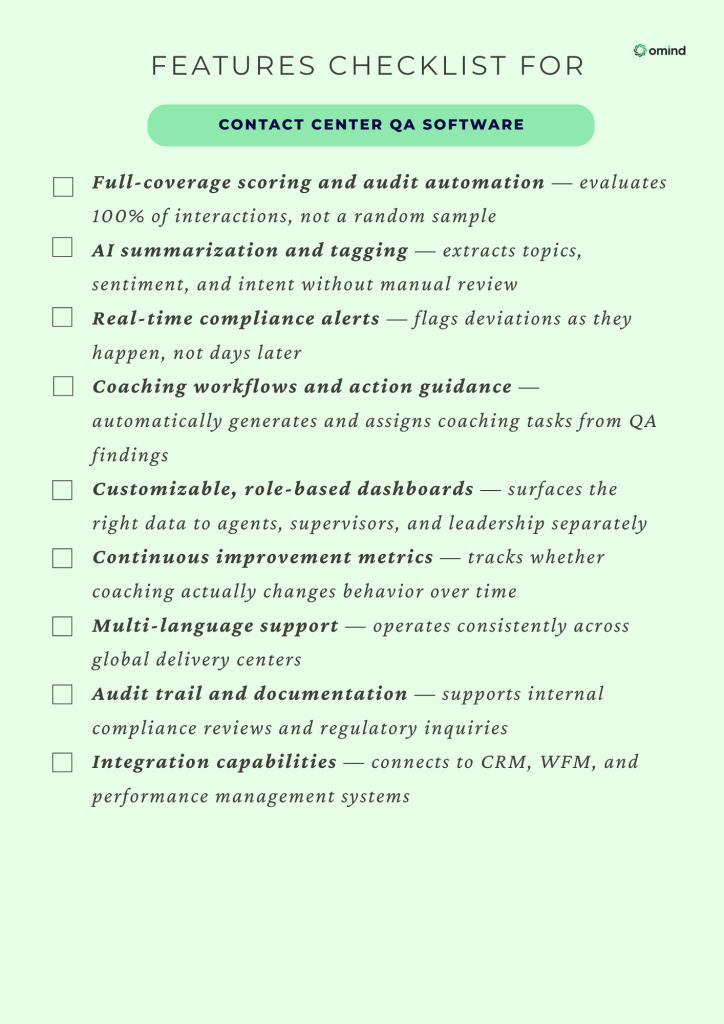 If a platform you're evaluating can't demonstrate each of these capabilities with specific feature documentation or live demos, push harder. These aren't wish-list items—they're functional requirements for operating a modern contact center. ## **Implementation Best Practices: Getting QA Software Right From Day One**
Even the best contact center QA software fails if implementation is rushed. Adoption challenges and legacy system entanglement are the two most common reasons QA transformations stall. Here's a practical path that avoids both. ### **Week 1–2: Foundation and Data Audit**
Before going live, map your existing QA criteria to the new platform's scoring framework. Identify which compliance rules need to be configured. Audit your current data sources and integration points—CRM, telephony platform, workforce management—and establish what will feed into the QA system. Resist the temptation to go live before these foundations are in place. ### **Week 3–6: Pilot and Calibration**
Run a controlled pilot with a representative subset of agents and interactions. Compare AI scores against human evaluator scores on the same calls—this calibration step surfaces where scoring criteria need refinement and where the AI model needs adjustment. Don't skip this phase; it's where trust in the system is built or lost. ### **Month 2–3: Coaching Workflow Integration**
Begin connecting QA findings to coaching workflows. Train supervisors to act on system-generated coaching tasks rather than building their own review queues. This is the operational shift that separates QA automation from QA transformation: the system tells you who needs coaching, on what, and when. ## **Why Modern QA Software Must Do More Than Score Calls**
The contact center quality assurance software market is full of platforms that promise insight. Fewer deliver change. The distinction matters because insight without action is just expensive data storage. The shift to AI-powered QA is no longer a future consideration—it's a competitive necessity. Centers that continue operating with random sampling, manual scoring, and disconnected workflows will fall further behind on compliance, coaching speed, and operational consistency. The gap between visibility and action is where performance loss lives. Intelligent QA software changes this equation. By auditing every interaction and flagging compliance risks in real time, QA becomes a system that improves the operation. **See How AI-Driven Contact Center Quality Assurance Works** [Book a Demo](/okf/page/schedule-a-demo.md)
---
## Contact Center Reporting Software Explaining Customer Experience Performance
Most contact centers possess more data than ever. Leaders track performance dashboards, service-level reports, quality scorecards, and compliance metrics daily. Yet, when customer experience declines, operational leaders often struggle to answer the most critical question. What caused the change? Reporting software reveals that a performance shift occurred. However, it rarely identifies the specific operational conditions that created the shift. As contact centers become highly data-driven, traditional systems must evolve. Modern contact center reporting software is moving beyond static dashboards and basic KPI tracking. Consequently, it is transforming into a broader system for operational visibility, root-cause analysis, and performance improvement. Ultimately, operations leaders do not need more numbers. Instead, they need clear explanations that drive immediate, corrective action.
The Operational Visibility Maturity Model STAGE 1 ➔**Reporting** What happened?
STAGE 2 ➔**Analytics** Why did it happen?
STAGE 3 ➔**Interaction Intelligence**Customer experience
STAGE 4 ➔**Predictive Intelligence**What happens next?
STAGE 5**Corrective Action**Real-time resolution
## Why Most Contact Center Reports Fail to Drive Better Outcomes?
Traditional reporting structures often create an illusion of control. Management reviews beautifully formatted charts every week. Meanwhile, the underlying operational issues remain completely unaddressed because the data lacks context. ### Reports Identify Outcomes, Not Causes
Standard reports display historical results rather than current operational friction. For example, a dashboard can flag a sudden drop in customer satisfaction. Because it only tracks the outcome, it cannot pinpoint the specific policy that confused buyers. Traditional BI vs. Intent Intelligence: The Visibility Gap What Legacy Reports Show? What Legacy Reports Fail to Explain? CSAT dropped significantly - Why customers actually became dissatisfied during the live interaction.
- Hidden phonological friction and severe listener cognitive fatigue.
Escalations increased sharply - What exact conversational patterns triggered escalation behaviors.
- Specific trust breakdowns during high-intent negotiation or compliance checkpoints.
AHT (Average Handle Time) increased - Which specific step in the process introduced operational friction.
- Dead air and repetition loop patterns caused by accent gaps or slow legacy knowledge base search tools.
FCR (First Call Resolution) declined - Where the precise breakdown in final resolution occurred.
- Missed intent mapping and downstream compliance risk patterns that force repeat inquiries.
Standard dashboards keep teams operating inside isolated operational silos. To uncover why customer journeys stall, systems must surface data showing [how cross-functional workflows create operational blind spots](/okf/article/contact-center-workflow-management-data-reveals-about-operational-ownership.md). ## Why Emerging Service Risks Often Remain Invisible in Traditional Reporting?
Standard monitoring metrics frequently mask systemic vulnerabilities. When leaders rely solely on high-level averages, they miss the early warning signs of operational decay. - **Reporting Is Primarily a Lagging Indicator:** Metrics naturally move after the customer experience has already changed. Operational failures occur early in the customer lifecycle, but they only surface in reports weeks later.
- **Sampling Leaves Blind Spots:** Traditional quality assurance practices rely on evaluating a tiny percentage of interactions. Because managers pull random samples, partial visibility obscures deeper, systemic issues. Consequently, [dangerous patterns of agent non-compliance](/okf/article/automated-compliance-monitoring-governance.md) or broken workflows go completely unnoticed.
### Customer Conversations Reveal Problems Before Reports Do
Long before a KPI drops, customer conversations signal impending trouble. Specifically, specific friction points consistently emerge during daily interactions: - Customers repeatedly explain their issues across multiple channels
- Widespread customer confusion regarding billing updates
- Policy friction caused by rigid internal rules
- Agent uncertainty during complex software updates
- Rising frustration during standard identity verification
## Contact Center Reporting Software Helping Leaders Understand
To drive real utility, platforms must do more than organize rows and columns. They must translate raw data into clear operational directions. Contact center reporting software helps organizations collect, analyze, and visualize operational data to monitor performance, identify trends, and support decision-making across customer service operations. To fulfill this definition, modern software must answer five core operational questions: 1. **What Is Happening?** This provides immediate operational visibility across all active queues.
2. **Where Is It Happening?** This delivers team-level visibility to isolate underperforming units.
3. **Who Is Affected?** This quantifies the direct impact on both customers and agents.
4. **Why Is It Happening?** This initiates a deep root-cause investigation into anomalous data.
5. **What Should Happen Next?** This points leaders directly toward targeted corrective action.
## Essential Capabilities of Modern Contact Center Reporting Software
To support modern enterprise demands, a reporting platform must include several foundational technical capabilities: - **Real-Time Reporting and Alerts:** Instant notifications when queue thresholds or compliance levels breach acceptable boundaries.
- **Omnichannel Visibility:** Unified reporting across voice, chat, email, and digital messaging channels.
- **Quality Assurance Reporting:** Aggregated scorecards that track skill development and process adherence over time.
- **Speech and Interaction Analytics Integration:** Tools that ingest speech analytics, interaction analytics, and [customer interaction analytics](/okf/article/customer-interaction-analytics-platform-explained.md) data into one interface.
- **Coaching and Performance Intelligence:** Automated workflows that deliver targeted training materials based on specific [performance gaps](/okf/article/ai-qms-signals-coaching-intelligence.md).
- **Compliance Monitoring:** Audit logs that verify mandatory disclosures across every single interaction.
- **Role-Based Dashboards:** Customized views tailored specifically for front-line supervisors, operational directors, and executive leadership.
## How AI, Speech Analytics, and QA Intelligence Improve Reporting Accuracy?
Advanced artificial intelligence transforms static tracking into active operational analysis. This technology bridges the gap between historical reporting and real-time intervention. ### Automated Analysis Across 100% of Interactions
AI removes the limitations of manual sampling. By analyzing every single conversation, the system provides a comprehensive view of operational health. Therefore, leaders spot emerging anomalies immediately. ### Speech Analytics Identifies Customer Frustration Earlier
Acoustic and semantic analysis detects rising customer frustration before a formal complaint occurs. Because the software flags change in voice tone and word choice, supervisors can step in to salvage relationships early. ### QA Intelligence Detects Coaching Opportunities at Scale
Instead of reviewing random calls, QA intelligence surface specific conversations where agents struggled with process steps. Consequently, supervisors spend less time searching for problems and more time delivering targeted coaching. ### Predictive Analytics Surfaces Emerging Risks Before KPI Declines
Predictive models analyze early conversation behaviors to forecast future metric drops. Because these systems flag rising friction trends early, leaders fix broken processes before they damage the monthly CSAT score. ## Building a Reporting Strategy for Corrective Action
To transform your data into a continuous improvement engine, implement this structured approach: 1. **Monitor Core KPIs:** Establish clean baselines for handle times, volume, and service levels.
2. **Detect Emerging Trends:** Watch for statistical deviations across specific queues or time blocks.
3. **Investigate Metric Relationships:** Analyze how changes in handle time impact your repeat contact rates.
4. **Validate Findings Through Customer Interactions:** Review call transcripts and text strings to contextualize the data.
5. **Identify Root Causes:** Isolate the specific broken policy, software bug, or knowledge gap driving the variance.
6. **Coach Teams Based on Evidence:** Provide agents with direct examples from their own interactions to guide improvement.
7. **Measure Business Outcomes:** Verify that your operational changes successfully restored your core performance metrics.
## Conclusion
Most contact centers do not struggle with a lack of reporting. Instead, they struggle with a lack of clear explanation. Traditional reporting software helps leaders understand precisely what happened in the past. However, basic metrics cannot fix a broken customer experience. To build an agile operation, companies must integrate analytics, interaction intelligence, and predictive models. [AI-powered call quality analytics](/okf/page/home.md) combine signal processing with automated speech evaluation to turn raw voice data into structured insights. It allows teams to understand what customers experience during live interactions. By moving beyond static dashboards, organizations turn raw operational data into clear, permanent performance improvements. ### Is Your Reporting Software Leaving You Blind to Real Customer Friction?
Static dashboards only show you that a metric dropped—not why it happened. Request a customized operational visibility audit today to discover how interaction intelligence can uncover the hidden root causes inside your customer conversations. [Schedule Your Audit Now](/okf/page/schedule-a-demo.md)
---
## Contact Center Use AI Analytics Software for Smart Operational Intelligence
Most contact centers collect massive volumes of interaction data, yet supervisors still struggle to understand why calls succeed or fail. Traditional analytics reports metrics like handle time or CSAT — but it rarely explains what actually happened inside the conversation. Modern AI-driven analytics platforms now combine speech analytics, automated call auditing, and [real-time quality monitoring](/okf/article/real-time-qa-performance-intelligence.md) to turn every customer interaction into operational intelligence.
## What Is Contact Center Analytics Software?
Contact center analytics software is a category of technology that collects, processes, and interprets data from customer interactions across voice, chat, email, and CRM systems. The goal is to surface insights that help contact centers improve agent performance, service quality, and operational efficiency. Historically, these platforms focused on high-level reporting dashboards — call volumes, average handle times, and CSAT scores. Modern analytics platforms layer in AI-powered conversation analysis, automated quality monitoring, and predictive insights that go far beyond surface-level metrics. > "Analytics used to measure outcomes. Today, AI analytics explains the conversation itself."
## Why Traditional Analytics Often Misses the Real Problem?
Standard analytics tools are built to track outcomes. When AHT increases, CSAT drops, or escalations spike, a dashboard can flag the change — but it cannot tell you why it happened. That diagnostic gap is where traditional analytics falls short. The root causes of performance issues typically live inside the conversation itself: an agent who misunderstands a customer's request, a recurring product complaint that keeps getting mishandled, or a compliance script that agents consistently skip. None of these show up in standard metric reports. The result? Many contact centers rely on [manual call sampling](/okf/article/ai-call-center-auditing-vs-call-sampling.md) to investigate quality issues — with supervisors reviewing as little as 2% of total call volume. That leaves 98% of interactions completely unexamined, and most coaching decisions based on incomplete data. To uncover the true drivers behind operational variance, organizations must implement a comprehensive [call center analytics platform](/okf/article/call-center-analytics-platform.md) capable of indexing multi-channel transcripts. ## The 5 Core Types of Contact Center Analytics
Understanding the different categories of analytics helps contact centers select the right tools for their needs: 1. **Historical Analytics:** Tracks call volume trends, customer behavior patterns, and performance benchmarks over time. Useful for capacity planning and [identifying long-term shifts in demand](/okf/article/predictive-analytics-ai-qms-call-volume.md).
2. **Real-Time Analytics:** Provides live visibility into active calls, queue health, and agent activity. Enables supervisors to intervene in the moment before issues escalate.
3. **Predictive Analytics:** Uses historical data and machine learning to forecast call volumes, identify customers at risk of churn, and predict CSAT outcomes before they are measured.
4. **Omnichannel Analytics:** Unifies data across voice, chat, email, and digital channels to create a complete view of the customer journey — including how customers switch between channels and what drives escalations.
5. **Speech Analytics:** Applies natural language processing (NLP) to call recordings to detect sentiment, identify key topics, [monitor compliance language](/okf/article/ai-call-center-compliance-auditing-best-practices.md), and score interactions at scale. This is the layer that transforms raw conversation data into structured, actionable intelligence.
## How Speech Analytics Works in Modern Contact Centers?
[Speech analytic](/okf/article/speech-analytics-in-call-centers-the-key-to-smarter-quality-management.md) is a multi-stage processing pipeline that converts unstructured audio into searchable, scoreable interaction data. - **Call recording** — captures every interaction across all channels.
- **Transcription** — converts audio into text using automated speech recognition (ASR).
- **NLP analysis** — processes transcript to identify topics, intents, and conversational patterns.
- **Sentiment detection** — marks emotional signals during call.
- **Interaction scoring** — the call is automatically evaluated against predefined quality criteria.
The output includes customer frustration signals, frequent issue topics, script adherence rates, and missed sales opportunities — delivered as structured data that can feed QA workflows, coaching programs, and performance dashboards. ## How AI Call Auditing Replaces Manual QA Scorecards
Traditional QA programs depend on random sampling. A supervisor selects a handful of calls per agent each month, manually scores them, and delivers feedback days or weeks post-interaction. It is slow, inconsistent, and deeply incomplete. AI call auditing changes this entirely. Instead of sampling, the system [analyzes up to 100% of calls automatically](/okf/article/ai-qms-contact-center-audit-prevent-percent-review-problem.md). It scores interaction against the same criteria, [eliminating evaluator bias](/okf/article/ai-quality-management-reduce-risk-variability.md) and ensuring consistent standards across the entire team. Moreover, the system: - Immediately flags compliance risks rather than later
- Identifies coaching opportunities as they occur
- And QA managers shift from manual call review to strategic oversight
## Key Metrics Contact Center Analytics Software Should Track
Effective analytics platforms go beyond recording KPIs — they explain the conversation drivers behind each metric: How AI Analytics Enhances Contact Center Metrics Metric What It Measures What AI Analytics Adds Average Handle Time Call duration efficiency Identifies conversation patterns causing long calls First Call Resolution Issue resolution rate Reveals root causes of repeat contacts CSAT / NPS Customer satisfaction Links scores to specific conversation behaviors Customer Effort Score Ease of resolution Detects friction points in real interactions Escalation Rate Volume of escalations Surfaces trigger phrases and policy gaps ## **How AI Quality Management Turns Analytics Into Action**
Analytics alone is not enough. The value lies in what happens next. Modern AI quality management systems close the loop between interaction data and operational improvement by automating the workflow that traditionally required manual effort at every step. The workflow looks like this: conversations are captured and analyzed in real time, quality scores are generated automatically, compliance risks are flagged for immediate review, and [coaching recommendations](/okf/article/ai-coaching-platform-call-centers.md) are surfaced to team leaders — all without a supervisor manually listening to a single call. The result is a continuous improvement loop. Agents receive faster, more consistent feedback. Managers gain genuine visibility into team performance. And compliance teams can demonstrate audit trails across 100% of interactions. ## How to Choose the Right Contact Center Analytics Software?
When evaluating platforms, assess these four dimensions: - **Data Integration:** Does it connect with your CRM, voice systems, and ticketing platforms? Siloed analytics produce incomplete insights.
- **AI Capabilities:** Look for native speech analytics, sentiment detection, predictive insights, and QA automation — not just reporting dashboards.
- **Operational Features:** Evaluate workflow automation, compliance monitoring, and real-time alerting alongside standard performance dashboards.
- **Scalability:** Can the platform handle your interaction volume today and grow with your team? AI auditing of 100% of calls requires robust infrastructure.
## AI-Driven Interaction Intelligence with AI QMS
[AI QMS platform for contact center](/okf/page/home.md) do not treat analytics, QA, and voice AI as separate tools. They will converge into unified interaction intelligence platforms that capture every conversation, understand it, evaluate it, and drive improvement automatically. Key trends shaping this evolution include - [AI-assisted agent coaching](/okf/article/automated-call-coaching-vs-traditional-frameworks.md) delivered in real time,
- predictive CX analytics that surface at-risk customers before they escalate, and
- fully automated QA workflows that replace periodic audits with continuous quality assurance.
For contact centers, the question is no longer whether to invest in analytics. It is whether your analytics investment goes deep enough — from surface metrics all the way into the conversation intelligence that drives performance. ### See AI-Driven Call Quality Analytics in Action
Traditional analytics tools tell you what happened in your contact center. AI-powered quality management platforms reveal why it happened — and how to improve it. [**Book a Demo of Omind AI QMS**](/okf/page/schedule-a-demo.md)
---
## Contact Center Workflow Management Data Reveals About Operational Ownership
Modern contact center workflows are fracturing because no single team owns the process across different channels and automation layers. Discover how tracking actual workflow behavior helps leaders find hidden friction points and make better operational decisions. Most executives believe their customer service pipelines fail because technology breaks. However, the real problem is much more systemic. It fails because nobody owns the process once it crosses different teams, channels, and automation layers. Because [organizations rapidly deploy AI agents and hybrid service models](/okf/article/ai-qms-vs-ai-call-center-software.md), operational ownership is fracturing. This fragmentation does not always cause total system meltdowns. Instead, it creates quiet, chronic operational friction that leaders struggle to identify, explain, and prioritize.
## Why is Modern Contact Center Workflow Management Difficult to Manage?
Over the past two years, customer service environments have shifted rapidly. Now leaders overlook what [contact center workflow management data reveals about operational ownership](/okf/article/call-center-process-management-execution-gap.md) and execution. They are introducing AI-assisted service models, automated routing, and complex self-service escalation paths. Consequently, customer interactions no longer move through a single isolated team. For instance, a single query might jump from a digital bot to a live human agent, and then to a back-office specialist. ### More Workflow Layers Added, the More Failure Points Created
Every time you add a new automation layer, you create new process variations. For example, a customer might encounter unexpected routing rules or broken escalation dependencies. Because these systems are deeply interconnected, a small issue in one-layer ripples through the entire chain. Every additional step creates another distinct opportunity for friction to emerge. ## Why Workflow Friction Increases When Ownership Fragments?
The operations team owns live agent performance, while the IT team manages the underlying infrastructure. Meanwhile, the digital team builds automation bots, and the workforce management team tracks scheduling. Therefore, every team owns a tiny slice of the pie. However, few teams own the contact center workflow as a unified process. When ownership fragments, accountability completely disappears. ### How Cross-functional Workflows Create Operational Blind Spots?
Because teams work in isolated silos, they rarely notice when details drop during inter-departmental handoffs. For instance, an issue might look perfectly fine on an individual team dashboard. Consequently, cracks only appear in the blank spaces between departments. These cross-functional gaps cause delayed issue detection, conflicting priorities, and misaligned improvement initiatives. ## Where Friction Hides in Contact Center Workflows
Modern customer resolution workflows look like this: Omnichannel Escalation Path & Friction Mapping Step Owner Potential Friction Point 1. Self-Service Portal Digital Experience Dead ends or confusing menus 2. Virtual Agent Bot AI Automation Team Intent recognition failure 3. Live Tier 1 Agent Customer Support Ops Missing context from the bot 4. Specialist / Back Office Finance or Logistics System data sync delays Operational data frequently exposes gaps where execution drifts from SOPs, making it vital to learn [where your contact center workflow is breaking](/okf/article/call-center-process-management.md) across live interactions. Multi-layered customer journeys make decentralized teams rely heavily on [aggregated, unverified self-reported vendor scorecards](/okf/article/why-cross-vendor-quality-management-fails-brand-standards.md) and break accountability. **Where Workflow Breakdowns Typically Occur:** Friction strikes hardest during the transitions. When critical context vanishes between channels, customers are forced to repeat their information—driving up both customer frustration and operational costs. ## When Workflow Friction Starts Affecting Business Outcomes?
When a **contact center workflow** stalls, the symptoms [disguise themselves as traditional metric failures](/okf/article/call-center-performance-management-behavioral-context.md). For example, leadership might notice a sudden spike in Average Handle Time (AHT) or a drop in first-contact resolution. Because managers only see the high-level KPI changes, they immediately blame agent productivity. However, the true root cause is almost always a broken process path rather than poor agent performance. ## Turning Workflow Intelligence into Better Operational Decisions
You cannot fix every single broken process at the same time. Therefore, managers must prioritize issues based on concrete business impact. Specifically, [evaluate friction points by their frequency, financial cost, and risk](/okf/article/contact-center-process-optimization-friction.md) to the overall customer experience. This structured focus ensures you invest resources where they will generate the highest operational return. ### Why Decision Confidence Is Becoming a Competitive Advantage?
When you possess clear behavioral evidence, you can eliminate guesswork. Leaders can intervene faster and allocate corporate resources with absolute certainty. [AIQMS](/okf/page/home.md) serves as this critical [source of workflow intelligence](/okf/article/ai-quality-management-system-quality-decisions.md), allowing teams to prioritize fixes based on hard data rather than vague assumptions. ## What Recent Industry Developments Are Teaching Contact Center Leaders?
Here are the key takeaways from recent contact center developments: - **Transform** workflow management from isolated optimization into a [strict governance initiative across all departmental boundaries](/okf/article/call-center-quality-governance-contact-centers.md).
- **Coordinate** operational rules, security settings, and data handoffs to support expanding interaction ecosystems.
- **Discover** process friction and operational issues much earlier than competitors to maintain a performance advantage.
- **Diagnose** failures and adjust routing before minor glitches escalate into widespread systemic crises.
- **Protect** the customer experience by proactively identifying and resolving underlying workflow bottlenecks.
## Conclusion
Recent developments across the service industry continue to accelerate operational complexity. As customer journeys cross deep automation layers and specialized human teams, traditional process documentation is no longer enough. The companies that scale effectively are those that clarify ownership, monitor real-time behavior, and use workflow intelligence to make fast, definitive operational decisions. ### Is fragmented ownership stalling your customer service operations?
[Schedule our operational governance demo](/okf/page/schedule-a-demo.md) to learn how an AIQMS brings complete visibility to your cross-functional data handoffs and eliminates hidden process friction.
---
## Contact Centers Keep Missing Problems Hidden Inside 97% of Customer Conversations
Most contact centers review less than three percent of their customer calls, leaving massive operational and compliance risks completely hidden in the dark. Automated call quality monitoring provides [total visibility across every single conversation](/okf/article/automated-call-quality-monitoring-key-to-understanding-customer-expectations.md) to stop escalations. Imagine an enterprise contact center with 500 agents. Each agent handles roughly 50 customer interactions per day. Consequently, this single operation generates over 550,000 monthly interactions. Now look at the traditional quality assurance team. Because human reviewers can only listen to so many hours of audio, QA typically reviews only 1% to 3% of those conversations. Leadership bases critical operational decisions on a tiny, random sample of customer data. Expanding coverage beyond manual audits requires broad pattern detection through [speech analytics over traditional call monitoring](/okf/article/speech-analytics-vs-call-monitoring.md). Organizations need automated call quality monitoring to close this visibility gap before undetected errors turn into severe liabilities.
## Why Do QA Scores Improve While Customer Experience Declines?
Many customer service operations suffer from a confusing paradox. Specifically, internal QA scores steadily increase month after month, yet CSAT scores simultaneously drop. Furthermore, customer escalations increase and formal complaint volumes rise. This disconnect happens because standard scorecards evaluate compliance with rigid scripts rather than the actual resolution of the customer's problem. An agent might check every corporate box while completely failing to address the caller's underlying frustration. ### Why Traditional QA Often Creates False Confidence?
Traditional QA relies heavily on [selective sampling](/okf/article/ai-call-center-auditing-vs-call-sampling.md). Because reviewers pick calls at random, they naturally miss the nuanced trends that develop across thousands of unverified interactions. Additionally, human evaluation introduces massive reviewer variability. Two different analysts often score the exact same conversation differently, which leads to highly inconsistent data. Finally, delayed feedback loops mean that managers discover critical agent errors weeks after they occur. ## What Happens When Interaction Volume Outgrows Review Capacity?
The math behind manual QA simply does not add up at scale. For instance, consider a mid-sized [BPO environment](/okf/article/ai-qms-for-bpo.md) handling hundreds of thousands of calls. Manual QA vs Automated Evaluation Scale Metric Manual QA Program Automated Evaluation Monthly Interactions 500,000 500,000 QA Review Volume 5,000 500,000 Percentage Evaluated 1% 100% Because human staff can only review a fixed number of hours, the percentage of evaluated conversations shrinks as customer volume grows. ### Why Scaling QA Headcount Doesn't Solve the Problem?
Many companies attempt to solve this visibility crisis by hiring more QA analysts. However, labor cost growth scales linearly, while actual visibility gains remain marginal. Doubling your QA headcount from five to ten analysts only increases your coverage from 1% to 2%. Consequently, coaching cycles remain slow, and your management team stays trapped in a reactive loop. ### The Hidden Cost of Unevaluated Conversations
Leaving 97% of your data unexamined introduces massive financial liability. Specifically, compliance exposure festers in the dark when agents repeatedly fail to state mandatory disclosures. Furthermore, managers miss vital coaching opportunities, which forces agents to repeat bad habits. The lack of oversight triggers repeats escalations, driving up operational costs and customer churn. ## What Lives Inside the Other 97% of Customer Interactions?
The QA Visibility Gap **3% Sampled Tier** **Basic Script Adherence** What QA typically sees and scores
**97% Unreviewed Tier**- Compliance Drift
- Hidden Escalation Triggers
- Systemic Process Breakdowns
- Sub-surface Customer Frustration
### Emerging Compliance Violations
When you only review 3% of your calls, [compliance infractions](/okf/article/ai-call-center-compliance-auditing-best-practices.md) easily slip through the cracks. These issues repeat across thousands of calls long before formal audits uncover them, risking heavy regulatory fines. ### Escalation Triggers Hidden Across Thousands of Calls
Customers often drop subtle hints before they demand to speak with a manager. However, these patterns remain invisible in sampled reviews. ### Coaching Signals Managers Never See
Behavioral issues frequently go unnoticed if an agent performs well on their single sampled call. For instance, an employee might struggle with technical product questions during the rest of the week. Because these struggles stay hidden, performance issues continue for months without [targeted coaching](/okf/article/ai-qms-for-agent-coaching.md). ### Customer Frustration Patterns That Never Reach Leadership
Negative sentiment trends often hide inside unreviewed interactions. Customers might complain about a specific billing policy or a broken digital portal. Yet, because these complaints are scattered across thousands of unverified hours. ### Process Breakdowns That Appear as "Agent Issues"
When a representative takes too long to handle a call, managers typically blame the employee. Manual QA routinely misdiagnoses these corporate process breakdowns as individual performance problems. ## Why Sampling Worked in the Past and Why It Breaks at Enterprise Scale?
Reasons why sampling worked in the past: ### The Original Logic Behind QA Sampling
Decades ago, contact centers operated with fewer channels and lower transaction volumes. Listening to a small handful of cassette tapes provided a statistically viable snapshot. Sampling was a practical compromise dictated by technological limitations. ### The Enterprise Scale Challenge
Modern enterprises manage multi-site operations, global BPO delivery, and multilingual customer support. Managing high interaction volumes across distinct time zones makes manual tracking impossible. ### The Same Shift Happening in Enterprise AI Evaluation
We see this exact same transformation occurring within corporate technology teams. Specifically, enterprise AI quality evaluation has completely abandoned manual spot-checking. ## Automated Call Quality Monitoring Changes the Unit of Analysis
- **Reviewing Calls to Evaluating Operations:** Shifting to automated call quality monitoring fundamentally changes [how leaders manage quality](/okf/article/qa-software-for-contact-center-leaders.md). In contrast, the new approach evaluates broad operational patterns across your entire customer base.
- **Lagging Indicators to Early Detection:** Manual reviews offer lagging indicators, telling you what went wrong weeks ago. Automated analysis provides early detection instead. It allows operations leaders to find and correct errors before they turn into escalations.
- **Isolated Events to Failure Pattern Detection:** Automation helps you track structural issues. Consequently, you can quickly isolate recurring [compliance drift and pinpoint specific escalation clusters](/okf/article/quality-compliance-monitoring-operational-drift.md).
## Five Operational Failure Patterns Automated Call Quality Monitoring Detects Earlier
1. **Compliance Drift:** Small behavioral deviations that gradually turn into systemic legal liabilities across the whole company.
2. **Escalation Clusters:** A sudden spike in customer complaints tied to a specific product update, billing change, or software bug.
3. **Coaching Bottlenecks:** Specific areas where agents fail to improve because supervisors lack the precise data needed to guide them.
4. **Script Abandonment:** Steps in the conversation that agents completely stop following whenever they face intense pressure.
5. **Sentiment Deterioration:** Subtle shifts in customer tone and frustration that occur long before your traditional KPIs show a decline.
## A Better Question Than "How Many Calls Did QA Review?"
To fix your quality operations, you must change how you measure success. The traditional framework focuses entirely on output metrics, asking how many interactions your team reviewed. More practical [call quality monitoring tools](/okf/page/home.md) focuses on risk, asking exactly how much operational risk remains completely unevaluated. ### The Evaluation Coverage Framework
To assess your current exposure, evaluate your QA program across these five critical dimensions: - **Percentage of Interactions Evaluated:** Move from a 1% sample to total operational coverage.
- **Time-to-Feedback:** Reduce the gap between agent errors and managerial coaching from weeks to minutes.
- **Coaching Visibility:** Identify precise behavioral trends rather than relying on generic performance feedback.
- **Compliance Visibility:** Track mandatory disclosure rates across every single conversation automatically.
- **Escalation Visibility:** Isolate hidden conversational friction points before they turn into formal client complaints.
When evaluating the frontlines, monitoring final outcomes like CSAT is deceptive without a [workflow visibility framework](/okf/article/call-center-workflow-management-execution-gap.md) to track every single point of execution deviation in real time. ## Conclusion
As interaction volumes continue to climb, the primary risk facing modern contact centers is not a lack of data. Rather, the risk is failing to evaluate enough of that data to catch critical operational errors before customers, auditors, or clients do. Relying on manual sampling keeps leadership blind to systemic errors, compliance drift, and process deficiencies. Transitioning to automated call quality monitoring helps organizations move past sampled visibility. By evaluating every interaction, your enterprise can protect its revenue, support its agents, and secure its compliance posture. ### Secure Your Operations with Total Visibility
Stop guessing what happens inside your unreviewed customer conversations. [Book a technical architecture review](/okf/page/schedule-a-demo.md) with our operations team to discover how automated call quality monitoring eliminates compliance blind spots.
---
## Control Customer Experience with AI QMS for Outsourcing BPOs Buyers
Outsourcing customer support creates scale, often leading to blind spots. Most enterprise support programs now span multiple BPOs, regions, languages, and operational teams. However, customers still expect one consistent experience every time they contact the brand. The problem is not always visible in operational dashboards. Meanwhile, customer trust slowly erodes interaction by interaction. This is why enterprise outsourcing teams are increasingly turning AI QMS for outsourcing instead of relying on fragmented manual QA processes.
## Why Multi-Vendor Outsourcing Creates Quality Blind Spots?
Most enterprise outsourcing environments were not built for consistent customer experience visibility. They were built for scale, cost efficiency, and operational flexibility. Consequently, enterprises often inherit fragmented quality processes across vendors. ### Different Vendors Operate with Different Standards
Even when vendors follow the same scripts, the customer experience can vary dramatically. One site may sound calm and confident. While another may sound rushed, robotic, or poorly trained. The inconsistency becomes dangerous because customers do not separate the enterprise brand from the outsourcing vendor behind the interaction. They only remember the experience itself. ### Sample-Based QA Misses Systemic Problems
Most BPO environments still rely heavily on [manual QA sampling](/okf/article/ai-call-center-auditing-vs-call-sampling.md), creating operational blind spots. A vendor may review only a tiny percentage of total interactions. Consequently, major behavioral issues can stay hidden for weeks or months. For example: - Escalation handling may collapse during peak queue pressure
- Compliance language may drift over time
- Agents may create repeat contacts without detection
- Certain sites may consistently underperform empathy behaviors
## Customers Experience One Brand, Not Multiple Vendors
This distinction matters operationally. However, customers do not care which vendor handles the interaction. A customer calling twice expects the same experience both times. Instead, many enterprises unintentionally create fragmented customer journeys because service quality varies between vendors, locations, and supervisors. That inconsistency damages trust quickly in industries with high customer sensitivity, including: - Banking
- Insurance
- Healthcare
- Telecom
- Travel
- Retail support
One poorly managed BPO partner can quietly damage the reputation of the entire customer support operation. ## How AI QMS Solves Multi-Vendor Quality Inconsistency?
[AI quality management software](/okf/article/ai-quality-management-tool.md) changes how enterprise outsourcing oversight works. Instead of isolated QA programs across vendors, enterprises gain one quality intelligence layer across the full outsourcing ecosystem. ### One Quality Framework Across Every Vendor
AI-based QA automation for call centers evaluates every interaction using the same scoring logic, causing consistency. Without standardized evaluation models, vendor comparisons become political instead of operational. One BPO claims scoring is too strict, while another argues their interactions are more difficult. Soon, the conversation shifts away from customer experience and toward defending scorecards. AI QMS reduces that ambiguity. Every vendor gets measured against the same behavioral standards, compliance rules, and interaction criteria. Consequently, enterprise buyers gain cleaner benchmarking visibility across the portfolio. ## Real-time Visibility Replaces Delayed QA Reporting
Traditional QA reporting cycles create a dangerous delay. By the time monthly scorecards arrive, thousands of interactions are already completed. [AI call center quality assurance](/okf/article/ai-call-center-quality-assurance-software.md) shortens visibility gap dramatically. Instead of waiting for sampled reviews, outsourcing teams can monitor interaction quality trends while issues are still developing. It allows faster operational intervention. For example: Traditional QA Process AI QMS Monitoring Small random samples Full interaction analysis Delayed monthly reporting Near real-time visibility Reactive escalation handling Early risk detection Inconsistent scoring logic Standardized evaluation Limited vendor comparisons Portfolio-wide benchmarking ## AI QMS Makes Vendor Benchmarking More Credible
Most vendor benchmarking relies on incomplete data, causing misleading conclusions. One vendor may appear stronger simply because fewer problematic calls were reviewed. Another may appear weaker because sampled interactions captured more escalations that month. Automated quality management system changes this by analyzing every interaction instead of isolated call samples. Consequently, enterprise teams can benchmark vendors using measurable operational patterns. ### What Enterprise Buyers Can Measure with AI QMS
Enterprise outsourcing teams can identify: - Repeat contact drivers by vendor
- Escalation frequency by site
- Compliance adherence trends
- Customer frustration indicators
- Resolution quality consistency
- Script adherence patterns
- Empathy scoring trends
That level of visibility changes vendor governance conversations immediately. Enterprise vendor management programs increasingly rely on interaction analytics because operational KPIs alone rarely explain customer dissatisfaction. ## AI QMS Improves Vendor Governance and QBRs
AI-based QMS solutions for call center shifts vendor governance from anecdotal reporting to interaction-level evidence. Instead of arguing over isolated examples, enterprise teams can present measurable trends across the full interaction portfolio. For example: - Escalation growth over time
- Compliance drift by queue
- Resolution quality by geography
- Customer sentiment patterns during peak periods
That precision creates more productive vendor conversations, improving accountability. ### New Vendor Launches Become Easier to Control
The first weeks of a new outsourcing launch are usually unstable. Meanwhile, enterprise leaders often have limited visibility into customer experience quality during rollout. AI-powered quality management system reduces that uncertainty. ### Faster Quality Baselines During Vendor Onboarding
AI-powered quality management software establishes quality visibility from day one. Consequently, enterprise teams can detect operational issues earlier. For example: - Script confusion
- Compliance failures
- Escalation spikes
- Resolution breakdowns
- Poor call control behaviors
Early visibility prevents those issues from spreading across the broader operation. ## AI QMS Supports Better Vendor Transition Decisions
Vendor expansion decisions carry financial and operational risk. The reductions create political friction and vendor replacements disrupt operations. Yet many outsourcing decisions still rely heavily on partial QA reviews combined with high-level KPIs. It creates blind spots at leadership level. ### Full Interaction Analysis Creates Better Strategic Decisions
[AI-powered call quality analytics](/okf/article/ai-powered-call-evaluation-tools.md) provide interaction-level evidence across the full outsourcing portfolio, allowing enterprise leaders to evaluate: - Vendor consistency over time
- Operational stability under pressure
- Customer experience quality trends
- Compliance reliability
- Coaching effectiveness
As a result, vendor strategy decisions become more evidence-based and less dependent on selective reporting. Manual QA vs AI QMS in Outsourcing Operations Area Manual QA AI QMS Interaction Coverage Small samples 100% interaction analysis Vendor Comparisons Inconsistent Standardized benchmarking Escalation Visibility Delayed Near real-time detection Compliance Monitoring Reactive audits Continuous monitoring QBR Discussions Subjective debates Evidence-driven governance Vendor Oversight Fragmented Unified visibility ## What Enterprise Buyers Should Look for in an AI QMS Platform?
Not every AI QMS platform is designed for enterprise outsourcing complexity. Enterprise buyers evaluating vendor performance should ensure their delivery partners use [BPO quality management platforms](/okf/article/qms-management-software-bpo.md) capable of generating immutable evaluation audit trails. Specifically, buyers should evaluate whether the platform supports: - **Multi-Vendor Governance:** The platform should support consistent scoring across vendors, sites, and geographies.
- **Compliance Flexibility:** Different vendors may support different regulatory environments. For example:
- - HIPAA monitoring
- PCI compliance
- Financial disclosure adherence
- Internal policy enforcement
- **Real-Time Analytics and Alerts:** Delayed reporting weakens operational response time. Real-time visibility helps teams intervene faster when quality trends decline.
- **Enterprise Integration Capabilities:** AI QMS becomes significantly more valuable when integrated with:
- CRM systems
- Workforce management platforms
- BI dashboards
- Ticketing tools
- [Speech analytics platforms](/okf/article/speech-analytics-in-call-centers-the-key-to-smarter-quality-management.md)
## AI QMS Is Becoming the Control Layer for Enterprise Outsourcing
Most enterprises have already outsourced customer operations. Without consistent interaction intelligence across vendors, customers experience slow fragments behind the scenes. AI QMS creates one operational view across that complexity. [Omind AIQMS](/okf/page/home.md) helps enterprise outsourcing teams monitor vendor quality across every interaction using AI-driven interaction analysis instead of fragmented QA sampling. Because customers do not remember which vendor handled the interaction and remember the experience felt reliable. ### Explore AI QMS for Enterprise BPO Oversight
Most enterprises outsourced customer operations years ago. The real challenge now is controlling quality consistently across every vendor, site, and interaction. [See AI QMS for Enterprise Outsourcing](/okf/page/schedule-a-demo.md)
---
## Conversation Intelligence Software for Call Centers: From 2% Audits to 100% QA Visibility
Most call centers still operate with a critical blind spot—reviewing just a fraction of total customer interactions. When only 2–5% of calls are audited, most of the customer experience, compliance risks, and agent performance signals go unnoticed. That’s the [limitation of legacy systems](/okf/article/migrating-to-ai-qms-from-legacy-systems.md). Conversation intelligence software changes that equation entirely. Instead of sampling, it enables full visibility, real-time insight, and scalable coaching. This guide breaks down how that transformation happens inside modern call center operations.
## Why Traditional Call Center QA Breaks at Scale?
Quality assurance in most call centers was never designed for today’s volume or complexity. Manual audits worked when call volumes were lower and compliance requirements simpler—but that model breaks quickly under scale. At the core of the issue is sampling. [Reviewing 2–5% of calls](/okf/article/ai-qms-contact-center-audit-prevent-percent-review-problem.md) mean decisions are based on incomplete data. High-performing agents might be misjudged, while underperformance or compliance risks in the remaining 95% go undetected. Operationally, manual QA introduces bottlenecks. Evaluations take time, scoring varies between reviewers, and feedback often reaches agents days—or even weeks—after the interaction. By then, the moment to correct behavior has already passed. The impact is measurable: - Longer average handling times (AHT) due to inconsistent agent performance
- Lower first call resolution (FCR) from missed coaching opportunities
- Increased compliance exposure due to limited monitoring
What looks like a process inefficiency is a structural limitation. And fixing it requires more than incremental improvement—it requires a shift in how QA operates. ## What Changes with Conversation Intelligence (Before vs After)
In a traditional setup, QA is reactive. Calls are selected randomly, scored manually, and used for periodic coaching. Insights are delayed and often disconnected from real-time performance. Conversation intelligence software optimizes QA and redefines manual sampling to [automated call quality monitoring](/okf/article/automated-call-quality-monitoring-key-to-understanding-customer-expectations.md). With conversational intelligence, the model shifts: - Every call is automatically transcribed and analyzed
- QA scoring is applied consistently across 100% of interactions
- Insights are generated instantly, not retrospectively
- Supervisors move from evaluators to performance enablers
The difference isn’t just efficiency, it’s control. Instead of guessing what’s happening on calls, operations teams gain continuous visibility into performance, compliance, and customer experience. More importantly, QA evolves from a reporting function into [an intelligence layer](/okf/article/agent-analytics-call-centers-intelligence-framework.md) that actively drives outcomes. ## How Conversation Intelligence Software Transforms Call Center QA Scorecards?
One of the biggest misconceptions is that adopting conversation intelligence requires abandoning existing QA frameworks. The opposite is true, it enhances them. Every call center already operates with [defined scorecards](/okf/article/call-centre-qa-scorecard-template-for-cx.md): - Compliance criteria (disclosures, script adherence)
- Soft skills (empathy, tone, clarity)
- Process adherence (call handling steps)
Conversation intelligence software maps directly to these parameters. Instead of manually evaluating each call, AI automatically detects whether these elements are present—and scores them consistently. This introduces two major shifts: 1. **Standardization:** Every call is evaluated against the same criteria, removing subjectivity
2. **Scalability:** QA teams can monitor thousands of interactions without increasing headcount
## Real-Time vs. Post-Call Analysis: Choosing the Right QA Approach
A common mistake in adopting conversation intelligence is assuming real-time analysis is always better. In practice, both real-time and post-call QA serve different purposes. **[Real-time call center monitoring](/okf/article/real-time-call-center-monitoring-systems.md)** is designed for immediacy: - Alerts agents when compliance steps are missed
- Provides live guidance during calls
- Prevents errors before they escalate
**Post-call QA**, on the other hand, focuses on depth: - Identifies performance trends across calls
- Enables detailed coaching and analysis
- Supports strategic decision-making
For high-risk environments (e.g., compliance-heavy industries), real-time alerts can reduce exposure. For performance improvement and training, post-call insights provide richer context. ## Building an AI-Driven Coaching Workflow with Conversation Intelligence
Traditional coaching relies on limited data and subjective feedback. Managers review a handful of calls, identify issues, and provide general guidance. The impact is inconsistent. With conversational intelligence, coaching becomes systematic. Instead of generic advice, agents receive precise guidance based on [sentiment analysis insights](/okf/article/call-center-sentiment-analysis-tool.md). Every interaction is analyzed, and specific behaviors—positive or negative—are flagged automatically. This allows supervisors to: - Prioritize high-impact coaching opportunities
- Deliver targeted, data-backed feedback
- Track improvement over time
## Scaling Conversation Intelligence Across High-Volume Call Centers
As call volumes grow, traditional QA models become increasingly unsustainable. Hiring more QA analysts only scales linearly, while call volumes often grow exponentially. [AI call auditing software](/okf/page/home.md) introduces a different model that builts for scale. In high-volume environments: - Thousands of calls can be analyzed simultaneously
- QA coverage expands without proportional increases in cost
- Insights remain consistent across teams and geographies
This is particularly critical for: - Multi-location operations
- Multilingual support environments
- BPOs handling diverse client requirements
However, scaling isn’t just about volume. It also requires: - Consistent evaluation criteria across regions
- Adaptability to language and accent variations
- Integration with existing systems (CRM, dialers, QA tools)
When implemented correctly, conversation intelligence enables QA to scale without compromising quality—or increasing operational complexity. ## Common Pitfalls (And How to Avoid Them)
While the benefits are significant, implementation isn’t without challenges. Some of the most common pitfalls include: - Over-reliance on automation without human oversight
- Misinterpretation of sentiment or tone
- Resistance from agents due to increased monitoring
- Integration challenges with existing systems
Ignoring these factors can limit the effectiveness of even the most advanced tools. Successful implementations take a balanced approach: - Combine AI insights with human judgment
- Introducing transparency in how data is used
- Roll out gradually with clear communication
Addressing these challenges upfront not only improves adoption but also builds trust across teams. ## Final Takeaway
The gap between auditing 2% of calls and analyzing 100% isn’t just a matter of efficiency, it’s a difference in how call centers understand and manage performance. Conversation intelligence software closes that gap. It replaces guesswork with data, delays with real-time insight, and [reactive QA with proactive performance management](/okf/article/why-cfos-need-call-center-qa-software-to-drive-roi.md). For operations leaders, the question is no longer whether to adopt it. But how quickly can they move from limited visibility to full intelligence. See how conversation intelligence can transform your QA from partial sampling to complete visibility. [Book a demo today](/okf/page/schedule-a-demo.md).
---
## Conversational AI Quality Monitoring: Scaling Real-time QA
Most conversational AI quality monitoring systems stall at deployment. The harder question — what happens to quality after thousands of AI-led interactions go live daily — goes unanswered. A conversational AI quality monitoring system (AI QMS) is the control layer that closes that gap.
## Why Do Enterprises Need Conversational AI Quality Monitoring?
The term gets conflated with analytics, dashboards, or even the conversational AI platform itself. A true AI QMS sits on one layer above: it monitors, evaluates, scores, and improves every conversation — not just routes and transcribes it. Think of it as the quality governance layer of your conversational AI stack. The bot handles the interaction. The QMS decides whether that interaction met the standard, why it did or didn't, and what should change next. This is the difference between [AI Call Center Software vs. AI QMS](/okf/article/ai-qms-vs-ai-call-center-software.md). What AI QMS Includes vs What It Is Not Included in AI QMS What it is NOT AI call auditing & QA scoring Basic interaction analytics Compliance monitoring Just the Chatbot/Voicebot Performance tracking Simple transcription ## Moving from Manual Sampling to 100% AI Call Auditing
Legacy QA reviewed a random 1–3% of calls. That slice introduced bias, missed edge-case risks, and left coaching decisions to chance. [AI-driven monitoring](/okf/article/automated-call-quality-monitoring-key-to-understanding-customer-expectations.md) changes the math entirely by evaluating every interaction against defined criteria. Traditional Sampling vs AI Full-coverage Monitoring Traditional Sampling AI Full-coverage Monitoring 1–3% of calls reviewed Random selection bias Compliance gaps discovered late Coaching based on anecdote 100% of conversations scored Consistent, criteria-based evaluation Risk flagged in real time or post-call [Pattern-based coaching data](/okf/article/ai-qms-signals-coaching-intelligence.md) ## How do the AI-driven Evaluation Engine Works?
Under the hood, a conversational AI QMS runs each interaction through a layered evaluation pipeline: - **Conversation ingestion:** Voice, chat, and bot logs are ingested alongside metadata. For voice channels, **[speech analytics](/okf/article/speech-analytics-in-call-centers-the-key-to-smarter-quality-management.md)** converts audio into structured data with speaker-level tagging and silence tracking.
- **AI scoring models:** The engine evaluates intent recognition accuracy, sentiment trajectory, script adherence, escalation signals, and interruption patterns. It then applies weighted logic against **[custom QA scorecards](/okf/article/call-centre-qa-scorecard-template-for-cx.md)** tuned for compliance, CX, or resolution goals.
- **Learning loop:** QA feedback cycles back into the model. Scores from flagged conversations inform threshold adjustments and, in more mature deployments, prompt refinements to the conversational AI itself — closing the loop between monitoring and improvement.
## Real-time QA: Intervention Before the Call Ends
Post-call analysis is valuable, but [real-time QA monitoring](/okf/article/real-time-qa-performance-intelligence.md) is transformative. When a compliance keyword is missing or sentiment collapses mid-conversation, live alerts can surface a prompt for the agent or trigger bot correction — before the call escalates. Early deployments show measurable reductions in escalation rates and CSAT recovery time when real-time QA alerts are embedded into agent-assist workflows. The QMS shifts from observer to active participant in call quality. This is becoming non-negotiable for [high-volume contact centers](/okf/article/qa-for-call-centers-at-scale.md) looking to reduce escalation rates and CSAT recovery time. ## What Enterprise QA Reporting Shows Decision-makers?
Effective AI QMS reporting translates raw conversation data into three tiers of intelligence: - QA score distribution across agents, teams, and channels — identifying outliers without waiting for a manager's audit
- Sentiment trends correlated with product type, time of day, or campaign — surfacing systemic friction, not one-off bad calls
- Script adherence rates mapped to outcomes like first-call resolution, conversion, and churn signal detection
- Compliance score trends with audit-ready exportable logs for **BFSI, healthcare, and BPO** regulatory review
The difference between a reporting tool and a QMS is that the QMS connects these metrics to business outcomes. ### Evaluating a system: a buyer's checklist
Not every platform marketed as "AI quality monitoring" delivers full QMS capability. Before committing, verify: - Does it support 100% conversation coverage, not sampling?
- Can scorecards be customized by use case — compliance vs CX vs resolution?
- Are real-time alerts configurable by keyword, sentiment threshold, or silence duration?
- Does it support multi-channel ingestion — voice, chat, bot logs — in one view?
- How deep is the reporting layer? Can output tie QA scores to revenue or churn metrics?
- What CRM and contact center integrations are available out of the box?
Evaluating virtual agents requires monitoring conversational context and leveraging [AI observability in contact centers](/okf/article/contact-center-ai-observability.md) to separate infrastructure uptime from true interaction success. ## Where Does This Goes Next: Autonomous Quality Optimization?
Current [AI QMS](/okf/page/home.md) platforms monitor to predictive control. The next generation will predict and act. Predictive QA — flagging risk before a conversation goes wrong based on early intent signals — is already in limited deployment. Self-optimizing bots that adjust behavior based on QA feedback loops are close behind. The trajectory runs from quality monitoring → quality intelligence → autonomous CX optimization. Enterprises that build QMS infrastructure now are positioning themselves to operationalize that evolution rather than retrofit it later. ### Ready for The Next Step
A conversational AI quality monitoring system isn't a feature — it's the operating layer that makes enterprise AI deployments auditable, improvable, and defensible. The shift from 1% sampling to 100% coverage isn't incremental. It's categorical. [Audit my QA setup](/okf/page/schedule-a-demo.md)
---
## Cross-vendor Quality Management Fixing Quality Metrics Failures for Brand Standards
As customer support operations expand, maintaining consistent customer experiences becomes increasingly difficult. Specifically, modern enterprises distribute customer interactions across internal teams, BPO partners, regional contact centers, and specialized service providers. Most organizations believe consistency already exists because vendors meet expected performance targets like QA scores, CSAT, and SLA commitments. However, these indicators only reveal whether outcomes are acceptable. They do not verify whether customers have the same experience across touchpoints. Therefore, [enterprises must look beyond baseline metrics](/okf/article/quality-governance-contact-centers-scale.md) to establish true cross-vendor quality management.
## Why Multi-vendor Operations Create a False Sense of Consistency?
When vendor ecosystems grow, customer interactions become highly distributed. Consequently, operational practices evolve independently, and quality oversight becomes fragmented. Leadership often assumes consistency exists because high-level performance metrics appear aligned. For instance, consider two different customer service partners: Performance Metric Vendor A Vendor B QA Score 92% 91% CSAT Score 87% 88% From a corporate reporting perspective, both vendors appear successful. However, from a customer perspective, the actual experience may be fundamentally different. For example, Vendor A might hit targets by rushing customers off the phone. Meanwhile, Vendor B might achieve scores through excessive credits. Therefore, metrics create confidence, but they do not verify actual consistency. “ Aggregated metrics hide operational variance. Specifically, a 90% CSAT score can mask two entirely different customer experiences across different BPO partners. ”— Contact Center Operations Insight
## Why Quality Metrics Fail to Verify Brand Standards?
Traditional quality programs are designed to answer outcome-based questions. For instance, did agents achieve compliance targets? Did customers report basic satisfaction? Because of this narrow focus, legacy audits rarely evaluate how the experience was delivered. Specifically, traditional scorecards miss critical behavioral elements: - Was true ownership demonstrated during the interaction?
- Was customer effort minimized effectively?
- Was company policy applied consistently across locations?
Consequently, organizations believe they are delivering a unified brand experience while customers encounter entirely separate service realities. Therefore, relying on outcome-based metrics creates a severe [governance blind spot](/okf/article/automated-call-quality-monitoring-evaluation-coverage.md). ## Cross-vendor Quality Management and Standard Verification Problem
Most organizations can easily define their core brand standards. For example, leadership teams often dictate that agents must reduce customer effort, demonstrate ownership, and resolve issues efficiently. However, the real operational challenge is proving that those standards are actually executed during live customer interactions. The Execution Gap Operational Core The Breakdown Path Downstream Result Defined Brand Standards Corporate expectations for customer compliance and localized voice clarity.
(The Measurement Gap) Aggregated Vendor Scorecards Flattened metrics that completely obscure individual regional performance flaws.
▲ \[Missing Link: Interaction Evidence\] ▲ **Architectural Reality:**- Traditional workflows jump directly from corporate standards to vendor scores using blind 1–5% random auditing samples.
- This omission isolates critical localized friction points, hiding the exact linguistic or operational breakdowns occurring across disparate offshore BPO teams.
- Without immediate interaction visibility, the actual evidence behind customer churn and compliance anomalies remains buried in the unmonitored 97% of daily interactions.
Without direct verification, vendor oversight relies on dangerous assumptions. As a result, governance becomes purely reactive. Therefore, companies cannot manage experience consistency without changing how they evaluate vendor performance. ## The Four Components of Verifiable Brand Standards
Verifying brand standards requires more than basic scorecards and occasional audits. Instead, organizations need a repeatable operational model built on **cross-vendor quality management** principles. ### Component 1: Operational Standard Definition
Brand standards must be translated into observable behaviors. For instance, the vague goal to "reduce customer effort" must become concrete. Specifically, it must mean clear transfer avoidance, documented first-contact resolution attempts, and proactive issue handling. Because standards that cannot be observed cannot be verified, definition is the critical first step. ### Component 2: Shared Evaluation Criteria
All vendors must be evaluated against identical quality expectations. Frequently, inconsistency stems from different QA teams, separate scorecards, and isolated calibration processes. Therefore, true consistency requires a common evidence framework across all external partners. ### Component 3: Interaction-Level Verification
Verification happens inside actual customer interactions, not on high-level dashboards. Specifically, organizations must observe resolution behavior, policy execution, and customer effort creation. Because manual sampling is limited, many organizations now shift toward interaction intelligence platforms. Consequently, these systems evaluate every interaction against shared standards. ### Component 4: Continuous Consistency Monitoring
Consistency cannot be validated once and assumed to last forever. Instead, organizations need ongoing visibility into execution drift and vendor-specific deviations. Because operational drift occurs naturally over time, continuous monitoring is an operational discipline rather than a quarterly audit activity. It prevents severe [operational variation](/okf/article/ai-quality-management-reduce-risk-variability.md) from fracturing the customer experience. ## Why Interaction-level Evidence Matters More Than Scorecards?
Traditional reporting provides QA averages, CSAT trends, and SLA attainment. However, scorecards only summarize performance, whereas [interaction-level evidence explains it](/okf/article/call-center-performance-management-behavioral-context.md). Specifically, interaction evidence reveals exactly how ownership was demonstrated and how customer expectations were managed. Because of this depth, evidence enables leaders to distinguish between similar outcomes and similar experiences. Therefore, leaders can identify specific behavioral deficiencies before they impact customer retention. ## Building a Shared Evidence Layer Across Vendors
To achieve true alignment, the objective is not identical vendor behavior. Instead, the goal is the consistent execution of brand standards. Achieving this baseline requires four shared elements: 1. Shared quality definitions.
2. Shared evaluation models.
3. Shared interaction evidence.
4. Shared governance mechanisms.
Consequently, organizations that establish a common evidence layer gain a reliable way to verify consistency across distributed operations. Therefore, they eliminate the silos that typically isolate external BPO partners from internal teams. ## Scaling Cross-Vendor Quality Management with Modern Systems
An automated quality management system like [Omind AIQMS](/okf/page/home.md) works more than a function merely as a vendor monitoring tool. It serves as a shared evidence layer and evaluates interactions consistently across internal and external operations. Moreover, the [platform removes the friction](/okf/article/call-center-process-management-execution-gap.md) of disparate BPO QA teams by acting as a single source of truth. should not. Instead Consequently, this shared architecture allows leaders to: - Assess live execution against common corporate standards.
- Compare exact customer experiences across separate vendors.
- Identify specific consistency gaps and operational drift immediately.
As a result, leadership improves governance confidence through real-world data. Therefore, the organization gains a reliable method for validating brand standards instead of relying on aggregated, self-reported performance metrics. ## Conclusion
Quality metrics indicate whether vendors achieve acceptable outcomes, but they cannot verify whether customers experience the same brand. As service delivery becomes increasingly distributed, organizations must move beyond high-level performance reporting. Specifically, companies must transition toward execution verification. Those that establish verifiable brand standards through interaction-level evidence gain deep operational oversight. More importantly, they gain confidence that the experience being promised is the experience being delivered. ### Ready to unify your multi-vendor support operations?
Stop relying on fragmented vendor scorecards that hide real customer experience. [Contact our enterprise operations team](/okf/page/schedule-a-demo.md) to learn how to deploy a unified evidence layer across all your global BPO partners.
---
## Customer Complaint Analytics Fixing Recurring Operational Failures in BPOs
Many enterprise organizations invest heavily in customer experience initiatives, agent training, and quality assurance workflows. Yet, the same familiar complaints continue appearing on dashboards month after month. Refund delays return, billing questions resurface, and escalation queues grow despite constant improvement initiatives. BPOs often struggle with recurring failures because traditional scorecards mask the structural issues. Overcoming this requires deep-dive [investigations into why performance changed](/okf/article/call-center-root-cause-analysis-performance.md) across teams. The core issue is rarely a shortage of customer feedback. Instead, businesses frequently analyze issues as isolated events rather than symptoms of systemic problems. Implementing an effective framework for customer complaint analytics helps operational leaders move beyond basic dissatisfaction tracking to uncover the exact friction points driving recurring service failures.
## Why Do the Same Customer Complaints Keep Coming Back?
Traditional QA models often categorize complaints by surface-level descriptions. Consequently, teams fix the immediate customer issue but leave the underlying process broken. Customer Complaints and Operational Infrastructure Complaint Category Possible Operational Root Cause Billing confusion Inconsistent invoice typography and design Delayed refund Broken multi-department approval workflow Long hold times Workforce planning errors or legacy tool lag Repeat contacts Ineffective agent [first-contact resolution metrics](/okf/article/first-call-resolution-improvement-software.md) ### Complaint Data Is Usually a Lagging Indicator
Customer friction happens long before an executive views a monthly report. Specifically, operational failures often exist weeks before a formal ticket is filed. Therefore, contact center leaders discover issues only after key [retention metrics decline](/okf/article/customer-retention-metrics-limitations.md). ### Many Frustrated Customers Never Complain
Most unhappy buyers choose silence over interaction. They simply abandon their shopping carts or quietly switch to competitors. Because of this behavior, traditional tracking tools capture only visible dissatisfaction. You cannot fix what you do not see without deeper tracking mechanisms. ## What Customer Complaint Analytics Actually Reveals?
This methodology does not rely on generic software metrics. Instead, customer complaint analytics is the systematic process of identifying recurring customer issues, measuring their exact operational impact, and uncovering the underlying system defects driving negative experiences. An analytical engine uncovers: - Systemic process bottlenecks and tool delays.
- Specific agent coaching gaps and policy misunderstandings.
- Hidden policy breakdowns that frustrate users.
- Real-world customer effort drivers across channels.
## Hidden Cost of Treating Complaints Instead of Root Causes
When organizations treat symptoms, escalation volumes continue growing over time. Frontline teams become stuck in a permanent reactive mode, which strains support resources. Consequently, contact center operating costs rise while overall customer satisfaction steadily drops. ## Metrics That Expose Recurring Service Failures
To fix these loops, leaders must treat metrics as operational diagnostic indicators rather than static reports. - **Complaint Volume Trends:** Tracking overall volume helps isolate macro patterns. For instance, a sudden spike points directly to a recent software deployment or policy shift.
- **Repeat Complaint Rate:** This is arguably your most critical metric. Specifically, it reveals whether you’re engineering or billing teams resolved the root issue.
- **First Contact Resolution (FCR):** Low FCR rates show that agents lack the authority or data needed to settle issues during the initial call.
- **Customer Effort Score (CES):** High effort scores correlate directly with long-term churn.
## Customer Complaint Analytics and Finding the Real Cause Behind Escalations
Consider a large retail contact center facing a massive surge in negative feedback. ### The Reported Data
The initial reports flagged three major issue categories: 1. Delayed customer refunds.
2. Inconsistent billing statements.
3. High repeat contact rates.
Management initially assumed the issue was a slow refund processing tool. Therefore, they planned to purchase an expensive software upgrade. ### What Analytics Revealed?
A deep review uncovered a different reality. The technology worked perfectly. However, the team discovered major workflow gaps. Agents used wildly inconsistent workflows because of poor documentation. Additionally, supervisor approval requirements created massive internal bottlenecks. ### The Actual Root Cause
The crisis stemmed from a process governance failure, not a software limitation. By updating policy documentation and removing unnecessary approval loops, escalations dropped by 40% in thirty days. ## How AI Improves Customer Complaint Analytics?
Artificial intelligence serves as a processing engine to scale manual audit processes, not a magical replacement for human strategy. - **Automated Categorization:** Categorize thousands of unstructured tickets instantly without human bias.
- **Theme Clustering:** Group related interactions across phone, email, and chat to pinpoint emerging product defects.
- **Root-Cause Discovery:** Trace language patterns to isolate the exact moment an interaction derailed.
## Why Complaint Data Alone Cannot Explain Customer Behavior?
Formal complaints represent only a [small fraction of the total experience](/okf/article/experience-management-software-customer-behavior.md). For instance, an account holder might struggle with an online checkout system for weeks without ever notifying support. Behavioral shifts always show up before ticket spikes. Consequently, looking only at submitted tickets means you are missing early warning signs buried inside daily customer conversations. ## Complaint Analytics vs. Customer Interaction Analytics
These two systems are complementary because they [address entirely different operational questions](/okf/article/customer-interaction-analytics-platform-explained.md) Complaint Analytics vs. Interaction Analytics Diagnostic Question Complaint Analytics Interaction Analytics What issues did customers explicitly report? Yes Partial What did users experience during calls? No Yes Where are the emerging operational risks? No Yes What specific behaviors drive escalations? Partial Yes ## Building a Program That Prevents Future Escalations
When building [agent quality management program](/okf/page/home.md) prevents future escalation, here are few things to consider: 1. **Centralize Complaint Sources:** Pull text transcripts, chat logs, and bill tickets into a unified database.
2. **Standardize Your Operational Taxonomy:** Stop using vague labels like "Product Issue." Instead, use precise tags such as "Mobile App Checkout Timeout."
3. **Investigate the Operational Root Causes:** When a trend appears, audit the specific backend systems, policies, and training materials linked to that department.
4. **Coach Teams Using Real Interaction Evidence:** Share exact interaction transcripts during training sessions to demonstrate successful resolution paths.
## Conclusion
Organizations rarely fail due to a lack of customer data. Rather, they struggle because information arrives long after customer frustration has caused damage. Analytical programs deliver real value when leaders use complaints as triggers for deep operational investigation. By pairing historical metrics with interaction intelligence, enterprises can eliminate recurring friction points before they damage customer retention. ### Ready to Locate the Operational Gaps Driving Your Repeat Contacts?
Identifying recurring customer issues is only the first step—eliminating them requires deep visibility into 100% of your interactions. [Schedule a custom platform demo](/okf/page/schedule-a-demo.md) to see how our conversation intelligence platform transforms unstructured audio into clear process improvements.
---
## Customer Context in Contact Centers Fixing Hidden Cost of Context Failure
Every day, contact center leaders look at their technology bills. They see major investments in CRM systems, modern CCaaS platforms, and omnichannel routing. Yet, their agents still greet frustrated customers who utter the exact same phrase: "I already told someone this." This friction points to a painful reality regarding customer context in contact centers. Most enterprise operations do not actually suffer from a customer data problem. Instead, they suffer from a customer context execution problem. The underlying customer history exists, and your CRM securely stores the records. Despite these tools, information breaks down inside live interactions faster than leadership can detect.
## Question Most Contact Center Leaders Cannot Answer
Operations leaders frequently watch their core operational metrics move in the wrong direction. Escalations climb steadily, CSAT dips, and repeat contacts clutter the queues. Consequently, handle times stretch longer because agents must rebuild stories from scratch. When these trends surface, executives ask a fundamental question: Why is this happening? Unfortunately, most leaders cannot confidently pinpoint the root cause. This visibility gap creates massive, [hidden operational expenses](/okf/article/ai-powered-quality-management-systems-cost-cx.md) long before the damage shows up on an executive dashboard. “ The hidden margin killer in multi-shore operations is compounding financial drain of systemic data friction. Every second spent re-authenticating and re-explaining handles times into premium cost tiers, directly bleeding thousands of dollars in operational inefficiencies. ”— VP of Operations, Global BPO & Contact Center Infrastructure
## Customer Context Is Not Customer Data
To solve this issue, we must clarify a common misunderstanding. Customer data and customer context are not the same thing. - **Customer Data:** This is information that merely exists in your ecosystem. It includes purchase records, account history, address changes, and old support tickets.
- **Customer Context:** This is information that agents actively use during a live interaction to advance the conversation.
Static CRM Data vs. Dynamic Telephony Context Transfer Data Architecture Layer CRM Environment (Locked Static System) Live CCaaS Telephony Path (Dynamic Transfer) Operational State LOCKED / SILOED DROPPED AT TRANSFER Information Captured - Historical account details (e.g., billing address, fixed metadata).
- Past completed support tickets and legacy transaction records.
- Real-time customer intent derived from live digital IVR inputs.
- Immediate emotional state or live escalations typed into a chat bot.
Technical Failure Mode Data remains highly accessible to database queries but remains completely decoupled from the ongoing voice signaling path. - SIP signaling headers strip out custom text data during transfer fields.
- WebRTC or telephony trunks fail to pass JSON session tokens.
Downstream Impact Agents must open separate tabs to read passive records, adding cognitive load and delaying call resolution. - Receiving agent answers completely blind without customer context.
- The customer is forced into an identical repetition loop of their history.
Many enterprises possess petabytes of customer data. However, far fewer organizations successfully [operationalize customer context in contact centers](/okf/article/experience-management-software-customer-behavior.md). If that data does not guide the live conversation, it holds no operational value. ## Why Customers Still Repeat Themselves Despite CRM and Omnichannel Investments?
Technology investments do not automatically create seamless conversation continuity. In fact, context typically breaks down at predictable operational failure points. ### Failure Point #1 — Agents Cannot Operationalize Context Fast Enough
During a live call, agents must navigate multiple applications and disconnected workflows. They search through fragmented customer histories while trying to listen to the caller. Because these systems do not talk to each other, the agent cannot find the right notes quickly enough. ### Failure Point #2 — Customer Context Breaks During Channel Switching
Customers frequently shift between communication channels. For instance, a customer might start an interaction with a web chat bot and later transition to a live phone call. Omnichannel Channel Transitions & Context Preservation Channel Transition Common Context Status Impact on Customer Digital Self-Service → Live Voice Completely Lost Customer repeats account history Chat Bot → Tier 1 Agent Partially Lost Customer repeats the core problem Tier 1 Agent → Tier 2 Escalation Frequently Lost Customer loses trust in the brand Consequently, the customer must restart their conversation from the absolute beginning. ### Failure Point #3 — Context Exists but Is Applied Inconsistently
[Process variation drives inconsistent agent behavior](/okf/article/call-center-performance-management-behavioral-context.md) across the floor. Rushed interactions and coaching gaps mean some agents review historical notes, while others ignore them entirely. Therefore, the same customer experiences a completely different journey depending on which agent answers the phone. ### Failure Point #4 — Context Failures Remain Invisible to Leadership
This is the most dangerous operational breakdown. Leadership teams know their CSAT scores are dropping, but they cannot see how often context failures occur. They do not know which teams struggle or how these failures impact customer outcomes. Forcing customers to repeat account data or timelines across multiple channels is a costly visibility failure. Contact centers must actively address this systemic [operational visibility problem](/okf/article/customer-effort-analysis-operational-work-transfer.md) to prevent compounding churn. ## The Hidden Cost of Customer Context Failure
When **customer context in contact centers** fails, operational efficiency plummets across multiple departments. - **Rising Customer Effort:** Customers lose patience when they must repeatedly provide account numbers, verification details, and issue descriptions. This friction directly drives down brand loyalty.
- **Escalation Growth:** Repeated explanations quickly erode customer trust. When a customer feels ignored, they demand to speak to a supervisor, which spikes your escalation rates.
- **Longer Resolution Cycles:** Interactions naturally become longer when agents must rebuild timelines. Therefore, repeat contacts increase, handle times balloon, and overall operational costs rise.
- **Missed Revenue Opportunities:** Context failures destroy your retention, cross-sell, and renewal discussions. An agent cannot position a new offer effectively if they do not know the customer just suffered a major service failure.
## Why Traditional QA Struggles to Diagnose Customer Context Problems
Most quality assurance teams operate with a massive visibility gap. Because they [rely on manual processes, they only review a tiny percentage](/okf/article/ai-qms-contact-center-audit-prevent-percent-review-problem.md) of total interactions. - **Sampling Hides Repeating Patterns:** [Reviewing a handful of random calls](/okf/article/ai-call-center-auditing-vs-call-sampling.md) cannot expose systemic context failures. Supervisors miss the broader trends because they only see isolated moments.
- **Supervisors See Incidents, Not Behaviors:** The real operational issue is rarely a single bad conversation. Instead, the issue is a recurring pattern of broken handoffs that manual QA processes cannot catch.
- **Customer Context Breakdowns Appear Random:** Without comprehensive interaction visibility, context failures look like isolated incidents. Managers treat them as one-off agent mistakes rather than systemic process flaws.
## What do High-performing Contact Centers Measure Instead?
Leading operations look past high-level outcomes like CSAT or Net Promoter Score. Instead, they [analyze interaction-level behaviors across 100% of their customer contacts](/okf/article/automated-call-quality-monitoring-evaluation-coverage.md). - **Repeated Information Requests:** Tracking how often agents ask for data the customer has already provided.
- **Customer Effort Signals:** Monitoring phrases like "I already explained this to the chatbot" or "Can you see my previous ticket?"
- **Transfer-Induced Context Loss:** Measuring exactly where information disappears during internal handoffs.
- **Repeat Contact Patterns:** Mapping how failed context continuity drives customers to call back within 48 hours.
## Why Has Customer Context Become an Operational Visibility Problem?
Most enterprise organizations assume they face a software integration challenge. However, they face an operational visibility challenge. The inability to observe context failures at scale creates delayed interventions and ineffective coaching. Consequently, teams deliver inconsistent experiences that cause unexplained CX declines. You cannot fix a breakdown that you cannot see. ## From Customer Context to Customer Experience Intelligence
The executive conversation is shifting away from basic infrastructure. Leaders no longer ask, "Do we have customer data?" Instead, they ask, "Can we identify exactly where customer context in contact centers fails before it ruins the customer experience?" Modern [enterprise-grade quality management software](/okf/page/home.md) require deep visibility into interaction behaviors, context utilization rates, and emerging friction patterns. Tracking these customer effort signals allows operations to fix broken journeys before they impact the bottom line. ## Conclusion
True customer context in contact centers is not defined by the volume of data sitting in your CRM. It is defined by whether that context survives every single transfer, channel transition, and live conversation. When customers repeat themselves, the issue is rarely missing information. More often, it is an operational failure to monitor and maintain context across the journey. The organizations that protect their customer experience most effectively are not those with the largest software stacks. They are the ones that see context breakdowns early and fix them immediately. ### Is Hidden Context Loss Sinking Your CSAT Scores?
Stop guessing why your customers are repeating themselves. [Contact our team](/okf/page/schedule-a-demo.md) to see how automated interaction visibility can surface context breakdowns across 100% of your calls and chats.
---
## Customer Experience Management Systems Bridging CX Strategy to Execution
Customer experience management systems are often positioned as the backbone of modern CX strategy. They promise visibility into customer journeys, sentiment trends, and experience gaps across touchpoints. Yet in contact center–led organizations, there is a persistent disconnect: CX intent is well defined, but CX execution breaks at scale. This gap is not caused by a lack of customer feedback or dashboards. It exists because most customers experience management systems stop at measurement. They describe what customers feel—but not whether frontline interactions consistently meet experience, quality, and compliance expectations in real time.
## What Is a Customer Experience Management System?
A customer experience management system is typically defined as software that helps organizations design, monitor, and optimize customer journeys across channels. In practice, this includes capabilities such as: - Journey mapping and experience design
- Voice-of-customer (VoC) collection
- CSAT, NPS, and feedback analytics
- Experience reporting and visualization
These systems play an important role in shaping CX strategy. They help organizations understand customer expectations, identify friction points, and track perceived experience outcomes over time. However, they are not designed to govern frontline behavior at scale in high-volume environments like contact centers. ## Why Traditional CXM Systems Plateau in Contact Centers?
Contact centers are where customer experience promises are most frequently tested—and most frequently broken. Traditional CXM platforms struggle here for structural reasons. ### Feedback Lag vs. Real-Time CX Reality
Most customer experience management systems rely on post-interaction feedback. Surveys, callbacks, and sentiment analysis arrive after the interaction has already concluded. By the time CX teams detect an issue: - Customer interaction is over
- Compliance risk has already occurred
- Agent’s behavior cannot be corrected retroactively
This creates a lag between experience insight and operational response. ### CX Metrics Without Behavioral Evidence
High-level CX metrics do not explain *why* experience outcomes occur. - CSAT does not confirm policy adherence
- NPS does not validate call handling quality
- Sentiment does not equal compliance
As a result, CX leaders often see improving experience scores while operational risk, inconsistency, and regulatory exposure quietly increase beneath the surface. ## Where Quality Management Becomes a CX System?
In contact centers, customer experience is enforced through behavior, not dashboards. This is where quality management transitions from a support function into a CX execution layer. ### CX Is Enforced, Not Measured
Quality management systems observe what happens during customer interactions. When augmented with AI, they can continuously evaluate: - Agent adherence to CX standards
- Policy and compliance alignment
- Conversation flow consistency
- Customer treatment across all calls, not samples
This is why [AI QMS for call centers](/okf/article/quality-management-system-tools-call-centers.md) increasingly overlaps with CX outcomes. It does not define experience strategy—but it determines whether that strategy is consistently delivered. ### From Scorecards to Systemic Experience Control
Traditional QA models rely on manual scorecards and small interaction samples. This limits their effectiveness as CX enforcers. [AI-driven call center quality auditing](/okf/article/ai-call-auditing-contact-center-quality.md) changes this dynamic by enabling: - 100% interaction coverage
- Automated quality scoring
- Speech and voice analytics
- Predictive identification of experience and compliance risks
At this stage, quality management stops being reactive oversight and becomes systemic experience control. ## Components of a CX-grade Quality Management System
When quality management is treated as part of the CX execution layer, several capabilities become essential. ### Continuous Quality Monitoring
A CX-aligned quality management system with must monitor interactions continuously, not selectively. This includes: - AI-powered quality management system logic
- Real-time or near-real-time evaluation
- Call center quality monitoring software that scales without human sampling bias
This ensures that CX standards are applied uniformly across every customer interaction. ### Compliance as a CX Safeguard
Compliance failures are not just regulatory issues—they are customer experience failures. [Call center compliance auditing](/okf/article/ai-driven-compliance-monitoring-contact-centers.md) and automated compliance monitoring protect CX by: - Preventing misinformation
- Ensuring fair treatment
- Reducing escalation and dispute risk
In regulated industries, compliance consistency directly influences trust and long-term customer relationships. ### Agent Coaching Linked to CX Outcomes
Quality data becomes operationally valuable when it informs agent development. Modern call quality monitoring tools enable: - Targeted coaching interventions
- Root-cause analysis of CX breakdowns
- Alignment between agent behavior and experience goals
This closes the loop between CX intent and frontline execution. ## How Enterprises Should Evaluate a Customer Experience Management System?
For CX leaders evaluating customer experience management systems, the critical question is no longer *what insights the system provides*, but *how effectively those insights are enforced operationally*. ### Does It Observe 100% of Interactions?
If a system relies solely on surveys or samples, it cannot govern CX consistency. Execution requires full visibility. ### Can It Explain *Why* CX Breaks?
Effective CX systems must connect outcomes to behaviors, not just scores. This requires quality intelligence, not just experience reporting. ### Can It Predict Risk Before CX Failure?
Predictive analytics in contact centers enable organizations to identify emerging quality and compliance risks before they surface as customer dissatisfaction. Without this capability, CX remains reactive. ## When do CXM and AI QMS Converge?
In mature enterprise environments, customer experience management systems and AI-driven quality management systems operate together within a clearly defined role. CX platforms typically: - Define journeys and experience goals
- Track perception and sentiment
- Inform CX decisions
[AI QMS platforms, such as Omind](/okf/page/home.md), often operate beneath these programs as execution and governance layers—continuously auditing interactions, monitoring compliance, and surfacing quality risks that directly impact customer experience. In this model, CX strategy remains centrally owned, while quality systems ensure those strategies are consistently delivered across every customer interaction. ## Final Takeaway
A customer experience management system is essential but incomplete on its own. Experience strategy without execution governance creates blind spots that surface such as inconsistency, risk, and customer frustration. In contact centers, CX is enforced through behavior, compliance, and quality discipline at scale. Organizations that recognize this distinction move beyond measuring experience to operationalizing it. Customer experience management systems define the destination. Quality management systems ensure the organization arrives there. AI-driven quality management systems help organizations operationalize CX by continuously auditing interactions, monitoring compliance, and identifying experience risks before they surface in customer metrics.
If you want to see how CX strategy translates into consistent execution across real customer conversations, explore how AI QMS works in practice.
[Schedule a Demo](/okf/page/schedule-a-demo.md)
---
## Customer Interaction Analytics Platform: How to Implement, Evaluate, and Drive ROI
Most CX teams don’t struggle with *understanding* customer interaction analytics—they struggle with making it work in real operations. Platforms promise visibility across calls, chats, and customer journeys, but without the right implementation and evaluation approach, they often turn into passive dashboards rather than active decision systems. This guide focuses on what drives outcomes: how to implement a customer interaction analytics platform, how to evaluate the right solution, and how to turn insights into measurable ROI.
## What a Customer Interaction Analytics Platform Really Does?
At a surface level, these platforms analyze customer conversations across channels—voice, chat, email, and more. But in practice, their value goes beyond analysis. A mature customer interaction analytics platform [acts as a decision engine](/okf/article/ai-quality-management-system-quality-decisions.md), not just a reporting layer. It captures interaction data, processes it using AI models, identifies patterns such as intent or sentiment, and then feeds those insights into workflows that teams can act on. The gap most teams encounter is this: they collect insights but fail to operate them. Without integration into daily processes—like quality assurance, coaching, or escalation workflows—analytics remains disconnected from outcomes. ## Where It Fits in Your CX Tech Stack?
Customer interaction analytics doesn’t operate in isolation. Its effectiveness depends on how well it connects with the rest of your CX ecosystem. Typically, it sits between: - **CCaaS platforms** (where interactions happen)
- **CRM systems** (where customer data lives)
- **QA and performance tools** (where improvements are tracked)
The data flow is straightforward in theory: interactions are captured, processed, analyzed, and then converted into insights. But the complexity lies in ensuring those insights trigger actions—like flagging at-risk customers, alerting supervisors, or guiding agents in real time. A key distinction here is [real-time vs post-interaction analytics](/okf/article/ai-quality-management-call-center.md). While many platforms analyze conversations after they occur, leading solutions increasingly support real-time interventions—where insights can influence outcomes during the interaction itself. ## The 5 Capabilities That Actually Drive Business Impact
Not all features deliver equal value. The platforms that generate ROI consistently excel in five areas: 1. **Accurate Transcription & Language Understanding** If the system misinterprets conversations, every downstream insight becomes unreliable.
2. **Intent and Sentiment Detection** Beyond keywords, strong platforms understand context—why the customer is calling and how they feel.
3. **Real-Time Alerts and Triggers** The ability to act during a conversation—such as flagging escalation risks—changes outcomes immediately.
4. **Automated QA & Compliance Monitoring** Instead of sampling a small percentage of calls, teams can [evaluate 100% of interactions](/okf/article/conversation-intelligence-software-call-centers.md).
5. **Workflow Integration for Coaching and Actions** Insights must feed directly into agent coaching, [supervisor actions, and operational workflows](/okf/article/ai-qms-for-agent-coaching.md).
Without these capabilities working together, analytics remain fragmented and underutilized. ## How to Implement Customer Interaction Analytics Platform?
Execution is where most initiatives fail. A structured approach makes the difference. ### **Step 1: Define Business Outcomes First**
Start with clear goals—reducing average handling time (AHT), improving first call resolution (FCR), or increasing CSAT. Without defined outcomes, insights lack direction. ### **Step 2: Map Your Data Sources**
Identify all interaction channels—calls, chats, emails—and ensure consistent data capture. Include CRM and historical data for context. ### **Step 3: [Build Your AI Taxonomy](/okf/article/ai-qms-signals-coaching-intelligence.md)**
Define intents, topics, and sentiment categories that align with your business objectives. This step determines how effectively insights map to real issues. ### **Step 4: Integrate with Workflows**
Connect analytics outputs to QA systems, dashboards, and alerts. For example, route flagged calls to supervisors or trigger coaching sessions automatically. ### **Step 5: Operationalize Insights**
Establish a rhythm: daily monitoring, weekly reviews, and monthly optimization. Insights should lead to continuous improvement, not one-time analysis. ## How to Evaluate Platforms: A Practical Framework
Choosing the right [QA platform](/okf/page/home.md) with customer interactions analytics requires more than comparing feature lists. Focus on what impacts performance in real environments. - **Accuracy vs Coverage:** Some platforms analyze all interactions but with lower accuracy, while others offer high precision on limited data. The right balance depends on your use case.
- **Real-Time vs Batch Processing:** Real-time analytics enables immediate action but may come with higher complexity. Batch processing is simpler but limits responsiveness.
- **Integration Depth:** Evaluate whether the [platform integrates](/okf/article/ai-qms-software-buyers-guide.md) seamlessly with your existing stack or requires heavy customization.
- **Scalability:** Consider language support, geographic coverage, and the ability to handle increasing interaction volumes.
- **Hidden Costs:** Look beyond licensing—factor in data processing, implementation, and ongoing optimization costs.
### Why Do Most Implementations Fail?
Despite strong technology, many deployments fall short due to operational gaps. - **Insight overload:** Teams receive more data than they can act on, leading to inaction. Another is lack of ownership. When no team is responsible for driving outcomes, insights remain unused.
- **Data quality:** Fragmented or incomplete data leads to inaccurate analysis, undermining trust in the platform.
- **Failure to establish a closed-loop system:** Organizations cannot turn insights lead to actions, which are then measured and refined. Without this loop, analytics becomes static.
## Turning Insights into Measurable ROI
The real value of a customer interaction analytics platform lies in its ability to influence key metrics. For example: - [Identifying recurring customer issues](/okf/article/why-cfos-need-call-center-qa-software-to-drive-roi.md) can reduce repeat calls and improve FCR
- Detecting agent behavior patterns can drive targeted coaching and reduce AHT
- Analyzing sentiment trends can help address churn risks early
The key is to map insights directly into business KPIs and track improvements over time. This requires a structured feedback loop where insights inform actions, and results are continuously measured. ## Real-World Use Cases
In practice, these platforms deliver value across multiple areas: - **Quality Assurance Automation:** Evaluate all interactions instead of relying on sampling
- **Agent Performance Improvement:** Provide targeted coaching based on real conversations
- **Customer Experience Optimization:** Identify friction points across the journey
- **[Compliance Monitoring](/okf/article/ai-qms-risk-management-contact-centers.md):** Ensure adherence to regulations in regulated industries
Each use case becomes more effective when integrated into daily workflows rather than treated as a separate initiative. ## When You Don’t Need a Customer Interaction Analytics Platform
Not every organization benefits immediately from such a platform. If interaction volumes are low, manual analysis may be sufficient. Similarly, teams without the operational capacity to act on insights may struggle to realize value. In some cases, basic reporting tools can address immediate needs without the complexity of a full analytics solution. ## The Future: From Interaction Analytics to Autonomous CX
Customer interaction analytics is evolving beyond retrospective insights. Emerging systems are moving toward real-time guidance, where agents receive recommendations during conversations. Predictive models are enabling teams to anticipate customer needs, while automation is reducing the need for manual intervention. Over time, this shift is leading toward autonomous CX systems, where insights not only inform decisions but also execute them. ## Final Takeaways
A customer interaction analytics platform is not just a tool—it’s an operational capability. Success depends less on the technology itself and more on how it is implemented, integrated, and used. Teams that focus on execution, align insights with business outcomes, and build closed-loop systems are the ones that see real ROI. Without that, even the most advanced platform risks becoming just another dashboard. ### Turn Interaction Data into Actionable CX Outcomes
Ready to move beyond dashboards? See how a customer interaction analytics platform can fit into your workflow and start delivering measurable ROI. [Request a demo](/okf/page/schedule-a-demo.md)
---
## Customer Service and Customer Experience: The Operational Gap Slowing Consistency
Most contact centers use the terms **customer service and customer experience** interchangeably. They are not the same thing. Treating them as equivalent is one of the reasons contact centers struggle to produce consistent outcomes. If leadership discussions about experience are not connected to quality control mechanisms inside the contact center, the result is variability. And variability is the enemy of experience.
## Customer Service vs Customer Experience: Structural Differences in Contact Centers
At a surface level, the distinction appears simple. Customer service refers to the handling of an inquiry, complaint, or request. It is transactional and lives at the interaction level. Customer experience reflects how those transactions combine over time. It is systemic and reflects consistency, process integrity, and resolution reliability. Here is the difference between the two: Customer Service vs Customer Experience Dimension Customer Service Customer Experience Scope Single interaction Entire lifecycle Ownership Frontline teams Cross-functional systems Measured by QA scores, FCR, AHT CSAT trends, NPS, retention Control lever Agent behavior Workflow design, quality governance ## How Customer Service Metrics Impact Customer Experience Outcomes?
Operational drift expands rapidly when siloed software handoffs create a massive gap, causing [context failures to remain invisible to leadership](/okf/article/customer-context-in-contact-centers-visibility-gap.md) until churn rates rise. Contact centers often optimize metrics that unintentionally distort experience. - **Average Handle Time (AHT)** pressure can push agents to close conversations prematurely. The interaction appears efficient. The customer may call back.
- **Script adherence scoring** can penalize natural conversation. The script is followed. The customer feels unheard.
- **Incentive structures** tied only to speed or volume can reduce resolution depth. The ticket is closed. The issue persists.
- **Manual QA scorecards** introduce evaluator bias. Different auditors score differently. Agents adjust behavior toward scoring patterns instead of customer needs.
These misalignments create a gap between measured service performance and actual customer outcomes. Without structured oversight, service metrics begin optimizing the wrong behaviors. ## Why Customer Experience Strategies Fail Without Quality Management?
Many organizations invest in journey mapping and experience frameworks. Fewer address operational control inside the contact center. Four recurring problems appear: 1. **Sample-Based Quality Assurance:** [Traditional QA reviews a small percentage of interactions](/okf/article/customer-experience-management-software-ai-qa.md). That sampling creates blind spots. Systemic issues remain undetected until escalations increase.
2. **CSAT as a Primary Indicator:** Customer satisfaction surveys capture perception after interaction. They do not diagnose integrity or detect compliance violations.
3. **Siloed Compliance Monitoring:** In regulated industries, compliance auditing is often separated from quality evaluation. One team reviews disclosure, while another reviews service tone.
4. **Disconnected Speech Analytics:** Many centers deploy speech analytics tools. They generate insights, yet those insights do not recalibrate QA scoring logic or workflow design.
When quality control, compliance auditing, and analytics operate independently, experience becomes inconsistent. Often, customer experience strategy fails not because of intent, but because of fragmented execution. ## From Manual QA to AI-Driven Quality Management
Manual QA models were designed for small volumes. Modern contact centers operate at scale. [AI QMS platforms](/okf/page/home.md) apply consistent scoring logic across 100% of interactions, reducing evaluator bias and increasing pattern detection accuracy. - **100% Interaction Coverage:** [AI call center auditing](/okf/article/ai-call-center-auditing-vs-call-sampling.md) allows every interaction to be evaluated against predefined quality and compliance parameters. This removes sampling bias and surfaces pattern-level issues.
- **Automated Compliance Monitoring:** Regulated disclosures, required language, and risk signals can be continuously tracked. Instead of post-incident reviews, compliance becomes proactive.
- **Speech Analytics Integration:** [Speech and voice analytics for call centers](/okf/article/customer-experience-management-systems-for-cx-strategy.md) can detect tone shifts, escalation triggers, repeated objections, or friction points. When integrated with QA scoring, these insights influence coaching and workflow updates.
- **Predictive Quality Signals:** Predictive analytics in contact centers can identify agents at risk of performance decline or detect trending complaint categories before CSAT drops.
## Operational Control Domains That Shape Customer Experience
To connect customer service to customer experience, contact centers must manage multiple control domains simultaneously. 1. **Interaction-Level Control:** Each interaction should be evaluated against defined behavioral and procedural standards. This includes clarity, accuracy, resolution completeness, and adherence to required disclosures.
2. **Compliance Integrity:** For industries such as insurance, banking, or pharmaceuticals, compliance auditing cannot be separated from service evaluation. Required statements, consent verification, and risk language must be embedded in scoring models.
3. **Workflow Adherence:** [Call center workflow](/okf/article/call-center-process-management.md) design determines escalation paths, transfer logic, and case closure procedures. If workflows are inconsistent, customers experience repetition and fragmentation follows.
4. **Cross-Interaction Pattern Detection:** A single interaction may appear successful. Repeated interactions for the same issue signal process breakdown. Quality monitoring tools must detect repeat contact trends, transfer loops, and unresolved issue clusters.
5. **Predictive Intervention:** Instead of waiting for complaints, predictive models can deteriorate trends. One can trigger coaching insights before performance declines.
## CSAT Cannot Measure Customer Experience in Call Centers
[Customer satisfaction scores](/okf/article/how-contact-center-quality-monitoring-systems-turn-every-interaction-into-actionable-insight.md) reflect perception at a moment in time. They do not measure structural reliability. Several limitations apply: - Response bias
- Non-response distortion
- Lack of root-cause visibility
Relying exclusively on CSAT creates delayed feedback loops. By the time scores decline, process inconsistencies have already spread. ## What to Look for in Contact Center Quality Management Software?
If customer experience consistency is the goal, evaluation criteria must go beyond dashboards. Key capabilities should include: - Full interaction monitoring, not limited sampling
- Configurable scoring frameworks aligned to business rules
- Integrated speech analytics for contextual insight
- Automated compliance monitoring logic
- Workflow adherence validation
- Predictive performance modeling
- Role-based performance visibility
Organizations exploring [call center quality management software](/okf/article/call-center-quality-management-software-a-smarter-way-to-drive-cx-excellence.md) should assess whether the platform enforces standards or merely visualizes data. ## Stop Measuring Satisfaction and Start Engineering Experience
Customer service is an isolated event and customer experience is the system behind it. If your infrastructure is inconsistent, your customer’s experience will be too. High-level experience is a set of rigorous operational requirements: - **Universal Quality Standards:** Measure every interaction, not a random sample.
- **Hard-Coded Compliance:** Enforce rules through systems, not just memos.
- **Proactive Recovery:** Detect workflow failures before the customer does.
- **Data-Led Coaching:** Train based on performance trends, not just the loudest complaints.
### Get Control of Your Contact Center
Consistency doesn't happen by accident. If you can't measure service quality at scale, you don't have control over your brand. Use AI-driven quality management to bridge the gap between what your agents do and what your customers experience. [Schedule a Strategy Demo](/okf/page/schedule-a-demo.md)
---
## Customer Service QA Software for High-quality Call Center Experiences
Delivering consistent customer service in a call center is not a training problem alone. It is a quality management problem. Most call centers already have scripts, policies, and coaching programs in place. Yet experience quality still varies widely from agent to agent. The root cause is rarely effort or intent. It is the absence of a systematic way to measure, manage, and improve quality at scale. This is where call center quality software plays a critical role. It works as a monitoring layer, supporting operational backbone that connects service standards to day-to-day execution.
## Why Is Consistent Call Center Quality Difficult to Achieve?
Call centers operate under conditions that make consistency inherently hard: - High interaction volumes
- Variable customer emotions and intent
- Real-time decision-making by agents
- Frequent policy and process changes
Traditional QA approaches attempt to control this complexity through sampling. A small percentage of calls are reviewed manually, scored, and discussed after the fact. Sampling loses patterns, delayed feedback reduces impact, and subjective scoring erodes trust in QA outcomes. The result is a widening gap between defined service standards and actual customer experience. ## What Is Call Center Quality Software?
Call center quality software is designed to evaluate, track, and improve the quality of customer interactions across voice and digital channels. Unlike spreadsheet-driven or ad-hoc QA programs, AI quality software provides: - A centralized framework for defining quality standards
- Consistent evaluation logic across agents and teams
- Ongoing visibility into quality performance and trends
- Structured documentation for coaching and compliance
The defining characteristic is not automation alone, but repeatability—the ability to apply the same quality lens across every interaction, regardless of scale. ## [Limits of Traditional Customer Service QA](/okf/article/ai-call-center-auditing-vs-call-sampling.md) Models
Legacy QA programs were built for environments with fewer interactions and slower feedback loops. In modern call centers, they introduce several structural weaknesses. ### Limited Coverage
Manual QA typically reviews a small fraction of total calls. This creates blind spots where recurring issues can persist undetected. ### Delayed Feedback
Agents often receive QA feedback days or weeks after an interaction, reducing relevance and learning effectiveness. ### Inconsistent Scoring
Different reviewers interpret criteria differently, leading to score variability and internal disputes about fairness. ### Reactive Quality Management
Issues are identified after they have already impacted on customer experience and operational metrics. ## How Call Center Quality Software Improves Experience Consistency?
[Quality assurance software for contact center](/okf/article/quality-assurance-contact-center.md) drives consistency by standardizing how quality is defined, observed, and acted upon across every customer interaction. ### Establishing a Single Definition of Quality
Quality software forces clarity. Service expectations must be explicitly defined, structured, and applied consistently. This reduces ambiguity and aligns agents, QA teams, and leadership around the same standards. Consistency begins not with monitoring, but with shared definitions. ### Expanding Visibility Beyond Sampled Calls
Modern customer service QA software supports broader interaction analysis than manual programs alone. While human review remains essential, software-assisted QA increases visibility into recurring behaviors, risks, and experience gaps. ### Shifting QA From Policing to Coaching
When QA is inconsistent or opaque, agents often perceive it as punitive. Structured, [automated QA software](/okf/article/ai-qms-software-buyers-guide.md) supports more constructive outcomes by: - Making evaluation criteria transparent
- Linking feedback to specific behaviors
- Supporting targeted coaching rather than generic correction
This reframes QA as a development mechanism, not a surveillance tool. ## Building High-Quality Call Center Experiences at Scale
Consistency does not mean robotic conversations. Customers expect empathy, adaptability, and human judgment. The goal of call center quality software is not to script agents, but to ensure that core service principles are applied reliably. These principles often include: - Clear communication
- Accurate information
- Regulatory adherence
- Appropriate empathy and tone
## How are Contact Centers Moving from Individual Scores to Quality Trends?
[QA tools for contact centers](https://www.omind.ai/blog/qms/why-call-center-qa-software-falls-short/) moves from isolated call scores to experience-level insights. Instead of asking: - “How did this agent perform on this call?”
Organizations can ask: - “Where are customers consistently encountering friction?”
- “Which behaviors correlate with escalations or dissatisfaction?”
- “Which teams require focused coaching or process changes?”
This trend-based perspective supports strategic improvements rather than reactive corrections. ## Aligning QA With Compliance and Operational Control
[AI call center quality assurance](/okf/article/ai-call-center-quality-assurance-software.md) and compliance tools operate in parallel but disconnected workflows. Call center quality software helps unify these efforts by embedding compliance checks within quality evaluations. This alignment supports: - Consistent policy adherence
- Structured audit documentation
- Reduced risk of missed disclosures or procedural steps
## Role of AI in Modern Call Center Quality Software
AI capabilities are increasingly embedded within call center quality software to support scale, consistency, and speed. These capabilities assist by: - Identifying recurring quality patterns
- Highlighting potential experience risks
- Supporting broader interaction coverage
[Advanced AI QMS platforms](/okf/page/home.md) follow this model. They use AI to enhance visibility and consistency while keeping human judgment central to coaching and decision-making. ## Conclusion
Call center quality experience needs more than sampling, intuition, or periodic reviews. As interaction volumes and expectations grow, contact centers treat quality as a systemic capability. Customer service QA software provides the structure to translate service standards into consistent execution. When implemented thoughtfully, it helps call centers move from reactive quality checks to sustained, measurable experience improvement. Is your organization reassessing how quality is measured and managed across call center operations? Omind can help you review how AI-enabled QA frameworks operate in practice. Let’s [book a demo](/okf/page/schedule-a-demo.md) to know more.
---
## Customer Service QA Software Is Evolving from Call Monitoring to Quality Intelligence
Customer service QA software has traditionally served a narrow but important role in contact center operations. Early systems were designed to support manual review, validate adherence to standards, and document quality performance using predefined scorecards. This model worked when interaction volumes were manageable and QA insights were primarily used for retrospective evaluation. Quality programs focused on reviewing what happened rather than interpreting why it happened or what should be prioritized next. As service operations expanded, that context changed. QA data began informing coaching decisions, compliance oversight, and customer experience analysis. Expectations placed on QA software widened, exposing structural limitations in systems originally designed for observation rather than interpretation.
## Why Call Monitoring Was the Original Role of QA Software?
Early QA systems reflected operational constraints. [Manual quality management](/okf/article/call-center-quality-control-guide.md) frameworks are limited to how many interactions could be evaluated. Scorecards provided consistency, helping reviewers assess adherence and document outcomes within a controlled framework. These tools were effective for their purpose: - validating internal standards
- identifying clear handling issues
- supporting post-interaction coaching discussions
QA functions as a monitoring layer, recording outcomes after interactions occurred. > **Key takeaway:** Early QA software was built for oversight, not interpretation.
## Where Traditional Customer Service QA Software Breaks at Scale
As interaction volumes increased, the assumptions behind this model began to fail. ### Sampling Limits Behavioral Visibility
When only a [fraction of interactions is reviewed](https://www.gartner.com/en/customer-service-support/trends/recommended-qa-competencies#:~:text=Eighty%2Deight%20percent%20of%20service,and%20support%20reps%20to%20exhibit.), it becomes difficult to distinguish isolated errors from recurring behavior. QA evaluation workflows emerge gradually may never surface clearly through sampling alone. This weakens confidence in trend analysis and limits the ability to detect systemic issues. ### Retrospective Insights Delay Action
Manual QA insights arrive after the customer interaction has ended. Feedback loops stretch, coaching becomes reactive, and potential compliance risks are identified only after exposure. Timing reduces the practical value of otherwise accurate evaluations. ### Inconsistent Scoring Reduces Trust
Even with calibration efforts, interpretation can vary between reviewers over time. Differences in judgment, evolving standards, and reviewer context introduce inconsistency. When stakeholders question the reliability of QA outputs, those insights are less likely to inform broader decisions. These issues are not execution failures. They reflect design constraints in systems built for limited observation rather than continuous understanding. ## Why Is QA Data No Longer Used by QA Teams Alone?
Quality insights now influence decisions across multiple functions. In many contact centers, [AI-enabled quality management systems](/okf/article/ai-powered-quality-management-systems-cost-cx.md): - supervisors rely on QA data to guide coaching focus
- compliance teams reference QA findings to monitor risk trends
- CX teams seek behavioral context behind customer outcomes
As usage expanded, QA data was no longer evaluated solely on scoring accuracy. It needed to be interpretable, reusable, and timely enough to support different decisions. ## Monitoring Versus Decision Intelligence
The difference between monitoring and decision intelligence is functional, not semantic. Monitoring focuses on observation. It answers whether an interaction met defined criteria. Decision intelligence focuses on interpretation. It helps teams understand: - which behaviors repeat across interactions
- which signals warrant attention
- where limited resources should be applied first
This does not replace monitoring. It extends it. Instead of treating each interaction independently, decision intelligence emphasizes patterns, relevance, and prioritization. ## What AI Changes Inside Customer Service QA Software
AI changes the scope insights and assist large-scale interaction analysis. AI QA systems can surface recurring behavioral signals that are difficult to detect through manual review alone. Patterns emerge across conversations rather than within isolated examples. This allows QA insights to shift from individual evaluations toward broader behavioral visibility. Human judgment remains responsible for interpretation, prioritization, and response. ## How Modern QA Software Supports Cross-Team Decisions
When applied with structure, modern customer service QA software can support decision-making across functions. - [Agent coaching workflows](/okf/article/customer-experience-management-software-ai-qa.md) help supervisors focus on recurring behaviors rather than isolated incidents.
- [Compliance monitoring](/okf/article/qa-automation-cost-strategy-contact-centers.md) runs broader monitoring supports earlier awareness of emerging deviations, allowing intervention before issues escalate.
- Additional CX analysis links behavioral signals with outcome data provides context when investigating dissatisfaction.
In each case, the value lies in prioritization, not automation. ## Building QA with Advanced Platforms
Customer service QA software is undergoing a functional shift. What began as a tool for reviewing interactions now helps organizations understand quality patterns, identify priorities, and navigate scale. The objective is to build clearer visibility into where attention matters. [Explore AI QMS with Omind](/okf/page/schedule-a-demo.md) and watch these concepts in practice.
---
## Customer Service Quality Assurance Enables Scalable QA for Contact Centers
Most contact centers rely on manual sampling to review customer interactions — often evaluating only a small fraction of conversations**.** This approach leaves critical service issues and compliance risks undetected. Modern customer service quality assurance is evolving toward [AI-driven monitoring](/okf/article/call-center-quality-assurance-ai.md) that analyzes every interaction, enabling faster coaching, better customer outcomes, and quality management that actually scales.
## What Is Customer Service Quality Assurance?
Customer service quality assurance is the systematic process of evaluating customer interactions to ensure agents meet defined performance standards, deliver consistent experiences, and adhere to regulatory and brand requirements. A complete QA program typically encompasses four core components: - Interaction review — evaluating calls, chats, and emails against defined criteria
- Evaluation scorecards — structured frameworks that score agent behavior and outcomes
- Coaching and feedback — translating scorecard results into targeted improvement conversations
- Performance tracking — measuring trends over time across individuals, teams, and the organization
## Why Customer Service Quality Assurance Matters in Modern Contact Centers?
Customer interactions are both a risk and an opportunity. Every conversation is a direct expression of a brand's service commitment — and a potential compliance exposure. QA programs are what turn that reality into something manageable. The strategic stakes are significant. Poor service interactions damage customer retention: research consistently links unresolved service failures to elevated churn rates, and most customers who leave after a bad experience do so without filing a formal complaint. QA programs surface the failure patterns that customer satisfaction surveys miss. For regulated industries — [financial services, healthcare, insurance](/okf/article/ai-driven-compliance-monitoring-contact-centers.md) — the compliance dimension is equally consequential. Agents who deviate from required disclosures or prohibited scripts create legal and regulatory exposure. Without consistent interaction review, those deviations go undetected until they become incidents. And for enterprise operations running offshore BPO teams across multiple time zones, QA is the primary mechanism for maintaining performance consistency at scale. ## The Limitations of Traditional Customer Service QA Programs
Traditional manual QA programs share a fundamental constraint: The Sampling Gap. When a contact center [reviews only 1–3% of interactions](/okf/article/ai-qms-contact-center-audit-prevent-percent-review-problem.md), up to 99% of an agent's performance remains invisible to management. ### 3 Hidden Risks of Manual Sampling
The downstream consequences of a sampling-based model create significant operational risks: - **Undetected Compliance Violations:** Legal or internal script deviations that occur on the 98% of unreviewed calls go completely uncaught, increasing corporate liability.
- **Inaccurate Performance Coaching:** Agents who perform well on a handful of "lucky" sampled calls receive feedback that doesn't reflect their actual behavioral trends.
- **Invisible Service Trends:** Specific issues that only appear during peak hours or for certain product types remain hidden because they rarely fall within the random sample.
### Inconsistency & Feedback Delays with Human Element
Beyond the lack of coverage, manual reviews introduce two critical "Expertise" hurdles: 1. **Evaluator Subjectivity:** Different QA analysts often score identical interactions differently, leading to inconsistent standards and agent frustration.
2. **The Feedback Lag:** In a manual environment, feedback typically reaches the agent days or weeks later. By then, the context of the call has faded, and the negative behavior had already been repeated hundreds of times.
Traditional QA vs AI-Powered QA Traditional QA AI-Powered QA Sampled 1–3% of interactions Full interaction coverage Manual call reviews Automated analysis Delayed feedback — days or weeks Real-time insights Inconsistent evaluator scoring Standardized AI scoring High QA staffing costs Scales without headcount ## Key Metrics Used in Customer Service Quality Assurance
An effective QA program measures performance across three interconnected layers: ### Customer-Facing Outcomes
These are lagging indicators. They tell you how the customer felt after the interaction has ended. Relying solely on these misses the process-level drivers that cause scores to fluctuate. - **CSAT (Customer Satisfaction):** Immediate feedback on a specific interaction.
- **NPS (Net Promoter Score):** A measure of long-term brand loyalty.
- **CES (Customer Effort Score):** Gauges how easy it was for the customer to get their issue resolved.
### Operational QA Metrics
These describe how the interaction was handled and are the primary focus of coaching. - **Quality Score:** The aggregate result of your internal scorecard evaluation.
- **FCR (First Call Resolution):** The gold standard for efficiency—solving the problem the first time.
- **AHT (Average Handle Time):** Balancing speed with service quality.
### Agent Behavioral Metrics
This is the most granular layer, revealing the behavioral patterns underneath the operational numbers. - **Compliance Adherence:** Meeting legal and internal regulatory requirements.
- **Communication Quality:** Tracking empathy signals, active listening, and script accuracy.
- **Sentiment Analysis:** Identifying the emotional tone of the agent throughout the call.
### The AI Advantage
The traditional "sampling" method is often statistically unreliable. AI-driven QA creates a step-change by scoring 100% of interactions automatically. Manual QA Sampling vs AI-Driven QA (100% Coverage) Capability Manual QA Sampling AI-Driven QA (100% Coverage) Statistical Reliability Low (Subject to "luck of the draw") **Absolute** (Full data set) Feedback Loop Delayed (Days or weeks) **Real-time** (Instant coaching) Bias Mitigation High (Human subjectivity) **Low** (Standardized algorithms) ## How AI is Transforming Contact Center Quality Assurance (QA)
Modern QA is shifting from manual sampling to Automated Quality Management. This evolution is powered by three core technologies: Speech Analytics, Conversation Intelligence, and Machine Learning. When applied at scale, these tools convert raw audio into strategic business assets. ### The Tech Stack
- **Speech Analytics:** Converts unstructured audio into searchable data, including transcripts, speaker ID, and sentiment signals (e.g., detecting overtalk or prolonged silence).
- **Conversation Intelligence:** Layers pattern recognition over transcripts to automatically flag script deviations, identify customer frustration, and score compliance.
- **Machine Learning:** Continuously refines scoring logic based on historical data to improve accuracy in detecting complex human emotions.
## How AI Enables 100% Interaction Monitoring?
The shift from sampled QA to full interaction monitoring is not incremental — it is a different category of operational capability. When every conversation is evaluated, the entire logic of quality management changes. Coaching decisions stop being based on the handful of calls a supervisor happened to review. They are based on an agent's actual behavior across all interactions. Compliance monitoring becomes continuous rather than retrospective — deviations are flagged in near real time rather than surfaced in a quarterly audit. Service issues that appear in a specific channel, time window, or interaction type become visible because no interaction falls outside the monitoring scope. The outcomes follow consistently across enterprise deployments: - **Agent coaching cycles accelerate** feedback is delivered same day based on that day's actual interactions
- **Compliance incident rates decline** continuous monitoring closes the gaps that sampling leaves open
- **QA team capacity shifts** analysts move from manual review work to calibration, coaching design, and trend analysis
- **[Customer experience improves](/okf/article/customer-service-qa-software-beyond-call-monitoring.md)** performance issues are corrected in near real time, not discovered weeks later through escalation data
## Customer Service QA Best Practices for Contact Centers
The difference between QA programs that drive improvement and those that generate reports is largely a question of operational discipline. AI-assisted QA must produce following results: - **Define clear QA goals before building scorecards** — QA criteria should map directly to business outcomes, not generic service standards.
- **Build standardized scorecards that all evaluators apply consistently** — subjective scoring generates data that cannot be reliably acted on.
- **Review interactions across all channels, not just voice** — chat and email interactions carry the same compliance and service quality risks.
- **Deliver coaching feedback quickly** — the shorter the gap between interaction and feedback, the higher the agent's ability to connect the coaching to the behavior.
- **Calibrate QA evaluations regularly** — cross-team calibration sessions ensure scoring consistency as products, policies, and standards evolve.
- **Use QA data to inform training design** — aggregate performance patterns should drive [training curriculum decisions](/okf/article/ai-qms-agent-performance-improvement.md), not just individual coaching conversations.
## The Future of Customer Service Quality Assurance
The current generation of [AI QMS platforms](/okf/page/home.md) centered on automated scoring, full interaction coverage, and real-time dashboards. However, the next phase goes further. Predictive performance insights are beginning to move from research to deployment. Rather than scoring what happened, next-generation systems [model agent behavior trajectories](/okf/article/predictive-ai-qms-for-pattern-detection.md) — identifying which agents are trending toward performance or compliance risk before that risk materializes in scorecard results. The intervention points move from after-the-fact to before-the-fact. Real-time agent guidance — in-call prompts triggered by AI detection of sentiment shifts, compliance exposure, or resolution risks are already appearing in enterprise deployments. Automated coaching sequences, generated from AI-detected skill gaps and delivered through integrated learning systems, are beginning to replace static training schedules. ### Ready to Move Beyond Manual QA Sampling?
See how AI-driven quality assurance audits 100% of your customer interactions, automates QA scoring, and delivers real-time coaching insights — without increasing QA headcount. **[Request a Demo](/okf/page/schedule-a-demo.md)**
---
## Customer Service Quality Assurance Tools are Transforming Contact Center QA
*Contact center quality programs were built for a world where reviewing 1–2% of calls was considered acceptable. Today, that model breaks down. Critical compliance gaps go unnoticed, coaching happens weeks later, and QA teams struggle to keep pace with millions of customer interactions.*## What Are Customer Service Quality Assurance (QA) Tools?
QA tools are the systems contact centers use to monitor and refine agent-customer interactions. At their core, these [platforms ensure customer conversation](/okf/article/qa-best-practices-call-center-success-scalable-processes.md) aligns with brand standards, legal compliance, and the desired customer experience. Traditionally, this workflow relies on four pillars: - **Call Monitoring:** Reviewing recorded or live interactions.
- **Standardized Scorecards:** Measuring performance against set KPIs.
- **Compliance Tracking:** Ensuring agents follow regulatory scripts.
- **Agent Coaching:** Turning evaluation data into behavioral change.
As contact centers scale to thousands of agents, the gap between what a manual team can review and the millions of actual interactions occurring has become a significant operational risk. ## What Is an AI-Powered Quality Management System (AI QMS)?
An AI-powered quality management system — or AI QMS — is a platform that uses machine learning, natural language processing, and generative AI to automate the evaluation of customer interactions on a scale. Rather than replacing QA teams, AI QMS amplifies them: transforming manual reviewers into strategic analysts who work with data instead of against volume. The core distinction between [legacy QA tools and a modern AI QMS](/okf/article/qa-software-for-contact-center-leaders.md) is coverage and speed. Traditional QA vs AI QMS – Core Comparison Traditional QA AI QMS Manual reviews by analysts Automated evaluation of every interaction Random 1–3% sampling 100% interaction coverage Feedback delivered in days or weeks Real-time and near-real-time insights Subjective scoring Consistent, standardized scoring at scale Reactive compliance detection Proactive risk flagging and alerting ## How AI-Powered Call Auditing Works?
[Modern AI auditing](/okf/article/ai-call-auditing-contact-center-quality.md) replaces basic keyword triggers with a multi-stage evaluation pipeline. This shift from simple word-matching to contextual understanding is what ensures accuracy across voice, chat, and email. ### 1. Ingestion & Transcription
The process begins by capturing interactions and routing them through a high-fidelity speech-to-text engine. Current enterprise platforms typically achieve over 90% accuracy, maintaining clarity even across varied accents or noisy environments. ### 2. Contextual Analysis (NLU)
Once transcribed, Natural Language Understanding (NLU) parses the text. Instead of just "hearing" words, the AI identifies: - **Intent:** What the customer actually wants.
- **Sentiment:** The emotional tone of the exchange.
- **Topics:** The core subjects discussed.
### 3. Automated Scoring & Compliance
The AI then measures the conversation against your specific QA scorecard. It simultaneously evaluates two parallel tracks: - **Performance:** Scoring dimensions like empathy, script adherence, and resolution quality.
- **Risk:** A compliance layer scans for required disclosures or prohibited language, flagging violations in real-time.
### 4. Behavioral Insights
The final output is a structured coaching report. Rather than a raw data dump, it provides a prioritized view of performance trends, identifying exactly which agents need support and which specific behaviors require correction. ## Generative AI in Quality Management
The newest frontier in contact center QA is [generative AI](/okf/article/generative-ai-coaching-scripts-call-centers.md) — large language models applied not just to scoring, but to synthesis, explanation, and recommendation. Where earlier NLP-based QA systems detected keywords or matched patterns, generative AI *understands* conversations in context. Traditional NLP QA vs Generative AI QA Traditional NLP QA Generative AI QA Keyword detection Contextual conversation understanding Rule-based triggers Nuanced reasoning across the full call Structured outputs only Natural language summaries and recommendations Limited root-cause analysis Pattern analysis across thousands of interactions ## Benefits of AI-Driven Customer Service QA Tools
AI QMS Impact at a Glance 100% Interaction Monitoring Every call, chat, and email evaluated — no sampling gaps. ~80% Faster Coaching Cycles Real-time insights replace multi-week feedback loops. 3× QA Team Throughput Analysts focus on exceptions, not repetitive review work. ↓ Compliance Risk [Automatic flagging of violations across all interactions](/okf/article/ai-qms-risk-management-contact-centers.md). Beyond coverage, the compounding benefit of AI QMS is the quality of the data it generates. When 100% of interactions are scored consistently, organizations can build reliable benchmarks, track CX metrics over time, and identify the specific behaviors that correlate with resolution rates, CSAT, and retention. Manual QA, by contrast, generates noisy, incomplete data that is difficult to act on at a strategic level. ## Key Features to Look for in Customer Service Quality Assurance Tools
Not all QA platforms offer the same depth. When evaluating tools for enterprise deployment, prioritize features that scale with your operation and integrate into your existing tech stack. - **AI call auditing**— automated evaluation of voice, chat, and email at scale
- **Automated QA scorecards**— configurable scoring models aligned to your service standards
- **Real-time compliance alerts**— instant flagging of regulatory violations and risk phrases
- **Sentiment and intent detection**— understand customer emotion and agent tone across every interaction
- **Coaching recommendations**— AI-generated insights that guide agent development
- **Analytics dashboards**— aggregate and agent-level reporting with trend analysis
- **CRM and telephony integrations**— seamless data flow with Salesforce, Zendesk, Genesys, and others
- **Multilingual support**— essential for global BPOs and offshore contact center models
- **Security and compliance frameworks**— SOC 2, GDPR, HIPAA alignment for regulated industries
### Use Cases Across Global Contact Centers
- **BPO Operations:** Large-scale monitoring across hundreds of agents and multiple client accounts.
- **Financial Services:** Automated compliance monitoring for disclosures, suitability, and regulatory language.
- **Healthcare Support:** HIPAA-aligned QA for member services, prior auth, and care coordination calls.
- **E-Commerce CX:** CX optimization across high-volume order, return, and escalation interactions.
For [global BPOs managing agents](/okf/article/ai-qms-for-bpo.md) across time zones and languages, AI QMS is particularly transformative. A centralized AI QMS standardizes evaluation criteria globally while preserving the flexibility to apply region-specific compliance rules. ## How AI QMS Helps QA Teams Deliver Faster Agent Coaching?
The most direct impact of AI QMS on agent performance is the compression of the feedback loop. In a manual QA workflow, an agent might wait two to three weeks to receive coaching on a specific interaction. By then, the behavioral habit — good or bad — has often become entrenched. [AI QMS](/okf/page/home.md) enables near-real-time QA insights. Supervisors can see performance data within hours of interaction, and automated coaching alerts can notify agents of specific behaviors immediately after a call. Trend analysis across an agent's interaction history allows coaches to identify patterns — not just isolated incidents — and prioritize their time on the agents and skills that will drive the greatest CX impact. The result is faster agent skill development, higher first-call resolution rates, and a coaching culture built on data rather than subjective judgment. For enterprises managing large-scale onboarding — particularly in offshore and nearshore environments — this accelerated feedback loop is a meaningful competitive advantage. ## Choosing the Right Customer Service Quality Assurance Tool
Enterprise software evaluation for QA platforms should move beyond feature checklists into a structured assessment of operational fit and long-term scalability. Key Evaluation Criteria for AI-Powered QA & Call Monitoring Platforms Evaluation Criteria What to Ask QA automation depth Does the platform support 100% interaction evaluation, or is it a sampling overlay? AI accuracy What is the transcription accuracy? How is the scoring model validated against human review? Integration ecosystem Does it connect natively with your telephony, CRM, and WFM platforms? Scalability How does performance and cost scale as interaction volume grows 5× or 10×? Analytics depth Can you build custom reports, export data, and connect to your BI tools? Compliance framework Is the platform certified for your industry's regulatory requirements? ## Conclusion
Customer service quality assurance tools are evolving rapidly as contact centers scale and customer expectations rise. AI-powered quality management systems are transforming QA from a manual auditing process into an automated intelligence layer that continuously evaluates customer interactions and helps teams improve service quality in real time. For enterprises managing large-scale support operations, AI QMS is becoming the foundation of modern customer experience management — not a nice-to-have, but the infrastructure that makes high-performance service delivery possible on a scale. ### See How AI-Powered QA Evaluates Every Customer Interaction
Discover how modern AI QMS platforms automate call auditing, monitor 100% of conversations, and deliver real-time insights for faster agent coaching. [Request a Demo](/okf/page/schedule-a-demo.md)
---
## Does AI in Quality Management Reduce Risk, Variability, and Manual Workload?
**AI in quality management** has reached an inflection point. As regulatory requirements intensify and operational complexity grows, traditional quality processes are struggling to keep pace. Manual inspections, human sampling, and reactive correction models are no longer sufficient for organizations managing distributed teams, global operations, and increasingly stringent compliance demands. [AI-enabled Quality Management Systems](/okf/page/contact-centers.md) (QMS) are emerging as the solution. They transform quality from a periodic checkpoint into a continuous, data-driven function. These platforms automate tasks, detect patterns, predict risks, and eliminate variability at scale. For quality leaders, this shift represents a move from fighting fires to preventing them entirely. ## Why Traditional Quality Management Is Breaking Down?
The challenges facing quality teams today are fundamentally different from those of a decade ago. Regulatory bodies are demanding greater transparency and real-time auditability. Operations span multiple sites, shifts, and time zones, making standardization difficult. Meanwhile, quality teams are expected to do more with less—maintaining rigorous oversight while reducing costs. Traditional QMS platforms weren't designed for this environment. They rely on manual documentation, periodic sampling, and human interpretation of which introduce delays, inconsistencies, and blind spots. By the time a quality issue surfaces, it may have already impacted customers, compliance status, or operational efficiency. The result is a system built on reactive correction rather than proactive prevention. Quality teams spend their time documenting problems that have already occurred instead of identifying and addressing risks before they materialize.## What AI in Quality Management Means?
AI in quality management goes beyond simple automation. While traditional systems execute predefined rules, [**AI-powered QMS platforms**](/okf/page/home.md) analyze patterns, interpret intent, and generate predictive insights. They continuously learn from quality data across interactions, processes, and outcomes—identifying anomalies that would be invisible to human reviewers or rule-based systems. For instance, AI QMS **by Omind** uses advanced Natural Language Processing (NLP) and Sentiment Analysis to evaluate up to [**100% of customer interactions**](https://www.omind.ai/blog/qms/automated-call-quality-monitoring-software-omind/). It spots emotional cues and intent shifts in real time. This capability transforms quality management into three fundamental ways: 1. risk detection becomes predictive rather than reactive,
2. assessments achieve full coverage instead of sampling, and
3. quality standards become consistently applied across every touchpoint.
Modern AI QMS platforms including **Omind's solution**, integrate into existing quality ecosystems, without wholesale system replacement. They connect with LMS, CRM, ERP, and compliance platforms to create a unified view of quality across the organization.## How AI-driven QMS Reduces Operational Risk?
When you talk about [risk management](/okf/article/ai-qms-risk-management-contact-centers.md), AI becomes the most valuable partner. It offers continuous 24/7 monitoring against your quality standards. This system provides **proactive prevention**, reducing the pressure and stress on operations. ### What AI Does for Your Team:
- **Flags the Future:** AI catches deviations the moment they occur—not just catching an error but spotting the *potential* for a larger failure. This gives you the precious time to resolve an issue **before** it hits a customer or turns into a massive regulatory problem.
- **Connects the Dots:** Individual errors are easy to handle, but what about the sneaky systemic problems? AI uses powerful **pattern recognition** to identify trends you’d never see from individual case files. *For example:* The system notices quality scores consistently dipping every Tuesday afternoon, pointing to a training or shift issue you can now instantly fix.
- **Builds a Bulletproof Record:** Every quality event is automatically captured, categorized, and linked to policies, essentially creating a **transparent, unassailable evidence chain**. When regulators come calling, you don't spend weeks gathering documents; you hand them a crystal-clear narrative.
## Eliminating Variability Through Consistent Standards
Human judgment introduces variability into quality assessments. Two reviewers evaluating the same interaction may reach different conclusions based on experience, interpretation, or subjective preferences. While calibration sessions help, they can't eliminate this variability entirely, across distributed teams. AI-powered QMS platforms apply standardized criteria uniformly across every evaluation. Scoring models remain consistent whether assessing the first interaction of the day or the thousandth. Quality defects are interpreted using the same logic across all teams, shifts, and geographic locations. They amplify human expertise, while defining the standards and training models for consistent results. The result is reliable, comparable quality data that supports meaningful [performance management](/okf/article/call-center-agent-performance-metrics-ai-quality-management.md) and continuous improvement.## Automating Manual Workload Without Reducing Oversight
One of the most immediate benefits of an **AI QMS** is elimination of repetitive manual tasks. **AI quality control automation** steps in to handle the administrative load, allowing experts to focus on analysis, coaching, and strategic initiatives. Key benefits of **AI QMS platforms** are: - **Documentation is Instant:** Tasks that once demanded hours of manual effort—like report generation, event categorization, and evidence gathering—are now completed automatically by the system.
- **Faster Resolution:** Non-compliances are immediately routed to the right owners with full context. Corrective and Preventive Action (CAPA) workflows are triggered automatically based on preset thresholds, ensuring timely resolution without constant manual monitoring.
[**AI automation**](/okf/article/automated-call-quality-monitoring-key-to-understanding-customer-expectations.md) leads to *better* monitoring**.** By removing manual bottlenecks, AI enables your quality team to assess more interactions, monitor more processes, and respond to issues faster, all while maintaining rigorous standards and complete audit trails.## The Path Forward for Quality Leaders
AI-driven quality management is rapidly becoming the standard, not an upgrade. Organizations that adopt AI-powered QMS platforms gain competitive advantages in risk management, compliance efficiency, and operational consistency. Those that delay face growing gaps between their quality capabilities and industry expectations. AI QMS By Omind integrate with existing systems and scale incrementally starting with high-impact use cases and expanding as teams build confidence and capability. The key is to recognize that quality management has fundamentally changed, and the tools must evolve accordingly. For quality leaders, the question isn't whether to adopt **AI in quality management**, it's how quickly they can implement it to stay ahead of rising complexity, regulatory demands, and competitive pressure. **Are you ready to see how AI transforms quality management?** Explore AI QMS by Omind that delivers predictive insights, automated workflows, and enterprise-scale consistency. Let’s [**schedule a demo**](/okf/page/schedule-a-demo.md).
---
## Does AI QMS Software for Enterprises Unify Quality, Compliance, and Intelligence in Contact Centers?
The modern enterprise operates across continents, supply chains, and regulatory frameworks. It was unimaginable a decade ago for industries. In this environment, quality management has evolved from a compliance checkbox into a strategic imperative. [**AI QMS software for enterprises**](/okf/page/enterprises.md) is reshaping how organizations approach quality assurance. These platforms embedded predictive intelligence and connected data systems into quality workflows to build a proactive governance engine.## Why Are Legacy QMS Models Leading to The Enterprise Quality Gap?
Traditional quality management systems weren't designed for the complexity of today's enterprise landscape. Data lives in silos across departments, audits remain reactive, and compliance tracking creates administrative overhead that slows innovation. Industries under intense regulatory pressure—manufacturing, banking and financial services, life sciences—feel this friction most acutely. Leading QMS providers like Intellect, SmartSolve, and Interneer Inc have recognized this plateau, evolving their platforms to incorporate AI capabilities. Yet many enterprises still struggle with systems that document quality issues without truly understanding or predicting them. The gap between data collection and actionable intelligence remains the Achilles' heel of legacy quality management. ## Inside the Modern AI QMS Stack: From Automation to Intelligence
**AI QMS software for enterprises** from traditional systems requires looking beneath the surface. The modern AI QMS stack operates across multiple intelligence layers. Data ingestion and normalization form the foundation, automatically parsing documents, sensor feeds, customer interactions, and call transcripts into unified quality datasets. Machine learning models then analyze this information to predict defects, detect compliance anomalies, and identify patterns in call quality that human auditors might miss. Natural language processing transforms unstructured voice and text data—from customer service calls to technician notes—into real-time quality metrics that drive immediate action. Perhaps most critically, these systems create continuous feedback loops, learning from every deviation and corrective action to improve their predictive accuracy. This isn't automation replacing judgment; it's intelligence augmenting decision-making across the entire quality lifecycle.## Enterprise-Scale Advantages: Beyond Standard Quality Assurance
The best **AI QMS software for enterprises** delivers value that extends far beyond traditional quality departments. Unified governance enables consistent compliance reporting across global business units, regardless of regional variations in regulations or standards. **Call auditing tool** integration allows organizations to evaluate service interactions and training effectiveness through the same quality lens applied to manufacturing or product development. Predictive risk management shifts supplier quality assessments from periodic reviews to continuous monitoring, identifying potential issues before they disrupt production. Automated CAPA workflows ensure that corrective and preventive actions maintain complete traceability while reducing cycle times by 60-70% compared to manual processes. These cross-functional capabilities transform quality from a cost center into a competitive advantage, where insights from one department strengthen operations across the entire organization.## AI in Action: Enterprise Use Cases
The true power of AI Quality Management Systems emerges when adapted to specific enterprise domains. Here's how leading industries are leveraging [**AI to transform** ](/okf/article/ai-call-center-quality-assurance-how-automation-transforms-cx-and-compliance.md)**quality assurance**:
- **Manufacturing:** AI analyzes vast amounts of **production data** in real-time to assign a quality risk score. This triggers interventions *before* defective products reach the customer, moving quality from reactive checks to **proactive prevention**.
- **Banking and Financial Services:** Institutions leverage AI for **audit automation** and compliance intelligence, mirroring capabilities seen in platforms like Intellect Banking Software. AI helps navigate complex regulatory requirements efficiently while rigorously maintaining service quality.
- **Life Sciences:** AI-based validation tracking ensures that every step of drug development and manufacturing adheres to rigorous standards. It handles necessary documentation automatically, eliminating documentation bottlenecks and speeding up time-to-market.
- **Call Center Operations:** Within the broader QMS framework, AI tools are integrated to audit calls and track **quality assurance** across customer interactions. This directly connects front-line service quality to overarching enterprise quality objectives.
## Evaluating the Right AI QMS Software for Enterprises
Choosing an AI Quality Management System requires looking past basic features and focusing on fundamental architectural decisions that impact long-term enterprise success. **1. System Architecture: Scalability and Performance** The system's ability to handle massive and increasing data volumes and a growing user base (e.g., across multiple global facilities) without suffering performance degradation. Ensures the QMS remains reliable and fast as your organization and data grow, providing a sustainable, future-proof solution. **2. AI Transparency: Explainability (XAI)** The platform's commitment to **AI Explainability (XAI)**, allowing quality teams to easily understand *why* the AI flagged a specific quality issue, generated a risk score, or recommended a corrective action. Builds **trust** in automated decisions, which is non-negotiable for highly regulated and critical quality processes. **3. Interoperability: Integration APIs** The robustness of the **Integration APIs** and the ease with which the QMS can connect to your existing enterprise landscape (e.g., ERP, CRM, MES, PLM systems). Seamless data flow eliminates manual entry, ensures data consistency across the business, and maximizes the ROI of your entire IT ecosystem. **4. Data Governance: Open Architecture** The vendor's approach to **data transparency** and an **open architecture**. Specifically, look for platforms that *do not* lock your quality data into proprietary formats. Makes your quality data accessible for broader business intelligence (BI) initiatives while maintaining critical governance and security controls. **5. Compliance and Vendor Readiness** Look for clear regulatory certifications (e.g., ISO, FDA, GxP) that validate the platform's ability to meet your specific industry compliance requirements. When evaluating enterprise-focused solutions like [**AI QMS**](https://www.omind.ai/products/ai-qms/) by Omind, prioritize vendors that demonstrate AI readiness, strong support, and proven deployment success in your sector.## Conclusion
The trajectory of AI QMS technology points toward a future where quality systems function as enterprise intelligence hubs rather than standalone compliance tools. Next-generation platforms will evolve into quality data lakes that feed business intelligence across departments, connecting insights from [**call auditing tool**](/okf/article/how-ai-call-center-auditing-tools-are-redefining-quality-assurance-in-call-centers.md) with production metrics and customer satisfaction scores. This convergence transforms quality management from a defensive function into a strategic capability that drives innovation, reduces risk, and enhances customer experience simultaneously. Organizations implementing **AI QMS software for enterprises** can improve their agent efficiency. The platform can help them lead with superior quality, compliance, and competitive advantage.
---
## Does Real-time QA Software Support Compliance and Audit Readiness?
Compliance audits are rarely failed because organizations ignore the rules. More often, they fail because quality evidence is incomplete, delayed, or scattered across systems when auditors ask for it. Traditional quality assurance (QA) models were not designed for today’s regulatory environment. They rely on retrospective reviews, limited sampling, and manual documentation—approaches that struggle to keep pace with continuously evolving compliance requirements. As audit expectations rise, organizations are being pushed to rethink not just how they *pass* audits, but how they always remain audit ready. This is where real-time QA software comes as an upgrade. The tools provide live insights begin into compliance management.
## Why Traditional QA Models Struggle During Compliance Audits
Most legacy QA frameworks operate on a periodic review cycle. Interactions, processes, or transactions are evaluated days or weeks after they occur. Findings are documented, shared, and addressed later—often long after risks have already materialized. From an audit perspective, this creates several challenges: - **Sampling gaps**: Only a fraction of total activity is reviewed, leaving blind spots auditors increasingly questioned.
- **Lagging indicators**: Issues are identified after policy breaches have already occurred.
- **Manual evidence assembly**: Audit preparation becomes a scramble to collect logs, reports, and explanations across teams.
- **Inconsistent documentation**: QA outcomes may vary depending on reviewer interpretation or timing.
## What Are Real-Time QA Insights?
[Live quality analysis insights](/okf/article/why-cfos-need-call-center-qa-software-to-drive-roi.md) refer to the continuous evaluation of quality and compliance signals as activities occur, rather than after the fact. Instead of waiting for periodic audits or reviews, quality data is generated, analyzed, and logged in near real time. This does not mean replacing human judgment. Rather, it means augmenting QA teams with systems that can: - Monitor adherence to defined policies and standards continuously
- Detect deviations as they emerge
- Maintain an ongoing record of quality performance
- Surface patterns that may indicate systemic risk
In practice, real-time QA software shifts QA from a control mechanism into an early-warning system. ## How Real-time Quality Assurance Software Builds Compliance Readiness?
[Real time compliance QA](https://www.omind.ai/blog/qms/how-ai-qms-solves-qa-challenges/) for call center helps: 1. ### **Early Risk Identification Before Issues Escalate**
When compliance risks are detected in real time, organizations gain the ability to act before those risks compound. Instead of discovering gaps during an audit window, teams can address them while evidence is still fresh and corrective action is simpler. This proactive posture aligns closely with what regulators expect: not perfection, but demonstrable control and responsiveness. 2. ### **Continuous Documentation Instead of Audit-time Reconstruction**
Auditors look for evidence that policies are not only defined but followed consistently. [Automated compliance auditing](/okf/article/predictive-ai-qms-prevents-compliance-failures.md) systems generate documentation as part of daily operations, creating an always-on audit trail. Real-time data feeds directly counter the operational blind spots that cause [compliance detection delay in call center operations](/okf/article/ai-compliance-monitoring-call-center-detection-delay.md), dropping risk to zero. Rather than reconstructing events retroactively, organizations can present: - Time-stamped quality evaluations
- Logged policy adherence checks
- Recorded corrective actions and follow-ups
Continuous documentation reduces reliance on subjective explanations and strengthens confidence in reported controls. 3. ### **Clear Visibility into Policy Adherence**
Traditional QA often focuses on outcomes. Real-time QA focuses on process compliance on how decisions were made, whether required steps were followed, and where deviations occurred. This matters because many audits are less concerned with isolated failures and more concerned with systemic weaknesses. AI-based [quality management for audit](/okf/article/ai-qms-modern-call-center-quality-management.md) helps surface those weaknesses early, when they are still manageable. 4. ### **Reduced Audit Disruption Across Teams**
Audit preparation often diverts operational teams from their core work. When [QA insights](https://www.omind.ai/blog/qms/contact-center-analytics-software-qa-2025/) are already structured, searchable, and aligned with compliance requirements, audit requests become retrieval exercises, not investigative projects. ## Moving From Reactive Audits to Continuous Audit Readiness
A key shift enabled by real-time QA is the move from event-based compliance to continuous readiness. In reactive models: - Audits trigger QA activity
- Gaps are discovered late
- Remediation is rushed
In [continuous compliance and risk detection](/okf/article/ai-call-center-quality-assurance-software.md) models: - QA runs alongside operations
- Evidence accumulates organically
- Audits validate existing controls
This reframing changes how compliance is perceived internally. Instead of being an external obligation, it becomes a byproduct of disciplined operations. ## What Auditors Typically Expect from Real-time QA Software?
While requirements vary by industry and regulation, auditors consistently assess a few core areas: ### **Traceability**
Can actions be traced back to defined policies and procedures? Real-time QA systems link operational behavior directly to policy checkpoints, making traceability easier to demonstrate. ### **Consistency**
Are rules applied uniformly across teams and time periods? Continuous QA reduces reviewer subjectivity and highlights deviations from standard practice. ### **Evidence of Control**
Are controls active, monitored, and adjusted when necessary? Real-time insights show that controls are not static documents but living mechanisms. ### **Corrective Action**
When issues arise, are they acknowledged and addressed? Logged remediation actions strengthen audit narratives and demonstrate accountability. ## Applying Real-time QA in Regulated Environments
- **Financial Services:** In highly regulated financial environments, compliance failures often stem from process drift rather than intent. Continuous QA helps identify deviations early and maintain consistent standards across large operational teams.
- **Contact Centers:** For customer-facing operations, real-time QA can monitor adherence to scripts, disclosures, and behavioral guidelines—areas frequently scrutinized during audits.
- **[Healthcare and Other Regulated Operations](https://www.omind.ai/blog/qms/contact-center-quality-assurance-solutions/):** Where documentation accuracy and procedural compliance are critical, real-time QA supports both regulatory readiness and operational quality.
## Role of AI-Driven Quality Management Systems
Modern AI-driven quality management systems are designed to support this shift toward continuous compliance by automating large portions of monitoring, evaluation, and documentation. [AI QMS solutions](/okf/page/home.md) enable organizations to move from sampled reviews to broader, real-time quality visibility without overwhelming QA teams. It is important to note that technology alone does not ensure compliance. Governance, policy clarity, and human oversight remain essential. AI-driven QA systems are best understood as infrastructure for consistency, not replacements for accountability. ## Conclusion
Real-time QA software does not eliminate audits, prevent every failure, or guarantee compliance outcomes. They provide a more controlled, transparent, and defensible compliance posture. When quality is monitored continuously, audits become confirmations of existing discipline rather than stress tests of organizational memory. For teams operating in regulated environments, this shift can mean fewer surprises, clearer accountability, and a more sustainable approach to compliance management. For teams exploring real-time QA insights for operations and compliance readiness can [reach Ominds](/okf/page/schedule-a-demo.md) for a detailed walkthrough.
---
## End-to-End QA Automation Adds Cost Advantage for Modern Contact Centers
Contact centers are under more cost pressure today than at any other point in the past decade. Volumes fluctuate unpredictably, customer expectations continue to rise, and compliance requirements expand with every new process update. Yet, even as operations evolve, one function has remained stuck in an outdated model: manual quality assurance.
The problem is clear: QA should help control costs, but manual QA has quietly become a major expense. Now, automating QA is more than just a tech upgrade—it is a cost-saving strategy. When fully automated, it changes how teams check quality, manage performance, and cut waste.
## Manual QA Inefficiencies Are No Longer Sustainable
Traditional QA relies on heavy sampling, repetitive scoring, ongoing discussions, and repeated review cycles. All of these add extra costs. A few operational realities show why the model breaks down:
- Limited sampling means many errors go unnoticed until they become escalated. In fact, [industry benchmarks](https://www.gartner.com/en/documents/3889017) suggest that manual teams often capture less than [2% of total interactions](/okf/article/ai-qms-contact-center-audit-prevent-percent-review-problem.md), creating a massive 'blind spot' for operational risk.
- Evaluators spend a large portion of their day repeating the same scoring tasks.
- Inconsistent evaluations trigger disputes and rework.
- Training and retraining agents become costlier when feedback is delayed.
Manual QA Model vs. End-to-End Automation (AI QMS) Feature Manual QA Model End-to-End Automation (AI QMS) Cost Impact High Risk vs. Full Visibility Major Labor Savings Sampling Rate 1% – 2% of interactions 100% of interactions Scoring Speed 15–30 mins per call Near-instantaneous Feedback Loop Delayed (Days/Weeks) Real-time / Immediate Consistency Subjective / High Bias Objective / Standardized Platforms like [AI QMS by Omind](/okf/page/home.md) fit easily into current QA workflows, providing unified scorecards, dashboards, and coaching tools without disrupting daily work. Still, teams spend a lot of time and effort on QA, but often cannot stop later problems. This imbalance makes manual QA a hidden cost in modern customer experience operations.
## What “End-to-End QA Automation” Actually Means?
Many organizations think automation just means digitizing scorecards or using simple analytics. But end-to-end QA automation is different. It uses an automated quality assurance system that:
- Scores interactions automatically
- Monitors call and chat continuously.
- Flags deviations in real time
- Connects QA findings to coaching workflows
- Centralizes dashboards, trends, and insights
This creates a quality system where monitoring, auditing, insights, and coaching are automated. Platforms like AI QMS, as described on their websites, use this approach by bringing automated call monitoring, analytics, and coaching together in one system.
## Direct Cost Advantages of Automating QA
When QA automation takes over repetitive evaluation tasks, operational costs start to drop quickly. For teams using AI QMS, these benefits come from centralized dashboards, auto-scored interactions, and built-in coaching workflows, all of which support efficiency without adding complexity.
The most immediate cost levers include:
- **Reduced evaluator hours:** [Automation handles the bulk of scoring](/okf/article/why-cfos-need-call-center-qa-software-to-drive-roi.md), allowing evaluators to focus on judgment-driven tasks. It reduces the total labor demand for QA without compromising quality.
- **Lower rework costs:** Real-time detection helps fix issues before they spread, reducing training loops, performance issues, and escalations.
- **Consistent scoring reduces wasted time:** Uniform evaluation prevents lengthy discussions among agents, QA analysts, and supervisors.
- **Scalable QA without scaling headcount:** When automation handles large volumes, growth in call volume no longer means proportional growth in QA staffing.
- **Better visibility helps control operational overspend:** Automated insights help leaders make grounded decisions on staffing, coaching focus, and compliance adherence.
Traditional dashboards look flawless even as repetitive frontline systemic errors inflate overhead. It means [financial reports rarely explain cost growth](/okf/article/contact-center-operational-costs-hidden-drivers.md) accurately. Solutions like AI QMS by Omind help reduce repetitive QA work and centralize quality insights. This lets teams reduce effort without making things more complicated.
## Indirect Cost Advantages Leaders Often Overlook
QA automation saves more than just labor hours. Several indirect benefits also help reduce costs:
- **Lower agent churn:** [Gallup](https://www.gallup.com/workplace/247391/fixable-problem-costs-businesses-trillion.aspx) research shows the cost of replacing a single employee can be up to twice their annual salary, making retention a top-tier cost-saving metric.
- **More accurate performance baselines:** Leaders get a clearer view of strengths, gaps, and patterns, reducing guesswork in scheduling and workforce planning.
- **Reduced compliance exposure:** Continuous monitoring ensures issues are caught early, helping avoid the cost of compliance deviations.
- **Better customer experience reduces downstream leakage:** Fewer escalations, fewer repeat interactions, and more predictable outcomes all contribute to long-term cost stability.
These extra benefits add up over time, making automation a long-term way to control costs, not just a quick fix.
## Why Is QA Automation Even More Valuable for Enterprises?
Large organizations face challenges such as multilingual operations, global compliance requirements, distributed QA teams, and high call volumes. For enterprises, QA automation is especially valuable:
- Standardized evaluation across teams, regions, and processes
- Reduced reporting overhead
- Stronger [governance and audit readiness](https://www.ibm.com/reports/data-breach)
- Ability to handle high-volume interactions without scaling resources
- Unified visibility at the enterprise level
End-to-end QA automation gives enterprises the tools to maintain consistency and reduce operational friction.
### Automation Enhances Human Evaluators
Instead of spending hours scoring interactions, automation evaluators shift toward:
- [Identifying coaching themes](/okf/article/ai-coaching-platform-call-centers.md)
- Reviewing complex edge cases
- Supporting QA calibration
- Guiding supervisors using insight-led recommendations
This change increases the value of QA and lets teams keep their operational costs down.
## What It Takes to Implement End-to-End QA Automation Effectively?
Organizations do not need [deep technical skills to start automating](/okf/article/migrating-to-ai-qms-from-legacy-systems.md) QA, but they should be clear about things:
- Define clear QA coverage goals: Full automation works best with structured outcomes—coverage targets, scoring rules, and evaluation criteria.
- Set up integrated scorecards and workflows: It helps mirror the organization’s unique quality benchmarks.
- Ensure data consistency and governance: Accurate insights depend on consistent, high-quality data inputs.
- Prepare teams for new workflows: Supervisors, agents, and evaluators should understand how automation influences visibility and coaching.
AI QMS brings together auto-scoring, dashboards, and coaching tools in one place, helping teams switch to automation without slowing down their work.
## QA Automation as a Cost Strategy, Not Just a Tool
As interactions grow and expectations rise, the old, labor-intensive QA approach becomes too expensive. End-to-end QA automation is a scalable option that brings together quality, performance, and cost efficiency throughout the customer journey.
Organizations that adopt automation early benefit from:
- Full visibility
- Predictable performance
- Reduced operational friction
- Stronger compliance assurance
## Conclusion
Controlling costs in contact centers depends on how well teams monitor quality, manage performance, and prevent mistakes. End-to-end QA automation gives leaders a clear way to do all three without adding extra work.
If your team is considering this approach, now is a good time to identify gaps in your current QA model and pinpoint where automation can make a real difference. As a low-risk step, you might propose conducting a one-week sample auto-scoring test.
If you are considering moving to automated QA, AI QMS by Omind offers a single solution for monitoring, scoring, and coaching across large operations. You can [schedule a demo](/okf/page/schedule-a-demo.md) to see how it works.
---
## Enterprise Agent Quality Management Software: Automating Call Center QA at Scale
Agent quality management software evaluates customer interactions, applies quality criteria, identifies behavioral patterns, and supports targeted coaching. However, a QA team can complete every scheduled evaluation and still miss the behavior damaging customer experience across thousands of conversations. When quality decisions rely on small sample sizes, a stable aggregate score hides repeated policy failures, poor explanations, missed resolution steps, and coaching gaps. Operations leaders remain accountable for performance they cannot fully observe. The relevant buying question is not whether a platform can score more interactions, but whether its findings can be trusted, prioritized, and acted upon to drive measurable improvement.
## What Agent Quality Management Software Should Prove?
Processing higher interaction volume is not an operational outcome. A credible agent quality management software platform must prove that it can perform six core functions: - Apply correct, channel-specific evaluation criteria.
- Explain the precise evidence behind every passed or failed score.
- Distinguish isolated mistakes from recurring agent habits.
- Prioritize material compliance and customer experience risks.
- Support human review, appeals, and calibration.
- Measure whether agent performance improves after coaching.
The platform must move beyond passive score generation to provide a defensible framework for operational change. ## Why Do Traditional QA Misses the Failures That Matter?
Traditional QA measures review activity rather than behavioral correction. This structural limitation stems from four mechanical failures: - **Sampling Hides Frequency:** [Evaluating 1% to 2% of interactions](/okf/article/call-sampling-risk-contact-center-performance.md) cannot establish whether a failure is a one-time mistake, a repeated agent habit, a team-wide training gap, or a broken script.
- **Human Scoring Creates Variation:** Uncalibrated criteria such as empathy, clarity, and ownership are interpreted differently across evaluators. Conflicting scores erode agent trust in the QA process.
- **Feedback Arrives After the Damage:** By the time a sampled interaction is reviewed weeks later, the agent may have repeated the same error across dozens of unmonitored customer conversations.
- **Coaching Completion Is Mistaken for Improvement:** Most contact center QA programs track whether a coaching session occurred. Far fewer can prove whether the coached behavior changed in subsequent interactions.
Software value decays when legacy habits persist after implementation. Understand [why teams fall back to spreadsheets after contact center QA software adoption](/okf/article/contact-center-qa-software-adoption.md) to prevent duplicate administrative work across teams. ## Six Tests Agent Quality Management Software Must Pass
To move from passive reporting to active risk reduction, buyers should evaluate platforms against six operational tests. ### \#1: Can It Evaluate the Interactions That Matter?
- **Operational Failure:** A platform claims broad coverage while scoring voice calls well but treating chat, email, and messaging as secondary, unstructured data sources.
- **Proof Required:** Support for omnichannel evaluations, multi-language processing, channel-specific scoring logic, and explicit rules for handling low-quality or incomplete audio.
- **Demo Question:** Show how the same compliance requirement is evaluated across a voice recording, a chat transcript, and a customer email.
### \#2: Can It Reproduce Your Scorecards and Exception Rules?
- **Operational Failure:** Generic vendor scorecards fail to reflect custom policies, critical failure conditions, business unit variations, and approved process exceptions.
- **Proof Required:** Support for [agent scorecard software](/okf/article/agent-performance-scorecard-software.md) features like weighted questions, conditional logic, non-applicable criteria, critical-fail triggers, and scorecard version control.
- **Demo Question:** Build one of our current scorecards and show how an approved policy exception alters the final evaluation score.
### \#3: Can It Defend Every Failed Score?
- **Operational Failure:** Black-box automated scores create disputes. Agents, supervisors, and compliance teams require full visibility into why an interaction failed.
- **Proof Required:** Direct mapping of failed criteria to exact transcript excerpts, audio timestamps, triggered compliance rules, and a human override path.
- **Demo Question:** Select a failed interaction, show the exact line of evidence behind the score, and demonstrate how a supervisor submits an appeal.
### \#4: Can It Separate Isolated Mistakes from Recurring Behavior?
- **Operational Failure:** A single bad call resulting in an immediate alert causes knee-jerk coaching, whereas systemic behavioral patterns go unnoticed.
- **Proof Required:** Longitudinal agent-level trends, behavior frequency metrics, channel/queue segmentation, and clear differentiation between agent errors and process gaps.
- **Demo Question:** Demonstrate how the system proves a failure is a repeated agent habit rather than an isolated outlier.
### \#5: Can It Prioritize Coaching Without Overwhelming Supervisors?
- **Operational Failure:** Scoring 100% of interactions generates alert fatigue, flooding supervisors with hundreds of unprioritized notifications.
- **Proof Required:** Automated ranking based on [failure frequency, compliance exposure](/okf/article/predictive-qa-analytics-contact-center-risk-forecasting.md), customer impact, escalation risk, and business importance.
- **Demo Question:** If 500 interactions fail a criterion today, show which five the supervisor should review first and explain the underlying prioritization logic.
### \#6: Can It Prove Behavior Changed After Coaching?
- **Operational Failure:** Tracking completed coaching hours measures operational effort rather than behavioral change or risk reduction.
- **Proof Required:** Pre-coaching behavior baselines [recorded coaching events](/okf/article/call-center-agent-coaching-software.md), automated tracking of subsequent relevant interactions, and trend-line comparison.
- **Demo Question:** After an agent completes coaching for a specific failure, how does the platform track that exact behavior across their next 50 calls?
## Manual QA, Weak Automation, and Operationally Useful QM
Automated scoring can scale bad configurations, poor transcription, and false positives. High-performing contact centers require an [automated agent QA software](/okf/article/automated-qa-call-centers-visibility-gap.md) solution that balances automated coverage with structured human oversight. Contact Center QA & Performance Stack Comparison Evaluation Dimension Manual Legacy QA Basic Automated QA Omind AI QMS Interaction Audit Coverage 1–2% random sample 100% (High false positives) 100% risk-prioritized audit Scoring Integrity & Bias High evaluator variance Black-box scoring engine Deterministic evidence trails Coaching & Feedback Loop Retrospective (10–14 days lag) Unfiltered alert noise Automated, habit-based workflows Audio & Accent Handling High human effort needed High transcription drop-off - Integrated Accent Harmonizer
- Sub-150ms real-time processing
Automation does not replace governmental technology. A platform must strengthen supervisor judgment by surfacing clear, defensible evidence rather than obscuring performance behind unexplained numerical scores. ## How to Test Quality Management Software During a Vendor Demo?
Scripted vendor demos using pristine sample data do not reflect operational reality. Buyers must control the evaluation process by requiring vendors to process representative data live. Request that the vendor evaluate: - A standard, low-friction interaction.
- A high-friction conversation with crosstalk or background noise.
- A valid policy exception where a standard rule was bypassed correctly.
- An interaction with disputed historical human QA scores.
- A sequence of interactions demonstrating recurring behavior over time.
- An interaction failure caused by a broken process rather than agent error.
Require the vendor to display the exact evidence behind every score, demonstrate the appeal workflow, and show how post-coaching behavior is tracked in subsequent conversations. A rehearsed demonstration proves software works on controlled data; a buyer-led evaluation proves whether it can perform within your contact center. ## Focus on Operational Evidence and Improvement
Generating more scorecards, sending more alerts, or claiming 100% coverage does not improve contact center performance. Unexplainable scores and unprioritized data only add friction to operations. [Contact center quality management software](/okf/page/home.md) identifies material risks early, provide supervisors with defensible evidence, enable targeted coaching, and verify that [performance improves over time](/okf/article/contact-center-quality-management-software-guesswork.md). Test AIQMS using your organization's scorecards and representative interactions. Evaluate how the platform explains scoring decisions, identifies recurring agent behaviors, prioritize supervisor workflows, and tracks post-coaching outcomes. ### Test Your QA Software Against Real Operational Evidence
Generic vendor demos with clean, pre-packaged data don't reveal how a system handles your real-world interactions, edge cases, or custom policies. **[Book a Live AIQMS Sandbox Demo](/okf/page/schedule-a-demo.md)** Bring your hardest scorecards, complex compliance rules, and disputed audio files. Watch us display the exact evidence behind every score and prove how post-coaching behavior is tracked in real-time.
---
## Enterprise AI QA Reporting Tools Moving to Real-Time Intelligence
When most people hear "AI in QMS," they picture software testing pipelines. In an enterprise, AI QA reporting tool plays far more significant role. [AI quality management](/okf/article/ai-quality-management-reduce-risk-variability.md) means replacing periodic, human-led audits with a continuous intelligence system—one that scores every interaction, surfaces patterns in real time, and feeds coaching directly to the floor. Traditional QA looks like this: a small team reviews a random slice of calls, fills out scorecards days after the fact, and passes feedback through a manager chain. By the time an insight reaches an agent, it's stale. [AI QMS vs. Traditional QA](/okf/article/ai-powered-qms-replacing-traditional-qa.md) is a comparison that highlights how conversation intelligence becomes the operating layer—not an afterthought.
> "QA is no longer a compliance checkbox. It's the engine of continuous performance improvement—and AI is what makes it run at scale." — Head of CX Operations
## Limitations of Manual Sampling in Contact Centers
The industry standard for manual QA is reviewing somewhere between 1% and 3% of total call volume. That means in a contact center handling 50,000 calls a month, QA teams are working from roughly 500 to 1,500 interactions. The remaining 49,000+ calls are invisible. While standard dashboards can track agent output, enterprise QA teams require [advanced contact center reporting software explaining customer experience performance](/okf/article/contact-center-reporting-software-operational-visibility.md). The problem is low coverage and false confidence. When sampled calls come back clean, it can look like everything is fine. But compliance violations, off-script conversations, and early churn signals exist in the unreviewed majority. This is why [scaling QA coverage](/okf/article/contact-center-qa-coverage-scaling-risk.md) is critical. Otherwise, systemic risks compound quietly until they become a regulatory incident or a spike in CSAT decline. - ~2% of calls reviewed in typical manual QA programs
- 98% interactions contain unreviewed risk and performance data
- Days’ average lag between a call and agent feedback in legacy workflows
## How does Enterprise AI QA Reporting Tools Achieve 100% Coverage?
AI makes full coverage operationally feasible in a way that was simply impossible with human reviewers. [Speech-to-text transcription](/okf/article/speech-analytics-in-call-centers-the-key-to-smarter-quality-management.md) converts every call to analyzable text. NLP-based scoring applies consistent rubrics across all interactions simultaneously. Rule-based compliance checks flag deviations the moment they occur—not days later. The result is more coverage with different quality of visibility. Every agent gets scored on the same criteria, eliminating the **[subjectivity trap](/okf/article/ai-qms-agent-performance-improvement.md)** of manual reviews. Outliers surface automatically, and trends become statistically meaningful because the sample size is the entire population. - Call captured & transcribed
- NLP scoring applied
- Compliance flags triggered
- Insights surfaced in real time
## Replacing Manual Audits with Automated AI Reporting
Manual QA is slow, subjective, and resource intensive. A QA analyst might evaluate 15–20 calls per day, each taking 20–30 minutes to review and score. [AI call auditing](/okf/article/ai-call-auditing-contact-center-quality.md) eliminates that bottleneck entirely. Calls are transcribed and scored automatically against custom scorecards. Compliance tags are applied based on keyword and phrase detection. The workflow that used to take days now runs in minutes—and it doesn't tire or drift. This isn't automation for automation's sake. It frees QA teams to focus on the work that genuinely requires human judgment: resolving edge cases, designing better evaluation criteria, and working directly with agents on development. ## From QA reporting to real-time decisioning
Traditional QA reporting is a backward-looking exercise. Static dashboards show what happened last week. Post-call reviews create a feedback loop measured in days. The real problem isn't bad data—it's decision latency. By the time insight reaches the person who can act on it, the moment has passed. AI QA reporting collapses that latency. [Real-time feedback systems](/okf/article/real-time-qa-performance-intelligence.md) allow live dashboards update as calls complete. Instant alerts fire when a compliance risk is detected mid-shift. Trend detection identifies a pattern across dozens of interactions before it becomes a systemic issue. The shift isn't just from slow reporting to fast reporting, it's from reporting as a record to reporting as an operational tool. ## From call quality analytics to agent coaching
Analytics that stay in a dashboard are just noise. The value of AI QA data is realized when it closes the loop to agent behavior. By integrating [automated call coaching](/okf/article/automated-call-coaching-vs-traditional-frameworks.md), feedback triggers are tied to specific scorecard failures. When this loop works, new agent ramp time shortens. CSAT improvements show up within weeks rather than quarters. QA stops being something that happens to agents and starts being something that actively accelerates them. ## AI in call center compliance: detecting risks before they escalate
Compliance is where sampling-based QA creates the most exposure. Missed disclosures, regulatory violations, and script deviations in unreviewed calls are liabilities that don't disappear because no one caught them. They surface in audits, in customer complaints, and in regulatory actions. [AI QA systems](/okf/page/home.md) apply [compliance monitoring](/okf/article/call-center-compliance-monitoring-software.md) across every interaction. It includes tracking required phrases, flagging prohibited language, and generating alerts in real time when risk thresholds are breached. The result is [audit readiness](/okf/article/real-time-qa-insights-compliance-audit-readiness.md) for continuous support. ## Key Features to Look for in AI QA Reporting Solutions
Not all AI QA reporting platforms are equivalent. When evaluating options, the criteria that separate genuine [enterprise-grade tools](/okf/article/ai-qms-software-buyers-guide.md) from lighter solutions include: - 100% call coverage, not sampling
- Real-time dashboards and alerts
- Custom QA scorecards
- Compliance tracking and risk flagging
- Agent-level coaching integration
- Scalability for BPO environments
## The future of QA: From Reporting to Continuous Quality Intelligence
The next evolution of QA is faster reporting with predictive intelligence. Systems that don't just score past performance but forecast which agents are at risk of compliance failure, which types are generating churn signals, and where process adjustments will have the highest impact before problems compound. The organizations that treat QA as a continuous intelligence system are the ones building durable CX advantages. The shift from sampling to full coverage is the foundation. Real-time decisioning is the operating model. Predictive optimization is where it goes next. ### Ready to transform your QA?
See how our enterprise-grade AI QA reporting tool fits into your CX strategy and what full-coverage QA looks like in practice. [Talk to our QA experts](/okf/page/schedule-a-demo.md)
---
## Evaluating Call Center Compliance Monitoring Software
Call center compliance monitoring software should evaluate interactions between agent and caller against defined criteria. Moreover, the platform should identify potential deviations, show the evidence behind each finding, and let compliance or QA teams review and suggest corrective action. For buyers, the challenge is therefore not finding software that claims to use AI. It is determining whether the platform can produce [reliable compliance visibility at contact-center scale](/okf/article/ai-call-center-compliance-visibility.md). This guide explains what to evaluate before choosing one.
## What Call Center Compliance Monitoring Software Does
Call center compliance monitoring software evaluates customer interactions against defined regulatory, policy, and operational requirements. Depending on the business, they may include: - mandatory disclosures
- customer authentication
- consent requirements
- prohibited statements or claims
- complaint handling
- escalation procedures
- payment or sensitive-data handling
- client-specific process requirements
Advance platforms can analyze interactions, apply predefined evaluation criteria, [surface potential compliance risks](/okf/article/contact-center-compliance-risk-management.md), and preserve evidence for reviewers. It makes compliance monitoring different from basic conversation visibility. ## What Compliance Monitoring Software Can Detect?
The strongest use cases involve the following Contact Center Compliance Verification Matrix Compliance Requirement What the Platform May Check Evidence a Reviewer Needs Mandatory disclosure Whether the required disclosure occurred Transcript, speaker and timestamp Customer verification Whether authentication occurred at the required stage Interaction sequence Consent Whether required consent was captured Relevant statement and timestamp Prohibited claim Whether an agent made a restricted statement Speaker-attributed context Complaint escalation Whether qualifying complaints followed the required path Interaction and workflow evidence Sensitive-data handling Whether protected information appeared where it should not Relevant interaction segment A sentence can have different implications depending on who said it, when it appeared, what preceded it, and what type of interaction was taking place. ## How AI Compliance Monitoring Software Evaluates Interactions?
Most AI-powered compliance monitoring systems combine several layers of interaction analysis. The platform first ingests supported conversations and converts them into structured data through transcription or digital-message processing. It can then identify speakers, interaction events, relevant phrases, conversation sequence, and other signals required by the configured evaluation criteria. Those criteria are applied to determine whether expected behaviors occurred or whether a potential compliance exception needs attention. A useful result should should show the reviewer: Compliance Evaluation, Audit & Verification Workflow Step 1
**Requirement** Mandatory compliance or script protocol (e.g., Mini-Miranda disclosure).
→
Step 2
**Interaction Evidence** Captured speech-to-text transcript or audio phrase detected by **AI QMS**.
→
Step 3
**Potential Exception** Customer interruption, overtalk, or phonetic audio degradation.
→
Step 4
**Review Status** Verified Passed / Flagged for Supervisor Review
## Compliance Monitoring Is Different From Call Monitoring and Compliance Auditing
Contact Center QA & Compliance Functions Breakdown Function Primary Purpose [Call Monitoring](/okf/article/speech-analytics-vs-call-monitoring.md) Make customer interactions observable and analyzable. Compliance Monitoring Identify potential deviations from defined interaction requirements. Compliance Auditing Systematically assess and evidence adherence across interactions, periods, or controls. Quality Management Evaluate broader agent quality, performance, CX, and compliance outcomes. ## What to Look for in Call Center Compliance Monitoring Software
A long feature list does not tell you whether a platform will work inside your operation. Evaluate the areas that determine whether the software can produce [usable compliance evidence at scale](/okf/article/automated-policy-monitoring-contact-center.md). Enterprise AI QMS Buyer Evaluation Framework Evaluation Area What Buyers Should Ask Coverage Which channels and interaction types can the platform evaluate? Configurability Can compliance criteria vary by team, process, product, or client? Context Does the system evaluate conversation context or mainly keywords? Evidence Can reviewers see why an interaction was flagged? Human Review Can uncertain or high-risk findings be validated? Workflow What happens after a potential issue is detected? Reporting Can teams identify recurring patterns and affected groups? Integrations Does it connect with telephony, CRM, and QA systems? Security How is interaction data stored, accessed, and governed? Scalability Can monitoring expand across teams, channels, and interaction volume? ### Coverage should mean usable coverage
An compliance monitoring platform must process supported interaction types, languages, queues and evaluation criteria at the required scale. AIQMS currently positions its platform around[ automated analysis of calls and chats](/okf/article/automated-call-scoring-software-ai-qms.md), configurable criteria, compliance-risk alerts, reporting, coaching and human validation. ### Compliance criteria must be configurable
Contact centers rarely operate under one universal compliance checklist. Requirements may differ by campaign, client, line of business, workflow or geography. Buyers should understand how easily evaluation criteria can be configured and maintained without rebuilding the entire monitoring process. ### Evidence matters more than alert count
A reviewer should be able to move from a potential compliance finding directly to the relevant part of the interaction. If every alert requires somebody to replay a complete call manually, the software has automated detection without meaningfully improving investigation. ## How to Compare AI Tools for Call Monitoring and Compliance Checking?
When comparing AI tools for call monitoring and compliance checking, use these tests: QA Implementation Maturity Matrix: Weak vs. Strong Compliance Frameworks Buyer Test Weak Implementation Stronger Implementation Detection Primarily keyword alerts Interaction evaluation with context Evidence Generic compliance flag Traceable transcript or interaction evidence Review AI output treated as final Human-validation path for uncertain findings Criteria Fixed templates Configurable compliance requirements Workflow Findings remain in a dashboard Findings connect to review and corrective action Reporting Counts of alerts Patterns by team, agent, rule or workflow Integration Standalone application Fits existing QA and contact-center systems ## Accuracy, Human Validation and False Positives
AI does not remove the need for QA governance. A monitoring system can produce poor results if transcription quality is weak, speakers are incorrectly identified, criteria are ambiguous, or the model interprets complex interactions too aggressively. Buyers should therefore ask how the platform supports: - evidence review
- correction of questionable evaluations
- calibration between automated and human scoring
- changes to compliance criteria
- escalation of ambiguous findings
AIQMS's current product positioning explicitly combines automated interaction analysis with human validation rather than presenting automation as a replacement for oversight. The objective should be to automate repeatable evaluation while preserving human judgment where interpretation, risk or uncertainty makes it necessary. ## Integrations, Security and Deployment Requirements Matter
Compliance monitoring operate in isolation. Before selecting software, understand how it fits the surrounding contact-center architecture. - **Interaction ingestion:** Can it work with the telephony, CCaaS and digital-interaction systems already in use?
- **CRM and QA workflow:** Can findings be associated with the right agent, customer interaction, campaign or QA process?
- **Access control:** Can compliance reviewers, supervisors and administrators receive different permissions?
- **Data governance:** Where are recordings, transcripts and evaluation results processed and stored? What controls govern retention and access?
- **Enterprise security:** AIQMS provides audit trails and data-governance controls. Enterprises should still validate the exact certifications, deployment model, contractual controls and data-handling requirements relevant to their own environment during procurement.
## Where Compliance Monitoring Fits in the Broader Compliance Stack?
Interaction monitoring is one layer of compliance, not the entire compliance program. For example, the FTC's Telemarketing Sales Rule also governs areas such as Do Not Call restrictions, permissible calling practices and requirements surrounding certain prerecorded telemarketing calls. Those controls cannot be reduced to post-call conversation analysis alone. Likewise, healthcare organizations handling protected health information operate within HIPAA privacy and security requirements that extend well beyond what an interaction-monitoring platform can observe. > **“Which interaction-level compliance controls can this software monitor reliably, and how does it connect with the rest of our compliance environment?”**
## Questions to Ask During a Vendor Demo
Do not let the demonstration stay inside a preselected perfect example. Give the vendor one of your real compliance scenarios and ask: 1. **Show us exactly why this interaction was flagged.**
2. **Show us how the compliance criteria can be changed.**
3. **What happens when the AI evaluation is uncertain or wrong?**
4. **How does the finding move into our QA, escalation or coaching workflow?**
5. **How can we [identify repeated compliance failures](/okf/article/ai-compliance-monitoring-call-center-detection-delay.md) across agents or teams?**
6. **What interaction data is retained, where is it processed, and who can access it?**
## How AIQMS Supports Compliance Monitoring
[AIQMS](/okf/page/home.md) combines compliance monitoring with a [broader quality-management workflow](/okf/article/ai-qms-risk-management-contact-centers.md). The platform includes automated interaction evaluation, configurable evaluation criteria, compliance-risk alerts, reporting, coaching capabilities, multilingual analysis and human validation. AI inspect up to 100% conversations and the value comes from connecting: Unified Quality Management Environment Workflow Stage 01 **Interaction Evaluation**
→
Stage 02 **Evidence Capture**
→
Stage 03 **Review & Audit**
→
Stage 04 **Targeted Action**
within the same quality-management environment. ## Choose Evidence Over Alert Volume
The best call center compliance monitoring software is not the platform that promises the most AI. It is the one that can evaluate the interaction controls that matter to your operation, show credible evidence behind potential failures, support human review where needed, fit into existing workflows, and give teams a practical way to act on what the system finds. ## Evaluate Compliance Visibility Before You Buy
Are your compliance teams drowning in alert volume without the context needed to prove adherence? Modern call center compliance governance demands full interaction coverage, traceable evidence, and seamless human validation.
- **Audit 100% of interactions** across voice and digital channels automatically
- **Trace flagged exceptions** directly to exact audio timestamps and transcript segments
- **Bridge compliance and coaching** within a single unified quality management workflow
[Book AIQMS demo](/okf/page/schedule-a-demo.md)
---
## Gaining Visibility with Call Center Monitoring Software in Call Center Operations
Call center leaders need visibility into what happens during customer interactions. Without it, issues surface late—after customers complain, metrics slip, or compliance problems escalate. At the same time, excessive oversight can create friction, reduce agent autonomy, and distort performance behavior. Call center monitoring software sits at the center of this tension. Its role is to make conversations observable at scale without turning supervision into constant intervention. Understanding what monitoring software actually does—and where its limits are—is essential before treating it as a quality or performance solution.
## **What Call Center Monitoring Software Is (and Isn’t)?**
Call center monitoring software is designed to observe interactions, not to judge them in isolation. At a high level, monitoring platforms typically focus on: - Capturing live or recorded interactions
- Making conversations searchable and reviewable
- Providing visibility for supervisors and managers
[Modern QMS for call center](/okf/article/quality-management-system-tools-call-centers.md) are *not*: - A full quality assurance system on its own
- A coaching or performance management framework
- A substitute for defined QA criteria
Monitoring answers the question *“What is happening?”* It does not, by itself, answer *“Was this good?”* or *“What should change?”*## **Real-time vs Post-Call Monitoring**
Most monitoring platforms support one or both of the following modes. ### **Real-Time Monitoring**
Real-time monitoring allows supervisors to: - Listen to active calls
- Intervene when necessary
- Escalate issues in the moment
This is often used for: - New agent support
- High-risk interactions
- Live issue resolution
However, real-time visibility is inherently limited by human attention. Supervisors can only monitor a small number of calls simultaneously. With real-time [call monitoring drives](/okf/article/real-time-call-center-monitoring-systems.md), contact centers can manage cost reduction. ### **Post-Call Monitoring**
Post-call monitoring focuses on: - Reviewing completed interactions
- Searching for specific events or phrases
- Analyzing interaction trends over time
This mode supports broader oversight because it is not constrained by live availability. ## **Core Capabilities Found in Monitoring Software**
While features vary by platform, most call center monitoring software includes a common capability set. ### **Call Recording and Playback**
Recording enables supervisors and analysts to: - Review interactions for context
- Investigate disputes or escalations
- Support coaching conversations
Without structured evaluation criteria, recordings alone provide information but not conclusions. ### **Keyword and Event Detection**
Monitoring tools often allow teams to: - Flag specific words or phrases
- Identify events such as interruptions or transfers
- Surface calls for further review
These detections highlight *where to look*, not *what to conclude*. ### **Agent and Team-Level Visibility**
Dashboards commonly show: - Call volumes
- Interaction durations
- Basic behavioral indicators
This supports operational awareness but does not replace quality evaluation. ## **Operational Use Cases for Monitoring Software**
Monitoring software is most effective when aligned to specific oversight needs. ### **Supervisor Oversight**
Supervisors use monitoring to: - Understand daily call patterns
- Identify agents who may need support
- Investigate anomalies
This visibility helps prioritize attention rather than spread it thinly. ### **Escalation and Risk Identification**
Monitoring can surface: - Repeated customer frustration
- Abnormal call behaviors
- Potential policy deviations
These signals indicate *risk presence*, not confirmed failures in [AI-driven compliance monitoring](/okf/article/ai-driven-compliance-monitoring-contact-centers.md) for regulated contact centers. ### **Coaching Discovery**
By identifying calls worth reviewing, monitoring tools help teams decide which interactions deserve coaching attention, even before formal QA scoring occurs. ## **Where Monitoring Ends and Quality Assurance Begins**
Monitoring and QA are often discussed together, but they serve different purposes. - **Monitoring** provides visibility
- **Quality assurance** provides evaluation
A monitored call is not automatically a scored call. Without QA frameworks: - Visibility does not translate into improvement
- Data remains descriptive rather than actionable
Monitoring systems typically feed data *into* QA processes rather than replacing them. ## **The Role of AI in Modern Monitoring Software**
AI is increasingly used to enhance monitoring, particularly where scale exceeds human capacity. Common AI-assisted monitoring functions include: - Pattern recognition across large call volumes
- Automated alerting based on defined triggers
- Prioritization of interactions for review
These capabilities help reduce noise by narrowing attention to relevant interactions. AI in monitoring is generally used to filter and surface information. The A[I catches what human QA misses](/okf/article/ai-powered-call-center-qa-software-scale.md) at scale and judge quality without proper framework. ## **Limitations of Call Center Monitoring Software**
Monitoring tools introduce their own challenges when expectations are misaligned. - **Visibility Without Action:** Seeing issues does not resolve them. Without processes to respond, monitoring data accumulates without impact.
- **Alert Fatigue:** Excessive alerts can overwhelm teams, leading to ignored signals and reduced trust in the system.
- **Data Fragmentation:** When monitoring data is not connected to QA, coaching, or compliance systems, insights remain siloed.
## **Choosing Monitoring Software Based on Operational Needs**
Selecting a [call center QMS software](/okf/page/home.md) requires clarity on intended use. Key considerations often include: - **Team size and call volume:** Larger operations need stronger filtering and prioritization
- **Use case focus:** Live supervision vs retrospective analysis
- **Integration expectations:** How monitoring data connects to QA or analytics workflows
Monitoring platforms are most effective when scoped narrowly rather than expected to solve every quality challenge. ## **Monitoring as an Input, Not an Outcome**
Call center monitoring software provides **observability**, not improvement by default. Its value depends on how well teams translate visibility into decisions, coaching, and system changes. Organizations that treat monitoring as part of a broader quality management ecosystem tend to extract more value than those using it as a standalone oversight tool. ### **Closing Perspective**
Call center monitoring software answers an essential question: *What is happening inside customer conversations?* It does not answer *why it matters* or *what should change* without additional structure. Used thoughtfully, monitoring enables informed oversight without constant intervention. Used in isolation, it risks becoming a stream of data with no clear direction. ### **See How Monitoring Connects to Quality Management**
Understand how call monitoring insights flow into structured quality evaluation and oversight. [**Request a demo**](/okf/page/schedule-a-demo.md)
---
## How AI Call Center Auditing Tools Are Redefining Quality Assurance in Call Centers?
Every customer conversation tells a story—but if your QA team audits only 2% of calls, most stories go unheard. That's the reality for many contact centers relying on manual quality assurance processes. Traditional call auditing methods, while well-intentioned, simply can't keep pace with the volume and complexity of modern customer interactions. This is where AI call center auditing tools are changing the game, offering a smarter, more scalable approach to understanding what's really happening on every call.## Why Call Center Auditing Needs a Smarter Approach?
Manual QA processes have long been the industry standard, but they come with serious limitations. Most contact centers audit fewer than 5% of customer interactions, leaving significant blind spots in agent performance, compliance adherence, and customer satisfaction. Human evaluators, no matter how skilled, can only review a fraction of conversations—and even then, subjective bias can influence scoring consistency. The cost of these gaps is measurable: missed coaching opportunities, undetected compliance violations, and customer dissatisfaction that goes unnoticed until it's too late. As call volumes increase and customer expectations evolve, the need for comprehensive, objective quality assurance has never been more critical. [**Call center QA software**](/okf/article/the-staffing-strategist-your-guide-to-talent-acquisition-3.md) powered by artificial intelligence addresses these challenges head-on.## What Is an AI Call Center Auditing Tool?
An **ai call center auditing tool** is a technology platform that uses artificial intelligence to automatically evaluate customer interactions at scale. Unlike traditional QA software that requires manual listening and scoring, AI-powered systems analyze conversations using natural language processing, speech analytics, and machine learning to assess quality, compliance, and performance metrics. These tools go beyond simple keyword spotting. Modern **call center quality assurance software** can detect sentiment, identify compliance risks, evaluate soft skills like empathy and active listening, and even flag potential customer churn signals. The key difference between traditional and AI-powered systems lies in coverage and consistency—AI can audit 100% of interactions with the same objective criteria every time. **AI QMS software** (Quality Management Systems) represents the next evolution of these tools, integrating auditing capabilities with broader performance management, coaching workflows, and predictive analytics.## How AI Auditing Tools Work?
The process begins when customer interactions—whether voice calls, chat transcripts, or emails—are ingested into the AI platform. For voice conversations, advanced speech-to-text engines transcribe audio into analyzable text. The system then applies natural language processing to understand context, tone, and meaning beyond just words. The AI model evaluates each interaction against predefined quality scorecards, compliance requirements, and performance benchmarks. It can identify script adherence, proper procedures, regulatory language, and customer sentiment shifts in real time. The results flow into intuitive dashboards where supervisors can review flagged conversations, identify trends, and prioritize coaching opportunities. This automated workflow transforms **AI for call center quality assurance** from a reactive, sample-based process into a proactive, comprehensive strategy that captures insights from every customer touchpoint.## Key Benefits of AI-powered QA Systems
The advantages of implementing an [**AI call center auditing tool**](https://www.omind.ai/blog/qms/call-audit-tool-and-processes/) extend across multiple dimensions: - **Real-time accuracy across 100% of calls** means no conversation goes unexamined. Instead of extrapolating quality metrics from a small sample, teams gain complete visibility into performance trends and outliers.
- **Automated compliance checks** provide consistent monitoring of regulatory requirements, reducing risk exposure. The AI flags potential violations immediately, allowing teams to address issues before they escalate into costly penalties.
- **Bias-free performance evaluation** ensures every agent is assessed using the same objective criteria. This consistency improves fairness in coaching and performance reviews while building trust within teams.
- **Faster coaching insights for agents** emerge from granular analysis that pinpoints specific improvement areas. Supervisors spend less time listening to calls and more time having meaningful coaching conversations backed by concrete data.
## Choosing the Right AI Call Center Auditing Tool
Not all AI auditing platforms are created equal. When evaluating solutions, prioritize data security and privacy protections—customer conversations contain sensitive information that demands enterprise-grade safeguards. Transparency in how AI models make scoring decisions helps build trust and allows teams to validate results. Speech-to-text accuracy matters significantly, especially for industry-specific terminology or accents. Scalability ensures the platform can grow with your contact center's needs without performance degradation. While free or trial-based tools can provide a starting point, they often lack the depth, customization, and support needed for serious quality management. Our platform demonstrate how enterprise-focused [**AI QMS software**](/okf/page/home.md) delivers comprehensive auditing alongside coaching workflows, performance analytics, and integrations with existing contact center infrastructure. ## Final Thoughts
AI-powered call auditing doesn't replace quality assurance teams—it amplifies their impact. By automating the time-consuming work of listening and scoring, AI frees QA professionals to focus on strategic initiatives: coaching, process improvement, and building better customer experiences. Looking ahead, **AI call center auditing tools** will increasingly incorporate predictive capabilities, identifying potential quality issues before they occur and recommending proactive interventions. The question for contact center leaders isn't whether to adopt AI-driven QA, but how quickly they can implement it to stay competitive in an environment where customer experience defines success. Are you tired of QA blind spots? Schedule a strategy call with our experts and discover how quickly your center can go from auditing 5% of calls to upto 100%.
---
## How AI QMS Fits Modern Quality Management in Call Centers?
Quality expectations in call centers have changed dramatically over the last decade. Customers now move seamlessly between voice, chat, email, and social channels. Teams are distributed, compliance pressure is higher, and call volumes often shift unpredictably. Traditional QA methods—manual audits, error-prone sampling, and delayed coaching—weren’t built for this level of speed or complexity. An **AI QMS for call centers** bridges this gap by automating evaluation, scaling oversight across all channels, and providing real-time visibility into every customer interaction.## Why Can’t Traditional QA Keep Up Anymore?
For many organizations, quality management still depends on supervisors sifting through a small sample of calls to evaluate [agent performance](/okf/article/call-center-agent-performance-metrics-ai-quality-management.md). This approach creates several issues: - **Sampling only covers a tiny percentage of conversations.** Critical quality failures or compliance misses often happen in the interactions no one reviewed.
- **Human scoring is inconsistent.** Different supervisors evaluate differently, creating gaps in fairness, accuracy, and development.
- **Slow feedback loops weaken CX.** If an issue surfaces days after a customer has already churned or escalated, the insight loses its value.
- **Lack of root-cause understanding.** Without full-coverage data, leaders cannot reliably link operational trends to customer conversations.
The [limitations of manual QA](https://www.omind.ai/blog/qms/bpo-quality-assurance-broken/) include workflow issues and lack of scale, speed, and objectivity.## What AI QMS Brings to Modern Call Centers?
An [**AI-powered quality management system**](https://www.omind.ai/products/ai-qms/) changes the operating model by analyzing every conversation in real time. - **Automated call quality auditing** AI evaluates 100% of interactions for accuracy, process adherence, tone, sentiment, and compliance. This eliminates sampling blind spots and reduces scoring workloads dramatically.
- **Real-time quality monitoring** Instead of discovering issues days later, supervisors can respond instantly to risk signals such as customer frustration, compliance gaps, or misleading statements.
- **A modern call center quality management software layer** [AI-powered call center QA software](/okf/article/ai-powered-call-center-qa-software-scale.md) integrates with telephony, CRM, and WFM platforms, becoming the intelligence engine behind QA, coaching, and [performance management](/okf/article/qa-best-practices-call-center-success-scalable-processes.md).
## How AI QMS Improves Quality Management End-to-End
When AI evaluates every customer conversation, the result is a continuous stream of insight that improves performance across the entire operation. - **Targeted coaching for agents** Instead of generic feedback, the [**call center quality management software**](/okf/article/call-center-quality-management-software-a-smarter-way-to-drive-cx-excellence.md) gives agents receive precise coaching.
- **Stronger compliance posture** AI detects missing disclosures, scripting deviations, risky promises, or regulatory gaps automatically reducing exposure.
- **Sentiment-driven CX improvements** Real-time detection of frustration, hesitation, or confusion helps teams recover negative interactions before they escalate.
- **Deep trend intelligence for leaders** AI connects quality, sentiment, process adherence, and operational metrics to identify root causes of repeat contacts, long handle times, or customer dissatisfaction.
## Why AI QMS Fit Call Center Tech Stack?
Modern call centers rely on omnichannel platforms, remote operations, and rapidly changing customer expectations. [**AI QMS**](/okf/page/contact-centers.md) fits seamlessly because: - It works across voice, chat, email, social, and messaging
- It reduces QA labor while increasing accuracy
- It gives supervisors more time for coaching, not scoring
- It standardizes quality across remote and hybrid teams
- It supports enterprise-level growth with consistent governance
AI QMS isn’t an add-on—it has become foundational infrastructure for quality and compliance.## Conclusion
Quality management in call centers must match the speed, volume, and complexity of modern customer interactions. Manual sampling and delayed audits cannot provide the full visibility required to improve performance or protect customer trust. AI QMS [**quality monitoring in real time**](/okf/article/real-time-qa-performance-intelligence.md) solves this by delivering automated audits, real-time monitoring, and scalable oversight across every channel. For call centers looking to modernize quality management, the shift to AI is now a strategic necessity—not an optional upgrade. See how AI-powered real-time auditing and full-coverage quality monitoring can transform your call center. [**Request a tailored demo**](/okf/page/schedule-a-demo.md) to explore what an AI QMS can unlock for your organization.
---
## How AI QMS for Agent Coaching Enables Scalable Development in Contact Centers?
Agent coaching has always been central to contact center quality. Yet the way coaching is delivered has not evolved at the same pace as contact center operations themselves. Many coaching frameworks still assume limited interaction volumes, periodic reviews, and sufficient human capacity to manually evaluate agent performance. Those assumptions increasingly break down as contact centers scale. In most contact center environments, [quality assurance functions](https://www.salesforce.com/service/contact-center/quality-assurance/) as the mechanism that connects interaction monitoring with coaching, compliance, and service consistency. As interaction volumes expand across voice and digital channels, coaching systems are under pressure to remain consistent, timely, and operationally feasible. In this environment, **AI QMS for agent coaching** is emerging not as a replacement for human judgment, but as an enabling layer that allows coaching models to function at scale.
> **“When coaching frameworks are designed for low volume, scale doesn’t expose inefficiency — it exposes structural limits.”**
## Why Agent Coaching Becomes Harder as Contact Centers Scale?
[Contact center agent coaching](/okf/article/automated-call-coaching-vs-traditional-frameworks.md) becomes more complex by default as the agencies scale themselves. Agents handle a higher number of interactions across multiple channels, often under tighter compliance and quality expectations. At the same time, leadership teams expect coaching to remain consistent across teams, shifts, and locations. Traditional coaching models struggle in this context because they rely heavily on limited samples and periodic evaluation cycles. When only a fraction of interactions is reviewed, coaching inputs can reflect isolated incidents rather than sustained patterns. Common scale-related coaching pressures include: - Rising interaction volumes across voice and digital channels
- Increased compliance and consistency expectations
- Limited QA capacity relative to total interactions
- Delayed coaching feedback cycles
According to industry observers[, automated quality assurance tools](https://www.startus-insights.com/innovators-guide/contact-center-trends/) are gaining traction because they help organizations handle larger volumes of interaction data systematically. ## Limits of Traditional Coaching Models in Contact Centers
Traditional coaching frameworks are typically anchored to manual quality reviews. Evaluators listen to or review selected interactions, score them against predefined criteria, and provide feedback based on those assessments. While this approach offers structure, it introduces several structural constraints. Traditional coaching models tend to: - Rely on small, manually selected interaction samples
- Depending on human interpretation of scorecards
- Deliver feedback days or weeks after interactions occur
These limitations are not execution failures. They are inherent to frameworks designed around human review capacity rather than system-level evaluation. Traditional Coaching vs AI-QMS-enabled Coaching Dimension Traditional Coaching Models AI-QMS-enabled Coaching Evaluation coverage Limited, sample-based Broad, automated coverage Feedback timing Periodic and delayed More continuous and timely Consistency Reviewer-dependent System-supported Scalability Constrained by QA headcount Designed to scale with volume Coaching inputs Isolated reviews Pattern-informed signals ## What AI QMS for Agent Coaching Changes at the System Level?
AI QMS for agent coaching shifts how coaching inputs are generated. Instead of depending on isolated reviews, coaching signals are derived from broader interaction data. Evaluation becomes continuous rather than episodic, and coaching is informed by patterns that emerge over time. At the system level, this changes the role of quality management. AI QMS functions as an infrastructure layer that automates evaluation workflows and centralizes insights. These insights can then be used to inform coaching decisions, without requiring QA teams to manually review every interaction. > **“Automation doesn’t remove coaching judgment — it changes what that judgment is based on.”**
Importantly, this shift does not eliminate human oversight. It changes the source of information that coaching decisions rely on. ## Role of Automated Quality Assurance in Coaching at Scale
Automated quality assurance plays a critical role in enabling coaching at scale. By automating evaluation across interactions, QA systems expand coverage beyond what manual processes can realistically achieve. At a system level, automated QA enables: - Consistent application of evaluation criteria
- Reduced dependence on manual review throughput
- Clearer visibility into recurring trends and gaps
In a coaching context, these structured inputs help QA and coaching teams focus on interpretation and action rather than review volume. ## How AI QMS Supports Coaching Without Replacing Human Judgment?
A common concern with automation in coaching environments is the perceived loss of human discretion. AI QMS does not remove human decision-making. Instead, it reshapes where that decision-making is applied. Automated systems surface signals and trends. Leaders, managers, and coaches remain responsible for interpreting those signals within the appropriate operational context. Coaching conversations still require nuance, empathy, and situational awareness. This balance allows automation to support scale without flattening human judgment. ## What Scalable Agent Coaching Looks Like in Practice?
In practice, scalable agent coaching looks less like periodic correction and more like continuous alignment. Coaching touchpoints can occur more frequently because they are informed by ongoing evaluation rather than sporadic reviews. In scalable coaching models: - Feedback reflects recurring patterns, not isolated incidents
- Coaching focus areas align more closely with observed trends
- Managers spend less time preparing reviews and more time delivering guidance
Scalability here refers to system design, not coaching intensity. ## AI QMS Platforms Fit into Modern Contact Center Operations
Within modern contact center operations, AI QMS platforms provide the infrastructure that makes scalable coaching possible. They centralize evaluation data, automate quality workflows, and surface insights that can be shared across QA and coaching functions. Platforms such as **[Omind AI QMS](/okf/page/home.md)** are designed to support this shift by automating interaction evaluations and surfacing consistent coaching inputs on a scale. Their role is to enable operational consistency, not to dictate coaching decisions. ## Conclusion
Agent coaching challenges in contact centers are increasingly structural rather than managerial. As interaction volumes and complexity grow, traditional coaching frameworks struggle to provide consistent, timely, and representative feedback. AI QMS for agent coaching reflects an evolution in how quality and coaching systems operate. By automating evaluation and enabling broader coverage, these systems allow coaching models to scale without losing coherence or human oversight. The result is a more durable foundation for agent development in modern contact center environments. For teams exploring how AI QMS for agent coaching fits into scalable contact center operations, reviewing how platforms such as **Omind AI QMS** structure automated quality assurance and coaching workflows can offer practical context for this approach. If helpful, a [guided product walkthrough](/okf/page/schedule-a-demo.md) is available here.
---
## How AI QMS for Call Centers Pushes Real-Time Agent Performance Optimization?
Most contact centers have solved the visibility problem. The real challenge now is turning that insight into consistent, measurable change of behavior. Most contact centers have already accepted one truth: you can't improve what you don't measure. That's why AI QMS for contact center adoption is accelerating—because it [solves the biggest flaw in traditional QA](/okf/article/ai-powered-qms-replacing-traditional-qa.md): limited visibility. But here's the uncomfortable reality: monitoring 100% of interactions does not automatically improve performance. Many teams still struggle with delayed behavior change, repeated compliance errors, and inconsistent customer experience—even after deploying AI-powered quality management systems.
## Why Traditional QA Fails at Scale?
Traditional quality assurance programs were built for a different era—when contact centers handled hundreds of calls per day and manual review was feasible. At scale, the math breaks down entirely. The structural problems are well understood: [1–3% sampling rates ](/okf/article/ai-qms-contact-center-audit-prevent-percent-review-problem.md)mean the vast majority of interactions go unreviewed. Feedback loops stretch from days to weeks, arriving long after the behavior has repeated itself across dozens of additional calls. Scoring becomes inconsistent as individual QA analysts apply slightly different interpretations of the same rubric. And compliance blind spots emerge precisely where organizations can least afford them—in regulated industries, in escalation queues, in high-value sales conversations. > **Key insight** Traditional QA fails because of math and latency. Sampling is a structural compromise, not a methodology. And delayed feedback is, at scale, almost no feedback at all.
## What AI QMS Actually Changes?
AI-powered quality management systems address these structural failures by operating at machine speed and machine scale. The core capabilities represent a genuine step change from what was previously possible. - **100% interaction monitoring** — every call, chat, email, and digital touchpoint captured and analyzed, not a sample
- **Automated scoring** — consistent rubric application across thousands of simultaneous interactions without human fatigue or bias
- **[Real-time alerts ](/okf/article/real-time-qa-performance-intelligence.md)**— compliance violations and critical quality failures surfaced in the moment, not the following week
- **Pattern detection** — systemic issues identified across populations of agents, not just individual outliers
## How AI QMS Works: From Interaction Capture to Action
The architecture of a modern AI QMS typically follows a five-step pipeline, each layer adding intelligence to the raw data flowing through it. 1. **Omnichannel ingestion:** Voice calls, digital chat, email, and SMS are captured in real time and routed into a unified analysis pipeline, regardless of the originating channel.
2. **Speech and text analytics:** Transcription engines convert voice to text; natural language processing extracts sentiment, intent, key phrases, silence duration, and speaker dynamics.
3. **Automated QA scoring:** Each interaction is evaluated against your [custom scorecards](/okf/article/contact-center-quality-assurance-checklist.md)—compliance disclosures, soft skills, resolution quality—applied consistently at scale.
4. **Real-time compliance detection:** Triggers fire instantly when a required disclosure is missed, a prohibited phrase is used, or a regulated script deviation occurs—while the call is still in progress.
5. **Coaching triggers and the action layer:** Detected issues route to supervisors with prioritization context. Coaching workflows are initiated, tracked, and measured for downstream behavior change.
That fifth step—the action layer—is where most competing implementations fall short. Capturing and scoring interactions is the solved problem. The unsolved problem is what happens *after* a score is assigned. ## AI QMS Maturity Model for Continuous Performance Engine
A useful way to think about AI QMS is as a maturity journey, not a feature set. Most organizations enter stage one and have the infrastructure to reach stage four—but the path requires intentional architecture at each step. The 4 Stages of QA Maturity in Contact Centers Stage QA Type Description Stage 1 Reactive QA Manual sampling (1–3%). Delayed audits. Feedback arrives days or weeks after the interaction. Compliance blind spots are systemic. Stage 2 Automated QA 100% interaction monitoring. Faster insights. Scoring automation reduces manual QA load — but action still depends on human triage speed. Stage 3 Real-Time QA Instant compliance alerts. In-call intervention capability. Coaching triggers fire faster. Supervisors move from reactive to responsive. Stage 4 Predictive & Adaptive QA [Pattern detection surfaces systemic risk](/okf/article/predictive-ai-qms-for-pattern-detection.md) before it becomes widespread. Preemptive intervention replaces reactive remediation. The system learns. ## Business Impact: Beyond QA Scores
The business case for AI QMS is strongest when the impact is mapped across three distinct layers, each building on the last. Business Impact of AI QMS: Beyond QA Scores Operational Efficiency Risk Reduction Performance Improvement • Reduced manual QA workload • Faster feedback loops • Supervisors redirected from auditing to coaching and development • Continuous compliance monitoring across 100% of interactions • Real-time exception detection • [Audit readiness](/okf/article/real-time-qa-insights-compliance-audit-readiness.md) without manual preparation • Faster agent ramp with data-driven onboarding • Consistent CX delivery through [standardized coaching](/okf/article/ai-coaching-platform-call-centers.md) • Measurable skill development over time Traditional QA cycles mean operational decisions are made on data that is weeks old. AI QMS compresses that cycle, allowing leaders to identify and respond to emerging quality issues, compliance risks, and customer experience breakdowns before they compound into systemic problems. ## What to Look for in an AI QMS Platform?
For teams currently evaluating solutions, the features-vs-outcomes distinction is the most important lens to apply. Many platforms offer impressive feature lists. Fewer can demonstrate a clear pathway from monitoring to measurable performance improvement: - True 100% monitoring across all interaction channels—not sampling-assisted or post-call only for voice
- Real-time alerts with configurable thresholds, not just post-call dashboards
- Customizable scorecards that reflect your specific compliance, quality, and brand standards
- Pattern detection and trend analysis across agent cohorts, not just individual call flags
- Native integration with your existing CCaaS and CRM infrastructure
- Coaching workflow management with tracking and outcome measurement
## Enhancing AI QMS with Real-Time Voice Clarity
[Real-time speech enhancement technology](https://www.accentharmonizer.ai/blog/ai-accent-translation-for-contact-centers/) operates at a layer below QA scoring. It improves raw input before the interaction data flows into your QMS pipeline. The impact surfaces across several key metrics: - **Comprehension rates** improve when customers and agents understand each other with less effort, reducing repeat requests and verification loops
- **Average handle time** decreases as calls move more efficiently without comprehension-driven friction
- **Compliance reliability** increases when required disclosures are delivered and understood clearly, not just spoken
- **Agent consistency** improves when QA scores reflect actual process adherence rather than communication-induced variation
Positioned correctly, voice clarity technology is an extension of AI QMS impact—an upstream improvement that makes downstream quality data more accurate, more actionable, and more attributable to agent performance. ## AI QMS Assisting Monitoring to Autonomous Performance Systems
The trajectory of AI QMS points toward something that the current generation of platforms only partially realizes: a [shift from detecting issues to predicting](/okf/article/ai-in-quality-management.md) and preventing them. Today's systems are excellent at identifying what went wrong and triggering a response. The next generation will increasingly operate on pattern inference—recognizing the early signals that precede quality failures before they occur in individual interactions. Predictive QA will surface agents at risk of compliance drift before violations happen. Autonomous coaching systems will deliver targeted, contextual development content triggered by behavioral patterns, not just flagged calls. Real-time intervention will expand from supervisors whispering cues to AI systems dynamically adjusting agent guidance based on live conversation analysis. The destination is a contact center quality function that shifts from reactive remediation to continuous, intelligent performance management—one where the system itself learns what "great" looks like and actively works to replicate it across every interaction. ## Turning Insight into Performance
[AI QMS](/okf/page/home.md) has already solved the visibility problem in contact centers. Every interaction can be captured, analyzed, and scored. Compliance violations can be detected the moment they occur. Patterns that would have remained invisible under sampling-based QA are now surfaced automatically. The contact centers that pull ahead in the next wave of AI QMS adoption will be those that build the operational infrastructure to close the loop—connecting detection to action, action to coaching, and coaching to measurable, sustained behavior change. That's not a technology problem. It's an architecture problem. And it's the problem worth solving next. ### Ready To Move Beyond Monitoring?
See how a closed-loop AI QMS can turn quality data into measurable performance improvement across your contact center. [Request a Demo](/okf/page/schedule-a-demo.md)
---
## How AI QMS for Contact Centers Unifies Coaching, Compliance, and Customer Experience (CX)
Many contact centers use separate systems for coaching, compliance monitoring, and customer experience tracking. Quality assurance teams typically review only 2-5% of interactions, leaving [most interactions unseen](/okf/article/ai-powered-qms-replacing-traditional-qa.md). For instance, in a contact center handling 20,000 interactions daily, this could mean that 19,000 interactions go unchecked. By not monitoring these interactions, contact centers risk accumulating fines for regulatory noncompliance or losing customers due to unresolved issues.
Implementing an AI QMS for Contact Centers can not only address these gaps but also lead to significant cost savings. For example, it can reduce the need for large manual QA teams, potentially saving hundreds of thousands of dollars annually.
Imagine an agent handling a sensitive complaint, failing to make a required disclosure, and saying something that harms the customer experience. Traditional QA might catch this weeks later, if at all, but with an AI QMS system, this issue can be flagged and addressed in real-time. This contrast highlights how weeks of potential damage can be turned into immediate correction, preventing compliance risks, retaining customers, and ensuring timely coaching for the agent.
However, advanced call center compliance software helps QA officers respond immediately to policy violations. It ensures customer interactions are remediated before the customer is lost, and a compliance fine is issued. The platform helps prevent regulatory penalties, customer churn, and inconsistent service quality.
## What Is AI QMS for Contact Centers?
AI QMS is a straightforward [quality management tool](/okf/article/contact-center-quality-monitoring-systems.md) that captures every customer interaction across all channels, including voice, chat, and email. It flags what matters most, giving contact centers complete oversight and real-time insights rather than relying on limited, delayed feedback.
### Core Capabilities
Modern AI QMS platforms offer a wide range of features that turn risk and disconnected systems into unified control:
- **Automated Scoring of Every Interaction:** Go beyond the 2-5% manual review by instantly and objectively scoring all calls, chats, and emails. This capability is supported by a recent benchmark study from the Institute for Customer Service Excellence, which found that [AI-driven scoring system](/okf/article/ai-call-auditing-contact-center-quality.md)s improved accuracy and objectivity by more than 70% compared with traditional methods. With these insights, contact centers gain a reliable and comprehensive view of their operations.
- **Sentiment and Emotion Detection:** Assess the tone of both the agent and the customer to understand the customer experience better and identify moments of friction.
- **Real-Time Compliance Monitoring:** Instantly find and alert supervisors about missed disclosures, forbidden phrases, or regulatory violations as they happen.
- **Integrated Coaching Workflows:** Turn insights into action with built-in tools for personalized feedback, tracking agent progress, and gamification. This approach helps improve vital performance metrics such as Average Handle Time (AHT) and First-Call Resolution (FCR), showcasing clear business benefits and a return on investment in agent development.
- **Customizable Evaluation Criteria:** Adjust quality scoring models to align with your business goals, brand standards, and evolving compliance requirements.
- **Unified Dashboards & Actionable Insights:** Bring together all data, including quality scores, compliance risks, and customer experience metrics, to highlight significant trends and provide detailed audit trails for every interaction.
### Why Modern Contact Centers Need AI QMS Now?
AI QMS is [an operational necessity](/okf/article/ai-qms-modern-call-center-quality-management.md), not just a competitive advantage. It helps manage rising customer expectations, stricter regulations, and the challenges of modern, distributed teams.
## Where AI QMS Provides Maximum ROI to Industries?
AI QMS delivers the best return on investment in settings where risk, high volume, and customer experience demands come together.
### BFSI, Healthcare, Finance, and Insurance
Use Case Capability Benefit High Compliance Demand
Automated monitoring of mandatory disclosures, policy checks, and creation of detailed audit trails for every interaction. Reduced Fines & Risk: Transforms compliance from a reactive cost to a proactive safeguard.
Sensitive Data
Consistent and instant detection of privacy violations (e.g., PII handling). Trust & Security: Prevents costly data breaches and maintains customer trust.
### Global Contact Centers
Use Case Capability Benefit Scale & Inconsistency
Scores 100% of interactions and enforces quality standards across all agents, shifts, and locations. Consistent Quality: Ensures a unified brand experience worldwide, regardless of volume.
Multilingual Operations
Advanced language processing (like Omind's) supports quality and compliance checks across all supported languages. Operational Efficiency: Eliminates the need for specialist language QA teams for basic scoring.
### Sales, Collections, and Technical Support
Use Case Challenge Benefit Sales & Collections
Balancing successful business outcomes (closing a deal, securing a payment) with [strict regulatory guidelines](https://www.fcc.gov/sites/default/files/tcpa-rules.pdf) (TCPA, FDCPA). Optimized Revenue: Maintains high close rates while eliminating compliance violations that risk revenue loss.
Customer & Technical Support
Balancing quick resolution and accurate knowledge (Quality) with positive customer rapport (CX). Reduced Escalations: Identifies training gaps faster, leading to higher first-call resolution (FCR) and better CSAT.
## What to Evaluate When Considering an AI QMS Platform?
Choosing the right AI Quality Management System is an important decision. Focus on these key areas when you evaluate your options: ### I. Coverage & Data Foundation
- 100% Interaction Monitoring: The platform must move beyond sampling and automatically analyze 100% of calls, chats, emails, and other channels.
- Omnichannel Support: Ensure it can provide a unified, consistent view of quality across all channels where your agents interact with customers.
- Multilingual Capabilities: If you operate globally, confirm the AI engine can accurately score and analyze sentiment across all required languages.
### II. Core AI & Evaluation
- Customizable QA Scorecards: Look for flexibility to build scorecards that align precisely with your unique brand standards, business KPIs (FCR, AHT), and specific campaign needs.
- AI-Driven Sentiment & Emotion Detection: Does the system analyze both what was said using speech-to-text and how it was said, including tone, emotion, and sentiment? This is important for customer experience.
- Compliance Rule Alignment: Can you easily configure and update compliance rules (e.g., [PCI DSS](https://www.pcisecuritystandards.org/standards/), [HIPAA](https://www.hipaajournal.com/hipaa-compliance-checklist/), GDPR disclosures) and receive real-time alerts when violations occur?
### III. Actionability & Workflow
- Integrated Coaching Workflows: The system should make it easy to turn insights into action. Look for features such as automated coaching assignments, agent self-evaluation tools, and built-in e-learning modules.
- Real-Time Dashboards & Analytics: Data must be delivered instantly via intuitive, centralized dashboards that enable supervisors to track SLAs, quality scores, and risks in real time.
- Predictive Insights: Does the platform offer predictive analytics to forecast potential churn risks, top-performing behaviors, or training gaps before they become systemic problems?
- Transparency and Audit Trails: The AI’s scoring should be easy to understand. Ensure it provides a clear audit trail for every score and decision, which is important for compliance and agent trust.
### IV. Technology & Business Readiness
- Seamless Integration: The solution must easily integrate with your existing CRM (Salesforce, Zendesk), WFM, and contact center infrastructure via robust APIs.
- Scalability and Reliability: It must be cloud-based to scale effortlessly with your business growth and fluctuating call volumes, ensuring high uptime (SLA).
- Security & Data Privacy: Confirm the vendor meets required data security standards (e.g., ISO 27001) and has clear, robust policies for handling customer and agent data privacy.
## How Omind’s AI-QMS Unifies Coaching?
[AI-QMS by Omind](/okf/page/home.md) enables contact centers, BPOs, and enterprises to automate quality assurance. It transforms QA from a reactive compliance check into a continuous method to improve performance and drive results.
### Essential Features of AI QMS Platforms
Omind’s platform reviews all calls, chats, and emails and uses advanced analytics to give complete oversight:
- **100% Automated Scoring:** Instantly and objectively scores every interaction, eliminating the limitations of manual sampling. For a typical 300-seat contact center, this can lead to significant resource savings. Automating quality assurance reduces the need for large QA teams, potentially saving up to 20% in operational costs. This translates to approximately $250,000 annually, thereby streamlining operations and improving cost efficiency.
- **Real-Time Risk Alerts:** Instantly flags compliance risks, forbidden phrases, and missed disclosures as they occur.
- **Deep Conversational Analytics:** Detects customer and agent sentiment, emotion, and tone across multiple languages.
- **Customizable QA:** Use custom scorecards to match quality measurement with your business goals and changing compliance needs.
- **Integrated Coaching:** Provides immediate, personalized feedback to agents through real-time coaching and tracks performance improvements with integrated dashboards.
### Measurable Business Impact
Organizations that use Omind’s AI-QMS see precise, measurable results:
- **QA Productivity:** Dramatically increase the number of audited interactions without increasing headcount.
- **Compliance Accuracy:** Improve adherence by automating detection and delivering real-time alerts, reducing regulatory risk.
- **Customer Experience (CX):** Boost customer satisfaction (CSAT) scores by delivering consistent quality and reducing escalations.
- **Strategic Value:** Turns quality assurance from a cost center into a strategic advantage that drives business results.
## Conclusion
Omind’s AI QMS is turning quality assurance, compliance, and customer experience from scattered, manual tasks into unified, smart systems. This leads to steady quality, lower customer churn, less compliance risk, faster agent growth, and ongoing improvements. For contact center leaders facing higher customer expectations, more complex regulations, and scaling challenges, AI QMS is more than just an upgrade. It is the foundation for long-term success. Consider evaluating AI QMS platforms now to prepare your contact center for the future and turn quality into a competitive advantage. Want to see how Omind’s AI-QMS can improve your contact center’s quality, compliance, and customer experience? [Book a demo](/okf/page/schedule-a-demo.md) today to learn how full interaction monitoring, real-time coaching, and automated compliance can bring real results to your organization. Join other leading contact centers already using AI to unify their quality management.
---
## How AI QMS helps COOs to Reduce Operational Waste?
Quality assurance used to sit quietly in the background. A few analysts reviewed a few calls and managers checked scorecards. Leadership review monthly averages and assumed the operation was under control. But, then margins tightened. Suddenly, every repeat call, escalation, and compliance failure started showing up in operating costs. That changed how COOs viewed QA. AI QMS is no longer a “QA tool.” It is an operational visibility system. Specifically, it helps leadership identify where customer conversations are quietly draining margin across support, collections, sales, and retention teams. However, many AI QMS platforms still oversell dashboards while underdelivering operational impact. This guide breaks down what COOs should actually evaluate before investing in AI-driven quality management.
## Why COOs Are Taking Over AI QMS Buying Decisions?
Traditional QA models were built for compliance reporting. They were not built for operational diagnosis. Most contact centers still review a tiny fraction of interactions. In many cases, sampling rates remain [between 1% and 3%](/okf/article/ai-powered-qms-replacing-traditional-qa.md). That creates a dangerous illusion of visibility. ### **Why Sampling Breaks at Scale?**
In a 5,000-agent operation handling millions of annual interactions, sampled QA reviews can miss entire categories of recurring customer friction. For example: - Escalation patterns may cluster around one workflow
- Script failures may affect only one region
- Compliance gaps may emerge during specific shifts
If those conversations never enter the sample pool, leadership never sees the problem early enough to fix it. Consequently, COOs are shifting toward AI quality management systems for call center analyze 100% of customer interactions instead of relying on random call sampling. ### **What AI QMS Actually Changes in Contact Center Operations?**
AI QMS identifies repeatable interaction failures that quietly increase: - Average Handle Time (AHT)
- Repeat contacts
- Agent escalations
- Compliance exposure
- Attrition
- Cost per resolution
Specifically, it surfaces patterns humans cannot realistically detect at enterprise scale. Traditional QA vs AI QMS Traditional QA AI QMS Reviews small call samples Reviews 100% of interactions Reactive reporting Real-time operational visibility Manual scorecards Automated scoring and trend detection Delayed coaching cycles In-the-moment coaching workflows Limited compliance visibility Continuous compliance monitoring Subjective evaluations Consistent scoring frameworks ## **The First Question Every COO Should Ask Vendors**
**Does the Platform Analyze Every Interaction?** Not “most interactions.” Every interaction. This is where many AI QMS buying conversations become misleading. Some vendors market expanded sampling as “full visibility.” However, analyzing 20% of calls still leaves operational blind spots. That matters because operational failures rarely appear evenly. For example: - One client account may generate unusual escalations
- One product line may confuse agents repeatedly
- One onboarding workflow may trigger excessive handle time
Partial visibility delays detection. Full interaction analysis changes the equation. Patterns become measurable instead of anecdotal. ## **Why Real-Time AI QMS Matters More Than Retrospective Reporting?**
Traditional QMS platforms still operate on delayed processing models. They deliver insights hours or process interactions overnight. In some cases, the gap creates a major operational limitation. By the time reporting arrives: - The customer already churned
- The escalation has already spread
- The compliance breach already occurred
Real-time [agent quality management software](/okf/page/home.md) changes response speed. Supervisors can intervene during live operational windows instead of reviewing failures after the fact. This capability is why [real-time feedback systems in contact centers](/okf/article/real-time-qa-performance-intelligence.md) have transitioned from a luxury to a non-negotiable requirement for high-volume environments. ### Real-Time Monitoring and Compliance
In regulated industries like financial services and healthcare, delayed QA reviews increase exposure because disclosure failures or verification mistakes may continue unchecked for hours or days. For specialized sectors, implementing [AI QMS for HIPAA-compliant call monitoring](/okf/article/ai-qms-hipaa-compliant-call-monitoring.md) ensures that data privacy and quality governance scale together. Consequently, many enterprise operations now prioritize real-time monitoring capabilities during vendor evaluations. ## Integration Problems Quietly Destroy ROI
Operations executives struggle to balance margins because unexpected [contact center operational costs rise long before traditional metrics reveal the problem](/okf/article/contact-center-operational-costs-hidden-drivers.md) to the back office. Many AI deployments start failing internally, so teams are trying to connect: - CCaaS platforms
- CRM systems
- Workforce management tools
- Ticketing systems
- QA workflows
- Reporting environments
Months disappear and internal IT resources get overwhelmed. Eventually, managers stop trusting the reporting because systems produce conflicting data. ### What COOs Should Evaluate During Integration Reviews?
COOs should ask vendors: 1. How long does deployment typically take?
2. Which integrations are native versus custom?
3. How frequently does data sync occur?
4. Who manages ongoing maintenance?
5. What operational dependencies remain manual?
A platform that requires constant engineering support rarely scales cleanly. ## Dashboards Alone Do Not Improve Agent Performance
Many vendors overfocus on analytics visuals like heatmaps or sentiment graphs. However, dashboards do not change frontline behavior. The goal is [turning agent monitoring into agent intelligence](/okf/article/agent-analytics-call-centers-intelligence-framework.md) by creating a framework where data automatically triggers the next-best-action for the supervisor. The real evaluation question is operational: ### Can Managers Turn Insights into Coaching Without More Admin Work?
If supervisors must manually: - Review recordings
- Extract examples
- Build coaching plans
- Schedule sessions
- Track improvements
Good AI QMS platforms reduce that friction. Specifically, they connect: - Quality findings
- Coaching workflows
- Agent performance tracking
- Follow-up monitoring
That creates a closed operational loop. Without that loop, the platform becomes another reporting interface nobody uses consistently after implementation. ## Why Multi-Site Operations Expose Weak AI QMS Platforms?
Single-site demos rarely reveal enterprise complexity. BPO environments do. Different clients often require: - Different QA scorecards
- Different compliance workflows
- Different escalation paths
- Different reporting structures
Weak platforms struggle under that operational load. Consequently, teams create duplicate workflows, duplicate governance layers, and duplicate reporting structures. Administrative complexity explodes. ### **Expertise Anchor: Enterprise AI QMS Scalability**
Enterprise-grade AI QMS platforms should support: - Multi-client governance
- Role-based permissions
- Regional compliance structures
- Custom scoring frameworks
- Centralized reporting visibility
Without those controls, operational management becomes fragmented across sites and business units. ### **Compliance Failures Usually Start Small**
Major compliance incidents rarely begin as catastrophic events. Most start as small process misses: - Incomplete disclosures
- Incorrect authentication
- Missing consent statements
- Improvised agent explanations
Traditional QA misses many of these because sampled reviews leave most conversations unseen. That creates false confidence. Leadership believes processes are working because reviewed calls appear compliant. Meanwhile, operational exposure continues quietly in unreviewed interactions. ### **What COOs Should Look for in AI QMS Compliance Features?**
Strong AI QMS platforms should provide: - Immutable audit trails
- Searchable interaction histories
- Automated compliance flagging
- Real-time alerts
- Evidence-ready reporting
That matters because regulators increasingly expect organizations to demonstrate repeatable monitoring controls. ## **Where AI QMS Generates Real Operational Leverage**
The biggest gains usually come from removing repeatable friction. Not from replacing agents. Not from “AI transformation” branding. From identifying the operational failures that repeat thousands of times weekly. ### Common Operational Gains from AI QMS
Evidence shows that [AI-powered quality management systems slash operational costs](/okf/article/ai-powered-quality-management-system.md) most effectively when they focus on reducing 'rework' and repeat contacts. Operational Area Typical Impact AHT Reduced call extension from workflow confusion FCR Fewer repeat contacts caused by unclear communication Compliance Faster detection of disclosure failures Attrition More consistent and fair agent evaluations Coaching Faster identification of performance gaps Customer Experience Reduced escalation frequency ## How to Evaluate AI QMS Vendors Without Falling for Analytics Theater?
Before signing a contract, COOs should ask vendors four direct questions: 1. **How Much of the Operation Is Actually Analyzed?** Look for verified full-interaction coverage.
2. **How Fast Are Insights Delivered?** Real-time visibility matters more than retrospective reporting.
3. **How Are Insights Operationalized?** Analytics without coaching workflows rarely changes outcomes.
4. **How Complex Is Deployment?** Integration friction can quietly destroy ROI projections.
If vendors cannot explain those mechanics clearly, the platform may be optimized for demos instead of operational reality. ## Final Takeaway
COOs do not need prettier dashboards. They need fewer preventable failures inside customer conversations. That means automated call quality monitoring should not work as a reporting tool alone. It must work as an operational control system capable of reducing friction across coaching, compliance, performance management, and customer experience simultaneously. The platforms that succeed operationally are usually the ones that: - Reduce manual oversight
- Surface hidden friction early
- Connect insights directly to action
- Improve frontline execution at scale
**Do you want to move forward with AIQMS?** [Schedule a demo today](/okf/page/schedule-a-demo.md)
---
## How AI QMS Reduces Audit Risk & Manual Workload in Financial Services?
Managing audits and compliance is a constant balancing act for financial institutions. Manual processes consume hours, increase the likelihood of errors, and often leave compliance teams scrambling to meet regulatory deadlines. Consider a mid-sized bank with 12 branches: auditors spent weeks manually reviewing transactions, yet inconsistence persisted across locations. This is where **AI QMS for financial service** comes in. By leveraging predictive analytics, automation, and regulatory compliance automation, AI QMS enables banks to manage audit risk using AI effectively while reducing manual workload. Instead of merely handling tasks faster, it provides actionable insights and consistent audit outcomes across teams.
> **“Manual audits not only consume time but also expose institutions to errors and regulatory penalties. Automation is the only way to scale compliance effectively.”**
## Cost of Manual Audits and Inconsistent Processes
Legacy call sampling fails to uncover systemic drift across complex financial products. Banks without [AI-driven quality management](/okf/article/ai-quality-management-reduce-risk-variability.md) face several challenges: - **High manual workload:** Teams spend countless hours reviewing compliance data, often leading to burnout and errors.
- **Quality variability in audits:** Different auditors apply different standards, creating inconsistencies across branches.
- **Limited operational visibility:** Without automated insights, decision-makers struggle to identify risk areas in real-time, increasing exposure to penalties.
A 2025 industry study highlighted that nearly 60% of financial institutions struggle with internal audit automation, which hampers both efficiency and risk oversight. True audit readiness requires an infrastructure connecting [banking contact center compliance software to real-time violation detection](/okf/article/ai-qms-banking-call-center-compliance.md) across 100% of interactions. ## How AI QMS Streamlines Audits and Reduces Manual Workload?
Imagine that same mid-sized bank adopting [AI QMS](/okf/page/home.md) for financial services. The system automatically analyzes transactions, flags anomalies, and prepares audit-ready documentation. Tasks that previously took weeks now take days, freeing auditors to focus on strategic decision-making. Automated quality assurance financial services ensure repetitive tasks—like checking compliance logs or cross-referencing data—are handled with minimal human intervention. By reducing manual involvement, auditors can concentrate on investigating complex cases rather than sifting through routine data. This approach also allows for operational risk reduction AI, where [predictive models](/okf/article/predictive-analytics-ai-qms-call-volume.md) identify potential compliance gaps before they become critical issues. The result: faster, more accurate audits with less human effort. ## Reducing Risk and Ensuring Consistency Across Teams
Consistency is key in financial audits. AI QMS standardizes evaluation criteria across all teams and branches, eliminating quality variability in audits. Consider a regional bank with multiple branches: before AI, one branch might flag a transaction as compliant while another would fail it under slightly different criteria. After implementing AI QMS, every branch follows the same automated scoring rules. Audits become predictable, reliable, and easier to benchmark. Additionally, audit risk management using AI allows institutions to prioritize high-risk areas. Predictive scoring identifies potential problem areas in advance, helping auditors focus on what matters most. ## Real-World Outcomes: Case Study Examples
- **Before AI QMS:** A bank’s compliance team spent 50 hours per month reviewing audit logs manually. Errors were frequent, and regulators occasionally questioned inconsistencies.
- **After AI QMS:** Manual audit hours dropped by 40%, errors were significantly reduced, and branch audits were fully standardized. The compliance team now uses real-time dashboards to monitor high-risk transactions, improving financial services risk management.
Another example: predictive alerts allowed a bank to detect a pattern of potential non-compliance in high-value transactions. Without AI, this issue would have gone unnoticed for months. > “Nearly 60% of financial institutions cite inconsistent audits and manual processes as their top compliance challenge. AI-driven quality management is no longer optional—it’s becoming essential.” – [Gartner](https://www.gartner.com/en/newsroom/press-releases/2025-10-20-gartner-identifies-the-top-strategic-technology-trends-for-2026)
## Strengthening Compliance and Operational Oversight
Beyond reducing workload and standardizing audits, **AI QMS for financial service** strengthens regulatory compliance. Regulatory compliance automation ensures institutions meet ever-changing requirements without relying solely on manual checks. At the same time, predictive insights enhance financial services risk management, enabling leaders to proactively address operational risks. This combination of automation, analytics, and standardization creates a resilient, future-ready audit function. ## Conclusion
Implementing **AI QMS for financial service** allows banks to streamline audits, reduce manual workload, and manage audit risk management using AI more effectively. It delivers consistent, reliable results, improves efficiency, and provides actionable insights that empower compliance teams to focus on strategic initiatives rather than routine tasks. For financial institutions looking to stay ahead in an increasingly complex regulatory landscape, adopting AI QMS isn’t just a convenience, it’s a competitive advantage. [Schedule a consultation](/okf/page/schedule-a-demo.md) to see how AI QMS can streamline your audits and enhance compliance efficiency.
---
## How AI QMS Removes Limitations of Manual QA Coverage for Contact Centers?
Manual audits have long been the backbone of quality assurance in contact centers. They provide structure, documentation, and a sense of control. For many teams, audits are how quality is measured, discussed, and defended. But as interaction volumes grow and customer journeys become more complex, manual audits are increasingly stretched beyond what they were designed to handle. The issue is not effort or intent, rather it is coverage. Automated QA coverage for contact centers helps fix this problem.
## What Are the Drawbacks of Manual QA Audits?
Manual audits were built for a time when: - Interaction volumes were manageable
- Channels were limited, often voice-only
- QA teams could review a meaningful portion of total interactions
In that context, audits worked. They offered a reasonable balance between oversight and effort. Today, contact centers operate at different scales. Thousands of interactions occur daily across voice, chat, email, and digital channels. Yet audit programs still rely on a small, fixed number of reviews per agent or per period. Manual audits remain valuable—but they were designed for assurance, not for comprehensive visibility. ## Why Manual Audits Inherently Limit QA Coverage?
The limitations of manual audits are structural, not operational. Even in well-run QA programs: - Audit volumes are capped by reviewer capacity and cost
- Sample sizes remain largely static, regardless of interaction growth
- Reviews happen after the interaction, often days or weeks later
As volumes increase, the proportion of interactions reviewed declines. As a result, QA teams are making judgments about performance, compliance, and risk based on a progressively smaller slice of reality. No amount of reviewer training or process refinement changes this ceiling. ## What Gets Missed When QA Coverage Is Limited?
When platforms review only a small fraction of interactions, certain issues become difficult to detect. Commonly missed patterns include: - **Low-frequency, high-impact [compliance failures](/okf/article/predictive-ai-qms-prevents-compliance-failures.md)** that do not appear often enough to surface in audits
- **Gradual agent behavior drifts**, where tone or adherence erodes slowly over time
- **Process deviations** under wraps due to average scores
- **Inconsistent scoring**, where outcomes depend more on who reviewed the interaction than what occurred
Limited coverage does not reduce risk. It delays its detection and fragments understanding. Eliminating operational black boxes requires upgrading from sample-based reviews to modern [AI quality monitoring systems](/okf/article/ai-quality-monitoring-system-fixing-traditional-qa.md) capable of auditing 100% of interactions. ## Why Increasing Audit Volume Alone Doesn’t Solve the Problem
A common response to coverage gaps is to increase audit volume. In practice, this creates new constraints. - Adding reviewers increases cost linearly
- Maintaining scoring consistency becomes harder as teams grow
- Feedback cycles remain retrospective
Even with more audits, QA remains reactive. The organization sees issues after they have already occurred and repeated. ## How AI QMS Extends QA Coverage Beyond Manual Audits?
An AI Quality Management System (AI QMS): - Evaluates far more interactions than manual audits alone can support
- Applies consistent evaluation logic across large datasets
- Identifies patterns and anomalies that are statistically unlikely to surface through audits
It does not remove human judgment from QA, rather repositions it. Auditors spend less time deciding which interactions to review and more time interpreting patterns, validating risk, and guiding corrective action. Coverage expands without requiring a proportional increase in headcount. ### Manual Audits vs AI QMS: Coverage Comparison
Manual Audits vs AI QMS: Coverage Comparison Dimension Manual Audits AI QMS Interaction coverage Small, fixed samples Expanded, scalable Consistency Auditor-dependent System-driven Feedback timing Delayed Near real-time Risk visibility Fragmented Centralized Cost scaling Linear Non-linear ## How Do Manual Audits and AI QMS Work Together?
AI QMS is most effective when it complements manual audits. In practice: - AI QMS expands the surface area of visibility
- Manual audits provide depth, context, and human judgment
- Together, they improve confidence in QA outcomes
Auditors can focus on higher-risk areas in the database. This combination strengthens [audit defensibility and decision-making](https://www.omind.ai/blog/qms/ai-call-auditing-software/). ## AI QMS Fits in Modern QA Operations
Relying on a small sample size leaves 98% of interactions unexamined, introducing significant [call sampling risk](/okf/article/call-sampling-risk-contact-center-performance.md). The value lies in sustained visibility as operations scale, not in automation alone. Platforms such as **[Omind AI QMS](/okf/page/home.md)** rather than acting as a reporting layer, it functions as: - A coverage extension beyond manual audits
- A centralized source of quality and risk signals
- A way to align QA insight with operational action
## Coverage Is a Design Decision
Manual audits depend on human capacity, fixed samples, and retrospective review. Extending QA coverage requires evaluating system-level interaction change and surface risks. AI QMS makes that change feasible—without relying on linear increases in effort. You cannot govern what you only partially observe. Expanding coverage is not a matter of doing more audits. It is a matter of redesigning how QA sees the operation. [Book your demo](/okf/page/schedule-a-demo.md) today to learn more about AI QMS and how it scales operations in contact centers.
---
## How AI QMS Supports Quality and Compliance In Insurance Sector?
Insurance customer journeys are among the most complex service interactions in any regulated industry. From initial inquiries and onboarding to policy servicing, renewals, and claims, each interaction introduces its own quality and compliance considerations. As these journeys span multiple stages, teams, and systems, maintaining consistent oversight becomes increasingly difficult. In this environment, quality challenges are rarely caused by a lack of data or insight. Instead, they stem from the difficulty of applying consistent quality standards across long, regulated interaction chains. A **quality management system for insurance** plays an important role in addressing this gap by supporting structured oversight, repeatable evaluation, and scalable decision-making across complex customer journeys.
## Complex Insurance Customer Journeys and its Uniqueness
Insurance interactions are rarely isolated events. A single customer relationship may involve dozens of touchpoints over time, each governed by internal standards, contractual obligations, and regulatory expectations. Insurance contact centers can detect missed mandatory disclosures at scale by integrating [speech analytics to expose compliance failures](/okf/article/speech-analytics-for-insurance-call-center.md). ### **Multi-stage, multi-touch interactions**
Insurance journeys often span multiple phases—quoting, onboarding, servicing, claims handling, and renewals. Each phase may involve different teams, communication channels, and quality criteria. As complexity increases, so does the risk of inconsistency in how interactions are evaluated and reviewed. ### **High regulatory and documentation expectations**
Insurance teams operate in environments where documentation, disclosures, and adherence to approved processes are essential. Even small deviations can introduce compliance risk, particularly when quality oversight is fragmented or uneven across teams. ## Quality and Compliance Challenge in Insurance Operations
As insurance organizations scale, traditional approaches to quality assurance begin to show their limits. ### **Limits of manual QA in insurance environments**
Manual QA processes typically rely on sampling and human review. While effective at small scale, this approach becomes increasingly difficult to sustain as interaction volumes grow. Limited coverage, reviewer subjectivity, and delayed feedback can prevent teams from identifying issues early. ### **Why QA oversight in insurance operations often breaks at scale**
Insurance operations often involve distributed teams, third-party partners, and multiple service channels. Without a structured system to apply quality standards consistently, interpretations can vary, leading to uneven enforcement and reduced confidence in QA outcomes. ## Quality Management System for Insurance Needs to Enable
A **quality management system for insurance** does not need to manage customer journeys themselves. Instead, it needs to support how quality is assessed, governed, and acted upon across those journeys. Platforms such as AI QMS by Omind support these requirements. It provides structured audit workflows and centralized quality oversight across complex, regulated interaction environments. ### **Consistent evaluation across complex journeys**
As customer interactions span multiple stages, quality evaluation must remain consistent. Standardized criteria and evaluation frameworks help ensure that interactions are assessed against the same expectations, regardless of where they occur in the journey. ### **Structured quality governance, not ad-hoc review**
Quality decisions become more reliable when they follow defined workflows rather than ad-hoc judgment. Structured governance helps clarify ownership, escalation paths, and review responsibilities, reducing ambiguity across teams. ## Supporting Insurance Compliance Monitoring Without Overreach
Compliance monitoring in insurance environments requires balance. Oversight must be thorough, but it should not attempt to replace policy management or regulatory interpretation. ### **Monitoring adherence across regulated interactions**
Insurance compliance monitoring focuses on whether interactions align with defined standards and obligations. A structured QA approach supports early identification of deviations, helping teams respond before issues escalate. ### **Creating audit-ready quality evidence**
Consistent quality processes generate traceable records that support internal reviews and external audits. This audit readiness is achieved through repeatable evaluation logic and documented decision paths, rather than reactive data collection. ## Quality Assurance in Regulated Industries Matters More
Many regulated organizations already have access to interaction data and performance insights. The challenge lies in translating that visibility into operational follow-through. ### **Insight visibility vs. operational follow-through**
Insights alone do not change outcomes. Without systems that embed those insights into daily QA workflows, organizations risk repeating the same issues despite growing awareness. ### **Embedding quality decisions into daily operations**
Effective quality assurance in regulated industries depends on execution. Applying quality standards consistently through defined processes, decisions become repeatable. ## Where AI QMS Fits in Supporting Insurance Quality Programs
AI quality management systems are designed to support this execution layer. ### **AI QMS as a quality execution and governance layer**
The software supports quality decision across interactions while working as an intelligence source. It structures audits, standardizes evaluations, and maintains consistency as operations scale. ### **Complementing analytics and monitoring tools**
Insurance organizations often use multiple tools for analytics and monitoring. An AI QMS complements these systems. The platform focuses on governance and execution, translating insights into quality actions without overlapping responsibilities. Platforms such as [**AI QMS by Omind**](/okf/page/home.md) support insurance quality programs. The centralized framework for audits, oversight, and quality governance, allows analytics to continue serving their respective roles. ## Scaling Quality and Compliance Across Insurance Teams
As insurance organizations grow, sustaining quality becomes a question of structure rather than effort. **Maintaining consistency across teams, partners, and regions** Common evaluation frameworks and visibility help ensure quality standards, even as teams expand or become geographically distributed. **Supporting long-term quality maturity** Over time, structured quality systems enable organizations to move from reactive issue resolution to proactive oversight. This shift supports long-term maturity by making quality management more predictable and sustainable. ## Conclusion
Insurance customer journeys amplify both operational complexity and compliance risk. As these journeys expand across stages and teams, analysts must scale quality oversights. A quality management system for insurance supports this need by providing structure, consistency, and governance across complex interaction flows. Rather than attempting to manage customer journeys themselves, AI QMS platforms help organizations apply quality standards more reliably supporting informed, repeatable quality decisions in high-compliance environments. For insurance teams evaluating how quality oversight can scale across complex, **AI QMS by Omind** can prove useful. Lets [book a demo](/okf/page/schedule-a-demo.md) to know more.
---
## How AI QMS Transforms Call Center QA Tools for Real-Time Performance?
Most call center QA tools promise better quality — but still rely on delayed feedback and partial visibility. By the time issues are flagged, the damage is already done. The real shift isn't better QA tools — it's moving to AI Quality Management Systems (QMS) that monitor every interaction and act in real time. If your team is still sampling 1–5% of calls, manually scoring interactions, and waiting days for coaching cycles to close — you're not running quality management. You're running quality guesswork. This guide breaks down exactly what separates a traditional call center QA tool from a modern AI QMS, how the technology actually works, and what to look for when your organization is ready to make the shift.
## What Is a Call Center QA Tool?
A call center QA tool is software designed to help supervisors monitor, score, and evaluate agent interactions. At its core, it typically includes call recording, manual evaluation forms, scorecards, and reporting dashboards. For small teams, this works. But the [traditional QA model was built for a different era](/okf/article/ai-powered-qms-replacing-traditional-qa.md) — one where call volumes were manageable, compliance requirements were simpler, and "reviewing ten calls a week" was considered due diligence. The Traditional QA Workflow in Contact Centers Step 1 Supervisors randomly sample 1–5% of total interactions Step 2 Each sampled call is manually reviewed against a scorecard Step 3 Scores are logged and compiled into periodic reports Step 4 Agents receive feedback days or weeks after the interaction Step 5 Coaching is scheduled and delivered — then the cycle repeats This workflow has three fundamental problems that compound at scale: - Sampling 5% means 95% of interactions — including compliance violations, escalation triggers, and coaching opportunities — go completely unreviewed.
- Manual reviews introduce human bias. Two supervisors evaluating the same call will often score it differently, creating fairness and measurement issues. Inconsistent scoring:
- When an agent learns about a problem two weeks after it happened, the context is gone. Coaching loses its impact.
## Call Center QA vs AI QMS: The System-Level Shift
QA tools and QMS platforms are not the same thing, even when they share features on a spec sheet. A QA tool is a point solution for evaluating what happened. A [Quality Management System](/okf/article/qa-software-for-contact-center-leaders.md) is an operational framework. It evaluates, interprets, and acts — continuously. Traditional QA Tool vs AI Quality Management System Dimension Traditional QA Tool AI Quality Management System Interaction Coverage 1–5% sample 100% of all interactions Feedback Speed Days to weeks (delayed) Real-time during & after calls Primary Output Scores & reports Insights, alerts & triggered actions Compliance Detection Manual review Automated real-time monitoring Coaching Workflow Scheduled sessions Auto-assigned, data-triggered Analytics Depth Descriptive (what happened) Predictive (what will happen) Scalability Degrades with volume Scales with call volume The distinction matters because enterprises that treat QMS as a "better QA tool". The shift from QA tool to AI QMS isn't a software upgrade. It's a change in how quality is embedded into operations. ## How AI QMS Actually Works Beyond "Automated Scoring"?
Most vendor descriptions stop at "AI analyzes your calls." That's like describing a car as "a thing that moves." To evaluate whether an AI QMS is right for your operation, you need to understand the full processing pipeline. Here is what a production-grade AI QMS does, step by step: ### Step 1: Interaction Capture
The system ingests 100% of interactions across all channels — voice calls, chat transcripts, email threads, and messaging. Omnichannel capture is non-negotiable for modern contact centers where customers switch between channels mid-journey. ### Step 2: Speech and Text Analytics Processing
Transcribes raw audio and processes using [speech analytics engines](/okf/article/speech-analytics-in-call-centers-the-key-to-smarter-quality-management.md). The system identifies speaker turns, detects silence and hold time, flags emotional signals (frustration, escalation tone), and extracts entities like account numbers, product names, and compliance-relevant phrases. ### Step 3: Rule-Based + AI Scoring
Interactions are scored against two layers simultaneously. Rule-based evaluation checks for explicit compliance requirements — was the required disclosure made? Was the call concluded within policy? AI-based scoring evaluates softer dimensions: empathy, clarity, problem resolution quality, and adherence to best-practice conversation flows. ### Step 4: Compliance Detection
Dedicated compliance models scan every interaction for [regulatory triggers](/okf/article/ai-call-center-compliance-auditing-best-practices.md) — PII exposure, required consent language, prohibited phrases, and disclosure obligations. Flags are generated in real time, not after a manual review cycle. ### Step 5: Real-Time Alerts and Insights
For live calls, the [system surfaces alerts to supervisors](/okf/article/real-time-qa-performance-intelligence.md) and agents during the interaction — not after. Agent guidance can be delivered on-screen based on conversation context: suggested responses, compliance reminders, de-escalation prompts. ### Step 6: Coaching and Workflow Triggers
Post-interaction, the system automatically assigns coaching tasks based on identified performance gaps. Supervisors receive prioritized review queues. Trends are aggregated at the team, queue, and campaign level for operational decision-making.
### Expert Perspective
AI model calibration is the differentiator most buyers overlook. A well-tuned AI QMS trained on your specific call types and industry context will dramatically outperform a generic model — even one with a longer feature list.
## Where QA Fits in Your Call Center Workflow?
Traditional QA is an isolated function. It happens after calls, outside the operational flow, disconnected from the systems that actually run the contact center. That isolation is the problem. Upgrading legacy systems require selecting a platform based on [enterprise QA software evaluation criteria](/okf/article/best-call-center-qa-software.md) to verify root cause diagnosis. ### **AI QMS as an Embedded Operational Layer**
A properly deployed AI QMS operates at three distinct points in your workflow: - **During the call (Real-Time Layer):** Live guidance surfaces to agents and supervisors. Escalation risk scores update in real time. And it detects compliance risk in real time.
- **Post-call (Evaluation Layer):** The system auto-scores interaction, triggers coaching tasks and flags supervisor or team lead without manual triage.
- **Operations Layer (Trend Detection):** Aggregated insights feed into team performance dashboards, campaign health views, and leadership reporting. It identifies issues before they compound.
### **Workflow Triggers That Replace Manual Processes**
- **Escalation flags:** Auto-routed to supervisors with context already attached
- **Compliance alerts:** Immediately logged and queued for review with full call context
- **Coaching assignments:** Generated based on scoring data, not supervisor availability
- **Performance trends:** Surfaced at the team level for proactive management decisions
## How to Replace Manual QA Scorecards with AI QMS?
Migration from manual QA to AI QMS is not a single go-live event. Organizations that succeed treat it as a structured transition with defined phases. Here is the operational roadmap: ### **Phase 1: Audit Your Current QA Process**
Before deploying any new platform, document exactly what your current QA process measures, how it scores, and where the known gaps are. Identify your highest-risk interaction types, your most inconsistently scored dimensions, and your current feedback lag time. This baseline makes the AI QMS ROI measurable. ### **Phase 2: Translate Scoring Criteria into Digital Logic**
The data on current scorecard should be AI-readable. Some dimensions ("did agent use customer name") are straightforward checks. Others ("demonstrated empathy") require AI model training on your specific interaction examples. ### **Phase 3: Train and Calibrate AI Models**
Model training is where generic platforms diverge from purpose-built solutions. Caliberate your AI QMS on your call types, your industry language, your compliance requirements, and your customer base — not a generic contact center dataset. ### **Phase 4: Run Parallel QA**
For 4–8 weeks, run AI scoring and manual scoring simultaneously. This is not redundancy — it is calibration. Use the parallel period to [identify where AI scores diverge from human judgment](/okf/article/ai-qms-contact-center-audit-prevent-percent-review-problem.md), investigate the cause, and fine-tune models accordingly. ### **Phase 5: Scale to 100% Automation**
Once parallel QA confirms model accuracy meets your defined thresholds, transition to AI-led scoring at 100% coverage. Supervisors shift from manual reviewers to exception handlers — reviewing flagged interactions, coaching based on data, and managing trend-level performance. Manual QA vs AI QMS – Before & After Migration Metrics Metric Manual QA Baseline AI QMS post-migration Interaction Coverage 1–5% 100% Scoring Consistency Variable (human bias) Standardized Feedback Cycle Time 7–21 days Same day / real-time Compliance Detection Rate Limited by sample Near comprehensive QA Team Capacity (reviews/week) Constrained by headcount Unlimited via automation Coaching Trigger Lag Manual identification Auto-assigned post-interaction ## What to Look for in a Call Center QA Tool?
The QA technology market has matured rapidly. There are now dozens of platforms claiming AI-powered quality management. This [AI QMS Buyer's Guide](/okf/article/ai-qms-software-buyers-guide.md) cuts through marketing language to the capabilities that determine platform value: - **100% interaction coverage** — Not sampling. Not "up to X% of calls." Full coverage across all channels.
- **Real-time insights** — Alerts and guidance during live calls, not just post-call batch reports.
- **Hybrid scoring** — Both AI scoring and rule-based logic. Neither alone is sufficient.
- **Workflow integration** — Connects to your CRM, WFM, and ticketing systems. QA data should flow into operations automatically.
- **Compliance automation** — Dedicated compliance models, not just keyword matching. Should include audit trail generation.
- **Analytics depth** — The platform should support descriptive, diagnostic, and predictive analytics. Reporting dashboards alone is insufficient.
- **Model customization** — AI models trained on your data, your industry, and your compliance requirements. Generic models produce generic results.
### Buyer Tip
Ask every vendor for their model accuracy benchmarks on your specific call types, not their published headline numbers. Performance on generic datasets rarely translates to your actual operating environment.
## Why AI QMS Is Replacing Traditional Call Center QA Tools?
Traditional QA tool for call center helps when sampling was the only practical option. They deliver scores, generate reports and tell supervisors what happened eventually. [AI QMS](/okf/page/home.md) helps manage high volumes, real-time regulatory risk, and customer expectations. It's adds a structural shift in quality management can do for a contact center operation. The organizations moving fastest on CX performance and compliance confidence aren't finding a better QA tool. They're replacing the QA sampling model entirely — with systems built to monitor, analyze, and act at the scale of their operations demand. ### **Ready to See the Difference?**
See AI QMS Monitor 100% of Your Calls in Real Time. [Book a Demo](/okf/page/schedule-a-demo.md) to know more.
---
## How AI QMS Turns Customer Conversations Into Organizational Intelligence
Customer conversations are one of the most overlooked data assets inside a contact center. Every day, thousands of voice calls, chat messages, emails, and social DMs contain insights about customer expectations, product friction, compliance risks, and agent performance. Yet most organizations tap into only a small fraction of this knowledge. An [AI-powered quality management system](/okf/page/home.md) (AI QMS) changes this reality by transforming every interaction into structured intelligence that leaders across the business can act on.## The Visibility Gap: Why Most Organizations Miss Critical Insights
[Traditional QA processes](/okf/article/ai-powered-qms-replacing-traditional-qa.md) depend heavily on manual review and call sampling. This approach captures only a tiny percentage of daily interactions and leaves major intelligence gaps. Most customer insights never surface because conversations are scattered across channels and systems. Manual scoring also creates delays—problems are often discovered days after they’ve impacted CX or compliance. Without real-time visibility, it becomes difficult to diagnose what’s undermining customer satisfaction or driving repeat contacts.## What an AI-Powered Quality Management System Actually Delivers
An AI QMS for customer conversations addresses these limitations by analyzing [**100% of interactions**](https://www.omind.ai/blog/qms/automated-call-quality-monitoring-software-omind/) across voice and text channels. Instead of relying on sample-based audit methods, it uses automated scoring, risk detection, and insight extraction to give teams a unified view of customer experience. [**Speech analytics for QMS**](/okf/article/speech-analytics-in-call-centers-the-key-to-smarter-quality-management.md) captures keywords, topics, sentiment trends, and emotional cues. This allows teams to understand customer intent more clearly and categorize calls based on recurring issues. **Quality monitoring with AI insights** ensures that every conversation is evaluated for empathy, accuracy, compliance, and resolution quality. Supervisors receive instant alerts about high-risk interactions, while agents receive coaching recommendations tied directly to real examples. **Customer sentiment intelligence using AI** provides a deeper layer of insight by tracking positive, neutral, and negative sentiment patterns across teams, products, and customer segments.## How AI QMS Converts Conversations Into Enterprise-Level Intelligence
Because it operates across all channels and at full coverage, an AI QMS turns raw conversational data into insights that help every business function: **CX Leadership** gains visibility into major drivers of dissatisfaction, escalation triggers, and emerging customer needs. **Operations Teams** can identify which workflows cause long handle times or high repeat contacts. **Product & Engineering** receive real customer language that highlights usability issues, feature gaps, and bugs. **Compliance & Risk Teams** get consistent detection of script deviations, disclosures, and behavior that may elevate regulatory risk. **Marketing & Sales** understand objections, campaign reactions, and the language customers use when describing value. Instead of isolated QA reports, the organization gains a continuous stream of intelligence that can influence strategy.## Why AI QMS Outperforms Traditional Analytics Approaches
Manual analytics struggle to process large volumes of unstructured voice and text data. In contrast, an AI QMS turns this complexity into clarity. It connects [**performance metrics**](/okf/article/call-center-agent-performance-metrics-ai-quality-management.md) with conversational context, showing not just what happened, but why it happened. It also democratizes insights across the enterprise. Supervisors, analysts, product teams, and executives can each access dashboards or reports tailored to their needs—without relying on data scientists to interpret patterns. ## A Continuous Improvement Engine for Modern Contact Centers
An AI QMS supports a full closed-loop improvement cycle: analyze conversations, detect quality gaps, alert stakeholders, coach agents, and measure improvements. Because analysis happens in real time, teams can address issues before they escalate and continuously [enhance CX performance](/okf/article/why-ai-powered-call-monitoring-tools-are-essential-for-multi-channel-cx.md). ### **Conclusion**
Customer conversations are no longer just operational noise—they are a strategic intelligence asset. An AI-powered quality management system unlocks this value by converting every interaction into actionable insights for the entire organization. For contact centers looking to improve quality, reduce risk, and accelerate decision-making, AI QMS has become an essential foundation. Ready to unlock intelligence from every customer conversation? [**Request a demo**](/okf/page/schedule-a-demo.md) and see how AI QMS transforms quality and performance.
---
## How AI QMS Uses Continuous Audits to Drive Targeted Agent Improvement?
The manual QA processes samples just 1–2% of interactions, leaves out 98% of your customer experience. According to [Gartner](https://www.gartner.com/en/documents/5865079), traditional manual QA processes typically capture less than 2% of customer interactions, leaving a massive 'intelligence gap' in customer sentiment and compliance. For growing businesses, "random sampling" is no longer a profitable strategy. The gap of thousands of unmonitored hours leads to compliance slips, revenue opportunities vanish, and agent burnout goes undetected. To drive meaningful improvement, leaders are moving towards call center AI QMS platforms. The continuous auditing and monitoring feature helps achieve 100% visibility.
## Why Traditional Sampling Fails?
[Traditional manual QA](/okf/article/ai-call-center-auditing-vs-call-sampling.md) is a statistical lottery. When you only sample 1–2% of calls, leadership is essentially "guessing" at the state of their customer experience. This creates three critical failures: - **Visibility Gap:** 98% of your customer interactions are a "black box," leaving compliance risks and revenue leaks undetected.
- **Feedback Lag:** Feedback delivered 14 days later is useless. Agents forget the context, and the "teachable moment" vanishes.
- **Subjectivity Bias:** Manual scoring varies by 15–25% between different analysts. This inconsistency destroys agent trust and increases attrition.
## What Continuous Auditing Looks Like Inside an AI QMS?
Continuous auditing enables "faster sampling" and fundamental shift in workflow. Inside an [AI QMS](/okf/page/home.md), the process works in three layers: 1. **Ingestion:** 100% of audio and text is processed via Speech-to-Text and NLP.
2. **Signal Detection:** The system flags "High-Risk" signals (e.g., long silences, missing disclosures, or escalating frustration) in real-time.
3. **Prioritization:** Instead of a supervisor hunting for a call to grade, the AI pushes the highest-impact coaching opportunities to the top of their dashboard.
## How Precision Coaching Works?
By moving to a [100% audit model](/okf/article/ai-call-evaluation-software.md), coaching transforms from a generic lecture into a precision strike: - **Granular Mapping:** Stop saying "work on empathy." Start by saying "You missed the empathy statement at the 3-minute mark when the customer mentioned a late delivery."
- **Verified ROI:** The AI tracks if the agent uses the coaching in their next 50 calls. You finally have a Closed-Loop Feedback system that measures if your training is working.
## How Continuous Compliance Monitoring Mitigates Compliance Risk?
In a manual QA environment, compliance is a game of chance. If your team only audits 2% of calls, you are effectively leaving **98% of your regulatory exposure unmonitored**. For industries governed by TCPA, HIPAA, or PCI-DSS, this visibility gap isn't just an operational flaw—it’s a massive financial liability. ### Preventing Compliance Issues
Manual checkers often miss "compliance leakage"—the subtle omission of mandatory disclosures or improper identity verification (ID&V) that occurs when agents are under high call-volume pressure. AI QMS provides 100% oversight, ensuring that every "must-say" phrase and regulatory disclosure is captured. With the average cost of a single TCPA violation ranging from $500 to $1,500 per call, an undetected systemic error across a 50-agent floor can result in six-figure penalties before a manual audit even identifies the trend. ### Moving from Post-Mortem to Proactive Defense
Traditional compliance auditing is "post-mortem"—you discover a breach weeks after it happened. [AI-driven continuous monitoring](/okf/article/real-time-call-center-monitoring-systems.md) shifts the timeline to near real-time. AI models use NLP to detect "high-risk keywords" or the absence of required legal scripts. These interactions are instantly escalated to compliance officers, allowing for immediate remediation (e.g., calling the customer back to rectify a disclosure error) before the incident escalates into a legal grievance. ### Hardened Audit Trails for Regulators
When a regulatory body requests an audit, providing a spreadsheet of 20 sampled calls is no longer the gold standard. Continuous auditing generates a comprehensive digital paper trail for every single customer touchpoint. Organizations utilizing [AI-driven compliance](/okf/article/ai-driven-compliance-monitoring-contact-centers.md) reporting reduce "Time-to-Audit" by 70%, as the data is already structured, scored, and ready for export. This level of transparency significantly lowers the risk of "willful negligence" findings during external investigations. ### Reducing "False Positives" in Risk Assessment
Human auditors often flag "frustrated tone" as a compliance risk, even when the agent follows protocol perfectly. AI distinguishes between emotional sentiment and procedural adherence. This precision ensures your compliance team spends 0% of their time on false alarms and 100% of their time on actual systemic risks. ## Operational Impact: What Continuous Audits Change for QA Teams
Continuous auditing changes how contact centers review calls and team accomplishes goals every day. - **Reclaiming Executive Time:** When AI handles the heavy lifting of call selection and initial scoring, your QA analysts can start being Performance Strategists. Analysts spend less time searching for relevant calls and more time analyzing root causes and preparing high-impact coaching plans.
- **Standardizing the "Quality Bar":** Human subjectivity can impact agent morale. AI applies the exact same logic to every interaction, 24/7. [Automated scoring](/okf/article/automated-call-scoring-software-ai-qms.md) removes "analyst bias," ensuring every agent is measured against the same objective baseline. Human reviewers still provide the "final word" in complex cases, but the system ensures the starting data is always uniform.
- **Predictable Operations & Planning:** Because continuous auditing provides real-time data, supervisors no longer must wait for "End of Month" reports to see if a team is hitting its targets. It identifies a dip in CSAT or an increase in Average Handle Time (AHT) and fixes it immediately.
## Conclusion
Continuous auditing has moved from randomized checks to total operational visibility. By eliminating the 2% sampling trap, your organization gains: - **Fairer Feedback:** Agents receive coaching based on their actual performance patterns, not a "bad luck" call.
- **Proactive Compliance:** Risk is identified in real-time, preventing small errors from getting fines.
- **Strategic Velocity:** Supervisors spend less time hunting for data and more time developing top-performing talent.
As industry moves toward complete digital coverage, continuous quality monitoring helps data-driven contact center. ### How an AI QMS Enhances Quality Process
Do you want to fix QA blind spots? An AI-driven quality management workflow helps you operate with more clarity without adding to your team's manual workload. [Book a walk through the platform](/okf/page/schedule-a-demo.md) and see how it fits your team’s goals.
---
## How AI QMS Uses Pattern Detection to Predict Service Failures Before They Happen?
In every contact center, service failures rarely occur “out of nowhere.” They develop gradually—through recurring behavior patterns, repeated policy misses, subtle compliance slippages, and rising customer friction that teams often notice too late. Traditional quality monitoring captures these issues after they have already impacted customers, reputations, or regulatory outcomes. AI-powered Quality Management Systems (AI QMS) introduce something fundamentally different: the ability to analyze patterns across 100% of interactions. The predictive AI QMS for banks and other enterprises can spot early risk signals long before they escalate. Instead of reacting to failures, teams can intervene at the first sign of deviation. This blog explains how AI QMS uses pattern detection to anticipate service issues, reduce operational risk, and strengthen both employee performance and customer experience—without relying on unrealistic automation promises.
## Why Pattern Detection Matters in Modern CX Operations?
Customer conversations generate massive amounts of unstructured data, often missed by human quality teams can manually review. It means early warning signs often go unnoticed, including: - repeated confusion over a process update
- subtle drops in product explanation clarity
- language patterns that indicate customer frustration
- agents struggling with new workflows
- small but consistent compliance slip-ups
Pattern isolation surfaces hidden anomalies across calls, validating how advance engine uses [predictive QA analytics for risk forecasting](/okf/article/predictive-qa-analytics-contact-center-risk-forecasting.md) to bypass the limits of standard sampling. ## How AI QMS Identifies Early Warning Signals?
AI pattern detection for contact centers can identify the following: ### Repeated Deviations from Standard Processes
When multiple agents begin handling a workflow differently, it often reflects: - unclear SOPs
- inconsistent training
- emerging edge cases customers are frequently encountering
AI QMS highlights these deviations automatically, flagging workflows where agents increasingly diverge from expected steps. This gives supervisors a chance to refine scripts, update training, or fix broken processes before customer dissatisfaction rises. ### Rising Friction Indicators in Customer Language
Customer sentiment rarely shifts overnight. Instead, dissatisfaction builds through recurring linguistic cues such as: - repeated expressions of confusion
- similar objections across calls
- longer silence periods
- frequent requests for clarification
- escalations trending in a specific topic
[AI QMS](/okf/page/home.md) identifies these shifts as patterns—showing where customers may be struggling or where product messaging is unclear. CX leaders can then act before negative sentiment spreads. ### Compliance Slip Patterns Suggest Emerging Risk
Compliance failures often begin as small, isolated misses. Example patterns include: - increasing instances of missing mandatory disclosures
- repeated failure to verify identity on specific call types
- partial script adherence across certain teams or shifts
- rising pause/resume errors during payment handling
Early detection lets QA teams to deploy corrective training or adjust workflows before regulators identify issues. ### Agent Behavior Trends Predict Performance Dips
[Gartner](https://www.gartner.com/en/newsroom/press-releases/2025-11-04-gartner-survey-finds-regular-ai-system-assessments-triple-the-likelihood-of-high-genai-value) defines this move from traditional QA to AI-driven interaction analysis. as "Quality Intelligence”. AI QMS analyzes all calls to detect: - early drops in empathy, clarity, or pace
- difficulty with new product terms
- recurring misunderstandings of customer questions
- inconsistent handling of objections
### Topic-driven Failure Patterns
AI QMS clusters conversations by topic: billing, onboarding, cancellations, technical support, and more. Common examples include: - a surge in customers asking the same question
- rising call durations for a specific workflow
- repeated mis-explanations of a particular policy
Recognizing the *topic* behind the pattern helps teams fix root causes, not just surface behaviors. ## What Makes AI-based Pattern Detection Different from Traditional QA?
Traditional QA is retrospective and sampling-based, which means teams only see a small fraction of interactions. Automated QA insights changes this: 1. **Breadth of Coverage:** AI reviews nearly all interactions, allowing patterns to surface even when they begin as statistical outliers.
2. **Speed of Detection:** Instead of discovering issues after escalations or complaints, AI highlights them when only a few cases appear.
3. **Granular Insights:** Patterns are visible at the level of:
- - process steps
- topics
- agent clusters
- customer sentiment
- specific compliance flows
4. **Focus on Prevention:** Proactive insight means fewer:
- - repeated failures
- customer escalations
- compliance risks
- performance dips
## AI QMS Helps Teams Intervene Before Service Breaks Down
Preventing service failures before customer escalations occur requires pairing pattern detection with [AI observability to identify agent failures](/okf/article/contact-center-ai-observability.md). Here is how operational teams use AI-driven patterns to resolve issues proactively: 1. **Policy Optimization:** When pattern analysis reveals where workflows or AI agents struggle, teams can refine SOPs and prompt guidelines to prevent repeat errors.
2. **Targeted Coaching:** Supervisors can deliver targeted agent coaching based on actual, emerging interaction trends rather than relying on generic training modules.
3. **Process Redesign:** Recurring friction signals highlight broken steps, outdated context sources, or bottlenecked customer journeys.
4. **Early Compliance Safeguards:** When early risk patterns surface, compliance teams can deploy rapid micro-corrections before minor non-compliance escalates into full investigations.
5. **Customer Experience Improvements:** Voice-of-Customer (VoC) insights extracted from pattern detection allow organizations to eliminate systemic friction before it degrades CSAT or NPS metrics.
## Why Do Predictive Quality Matters More?
Call center predictive analytics face increasing operational complexity: - higher customer expectations
- multichannel interactions
- evolving compliance standards
- continuous product or policy changes
Pattern detection allows teams to keep pace with this complexity without increasing manual review effort. It also strengthens trust by embedding consistency, accuracy, and early visibility into every stage of customer operations. ## Conclusion
Preventing service failures requires more than scoring calls or evaluating agents. It requires understanding how small changes across conversations compound into operational risk. AI QMS brings structure, visibility, and foresight to this process by identifying patterns early—long before customers or auditors feel the impact. Organizations that embrace predictive quality can move from firefighting to prevention, allowing teams to deliver more accurate, consistent, and customer-centric experiences every day. ### Predictive Quality in Action
Ready to understand how pattern detection can strengthen compliance, improve service consistency, and help your teams act *before* issues escalate? [**Book a demo** ](/okf/page/schedule-a-demo.md)to see how an AI QMS can surface risk signals early, optimize agent performance, and elevate customer experience with timely, precise insights.
---
## How AI Quality Assurance for Call Centers Evaluates Customer Interactions?
Most contact centers review fewer than 5% of customer interactions. Supervisors rely on [random call samples](/okf/article/ai-call-center-auditing-vs-call-sampling.md), manual scorecards, and gut instinct — while the other 95% of conversations remain invisible. The result is a quality program built on incomplete data, delayed feedback, and missed compliance risks. There is a better way. Modern AI-driven quality assurance systems evaluate every single interaction — automatically, consistently, and at scale. This guide explains how they work, why they matter, and what it takes to build a quality program that keeps pace with contact center volume.
## What Is Quality Assurance in a Contact Center?
QA or Quality assurance in call center evaluates agent-customer interactions against specific service standards, compliance mandates, and customer experience benchmarks. At its core, QA is the lens through which a contact center measures whether agents are meeting operational expectations—and more importantly, whether those interactions are successfully driving customer loyalty and brand value. ### Why AI-based Quality Assurance Matters for Customer Experience?
QA has evolved from a back-office formality into a strategic growth engine. When powered by AI, it drives the four outcomes that define contact center success: - **Predictive Customer Loyalty (CSAT/NPS):** Beyond simple de-escalation, modern QA uses sentiment analysis to flag "at-risk" interactions before they result in churn. It ensures every agent delivers the empathy and precision that Gen Z and Millennial consumers now demand.
- **Hyper-Personalized Coaching:** AI-driven QA eliminates the "sampling bias" of manual reviews. By analyzing 100% of interactions, leaders can provide agents with coaching tailored to their specific behavioral gaps—reducing burnout and improving retention by up to 30%.
- **Automated Risk & Compliance:** In regulated industries like Finance or Healthcare, QA is your "Always-On" auditor. Automated rule-based enforcement catches 100% of compliance breaches (like missed disclosures or data mishandling) in real-time, preventing catastrophic legal fees.
- **Cross-Functional Operational Intelligence:** AI quality assurance in call center identifies the root causes behind high Average Handle Time (AHT) or low First Contact Resolution (FCR), QA provides the data needed to fix systemic product or process flaws across the entire enterprise.
## How Traditional Contact Center QA Works?
Traditional contact center QA relies on a linear workflow. The system runs random sampling and scorecard-based review, capturing only 3 to 5 calls per agent monthly. This creates a massive visibility gap, where in a 100-agent center, 99.6% of interactions remain unexamined, leaving compliance risks undetected and coaching based on statistically insignificant samples. Because manual reviews are subjective and feedback loops are often delayed by days or weeks, the process becomes more symbolic than substantive, failing to provide the real-time, standardized benchmarking required to scale modern operations effectively. ## How AI-Driven Quality Assurance Works?
AI-driven quality assurance for call center replace the manual bottleneck with a structured, automated pipeline that provides 100% visibility. ### Stage 1: Multimodal Interaction Capture
The system ingests data from every touchpoint—voice, chat, email, and social. AI-driven QA harmonizes this [omnichannel data](/okf/article/why-ai-powered-call-monitoring-tools-are-essential-for-multi-channel-cx.md), so a chat thread is analyzed with the same rigor as a phone call. ### Stage 2: The Neural Processing Layer
The AI "understands" the conversation using: - **Transcription:** Converting audio to text and distinguishing between agent and customer.
- **Semantic Intelligence:** Identifying intent and context (e.g., recognizing sarcasm vs. genuine praise).
- **Acoustic Signaling:** Detecting emotion through pitch, volume, and silence.
### Stage 3: Bias-Free Automated Scoring
Interactions are instantly measured against your Quality Rubric. The AI checks for compliance, soft skills, and resolution accuracy. Because the scoring is automated, it eliminates the "evaluator bias" common in manual assessments. ### Stage 4: Predictive Insight & Closed-Loop Action
The final output is a live feed of coaching opportunities and trend reports. This stage ensures that QA data flows directly into performance management workflows, closing the gap between "finding a problem" and "fixing it." Manual QA vs. AI-Driven QA Feature Manual QA AI-Driven QA Coverage 1% – 2% of interactions (Random sampling) Up to 100% of interactions (Universal audit) Feedback Lag Insights arrive after the "teachable moment" has passed. Same-day coaching or live-in-call assistance. Consistency Scores vary by the evaluator’s mood, bias, or fatigue. Uniform standards applied to every call without bias. Compliance Hope the 2% sample catches a violation. Automated flags for 100% regulatory or script breaches. ## How AI Quality Management Systems Transform QA?
AI quality management systems do not just automate what manual QA was already doing — they expand what QA can accomplish entirely. [Automated call auditing](/okf/article/ai-call-auditing-contact-center-quality.md) replaces sampling with complete interaction coverage. Every call, every chat, every email is evaluated. Compliance teams gain an audit trail across 100% of interactions. Performance managers see a complete, unbiased view of each agent's quality profile rather than a snapshot of three calls per month. Conversation analytics surfaces patterns that would be impossible to detect manually — a specific product complaint increasing in frequency, a phrase that reliably predicts escalation, a compliance step consistently skipped on inbound calls between 5pm and 7pm. [Real-time compliance monitoring](/okf/article/automated-compliance-monitoring-governance.md) flags issues as they occur, rather than during the next monthly review cycle. And performance dashboards give team leaders a single view of quality health across the entire contact center — by agent, team, channel, or interaction type. [Omind AI QMS](/okf/page/home.md) bring all these capabilities together in a single system. It enables contact centers to move from reactive quality sampling to proactive, AI-driven quality management on a scale. ## Conclusion
The trajectory of contact center QA points clearly toward greater automation, greater intelligence, and greater integration with real-time operations. [Real-time AI agent coaching](/okf/article/automated-call-coaching-vs-traditional-frameworks.md) is an emerging system that can surface guidance to an agent mid-call based on what the conversation is heading toward, rather than waiting until after the fact. Predictive CX analytics will allow QA systems to identify at-risk interactions before the customer expresses frustration. Automated compliance monitoring will shift from detective to preventive — flagging potential compliance risks in real time rather than after the fact. The longer arc points toward conversational intelligence platforms that unify analytics, QA, and coaching into a single system — one where quality assessment is not a separate process but an embedded layer of how contact centers operate every day. ### See AI-Driven Quality Assessment in Action
Modern contact centers cannot rely on manual call reviews alone. AI quality assurance call center analyze every customer’s interaction and provide real-time insights for performance improvement. [**Book a Demo of Omind AI QMS**](/okf/page/schedule-a-demo.md)
---
## How AI-Driven Contact Center QA Software Supporting CX at Scale?
Most contact centers still evaluate less than 5% of customer interactions—yet expect consistent service quality, compliance, and agent performance. That gap isn’t just operational—it directly impacts revenue, customer trust, and brand perception. Contact center QA software is no longer just a monitoring tool. With AI-driven capabilities, it has evolved into a system that analyzes every interaction, identifies performance gaps in real time, and turns quality assurance into a scalable driver of customer experience (CX) and business outcomes.
## What Is Contact Center QA Software?
At its core, contact center QA helps organizations monitor, evaluate, and improve customer interactions across channels like voice, chat, and email. Traditional systems focused on manual call reviews and static scorecards. Modern platforms are going much further. ### And Why It’s No Longer Optional
Today’s QA software combines automation, speech analytics, and AI to: - Analyze 100% of interactions instead of small samples
- Automatically score agent performance
- Detect customer sentiment and intent
- Flag compliance risks in real time
- Provide actionable insights for coaching and training
The shift is significant. QA is no longer just about auditing past interactions—it’s about continuously improving future ones. For contact centers operating at scale, especially those managing distributed or outsourced teams, relying on manual QA processes is no longer sustainable. The complexity of customer expectations, regulatory requirements, and operational scale demands a more intelligent, automated approach. ## The Real Problem: Why Most QA Programs Break at Scale
Despite investments in quality assurance, many contact centers struggle to maintain consistency and visibility as they grow. The problem isn’t a lack of effort—it’s the limitations of traditional QA models. Here’s where most QA programs fail: 1. **Limited Coverage:** Manual QA typically [reviews only 2–5% of interactions](/okf/article/ai-call-center-auditing-vs-call-sampling.md). This creates massive blind spots where critical issues—like compliance violations or poor customer experiences—go unnoticed.
2. **Inconsistent Scoring:** Different QA analysts often interpret scorecards differently, leading to subjective evaluations and reduced trust in the system.
3. **Delayed Feedback Loops:** By the time feedback reaches agents, the interaction is long over. This delay reduces the effectiveness of coaching and slows performance improvement.
4. **Compliance Risks:** Without real-time monitoring, compliance issues are often identified after the fact—when the damage is already done.
5. **QA as a Bottleneck:** As call volumes grow, QA teams struggle to keep up, turning quality assurance into a reactive, resource-intensive function.
These challenges highlight a fundamental issue: traditional QA systems were not designed for modern, high-volume, omnichannel contact centers. ## How AI-Powered Contact Center QA Software Works?
AI-driven QA software addresses these limitations by transforming how interactions are captured, analyzed, and acted upon. Here’s how a typical system works: 1. **Interaction Capture:** All customer interactions—calls, chats, emails—are recorded and centralized in a unified platform.
2. **Speech-to-Text & NLP Processing:** Voice interactions are transcribed, and natural language processing (NLP) is applied to understand context, intent, and sentiment.
3. **Automated Analysis:** The system evaluates conversations based on [predefined QA scorecards](/okf/article/contact-center-quality-assurance-checklist.md), identifying key metrics like compliance adherence, empathy, and resolution quality.
4. **Real-Time Insights:** AI models detect issues such as customer frustration, escalation risks, or regulatory violations as they happen.
5. **Scoring & Reporting:** Interactions are automatically scored, and performance data is visualized through dashboards for managers and QA teams.
6. **Coaching Triggers:** Insights are translated into actionable recommendations, enabling [targeted coaching for agents](/okf/article/ai-qms-for-agent-coaching.md).
The result is a continuous feedback loop where every interaction contributes to performance improvement—not just a sampled subset. ## Contact Center QA Software Features That Drive ROI
Not all QA software delivers the same value. The real differentiator lies in how features translate into measurable business outcomes. - **100% Interaction Monitoring:** Full coverage eliminates blind spots and ensures every customer interaction is evaluated.
- **Automated QA Scorecards:** Standardized scoring reduces bias and ensures consistency across teams and locations.
- **Speech & Conversation Analytics:** Understanding sentiment, intent, and keywords helps uncover hidden patterns in customer behavior.
- **Real-Time Alerts & Compliance Flags:** Immediate notifications allow teams to address issues before they escalate or violate regulations.
- **Coaching & Performance Dashboards:** Data-driven insights enable personalized coaching and faster agent improvement.
- **Predictive Quality Insights:** Advanced systems go beyond analysis to predict potential risks and performance issues before they occur.
When implemented effectively, these capabilities shift QA from a cost center to a performance multiplier. ### Contact Center QA Software vs Manual QA: A Clear Comparison
Manual QA vs AI-Powered QA Software – Capability Comparison Capability Manual QA AI-Powered QA Software Coverage 2–5% of interactions 100% of interactions Speed Delayed analysis Real-time insights Consistency Subjective scoring Standardized evaluation Coaching Reactive feedback Proactive, data-driven coaching Compliance Post-issue detection Real-time risk alerts ## How to Choose the Right Contact Center QA Software?
Selecting the right QA requires more than comparing feature lists. Decision-makers need to evaluate how well a platform aligns with operational goals and future scalability. Here are key factors to consider: - **Depth of AI Capabilities:** Look beyond basic automation. Evaluate how effectively the platform analyzes conversations and generates insights.
- **Omnichannel Support:** Ensure the solution can handle voice, chat, email, and other interaction channels seamlessly.
- **Customizable Scorecards:** Flexibility in defining evaluation criteria is essential for aligning QA with business objectives.
- **Integration Ecosystem:** The software should integrate with existing CRM, telephony, and workforce management systems.
- **Scalability for BPO and Global Teams:** For organizations working with outsourced vendors, the platform must support consistent QA across multiple locations.
- **Ease of Implementation:** Time-to-value matters. Complex deployments can delay ROI and disrupt operations.
A structured evaluation approach helps ensure the chosen solution delivers both immediate and long-term value. ## Ensuring QA Consistency Across Outsourced Teams for BPOs
For organizations leveraging BPO partners, quality assurance becomes even more complex. Multiple vendors, geographies, and teams introduce [variability that is difficult to control](/okf/article/quality-assurance-software-bpo.md). Common challenges include: - Different QA standards across vendors
- Inconsistent scoring and evaluation criteria
- Limited visibility into outsourced operations
- Communication gaps between internal and external teams
Contact center QA software addresses these challenges by creating a unified quality framework. With centralized scorecards, real-time monitoring, and shared dashboards, organizations can: - Standard quality benchmarks across all teams
- Maintain visibility into BPO performance
- Ensure consistent customer experience regardless of location
- Align internal and external teams around the same KPIs
This level of alignment is critical for scaling operations without compromising quality. ## From QA to CX Intelligence: The Future of Contact Center Quality Management
The role of QA is evolving. What was once a backward-looking evaluation process is becoming a forward-looking intelligence system. Modern [contact center quality management software](/okf/page/home.md) are increasingly integrated into broader CX strategies, enabling: - Predictive analytics to identify potential issues before they occur
- Real-time agent assistance during live interactions
- Deeper insights into customer intent and behavior
- Feedback loops that inform product, marketing, and service improvements
## Conclusion
Contact center QA software has moved beyond its traditional role as a compliance and monitoring tool. It is now a critical component of modern customer experience strategy. By enabling full interaction visibility, real-time insights, and data-driven coaching, AI-powered QA systems help organizations: - Improve service quality at scale
- Reduce compliance risks
- Enhance agent performance
- Deliver consistent customer experiences across teams and geographies
For decision-makers, the question is no longer whether to invest in QA software—but how to leverage it as a strategic advantage. ### See It in Action
If you’re evaluating how to scale quality assurance across your contact center or BPO operations, the next step is to see how AI-driven QA works in a real environment. [Explore how call center QA tools](/okf/page/schedule-a-demo.md) transform your QA process.
---
## How AI-Powered Call Auditing Improves Conversation Accuracy in Contact Centers?
Most conversations about AI in the contact center focus on one number: how many calls does the system review? The answer used to be a few percent. Now it can be every single one. That is a genuine breakthrough — and it still misses the deeper question. AI-powered call auditing solves the coverage problem of [sampling 1–5% of calls to analyzing 100%](/okf/article/ai-call-center-auditing-vs-call-sampling.md). But coverage is not accurate. In global contact centers where accents, dialects, and multilingual speech are common, AI can only surface reliable insights if it first accurately understands what was said. Speech clarity and accent harmonization are the missing layer.
## Why 100% Call Coverage Is Not the Same As 100% Accuracy?
Manual QA reviews somewhere between 1–5% of interactions in a typical enterprise contact center. The problems with that are well understood: blind spots in compliance monitoring, delayed coaching, evaluator bias, and no ability to scale. AI-powered call auditing addresses all of those. Every interaction gets reviewed. Feedback arrives faster. Scoring is more consistent. But a new category of error replaces the old one: the AI's understanding of the conversation itself may be imperfect. A system that reviews 100% of calls but misidentifies key phrases in 15% of them is not delivering 100% visibility — it delivers 85% accuracy at full scale, with no flag on the 15% it got wrong. That is a compliance risk, not a compliance solution. ## How AI-powered Call Auditing Actually Works?
At its core, [AI call auditing](/okf/article/ai-call-auditing-contact-center-quality.md) converts spoken interactions into structured data, then applies analysis rules to that data. The pipeline typically runs like this: audio is captured, converted to text via speech-to-text transcription, then processed by NLP models that detect sentiment, flag compliance phrases, score script adherence, and generate QA outputs. Real-time systems can surface alerts to supervisors during live calls. Post-call systems process recordings in batch. Both approaches rely on the same foundation: the accuracy of the transcribed text. NLP models, sentiment detectors, and compliance rule engines are only as reliable as the text they receive. A transcription error at the input stage is not corrected by downstream processing — it is amplified through it. > "The AI compliance pipeline is only as strong as its weakest layer — and the weakest layer is always speech-to-text in high-accent environments."
## The Accuracy Gap Nobody Talks About
Speech recognition models are trained predominantly on standardized speech datasets. When they encounter strong regional accents, multilingual code-switching, fast conversational pace, background noise, or overlapping speakers, recognition accuracy drops — sometimes significantly. In a [global contact center](/okf/article/ai-qms-for-healthcare-contact-centers-clarity.md) serving English-speaking customers, those conditions are not edge cases. They are the default operating environment. The consequences cascade through the auditing system. Missed compliance phrases mean mandatory disclosures go undetected. [Misidentified sentiment](/okf/article/ai-call-center-compliance-auditing-best-practices.md) produces inaccurate CSAT predictions. Script adherence scoring becomes unfair to agents whose speech patterns are underrepresented in the training data. QA managers see a clean dashboard built on noisy foundations. ## The Conversation Intelligence Stack
Think of AI call auditing as four layers, each dependent on the one below it. Problems introduced at the bottom layer cannot be fixed above — they can only be hidden. AI QMS Foundation Layers – Dependency Hierarchy Layer Primary Capabilities Depends On 1 **Speech Clarity Layer** Transcription accuracy, accent handling — Foundation — 2 **Conversation Understanding Layer** NLP, sentiment, intent classification Depends on Layer 1 3 **Compliance Intelligence Layer** Disclosure detection, script adherence Depends on Layer 2 4 **Operational Insight Layer** Coaching, QA scores, CX trends Depends on Layer 3 Most [AI auditing platforms](/okf/page/home.md) are invested in layers 2, 3, and 4. Layer 1 — speech clarity — is treated as a given, handed off to a commodity speech-to-text provider and assumed to be good enough. In monolingual, low-accent environments, that assumption holds. In global operations, it does not. ## Compliance Outcomes That Depend on Clarity
In regulated industries, conversation clarity is a compliance prerequisite. Consider the practical failure modes when speech clarity is poor. In financial services, a mandatory fee disclosure spoken with a strong accent may be transcribed incorrectly and never flagged as present. The agent delivered it; the system did not record it. In healthcare, authentication phrases misheard by a speech recognition model may generate false identity verification flags. In telecommunications, contract terms explained quickly in a regional dialect may be marked as missing when they were not. Each of these failures shares the same root cause: the AI auditing system did not accurately understand the conversation at layer 1, so every analysis above it is compromised. Accent harmonization addresses that root cause directly. ## What Global Contact Centers and BPOS Gain?
For [offshore delivery centers](/okf/article/ai-qms-for-bpo.md), accuracy-first AI auditing addresses multiple pain points simultaneously. Customer experience improves because agents do not need to repeat themselves as often, reducing call duration and frustration. QA fairness improves as the system scores agents on what they said rather than transcription model data. Coaching insights become more actionable because the data underlying them is more reliable. Compliance coverage becomes genuinely complete, not nominally complete. Operations where accent diversity is highest and traditional speech recognition accuracy is lowest, the largest gains from a speech clarity layer add to their AI auditing stack. ## How to Evaluate an AI-powered Call Auditing Platform?
When assessing platforms, most evaluation checklists focus on feature count. A more useful framework focuses on the accuracy of each layer in the conversation intelligence stack. - 100% interaction coverage
- Accent-adaptive speech processing
- Contextual NLP models
- Real-time and post-call analysis
- Compliance automation by industry
- Transparent transcription accuracy metrics
- Multilingual and dialect support
- Fair agent scoring across accents
The critical differentiator is transparency around transcription accuracy. Ask vendors to show recognition accuracy rates on your actual call audio — not benchmarks from standardized test datasets. ## Where Is Call Auditing Heading Next?
Moving beyond manual sampling to automated interaction logging builds enormous data visibility. Yet, this data is only useful if you establish cross-department workflows that turn basic discovery into [meaningful business interventions](/okf/article/speech-analytics-call-centers-operational-risk.md). The system detects and understand risks, provides real-time coaching, and adapts each agent's communication profile. That trajectory depends entirely on solving the accuracy problem first. Predictive compliance monitoring built on imprecise transcriptions will surface false positives. Real-time agent copilots that mishear accent patterns will coach incorrectly. Emotion AI that cannot distinguish a stressed delivery from a confident one due to accent bias will mislead supervisors. The move from monitoring to intelligence requires getting layer 1 right. Accent harmonization and speech clarity enhancement are not ancillary features of the next generation of AI auditing — they are its prerequisite. ### See how AI conversation intelligence works in real time
Explore how accent harmonization improves transcription accuracy, compliance detection, and QA fairness across global contact center operations. [Explore the technology](/okf/page/schedule-a-demo.md)
---
## How an AI Quality Management System Enables Scalable Quality Decisions?
Across modern contact centers and enterprise service operations, teams have access to more conversation-level insight than ever before. Interactions are captured, transcribed, reviewed, and summarized on a scale. Yet despite this growing visibility, many organizations struggle to translate those insights into consistent quality improvements. The challenge is **execution**. Conversation insights often surface patterns, risks, or opportunities, but without a structured operational layer, they remain observational. An **AI quality management system** plays a critical role in bridging this gap by embedding insights into auditable workflows, standardized evaluations, and repeatable decision processes that can scale.
## Why Do Conversation Insights Often Fail to Drive Quality Decisions?
Conversation insights typically highlight *what is happening* across customer interactions. However, quality decisions require clarity on *what should happen next* and *who owns the response*. ### Insights without ownership remain observational
When insights exist outside formal QA workflows, they lack accountability. Supervisors may recognize recurring issues, but without structured evaluation criteria or escalation paths, responses vary by team or reviewer. Over time, this inconsistency weakens trust in quality programs. ### Manual QA limits scale and follow-through
Traditional QA approaches rely on limited sampling and manual reviews. As interaction volumes grow, only a small fraction of conversations is evaluated. This creates blind spots, delays feedback and makes it difficult to apply insights uniformly. In such environments, insights inform awareness but rarely enable decisive action. ## Role of an AI Quality Management System in Operationalizing Insights
An **AI quality management system** provides the operational layer required to move from insight recognition to structured execution. Platforms such as [**AI QMS by Omind**](/okf/page/home.md) support operational layer by structuring how quality decisions are applied through standardized audits, evaluation workflows, and governance controls. Rather than generating insights itself, the system focuses on **how insights are applied**—through evaluations, scorecards, workflows, and reporting mechanisms that support consistent decision-making. Conversation-level signals can be mapped into predefined QA criteria, enabling teams to evaluate interactions against standardized expectations. This translation step is essential: it converts qualitative observations into measurable quality outcomes. ### Embedding decisions into quality operations
When QA processes are systematized, decisions are no longer ad hoc. Performance thresholds, compliance checks, and escalation rules become embedded into daily operations. This allows quality decisions to be applied consistently across agents, teams, and channels. ## How Automated Quality Audits Create Action at Scale?
**Automated quality audits** address one of the core limitations of manual QA: coverage. ### Moving beyond sample-based reviews
By expanding evaluation beyond small samples, organizations gain broader visibility into quality trends. While automation does not eliminate the need for human oversight, it supports more consistent application of QA standards across a larger interaction set. ### Standardized scoring for consistent decisions
Automated audits rely on predefined evaluation logic. This helps reduce variability caused by individual reviewer interpretation and supports fairer, more repeatable quality decisions. Over time, standardized scoring improves comparability across teams and reporting periods. ## Using QA Analytics for Decision-Making
Many QA programs generate dashboards and reports, but **QA analytics for decision-making** requires a different approach. ### Turning QA data into decision inputs
Analytics become actionable when they are tied to specific decisions—such as coaching priorities, process adjustments, or compliance reviews. Trend analysis, exception identification, and comparative performance views help leaders determine where intervention is required. ### Aligning QA analytics with business priorities
Not all metrics carry equal importance. Effective QA analytics focus on indicators that align with operational goals, regulatory requirements, and customer experience expectations. This reduces noise and ensures analytics support decisions rather than overwhelm stakeholders. ## Scaling Quality Decisions Across Teams and Operations
As organizations grow, maintaining consistency becomes increasingly difficult. ### Consistency across agents, teams, and regions
A centralized QA framework helps ensure that quality standards are interpreted uniformly, regardless of team size or location. Shared evaluation logic and centralized reporting support governance without requiring constant manual alignment. ### Enabling faster, repeatable quality decisions
When QA processes are automated and standardized, decision cycles shorten. Leaders can respond more quickly to emerging risks or performance gaps, without waiting for manual reviews to be completed or reconciled. ## Conclusion
Conversation insights are valuable, but they are not outcomes on their own. Without systems designed to operate them, insights remain informational rather than transformative. An **AI quality management system** provides the structure required to convert insight awareness into consistent, scalable quality decisions. Through automated quality audits and QA analytics for decision-making, organizations can apply standards more uniformly, respond faster to emerging issues, and maintain governance as operations grow. For teams exploring how an AI quality management system can support more consistent and scalable quality decisions. With **AI QMS by Omind** real QA environments can provide useful context. [Book a demo](/okf/page/schedule-a-demo.md) to know more.
---
## How Automated Call Scoring for Contact Centers Works and Where It Fits?
Manual quality assurance creates severe operational bottlenecks. Supervisors manually evaluating 1% to 2% of customer interactions introduces sampling bias, hides systemic compliance risks, and delays feedback cycles. Automated call scoring addresses this structural limitation by applying [standardized QA scorecards](/okf/article/ai-call-center-compliance-auditing-best-practices.md) across expanded interaction volumes, transforming quality management from a reactive audit into an operational diagnostic tool. This article explains how automated call scoring works, what can be scored, how scoring logic is configured, where human review still matters, and what buyers should evaluate in software.
## What Is Automated Call Scoring?
Automated call scoring is the use of software to evaluate customer conversations against predefined QA criteria and produce scores, pass/fail results, flags, or scorecards without requiring a human evaluator to manually grade every interaction. Modern automated evaluation frameworks analyze both functional steps and conversational behavior across multiple operational categories: - **Mandatory disclosures** and legal language
- **Customer authentication** and account verification protocols
- **Script adherence** and required workflow prompts
- **Process adherence** and back-office transactional accuracy
- **Resolution behavior** and root-cause troubleshooting
- **Empathy** and active listening indicators
- **Communication quality** and professional cadence
- **Closing procedures** and clear next-step expectations
- **Compliance criteria** across regulated interaction types
### Call Scoring Is Not the Same as Call Transcription or Analytics
Understanding system capabilities requires distinguishing three separate technologies: - **Transcription:** Converts spoken audio streams into structured, timestamped text.
- **Analytics:** Identifies patterns, sentiment trends, keyword frequency, and conversational signals across data sets.
- **Scoring:** Evaluates an individual interaction against defined quality criteria to produce an objective, policy-aligned performance grade.
## How Automated Call Scoring Works?
Automated evaluation follows a deterministic processing sequence from media ingestion to dashboard reporting: 1. **Ingestion:** The interaction audio or text stream is captured directly from telephony or CCaaS environments.
2. **Transcription & Normalization:** Audio is transcribed into text, separated by speaker channels, and cleaned of background acoustic noise.
3. **Scorecard Mapping:** The engine maps the interaction to the corresponding campaign or queue QA scorecard.
4. **Criteria Evaluation:** The scoring engine processes individual items against defined evaluation logic.
5. **Score Determination:** Deterministic rules or contextual machine-learning models generate individual item results.
6. **Logic Application:** System weighting models, conditional deductions, and critical-fail flags recalculate the overall grade.
7. **Evidence Attachment:** Exact transcript timestamp references and audio markers are attached to every evaluated line item.
8. **Routing & Storage:** Final scores, evidence logs, and exceptions are pushed to reporting databases, CRM dashboards, or supervisor review queues.
### From Conversation to QA Score
Consider how a system processes a single interaction: - **Required Disclosure:** The system verifies the exact phrase match within the first 30 seconds → **Pass**.
- **Authentication:** The agent skips the secondary identity verification step → **Critical Fail** (triggers automatic score zeroing and flags the compliance manager).
- **Resolution Quality:** Contextual evaluation analyzes whether the customer's specific billing inquiry was answered or deflected → **Contextual Pass/Fail** based on problem-handling markers.
## Can Automated Call Scoring Score 100% of Calls?
Contact center platforms frequently advertise the ability to evaluate 100% of customer interactions. In practice, modern systems can process every eligible and successfully processed interaction, removing the [blind spots inherent in traditional sampling](/okf/article/ai-call-center-auditing-vs-call-sampling.md). However, operational leaders must maintain a strict technical distinction between processing volume and scoring accuracy. ### 100% Processed Is Not the Same As 100% Reliably Scored
Several operational conditions cause evaluation failures or low confidence scores: - Extreme background noise or poor line audio quality
- Speech-to-text transcription failures or word error rate (WER) spikes
- Unsupported accents, dialects, or mixed-language conversations
- Missing telephony metadata or incorrect agent channel mapping
- Telephony API dropouts and integration failures
- Low-confidence model evaluations on highly complex, multi-part inquiries
- Ambiguous conversation structures with conflicting customer statements
Coverage measures how many interactions are processed. Reliability measures whether contact centers can trust those scores. ## How Automated Call Scoring Logic Is Configured?
The technical core of any evaluation platform lies in how it configures rules, AI models, and scorecard structures. ### Rules-based Criteria
Rules-based scoring applies deterministic logic to objective checklist items. These checks rely on exact phrase matching, structural event timing, or keyword triggers where the criteria are binary. Examples include verifying that a specific legal disclaimer was spoken, checking that caller authentication steps occurred before account details were discussed, or flagging prohibited terms. ### AI or Contextual Criteria
Contextual scoring uses [machine learning models and natural language understanding](/okf/article/customer-interaction-analytics-platform-explained.md) (NLU) to evaluate nuanced conversational dynamics where simple keyword detection fails. Examples include analyzing agent's technical explanation and assessing if they address root problem rather than prematurely closed to preserve handle time. ### Templates, Custom Scorecards, And Custom Models
Enterprise platforms deploy scoring logic across three configuration tiers: - **Prebuilt templates:** Out-of-the-box scorecards for standard greeting, closing, and professional etiquette checks.
- **Configurable scorecards:** Custom forms tailored by queue, department, or line of business with customized question weights, section gates, and critical-fail rules.
- **Custom models:** Domain-trained evaluations calibrated to specific industry regulatory environments, enterprise workflows, or business metrics.
### Scoring Criteria Need to Be Observable
Automated systems require objective, observable behavioral prompts to evaluate performance reliably. > Poor Criterion: Did the agent act professionally? Better Criterion: Did the agent acknowledge the customer's issue before proposing the next action?
Vague questions introduce scoring variance. Clear criteria state the exact behavior, phrasing, or process sequence required for a pass. ## Automated Call Scoring vs Manual QA
Automating evaluations shifts where QA teams allocate human oversight rather than eliminating the evaluation process entirely. Manual QA vs. Automated Call Scoring Analysis Dimension Manual QA Automated Call Scoring Coverage Limited sample (1–2% of calls) Broad coverage across eligible interactions Speed Slow, reviewer-dependent evaluation cycles Real-time or batch automated processing Consistency Subject to evaluator bias and fatigue Standardized, deterministic scoring logic Nuanced Judgment High capacity for complex, ambiguous context Dependent on model design and confidence thresholds Calibration Requires regular human-to-human alignment Requires model calibration against human evaluations Exceptions Reviewed manually during sample checks Automatically routed to supervisors via exception triggers Automated scoring handles repetitive checklist verification across massive volumes. This allows human QA teams to focus on reviewing edge cases, [leading calibration sessions](/okf/article/call-center-qa-calibration.md), and delivering targeted coaching. > Automated scoring does not eliminate QA judgment. It changes where QA teams spend that judgment.
## How Reliable Is Automated Call Scoring?
Scoring reliability is an ongoing operational variable rather than a static software metric. Reliability depends directly on data input quality, scorecard clarity, transcription precision, model weighting, calibration frequency, and ongoing policy alignment. ### Where Human Review Still Matters?
Human evaluation remains essential across several critical scenarios: - Interactions that return low-confidence model scores
- Agent-disputed evaluations requiring manual appeal
- High-risk compliance or regulatory failures triggering severe penalties
- Unusual or multi-intent interaction types that fall outside normal scripts
- Ambiguous customer intent that confuses natural language parsing
- Newly launched products, modified workflows, or updated policy guidelines
Enterprise teams implement **[shadow scoring during deployment](/okf/article/automated-qa-scoring-accuracy.md)**—running automated evaluation alongside manual human scoring to analyze scoring gaps, refine scorecard criteria, and calibrate models before trusting auto-scores for official reporting. ## How to Implement Automated Call Scoring?
Deploying automated evaluation procedure requires a systematic five-step approach: 1. **Define observable QA criteria:** Convert subjective form questions into clear, observable behaviors and explicit verbal markers.
2. **Separate deterministic and contextual criteria:** Assign binary checklist items (disclosures, authentication) to rules engines and nuanced behaviors (empathy, resolution) to contextual AI models.
3. **Configure scorecards and weighting:** Build targeted scorecards for specific queues, assigning appropriate point values and setting critical-fail parameters for legal compliance.
4. **Run automated and human scoring in parallel:** Execute shadow scoring across thousands of calls to identify line-item variance between machine outputs and expert human graders.
5. **Calibrate and monitor scoring drift:** Adjust confidence thresholds based on shadow data, and continually audit system outputs whenever scripts, products, or regulatory compliance rules change.
## What to Look for in Automated Call Scoring Software?
Evaluating vendor capabilities requires looking at past high-level artificial intelligence marketing claims and assessing five core functional parameters: 1. **Configurable scoring logic:** The system must allow custom scorecard creation, granular weighting adjustments, section-level gating, and critical-fail logic without requiring proprietary vendor code updates.
2. **Interaction coverage:** The architecture must demonstrate high processing throughput across diverse audio qualities, varied accents, and multi-channel transcripts.
3. **Evidence and explainability:** Reviewers must be able to click on any auto-scored criterion and immediately view the transcript line, audio timestamp, and decision logic that produced the mark.
4. **Calibration and human override:** The platform must include built-in workflows for side-by-side human-versus-machine calibration, agent dispute tracking, and supervisor score overrides.
5. **Integration, reporting, and governance:** The software must integrate cleanly with existing CCaaS platforms, CRMs, and data lakes while maintaining auditable logs for compliance reporting.
Do not ask only whether the platform "uses AI." Ask how the system produces, explains, validates, and governs the score. ## Where AIQMS Fits?
Automated call scoring answers one question: how did this interaction perform against defined QA criteria? A broader AI quality management system connects those automated evaluations with downstream workflows such as targeted coaching, compliance escalation tracking, executive reporting, and long-term performance management. Platforms like [Omind AIQMS](/okf/page/home.md) ingest raw scoring data across 100% of interactions, automatically [routing performance gaps to supervisor coaching dashboards](/okf/article/ai-qms-agent-performance-improvement.md), identifying systemic operational bottlenecks, and providing compliance audit trails across the enterprise. ### Automate up to 100% of Your Call Scoring with Confidence
Stop risking compliance failures and missing key performance signals in the 98% of calls your team can't manually review. **Omind AIQMS** delivers deterministic rules, NLU-driven evaluation, and automated exception routing—giving you complete visibility across every single interaction while cutting QA workload by up to 80%. **[Schedule Your Custom Demo](/okf/page/schedule-a-demo.md)** | **[Explore the AIQMS](/okf/page/contact-centers.md)**
---
## How Automated Compliance Monitoring Supports Governance in Regulated Contact Centers?
Compliance has always been a core responsibility for regulated contact centers. Yet as operations scale, the way compliance is governed often fails to keep pace with the complexity of modern interaction volumes, channels, and regulatory expectations. Many oversight models still rely on manual reviews, limited sampling, and periodic audit approaches that were workable in smaller environments but become strained at scale. In this context, automated compliance monitoring is increasingly positioned as a [governance support mechanism](/okf/article/ai-driven-compliance-monitoring-contact-centers.md). It provides the visibility and consistency required to oversee operations across large contact centers. Additionally, maintaining compliance across high-volume queues requires replacing manual sampling with [automated policy monitoring in contact centers](/okf/article/automated-policy-monitoring-contact-center.md) to catch deviations instantly.
> **“As contact centers scale, compliance challenges rarely disappear — they become harder to see.”**
## Why Compliance Becomes Harder to Govern as Contact Centers Scale?
As contact centers grow, contact center governance becomes more complex by default. Interaction volumes increase across voice and digital channels, agent populations expand, and [regulatory obligations](https://www.consumerfinance.gov/compliance/) often vary by region, product line, or customer segment. Governance teams are expected to maintain consistent oversight despite these variables. Manual oversight models struggle under these conditions. Sampling-based reviews provide only partial visibility into day-to-day compliance adherence. As volume increases, the gap between what is reviewed and what occurs widens. Organizations are shifting to continuous tracking systems to maintain deep [compliance visibility](/okf/article/ai-call-center-compliance-visibility.md) across all interaction queues. Common governance pressures in scaled contact centers include: - Rapid growth in interaction volume across channels
- Multiple, overlapping regulatory requirements
- Distributed teams operating across locations and shifts
- Limited reviewer capacity relative to total interactions
The challenge is not a lack of intent or expertise. It is a structural limitation in how oversight is executed. ## Limits of Traditional Contact Center Compliance Monitoring
Traditional contact center compliance monitoring is typically built around manual review workflows. Selected interactions are evaluated against predefined policies, and findings are documented for reporting or audit purposes. While this approach establishes a baseline, it introduces several constraints. Traditional compliance monitoring tends to: - Review only a small, representative sample of interactions
- Depend on consistent policy interpretation by individual reviewers
- Identify compliance gaps after interactions have already occurred
These limitations leaves operations blind to compounding liabilities. Regulators look for active control systems that target and [resolve compliance detection delay in high-volume call centers](/okf/article/ai-compliance-monitoring-call-center-detection-delay.md) before systemic script failures occur. They are inherent to compliance models designed around human review capacity rather than continuous oversight. Traditional vs Automated Compliance Monitoring Dimension Traditional Monitoring Automated Compliance Monitoring Evaluation coverage Sample-based Broad, system-supported Review cadence Periodic Ongoing Consistency Reviewer-dependent Criteria-driven Scalability Limited by reviewer capacity Designed to scale with volume Governance visibility Fragmented Centralized ## What Automated Compliance Monitoring Changes at the System Level?
Automated compliance monitoring changes how compliance signals are generated and surfaced. Instead of relying solely on episodic reviews, automated systems monitor a broader set of interactions using predefined rules and criteria. This allows compliance teams to observe patterns over time rather than isolated events. At the system level, automation introduces repeatability. Consistent evaluation criteria reduces variability and generates continuous visibility for governance teams. > **“Automation does not replace governance decisions — it changes the quality of the inputs those decisions rely on.”**
Importantly, this does not shift accountability away from human decision-makers. It changes the source of information that governance relies on, moving from partial samples toward more comprehensive monitoring coverage. ## The Role of Automation in Strengthening Contact Center Governance
Within a governance framework, automation functions as an enabler rather than an authority. [Contact center governance](/okf/article/contact-center-quality-assurance-ai-qms.md) still depends on policy definition, regulatory interpretation, and escalation decisions made by accountable leaders. Automation supports governance by: - Standardizing compliance application
- Improving traceability of monitoring outcomes
- Centralizing oversight data for governance review
This consistency helps governance teams focus on interpretation and decision-making rather than manual data collection. ## How Automated Compliance Monitoring Fits Within QA and Governance Workflows?
Compliance monitoring does not operate in isolation. It intersects closely with [quality assurance functions](/okf/article/ai-powered-quality-management-system.md), which often share evaluation infrastructure and interaction data. Automated compliance monitoring allows these functions to align more closely without duplicating effort. In integrated workflows: - QA teams focus on service standards and behavioral alignment
- Governance teams focus on policy adherence and oversight
- Automation supports both through shared evaluation outputs
In practice, this alignment reduces operational friction while preserving role clarity. ## What Governance Teams Should Expect from Automation (and What They Shouldn’t)
Adopting automated compliance monitoring requires clear expectations. Automation can support governance over time. However, it does not replace a firm's underlying regulatory responsibility. ### It can support:
- Consistent application of predefined compliance rules
- Broader monitoring visibility across interactions
- Structured documentation to support audits and reviews
### Automation still requires human judgment:
- Interpretation of regulatory requirements
- Contextual assessment of exceptions
- Escalation, remediation, and accountability decisions
This distinction is critical for defensibility and responsible governance. ## Automated Compliance Monitoring Platforms Fit in Regulated Contact Centers
In regulated contact centers, automated compliance monitoring platforms act as infrastructure layers that support governance objectives. They operationalize monitoring workflows, apply standardized evaluation criteria, and surface compliance signals at scale. [AI QMS](/okf/page/home.md) supports this role by automating interaction evaluations and centralizing compliance-related insights. Their purpose is to support consistent oversight, not to guarantee compliance outcomes or replace government accountability. ## Conclusion
Compliance challenges in regulated contact centers are increasingly structural rather than procedural. As operations scale, manual monitoring models struggle to provide consistent, timely, and comprehensive oversight. Automated compliance monitoring reflects an evolution in how modern contact centers support governance. By standardizing evaluation, expanding monitoring coverage, and improving visibility, automation helps governance frameworks function more effectively at scale—without redefining responsibility or promising regulatory outcomes. In practice, for teams assessing how automated compliance monitoring fits, Omind AI QMS can provide practical context for this approach. You can set up a [guided product walkthrough](/okf/page/schedule-a-demo.md) is available here.
---
## How Automated QA Scoring for Customer Support Improve CX Performance?
Most customer support teams don’t struggle with collecting quality data. They struggle with turning that data into consistent performance improvement. QA scorecards exist, evaluations happen, and reports are generated. However, the impact often stops there. Automated QA scoring promises to fix this by [analyzing every interaction, not just a sample](/okf/article/ai-qms-contact-center-audit-prevent-percent-review-problem.md). Yet many teams still fail to see measurable gains. The gap is not in automation itself, it’s in how QA scoring is designed, implemented, and connected to outcomes. This guide focuses on what works in real CX environments.
## What Automated QA Scoring Really Means in Practice?
Automated QA scoring shifts quality assurance from manual sampling to full interaction coverage. Instead of reviewing a small percentage of calls or chats, teams can evaluate nearly every customer interaction using AI. It can: - Analyze nearly 100% interactions
- Apply consistent scoring logic
- Identify trends faster
In theory, this improves visibility and consistency. In practice, it changes how QA functions within the organization. Traditional QA relies heavily on human reviewers. This often leads to delays, inconsistencies, and limited coverage. Automated systems, on the other hand, apply the same scoring logic across all interactions. As a result, teams gain a more complete and standardized view of performance. However, automation alone does not guarantee better outcomes. If the scoring logic is flawed or disconnected from business goals, the system simply scales inefficiency. ## Designing a QA Scorecard That Actually Works
A [strong QA system](/okf/article/call-centre-qa-scorecard-template-for-cx.md) starts with the scorecard. Many teams make the mistake of copying generic templates or overloading scorecards with too many metrics. Effective scorecards are focused, measurable, and aligned with business outcomes. Start by identifying the behaviors that directly influence performance. These may include issue resolution, communication clarity, compliance adherence, and empathy. Each metric should have a clear purpose. Weighting is equally important. Not all criteria should have the same impact. For example, resolving the customer’s issue should typically weigh more than following a script. Poor weighting leads to misleading scores, which reduces trust in the system. Finally, align QA metrics with CX goals. If your priority is reducing average handling time (AHT), your scorecard should reflect behaviors that influence efficiency. If your goal is to improve CSAT, then customer experience factors should take precedence. ## How to Implement Automated QA Scoring (Step-by-Step)
Execution determines whether automated QA succeeds or fails. A structured approach helps avoid common pitfalls. ### Step 1: Define Outcomes
Begin with clear objectives. These may include [improving first call resolution (FCR)](/okf/article/first-call-resolution-improvement-software.md), reducing repeat contacts, or increasing customer satisfaction. ### Step 2: Build the Scoring Framework
Translate your scorecard into rules or AI models. Define how each metric is evaluated and scored. ### Step 3: Integrate with Your Tech Stack
[Connect QA scoring](/okf/article/call-quality-assurance-software.md) with your contact center platform, CRM, and reporting tools. This ensures data flows smoothly across systems. ### Step 4: Validate and Calibrate
Before full deployment, test the system against human evaluations. Identify discrepancies and refine scoring logic. ### Step 5: Train Teams and Operationalize
Ensure supervisors and agents understand how scores are calculated and used. Embed QA insights into daily workflows, such as coaching sessions and performance reviews. Without this structure, automated QA risks becoming another disconnected tool. ## Connecting QA Scores to Real CX Metrics
QA scores only matter if they influence business outcomes. Many teams track quality metrics separately from operational KPIs, which limits their impact. To close this gap, map QA criteria directly to performance metrics. For example, if agents frequently miss key steps in issue resolution, this may lead to higher repeat call rates. By identifying and correcting this behavior, teams can improve FCR. Similarly, communication-related metrics often influence CSAT. Clear and empathetic interactions tend to result in better customer feedback. AHT is another critical metric. QA insights can highlight inefficiencies, such as unnecessary repetition or lack of clarity. Addressing these issues can reduce handling time without compromising quality. The key is to create a feedback loop. QA identifies issues, teams take action, and results are measured against business metrics. Over time, this loop drives continuous improvement. Operational Excellence: Metrics & Feedback Framework Category / Metric Strategic Objective & Actionable Steps FCR (First Contact Resolution) Identify and bridge missed resolution steps to prevent repeat interactions. CSAT (Customer Satisfaction) Improve communication quality and rapport through targeted soft-skill enhancements. AHT (Average Handle Time) Reduce operational inefficiencies by streamlining workflows and reducing dead air. ## Why Most QA Automation Fails
Despite the potential, many QA automation initiatives fall short. The reasons are often operational rather than technical. - **Poor [Calibration Between AI and Human Scoring](/okf/article/qa-software-for-contact-center-leaders.md):** One common issue is poor calibration. If AI scoring does not align with human judgment, trust breaks down. Teams may ignore insights or question their accuracy.
- **Over-reliance on Automation:** Another challenge is over-reliance on automation. While AI can scale analysis, it cannot fully replace human judgment. A balanced approach works best, where automation handles volume and humans handle nuance.
- **Lack of Clear Next Steps:** Teams receive scores but lack clear guidance on what to do next. Without defined workflows, insights remain unused.
- **Disconnected Systems:** Finally, fragmented systems can limit effectiveness. If QA data does not integrate with other tools, it becomes difficult to act on insights in real time.
**What Happens When It Fails**- Teams don’t trust scores
- Insights go unused
- ROI never materializes
## Turning QA Into a Continuous Improvement System
High-performing teams treat QA as an ongoing process, not a periodic review. Automation enables continuous monitoring, but improvement requires consistent action. This involves setting up workflows where insights trigger specific responses. For example, low scores in a particular metric can automatically flag interactions for review. Supervisors can then provide [targeted coaching to agents](/okf/article/call-center-agent-coaching-software.md). Over time, these small interventions lead to measurable gains. Performance tracking is also essential. Teams should monitor trends, not just individual scores. This helps identify systemic issues and measure the impact of changes. A closed-loop system ensures that QA insights lead to action, and that those actions are evaluated. This is where automation delivers real value. ## When Automated QA Scoring Isn’t the Right Fit?
While automation offers clear benefits, it is not always necessary. Teams with low interaction volumes may find manual QA sufficient. Similarly, organizations without the capacity to act on insights may struggle to justify the investment. In early-stage operations, it may be more effective to focus on building strong processes before introducing automation. The decision should depend on scale, complexity, and readiness. ## Final Takeaways
[AI QMS systems](/okf/page/home.md) transform customer support operations, but only when implemented correctly. Technology enables scale, consistency, and visibility. However, success depends on how well it is [integrated into workflows](/okf/article/ai-call-center-quality-assurance-software.md) and aligned with business goals. Teams that design effective scorecards, connect QA to performance metrics, and build continuous improvement systems are the ones that see real impact. Without that, automation risks becoming just another layer of reporting rather than a driver of performance. ### Turning QA Scores into Real Performance Gains
If your QA program isn’t improving AHT, CSAT, or FCR, the issue isn’t data—it’s execution. See how automated QA scoring can fit into your workflows, surface the right insights, and drive measurable CX outcomes. [Book a demo](/okf/page/schedule-a-demo.md) and explore how to turn every interaction into a performance advantage.
---
## How Call Center Agent Monitoring Software Drives Better Performance Through Intelligence?
Agent monitoring has always been central to call center operations, ensuring compliance, maintaining productivity, and delivering consistent customer experiences. But traditional approaches—manual audits, random call sampling, and spreadsheet-based evaluations—only scratch the surface. Today, AI-based monitoring software is transforming how organizations understand agent performance, moving beyond basic metrics to reveal insights about emotional tone, engagement quality, and coaching opportunities that were previously invisible.
## Why Agent Monitoring Matters in Call Center Operations
Agents are the voice of your customer experience. Every interaction they handle directly impacts satisfaction, loyalty, and revenue. Yet traditional monitoring methods capture only a fraction of what's actually happening. Manual call reviews are time-consuming and inconsistent. Supervisors struggle with real-time visibility into agent performance. Context for feedback often arrives too late to matter. The result is delayed interventions, inconsistent coaching, and missed opportunities to correct issues before they escalate. AI changes this dynamic entirely by enabling continuous, data-backed insights that help supervisors understand not just what agents are doing, but how effectively they're doing it. ## What Is Call Center Agent Monitoring Software?
Call center agent monitoring software is a platform that tracks, records, and evaluates agent interactions across voice and digital channels. It provides real-time dashboards that give supervisors visibility into productivity, adherence to schedule, and performance trends. Advanced AI-driven tools go further by incorporating speech analytics, emotion detection, and sentiment scoring to assess interaction quality. This technology enables fair, objective performance assessments while identifying specific areas where agents need support, making it possible to deliver proactive training that improves outcomes rather than reactive feedback that simply documents problems. ## Key Features of AI-Driven Agent Monitoring Software
### 360° Performance Visibility
Modern monitoring platforms track far more than call duration and handle time. They analyze tone, sentiment, resolution speed, compliance adherence, and customer satisfaction signals within each conversation. Unified dashboards combine quantitative metrics like average handle time with qualitative indicators like empathy scores and engagement levels, giving managers a complete picture of agent effectiveness across every dimension that matters. ### Automated Coaching Recommendations
AI identifies behavioral patterns that impact performance—whether an agent consistently demonstrates empathy, actively listens to customer concerns, or struggles with product knowledge gaps. Instead of leaving supervisors to manually identify coaching opportunities, the system suggests personalized training modules tailored to each agent's specific development needs, making coaching more targeted and efficient. ### Real-Time Alerts and Notifications
The most powerful monitoring happens in the moment. AI-driven systems flag live compliance violations, detect rising customer frustration, and identify opportunities for supervisor intervention while the call is still in progress. This allows managers to provide guidance when it matters most, preventing negative outcomes rather than reviewing them after the fact. ### Integrated QA & Performance Reports
By combining monitoring data with quality assurance scores, these platforms create holistic agent evaluations that track progress over time. Performance metrics are linked directly to business outcomes like CSAT, NPS, and first call resolution, making it clear how individual agent behaviors contribute to organizational goals and where improvement efforts will have the greatest impact. ### Benefits of Using AI for Agent Monitoring
[**AI-powered monitoring**](/okf/article/how-contact-center-quality-monitoring-systems-turn-every-interaction-into-actionable-insight.md) delivers scalability that manual processes simply cannot match, automatically analyzing 100% of interactions rather than a small sample. Objective performance scoring reduces evaluator bias and ensures consistency across the team. Managers spend less time on manual review and more time on meaningful mentoring conversations. Transparent, data-driven feedback builds trust and engagement among agents who understand exactly how they're being evaluated and what they need to improve. The outcome is a stronger performance culture where consistent customer experience delivery becomes the norm rather than the exception. ### Real-World Use Cases
Organizations are deploying agent monitoring software to solve specific operational challenges. Compliance teams use it to detect script deviations or missing regulatory disclosures across thousands of calls automatically. Performance managers identify agents struggling with tone or process adherence and intervene with targeted coaching before performance reviews. Customer retention specialists leverage sentiment analytics to catch frustration early and escalate at-risk accounts. Training departments measure the impact of coaching sessions by tracking before-and-after metrics, proving ROI on development investments. ## How to Implement Agent Monitoring Software Effectively
Successful implementation begins with a baseline performance audit to understand current capabilities and gaps. Integrate the monitoring platform with your CRM, telephony system, and existing [**QA tools**](/okf/page/home.md) to create a unified data environment. Define the key metrics that matter most to your business—whether that's CSAT improvement, resolution rate optimization, or compliance adherence. Train team leads not just on using the technology, but on interpreting data insights and translating them into effective coaching conversations. Scale gradually, starting with pilot teams and expanding as you refine feedback loops and automation. ## The Future of Agent Monitoring: From Oversight to Empowerment
The evolution of agent monitoring represents a fundamental shift in philosophy—from surveillance to enablement. Modern platforms focus on helping agents succeed rather than simply documenting when they fall short. As AI continues to advance, monitoring will become even more predictive, identifying performance risks before they materialize and recommending interventions that prevent issues rather than react to them. Adaptive learning systems will eventually allow AI to serve as a personal performance coach for each agent, providing real-time guidance and autonomous improvement pathways. The goal isn't to replace human judgment, but to empower every agent to deliver their best work consistently, with AI as an always-available partner in their professional development.
---
## How Call Center QA for Insurance Claims Closes the Compliance Gap During Monitoring?
Managing call center QA for insurance claims is a high-stakes balancing act between operational speed and strict regulatory adherence. In an industry where a single missed disclosure can lead to a state audit, relying on traditional manual reviews is no longer a viable strategy. However, most claims centers still only monitor a tiny 3% fraction of their total call volume, leaving a massive "quality blind spot" in their daily operations.
Consequently, systemic errors—such as failing to provide the California Fair Claims Settlement Practice disclosures—often go undetected until they become costly legal liabilities. Furthermore, as the NAIC shifts toward more rigorous oversight standards, carriers must evolve from random sampling to total transparency.
While manual scorecards audit claims handling, deploying [speech analytics for insurance call centers](/okf/article/speech-analytics-for-insurance-call-center.md) expand coverage across high-volume claims servicing and policy inquiries. This article explores how AI-driven Quality Management Systems (QMS) bridge the compliance gap for modern claims teams.
## **The Quality Blind Spot in Insurance Claims Operations**
Insurance claims centers handle high-stakes interactions where every call carries regulatory and financial weight. Agents drive the entire adjudication process from explaining policy terms to delivering mandatory disclosures. Yet, [traditional QA programs](/okf/article/ai-powered-qms-replacing-traditional-qa.md) typically review only **1% to 3%** of these interactions. This creates a massive oversight gap where critical errors hide in the [unmonitored 98%.](/okf/article/ai-qms-contact-center-audit-prevent-percent-review-problem.md)### **Hidden Risks in Your Claims Queue**
Without 100% coverage, systemic failures persist undetected: - **Compliance Gaps:** An agent consistently misrepresents coverage exclusions, but only their compliant calls happen to be sampled.
- **[Regulatory Exposure](/okf/article/ai-qms-risk-management-contact-centers.md):** During peak periods, teams may rush through **California Fair Claims Settlement Practice** disclosures or skip **NY Regulation 64** delay explanations to [lower AHT](/okf/article/contact-center-quality-metrics.md).
- **Privacy Violations:** Failure to verify caller identity creates immediate **HIPAA exposure** and crossline privacy risks.
State insurance commissioners are moving beyond asking *if* you have a QA process. The new standard focuses on meaningful oversight at scale. Regulators now evaluate whether your monitoring is comprehensive enough to detect and correct violations across your *entire* call volume. ## **100% Coverage for Claims Quality and Compliance**
AI QMS analyzes every claim interaction automatically, applying insurance-specific evaluation criteria that reflect the regulatory and operational complexity of claims processing. Were mandatory California Fair Claims Settlement Practice disclosures delivered within the required 15-day window? The system uses contextual natural language processing rather than simple keyword matching. A claim denial explanation that omits the reason for denial is flagged differently than one that provides the reason but fails to mention the appeal timeline. This contextual intelligence produces accurate compliance determinations that reduce false positives and ensure genuine violations receive appropriate attention. Real-time monitoring enables intervention before compliance gaps become regulatory events. When an agent begins discussing claim details without completing verification or provides inaccurate coverage information during a disputed claim call, supervisors receive immediate alerts with the option to intervene during the live interaction. For insurance BPOs [managing claims on behalf of multiple carriers](/okf/article/ai-qms-for-bpo.md), AI QMS applies [carrier-specific quality frameworks](/okf/article/quality-management-system-software-guide.md) automatically. Each carrier's unique disclosure requirements, quality standards, and coaching priorities are enforced based on the program associated with each interaction. ## **From Claims Quality Scores to Operational Intelligence**
The most valuable output of AI QMS for insurance claims operations is the operational intelligence generated from complete interaction analysis. When every call is evaluated, patterns emerge that sample-based QA cannot detect. A gradual increase in coverage misrepresentation across a specific product line becomes visible as a trend rather than an isolated incident. Correlation between higher AHT and specific claim types reveals process complexity that training can address. A spike in customer dissatisfaction during settlement discussions identifies a coaching opportunity with specific interaction examples. [Coaching recommendations](/okf/article/ai-coaching-platform-call-centers.md) are specific, evidence-based, and prioritized by risk. Instead of generic feedback, supervisors receive targeted insights tied to documented interactions. An agent who skips appeal rights disclosures on denial calls 40 percent of the time receives coaching with direct links to the specific calls demonstrating the pattern. Claims operations leaders gain visibility into which interaction types generate the most quality failures, which disclosure requirements are most frequently missed, and which agent skill gaps persist across the operation. This intelligence enables targeted investments in training, process improvements, and technology enhancements that deliver the greatest impact on claims quality and compliance. ## **Audit Readiness and Regulatory Documentation**
Insurance claims operations face regulatory examinations from state insurance departments, market conduct examiners, and carrier compliance teams. These examinations increasingly request evidence of comprehensive interaction monitoring rather than sample-based spot checks. [AI quality management system](/okf/page/home.md) creates tamper-resistant compliance records for every interaction. Quality scores, compliance flags, resolution actions, and coaching activity are stored in audit-ready formats that meet regulators’ evidentiary requirements. If a Market Conduct Examiner asks for proof that “Reasonable Investigation” was documented across a set of denied homeowners’ claims, the carrier can provide interaction-level evidence instead of relying on a 1% sample. The compliance documentation also serves as evidence in E&O defense, regulatory inquiries, and consumer complaint investigations. ## **Building Claims Quality Infrastructure With AI QMS**
Insurance claims quality management is evolving from periodic auditing to continuous governance. The BPOs that build AI QMS into their claims operations possess comprehensive monitoring capability. AI QMS by Omind delivers insurance-specific compliance intelligence and coaching analytics that drive [measurable improvement](/okf/article/ai-powered-quality-management-system.md). [Schedule a demo](/okf/page/schedule-a-demo.md) to see how it transforms your claims quality operation.
---
## How Call Center Quality Assurance is Critical for Consistent Customer Experience?
Customers expect seamless, high-quality interactions every time they reach out for support. Meeting these expectations consistently requires a robust quality assurance framework. **Call center quality assurance** (QA) serves as the cornerstone of delivering reliable customer experiences, ensuring compliance with regulations, and maintaining brand reputation. Yet traditional manual QA approaches struggle to keep pace with growing interaction volumes and evolving customer demands. ## What Is Call Center Quality Assurance?
**Call center quality assurance** is the systematic process of evaluating agent-customer interactions to ensure they meet established company standards and customer expectations. QA drives three critical outcomes: - consistency across every customer touchpoint
- improved customer satisfaction scores
- continuous agent development through actionable feedback
An effective QA program identifies training gaps, recognizes top performers, and provides the data necessary to make informed operational decisions. Modern **call center quality assurance software** incorporates AI-powered insights for visibility and customer interactions. The information lets contact centers to scale quality oversight and maintain the human touch. ## Core Elements of an Effective QA Program
Building a successful [**quality assurance program**](/okf/article/ai-call-center-quality-assurance-how-automation-transforms-cx-and-compliance.md) requires three foundational pillars working in harmony. ### Standardized Evaluation Criteria
The first pillar establishes clear, measurable standards for call quality. This includes defining specific parameters such as greeting protocols, empathy indicators, accuracy of information provided, compliance with scripts and regulations, and proper call resolution procedures. Standardized scorecards ensure every interaction is evaluated consistently, regardless of which QA analyst performs the review. ### Feedback and Coaching Loop
Quality assurance data becomes valuable only when it drives improvement. The second pillar connects evaluation insights directly to agent development through structured coaching sessions, targeted training programs, and recognition of exemplary performance. This continuous feedback loop transforms QA from a policing function into a growth engine that empowers agents to deliver better outcomes. ### Reporting and Continuous Improvement
The third pillar focuses on tracking [**key performance indicators**](https://www.omind.ai/blog/qms/call-center-metrics-examples-performance-tracking/) such as customer satisfaction scores (CSAT), first call resolution rates (FCR), and average handle time (AHT). Regular reporting surfaces trends, identifies systemic issues, and measures the impact of coaching initiatives. These elements form the foundation for scalable quality management that adapts as your business grows. ## Common Challenges with Traditional QA
Manual quality assurance programs face significant limitations that prevent contact centers from achieving their full potential. Traditional QA evaluates only 1-3% of total interactions due to time and resource constraints. This small sampling creates blind spots, making issues go undetected. Moreover, human subjectivity introduces inconsistencies in scoring. Different evaluators sometimes reaching different conclusions about the same interaction. Also, delayed feedback compounds to agents receiving coaching days or weeks after a call occurred, diminishing the learning impact. The operational cost of maintaining large QA teams to review even a fraction of calls makes comprehensive coverage financially prohibitive for many organizations. This is where AI and automation are transforming quality assurance from a sampling exercise into comprehensive, real-time oversight. ### How AI Enhances Call Center Quality Assurance?
Artificial intelligence-backed **call center quality assurance software** helps manage limitations of traditional QA. They include: ### Automated Call Scoring
AI-powered systems evaluate 100% of customer interactions. They use consistent criteria to remove sampling bias and providing complete visibility. Machine learning models analyze conversations across multiple dimensions. It includes compliance adherence, sentiment, etc., delivering objective scores at scale. ### Real-time Insights
The modern **QA** systems **for call center** detects issues in real-time. Sentiment analysis identifies frustrated customers who need immediate escalation. Compliance monitoring flags regulatory risks during live interactions. This real-time intelligence enables supervisors to intervene when it matters most, turning potential failures into recovery opportunities. ### Predictive Coaching
Advanced analytics of [**quality assurance platforms in BPO**](/okf/page/contact-centers.md) identify patterns to predict future performance issues before they impact customers. AI analyzing data to spot specific skill gaps and recommends targeted training interventions. The smart QA tools like AI QMS replace manual sampling to improve quality assurance with proactive performance optimization. ## Building a Simple Call Center QA Checklist with AI Integration
Implementing effective quality assurance doesn't require complexity. Start with these actionable steps: 1. **Define evaluation goals and parameters**: Establish what excellent performance looks like for your organization. Include metrics for tone, empathy, accuracy, compliance adherence, and problem-solving effectiveness.
2. **Choose measurable metrics**: Select KPIs that align with business objectives, such as CSAT scores, compliance pass rates, first contact resolution, and adherence to process standards.
3. **Automate repetitive tasks**: Leverage technology to handle high-volume activities like call scoring, sentiment analysis, and transcript review. This frees QA analysts to focus on strategic coaching and complex evaluation scenarios.
4. **Close the feedback loop with real-time coaching**: Implement systems that deliver immediate insights to agents and supervisors. Connect quality data directly to development plans and coaching sessions.
An AI QMS executes this checklist automatically across all customer interactions, ensuring nothing falls through the cracks while providing actionable intelligence to drive continuous improvement. ### QA for Continuous Improvement
The trajectory of quality assurance points clearly toward real-time, data-driven decision-making. Forward-thinking contact centers are moving beyond monthly quality scores toward continuous performance monitoring. Predictive analytics anticipate training needs before they become performance issues. AI-driven coaching provides personalized development paths for every agent based on their unique strengths and opportunities. This evolution represents a fundamental shift from quality assurance as compliance checking to quality as a strategic advantage. AI QMS represents this evolution—enabling teams to evaluate every interaction, coach faster, and elevate customer experience continuously. Organizations embracing this transformation gain competitive advantage through superior service quality, reduced compliance risk, and more engaged agent workforces. ### Conclusion
**Call center quality assurance** is essential for maintaining consistent customer experience. Traditional sampling approaches leave most interactions unreviewed and deliver feedback too slowly to prevent recurring issues. [**AI QMS** ](/okf/page/home.md)can help delivers scalable, data-driven quality assurance. The AI-based QA processes improve agents and client interactions, building trust and brand value. They provide 100% interaction coverage, real-time insights, and predictive coaching for building strategic. The foundation of exceptional customer experience is built on quality assurance that evolves with technology and customer expectations. Organizations that invest in modern QA capabilities will be able to lead the competitive service market. ### How Does Your QA Program Stack Up?
Are you getting full visibility into your customer interactions? Schedule a live demo for AI QMS by Omind and get a glimpse of our program's effectiveness.
---
## How Call Center Quality Assurance Software Are Helping Contact Center Leaders?
Contact center leaders are facing a reality check: traditional call center quality assurance software is no longer enough. Manual sampling methods miss critical compliance violations, delayed insights prevent real-time coaching, and subjective scoring creates inconsistent agent performance data. Meanwhile, customer expectations are rising, regulatory scrutiny is intensifying, and budgets remain tight. The leaders who continue relying on outdated quality management call center approaches are falling behind. They're operating blind on 90-95% of their interactions, reacting to problems weeks after they occur, and burning valuable QA resources on repetitive manual tasks that AI can handle better, faster, and more accurately. It's time to stop settling for partial visibility and reactive management. An [**AI Quality Management System**](/okf/page/home.md) (QMS) is an upgrade from outdated QA processes to true quality intelligence (QI).## Flaws of Traditional QA Systems
Traditional QA was designed for a different era. Human evaluators manually review a tiny fraction of interactions using static scorecards, delivering feedback days or weeks after calls occur. This creates multiple critical failures: - **Blind Spot Crisis**: Sampling 5-10% of interactions means you're missing 90-95% of what's happening. Compliance violations slip through. Customer pain points go undetected. Your best coaching opportunities vanish before you even know they exist.
- **The Speed Problem**: By the time manual call center QA tools surface an issue, the damage is done. The customer is gone. The compliance violation is filed. The agent has repeated the mistake dozens more times.
- **Inconsistency at Scale**: Different evaluators score the same interaction differently. Subjective judgment creates scoring variance that undermines coaching credibility and makes performance trends unreliable.
- **Resource Drain**: Your quality team spends 80% of their time on repetitive scoring tasks instead of strategic coaching and process improvement. It's an expensive, inefficient use of talent.
Traditional contact center quality monitoring simply cannot deliver the visibility, speed, and consistency modern contact centers require to compete.## Why AI QMS Is the Preferable Scalable Solution?
AI QMS software fundamentally transforms quality management from a sampling exercise into comprehensive intelligence. Here's what sets it apart: - **100% Coverage, Zero Blind Spots**: [AI call center auditing](/okf/article/ai-call-auditing-contact-center-quality.md) evaluates every single interaction across all channels—voice, chat, email, and social. You see everything, catch everything, and miss nothing.
- **Real-Time Intelligence**: Instant alerts on compliance risks, customer escalations, and coaching opportunities. Supervisors can intervene in the moment, not weeks later. Call center agent monitoring software powered by AI turns quality from a historical report into a [live management tool](https://www.gartner.com/en/newsroom/press-releases/2025-10-08-gartner-says-the-most-valuable-ai-use-cases-for-customer-service-and-support-fall-into-four-areas).
- **Consistent, Objective Scoring**: AI quality management systems for call center platforms apply the same evaluation criteria to every interaction. No scorer bias, no subjective variance—just reliable, consistent data you can trust to drive performance decisions.
- **Automated Efficiency**: Free your quality team from repetitive manual scoring. AI handles the volume while your experts focus on strategic coaching, calibration, and process optimization. It's not about replacing humans—it's about amplifying their impact.
- **Scalability Without Limits**: Growing from 50 to 500 agents? Expanding to new channels? Traditional QA requires proportional headcount increases. AI QMS scales instantly without adding resources.
## How Advanced QA for Call Center Improves ROI?
Organizations implementing [**AI-powered QA for call center** ](https://www.omind.ai/blog/qms/guide-call-center-quality-assurance-automation/)quality management software report transformative results: - **Compliance risk reduction** of 60-80% through real-time violation detection
- **QA team productivity gains** of 10x by automating repetitive evaluation tasks
- **Agent performance improvement** of 15-25% through faster, more targeted coaching
- **Customer satisfaction increases** of 12-20% by identifying and addressing pain points across 100% of interactions
- **Cost savings** of 40-60% in quality assurance operations while dramatically improving coverage
These aren't incremental improvements—they're competitive advantages that separate market leaders from those struggling to keep pace.## Your Next Step: Stop Leaving Money on the Table
Every day you continue with traditional QA, you're accepting blind spots, delayed insights, and missed opportunities. You're paying quality teams to do work that AI can handle more accurately and at a fraction of the cost. You're exposing your organization to compliance risks you can't see and customer issues you can't prevent. **Call center quality assurance software** has evolved. The question isn't whether to adopt [AI-powered quality management](/okf/article/quality-management-system-software-guide.md)—it's how quickly you can implement it before your competitors gain an insurmountable advantage. The leaders who win in today's contact center landscape are those who embrace comprehensive, automated, real-time quality intelligence. They're seeing every interaction, coaching in the moment, and continuously optimizing performance with data-driven precision. ## Ready to Transform Your Quality Assurance?
It's time to move beyond traditional QA limitations. Unlock the full potential of AI QMS by Omind (powered by Sanas). Your agents, your customers, and your bottom line will thank you. [**Schedule a demo**](/okf/page/schedule-a-demo.md) to know more.
---
## How Call Center Quality Management Software Scales Quality & Interaction Coverage?
Most teams don't struggle to *define* quality management. They struggle to operate it on a scale. By the time you're evaluating call center quality management software, the problem is already visible—missed compliance signals, inconsistent agent performance, and a QA process that can't keep up with interaction volume. A supervisor reviewing 3% of calls each week and calling it a quality program isn't a quality program. It's a sampling exercise with optimistic assumptions. The real challenge isn't choosing a tool. It's choosing a system that can turn quality into a continuous, enforceable process—not just a report.
### What is Call Center Quality Management Software?
Call center quality management software is a system that monitors, evaluates, and improves customer interactions across voice and digital channels. **Modern AI-powered QMS solutions analyzes up to 100% of interactions in real time**, replacing manual QA sampling with continuous quality control.
## What Call Center Quality Management Software Actually Needs to Do?
The category label does some of this a disservice. "Quality management software" sounds like a scoring tool. In practice, the strongest platforms function as a quality operating system, something that connects interaction data, agent behavior, compliance requirements, and business outcomes in a single workflow. That means the core responsibilities go well beyond QA audits. A capable system monitors interactions across every channel, standardizes how performance gets evaluated, enforces compliance in ways that are auditable, and triggers coaching or process changes when something goes wrong—automatically, not after a weekly review meeting. Most tools fall short not because they lack features, but because they're built around scoring rather than control. They generate dashboards. They don't generate outcomes. ## The 5 Functional Layers of Modern Quality Management Software
Breaking QMS down by a feature list misses how these systems actually work. To outshine legacy tools, a platform must operate in integrated layers—each one building on the last. 1. **Interaction Intelligence (The Foundation)**
Interaction Intelligence sits at the base. Unlike basic [speech analytics in call centers](https://www.google.com/search?q=https://www.theaiqms.com/blog/speech-analytics-in-call-centers/), which often focus only on voice keywords, modern intelligence processes text, behavioral signals, and cross-channel intent. Without this layer, every downstream decision is operating on incomplete data. 2. **Standardized Evaluation**
This layer handles the [quality assurance](/okf/article/qa-best-practices-call-center-success-scalable-processes.md): scorecards, automated scoring, and consistency checks across global teams. The goal here is radical standardization. Two supervisors using the same criteria must reach the same score, or the data becomes noise. 3. **The Compliance Engine**
Compliance is its own distinct layer. Rule detection, script adherence, and automated risk flagging give QMS its seat at the regulatory table. [AI QMS acts as a risk management engine](/okf/article/ai-qms-risk-management-contact-centers.md), reducing exposure in high-stakes industries like Finance and Healthcare. 4. **Workflow and Action**
This is where most platforms stall. Alerts and coaching queues must be triggered automatically. If a quality issue surfaces on a Monday but isn't reviewed until Friday, you’ve lost a week of performance. The systems turn [QA data into actionable agent improvement plans](/okf/article/ai-qms-agent-performance-improvement.md) immediately after the interaction ends. 5. **Predictive Insight and Optimization**
The final layer turns historical data into forward-looking decisions. It identifies which agent cohorts are trending toward churn or which script changes are actually moving CSAT. This is the leap from [manual monitoring to intelligent insights](/okf/article/ai-powered-qms-replacing-traditional-qa.md)### Scoring Tool vs. Quality Operating System
Legacy Scoring Tool vs Modern AI QMS (Operating System) Capability Legacy Scoring Tool Modern AI QMS (Operating System) Audit Coverage 2% Manual Sampling **100% Automated Coverage** Feedback Loop 5-7 Days (Retrospective) **Real-Time / Immediate Alerts** Compliance Keyword Spotting **Contextual Intent & Risk Detection** Data Silos Standalone Dashboards **Integrated with CRM & CCaaS** ## Why Most Call Center Quality Management Software Fails After Implementation?
Implementation failure in QMS rarely shows up as a dramatic crash. It shows up as slow abandonment—teams reverting to spreadsheets, managers skipping the platform, dashboards going unread. The causes are predictable. QA teams don't adopt the tool because the workflow doesn't match how they work. Insights exist but aren't actionable—there's no clear path from "this agent's compliance scores dropped" to "here's what happens next." The system isn't connected to the CRM or dialer, so data lives in a silo. And real-time capability is either absent or treated as a premium add-on, which means quality issues are always reviewed in retrospect. The software isn't usually the problem. The implementation is. Most vendors sell the vision of continuous quality and deliver a reporting layer that requires the same manual effort as before, just with better charts. ## How to Evaluate Call Center Quality Management Software?
When comparing platforms, the right questions are less about feature checklists and more about operational capability. Start with coverage: does the system analyze 100% of interactions, or is it still sampling? Then move to speed—real-time monitoring versus post-call analysis is not a minor distinction when compliance exposure is live. Depth matters too: keyword detection and speech analytics are not the same thing, and conflating them during evaluation leads to expensive surprises after go-live. Actionability is the question most buyers skip. Does the system trigger workflows, or does it produce dashboards that someone has to act on manually? The former scales. The latter doesn't. Compliance readiness deserves its own line of questioning—built-in rule sets, audit logs, and how quickly the system can be updated when regulations change. And integration scope determines whether you're buying a standalone tool or something that becomes part of the broader operational stack: CRM, CCaaS platform, workforce management, scheduling. ## Where AI Quality Management Call Center Changes the Game?
The difference between Rule-Based Keyword Systems (traditional) and Agentic AI Models (modern) is based on understanding intent, sentiment, and nuance. 1. **From 2% Sampling to 100% Visibility**
The core capability AI unlocks is full interaction coverage. Traditional QA was built for a world of constraints where you could only listen to a tiny fraction of calls. Today, [AI-powered call auditing](/okf/article/ai-call-auditing-contact-center-quality.md) automates monitoring at a scale that was previously impossible. This doesn't just improve quality; it fundamentally changes the economics of your operation. 2. **Generative vs. Traditional AI Models**
Most legacy vendors sell a "reporting layer" that requires the same manual effort as before. A true [AI QMS software for enterprises](/okf/article/what-enterprises-actually-need-from-qms-software-beyond-compliance.md) uses Large Language Models (LLMs) to: - **Remove Subjectivity:** Automated scoring eliminates the "evaluator bias" often found in manual audits.
- **Detect Patterns:** Instead of just flagging words, it identifies [customer behavior patterns](/okf/article/experience-management-software-customer-behavior.md) that predict churn or escalation.
3. **Real-Time vs. Post-Call Analysis**
Waiting for a weekly report is no longer a viable strategy in regulated industries. In 2026, [real-time feedback systems](/okf/article/real-time-qa-performance-intelligence.md) have become non-negotiable. Flagging a compliance breach *during* the call allows for mid-stream correction, preventing a "sampling error" from turning into a systemic legal risk. ### Why "Rules-Based" Systems Fail?
If your current software relies on simple "if/then" logic for keywords, it will break under the pressure of natural human conversation. Modern contact centers are moving toward conversational intelligence. Old Standard vs Modern Standard for Contact Center QA Old Standard (Traditional QA) Modern Standard (AI QMS) Method Manual Sampling & Checkboxes Logic Keyword Spotting ("Did they say X?") Scale Linear (More calls = More staff) Compliance Retrospective (post-audit) ## Daily Operational Impact from Monitoring to Workflow
The operational shift QMS creates is visible in how teams spend their time. Before a mature QMS, QA teams spend most of their capacity on auditing—pulling calls, reviewing manually, logging findings, and handing off feedback that may or may not reach an agent before their next shift. Managers work from static weekly reports. Agents get feedback on a lag that makes it hard to connect the coaching to the behavior. After implementation, the workflow inverts. QA teams shift from auditing to analysis—the system handles the review volume, and analysts focus on what the data means. Managers get real-time alerts and coaching queues rather than retrospective summaries. Agents receive faster feedback loops, which shortens improvement cycles and reduces the frustration of hearing about a problem weeks after it happened. The platform doesn't replace the people. It changes what they're doing with their time. ## The Future of Call Center Quality Management Software
The direction of the category is toward predictive quality—systems that don't just identify what went wrong but anticipate what's likely to go wrong before it does. Predictive scoring, autonomous coaching recommendations, real-time agent assist that surfaces information mid-call, and deeper voice and emotion analytics are all moving from experimental to standard. The longer arc is QMS becoming embedded in the CX stack rather than sitting alongside it—quality signals informing routing decisions, product feedback loops, and customer lifetime value modeling in real time. ## Conclusion
[AI-based quality management software](/okf/page/home.md) is an operational backbone of the modern contact center. By connecting interaction data, agent behavior, and compliance requirements into a single, continuous system, leaders can finally move from "sampling" to total visibility. The real winner is the team that can turn that data into immediate, human-centric action. The difference between platforms is no longer just feature depth. It’s whether the system can turn insight into action at the speed your operations demand—and whether your implementation gives your team the tools to lead with intelligence from day one. **Ready to see how your current QA process?** [Book a live demo](https://www.google.com/search?q=https://www.theaiqms.com/demo/) to see how AI QMS can close your 98% visibility gap today
---
## How Call Center Quality Management Tools Enables QA Automation?
Most contact centers still evaluate only a small fraction of customer calls for quality assurance. This limited visibility makes it difficult to detect compliance risks, identify coaching opportunities, or address systemic performance issues across large agent teams. Modern call center quality management tools use speech analytics, [automated monitoring systems](/okf/article/automated-call-quality-monitoring-key-to-understanding-customer-expectations.md), and AI-driven insights to analyze conversations at scale—giving operations leaders a clearer, more accurate view of performance across the entire customer experience.
## **What Are Call Center Quality Management Tools?**
Call center quality management tools are software platforms designed to help contact centers systematically evaluate agent performance, ensure regulatory compliance, and improve customer experience outcomes. Rather than relying on manual spot-checks, these tools create a [structured QA process](/okf/article/quality-management-system-software-guide.md) across every interaction. Core capabilities typically include: - Call monitoring and recording
- Automated QA scorecards
- [Performance analytics](/okf/article/ai-qms-agent-performance-improvement.md) and trend reporting
- Compliance auditing and risk detection
- Coaching workflows tied directly to interaction data
Together, these capabilities form [AI quality management system](/okf/article/quality-management-system-tools-call-centers.md) that supports agent performance improvement, reduces operational risk, and delivers more consistent customer experiences at scale. ## **Why Quality Management Is Critical in Modern Contact Centers?**
Contact centers face a convergence of pressures: rising call volumes, tightening [compliance regulations](/okf/article/ai-call-center-compliance-auditing-best-practices.md), and higher customer expectations. Without effective monitoring, organizations face: - Compliance violations that can result in fines or reputational damage
- Inconsistent agent performance that creates unpredictable customer experiences
- Unresolved customer issues that escalate and drive churn
- Coaching gaps that slow agent development and increase attrition
> **KEY INSIGHT:** BPO and enterprise contact centers with distributed agent teams face compounding risk when QA coverage is limited. A single compliance miss, scaled across thousands of calls, becomes a systemic problem.
## **The Core Components of a Quality Management System**
Modern quality management platforms are not single-feature tools—they are integrated systems built around a set of interconnected modules. ### **Call Monitoring**
Both live and recorded call monitoring give QA teams the ability to evaluate interactions as they happen or after the fact. Automated monitoring removes the need for manual selection, ensuring broader and more consistent coverage. ### **Quality Scorecards**
Scorecards define the evaluation criteria used to assess each interaction—whether that's adherence to a compliance script, resolution quality, or communication style. Standardized scoring reduces evaluator bias and makes performance data comparable across agents and teams. ### **Performance Analytics**
Aggregate data from scored interactions feeds performance dashboards that reveal trends, identify outliers, and benchmark teams against operational targets. This turns individual evaluations into organization-wide intelligence. ### **Coaching Insights**
The most effective quality management systems close the loop by connecting evaluation data directly to coaching workflows. When a performance gap is identified, the system surfaces the relevant interactions and recommended feedback—shortening the cycle from issue identification to improvement. ## **How Speech Analytics Powers Modern Quality Management Tools?**
Speech analytics allow contact centers to [detect compliance language automatically](/okf/article/automated-compliance-monitoring-governance.md) and flag prohibited phrases across 100% of calls. The core process works in stages: 1. Calls are recorded and routed to a transcription engine
2. Transcriptions are analyzed for keywords, phrases, and topic patterns
3. Sentiment analysis evaluates tone and emotional signals across the conversation
4. Outputs are mapped to QA criteria and performance metrics
In practice, speech analytics enables quality teams to: - Detect compliance language automatically—flagging missed disclosures or prohibited phrases
- Identify agent behavior patterns across thousands of interactions
- Surface customer sentiment trends that indicate satisfaction or escalation risk
> **KEY INSIGHT:** Where manual QA might review 2–5% of calls, speech analytics can process 100% of recorded interactions—creating a fundamentally different level of visibility.
## **Voice Analytics for Call Centers: Beyond Basic Call Monitoring**
Voice analytics and speech analytics are often used interchangeably, but there is a meaningful distinction worth understanding when evaluating tools. Speech analytics focuses primarily on the words in a conversation—transcription, keyword detection, topic classification, and compliance phrase matching. Voice analytics goes a layer deeper, analyzing the acoustic and paralinguistic signals in the audio itself. Voice analytics capabilities include: - Tone and pitch analysis to detect frustration, confusion, or confidence
- Silence and talk-time ratios that reveal interaction dynamics
- Emotion detection that flags interactions requiring supervisor review
Conversation intelligence platforms typically combine both layers—providing a complete picture of what was said and how it was said. For quality management purposes, this pairing is particularly powerful in identifying at-risk interactions that scored well on compliance criteria but showed signs of customer dissatisfaction. ## **How Call Center Quality Monitoring Systems Work?**
Understanding the technical workflow of a quality monitoring system helps operations leaders evaluate whether a platform will integrate effectively into their existing infrastructure. The end-to-end process typically follows this sequence: 1. Customer interaction occurs via voice, chat, or digital channel
2. Record and store interaction in a compliant audio or text repository
3. Routing recording to the analytics engine for transcription and processing
4. Mapping analytics outputs for QA scorecards and compliance rules
5. Scoring and flagging interactions are surfaced to QA supervisors
6. Coaching insights are distributed to team leads and agents
Modern systems also support real-time alerting—flagging interactions that meet defined risk criteria as they happen, enabling supervisors to intervene before a call ends. ### **Key Features to Look for in Quality Management Tools**
When evaluating quality management platforms, enterprise operations teams should assess tools against a core set of capabilities—not just a feature checklist, but an operational fit framework. AI QMS Evaluation Checklist – Key Capabilities to Assess Capability What to Evaluate Automated Call Monitoring Coverage rate, latency, channel support (voice, chat, email) AI-Based Analytics Accuracy of transcription and sentiment detection across [accents and environments](https://www.accentharmonizer.ai/blog/accent-harmonization-software-voice-clarity-revolution/) Compliance Monitoring Rule configurability, audit trail, real-time vs. post-call flagging Coaching Tools Integration with LMS or 1:1 workflows, feedback loop automation Reporting Dashboards Role-based views and integration with [agent performance metrics](/okf/article/call-center-agent-performance-metrics-ai-quality-management.md) CRM & Platform Integration Native connectors to CRM platforms. ## **Challenges of Manual Quality Monitoring**
Before evaluating modern solutions, it's useful to understand the structural limitations of traditional QA approaches—because these limitations are the primary driver of technology adoption in this space. Manual QA programs typically suffer from: - Low call coverage — most teams evaluate fewer than 5% of interactions
- Evaluator inconsistency — scoring varies based on individual interpretation
- Delayed insights — issues identified days or weeks after they occur
- Scalability limits — adding coverage requires adding headcount
These aren't process failures—they are structural constraints of human-powered review. No QA team, regardless of size, can manually review 100% of interactions in a high-volume contact center. Automated quality management tools exist specifically to remove this ceiling. ## **How AI Is Transforming Call Center Quality Management?**
Artificial intelligence has moved quality management from a sampling exercise to a comprehensive analytics capability. The shift is significant not just in scale, but in the kinds of insights that become possible. [AI-powered quality management platforms](/okf/page/home.md) now support: - Automated call scoring — every interaction evaluated against defined criteria without human review
- Conversation analysis — topic detection, question identification, and outcome prediction
- Predictive quality insights — identifying agents or teams at risk of performance decline before issues escalate
- Real-time agent guidance — in-call prompts that surface relevant information or flag compliance risks as the conversation unfolds
## **Best Practices for Implementing Quality Management Tools**
Technology alone does not produce better quality outcomes—implementation quality matters as much as the platform itself. Operations leaders who see the fastest results from QA automation typically follow a set of common practices. - Define QA metrics before selecting a platform — [what your metrics are actually telling you](/okf/article/contact-center-quality-metrics.md) before you automate
- Integrate with your CRM and telephony stack — standalone QA tools create data silos
- Train QA teams on analytics interpretation, not just tool operation
- Align coaching programs directly with analytics outputs — close the feedback loop
- Start with compliance monitoring as a baseline, then expand to performance analytics
- Review scorecard criteria quarterly to ensure they reflect current operational priorities
## **The Future of Call Center Quality Management**
The trajectory of quality management technology points toward real-time, predictive, and increasingly autonomous systems. Several trends are shaping the next generation of platforms. AI-driven conversation intelligence is expanding beyond QA scoring to full interaction understanding—capturing not just compliance signals but customer intent, unmet needs, and emerging product feedback. Predictive performance monitoring is moving from retrospective analysis to forward-looking risk indicators, helping operations teams identify performance issues before they surface in customer satisfaction metrics. Real-time quality scoring, once limited to post-call processing, is increasingly available as an in-call capability—enabling live coaching prompts and supervisor alerts without waiting for call completion. For enterprise and BPO operations leaders, the implication is clear: quality management is becoming less of a separate QA function and more of an integrated intelligence layer across the entire contact center operation. ### Want to Experience Change?
See how modern AI quality management tools analyze every customer conversation and surface coaching insights automatically. [**Request a Demo**](/okf/page/schedule-a-demo.md)
---
## How Call Quality Monitoring Tools Works at Scale in Call Center?
Call quality monitoring tools exist for one reason: to make customer conversations measurable, defensible, and improvable. Yet in many contact centers, quality monitoring still operates on partial visibility, inconsistent scoring, and delayed action. As call volumes increase and compliance pressure tightens, these gaps stop being minor inefficiencies and start becoming operational risks. This is where traditional quality monitoring models begin to fail and where AI-based quality management systems (QMS) enter the picture. This article breaks down what call quality monitoring tools do, why legacy approaches break at scale, what AI genuinely changes (and does not), and where most tools quietly fall short.
## What Call Quality Monitoring Tools Actually Do?
At their core, call quality monitoring tools evaluate customer conversations against predefined standards. These standards typically include: - Adherence to scripts or policies
- Compliance with regulatory or internal guidelines
- Agent communication behaviors
- Call outcomes and resolution quality
The output serves three operational purposes: 1. **Quality assurance** — validating that calls meet defined standards
2. **Coaching** — identifying performance gaps that require intervention
3. **Auditability** — creating records for internal reviews and regulatory scrutiny
One distinction is often overlooked: monitoring, analytics, and coaching are not the same thing. A call quality monitoring tool should first and foremost enforce QA standards consistently. Analytics and coaching only create value once that foundation exists. ## Why Traditional Call Quality Monitoring Fails at Scale?
Legacy quality monitoring relies on manual call reviews. QA analysts listen to a small sample of interactions, score them, and share findings with managers. This model breaks down for structural reasons: - **Sampling bias** — typically less than a small fraction of calls are reviewed, leaving most interactions unexamined
- **Inconsistent scoring** — outcomes vary based on reviewer interpretation, even with shared scorecards
- **Delayed feedback** — issues surface days or weeks after the interaction
As call volumes grow, QA teams become bottlenecks rather than control mechanisms. The limitation is not effort, it is scale. Sampling-based QA cannot support modern contact center volumes or regulatory pressure. ## What AI Actually Changes in Call Quality Monitoring and Doesn’t?
Most content claims AI "improves" call quality monitoring. That statement is incomplete. Here is what changes in practice—and what does not. ### What AI Changes
- **From sampling to full coverage:** Every call is evaluated against the same criteria, reducing blind spots.
- **From reviewer judgment to rule enforcement:** Quality parameters are applied consistently, minimizing subjectivity.
- **From retrospective reviews to near-real-time detection:** Compliance risks, escalation cues, and behavioral issues surface while corrective action is still possible.
### What AI Does *Not* Change
- Poorly designed QA frameworks
- Vague or contradictory scorecards
- Weak coaching discipline or managerial accountability
AI increases signal reliability. It does not create signal quality on its own. ## How AI QMS Applies AI to Call Quality Monitoring?
[AI QMS](/okf/page/home.md) applies automated QA operations rather than as a detached analytics layer. A typical AI QMS workflow follows this pattern: 1. Calls are transcribed and analyzed automatically
2. Defined quality and compliance rules are applied uniformly
3. Risk indicators—policy breaches, sentiment shifts, escalation language—are flagged
4. Scores populate QA dashboards tied to agents, queues, and campaigns
5. Managers act on patterns instead of isolated calls
The distinction matters. Many tools generate insights. Fewer support decisions, audits, and follow-through. If insights do not translate into coaching, remediation, or compliance reporting, QA becomes reporting theater. ## When AI-based Call Quality Monitoring Becomes Necessary?
AI-driven call quality monitoring becomes essential when: - Call volumes exceed what manual QA can reasonably review
- Compliance exposure increases, particularly in regulated industries
- Leadership requires defensible, auditable QA decisions
At this stage, automation is no longer a feature—it is infrastructure. ## Conclusion
Call quality monitoring tools only create value when they scale consistently, surface real risk, and support action. AI does not fix broken QA frameworks—but without AI, modern QA does not scale. The real question is not whether AI belongs in quality monitoring, but whether the QA model is designed to use it effectively. ### AI-based Call Quality Monitoring in Practice
For teams evaluating how AI-driven quality monitoring fits into their existing QA operations, the most useful next step is to see how it works in a real workflow. AI QMS is designed to apply quality standards consistently across every call, surface compliance risk early, and reduce the manual effort required from QA teams. If you want to understand how this approach would apply to your contact center, you can explore a live walkthrough here. [Schedule a demo](/okf/page/schedule-a-demo.md) of AI QMS!!
---
## How Can Predictive AI QMS Help Banks Prevent Compliance Failures Before They Happen?
Banking regulations keep changing, so staying compliant is more important than ever. As rules become stricter, banks need better technology to protect themselves. The [2025 IBM Cost of a Data Breach Report shows that a single data breach costs banks an average of $4.24 million. ](https://www.ibm.com/reports/data-breach)Non-compliance can quickly lead to huge losses. Predictive AI QMS helps banks identify and prevent compliance failures before they occur, serving as a key safeguard against financial trouble. If a single anomaly goes unnoticed today, your bank could face major fines tomorrow. But how does this technology actually work, and what can it do for your bank? In this blog, we’ll explain how predictive quality management systems work and how your institution can benefit.
## What is Predictive AI in Compliance Management?
Financial institutions now deal with stricter regulations, making compliance harder and more important. Traditional methods just aren’t enough anymore. In fact, [85% of executives](https://www.pwc.com/gx/en/issues/risk-regulation/global-compliance-survey.html) say compliance requirements have gotten much more complicated in the last three years. Predictive AI technology helps by offering real-time, data-driven solutions that stop compliance issues before they become bigger problems. [Omind’s AI QMS](/okf/page/home.md) integrates with your existing compliance systems and provides insights for proactive risk management. It stands out for two unique features: 'LayerDetect,' which finds complex patterns that traditional systems often miss, and '360-Audit,' which provides a full, real-time view of all transactions to ensure nothing is missed. The system uses advanced AI to spot patterns, identify unusual activity, and flag potential issues right away, so banks can act before problems occur.
## Challenge of Compliance Failures in Banks
When banks fail to meet compliance standards, they risk heavy fines, reputational damage, and severe penalties. Banks must comply with numerous local and international rules, including KYC (Know Your Customer) and anti-money laundering (AML) laws. With so many requirements, staying fully compliant is a huge challenge.
Imagine a compliance officer who overlooked a subtle anomaly in a client's transaction pattern, believing it inconsequential, only to later realize it was part of a larger money laundering scheme. Such oversight could plague a bank with substantial financial and reputational consequences, underscoring the critical need for proactive measures.
Manual processes often miss small issues or new risks. Many banks only review a small portion of their interactions, so some compliance issues can go unnoticed. Relying only on people can lead to errors, so banks need better, automated solutions.
Omind’s AI QMS helps financial institutions handle growing compliance challenges by automatically auditing all interactions. This makes it easier for banks to stay compliant at all times.
## How Predictive AI QMS Works for Banks?
AI QMS systems help banks stay compliant by analyzing large amounts of data in real time. They can identify potential compliance risks as they occur, so banks can respond quickly.
### Early Warning Triggers Driving Omind’s AI QMS
Omind’s predictive engine doesn’t rely on static, backward-looking rules. By continuously calculating risk scores across thousands of data points, it fires specialized early warning triggers based on operational drift, velocity shifts, and behavioral anomalies before a regulatory breach occurs.
1. **AML & Financial Crime Triggers:** Instead of just flagging transactions that sit right below the Currency Transaction Report threshold, the AI tracks *dispersion velocity*. If an account receives 12 incoming transfers from distinct geographic routing transit numbers within a tight 72-hour window, followed immediately by an outbound wire to a high-risk jurisdiction, the system can fires early alert.
2. **KYC & Onboarding Process Drift:** Traditional systems check if a document exists. However, Omind's AIQMS can cross-references the *unstructured text* inside an uploaded corporate charter against national business registries. If it detects a mismatch in active operating status or registered addresses across systems, it halts the automated onboarding workflow to prevent a systemic KYC violation.
3. **Communications & Market Conduct Triggers:** To stop systemic violations before they reach auditors, compliance officers must rely on [predictive QA analytics for contact centers](/okf/article/predictive-qa-analytics-contact-center-risk-forecasting.md) to map conversational trajectory risks. In contact center audio logs, the AI listens for banned words, tracks lexical density (the sudden introduction of high-risk terms like "guaranteed return", or "off-the-record") and much more. Banks can use predictive algorithms to find patterns and spot anything unusual that might signal compliance risks.
## Key Benefits of Implementing AI for Compliance in Financial Institutions
Adding predictive AI to a bank’s QMS offers many benefits. Here’s why financial institutions should consider using this technology:
1. **Efficiency:** AI automates compliance checks and audits, saving time and resources compared to manual reviews. Banks can now make sure every transaction, interaction, and process meets compliance standards.
2. **Cost Reduction:** With less need for manual audits and human checks, banks can lower their operating costs. Finding compliance risks early also helps avoid costly fines and penalties.
3. **Accuracy and Reliability:** Human error is common with traditional methods. AI makes compliance checks more accurate, so nothing gets missed. Its predictive abilities help banks stay ahead of problems.
4. **Real-time Action:** Predictive AI QMS enables banks to act immediately when a potential violation is detected. Quick action helps prevent bigger problems down the line.
5. **Enhanced Risk Management:** AI systems continue to learn and improve, enabling them to better predict risks and adapt to new rules. This leads to stronger risk management and better compliance over time.
When deploying proactive risk mitigation models, operations leaders must pay specific attention to how [AI QMS for banking call center compliance](/okf/article/ai-qms-banking-call-center-compliance.md) monitors transaction-specific protocols. ## Case Study: Proactive Compliance in International Banking
Here’s an example of how AI QMS can help financial institutions avoid compliance failures:
### The Challenge
A major international bank struggled to monitor millions of daily transactions with traditional manual audits and random spot checks. Even with a large compliance team, the huge volume created "blind spots" in Anti-Money Laundering (AML) and Know Your Customer (KYC) checks, leaving the bank open to big regulatory fines.
### The Action:
The bank switched from reactive sampling to automated compliance auditing with AI. The new system offered:
- **100% Data Coverage:** Analyzing every cross-border transfer in real time.
- **Pattern Recognition:** Finding complex "layering" techniques used in money laundering that human auditors often miss.
- **Predictive Alerting:** Flagging high-risk behavior before the final transaction goes through.
### The Result:
Prevention Before the Breach: In the first quarter after using AI QMS, the system found a series of complex, suspicious cross-border transfers.
- **Risk Mitigation:** The bank acted quickly and stopped a major compliance breach before it happened.
- **Operational Efficiency:** The system reduced the number of manual "false positive" reviews by more than 50% compared to industry benchmarks, detecting and predicting issues. The bank protected its reputation and avoided multi-million-dollar penalties for regulatory failures, providing a safety net that ensured compliance.
## Conclusion
The benefits of using predictive AI QMS for compliance are clear. Banks no longer have to rely on manual audits or random checks. With AI-powered solutions, financial institutions can manage risks early, improve audit accuracy, and avoid costly compliance failures.
Omind’s AI QMS has changed how financial institutions handle compliance, saving time and money while reducing risk. If your bank wants better compliance management, [request a demo](/okf/page/schedule-a-demo.md) to see how our predictive AI solution can help.
---
## How Contact Center Quality Monitoring Systems Turn Every Interaction into Actionable Insight?
Modern contact centers handle thousands of customer interactions daily across multiple channels—voice, chat, email, and social media. Each interaction represents an opportunity to build customer loyalty or a risk of damaging brand reputation. The challenge facing operations leaders is clear: how do you ensure consistent quality, maintain compliance, and drive customer satisfaction across every single touchpoint? The answer lies in comprehensive **contact center quality monitoring** that transforms raw interaction data into strategic intelligence. ## What Is Contact Center Quality Monitoring?
**Contact center quality monitoring** is the systematic process of evaluating both live and recorded customer interactions to ensure they meet established service standards and compliance requirements. This goes beyond simple call recording—monitoring encompasses analyzing voice tone, measuring adherence to scripts and procedures, evaluating resolution effectiveness, and assessing overall customer experience quality. Traditional quality monitoring relied on manual sampling, where supervisors randomly selected a small percentage of interactions for review. Modern monitoring has evolved into comprehensive systems that track performance across all channels in real-time. They allow contact centers to identify issues as they emerge. It helps in continuous performance improvement and customer trust, providing the visibility necessary to maintain excellence at scale. ## Why Continuous Monitoring Matters More Than Ever?
Customer expectations have risen dramatically. They expect personalized service delivered by knowledgeable agents who resolve issues on first contact. A poor interaction shared on social media can impact brand perception significantly. ### Moreover, remote and hybrid agent models, make direct oversight considerably more challenging.
Also, compliance regulations across industries require demand accurate tracking and documentation. **[Data-driven monitoring](https://www.omind.ai/blog/qms/ai-powered-call-center-monitoring-software/)** makes faster interventions possible when quality issues surface. It assists in objective performance reviews to support fair coaching and development decisions. ## Key Components of Quality Monitoring Program for Contact Center
Building an effective monitoring framework requires several integrated components working together seamlessly. - **Defined Evaluation Criteria:** Success starts with clarity on what constitutes quality performance. Establish specific, measurable standards covering accuracy of information provided, demonstration of empathy and active listening, adherence to compliance requirements, and effective problem resolution. Clear criteria ensure consistent evaluation regardless of who performs the assessment.
- **Real-time Call Observation:** Supervisors need the capability to listen to live interactions, score performance as it happens, and flag issues requiring immediate attention. Real-time observation enables on-the-spot coaching and prevents negative situations from escalating. This immediate visibility is particularly crucial for training new agents and ensuring compliance adherence.
- **Feedback and Coaching Integration:** Monitoring data becomes valuable only when it drives improvement. Connect quality insights directly to coaching sessions, creating a tight feedback loop where agents understand how they're performing and what specific behaviors to adjust. This integration transforms monitoring from surveillance into a development tool.
- **Analytics and Reporting:** Measure trends that matter—call sentiment patterns, escalation rates, agent improvement trajectories, and customer satisfaction correlations. Strong analytics surface systemic issues that individual call reviews might miss, enabling strategic interventions that improve overall performance.
## Limitations of Manual Monitoring in Large Contact Centers
One of the biggest drawbacks of manual call monitoring system is limited sampling. It creates blind spots causing quality issues, compliance violations, and missed training opportunities. Also, subjectivity in evaluator scoring bring inconsistent results. Delayed detection of compliance or satisfaction issues means problems compound before teams can address them. An agent using outdated information might handle dozens of calls incorrectly before manual QA catches the mistake. Lack of holistic performance visibility prevents leaders from understanding true quality trends across the organization. AI now solves these limitations by automating monitoring across every interaction, providing comprehensive coverage that manual processes simply cannot achieve at scale. ## How AI Elevates Contact Center Quality Monitoring?
Artificial intelligence fundamentally transforms [**quality monitoring**](/okf/article/how-call-center-agent-monitoring-software-drives-better-performance-through-intelligence.md) from a sampling exercise into comprehensive, intelligent oversight. ### Automated Analysis
AI-powered systems listen to and analyze 100% of customer interactions, evaluating multiple dimensions simultaneously—tone of voice, keyword usage, sentiment progression, compliance adherence, and resolution effectiveness. Machine learning models apply consistent evaluation criteria across every interaction, eliminating sampling bias and human subjectivity while providing complete visibility into quality performance. ### Real-Time Alerts
Rather than discovering issues through post-call review, AI flags problems as they occur. Immediate notification of compliance breaches allows supervisors to intervene before violations become audit findings. Detection of negative sentiment during live calls enables real-time escalation to prevent customer churn. This shift from reactive to proactive monitoring changes the entire quality management paradigm. ### Predictive Insights
Advanced analytics go beyond evaluating individual interactions to forecast future performance trends. AI identifies patterns indicating agent burnout risk, predicts customers likely to churn based on interaction sentiment, and surfaces training needs before they impact quality scores. Solutions like AI QMS extend quality monitoring into a continuous, AI-powered layer—providing actionable insights at scale that enable preventive rather than corrective quality management. ### Building a Data-Driven Monitoring Framework
Implementing effective quality monitoring requires a systematic approach that connects technology to outcomes. 1. **Define measurable KPIs**: Establish clear metrics aligned with business objectives—customer satisfaction scores, first call resolution rates, quality assurance scores, compliance pass rates, and average handle time. Ensure every metric connects directly to customer experience or operational efficiency.
2. **Select technology that supports real-time visibility**: Choose platforms that provide immediate access to interaction data, enable live monitoring, and deliver alerts when thresholds are breached. Real-time capability separates reactive from proactive quality management.
3. **Integrate monitoring data into training workflows**: Create direct pathways from quality insights to coaching sessions and training programs. Ensure agents receive feedback quickly enough to remember the interaction context and apply learning immediately.
4. **Automate reporting and escalation paths**: Build workflows that surface critical issues to the right stakeholders automatically. Eliminate manual report compilation that delays action.
### The ROI of AI-powered Quality Monitoring
Investing in comprehensive monitoring technology delivers measurable returns across multiple dimensions. Higher customer satisfaction scores result from consistent quality and faster issue resolution. Contact centers using AI monitoring see improvements in both CSAT and Net Promoter Scores as problems are caught and corrected before they impact multiple customers. Faster issue resolution and fewer escalations reduce operational costs—agents equipped with real-time feedback handle interactions more effectively on first contact. Stronger compliance posture protects organizations from regulatory risk and financial penalties. Automated monitoring documents every interaction, providing audit trails that manual systems cannot match. Lower QA overhead frees human evaluators to focus on complex coaching scenarios rather than routine scoring. Companies implementing AI quality monitoring tools report up to 40% faster feedback cycles, accelerating the impact of coaching interventions and shortening the time from identification to improvement. ### The Next Step in Predictive Quality Management
The evolution of **contact center quality monitoring** points clearly toward predictive performance optimization. Forward-thinking organizations are moving beyond asking "what happened?" to answering "what will happen?" and "how do we prevent issues before they occur?" Predictive quality management uses AI to identify leading indicators of performance problems, customer dissatisfaction, and compliance risk. This enables preventive coaching, proactive process adjustments, and strategic resource allocation. The contact center transforms from a reactive cost center to a proactive customer experience engine. With [**AI QMS, contact centers**](/okf/page/contact-centers.md) move beyond monitoring—into an era of predictive quality, where every interaction becomes a data point for improvement and competitive advantage. #### Conclusion
- **Continuous quality monitoring ensures consistent customer experience**: Comprehensive visibility across all interactions prevents quality gaps that damage satisfaction and brand reputation.
- **AI enables 100% coverage, real-time visibility, and predictive coaching**: Modern monitoring technology eliminates sampling limitations and provides intelligence that manual processes cannot deliver at scale.
- **AI QMS transforms monitoring into a proactive performance advantage**: Organizations embracing AI-powered monitoring gain competitive differentiation through superior quality, compliance assurance, and operational efficiency.
Quality monitoring is no longer optional infrastructure—it's strategic capability that separates customer experience leaders from followers in today's competitive landscape.
---
## How do AI Quality Assurance Systems Measure Call Quality for Contact Center?
AI is now embedded in most call center quality assurance programs. Yet many QA leaders still struggle with inconsistent scores, disputed evaluations, and uneven results across regions even when “100% of calls” are reviewed. Traditional quality programs struggle once interaction volumes scale, because [manual QA sampling](/okf/article/qa-for-call-centers-at-scale.md) breaks under high interaction volumes, leaving leaders with partial visibility into agent behavior, compliance risk, and customer experience trends that only emerge across thousands of conversations. When only a fraction of calls is reviewed, it becomes difficult to understand why performance fluctuates or where failures originate, which is why reviewing only a small percentage of [calls creates blind spots](/okf/article/ai-qms-contact-center-audit-prevent-percent-review-problem.md) that delay corrective action until customer satisfaction or audit outcomes are already impacted. Most AI QA systems fail before scoring begins at the speech layer. Accents, dialects, and offshore speech variability distort transcripts, weaken analytics, and quietly degrade QA accuracy. When that happens, automation scales are inconsistent rather than eliminating them. This is where modern AI quality assurance must be re-examined, starting with how calls are understood, not just how they are scored.
## What AI Quality Assurance Really Means in Call Centers?
AI for call center quality assurance is often framed as automation of manual scorecards. In practice, it is something more fundamental: a decision system that determines whether conversations met operational, compliance, and customer experience standards. Unlike traditional QA, which samples a small fraction of interactions, AI-driven QMS evaluates conversations continuously and at scale. It identifies behavioral patterns, policy deviations, and coaching opportunities that manual review cannot reliably surface. However, AI QA does not “observe” conversations directly. It depends on intermediate layers speech recognition, transcription, intent detection, and sentiment analysis. If these layers misinterpret speech, the QA decision itself becomes unreliable, even if the scoring logic is sound. ## Call Quality Monitoring and Speech Analytics Are Not Quality Assurance
Search queries such as *speech analytics call center* and *call quality monitoring tools* often appear alongside AI QA, but these are not equivalent capabilities. Speech analytics extracts signals: - Keywords
- Acoustic markers
- Sentiment indicators
- Conversation flow patterns
Quality assurance, by contrast, makes judgments: - Was policy followed?
- Was the issue resolved correctly?
- Was compliance maintained?
- Was the interaction effective?
## How AI Call Auditing Works at Scale?
AI call auditing automates evaluation by applying rules, behavioral models, or compliance checks across every interaction. Compared to manual sampling, this approach expands visibility and reduces reviewer fatigue. However, auditing systems frequently break into three places: 1. **Accent-driven transcription errors**, especially in offshore or multilingual environments
2. **Region-specific phrasing**, which can be misclassified as non-compliance
3. **Over-reliance on transcripts**, without accounting for speech variability
Auditing every call does not guarantee accuracy if the underlying speech interpretation is unstable. This is why QA teams often see higher dispute rates after deploying AI auditing—even though coverage increases. Quality data at interaction level helps teams to turning [QA data into actionable agent](/okf/article/ai-qms-agent-performance-improvement.md) improvement plans. ## Benchmarking AI QA Against Human Review
Human QA is often treated as a gold standard, but it is inherently variable. Reviewer fatigue, subjective interpretation, and accent bias all affect outcomes. Effective benchmarking focuses less on “AI vs human” and more on consistency and variance reduction. Reliable benchmarking approaches include: - Inter-rater agreement analysis
- Exception-based reviews rather than full overlap
- Trend alignment over time instead of matching score
## Hidden QA Accuracy Gap in Offshore and Multilingual Call Centers
Global BPO environments introduce a unique QA challenge: speech diversity at scale. Accents, dialects, and culturally specific phrasing can vary widely across agents and regions. Traditional responses—agent retraining or model retraining—are slow and operationally expensive, and they do not eliminate variability. Speech normalization offers a structural alternative. By reducing accent-driven variance at the audio level, QA systems receive more consistent input without forcing agents to change how they speak. This is particularly relevant for organizations evaluating [*AI QMS for call centers*](/okf/article/ai-qms-risk-management-contact-centers.md), where regional fairness and calibration matter as much as coverage. ## From Voice Analytics to Defensible QA Decisions
As AI QA systems become central to compliance, coaching, and performance management, explainability becomes critical. Defensible QA decisions require: - Traceable signals
- Clear reasoning paths
- Confidence in upstream interpretation
When QA outcomes are questioned by agents, auditors, or regulators. The ability to demonstrate how a decision was reached matters more than automation speed. Speech clarity underpins that confidence. Voice analytics alone cannot provide this assurance if transcription accuracy fluctuates across accents or environments. ## What to Look for in AI Call Center Quality Assurance Software?
When evaluating [AI QA platforms](/okf/page/home.md), search intent data shows users are looking beyond generic “AI benefits.” Practical evaluation criteria include: - How the system handles accent variability
- Whether speech normalization is built-in or assumed
- Transparency in benchmarking and scoring logic
- Audit traceability and exception handling
- Integration with existing QA workflows
## Conclusion
AI has changed what is possible in call center quality assurance but only when the fundamentals are addressed. Coverage, analytics, and automation matters. Yet none of them function reliably if speech is misinterpreted at scale. Accent variability is not an edge case in global contact centers; it is the operating environment. Organizations rethinking AI QA effectiveness may find that improving speech interpretation—through approaches such as Accent Harmonization used by Omind.ai—has a greater impact on QA accuracy than changing scorecards or adding more automation layers. As evaluation moves beyond basic compliance, leaders increasingly assess what enterprises actually need from [AI QMS beyond compliance](/okf/article/what-enterprises-actually-need-from-qms-software-beyond-compliance.md), including scalability, explainability, and the ability to translate quality data into measurable operational outcomes. Before optimizing QA workflows, it is worth ensuring that every call is being understood as clearly and consistently as possible. ### What 100% QA Coverage Looks Like in Practice?
If your quality program is still based on partial audits and delayed reviews, it may be time to evaluate what AI-driven QA changes at scale. [Schedule a demo](/okf/page/schedule-a-demo.md) to see how AI QMS analyzes every interaction and turns quality signals into operational decisions.
---
## How do Contact Center Compliance Auditing Monitors Every Interaction?
Most contact centers audit less than 2–3% of customer interactions, leaving most compliance risks completely invisible. When a violation surfaces, it is typically discovered weeks after the fact — after regulatory exposure has already accumulated. Modern contact center compliance auditing is shifting toward [AI-powered monitoring](/okf/article/call-center-compliance-auditing.md) evaluates every interaction in real time, transforming compliance from a reactive audit function into a proactive risk-detection system.
## What Is Contact Center Compliance Auditing?
Contact center compliance auditing is the systematic evaluation of customer interactions to verify that agents are meeting regulatory, legal, and internal conduct requirements. It is distinct from high-level corporate compliance audits, which focus on organizational policy. In practice, audits evaluate: - Agent disclosure statements — whether required regulatory language is delivered correctly
- Script adherence — whether mandatory phrases and prohibited language rules are followed
- Call recording consent — whether customers are properly notified before recording begins
- Sensitive data handling — whether card numbers, personal identifiers, or protected health information are handled per protocol
- Escalation procedures — whether agents follow required steps when calls meet defined escalation criteria
## Why Compliance Auditing Is Critical for Modern Contact Centers
The regulatory environment affecting contact centers is demanding and expanding. Frameworks including [PCI DSS, TCPA, GDPR, and HIPAA](/okf/article/ai-driven-compliance-monitoring-contact-centers.md) each impose specific requirements on how customer interactions must be conducted, recorded, and stored. Non-compliance carries consequences that range from regulatory fines to class action litigation to reputational damage that affects customer acquisition long after the incident. The operational risk factors that make contact centers especially vulnerable are well-established: high agent turnover means compliance knowledge is constantly being rebuilt in new staff. Inconsistent script adherence is endemic in high-volume environments. And the sheer volume of interactions in enterprise contact centers means that even a low rate of compliance deviation produces a significant absolute number of violations. ## Why Traditional QA Audits Miss Compliance Risks?
Manual sampling creates a structural vulnerability in three ways: - **[99% Blind Spot](/okf/article/ai-qms-contact-center-audit-prevent-percent-review-problem.md):** Reviewing a 1–3% sample means most compliance risks are never seen by management.
- **"Repetition" Trap:** Without real-time detection, a single error on Monday is repeated hundreds of times before the next coaching session.
- **Reactive Recovery:** Violations are typically discovered weeks after the fact, usually by an external auditor or through a customer dispute.
## How AI Is Transforming Contact Center Compliance Auditing
AI-driven auditing doesn't just "check more boxes” it replaces manual sampling with a unified, high-speed pipeline. This shift transforms compliance from a retrospective report into a real-time safety net. - **Unified Ingestion:** Funnel voice, chat, and email into a single stream, eliminating data silos.
- **Precision Transcription:** Speech-to-text engines convert every call into searchable data with speaker separation and exact timestamps.
- **Automated Rule Application:** Pre-configure logic (e.g., "Is the Opening Disclosure present?") to 100% of transcripts instantly.
- **Anomaly & Pattern Detection:** Machine learning identifies "hidden" risks—such as emerging behavioral trends or script-evasion tactics—that manual teams would never spot in a 2% sample.
- **Instant Remediation:** [Rule-based compliance analysis](/okf/article/real-time-qa-insights-compliance-audit-readiness.md) trigger real-time alerts, allowing supervisors to intervene on the same business day the error occurred.
## Key Compliance Rules That AI Monitoring Can Detect
AI compliance platforms operate regulatory requirements as specific, [configurable detection rules](/okf/article/ai-call-center-compliance-auditing-best-practices.md). Below are representative examples of how abstract compliance obligations translate into executable monitoring logic: Compliance Event Monitoring & Actions Event Compliance Rule Action Missing opening disclosure Required phrase not detected in first 30 seconds Alert QA team Card numbers spoken aloud PCI-sensitive data in transcript Immediate flag + mask Consent statement absent Recording consent not confirmed Compliance violation logged Mandatory script phrase missing Script adherences check failed Coaching flag triggered ## Compliance Metrics Every Contact Center Should Track
Compliance auditing generates operational data that most contact centers currently lack. [Key metrics to establish and track](/okf/article/call-center-quality-assurance-checklist.md) include: - Compliance score — aggregate pass rate across all monitored rules, reported at agent, team, and site level
- Rule violation rate — frequency of specific rule failures, segmented by rule type and interaction category
- Agent adherence rate — percentage of interactions per agent that meet all required compliance criteria
- Real-time violation detection rate — percentage of violations identified within the same business day as the interaction
- Compliance improvement trend — week-over-week and month-over-month movement in aggregate compliance scores
## How AI Compliance Auditing Improves Agent Performance?
Compliance monitoring works exclusively as risk management. The performance improvement dimension is equally significant and frequently underestimated. Transitioning from basic conversation logs to full risk management requires establishing [execution auditability for autonomous AI agents](/okf/article/ai-agent-audit-trail-contact-centers.md) during customer interactions. When AI monitors 100% of interactions, coaching conversations shift from anecdotal to data driven. > A supervisor no longer says, 'I reviewed two of your calls and noticed this issue’ they say, 'across your last 200 interactions, this disclosure was missing in 18% of cases.' That specificity transforms both the credibility and the effectiveness of the coaching conversation.
Faster feedback loops accelerate agent improvement. When systen detects violations on the same-day and flags them for coaching, the [correction cycle](/okf/article/ai-qms-agent-performance-improvement.md) runs in days rather than weeks. For new agents still building compliance habits, this acceleration is especially consequential. They need to correct early-stage errors before they calcify into persistent patterns. Consistent, data-driven feedback also improves onboarding. New agents working from the same AI-monitored criteria receive calibrate evaluation from day one. ## When Should Contact Centers Adopt AI Compliance Auditing?
The operational triggers for AI compliance monitoring adoption follow a consistent pattern across enterprise contact centers: QA Risk Indicators & Levels Indicator Risk Level Less than 5% of calls audited High Manual QA only High Operating in regulated industry (TCPA, HIPAA, PCI, GDPR) High Offshore or distributed agent teams Medium–High Rapid scaling — headcount or volume Medium–High The decision framework is straightforward: if more than one of these indicators applies to your operation, the compliance risk exposure from continuing with manual QA sampling outweighs the cost of AI monitoring. For industries with regulation operating on a scale, the question is how [AI compliance auditing](/okf/page/home.md) can bridge the gap between current coverage. ### Ready to Move from Reactive Auditing to Continuous Compliance?
See how AI compliance auditing monitors 100% of your customer interactions, flags violations in real time, and generates the audit documentation your regulators require. **[Request a Demo](/okf/page/schedule-a-demo.md)**
---
## How Do Contact Centers Lose Control of Standards Without Quality Compliance Monitoring?
Contact centers rarely lose control of their standards overnight; instead, small, unnoticed behavioral shortcuts slowly harden into standard operating procedures. Discover how modern quality compliance monitoring software tracks [real-time execution patterns to eliminate operational drift](/okf/article/quality-management-system-software-guide.md) before it impacts your customer experience. An operations director reviews an unexpected surge in customer escalations, digging into the transcripts to find the root cause. The investigation uncovers a frustrating pattern. Contract disclosure language varies slightly from person to person. Policy interpretation differs across internal teams, and supervisor coaching recommendations fail to align. When these minor variations go unchecked, they gradually solidify into your new operational norms. This process is called **Operational Drift**. It represents the hidden friction point were actual floor performance separates from corporate policy. Managing this vulnerability requires a proactive approach to quality compliance monitoring, moving past historical auditing to secure true operational control.
## Why High-Performing Teams Can Still Develop Compliance Gaps
Operational drift is the slow, collective departure from established performance standards, compliance rules, or communication protocols. It occurs so gradually that standard management dashboards rarely flag the change until a metric break. Even your top-performing teams can develop severe execution gaps because drift is driven by the natural human desire to find path-of-least-resistance workarounds. Operational Degradation: Policy Baseline vs. Vector Drift Origin Anchor Vector Drift Manifestation Type Root Cause & Enterprise Exposure Policy Baseline Standard Operating Procedures (SOPs)
→ Process DriftShortcut Habits
- Agents bypass mandatory verification fields to artificially suppress AHT.
- Undetected by standard 1-5% legacy QA sample pools until critical SLA breaches trigger client penalties.
→ Communication DriftUnapproved Scripts
- Frontline agents ad-lib legal compliance phrases or product descriptions to handle objections quickly.
- Introduces systemic compliance vulnerabilities, risking statutory violations in highly regulated sectors.
→ Coaching DriftInconsistent Feedback
- Team leaders evaluate performance based on subjective bias rather than objective, centralized parameters.
- Leads to fragmented agent skill levels across regional delivery centers (e.g., Philippines vs. LATAM).
Inside an active enterprise customer care center, this degradation surfaces across four distinct operational dimensions: - **Process Drift:** Frontline personnel gradually drop secondary documentation steps or workflow validations to decrease handle times.
- **Communication Drift:** Approved script language morphs into loose paraphrasing, altering legal disclosures or brand messaging.
- **Coaching Drift:** Different supervisors emphasize completely different metrics, delivering conflicting feedback to neighboring teams.
- **Escalation Drift:** Subtle customer complaints rise in volume, but because they remain disconnected across silos, leadership misses the pattern.
The fundamental danger of drift is its invisibility. Because execution degrades by a fraction of a percent each day, the floor feels stable until a systemic issue triggers a formal audit failure. ## The Four Early Warning Signs of Quality Compliance Drift
To prevent operational standards from eroding, management must learn to identify early structural warning signs rather than waiting for quarterly reports. Operational Degradation Matrix: Silent Killers of BPO Performance Warning Sign Operational Indicator (What's Happening) Root Cause / Underlying Risk Impact on Business & Customers CRITICAL #1: Unauthorized Workarounds Agents skip verification, shorten legal disclosures, or bypass system inputs to save time. Talk-time targets are too restrictive, forcing staff to prioritize speed over protocol. High compliance/security risks and compromised data integrity. WARNING #2: Repetitive Coaching Feedback Team leads write the exact same corrections on scorecards month after month. Current training interventions lack the authority or effectiveness to change entrenched floor habits. Stagnant agent growth and wasted management time in a broken feedback loop. WARNING #3: Inconsistent Customer Answers Different departments interpret policy variations independently. Siloed departments and a lack of centralized, standardized knowledge management. Eroded customer trust; buyers get promises from one agent that another claims are impossible. CRITICAL #4: Unexplained Escalation Surges High-level efficiency dashboards look healthy, but supervisor callbacks are steadily rising. Baseline quality standards are slipping beneath the surface of high-level metrics. Hidden customer friction swells until it erupts into major retention issues. Most organizations see the negative financial or operational outcomes of drift long before they pinpoint the behavioral deviations causing it. ## Why does Traditional Quality Compliance Monitoring Often Misses Drift?
Legacy quality assurance compliance monitoring infrastructures are structurally unequipped to stop operational drift. The traditional approach relies on manual [call center compliance monitoring](/okf/article/call-center-call-monitoring-software.md). Historical data is scored weeks after the calls conclude, creating a delayed, fragmented feedback loop. This approach introduces a critical strategic problem: - **Structural Blind Spot (The Sample Size Problem):** Legacy QA relies on manual monitoring that only samples 2% to 5% of random monthly interactions per employee. This leaves a massive [95%+ blind spot](/okf/article/ai-qms-contact-center-audit-prevent-percent-review-problem.md) where operational drift can happen completely unnoticed.
- **Delayed, Fragmented Feedback:** Historical data is scored weeks after the interactions conclude. By the time leadership spots an issue, the bad habit has already been entrenched on the floor for weeks.
- **Coverage vs. Confidence Gap:** Reviewing a tiny fraction of calls evaluates *individual performance* on those specific calls but yields zero statistical confidence regarding *emerging behavioral trends* across the broader workforce.
- **Missed Critical Tipping Points:** Manual audits fail to capture the exact moment a temporary workaround transforms from an isolated agent shortcut into an accepted, standard team habit.
## Customer Friction Is Often the First Signal That Standards Are Slipping
When internal quality systems fail to catch shifting behaviors, your customer base surfaces the issue first. Subtle changes in agent adherence translate directly into conversational friction, which manifests as explicit verbal clues during everyday client interactions. This friction registers clearly through specific, recurring phrases: - *"The last person I spoke with told me something completely different."*
- *"Nobody explained that this specific fee would be added to my monthly bill."*
- *"I have received three different answers from three separate people today."*
- *"Why wasn't I informed about these technical requirements before making the purchase?"*
These customer-led expressions matter because they highlight exactly where process execution diverges from company intent. When buyers repeatedly voice confusion over pricing or policies, they reveal systemic training gaps, disclosure failures, and coaching weaknesses. Buyers routinely map your operational drift before internal compliance teams know it exists. ## Why Quality Compliance Monitoring Must Shift From Auditing to Pattern Detection?
Halting operational drift requires a modern operational model. Enterprises must retire legacy retrospective auditing methods and embrace continuous Drift Detection. Legacy QA Model vs Modern AI QA Model **Legacy Model**Audit Calls → Find Isolated Errors → Correct Single Agent
**Modern Model**Detect Patterns → Identify Drift → Prioritize Intervention
This structural shift transforms how an organization handles quality control: - **Traditional Approach:** Evaluates calls in isolation, focusing on historic scores and individual agent mistakes.
- **Modern Approach:** Evaluates macro-conversational trends, highlighting emerging behavioral shifts across entire departments before they cause compliance failures.
## What Modern Quality Compliance Monitoring Looks Like in Practice?
[AI compliance monitoring](/okf/page/home.md) system allows enterprises to replace manual sampling with an automated, proactive defense infrastructure. Modern Operational Capabilities: Tech-Driven Performance Architecture Operational Capability Technical Execution Mechanism Strategic Outcome 100% Interaction Visibility Continuous ingestion of all voice and digital chat channels. Eliminates sampling blind spots completely. AI-powered Pattern Detection Semantic language engines parsing conversation structures. [Flags emerging team shortcuts in real time](/okf/article/conversational-ai-quality-monitoring.md) Voice of the Customer Intelligence Automated tracking of buyer friction and confusion phrases. Maps operational drift using customer signals. Automated Coaching Workflows Instant delivery of flagged call segments to dashboards. Closes the gap between error and correction. Modern framework replaces periodic [automated compliance auditing](/okf/article/ai-powered-call-auditing-conversation-accuracy.md) with a continuous feedback engine, providing supervisors with the precise data required to protect brand standards. ## Conclusion
Operations rarely lose control of their standards because of a single catastrophic event. Control erodes when minor workarounds become accepted daily behavior across thousands of unreviewed customer interactions. Relying on legacy manual sampling means managing your business through a rearview mirror. Modern [contact center compliance auditing](/okf/article/contact-center-compliance-auditing.md) requires real-time insight into floor behavior. By implementing a continuous detection framework, your enterprise can spot operational drift early, protecting your brand reputation, customer satisfaction, and compliance standing before execution gaps become institutional habits. ### Is Your Contact Center Experiencing Operational Drift?
Stop letting minor process deviations quietly undermine your customer experience and brand compliance. Schedule an operational review with our team today to discover how our quality compliance monitoring software delivers 100% visibility, catches behavioral drift early, and turns conversational patterns into actionable supervisor coaching. [Request Your Live Platform Demonstration](/okf/page/schedule-a-demo.md)
---
## How Does AI QMS Contact Center Audit Solve the 2% Review Challenge?
Limited reviews in contact centers can lead to significant losses, with companies missing out on millions in revenue due to unnoticed service problems. According to [Gartner](https://www.gartner.com/en/documents/5491195), most centers review just 1-2% of calls, even though these checks are key for compliance, customer experience, agent growth, and risk management. Reviewing only a small sample leaves gaps that manual QA teams cannot fill. Staying with the 2% review model can be costly, as companies may see up to a 5% increase in customer churn each year due to missed issues, resulting in millions in lost revenue. The [systemic risks created by low QA coverage](/okf/article/contact-center-qa-coverage-scaling-risk.md) in growing organizations are also related to 2% audit problem. AI QMS contact center audit models are a new way to fix this problem. Unlike older speech analytics tools that analyzed only a few samples, AI QMS uses machine learning to provide ongoing, automated insights into every interaction. This approach provides a clearer, more reliable view of performance without adding extra work for the team. In this blog, we examine why the 2% review problem persists, what it means for daily operations, and how an AI QMS framework can boost quality, compliance, and agent performance.
## **Why the 2% Audit Ceiling Still Limits Modern Contact Centers?**
Even with advanced routing, analytics, and CCaaS systems, most contact centers still review only a small number of interactions. The reasons are similar in many industries. - **[Manual sampling limits](/okf/article/ai-powered-qms-replacing-traditional-qa.md) what teams can catch:** Traditional QA teams lack the resources to review many calls. Even with dedicated staff, listening, scoring, documenting, and checking results takes too long, so there is a natural limit to what can be done.
- **Scoring is inconsistent:** Reviewers interpret the criteria differently. Even when teams try to align on scoring, personal styles can affect the reliability of the results.
- **Long feedback cycles slow down coaching:** By the time a problem appears in a weekly or monthly report, the agent may have repeated the same behavior several times.
- **[Compliance risks can go unnoticed](/okf/article/ai-qms-risk-management-contact-centers.md):** Checking only a few calls can leave new risks hidden until an escalation, dispute, or regulatory issue arises.
Manual QA vs. AI QMS Audit Feature Manual QA Model AI QMS Audit (100% Model) Sample Size ~2% of total interactions **100% of all interactions** Feedback Speed Delayed (Days or Weeks) **Near Real-Time** Scoring Logic Subjective (Reviewer bias) **Objective (Standardized logic)** Risk Detection Reactive (Found after the fact) **Proactive (Immediate alerts)** Scalability Linear (Requires more staff) **Exponential (Software-driven)** Coaching Focus Random / Anecdotal **Data-driven / Behavior-specific** ## **Business Impact of Limited Audit Coverage**
Manual auditing methods natively leave a 98% gap in compliance awareness. When a small portion of interactions is reviewed, the fallout goes beyond quality assurance. Without comprehensive visibility, organizations face compounding risks: - **Compliance Exposure Grows Quietly:** Limited auditing makes it incredibly difficult to catch deviations early. According to [Deloitte’s Global Risk Management](https://www.deloitte.com/global/en/services/consulting-risk/research/gx-third-party-risk-management-survey.html), automated monitoring is essential for managing conduct risk in regulated markets.
- **Quality Gaps Hurt Customer Trust:** When service issues go unaddressed, customers may reach out again or escalate their concerns. [HBR](https://hbr.org/2014/08/the-value-of-customer-experience-quantified) shows that unhappy customers are much less likely to stay loyal.
- **Supervisors Often Find Issues Too Late:** By the time a negative trend is noticed, it has already affected customer experience or compliance.
- **Agents Do Not Receive Timely, Specific Feedback:** Coaching becomes reactive instead of helping agents improve. Without detailed insights, supervisors cannot guide agents as effectively.
Moving beyond fractional sampling to [automated monitoring allows teams to surface failure patterns programmatically](/okf/article/automated-call-quality-monitoring-evaluation-coverage.md), shifting containment from reactive to proactive. ## **What Does an AI QMS Contact Center Audit Model Look Like?**
An AI QMS contact center audit framework differs significantly from traditional methods. Instead of sampling, it uses machine learning to review interactions at scale, enabling continuous auditing. [McKinsey reports](https://www.mckinsey.com/capabilities/growth-marketing-and-sales/our-insights/next-best-experience-how-ai-can-power-every-customer-interaction) that companies using AI in customer care see significant gains in efficiency and customer satisfaction. ### **Automated Scoring at Scale**
AI models for quality management review voice and digital interactions to track behaviors, check compliance, spot when customers sound frustrated or relieved, and assess how conversations are structured. The system applies the same rules each time, which helps reduce personal bias. ### **Behavior-level Visibility**
Instead of just scoring a call on overall performance, AI checks for specific behaviors, such as greeting quality, signs of empathy, information accuracy, and adherence to scripts and processes. Traditional Manual Review vs. AI QMS Automated Scoring Evaluation Category Traditional Manual Review AI QMS Automated Scoring Compliance Auditor "thinks" a script was followed. **Verifies 100% of mandatory disclosures.** Sentiment "Customer sounded frustrated." **Detects specific dB shifts & negative keywords.** Agent Empathy Noted if the auditor felt a connection. **Tracks empathy cues and active listening tokens.** Resolution Based on the outcome of one call. **Connects signals across multiple interactions.**
### **Faster Access to Performance Insights**
Supervisors no longer have to wait for weekly reports. In the past, finding patterns meant waiting for weekly cycles, which delayed action. Now, with dashboard updates every hour, patterns appear as soon as they start so that supervisors can respond right away. ### **Audit Trails with Consistent Logic**
Every evaluation uses the same standard, creating reliable data for coaching, reporting, and ongoing improvement. reviews interactions with clear scoring rules, letting teams see more without adding to their workload. ## **AI QMS Contact Center Audit Overcoming the 2% Review Barrier**
Switching to AI-driven auditing brings several changes that directly address the limits of manual QA models. ### **Automated Review Coverage Across 100% of Calls**
Instead of reviewing calls by hand, call center QA automation continuously checks all interactions. For example, this means moving from manually sampling 3,000 calls to automatically analyzing 150,000 calls each month. The platform reviews every interaction the same way, so the sample size is every call. ### **Continuous Behavior, Compliance, and Accuracy Scoring**
AI systems track small behaviors, process steps, and compliance actions during interactions. Even minor issues, including a missing disclosure or incomplete information, are immediately apparent. ## **Real-time Detection of High-risk or Non-compliant Interactions**
When the system detects risk indicators, it alerts supervisors so they can respond quickly rather than waiting to fix problems later. Issues do not stay hidden until they become bigger. Traditional QA introduces a delay between when a call occurs and when it appears in reports. Automated auditing shortens this wait. Supervisors get an almost real-time view of agent behaviors, compliance gaps, and trends. It helps them spot issues and coach teams more actively. While AI provides valuable insights, supervisors' experience and understanding of people make those insights more useful and support better decision-making. Reminding teams that people remain key helps reduce concerns about new technology. Teams do not have to wait for the next audit cycle—they can act as soon as a trend appears. ## **Faster Coaching Oppourtunities with Advanced Quality Audit in the Call Center**
Solving the 2% barrier helps quality and performance improve faster. It allows teams to: - **Coaching becomes real-time and data-driven:** Supervisors can guide agents by using specific behaviors aligned with customer expectations and compliance requirements.
- **Fair and consistent evaluations improve agent experience:** Because automated scoring uses the same rules for every interaction, agents receive fair, predictable feedback.
- **CX and operational KPIs gain stability:** With ongoing insights, teams can spot early signs of dissatisfaction, confusion, or policy issues. It lowers the risk of escalations and extra work.
- **Compliance confidence strengthens:** More coverage means fewer surprises and a clearer view of how well the team meets compliance standards.
## **Transitioning From 2% Sampling to an AI QMS Contact Center Audit Framework**
Switching from manual sampling to an [AI-driven audit model](/okf/page/home.md) takes planning, but the process is straightforward. To make the transition smooth, set up a phased schedule with clear milestones over 90 days. Start with pilot testing in week 4 to spot any early challenges and make adjustments. Common challenges include data integration, which you can address by ensuring all systems work with the AI framework, and getting staff buy-in, which improves with training and by showing how the new system helps their work. By week 8, expand the pilot to more departments and collect feedback to improve the process. Aim for a full rollout by day 90, ensuring all centers use the new AI QMS framework. A clear timeline like this turns goals into a practical, repeatable plan. 1. **Map your QA forms and compliance rules to AI scoring logic:** Your existing QA framework becomes the blueprint for automated evaluations.
2. **Configure behavior, accuracy, and compliance criteria:** AI models evaluate interactions using these rules, ensuring alignment with organizational standards.
3. **Connect CCaaS, telephony, or CRM systems:** Integration ensures complete visibility across voice and digital channels.
4. **Train supervisors on AI-assisted workflows:** The goal is not to replace QA, but to help teams be more effective and consistent.
5. **Roll out automated coaching loops:** As insights appear in real time, coaching becomes faster, fairer, and more actionable.
## **Final Takeaway**
The 2% audit model worked in the past, but now it limits visibility, compliance, coaching, and customer experience. Switching to AI QMS for contact center, audit frameworks is changing how quality is measured and managed. With more coverage, consistent scoring, and early warnings, AI-driven auditing removes blind spots without overloading QA teams. It creates a quality process that fits today’s contact centers and gives leaders the clarity and confidence to support their teams and customers. The platform helps contact centers become more efficient and responsive, driving growth and innovation through ongoing improvement and new technology. AI QMS by Omind helps teams spot early signs of audit issues, providing more insights without additional manual reviews. To see how AI QMS can transform your contact center, schedule a personalized demo or consultation with our experts. Find out what benefits your business can achieve. [Book a quick walkthrough](/okf/page/schedule-a-demo.md) to explore how AI QMS can improve your quality management systems.
---
## How does AI-Powered Call Auditing Closes the Gap of Manual QA?
*Most outbound QA teams review fewer than 5% of sales calls. The other 95% — including the compliance violations, the missed coaching moments, the deals quietly lost to poor objection handling — goes dark. With AI QMS, outbound sales call monitoring changes everything.*## Sampling Problem Is Bigger Than It Looks
In a typical outbound sales operation, a QA team of three or four analysts might review 200–300 calls per week. However, a contact center running 5,000 outbound calls per day generates more than 25,000 conversations in that same period. Thus, random sampling cannot cover the entire conversations. ### What gets missed in that unreviewed 95%?
Disclosure violations that regulators will care about. Agents make unauthorized claims about product terms. Patterns of failed objection handling that cascade into cancellation rates weeks later. The feedback loop for caught mistakes runs three to four weeks on average. Manual QA can't scale full coverage without headcount that no contact center budget justifies. AI quality management systems solve this by design. ## What AI-powered Call Quality Analytics Do Does During Conversation?
An AI-powered quality management system for outbound sales is not a call recording tool with better search. It's an automated auditing layer that scores every conversation against a defined set of quality parameters — in real time or near-real time — and surfaces the results in a format QA managers and supervisors can act on immediately. In practice, this means the system evaluates each call across dimensions that matter for outbound sales environments: script adherence, mandatory disclosure completion, sentiment trajectory, talk-to-listen ratio, objection handling quality, and escalation triggers. It flags anomalies, generates scores, and routes high-risk calls to human reviews. Manual QA vs AI QMS Dimension Manual QA AI QMS Call coverage 1–5% (sampled) 100% of interactions Feedback speed 3–4 weeks average Same-day or real-time Scoring consistency Varies by analyst Consistent across all calls Compliance detection Reactive (post-incident) Proactive (pattern-based) Coaching prioritization Based on reviewer availability Risk-ranked, data-driven queue ## Compliance monitoring at scale
For heavily regulated industries — financial services, insurance, utilities, healthcare — outbound call compliance isn't optional. Disclosure requirements, consent language, and product representation rules exist in specific, auditable forms. A missed disclosure of 0.5% of calls sounds like a rounding error until you realize 0.5% of 100,000 calls is 500 compliance incidents per week. AI QMS monitors these events continuously. Keyword detection, script adherence tracking, and real-time escalation flags create an audit trail that functions as both a prevention mechanism and a defense in regulatory review. When a compliance incident does occur, the system already has the call scored, flagged, and documented — reducing investigation time from weeks to hours. ## Coaching that arrives before the damage is done
The traditional coaching cycle works like this: an analyst samples a call, writes up feedback, routes it to a supervisor, who schedules a coaching session sometime in the next few weeks. By then, the agent had hundreds more conversations using the same problematic approach. The corrective intervention lands too late to prevent the compounding effect. [AI quality management software for call center](/okf/page/home.md) breaks this cycle by identifying coaching triggers. If an agent fails to handle a specific objection pattern across three consecutive calls, the system surfaces that trend before it becomes a performance pattern. Supervisors get a risk-ranked coaching queue based on actual call data, not reviewer availability. What a coaching-ready AI QMS surfaces automatically - Repeated objection-handling failures across calls
- Script deviation patterns by agent and by segment
- Sentiment drops that correlate with call abandonment
- Disclosure omissions flagged before next shift
- Escalation triggers matched to agent behavior data
## Choosing an AI QMS built for outbound sales
Not every AI quality management platform is designed for outbound sales environments. Some are optimized for inbound support; others for general conversation intelligence without the compliance depth that outbound teams need. Before evaluating vendors, define your requirements against these questions: - Does it audit 100% of calls, or is it still sample-based with AI layered on?
- How is the scoring calibration workflow managed by your team?
- Can supervisors override AI scores and feed corrections back into the model?
- Does it support real-time escalation alerting, or only post-call reporting?
- How are compliance workflows configured for your regulatory context?
- What integrations exist with your CRM and telephony stack?
The shift from manual sampling to AI-powered full-call monitoring supports outbound sales quality and is defined and enforced. Teams that make it stop managing by exception and start managing by intelligence. The blind spots narrow. The coaching cycles compress. And the compliance incidents that used to surface months after the fact start getting caught before they leave the queue. See how AI QMS monitors outbound sales call in real time — and what that means for your compliance and coaching workflows. [Learn how it works for enterprise teams](/okf/page/schedule-a-demo.md)
---
## How Enterprise Contact Centers Are Transforming Compliance with Proactive Monitoring?
In large enterprise contact centers, compliance rarely fails in obvious ways. More often, it slips quietly—during peak hours, across channels, or in interactions that never get reviewed. That’s why compliance is no longer just a back-office requirement. For many organizations, it has become a frontline operational concern tied directly to risk, trust, and performance. Reactive approaches introduce blind spots. Traditional sampling covers less than 2% of interactions, leaving a 98% visibility gap. [**Gartner predicts**](https://www.gartner.com/en/newsroom/press-releases/2022-08-31-gartner-predicts-conversational-ai-will-reduce-contac) that by 2026, 60% of contact centers will adopt AI-driven QA to mitigate risk. Partial interaction sampling, manual audits, and delayed evaluations mean that most conversations go unreviewed until after an issue escalates. When compliance gaps surface late, the consequences are rarely isolated—they show up as repeat customer complaints, audit exposure, and avoidable operational disruption. Proactive compliance monitoring addresses this gap by shifting oversight earlier in the process. Continuous monitoring, automated alerts, and real-time insights allow teams to detect deviations as they occur—before they turn into reportable incidents or downstream risk. AI-enabled platforms such as **AI QMS by Omind** are commonly used to support this transition, helping enterprises move away from retrospective audits toward real-time, actionable compliance management that aligns with the pace of modern contact center operations.
## Limitations of Traditional QA for Compliance
Traditional quality assurance models depend heavily on human review, which creates natural limits on both scale and consistency. Even well-run QA teams can only evaluate a small portion of total interactions. Most calls, chats, and emails pass through without review, creating blind spots where non-compliant behavior can go unnoticed until it escalates. [**Metrigy research**](https://metrigy.com/ais-impact-value-and-future-trends-in-2025/) indicates nearly half of all enterprises have already migrated to automated quality management to ensure 100% coverage. In large enterprise environments, these gaps carry real risks. Issues often surface only after a customer complaint, an internal escalation, or a regulatory review. By that point, the impact is no longer limited to a single interaction—it affects compliance posture, customer trust, and operational stability. [Manual QA also consumes](/okf/article/ai-qms-contact-center-audit-prevent-percent-review-problem.md) significant amount of time and effort. Teams spend hours scoring interactions, reconciling evaluation differences, and compiling reports. As volumes grow, this work becomes a bottleneck. Decisions slow down, trends take longer to emerge, and leadership has limited visibility into what is happening across the operation. These challenges are amplified in multilingual or geographically distributed contact centers. Different teams, regions, and evaluation practices can produce inconsistent outcomes, making it difficult to apply standards uniformly or compare performance across locations. ### Manual vs. Automated QA: The Cost Friction Comparison
How does AI QMS close the enterprise compliance gap? Feature Traditional Manual QA AI QMS Interaction Coverage 1% – 2% (Random Sampling) 100% (Every call, chat, and email) Risk Detection Reactive (Found after the fact) Proactive (Real-time alerts & flags) Consistency Subjective (Varies by auditor) Objective (Standardized AI logic) Feedback Loop 24–72 hours (Delayed) Instant (Real-time coaching & insights) Scalability Linear (Requires more staff) Exponential (Handles unlimited volume) Compliance Accuracy 70% – 80% (Prone to human error) 95%+ (Rule-based & ML validation) Automated contact center compliance monitoring addresses these limitations by removing scale constraints from routine evaluations. When monitoring and scoring are automated, enterprises can maintain consistent adherence to internal and client standards while reducing manual overhead. This shift allows human expertise to be applied where it adds the most value—coaching agents, managing exceptions, and overseeing compliance strategy—rather than reviewing interactions after the fact. ## What Proactive Compliance Monitoring Entails?
Proactive compliance monitoring is more than continuous auditing—it is a comprehensive approach to risk management within the contact center. Key capabilities include: - **Continuous monitoring of all interactions:** Every call, chat, and email is reviewed automatically to ensure no critical incident is overlooked.
- **Automated detection of policy deviations:** Alerts trigger in real time when processes, scripts, or regulations are not followed.
- **Real-time dashboards and reporting:** Leadership can view compliance trends and metrics briefly, supporting data-driven decision-making.
- **Integration with coaching insights:** [Agents receive timely guidance](/okf/article/ai-qms-signals-coaching-intelligence.md), correcting behavior before it escalates into compliance risk.
Platforms like **AI QMS by Omind** provide 100% interaction monitoring and automated compliance alerts, helping teams proactively manage enterprise compliance without introducing operational complexity. ## Direct Business Benefits of Compliance Monitoring System
Enterprises adopting proactive compliance monitoring experience tangible operational advantages: 1. **Faster detection of issues:** Continuous oversight reduces the time between potential non-compliance and resolution.
2. **Lower audit overhead:** Automation reduces manual labor while increasing accuracy, allowing QA teams to manage more interactions efficiently. [AI-driven automation](https://www.mckinsey.com/capabilities/operations/our-insights/generative-ai-in-operations) can reduce operational costs in these environments by up to 30%
3. **Data-led coaching for agents:** Real-time insights improve performance, ensuring policies are followed consistently.
4. **Enterprise-scale consistency:** Scalable monitoring across global teams and languages ensures uniform application of standards.
The website copy for AI QMS highlights measurable improvements achieved through automation, such as higher audit accuracy, real-time visibility, and streamlined compliance workflows—illustrating how enterprises can integrate these tools into existing operations. ## Indirect and Strategic Advantages
Beyond operational efficiency, proactive compliance monitoring contributes to broader enterprise goals: - **Enhanced customer trust:** Consistent policy adherence signals reliability and professionalism.
- **Predictable regulatory reporting:** [Continuous monitoring supports faster](/okf/article/ai-qms-risk-management-contact-centers.md), more accurate audit readiness.
- **Better workforce planning:** Actionable insights allow leaders to optimize staffing, coaching, and escalation workflows.
- **Strengthened enterprise governance:** Policies and standards are enforced consistently across all channels and locations.
These advantages create long-term value by transforming compliance from a reactive, labor-intensive process into a strategic lever for operational excellence. ## AI in Proactive Compliance
Artificial intelligence is central to modern compliance monitoring. AI tools enable enterprises to: - **Automate compliance auditing:** Reduce human bias and inconsistency with AI-driven evaluations.
- **Predict potential risks:** AI identifies patterns that may lead to non-compliant behavior, allowing preemptive action.
- **Deliver real-time coaching:** Agents receive guidance mid-interaction, reducing the chance of escalation.
- **Scale monitoring across thousands of interactions:** Ensures [global operations maintain consistent](/okf/article/ai-powered-quality-management-system.md) compliance standards.
[**AI QMS by Omind**](/okf/page/home.md) combines intelligent auditing, predictive insights, and coaching tools into a unified compliance ecosystem, allowing enterprises to monitor, evaluate, and guide their contact center workforce in real time. ## Implementation Considerations for Enterprise Contact Centers
To maximize the benefits of proactive compliance monitoring, enterprises should consider: - **Defining clear coverage and evaluation criteria:** Establish which interactions, policies, and behaviors are monitored.
- **Integrating dashboards and alerts with existing workflows:** Align automated alerts with QA, operations, and risk management teams.
- **Ensuring multilingual support:** For global enterprises, evaluations must be accurate across languages and regions.
- **Adoption planning:** Agents, supervisors, and QA teams should understand how automation impacts workflows and reporting.
**AI QMS by Omind** fits into existing operations, providing unified dashboards, automated alerts, and coaching tools without slowing productivity. ## Conclusion
Proactive compliance monitoring is redefining the enterprise contact center landscape. By moving from reactive audits to continuous, AI-powered oversight, organizations reduce risk, lower operational costs, and improve CX outcomes. The shift enables leaders to maintain consistent policy adherence, gain actionable insights, and make strategic decisions with confidence. ### **Ready to Eliminate Your Compliance Blind Spots?**
Stop relying on 2% sampling and start protecting your enterprise with 100% interaction coverage. **AI QMS by Omind** transforms your contact center into proactive risk management. It helps reduces overhead costs while ensuring every interaction meets your global standards. *Get a [Personalized Demo](/okf/page/schedule-a-demo.md) of AI QMS Today*
---
## How Quality Assurance in the Contact Center Manages Failing High QA Scores?
Quality assurance in the contact center has long been treated as a control mechanism. Scorecards, audits, and compliance checks are designed to ensure agents follow process and meet defined standards. On paper, this works. Dashboards show stable QA scores, acceptable average handle time, and steady CSAT. Yet many contact center leaders experience a familiar contradiction: customers call back, escalations persist, and unresolved issues quietly accumulate—despite “passing” quality scores. This gap between measured quality and experienced outcomes is where traditional quality assurance contact center models begin to break down.
## What Quality Assurance in the Contact Center Was Originally Built to Do?
At its core, quality assurance in the contact center was designed to bring structure and consistency to customer interactions. [Early QA programs](/okf/article/ai-powered-qms-replacing-traditional-qa.md) focused on a few essential goals: - Ensuring agents followed scripts and standard operating procedures
- Verifying regulatory and compliance adherence
- Creating a baseline for agent coaching and performance reviews
- Maintaining consistent service delivery across teams and shifts
To support these goals, most contact centers adopted manual QA processes built on interaction sampling. A small percentage of calls or chats were reviewed, scored against predefined criteria, and used to guide feedback and training. For years, this approach was sufficient. Volumes were manageable, channels were limited, and customer expectations were lower. But scale has changed everything. ## Why Traditional QA Breaks at Scale?
As contact center operations scale, many teams discover that traditional quality assurance models no longer explain customer outcomes as effectively as they once did. Differences in interaction coverage, evaluation methods, insight timing, and scalability create a clear divide between older QA approaches and modern quality assurance in the contact center. Understanding this difference is essential before assessing how QA should function. ### Traditional vs Modern Quality Assurance in a Contact Center
Traditional and modern approaches to quality assurance in the contact center differ in how interactions are evaluated, how insights are generated, and how effectively quality signals explain outcomes such as repeat contact or escalation. Traditional QA vs Modern QA Dimension Traditional QA Modern QA Coverage 2–5% sampled interactions [100% of interactions](/okf/article/call-center-quality-control-guide.md) Focus Script and checklist adherence Behavior and outcome drivers Insights Delayed, retrospective Near-real-time patterns Consistency Reviewer-dependent Structured, explainable signals Scalability Manual, volume-bound Scales without added effort Pushing agents to reduce handle times without monitoring resolution accuracy often degrades customer sentiment, proving one cannot evaluate [AHT and FCR in isolation](/okf/article/aht-vs-fcr.md). ## From Quality Assurance to Quality Intelligence
When high QA evaluations fail to stop rising customer churn, teams must audit the gap where [QA score and CSAT metrics diverge](/okf/article/qa-score-vs-csat.md). The shift from [quality assurance](/okf/article/qa-best-practices-call-center-success-scalable-processes.md) to quality intelligence, focuses on identifying patterns across all customer conversations. Here goal is not just to score performance, but to understand how specific behaviors and moments influence outcomes. In this model: - Quality programs **connect signals** to repeat contact, escalation, or resolution
- Analytics **surface risk moments** across large interaction volumes
- QA **functions diagnostically**, rather than serving only as an evaluation tool
Some AI-driven quality management systems like [Omind’s AI QMS](/okf/page/home.md), prioritize outcome-linked signals over isolated call scores. ## How AI Changes Quality Assurance Without Replacing Human Judgment?
A common misconception is that AI-driven QA removes human reviewers from the process. In practice, the opposite is true. AI reshapes how reviewers focus their time and attention. ### Full-Interaction Visibility
Instead of sampling, AI-enabled QA systems can analyze 100% of interactions across calls, chats, and other channels. This creates a complete view of customer experience, rather than a statistically thin snapshot. ### Automated Signal Detection
Advanced systems can surface patterns such as missed intent, emotional friction, or recurring compliance risk moments. These signals act as indicators, not verdicts. ### Human-in-the-Loop Review
Now, QA analysts and managers apply judgment to interactions that matter most. AI QMS structure these signals so reviewers can prioritize high-impact conversations instead of reviewing at random. ## Metrics That Matter More Than Traditional QA Scores
As quality assurance contact center models mature, the metrics used to evaluate quality must mature as well. Beyond standard QA scores, modern teams increasingly look at: - **Drivers** of [repeat contact and unresolved issues](https://www.omind.ai/blog/qms/reducing-average-handle-time-while-maintaining-quality-qms-strategies-that-work/)
- **Behavior-to-outcome correlations** (what agents do vs. what customers do next)
- **Risk-weighted compliance** indicators
- **Friction patterns** across customer intents
## What to Look for in a Modern Contact Center QA System
For teams reassessing their quality programs, certain capabilities have become increasingly important: - Analysis of all interactions
- Explainable insights
- Linkage between quality signals and outcomes
- Reviewer-in-the-loop workflows
- Scalable compliance monitoring
Many AI QMS platforms support these requirements through full-interaction analysis and structured, explainable quality signals. ## Quality That Explains Outcomes, Not Just Scores
Quality assurance is more than a box-checking exercise. Its real value lies in explaining why customers struggle, why they return, and why certain issues persist despite strong surface-level metrics. For contact centers where QA scores look healthy, but outcomes do not, the challenge is rarely effort. Teams often begin addressing this gap by conducting a quality clarity assessment using AI-driven quality management systems. Platforms like AI QMS let contact centers carry out these assessments in practice. They help QA teams move from scoring interactions to understanding outcomes. [Evaluate your QA visibility](/okf/page/schedule-a-demo.md) to see how AI-driven quality management systems analyze every interaction for insights that matter.
---
## How Real-Time Call Center Monitoring Drives Immediate Cost Reduction for Contact Center?
Contact center leaders face mounting operational pressure from every direction. Surge in call volumes, tightened compliance requirements, and other factors threaten customer satisfaction. Traditional quality assurance can no longer keep pace with these demands. Real-time call center monitoring systems within AI quality management systems (AI QMS) provide 100% QA coverage, solving blind spot problems in manual sampling. They allow supervisors to detect issues as they happen, not days later during a review session. In this blog, we discuss how AI QMS by Omind uses [**real-time speech analytics**](/okf/article/speech-analytics-in-call-centers-the-key-to-smarter-quality-management.md) to instantly pinpoint costly operational inefficiencies and deliver actionable insights for minimize risk.## Core Limitations of Traditional Call Monitoring
Call monitoring is the fundamental process of observing and evaluating agent-customer interactions to maintain quality, ensure compliance, and drive performance. However, contact center leaders must recognize the critical difference between the past and the present: Traditional Call Monitoring Modern Real-Time Monitoring Relied on: Supervisors manually reviewing recorded calls after the fact. Relies on: Automated scoring and continuous behavioral evaluation. Resulted in: Identifying problems too late to prevent customer impact or costly errors. Results in: Enabling immediate intervention and proactive compliance correction. ## What Are Real-time Call Center Monitoring Systems in an AI QMS Context?
Real-time call center monitoring systems represent an upgraded layer over standard QA frameworks. These [call monitoring software for QA teams](/okf/article/how-contact-center-quality-monitoring-systems-turn-every-interaction-into-actionable-insight.md), work as intelligent observation engines that process conversations as they unfold. AI QMS improves monitoring through real-time functions: - **Instant Compliance Detection:** Real-time flagging of compliance violations and immediate non-compliance alerts.
- **Objective Scoring:** Automated quality scoring based on predefined, unbiased criteria.
- **Behavioral Insight:** Intent and keyword detection, alongside sentiment drift analysis.
To build true operational agility, companies must dismantle the [four structural operational delays](/okf/article/conversation-intelligence-call-center-visibility-gap.md) that natively stall line management coaching workflows. The platform identifies critical deviations *during the call itself*—such as a missed disclosure, aggressive tone escalation, or script abandonment. This enables supervisors to provide immediate corrective guidance or intervention, dramatically shortening the feedback loop. ## Core Components of Modern Real-Time Monitoring
The shift from [manual quality assurance to AI QMS](/okf/article/ai-quality-management-reduce-risk-variability.md) relies on technologies that provide 100% coverage. These components drive immediate cost reduction and risk mitigation: ### **1. Live Call Visibility and Instant Alerts**
Supervisors gain real-time dashboards showing active call status, sentiment indicators, compliance markers, and script adherence across their entire team. When a call deviates from expected patterns, the system triggers instant alerts. Supervisors can then listen in, send a coaching message, or prepare targeted feedback ### **2. Automated Scoring for 100% of Calls**
[**AI QMS**](/okf/page/home.md) platforms assign quality scores to every call based on [customizable scorecards](https://www.omind.ai/blog/qms/call-center-quality-assurance-scorecard-creation/), eliminating the limitations of manual sampling. Automated scoring evaluates greeting compliance, empathy markers, issue resolution, closing procedures, and adherence to scripts. This 100% coverage reduces QA workload while dramatically improving scoring consistency and eliminating reviewer bias. ### **3. Real-Time Compliance Monitoring**
In regulated industries, compliance failures carry significant financial and reputational risk. Real-time compliance monitoring detects forbidden terms, disclosure omissions, verification gaps, and risk triggers as they occur. Global non-compliance penalties hit $14 billion in 2024, underscoring the value of real-time tools in averting fines, lawsuits, and trust erosion. ### **4. Real time Speech Analytics and Behavioral Insights**
Advanced real-time speech analytics decode keyword patterns, customer tone variations, silence duration, and escalation indicators *in the moment*. The system identifies behavioral cues that predict call outcomes: rising frustration, confusion about product details, or positive engagement signals. These insights improve both [agent performance](/okf/article/call-center-agent-performance-metrics-ai-quality-management.md) and customer satisfaction by enabling data-driven coaching. ## How Real-Time Monitoring Directly Reduces Costs?
Real-time monitoring stops financial bleed immediately by highlighting repeat-contact loops. It is exactly why traditional macro metrics fail when [contact center operational costs reflect lagging indicators](/okf/article/contact-center-operational-cost-drivers.md) of performance. - **Reduced Average Handling Time (AHT)**: Real-time coaching prevents common issues like rambling explanations, prolonged silences while searching for information, and repetitive questioning. As a result, when agents receive immediate guidance, calls stay more focused and efficient. Even modest AHT reductions—30 seconds per call—translate to significant cost savings across thousands of daily interactions.
- **Fewer Repeat Calls and Escalations:** Issues resolved correctly on the first call eliminate repeat contact volume and associated handling costs. Real-time monitoring identifies incomplete resolutions before customers hang up, allowing agents to address lingering concerns. Reduced escalations also lower supervisor workload and prevent customer churn.
- **Lower QA Hours Through Automation:** Traditional QA requires evaluators to manually review sample calls, complete scorecards, and document findings—a labor-intensive process. AI QMS replaces manual sampling with [automated full-coverage auditing](/okf/article/ai-quality-auditing-software-call-sampling-risk.md). QA teams shift from transactional checking to strategic coaching and process improvement, dramatically reducing the hours required for quality oversight.
## Use Cases Where Real-Time AI Monitoring Delivers Fast ROI
- **Customer support centers** leverage sentiment alerts and script adherence monitoring to maintain service quality across high volumes. Real-time visibility prevents minor issues from escalating into customer satisfaction failures.
- **Telecom and financial services** operations benefit from compliance-heavy monitoring that detects regulatory violations instantly, protecting against fines and reputational damage in heavily scrutinized industries.
- **Healthcare contact centers** use real-time verification monitoring and sensitive information handling protocols to [maintain HIPAA compliance](https://www.omind.ai/blog/qms/automated-hipaa-compliance-monitoring/) while ensuring accurate patient communication.
- **BPO and outsourcing providers** enforce SLA compliance and quality consistency across distributed teams, demonstrating value to clients through transparent performance data.
- **Remote teams** across industries maintain quality standards independent of agent location, enabling flexible workforce strategies without compromising oversight.
## Real-Time Monitoring as a Cost Strategy, not a QA Add-On
Real-time call center monitoring systems have evolved from a [quality assurance enhancement](/okf/article/the-staffing-strategist-your-guide-to-talent-acquisition-3.md) to a fundamental cost-control strategy. By reducing rework, preventing escalations, automating QA processes, and accelerating agent development, these systems deliver measurable savings that compound over time. Contact center leaders should evaluate whether their current monitoring approach is reactive—finding problems only after they affect customers and increase costs. Alternatively, they may adopt a real-time system that identifies issues early and prevents them before they escalate. ### Ready to Move Beyond Reactive QA?
The difference between traditional quality assurance and an AI-driven system is the difference between identifying risk and *preventing* it. See the [Omind platform](https://www.omind.ai/) in action, analyzing your specific quality framework and compliance risks. [**REQUEST A DEMO**](/okf/page/schedule-a-demo.md)
---
## How to Build a High-Impact QA Scorecard Template for Call Center?
Most call center QA scorecard template fails because they were never built for scale. These documents static and subjective. And they're completely disconnected from the business outcomes that matter. While most guides stop at “here’s a checklist,” modern QA leaders are asking a different question: how do you turn a QA scorecard into a system that drives performance, compliance, and customer experience—at scale? This guide goes beyond the template. It shows you how to build a [high-impact QA scorecard framework](/okf/article/qa-best-practices-call-center-success-scalable-processes.md), backed by real scoring logic, operational workflows, and AI-driven evaluation models.
## What Is a Call Center QA Scorecard Template?
A QA scorecard is a structured evaluation framework used to assess agent performance against defined standards across individual customer interactions. Unlike a general agent performance scorecard (which tracks output metrics), a QA scorecard focuses on the quality of each conversation: how the agent communicated, resolved issues, followed process, and represented the brand. In a well-designed call centre QA template, the scorecard serves three roles: - evaluation (did the agent meet standards?),
- coaching (where do they need to improve?), and
- compliance (are regulatory requirements being met?)
The best scorecards connect all three to CX outcomes and revenue impact—not just internal benchmarks. ## Why Traditional QA Scorecard Templates Fall Short?
Most traditional call centre QA scorecard template circulating online share the same structural flaws. Understanding these gaps is essential before building or upgrading your own. - **The Checklist Trap:** Binary yes/no scoring dominates most legacy scorecards. While straightforward, this model creates no space for nuance—an agent who handles a difficult customer with exceptional skill scores the same as one who just barely got through the call.
- **Subjectivity and Calibration Issues:** Without clearly defined scoring guidelines, evaluators default to gut feel. Two QA analysts reviewing the same call will score it differently—not because one is wrong, but because the criteria allow too much interpretation. This inconsistency breaks trust in the entire QA program.
- **[Sampling Blind Spots](/okf/article/ai-qms-contact-center-audit-prevent-percent-review-problem.md):** Manual QA typically reviews 1–2% of all interactions. The rest are invisible. That means trends, recurring compliance gaps, and coaching opportunities go undetected until a problem surfaces in a complaint, a churn spike, or a failed audit.
- **No Link to Business Metrics:** A QA score that doesn't correlate to CSAT, NPS, churn, or revenue is a reporting exercise, not a performance tool. Scorecards need to be predictive—not just descriptive.
## What a High-Impact QA Scorecard Template Includes (2026 Standard)
A modern QA scorecard goes beyond the basics. Here's what the 2026 standard looks like: ### [1. Core Evaluation Categories](/okf/article/contact-center-quality-assurance-checklist.md)
- Greetings and professionalism
- Communication clarity and empathy
- Process adherence and compliance
- Problem-solving and resolution
- Closing and next steps
### 2. Advanced Scoring Dimensions
Beyond the basics, leading programs now score for customer effort (did the agent make the resolution easy?), sentiment shift (did customer tone improve during the call?), conversation ownership (did the agent take accountability rather than redirect?), and risk signals (compliance triggers specific to regulated industries). ### 3. Weighting Logic
Weighting is the most overlooked element of scorecard design—and the most important. Not all criteria carry equal business impact. A recommended baseline weighting for most contact centers: - Compliance: 30%
- Resolution quality: 25%
- Communication and empathy: 25%
- CX factors (effort, sentiment, ownership): 20%
## How to Build a QA Scorecard Template: Step-by-Step
### Step 1: Define Business Objectives
Are you optimizing CX, compliance, sales conversion, or all three? Your objectives determine every downstream design decision—criteria, weights, and how scores connect to coaching actions. ### Step 2: Select Evaluation Criteria Based on Real Call Drivers
Pull criteria from your actual call data—common failure points, complaint themes, and compliance requirements—not from generic templates. Criteria that don't reflect real interactions create score inflation and missed coaching opportunities. ### Step 3: Define Scoring Guidelines (The Most Critical Step)
Vague criteria produce vague scores. For every criterion on your scorecard, define - What does each score level mean?
- What does 5/5 empathy look like in practice?
- What distinguishes a 3 from a 4 on problem-solving?
[Written scoring anchors](/okf/article/quality-management-system-software-guide.md) are what separate calibrated QA programs from subjective ones. ### Step 4: Choose a Scoring Model
Three options work across most use cases: - Binary (Yes/No): Best for compliance-heavy criteria with clear pass/fail standards
- Weighted scale (1–5): Best for CX-focused criteria requiring nuance
- [Hybrid model](/okf/article/call-center-agent-performance-metrics-ai-quality-management.md): Recommended for most programs—binary for compliance, weighted scale for communication and CX
### Step 5: Pilot, Calibrate, and Connect to Coaching
Run your new scorecard alongside the existing one for 2–4 weeks. Compare scores across evaluators to surface calibration gaps. Once scores are consistent, connect them directly to coaching workflows—each scorecard result should generate a specific coaching action, not just a number in a report. ## How to Use QA Scorecards for Coaching?
The shift from scores to coaching requires three steps: - **Aggregate scores across time** to identify trends—an agent scoring low on empathy consistently has a different coaching need than an agent who had one bad call.
- **Map score patterns to skill gaps** and [build targeted coaching plans](/okf/article/ai-coaching-platform-call-centers.md) rather than generic feedback.
- **Close the loop** track whether coaching sessions move scores in subsequent evaluations.
## AI-Powered QA Scorecards for QA Automation
The fundamental constraint of manual QA is coverage. When you can only review 1–2% of interactions, your scorecard data is statistically unreliable—and the 98% you're not reviewing may be where your biggest problems are hiding. AI-powered QA systems change the math entirely. With automated interaction scoring, every call, chat, and email gets evaluated—not just a sample. Scoring becomes objective and consistent across evaluators. Feedback loops compress from days to real time. More importantly, [AI transforms QA from reactive to predictive](/okf/article/predictive-ai-qms-for-pattern-detection.md). Instead of identifying problems after they've affected the customer, AI-powered systems churn risk signals, detect compliance gaps before they become audit findings, and flag coaching opportunities the moment they occur. The scorecard template becomes the foundation—AI makes it scalable. ### Common QA Scorecard Mistakes to Avoid
- Overcomplicating the template—more criteria does not mean better data; focus on what drives outcomes
- Ignoring soft skills, empathy, tone, and ownership are measurable when criteria are defined clearly
- Vague scoring criteria—if evaluators must interpret what a score means, calibration will fail
- No calibration process—evaluator alignment sessions are not optional; they're what make scores trustworthy
- Disconnecting scores from outcomes—if QA scores don't [correlate to CSAT or churn](/okf/article/why-cfos-need-call-center-qa-software-to-drive-roi.md), the program needs a redesign
## How to Turn Your QA Scorecard into a Performance Engine?
A well-built scorecard by an [AI-powered QMS](/okf/page/home.md) does more than measure quality. It aligns QA to CX metrics, feeds agent development, and generates the data needed for continuous improvement. The path from template to performance engine requires four shifts: - Align QA scoring to CSAT and NPS targets, not just internal quality benchmarks
- Integrate scorecard outputs directly into agent coaching workflows
- Use trend data to drive program-level improvements, not just individual feedback
- Scale with automation—AI-powered QA removes the sampling ceiling and makes 100% coverage achievable
### Stop Scoring Calls. Start Improving Them.
Most QA scorecards tell you what went wrong. Modern QA systems show you how to fix it—at scale, across every interaction, in real time. See how AI-powered QA can help your contact center evaluate 100% of interactions, eliminate scoring bias, and deliver real-time coaching insights. **[Book a Demo](/okf/page/schedule-a-demo.md)**
---
## How to Choose a Call Center QA Tool That Finds Problems Before Your KPIs Drop?
Traditional quality assurance relies on a small sample of customer interactions. AI-based QA tools promise to evaluate far more conversations through transcription and automated scoring. That sounds like progress, but greater coverage does not automatically produce better decisions. A platform may score every interaction and still fail to explain:
- Why CSAT is declining
- Which behaviors are driving escalations
- Whether the problem belongs to an agent, policy, process, or system
- Which coaching issue occurs often enough to deserve intervention
- Whether corrective action changed the behavior
Contact center leaders making high-stakes decisions from [incomplete interaction samples](/okf/article/call-sampling-risk-contact-center-performance.md). Operations and quality leaders must apply practical tests to evaluate whether a call center QA tool produces usable operational evidence or simply [automates an existing scorecard](/okf/article/call-center-qa-tool-ai-qms.md). ## What Should a Call Center QA Tool Actually Do?
A [call center quality assurance software](/okf/article/call-center-quality-assurance-software.md) monitors, evaluates, and analyzes customer interactions to assess agent performance, service quality, process adherence, and compliance. Modern platforms may include speech-to-text transcription, automated scoring, custom scorecards, sentiment indicators, quality dashboards, and coaching workflows. These capabilities are table stakes. Their presence does not prove that the system can [identify a meaningful operational problem](/okf/article/root-cause-analysis-call-center.md). A useful QA tool should help the buyer move through a precise diagnostic sequence: 1. Detect a pattern
2. Inspect the supporting interactions
3. Narrow the likely causes
4. Assign the right intervention
5. Measure whether the behavior changes
The buying decision should be based on the quality of the evidence, not the size of the feature list. ## Seven Tests Every Call Center QA Tool Should Pass
Evaluating contact center quality management platforms require rigorous testing across key operational functions. AI Quality Management System Evaluation Framework Evaluation Test What to Inspect Primary Red Flag 1. Coverage Integrity - Percentage of interactions ingested versus contextually scored across voice and digital channels.
- Treatment of transfers and short calls.
The vendor claims "100% QA" but cannot distinguish between basic transcription coverage and [contextual quality evaluation](/okf/article/automated-call-quality-monitoring-evaluation-coverage.md). 2. Contextual Scoring Ability to parse negation, paraphrasing, interrupted statements, sarcasm, and policy exceptions accurately. Heavy dependency on exact keyword strings that misclassify complex customer responses. 3. Human-AI Agreement Criterion-level scoring agreement, false positive/negative rates, and performance consistency across queues. Offering a single, broad accuracy percentage without providing underlying benchmark data or scoring criteria. 4. Explainable Evidence Direct inline links connecting every automated score to the exact transcript segment, rule logic, and audit history. Scoring outputs that lack clear supporting transcript evidence, leading to [agent disputes during calibration](/okf/article/call-center-qa-calibration.md). 5. Pattern Detection Aggregation of failures by agent, team, queue, channel, site, and customer intent to surface concentration trends. Presenting isolated failures as systemic trends or claiming automated text analysis definitively proves root cause. 6. Outcome Measurement Closed loop tracking from supervisor finding assignment through follow-up evaluations to [measure behavioral recurrence](/okf/article/automated-call-coaching-vs-traditional-frameworks.md). Generating automated coaching recommendations without tracking whether targeted behaviors improved. 7. Operating Effort Administrative overhead required for scorecard edits, calibration, version control, role access, and redaction. Routine scorecard updates require paid vendor professional services or complex technical reconfiguration. When evaluating vendors, leaders should demand proof of model accuracy rather than assuming [automated QA scoring reliability](/okf/article/automated-qa-scoring-accuracy.md) across complex call types. ## Run a Difficult-Interaction Test Before Believing in the Demo
Do not evaluate a call center QA software using only clean, curated vendor examples. Build a test set from your own operations containing complex real-world scenarios: - Correct language used in the wrong context
- Correct behavior expressed without expected keywords
- Negation and sarcasm
- Interrupted compliance statements
- Legitimate policy exceptions
- Poor audio, [heavy accents](https://www.accentharmonizer.ai/blog/ai-accent-translation-for-contact-centers/), or mixed languages
- Negative sentiment alongside successful technical resolution
- Polite customer language is masking an unresolved failure
For every interaction in the test set, evaluate five factors: 1. Did the platform classify the behavior correctly?
2. Can it display the exact evidence behind the score?
3. Can a human reviewer understand the decision logic?
4. Can an incorrect criterion be adjusted easily?
5. Does that adjustment apply consistently across similar past interactions?
A polished demo proves that the vendor can run a polished demo. A difficult interaction set shows whether the platform can survive your operation. ## Three Red Flags to Watch During the Vendor Demo
### Red Flag 1: Every Result Depends on Keywords
[Keyword rules support binary checks](/okf/article/automated-call-scoring-software-ai-qms.md), but they fail at contextual quality evaluation. If a system cannot process context or phrasing variations, scoring integrity breaks down. ### Red Flag 2: Scores Do Not Link to Evidence
A dashboard showing high-level scores without deep links to exact transcript segments forces managers to hunt for context manually during coaching sessions. ### Red Flag 3: The Vendor Cannot Show Post-Coaching Change
Finding a quality issue is only the first step. The platform must track whether assigned supervisor interventions reduce repeated operational failures over time. ## Where Omind AIQMS Fits?
[Omind AIQMS](/okf/page/home.md) is designed for contact center operations that need broader visibility than manual interaction sampling can provide. The platform evaluates customer conversations [across voice and digital channels](/okf/article/omni-channel-quality-monitoring-consolidated-service.md) to help quality and operations teams identify: - Repeated agent behaviors
- Coaching gaps
- Compliance failures
- Customer friction patterns
- Emerging service risks
AIQMS helps operations leaders investigate quality using evidence from the interactions taking place rather than assumptions drawn from a small sample. ## Buy Evidence, Not Automated Scorecards
A call center QA tool should help leaders answer five direct questions: 1. What is going wrong?
2. Where is it happening?
3. What evidence supports the finding?
4. What intervention should follow?
5. Did the problem decline?
When evaluating potential platforms for your operations, moving beyond superficial checklists is vital. Build a rigorous procurement strategy using a [contact center QA RFP](/okf/article/contact-center-qa-rfp.md) that forces vendors to prove their technical claims. A platform that only scores more calls may reduce manual work. A platform that connects interaction evidence to investigation, coaching, and follow-up measurement helps leaders act before service failures impact business metrics. [Request an AIQMS Demo](/okf/page/schedule-a-demo.md) to see how the call center QA tool helps teams evaluate interactions, identify repeated quality risks, and act on evidence.
---
## How to Find Where Your Contact Center Workflow Management Is Breaking?
A contact center can maintain documented standard operating procedures (SOPs), validated routing logic, clear escalation matrices, automated IVR flows, and fully staffed QA scorecards—and still produce rising repeat transfers, unnecessary customer re-authentication, skipped process steps, premature escalations, and inconsistent resolution times. A workflow being configured in a software platform does not prove it is being executed consistently during live customer conversations. Operational failure rarely stems from a total absence of process design. It stems from [unmanaged operational drift](/okf/article/quality-compliance-monitoring-operational-drift.md) between the intended workflow and actual customer interactions. To eliminate workflow failure, operations leaders must answer three fundamental questions:
- Where is live execution deviating from process design?
- What root cause—agent capability, training gaps, tool friction, or policy ambiguity—is driving the deviation?
- Did the operational fix change interaction behavior, or did it merely change documentation?
## What Contact Center Workflow Controls?
A contact center workflow is the operational sequence that moves an interaction from initial customer intake through to final resolution. Call Handling Pipeline in Contact Center Step 1 **Intent Identification**
→
Step 2 **Dynamic Routing**
→
Step 3 **Identity Verification**
→
Step 4 **Problem Handling**
→
Step 5 **Contextual Escalation**
→
Step 6 **Resolution Confirmation**
→
Step 7 **Post-Call Disposition**
A contact center workflow controls two distinct execution layers: - **System Actions:** Automated routing rules, CRM record creation, account lookups, system triggers, and ticket updates.
- **Human Actions:** Identity verification, problem probing, diagnostic evaluation, escalation judgment, policy interpretation, and explicit resolution confirmation.
While system actions show whether a trigger fired, human actions dictate whether the customer experienced a coherent, low-effort process. ## Workflow Design and Workflow Execution Are Not the Same Thing
Documentation measures how an operation was designed to run; interaction evidence measures how that operation actually functions under live queue pressure. Workflow Design vs. Real-World Execution Workflow Design Says Interaction Evidence Shows Route directly to tier-2 specialist queue Agent manually redirects caller due to bad intent mapping Verify customer identity once at intake Customer is forced to re-verify identity after transfer Resolve routine policy queries at Tier 1 Interaction escalates unnecessarily to Tier 2 Pass full interaction context during handoff Customer is forced to repeat the issue to the receiving agent Explicitly confirm resolution before disconnecting Call ends abruptly without confirming issue resolution Record precise disposition codes in CRM Agent selects inaccurate disposition code to lower handle time Closing execution gaps between automated responses and backend workflows require [contact center AI observability](/okf/article/contact-center-ai-observability.md) to map live friction points directly back to their root operational layer. ## Use a Workflow Deviation Diagnostic to Find the Break
To isolate where a process breaks, contact center leaders need a structured workflow deviation diagnostic. This operational framework maps systemic deviations across the interaction lifecycle. Process Execution vs. Operational Deviations Expected Process Step Observed Behavior Deviation Frequency Customer Consequence Root Cause Process Owner 1. Route directly to Tier-2 specialist queue Agent manually redirects caller due to bad intent mapping High (32%) Increased hold time and immediate customer frustration Outdated IVR intent classification rules CX Operations Lead 2. Verify customer identity once at intake Customer is forced to re-verify identity after transfer Medium (18%) Repetitive verification steps erode trust and increase AHT Lack of CTI token passing between queues IT Integration Architect 3. Resolve routine policy queries at Tier 1 Interaction escalates unnecessarily to Tier 2 High (27%) Unnecessary operational cost and extended resolution cycle Inadequate Knowledge Base articles for Tier-1 agents Quality Assurance Manager 4. Pass full interaction context during handoff Customer repeats issue details to receiving agent High (41%) Severe CSAT drop due to repeated effort No automated screen pop or CRM interaction summary Contact Center Product Owner 5. Confirm resolution before disconnecting Call ends without confirming issue resolution status Medium (15%) Repeat calls within 48 hours; depressed FCR metrics Agent rush to meet strict Average Handle Time (AHT) targets Operations Team Lead 6. Record precise disposition codes in CRM Agent selects incorrect disposition code to save time High (35%) Corrupted operational data; inaccurate root-cause reporting Manual disposition dropdowns without auto-tagging Analytics & Reporting Lead ### Diagnostic Step Example
- **Expected Step:** Escalate complex billing disputes to Tier 2 with complete interaction context.
- **Observed Behavior:** Customer reaches Tier 2 and is asked to explain the entire dispute from the beginning.
- **Deviation Frequency:** Occurs in 34% of Tier 2 billing transfers across offshore delivery sites.
- **Customer Consequence:** Increased customer effort, elevated average handle time (AHT), and higher customer dissatisfaction.
- **Likely Cause:** Handoff interface requires manual copy-pasting of notes; agents bypass step during peak volume.
- **Owner:** Contact Center Systems & Operations Team.
### Primary Signals of Workflow Breakdown
To identify process breaks, systematically inspect your interaction population for these primary operational signals: - **[Repeated Transfers](/okf/article/contact-center-quality-metrics.md):** Agents manually redirecting calls that should have been routed correctly by IVR or intent models.
- **Repeated Authentication:** Agents re-asking identity security questions after a customer successfully authenticated in the self-service layer.
- **Process Stage Stalling:** Extended hold times occurring at specific troubleshooting steps while agents search unmapped knowledge bases.
- **Escalation Loops:** Issues bouncing between Tier 1, Tier 2, and back-office teams without explicit ownership or resolution.
- **Skipped Control Steps:** Agents bypassing mandatory disclosures, compliance statements, or verification steps to meet AHT targets.
- **Incomplete Resolution:** Closing tickets or disconnecting calls without explicit confirmation from the customer.
- **Incorrect Dispositioning:** Agents tagging calls with generic "General Inquiry" dispositions to avoid logging process exceptions.
- **Cross-Site Execution Variance:** Identical workflows yielding wildly different FCR or transfer rates across different locations or outsourced BPO vendors.
## Is It an Agent Problem, a Process Problem, or a System Problem?
When workflows break, management often defaults on re-coaching agents. Misdiagnosing operational failures create misallocated capital and wasted effort. Operational Execution Analysis: Root Causes & Responses Observed Execution Pattern Likely Cause Correct Operational Response A single agent repeatedly skips a specific verification step Agent Capability Targeted supervisor coaching and targeted QA review An entire team skips the same mandatory workflow step Training / SOP Revise onboarding training materials and update SOP clarity Agents regularly stall at the exact same process stage Tool / System Re-architect CRM integration, knowledge base access, or UI Escalations cluster heavily around a specific customer request Policy Ambiguity Clarify decision rights, refund limits, or Tier 1 authority One operational site or BPO vendor executes differently Governance Standardize cross-site process controls and evaluation frameworks The same workflow failure persists despite repeated coaching Underlying Process Re-diagnose root cause; stop treating systemic issues as agent errors [Treating a system defect like an agent performance issue](/okf/article/ai-qms-for-call-center-process-management-tool.md) leads supervisors to spend endless hours coaching agents on broken software, inflating QA labor without fixing the metric. Conversely, treating an agent capability issue as a process flaw leads teams to redesign functional workflows unnecessarily, confusing the broader workforce and degrading operations. ## Standardizing Workflow Execution, Not Just Workflow Documentation
Contact center [workflow standardization](/okf/article/ai-qms-banking-call-center-compliance.md) must be measured by execution variance across interactions, not by whether agents completed an SOP training module. Real operational standardization requires defining three distinct process boundaries: - **Required Control Points:** Steps that allow zero variance under any circumstances (e.g., identity verification, regulatory disclosures, mandatory compliance checks).
- **Acceptable Judgment Range:** Operational stages where agents have explicit discretion based on context (e.g., probing depth, empathy phrasing, diagnostic sequencing).
- **Deviation Threshold:** The exact percentage of execution variance that triggers an operational process audit.
Sending an updated SOP document to distributed teams, regional sites, and BPO vendors does not standardize a contact center workflow. Consistent execution across every interaction channel does. ## How to Prove the Workflow Fix Worked?
A workflow intervention is not successful because an SOP was updated, a workflow automation was deployed, or agents acknowledged a policy update. It is successful only when customer interaction behavior materially changes. Before deploying an operational change, establish a baseline across your target metrics. Compare those metrics of post-intervention to validate operational impact: Operational Metrics: Baseline vs Targeted Outcomes Operational Metric Pre-Intervention Baseline Post-Intervention Targeted Outcome Transfer Deviation Rate High manual redirect rate from Tier 1 Reduced manual transfers; correct initial routing Re-Authentication Frequency 42% of transferred calls re-verified identity Re-verification eliminated on transferred context Escalation Path Continuity Frequent multi-tier escalation loops Single-pass escalation path with context intact Repeated Coaching Issues Same process failure recurring weekly Measurable reduction in targeted behavioral defects ## Where AIQMS Fits into Contact Center Workflow Management?
AI-powered Quality Management Systems (AIQMS) do not replace CCaaS workflow builders or orchestrate system-level routing rules. Instead, [AIQMS](/okf/page/home.md) functions as the objective interaction evidence layer across the contact center. By evaluating voice and digital customer conversations upto [100% of interactions](/okf/article/conversation-intelligence-software-call-centers.md), AIQMS enables operations leaders to: - Detect recurring workflow automatically.
- Expose variance in execution.
- Identify process failures.
- Track coaching interventions and process updates.
## How to Find Where Your Contact Center Workflow Is Breaking?
A contact center can maintain documented Standard Operating Procedures (SOPs), compliant routing logic, automated escalation triggers, and regular QA scorecards—and still experience repeat transfers, redundant authentication, missed process steps, unnecessary escalations, and inconsistent resolution. Having a **contact center workflow** configured in your CCaaS software or documented in an operational manual does not mean it is being executed consistently during live customer interactions. When customer experience metrics degrade, operations leaders must answer three fundamental diagnostic questions: - Where is actual execution deviating from our planned design?
- What structural or behavioral factor is driving the deviation?
- Did our corrective intervention change actual interaction behavior?
## What Contact Center Workflow Controls?
A contact center workflow is the operational sequence that moves a customer interaction from initial intake through final resolution. Every call center workflow process relies on two distinct operational components: - **System actions:** Automated routing, context passing, ticket creation, CRM field updates, and system-triggered notifications.
- **Human actions:** Identity verification execution, root-cause probing, policy interpretation, escalation judgment, and explicit resolution confirmation.
Understanding this distinction is critical: system triggers can fire successfully while human execution diverges entirely from the intended process. ## Workflow Design and Workflow Execution Are Not the Same Thing
Documentation reflects design intent. Interaction evidence reflects operational reality. When contact center workflows break, the failure rarely stems from missing documentation; it stems from execution variance. Contact Center Operations: Workflow Design vs Interaction Reality Workflow Design (What SOPs Specify) Interaction Reality (What Data Reveals) Route directly to the specialized queue Agent manually redirects the contact Authenticate customer identity once at intake Customer re-verifies details after transfer Resolve routine inquiries at Tier 1 Interaction escalates unnecessarily Pass conversation context during handoff Customer repeats the issue to Tier 2 Confirm resolution before disconnecting Call ends without explicit confirmation Log precise root-cause disposition Disposition logged is inaccurate or incomplete Measuring contact center workflow management solely through training completion or SOP audits creates false operational confidence. If transfer rates rise, First Contact Resolution (FCR) drops, escalation loops expand, or performance varies drastically across operating sites, the underlying issue is rarely the workflow design itself. It is execution variance across live interactions. ## Use a Workflow Deviation Diagnostic to Find the Break
To pinpoint operational breaks, contact center leaders must evaluate interactions using a structured workflow deviation diagnostic. The framework moves leadership beyond high-level KPI trends down to specific failure points. Handoff Friction Diagnostic Breakdown Diagnostic Step Operational Application Example Expected Step Escalate complex technical tier issues with full conversation context attached. Observed Behavior Tier 2 agents ask the customer to repeat their issue from the beginning. Deviation Frequency Occurs in 34% of Tier 1 to Tier 2 transfers across peak volume shifts. Customer Impact - Average Handle Time (AHT) increases by 180 seconds.
- CSAT drops by 12 points.
Likely Cause - Context fields fail to populate in CRM automatically.
- Agents lack a enforced, mandatory handoff summary step.
Operational Owner System Integration Lead / Contact Center Operations Director ## Core Signals to Inspect for Workflow Breakdown
When auditing contact center workflows, target these eight operational indicators: - **Repeated transfers:** Signals failed initial intent classification or agent workarounds.
- **Redundant authentication:** Points to broken context passing between IVR, bot, and live agent.
- **Mid-interaction stalling:** Highlights complex tooling navigation or missing knowledge assets.
- **Escalation loops:** Indicates vague policy boundaries or lack of Tier 1 authorization.
- **Skipped verification:** Reveals agents rushing under AHT pressure, creating compliance exposure.
- **Incomplete troubleshooting:** Shows agents bypassing required diagnostic trees.
- **Inaccurate dispositions:** Occurs when agents select default codes to minimize After-Call Work (ACW).
- **Cross-site variance:** Uncovers localized informal processes that diverge from central governance.
## Is It an Agent Problem, a Process Problem, or a System Problem?
Categorizing the root cause of a workflow failure prevents misallocating operational capital and coaching resources. Treating a system flaw as an agent performance issue wastes supervisor hours, while treating a training gap as a software defect leads to unnecessary redesigns. Process Deviation Matrix & Corrective Actions Deviation Pattern Root Cause Category Corrective Action A single agent consistently skips a required disclosure step Agent Behavior Targeted performance coaching An entire team skips the same troubleshooting step Training / Process Re-evaluate training modules and SOP clarity Agents pause for extended periods at the exact same process stage Tooling / System - Redesign UI and eliminate integration lag.
- Automate repetitive manual data entry.
Escalations cluster heavily around a specific policy rule Policy Ambiguity Re-define decision boundaries and authorization limits One operational site performs the process differently than others Governance / Standardization Align cross-site process controls and operational audits Recurring failure persists after multiple coaching interventions Incorrect Initial Diagnosis Re-diagnose underlying system or process constraints ## Standardize Workflow Execution, Not Just Workflow Documentation
Enterprise operations leaders structure call center workflow using three operational controls: 1. **Required Control Points:** Non-negotiable steps that must occur on 100% of applicable interactions.
- *Examples:* Mandatory regulatory disclosures, identity verification, clear escalation criteria.
2. **Acceptable Judgment Range:** Defined operational parameters where agents are expected to exercise discretion based on customer context.
- *Examples:* Depth of diagnostic probing, conversational pacing, specific troubleshooting sequence.
3. **Deviation Thresholds:** The quantitative limit where process variance triggers an automated operational review or coaching intervention.
## How to Prove the Workflow Fix Worked?
Before implementing a process change, establish a clear operational baseline. Track core deviation metrics prior to the intervention, then validate the impact against the same indicators post-deployment. Process Deviation & Corrective Actions Deviation Pattern Root Cause Category Corrective Action A single agent consistently skips a required disclosure step Agent Behavior Targeted performance coaching An entire team skips the same troubleshooting step Training / Process Re-evaluate training modules and SOP clarity Agents pause for extended periods at the exact same process stage Tooling / System - Redesign UI and eliminate integration lag.
- Automate repetitive manual data entry.
Escalations cluster heavily around a specific policy rule Policy Ambiguity Re-define decision boundaries and authorization limits One operational site performs the process differently than others Governance / Standardization Align cross-site process controls and operational audits Recurring failure persists after multiple coaching interventions Incorrect Initial Diagnosis Re-diagnose underlying system or process constraints ## Where AIQMS Fits into Contact Center Workflow Management?
[AI-powered Quality Management Systems (AIQMS)](/okf/page/home.md) do not replace CCaaS orchestration engines or workflow builders. Instead, AIQMS operates as the interaction evidence layer across voice and digital channels. While CCaaS systems define and trigger the intended sequence, AI QMS workflow intelligence analyzes customer conversations across interactions to evaluate execution. AIQMS enables operations leaders to: - Detect recurring process deviations across 100% of customer interactions.
- Identify specific steps where agents bypass mandatory protocols.
- Surface operational divergence between internal teams, shifts, and BPO partners.
- Isolate systemic tooling or policy bottlenecks from individual skill gaps.
- Validate whether corrective coaching or process redesigns successfully altered agent behavior.
## Stop Treating Process Design as Proof of Process Execution
A process diagram, an SOP document, or an automated routing trigger proves only that a workflow was designed. It does not prove that your customers are experiencing that process as intended. To protect capacity, reduce operating costs, and improve customer outcomes, operations leaders must shift focus to: - *"How frequently does live execution deviate from our design?”*
- *“Why are those deviations occurring?”, and*
- *“Did our latest fix permanently correct the behavior?"*
### Stop Guessing Where Your Contact Center Workflows Are Falling Short
Process maps and SOPs only show how your operations were designed to run. AIQMS analyzes 100% of customer interactions to highlight live execution deviations, isolate process bottlenecks from agent skill gaps, and verify that your fixes produce lasting behavior change. [See How AIQMS Uncovers Workflow Breaks](/okf/page/schedule-a-demo.md)
---
## How to Keep Scoring Consistent with Multilingual Contact Center QA?
A global contact center evaluates two similar interactions. In the English queue, the agent completed identity verification, followed procedural guidelines, delivered required disclosures, resolved the issue, and received a QA score of 88. In the Spanish queue, another agent executed the exact same process with the exact same outcome but received a QA score of 76. Was the Spanish service quality genuinely lower, or did the variance stem from transcription accuracy, cultural politeness expectations, evaluator interpretation, or scorecard localization flaws? This is the central challenge of multilingual contact center QA. The operational objective is not simply understanding conversations in multiple languages. It is ensuring that quality decisions remain comparable across every market.
## What Multilingual Contact Center QA Actually Means?
Multilingual contact center QA is the evaluation of customer interactions across multiple languages using consistent quality, compliance, behavioral, and customer-experience standards. It is critical to separate support execution from quality governance: - **Multilingual customer support:** The operational capability to serve customers in their preferred languages.
- **Multilingual contact center QA:** The governance capability to determine whether those interactions meet equivalent quality standards.
While a multilingual QA program spans transcription, automated or human scoring, localized compliance checks, and calibration, the underlying mandate remains clear: determining whether evaluation outcomes remain fair when the language changes. ## What Cross-Language Score Equivalence Means?
Cross-language score equivalence means that equivalent agent behavior produces comparable QA outcomes regardless of language, provided the underlying business policy and regulatory requirements are identical. Consider an enterprise operating across four major regional queues: QA Dimension Scores across Languages QA Dimension English Spanish Hindi German Verification 95% 94% 96% 95% Compliance 92% 88% 93% 91% Empathy 87% 78% 84% 86% Resolution 91% 90% 89% 92% If the Spanish queue consistently logs a 78% empathy score while English sits at 87%, operations leaders must diagnose the root cause: - Are Spanish agents behaving differently?
- Is the speech-to-text model underperforming on regional accents?
- Are sentiment analysis signals misinterpreting localized phrasing?
- Are human reviewers applying different standards for formal courtesy?
- Was the localized scorecard translated without accounting for conversational tone?
## Cross-Language Calibration and Code-Switching
Maintaining score equivalence requires [structured call center QA calibration across language boundaries](/okf/article/call-center-qa-calibration.md). Calibration sessions must evaluate language-level score distributions, evaluator agreement metrics, recurring score gaps, and compliance detection consistency. This complexity increases with code-switching—where agents and customers shift fluidly between languages mid-conversation: Multilingual BPO Call Flow Architecture Workflow Step 1
**English Greeting** Initial Touchpoint
→
Step 2
**Hindi Account Explanation** Core Information
→
Step 3
**English Security Verification** Compliance Check
→
Step 4
**Regional Terminology** Localized Terms
→
Step 5
**Hindi Call Wrap-Up** Call Resolution
Conversations that blend languages cannot be evaluated as isolated mono-lingual interactions. If identical operational behavior yields divergent scores based on language processing, the QA system itself requires recalibration. ## Why Traditional QA Creates Language Blind Spots?
1. **Capacity Depends on Bilingual Evaluator Availability:** Scaling manual QA requires hiring fluent evaluators with localized operational expertise for every market, creating high overhead and reviewer shortages.
2. **Sampling Rates Become Uneven:** High-volume queues receive structured evaluation, while smaller-language queues are sampled infrequently. Comparing a 200-call English sample against a 10-call Portuguese sample produces statistically unreliable comparisons.
3. **Translation Introduces Structural Distortion:** Pipeline translation often strips intent, politeness markers, specialized terminology, and emotional context before evaluation occurs.
Consequently, smaller-language queues face lower QA coverage and weaker comparative data, hiding genuine operational risks within evaluation noise. ## Build One QA Framework with Global Rules and Local Exceptions
### Create a Global Scorecard Layer
Core operational elements must remain consistent across all markets: - Customer authentication and verification steps
- Core process adherence and workflow execution
- Technical resolution accuracy
- Professional customer treatment and brand standards
### Add a Localized Evaluation Layer
Allow explicit variation where regional market or legal requirements diverge: - Region-specific legal disclosures and consent phrasing
- Localized escalation paths and regulatory reporting
- Specific product terminology and country-level policies
A standard architecture balances 70% Global QA Layer (shared behavioral standards) with 30% Local QA Layer (market-specific requirements). ### Choose the Evaluation Architecture Deliberately
Multilingual QA Strategy: Situation vs. Evaluation Approach Operational Situation Recommended Evaluation Approach High-risk regulatory disclosures Native-language evaluation with localized rule-checking Low-volume secondary market Translation-assisted evaluation backed by SME validation Heavy code-switching queues Context-aware native-language processing Centralized QA team with limited language skills Translation-assisted workflow paired with regional SME audits Standardization must establish cross-market comparability without [forcing distinct regulatory environments into an identical scorecard](/okf/article/call-centre-qa-scorecard-template-for-cx.md). ## Measure Multilingual QA by Language, Not Just Globally
A global aggregate score hides severe queue-level variance. An overall QA average of 88% provides false security if English sits at 92%, Spanish at 90%, German at 87%, and Tagalog at 74%. ### The Multilingual Measurement Framework
To maintain score integrity across global operations, track these language-level metrics within your [contact center quality assurance software](/okf/article/contact-center-quality-assurance-software.md): Multilingual Quality Management Metrics & Operations Metric Operational Purpose QA Coverage by Language Ensures smaller-language queues are not under-sampled Human-AI Agreement Rate Validates automated scoring trust across languages Score Variance by Language Detects systematic over- or under-scoring by queue Compliance Miss Rate Identifies regional disclosure and script failures Low-Confidence Rate Flags interactions requiring native SME inspection Calibration Delta Measures evaluator scoring alignment across regional teams ### Model Governance and Human Verification
Evaluating QA performance requires auditing the scoring models themselves. If human-AI scoring agreement reaches 94% in English, 93% in Spanish, but drops to 84% in Tagalog, those queues cannot share the same automation parameters. Human review serves as targeted model governance. Interactions with low confidence scores, complex code-switching, regulatory disputes, or high-risk flags must route directly to native-language SMEs for validation and system recalibration. ## Where AI Changes the Economics of Multilingual QA?
Deploying [automated QA scoring for customer support](/okf/article/automated-qa-scoring-for-customer-support.md) discourages evaluation coverage from bilingual reviewer headcount, moving contact centers from selective sampling to complete operational visibility. Traditional vs. AI-Assisted Quality Management Workflow Traditional QA Workflow (Legacy Process)
Step 1
**[Limited Sampling](/okf/article/call-sampling-risk-contact-center-performance.md)** 1–5% Manual Audit
→
Step 2
**Uneven Language Coverage** Blind Spots in Queues
→
Step 3
**Fragmented Data** Delayed Insights
AI-Assisted QA Workflow
Step 1
**100% Audit Rate** Total Interaction Visibility
→
Step 2
**Consistent Scoring Rules** Zero Evaluator Bias
→
Step 3
**Central Governance** Real-Time Compliance
With AI-driven evaluation engines like [Omind AIQMS](/okf/page/home.md), operations leaders shift from [manual queue listening to centralized quality intelligence](/okf/article/automated-call-quality-monitoring-evaluation-coverage.md): - Apply unified scorecard logic across multiple language streams instantly.
- Monitor real-time score variance and compliance gaps by language.
- Route edge cases and low-confidence scores to human reviewers automatically.
- Track coaching signals and agent performance trends across global markets.
The value of AI is not simply processing more languages. It makes cross-language quality measurable, scalable, and governable. ## Comparable Decisions Matter More Than Identical Language Handling
Supporting multiple regional languages does not guarantee a functioning multilingual QA program. The operational test is whether equivalent agent execution produces consistent, defensible quality decisions across every queue. A robust framework guarantees that: - Equivalent customer service behavior yields comparable scores.
- Smaller-language queues receive proportional audit coverage.
- Local compliance requirements are detected accurately.
- Evaluators and automated models remain calibrated across markets.
Multilingual contact center QA deliver quality decisions that are consistent, explainable, and governable across your enterprise. ### Optimize Your Global QA Operations
Measuring performance across international teams shouldn't mean dealing with uneven sampling, regional scoring bias, or fragmented compliance data. **AIQMS** applies consistent, rule-based QA evaluations across 100% of multilingual interactions. Unify global scorecards, detect regional compliance gaps in real time, and route complex code-switching cases directly to native SMEs—all from a single intelligence platform. Ensure scoring consistency and total compliance visibility across every language queue. **[Explore Omind AIQMS](https:/www.theaiqms.com/schedule-a-demo/)** to unify your global quality management framework.
---
## How to Measure AI Agent Resolution Quality in Customer Service?
An AI agent can give a customer a correct, fluent, policy-compliant answer and still fail to solve the underlying issue. A conversation ending successfully does not prove resolution. Neither does containment, low escalation, or a strong response-quality score. To determine whether an AI agent resolved an issue, enterprise contact centers must connect conversation quality to action execution, backend evidence, and downstream customer outcomes. AI-agent quality should be judged by whether the right outcome occurred, not only by whether the response sounded right.
## Answer Quality Is Not Resolution Quality
Evaluating an AI agent purely on conversation flow treats an active system like a basic informational search engine. Answer quality and resolution quality address fundamentally different operational questions. ### Answer Quality Asks:
- Was the response factually correct?
- Was it relevant to the prompt?
- Was it grounded in approved knowledge bases?
- Did it follow brand guidelines and policy?
- Was the tone appropriate?
### Resolution Quality Asks:
- Did the required action occur?
- Did the backend workflow complete correctly?
- Was the customer’s underlying problem solved?
- Was escalation appropriate for the intent?
- Did the customer need to return the same issue?
Consider a customer reporting a duplicate charge. An AI agent might deliver a perfectly articulated response explaining why temporary authority holds occur, matching policy word-for-word. Yet, it fails to check the payment gateway, never triggers the refund API, and does not escalate to a billing specialist. In this scenario, answer quality is high, but resolution quality is zero. [AI-agent quality monitoring](/okf/article/ai-quality-management-call-center.md) must evaluate responses, actions, and outcomes together rather than analyzing isolated transcripts. ## What Proves an AI Agent Resolved the Issue?
Proving resolution requires an explicit evidence hierarchy rather than relying on conversation signals alone. Interaction Resolution Evidence Layer Analysis Evidence Layer What It Tells You Signal Strength Customer says "thanks" or disconnects Customer may believe the interaction is complete Weak AI states the issue is resolved Agent claims completion in narrative prose Weak Required tool/API call returns success The requested technical operation executed Strong CRM/Order system state updates correctly Core business software records state change Strong No same-intent repeat contact within defined window The issue stayed resolved across channels Stronger Downstream business outcome completes Promised physical or financial event finalized Strongest ### Verify Actions, Not Claims of Action
The transcript is not the ground truth when an AI agent possesses system execution privileges. An agent can generate text stating, "I have updated your shipping address and processed the adjustment." That statement is a conversational response, not an operational state change. Quality monitoring must verify execution telemetry behind the scene: - Was the correct API endpoint called?
- Were valid parameters passed?
- Did the backend service return to a 200-OK success status?
- Did the target CRM record reflect the payload update?
Evaluating AI-agent quality differs fundamentally from evaluating a static chatbot's wording because validation must extend past the user interface into backend execution. ## Define "Resolved" Before Calculating Resolution Rate
Calculating an AI agent resolution rate without precise operational definitions produces misleading top-line figures. Organizations must establish three boundaries before setting their formula denominators. ### Define the Eligible Population
Not every incoming interaction should be expected to resolve autonomously. Exclude non-eligible traffic to isolate true performance: - **Resolvable intents:** Standard transactional queries with clear programmatic workflows.
- **Human-mandatory intents:** High-risk, sensitive, or licensed operations intended strictly for live agents.
- **Unsupported intents:** Queries outside current system boundaries or tooling capabilities.
- **Policy escalations:** High-value churn or legal flags requiring mandatory handoffs.
If a contact center handles 10,000 interactions, but 3,000 belong to human-mandatory or unsupported categories, performance should be evaluated on the 7,000 eligible interactions—not the total 10,000 volume. ### Define the Success Condition
Specify what technical state changes constitute completion per intent category. A return process requires a [generated shipping label and a CRM status update](/okf/article/ai-call-center-process-management.md). Account modification requires persistent database write. ### Define the Observation Window
Establish clear parameters for tracking repeat interactions: - Map contacts across all channels (voice, chat, email) to a unified customer ID.
- Filter return contacts by matching intent.
- Set fixed tracking timeframes (e.g., 24 hours, 72 hours, or 7 days based on cycle duration).
Without these operational parameters, a resolution rate cannot be compared accurately over time. ## Build the AI Agent Quality Scorecard Around Four Layers
Avoid building flat lists of unlinked metrics. [Structure quality criteria](/okf/article/call-centre-qa-scorecard-template-for-cx.md) based on the operational layer they prove. AI Agent Performance Measurement Framework Measurement Layer Core Metrics Core Question Response Quality Answer accuracy, relevance, policy adherence, grounding Did the AI say the right thing? Execution Quality Task-completion rate, incorrect-action rate, tool failure rate Did the AI perform the right action correctly? Resolution Quality Verified resolution rate, repeat-contact rate, false-resolution rate Was the underlying problem actually solved? Handoff Quality Appropriate escalation rate, context preservation score Did the AI transfer when required, with full context? ### Treat "False Resolution" as an Operational Metric
Explicitly track **false-resolution rate**: the percentage of interactions initially classified as resolved that later show operational evidence that the issue remained open. Indicators of false resolution include same-intent repeat contacts, reopened tickets, failed downstream API calls, or corrective manual interventions by human agents. AI Interaction Evaluation: Transcript vs. Execution Signal AI Interaction Handled
↓
Path A: Surface Observation Path B: Deterministic Verification Transcript Appears
- Polite agent response generated
- Session marked closed in log
↓
**Unverified Claim**(Weak Quality Signal)
Execution Occurs
- Tool call executed cleanly
- CRM updated correctly with payload
↓
**Verified Event**(Strong Quality Signal)
### Why Can Containment, AHT, and Low Escalation Mislead?
Measuring AI resolution quality requires going beyond basic containment by establishing [contact center AI observability to find the root cause of AI agent failures](/okf/article/contact-center-ai-observability.md). Relying on [traditional metrics](/okf/article/contact-center-quality-metrics.md) creates dangerous operational blind spots. Limitations of Conventional Surface Metrics Metric Primary Utility What It Fails to Prove Containment Tracks total volume prevented from reaching live queues Actual issue resolution Low Escalation Monitors human queue impact and agent involvement Correct handling or safety policy compliance Average Handle Time (AHT) Evaluates interaction speed and system latency Outcome accuracy or completeness Metric can improve while customer resolution degrades. An AI model tuned aggressively for high containment may simply drop or stall complex user sessions, artificially lowering escalation numbers while driving up frustration and cross-channel repeat contact. ## How to Compare Two AI Agent Versions Fairly?
When evaluating new prompt strategies, orchestration logic, LLM model versions, or agentic policies, maintain strict control parameters across test environments. To ensure valid baseline comparisons, hold constant: - Intent distribution across test samples.
- Target customer cohorts and eligibility criteria.
- The evaluation window and repeat-contact definitions.
Instead of relying on top-line containment figures, compare versions using [AI agent quality metrics](/okf/article/call-center-qa-metrics-best-practices.md): - Backend tool call success vs. parameter failure rates.
- False-resolution percentages within the observation window.
- Context transfer accuracy scores on human escalations.
- Verified policy violation counts.
## Where Resolution Measurement Breaks?
System breakdowns in measurement typically originate in data engineering gaps rather than LLM logic errors. - **Cross-Channel Identity Gaps:** If a customer contacts voice AI and follows up via web chat, [fragmented identity tracking masks the repeat contact](/okf/article/omni-channel-quality-monitoring-consolidated-service.md), falsely marking the initial interaction as resolved.
- **Delayed Backend Outcomes:** Payments, shipping updates, or account provisioning tasks may fail asynchronously hours after the conversation ends.
- **Multi-Intent Conversations:** A customer presents three distinct requests in one session. Resolving two while failing the third results in partial failure that simple binary session flags miss.
- **Missing Execution Telemetry:** When evaluation platforms review conversation logs without reading system log traces, tool-selection failures remain invisible.
- **Ambiguous Escalations:** Routing a complex query to a human specialist can represent a correct policy execution rather than an AI processing failure.
Resolution measurement is only as reliable as the operational data integrated beyond the transcript. ## What Data an AI Agent Monitoring Platform Must Connect?
Evaluating enterprise AI agents requires connecting four separate data layers into a unified analytical view. Enterprise Contact Center Data Integration Architecture Stage 1
**1. Conversation Data**
- Transcripts
- Intent classifications
- Customer sentiment
↓
Stage 2
**2. Agent Execution Data**
- API traces
- Tool calls
- Parameters & system status
↓
Stage 3
**3. Business-System Data**
- CRM updates
- Ticketing logs
- Payment platform status
↓
Outcome
**4. Post-Contact Outcome Data**
- Repeat contacts
- Reopened cases
- Downstream completion
Transcript-only monitoring platforms can evaluate what the AI said. They cannot, by themselves, prove what happened in the business. ## Where AI QMS Fits into AI Agent Resolution Monitoring?
Platforms like **[Omind AI QMS](/okf/page/home.md)** unify fragmented streams into a continuous evaluation model: - Correlating full interaction transcripts with tool execution logs automatically.
- Monitoring compliance and resolution signals across 100% of automated interactions.
- Flagging systemic false-resolution patterns across different model versions.
- Routing execution exceptions directly to supervisors for structured human-in-the-loop validation.
## Conclusion
Measuring AI-agent quality begins with a simple operational distinction: producing a good answer is not the same as resolving a customer's problem. The strongest quality programs look beyond conversational fluency to systematically verify what the agent said, what it executed, what changed in underlying systems, and whether the issue remained solved over time. ### Verify up to 100% of AI Agent Actions
High containment and fluent transcripts mean nothing if your backend systems never execute the customer's request. **Omind AIQMS** connects conversation logs with real-time CRM state changes and cross-channel telemetry, giving you visibility into true resolution quality. **[Schedule Your Custom Demo](/okf/page/schedule-a-demo.md)** | **[Explore the AIQMS](/okf/page/features.md)**
---
## How to Move From Legacy Systems Without Disrupting QA with QMS Software Migration?
Replacing a legacy quality management system is easy to underestimate. The technical project may look straightforward: connect interaction sources, configure scorecards, migrate data, train users, and switch systems. The operational reality is harder. Scorecards that worked for human reviewers may not translate cleanly into automated evaluation. Agent IDs may not match across CCaaS, CRM, and WFM systems. Historical QA data may be inconsistent. Supervisors may distrust automated scores. QA teams may end up running two systems simultaneously while trying to keep coaching and compliance workflows intact. Contact centers should not treat QMS software migration as a standard software replacement. For them, the real challenge is transferring trust from the old operating model to the new one without creating a gap in quality coverage.
## Why Contact Centers Replace Legacy QMS Software?
Legacy QA systems rarely fail all at once. More often, the operating model becomes harder to defend as interaction volume, channels, teams, vendors, and compliance requirements grow. The warning signs are usually familiar: - QA analysts review only a small fraction of total customer interactions.
- Coaching happens reactively.
- Different reviewers interpret the same scorecard criteria differently.
- Evaluate voice, chat, email, and messaging in separate workflows.
- Manual spreadsheets fill gaps the QMS does not handle.
- Compliance failures remain invisible unless the relevant interaction happens to be sampled.
- QA headcount must increase as interaction volume grows.
- Leadership sees quality scores but struggles to explain why CSAT, escalations, repeat contacts, or resolution rates are moving.
Transitioning from legacy environments requires decommissioning manual processes alongside technical deployment. Often teams fall back to [spreadsheets after contact center QA software adoption](/okf/article/contact-center-qa-software-adoption.md). But there are several ways to protect operational change after launch. ## What Should Actually Migrate to the New QMS?
One of the most expensive migration mistakes is assuming everything in the legacy environment deserves to survive. Years of QA operations usually leave behind a mixture of useful business logic, obsolete scorecards, duplicate reports, spreadsheet workarounds, historical records, and process rules nobody can clearly explain anymore. Before migration begins, divide legacy assets into four categories. Legacy QA Asset Migration Strategy Legacy Asset Move Rebuild Archive Retire Active QA scorecards Yes Sometimes — — Compliance rules Yes Often — — Agent and team mappings Yes — — — Historical QA scores Selectively — Often — Coaching categories Yes Sometimes — — Manual spreadsheet reports — Sometimes Sometimes Often Obsolete scorecards — — Sometimes Yes Duplicate reports — — — Yes Legacy sampling rules — Often — Sometimes The goal is not maximum data transfer. Rather, it aims at preserving what the business still needs while removing process debt that should not follow the organization into the new system. A QMS migration is one of the few moments when QA teams can challenge workflows. ## Step 1: Audit the Existing QA Workflow Before Touching the New System
Do not begin with configuration. Begin with the work. Map what happens today from the moment a customer interaction occurs to the moment a quality finding produces coaching, escalation, or another operational action. Document: - how to select interactions for review;
- how many interactions each agent is currently evaluated on;
- which teams perform manual QA;
- which scorecards apply to which queues;
- how weighted questions are calculated;
- which criteria are objective and which depend on reviewer interpretation;
- how calibration is handled;
- how disputed scores are resolved;
- how coaching actions are assigned;
- how compliance failures are escalated;
- which reports leadership receives;
- which spreadsheets or offline workflows sit outside the existing QMS.
Those unofficial processes are important. A spreadsheet maintained by one QA manager may contain routing logic, exception categories, vendor mappings, or escalation rules the formal system never captured. If those dependencies are not documented, the new QMS can be technically live while the actual QA workflow is broken. ### Define the problems the migration is supposed to fix
Before implementation, establish measurable migration objectives. Examples include: - increasing QA coverage beyond manual sampling;
- reducing the time between interaction and quality finding;
- evaluating voice and digital channels under the same quality framework;
- reducing scoring disagreement between reviewers;
- detecting recurring compliance failures earlier;
- reducing analyst time spent on repetitive evaluation;
- connecting QA findings with operational outcomes such as repeat contacts, escalation, or First Contact Resolution.
## Step 2: Decide What to Move, Rebuild, Archive, or Retire
Once the current workflow is mapped, evaluate each element of the legacy QA environment. Legacy QA Migration Framework: Action Matrix Action Strategy Scope & Objectives Target Artifacts & Elements Move Transition operational assets that are well-defined and currently in active production directly into the target QMS environment. - Active agent & team structures
- Valid compliance requirements
- Current escalation rules
- Approved coaching categories
- Essential quality benchmarks
Rebuild - Refactor items designed for manual evaluation to support automated processing.
- Convert subjective parameters into objective, observable evidence for scale.
- Maintain underlying business goals while eliminating reviewer variance.
- Subjective scorecards
- Manual empathy assessment criteria
- Unstandardized qualitative metrics
Archive - Retain historical records for compliance without bloating active workflows.
- Store data offline or in secondary storage rather than active production.
- Audit history
- Compliance evidence logs
- Long-term benchmark records
- Vendor dispute documentation
- Historical trend data
Retire Purge legacy elements that add technical debt or operational complexity without directly informing active coaching or compliance decisions. - Abandoned scorecards
- Duplicate & unconsumed reports
- Legacy sampling rules
- Unused evaluation categories
- Obsolete, non-actionable data fields
## Step 3: Validate Interaction Data and Identity Mapping
AI-based quality management depends on the interaction data it receives. If those inputs are incomplete or badly mapped, automated evaluation becomes unreliable regardless of how sophisticated the scoring logic is. Before migration, validate four areas. AI QMS Readiness: Ingestion & Data Quality Audit Matrix Audit Pillar Core Requirements & Objective Validation Checkpoints & Operational Exposure Interaction Coverage Confirm that all required interaction sources are connected to prevent blind spots. AI QMS cannot evaluate data it never receives. - **Multichannel Sources:** Voice recordings, transcripts, chat, email, and messaging.
- **Contextual Signals:** Transfer events, queue logs, and customer disposition data.
- **Gaps to Audit:** Missing channels, unintegrated queues, offline vendors, or truncated calls.
Agent Identity Resolution Reconcile disjointed system IDs to ensure automated evaluation scores map to the correct employee profile. - **System Fragmentation:** Discrepancies across CCaaS, telephony, WFM, CRM, and BPO reports.
- **Operational Risk:** Misallocated scores skewing supervisor, team, vendor, or individual performance data.
Metadata Quality Validate essential operational fields required to correctly interpret, segment, and act on quality evaluations. - **Core Fields:** Queue, channel, interaction type, timestamp, agent ID, team, vendor, duration.
- **Outcome Tracking:** Customer disposition and escalation status.
- **Operational Impact:** Poor metadata renders valid evaluations unsegmentable and non-actionable.
Transcript & Audio Quality Stress-test speech recognition using real-world production audio instead of generic vendor benchmarks. - **Acoustic & Speech Stress Factors:** Regional accents, code-switching, overlapping speech.
- **Environmental Noise:** Low bitrate, background noise, transferred call distortion.
- **Domain Precision:** Complex industry jargon and brand-specific terminology.
A migration should expose these limitations before scoring is trusted in production. ## Step 4: Rebuild QA Scorecards for Automated Evaluation
This is one of the most important parts of an AI QMS migration. A scorecard written for human judgment should not automatically be handed to an automated evaluator. Before configuration, classify questions into three groups. AI QMS Evaluation Criteria Taxonomy Matrix Category Category Operational Definition & Requirements Target Criteria & Observable Parameters Deterministic Criteria Relies entirely on binary, observable evidence. High automation accuracy due to explicit pass/fail conditions. - Required disclosure statement delivered
- Mandatory customer verification completed
- Prohibited phrase detection
- Mandatory process steps followed
- Explicit customer consent obtained
Contextual Criteria Requires nuanced interpretation. Migration teams must explicitly define evidence parameters to prevent scaling flawed QA rules. - **Soft Skills:** Empathy, ownership, professional tone
- **Resolution Skills:** Effective probing, proper objection handling
- **Governance Rules:** Define valid evidence, exclusions, exceptions, and ambiguity handling
Outcome-Linked Criteria Evaluates whether the interaction successfully fulfilled operational objectives and mitigated downstream friction. - First contact issue resolution
- Escalation avoidance
- Customer intent resolution
- Repeat contact risk reduction
- Clear next action communication
These can be valuable because they connect QA with business outcomes rather than isolated behaviors. However, they should only be used when the system has enough context to evaluate them reliably. ## Step 5: Create a Human Benchmark for AI Scoring
Automated QA should not move directly from configuration to formal agent scoring. Build a benchmark first. Select a representative set of customer interactions across: - different queues;
- high- and low-performing agents;
- different supervisors;
- common and unusual customer intents;
- simple and complex interactions;
- different channels;
- different regions or languages where relevant;
- high-risk compliance scenarios.
Have experienced QA reviewers evaluate those interactions using the agreed scorecard. Where human reviewers disagree, resolve the disagreement before treating the interaction as benchmark data. That step matters because otherwise the organization is comparing AI output against an unstable human standard. ### What should you compare?
Do not look only at the total score. Compare: - question-level agreement;
- missed compliance findings;
- false positives;
- contextual scoring differences;
- unsupported deductions;
- interaction evidence used to justify the score;
- repeat disagreement patterns.
The purpose is not necessarily to force perfect human-AI agreement. Instead, it should understand why disagreement occurs. A discrepancy may come from: - unclear scorecard language;
- inconsistent human scoring;
- missing context;
- poor transcripts;
- incorrect system configuration;
- or an actual automated evaluation error.
Those causes require different fixes. ## Step 6: Integrate the New QMS With CCaaS, CRM, WFM, and Interaction Sources
The QMS should fit into the contact center operating environment rather than become another isolated dashboard. AI QMS Enterprise Integration Matrix Integration Point Primary Operational Purpose Key Data Ingestion & Context Signals CCaaS & Telephony Serves as the baseline source for raw interaction audio, real-time streams, and telephony routing telemetry. - Call recordings & speech transcripts
- Multichannel communications (chat, email, messaging)
- Queue data, transfer events & agent identifiers
CRM Systems Enriches technical contact logs with customer account context, case histories, and interaction outcomes. - Customer history & account status
- Case type & disposition details
- Escalation status & resolution outcome
Workforce Management (WFM) Maps evaluation scores to organizational hierarchies and operational shift schedules. - Agent identity resolution
- Team structure & supervisor mapping
- Real-time scheduling context
BI & Business Analytics Connects AI-driven quality evaluations to macro business performance, CX metrics, and operational costs. - CSAT, FCR & repeat contact trends
- Escalation rates & complaint logging
- Vendor performance & operational cost metrics
Integration testing should verify not only whether data arrives, but whether it arrives with enough context to support the decisions QA and operations need to make. ## Step 7: Run the Legacy and New QMS in Parallel
For most enterprise contact centers, a controlled parallel run is safer than an immediate cutover. During this period: 1. the existing QA process continues;
2. the new AI QMS evaluates the same or overlapping interaction population;
3. QA teams compare outputs;
4. recurring discrepancies are investigated;
5. scorecard logic is adjusted;
6. integration gaps are corrected;
7. supervisors begin testing the new workflow without losing the old baseline.
The most important question during this stage is not: Do both systems produce exactly the same total score? A legacy system based on a handful of manually sampled interactions is not directly comparable with a system evaluating a much larger interaction population. Instead, ask: - Are scoring differences explainable?
- Are critical failures identified consistently?
- Can QA analysts trace a score back to evidence?
- Are false positives manageable?
- Are interactions mapped to the correct agent and team?
- Are recurring behaviors appearing consistently?
- Are supervisors receiving findings they can actually act on?
### **Who resolves scoring disputes?**
Define this before rollout. A practical escalation path may involve: 1. supervisor or QA reviewer challenges the evaluation;
2. evidence from the interaction is reviewed;
3. QA lead determines whether the problem comes from the scorecard, data, or system interpretation;
4. recurring issues are logged for rule or model refinement.
Without a dispute process, trust deteriorates quickly. ## Step 8: Pilot One Controlled Part of the Operation
Do not begin with every queue, site, channel, and BPO partner simultaneously. Choose a pilot area that is: - large enough to generate meaningful interaction volume;
- operationally important;
- representative of normal workflows;
- small enough to investigate when something goes wrong.
Possible pilot scopes include: - one customer-service queue;
- one BPO site;
- one product line;
- one channel;
- one supervisor group.
Continuous Quality Improvement Loop **Step 1** Interaction Live customer call
→
**Step 2** Evaluation AI QMS analysis
→
**Step 3** Finding Gap identified
→
**Step 4** Supervisor Action Alert & assignment
→
**Step 5** Coaching Targeted delivery
→
**Step 6** Follow-up Impact measurement
If the system stops at evaluation and reporting, the implementation is incomplete. The point of the pilot is not to prove that the platform can generate scores. It is to prove that the organization can use those scores to change what happens next. ## Step 9: Define Cutover Criteria Before the Pilot Starts
Migration should not move to production simply because the implementation calendar says the launch date has arrived. Define the conditions required before the legacy workflow can be reduced or retired. Typical cutover criteria include: - required interaction sources are being ingested consistently;
- agent and team mappings are reliable;
- critical scorecard criteria have been validated;
- recurring scoring discrepancies have been investigated;
- compliance findings can be traced to interaction evidence;
- supervisor workflows are functioning;
- QA analysts know how to handle exceptions;
- reporting is available to required stakeholders;
- access controls have been tested;
- users have completed role-specific training.
Avoid invented universal thresholds. Your organization should define what acceptable performance looks like based on risk, interaction volume, regulatory exposure, and operational requirements. Someone should also have explicit authority to delay cutover if those criteria are not met. Otherwise, deadlines start outranking quality. ## Step 10: Train QA Analysts and Supervisors for the New Operating Model
AI QMS migration changes roles. That change must be managed directly. ### **What changes for QA analysts?**
Manual quality assurance often consumes analyst time through: - interaction selection;
- repetitive scoring;
- form completion;
- spreadsheet updates;
- manual report preparation.
As more routine evaluation becomes automated, QA analysts can spend more time on: - exception investigation;
- scorecard calibration;
- disputed evaluations;
- root-cause analysis;
- emerging risk patterns;
- coaching effectiveness;
- process failures;
- high-risk interactions.
### **What changes for supervisors?**
Supervisors should not be trained only on navigation. They need to know what to do with findings. Training should cover: - how to inspect the evidence behind a score;
- when to challenge an automated evaluation;
- how to distinguish isolated errors from recurring behavior;
- when coaching is appropriate;
- when the issue should be escalated as a process problem;
- how to determine whether coaching changed future behavior.
Without this layer, automated evaluation can create more information without creating better management. ## Step 11: Measure QMS Migration Success at 30, 60, and 90 Days
Technical go-live is not the same as operational adoption. Use the first 90 days to verify whether the new QMS is changing how quality work gets done. AI QMS Implementation Operational Metrics & Milestone Timeline Timeline Phase Key Evaluation Metrics Strategic Objective First 30 Days - Interaction ingestion coverage
- Failed integrations & incorrect identity mappings
- Scoring exceptions & disputed evaluations
- Unresolved configuration problems
- Supervisor platform usage
**System Reliability**Establish baseline technical stability, data ingestion integrity, and model alignment.
By 60 Days - Percentage of interactions evaluated
- Reduction in repetitive manual QA tasks
- Latency between interaction & quality finding
- Volume of recurring behavior patterns identified
- Coaching actions generated from QA findings
- Exception-handling volume
**Workflow Adoption**Verify operational shifts: Are supervisors and QA teams actively working differently?
By 90 Days - Scoring consistency & repeat compliance failures
- Escalation patterns & coaching effectiveness
- Repeat contacts, FCR & CSAT impact
- Quality variance across teams/vendors
- QA effort required per evaluated interaction
**Operational Impact**Measure core CX business outcomes (note: not all metrics shift fully by day 90).
The point is to establish whether the new system is creating better evidence, faster intervention, and more consistent action. ### Before, During, and After QMS Migration
AI QMS Deployment Operating Model for Migration Lifecycle Operating Area Before Migration During Parallel Run After Cutover QA Coverage Primarily sampled Manual and automated evaluation operate together Automated evaluation becomes the primary coverage layer Score Validation Human reviewer dependent Human-versus-AI comparison Human review focuses on exceptions and disputes Coaching Often delayed and manually triggered Mixed legacy and new workflows Findings feed defined coaching workflows Score Disputes Analyst-led Joint adjudication Formal exception process QA Analyst Role High volume of manual scoring Validation and comparison More focus on exceptions, calibration, and root cause Quality Reporting Periodic Dual-system comparison New QMS becomes the primary evidence source Risk Detection Dependent on sampled interactions Legacy plus broader automated detection Wider interaction coverage with human oversight ### Common QMS Migration Failure Modes
1. **Copying the old scorecard without questioning it:** The existing scorecard may have been designed around what human reviewers had time to inspect. Automated evaluation changes that constraint. Some criteria should be rewritten, some split into more observable behaviors, and some removed entirely.
2. **Migrating unnecessary historical data:** More historical data does not automatically create better quality intelligence. Move what supports current operations. Archive what must remain accessible. Leave the rest behind.
3. **Ignoring identity mapping:** If agent, team, vendor, or supervisor mappings are unreliable, every downstream report becomes questionable. Fix identity resolution early.
4. **Missing interaction sources:** A platform can appear fully configured while entire queues, channels, or vendor teams remain absent. Test interaction coverage before trusting coverage claims.
5. **Deploying without a human benchmark:** Without a calibrated human baseline, teams cannot determine whether disagreement comes from AI error or inconsistent QA interpretation.
6. **Switching off legacy QA too early:** The parallel period exists for a reason. Retiring from the old workflow before the new one is operationally trusted creates unnecessary risk.
7. **Failing to define acceptable disagreement:** Human and automated evaluators will not agree on every contextual judgment. Decide how to review disagreements and when they become serious enough to block rollout.
8. **Treating supervisor adoption as an afterthought:** A system can evaluate every interaction and still fail if supervisors do not know how to act on the findings.
9. **Confusing technical go-live with successful migration:** An integration to be active does not mean the operating model has changed.
Migration is complete when the new QMS becomes part of normal QA, coaching, and operational decision-making. ## QMS Software Migration Readiness Checklist
Before retiring your legacy QMS, confirm that you can answer **yes** to the following questions: AI QMS & Deployment Readiness Checklist Phase & Category Verification Items Status Data Integration - Are all necessary interaction sources connected?
- Are voice and digital channels being captured correctly?
- Are agent, team, queue, and vendor identities mapped reliably?
Scorecard Design - Have legacy scorecards been reviewed rather than copied blindly?
- Have subjective criteria been rewritten around observable evidence where possible?
Scoring Calibration - Has automated scoring been compared with a calibrated human benchmark?
- Can QA analysts explain recurring human-versus-AI discrepancies?
Governance & Appeals - Can supervisors inspect the interaction evidence behind a finding?
- Is there a defined process for disputing automated scores?
Pilot & Training - Has the system been tested in a controlled production pilot?
- Can QA analysts handle exceptions and calibration?
- Can supervisors act on findings rather than simply read dashboards?
Rollout & Metrics - Have production acceptance criteria been formally agreed?
- Can pause the rollout if those criteria are not met?
- Can the legacy workflow remain available during the parallel phase?
- Have 30-, 60-, and 90-day success measures been defined?
If several answers are still no, the migration is not ready for full cutover. ## Moving From Legacy QA to AI QMS
The hardest part of a QMS software migration is not transferring data. It is transferring trust. QA analysts need to trust that evaluations. Supervisors need to trust that coaching recommendations and operations leaders require quality signals reflect what is happening across the contact center. For contact centers moving from limited manual sampling toward broader interaction evaluation, that process is what turns AI QMS from a software implementation into a usable quality operating model. [Omind AIQMS](/okf/page/home.md) evaluates customer interactions across voice and digital channels, helping QA and operations teams identify performance patterns, coaching gaps, and service failures that small manual samples can miss. ### Planning a Move from Legacy QA?
Before committing to cutover, review how your current scorecards, interaction sources, calibration process, and supervisor workflows would map into an AI quality environment. [**Review Your QMS Migration Plan →**](/okf/page/schedule-a-demo.md)
---
## How to Prioritize Call Center Process Automation Without Guessing?
Contact centers rarely struggle to find processes that can be automated. They struggle to identify which ones are causing enough operational damage to deserve attention. The common failure pattern is predictable: a key performance indicator drops, a visible manual task gets blamed, an automation project starts, and nobody proves whether the task caused the problem in the first place. Repetition proves that work exists. It does not prove that call center process automation will remove the cause of the performance breakdown. To allocate engineering and capital resources effectively, operations leaders must establish whether a targeted workflow is recurring, systemic, expensive, and fixable through technology.
## What Call Center Process Automation Covers?
Call center process automation uses software, execution logic, or AI to handle repetitive operational tasks with reduced manual effort. Common deployment points include: - Self-service containment and IVR navigation
- Intelligent routing and customer authentication
- Agent-assist guidance and knowledge retrieval
- Automated CRM updates and ticket creation
- Automated after-call work (ACW) and summary generation
- [Continuous QA evaluation](/okf/article/ai-call-evaluation-software.md) and compliance monitoring
The hard part is not identifying what can be automated. The hard part is proving which process is creating the specific operational failure you are trying to remove. ## Start With Failure, Not the Task
Engineering teams frequently automate what is visible rather than what is broken. When automation targets symptoms, the underlying operational friction persists. ### Example 1: Average Handle Time (AHT) Inflation
- **Observed Problem:** Overall AHT increases by 45 seconds across tier-1 support queues.
- **Initial Assumption:** Agents spend too much time typing notes after calls.
- **Automation Response:** Deploy automated call summaries.
- **Actual Root Cause:** CRM latency, duplicate verification steps, and fragmented customer context across three disparate systems.
Automating call notes saves 15 seconds of administrative labor but leaves the underlying system switching untouched. ### Example 2: Escalating Repeat Contact Rates
- **Observed Problem:** Customer callbacks spike within 48 hours of initial billing inquiries.
- **Initial Assumption:** Self-service deflection in the IVR or chatbot is failing.
- **Automation Response:** Build new conversational deflection trees.
- **Actual Root Cause:** Frontline agents lack the system authorization required to resolve billing exceptions on first contact.
To prevent misallocated, spend, map operations through a strict diagnostic chain: Operational Failure Chain Diagram 1. Metric Shift
AHT Spike / CSAT Drop
→
2. Human Behavior
Agent Fatigue & Friction
→
3. Process Step
Manual QA Review
→
4. Failure Pattern
1–5% Sampling Lag
→
5. Impact
Revenue & Churn Risk
Contact Center Operational Bottlenecks & Impact Analysis Operational Metric Secondary Behavior Friction Point Downstream Impact High AHT Excessive system toggling Manual identity re-verification Queue backup and increased abandon rate High Repeat Rate Immediate call transfer Strict permission limits on tier-1 agents Increased cost-per-resolution Low FCR Premature ticket closure Complex multi-screen data entry Customer effort spike and negative CSAT ## Decide Whether Automation Is Actually the Right Fix
A bad process automated faster remains a bad process. Not every recurring failure requires software engineering; many require [operational hygiene](/okf/article/quality-compliance-monitoring-operational-drift.md). Before committing capital, run every candidate workflow through the 4-step automation test: 1. **Is failure recurring?** Does the issue occur continuously, or is it an isolated outlier?
2. **Is it systemic?** Does the issue span multiple teams, locations, and tenure groups, or is it isolated to specific individuals?
3. **Is it expensive or risky?** Does friction drive measurable financial cost, customer churn, or regulatory exposure?
4. **Will automation remove the cause?** Will software eliminate the root failure, or merely accelerate a flawed workflow?
If the answer to any of these questions is no, software intervention is premature. ### Agent Issue vs. Process Issue
If an operational failure occurs among a small cluster of low-tenure employees, [targeted coaching](/okf/article/ai-qms-for-call-center-process-management-tool.md) or revised documentation is the correct intervention. If the same failure appears consistently across teams, tenure groups, delivery sites, channels, and interaction types, the underlying process or system is broken. Alternatively, operational teams should consider non-automation fixes: - Updating unclear policy guidelines
- Simplifying authentication step
- Expanding frontline resolution authority
- Correcting misconfigured routing tables
## Rank Process Failures by Frequency, Cost, and Risk
Prioritizing automation candidates by subjective operational frustration leads to poor ROI. Enterprise operations require a structured decision framework to rank candidate workflows objectively. Use a decision scorecard to evaluate candidate tasks across key operational vectors: Automation Prioritization & Workflow Decision Framework Evaluation Factor Decision Question Frequency How often does this failure pattern occur across total volume? Agent Effort How many manual touches or system steps does the workflow demand? Customer Effort Does the process force transfer, holds, or repeat interactions? Operational Cost What is the direct financial impact on AHT, concessions, or headcount? Risk Exposure Does the step carry regulatory penalties or compliance liabilities? Fixability Will automation definitively eliminate the root cause of the error? Apply predictable prioritization logic based on your scorecard output: - **High Frequency + High Impact:** Priority target for full process automation.
- **Low Frequency + High Risk:** Compliance control priority (e.g., automated disclosures).
- **High Frequency + Low Impact:** Tactical efficiency opportunity (e.g., auto-populating fields).
- **Low Frequency + Low Impact:** Deprioritize immediately.
## Use Interaction Evidence to Prove the Failure Is Systemic
Traditional quality assurance reviews a [small sample of interactions](/okf/article/conversation-intelligence-software-call-centers.md). It introduces severe sampling bias. A process failure that is distributed across teams, intermittent, or concentrated in specific calls can easily be missed or misdiagnosed as an isolated agent error. Analyzing interaction evidence across 100% of customer conversations provides an accurate picture of systemic friction. Unfiltered conversational data reveals: - Exact frequency of specific process deviations across all queues
- Correlation between specific system friction points and subsequent escalations
- Operational bottlenecks that occur across experienced and novice agents alike
- Direct linkage between policy friction and repeat contact rates
Comprehensive interaction analytics allow operational leaders to transition from anecdotal assumptions ("we think this process is broken") to verified operational facts ("this manual verification step occurs in 14% of calls and directly drives 38% of our repeat contacts"). ## Where AIQMS Fits in Call Center Process Automation
[AIQMS (AI-powered Quality Management System)](/okf/page/home.md) serves as the objective evidence layer that informs and validates automation decisions. By analyzing up to 100% of interactions, AIQMS surfaces recurring operational patterns, including: - Process deviations and manual workaround spikes
- Systematic [policy and compliance misses](/okf/article/ai-qms-banking-call-center-compliance.md)
- Customer sentiment drops linked to specific workflow steps
- Friction points that precede unnecessary escalations
Before committing engineering resources, AIQMS confirms whether a workflow failure is truly systemic and costly. After deployment, the platform continuously tracks interaction data to verify that the failure pattern has been eliminated. AIQMS moves the automation conversation from subjective assumptions to clear interaction evidence, ensuring capital is deployed where it delivers measurable return. ## Automate the Proven Problem
Successful contact center process automation depends on rigorous operational diagnosis: 1. Identify the operational failure impacting core metrics.
2. Prove the failure is recurring and systemic across the enterprise.
3. Quantify the direct financial cost or compliance risk.
4. Verify that software automation will remove the cause, not accelerate the symptom.
5. Capture a clear baseline before engineering begins.
6. Measure the targeted interaction metrics post-deployment to validate ROI.
The ultimate objective of call center process automation is not to automate maximum volume. It is to eliminate the right operational failure. ### Stop Automating Symptoms in Your Contact Center
If your leadership team is deciding where to commit automation capital next, start by analyzing the interaction evidence behind your core workflows. [Explore how Omind's AIQMS](/okf/page/schedule-a-demo.md) provides the interaction visibility needed to locate, quantify, and prove systemic operational failures before committing project budget.
---
## How to Standardize CX Across Vendors with Quality Assurance Software for BPO?
Outsourcing customer support shouldn't mean outsourcing control. Yet most BPO leaders still rely on fragmented QA processes, limited visibility, and inconsistent scorecards across vendors. Modern quality assurance software for BPO changes bringing centralized control, real-time insights, and measurable CX outcomes across every outsourced interaction.
## Why Traditional BPO QA Fails at Scale?
Most contact center teams are managing quality the same way they did a decade ago — and the gaps are getting harder to ignore. [Manual QA reviews 2–5% of total interactions](/okf/article/ai-qms-contact-center-audit-prevent-percent-review-problem.md), leaving the other 95% entirely invisible to leadership. But the volume problem is only part of the story. In multi-vendor BPO environments, the deeper issue is consistency. Every vendor runs their own scorecards, trains their own reviewers, and delivers feedback on their own schedule. What gets flagged in one center passes without comment in another. Over time, this scorecard drift quietly erodes the CX standard you promised customers. **The result:** reactive QA that catches problems after damage is done, compliance blind spots that compound across thousands of unreviewed calls, and no unified view of performance across your outsourced network.
### Core Insight
The real problem isn't the tools — it's governance. Fragmented QA across BPO vendors is a control failure, not a technology gap.
## What do BPO Leaders Need from QA Software?
Standardizing operational quality across global BPO vendors requires establishing clear frameworks for [scoring consistency in multilingual contact center QA](/okf/article/multilingual-contact-center-qa.md). Feature lists from QA vendors rarely reflect what BPO operations require. The real evaluation is about which one delivers the five capabilities that drive business outcomes: - [**Centralized QA Governance**](/okf/article/quality-governance-contact-centers-scale.md)**:** A single quality framework enforced uniformly across every BPO partner — not five different scorecards loosely aligned to the same objectives.
- **100% Interaction Visibility:** Full coverage across voice, chat, and email. Not sampling. Every interaction evaluated against consistent criteria.
- **Real-Time Compliance Monitoring:** Risk detection that fires during or immediately after interactions — not after a weekly review cycle.
- **Cross-Vendor Benchmarking:** The ability to compare QA performance across BPO partners on a level playing field, using the same data and the same standards.
- **Closed-Loop Coaching:** A system where QA scores automatically trigger coaching tasks, track completion, and feed back into performance improvement — without manual coordination.
## From Sampling to 100% Monitoring: The ROI Shift
The economics of manual QA and AI-powered QA are fundamentally different. Manual QA costs scale with headcount and volume. AI QMS costs scale with data processing — not reviewers. As call volumes grow, the unit cost of quality monitoring improves rather than compounding. Manual QA vs AI QA Software – Performance Comparison Metric Manual QA AI QA Software Interaction Coverage 2–5% 100% Feedback Speed Days to weeks Same day / real-time Scoring Consistency Variable (human bias) Standardized Coaching Trigger Reactive, scheduled Proactive, auto-assigned Compliance Detection Limited by sample size Near-comprehensive The downstream impact is measurable: faster agent ramp-up through targeted coaching, improved CSAT from consistency across vendors, lower compliance exposure from real-time monitoring, and reduced QA overhead as automation handles the review load. ## Managing Multiple BPO Vendors with One QA System
This is the capability gap that most QA platforms don't solve — and the one that matters most for enterprise BPO operations. Managing three or four outsourcing partners with separate QA systems creates a measurement problem that compounds every quarter. Modern quality assurance software for BPO centralizes vendor management by [standardizing the QA framework](/okf/article/quality-management-system-software-guide.md) at the platform level, not the vendor level. Every partner is evaluated against the same scorecard logic, the same compliance triggers, and the same performance benchmarks. The result is objective vendor benchmarking — without politics. Underperforming BPO partners are identified through data, not quarterly reviews. Coaching gaps are visible at the vendor level. Compliance enforcement is uniform, regardless of which partner handled the interaction.
### Strategic Advantage
No competitor directly addresses multi-vendor QA complexity at this level. Centralizing quality governance across outsourcing partners is one of the clearest operational advantages modern AI QMS platforms deliver.
## Compliance and Risk Monitoring in BPO Environments
In regulated industries — [financial services, insurance, healthcare](/okf/article/ai-driven-compliance-monitoring-contact-centers.md), utilities — compliance failure in a BPO environment carries penalties that far exceed the cost of any QA platform. Yet most BPO compliance programs still rely on post-call sampling to detect violations. The math doesn't work. If you're reviewing 3% of calls and a script deviation is occurring in 2% of interactions, you'll catch approximately 0.06% of the actual violations. The rest are creating liability at scale, invisibly. [Real-time compliance monitoring](/okf/article/ai-call-center-compliance-auditing-best-practices.md) in AI-powered QA software changes the detection model entirely: script adherence is evaluated on every call, required disclosures are flagged when absent, risk alerts are routed to supervisors immediately, and every flagged interaction is logged with full context for audit purposes. Compliance isn't a feature in this context — it's a risk management function that requires the same 100% coverage standard as your quality evaluation. ## How to Choose Quality Assurance Software for BPO?
The BPO QA software market has expanded significantly. Evaluating platforms on feature lists alone leads to poor selection decisions. Use this framework instead: - **Multi-BPO support:** Does the platform support separate vendor configurations within a unified governance framework? Or does each vendor require a separate instance?
- **Coverage model:** Is 100% interaction monitoring standard, or is sampling the default with AI as an add-on?
- **AI accuracy:** What are the model benchmarks on your specific call types and industry language? Generic accuracy numbers don't reflect real-world performance.
- **Integration depth:** Does it connect to your CRM, WFM, and ticketing systems — or does QA data stay siloed in a separate dashboard?
- **Geographic scalability:** Can it handle language, regulatory, and data residency requirements across your BPO footprint?
Scaling operations across vendor accounts requires adopting [bpo quality management software](/okf/article/qms-management-software-bpo.md), preventing cross-contamination of client compliance standards. ## From Monitoring Quality to Owning It
Quality assurance in BPO has historically been a support function. The shift to [AI-powered quality assurance software for BPO](/okf/page/home.md) makes QA a control system — one that enforces standards across every vendor, detects risk in real time, and produces coaching that drives measurable performance improvement at scale. BPO success depends on three things: visibility into what's happening across your outsourced network, standardization that holds every vendor to the same bar, and real-time action capability that closes the gap between insight and outcome. ### Ready to Take Control of BPO Quality?
[Book a demo](/okf/page/schedule-a-demo.md) to see how AI-powered quality assurance software transforms BPO performance at scale
---
## How to Stop Support Failures in Call Center QA for Retail Ecommerce?
One viral sale hits, and the chaos begins. Inventory glitches. Shipping delays stack up, and promo codes break at checkout. Suddenly, your support queue triples. Agents must improvise answers just to survive the shift, while first-time buyers form permanent opinions about your brand.
This high-stakes environment is exactly what call center QA for retail ecommerce actually deals with. It is not just about abstract "customer experience optimization." Instead, it is about managing operational chaos tied directly to revenue, playing out in real time across thousands of simultaneous conversations.
Traditional quality assurance methods simply cannot contain this level of volatility. In this guide, you will discover why legacy QA fails, how AI-powered quality management changes the game, and how to execute a retail-specific implementation that protects your bottom line.
## **Why Retail Contact Centers Break Differently Than Other Industries?**
Most QA literature treats contact centers as interchangeable. Retail support carries a specific financial weight that airline support, insurance support, and SaaS support do not. A bad airline call ruins a trip. A bad ecommerce call quietly sends a loyal customer to a competitor — usually without a complaint, a survey response, or any signal visible to the QA team. ## **The Three Failure Modes Specific to Retail Support**
Retail QA fails in three distinct ways that other industries rarely experience at the same frequency or velocity. - **First:** Retail agents operate in a constant state of promotional flux — seasonal sales, flash events, loyalty tiers, bundle discounts. One agent confidently quoting the wrong coupon terms creates a downstream wave of refund demands that QA teams discover days later, long after the damage is done.
- **Second:** The chatbot promises one thing. Email says another. The phone agent apologizes for both. Modern retail customers do not stay in one channel. They escalate across them, and every contradiction between channels is another erosion of trust that no single-channel QA program catches in full.
- **Third:** Every November, contact centers flood with temporary agents. Policy knowledge is shallow. Coaching cycles are compressed. Supervisors stop developing people because they are busy managing queue. Service quality drops precisely when purchase volume — and the stakes of every interaction — peaks.
## **Why Manual QA Cannot Keep Up With Modern Retail Commerce?**
Traditional QA was designed for a different contact center. Hundreds of daily calls, a small team, manual review feasible. ### **The Sampling Problem Is Worse Than Most Leaders Realize**
If your QA team reviews 3% of interactions, 97% of your customer conversations are invisible to quality control. That is not a minor gap. That is statistical irrelevance dressed as a process. Retail interactions change by interaction type. A subscription cancellation save call fails differently than a refund dispute. A product recommendation conversation requires different evaluation criteria than a damaged shipment complaint. Manual QA cannot apply type-specific criteria consistently across thousands of simultaneous conversations — not during normal operations, and certainly not during Black Friday volume. ### **Manual Scoring Creates Evaluator Variance That Hurts Agents**
Two supervisors applying the same rubric to the same call will score it differently. Consequently, agents receive inconsistent feedback that does not translate into consistent behavior change. Some agents calm escalating customers. Others accelerate the escalation. Manual QA rarely identifies that pattern at scale — it identifies individual call failures after the fact. ## **How AI QMS Changes the Equation for Retail and Ecommerce QA?**
AI quality management systems do not do manual QA faster. Specifically, an AI QMS analyzes 100% of interactions across voice, chat, email, and social channels — not a sample. It applies consistent evaluation criteria at machine speed. And it surfaces issues in real time, not in a weekly scorecard that arrives after the damage has compounded. ### **How the Technology Pipeline Actually Works?**
Understanding the pipeline separates genuine capability from surface-level AI packaging. - **Capture:** Every interaction enters the system regardless of channel. Voice calls, chat transcripts, email threads, and messaging are ingested into a unified analysis pipeline. Omnichannel ingestion is non-negotiable — a system that only handles voice leaves gaps retail QA teams will eventually find the hard way.
- **Intelligence:** Speech analytics processes tone, pacing, silence, and interruptions. Natural language processing handles content — what was said, whether required disclosures appeared, whether the agent quoted promotion terms accurately. This layer is where keyword-matching pretends to be intelligence, and where the gap between platforms becomes most visible.
- **Evaluation:** The AI applies scoring logic across 100% of volume without evaluator variance. Scorecards run consistently whether the contact center is handling 500 conversations or 50,000.
- **Decision:** Based on evaluation output, the system determines what happens next. A live alert to a supervisor. A coaching task triggered. A compliance flag routed for review. This is the layer most traditional tools skip entirely.
- **Action:** Real-time guidance surfaces to agents and supervisors during the call — not in a debrief scheduled for next Tuesday. An agent who handles a promotional compliance issue poorly at 10am can receive coaching before their next call at 10:15.
Manual QA vs. AI QMS Capability Manual QA AI QMS Interaction coverage 1–5% of conversations 100% across all channels Feedback speed Days to weeks after the call Real-time or within minutes Scoring consistency Varies by evaluator Consistent across all volume Promotional compliance monitoring Spot-check only Every agent, every call Seasonal scalability Collapses under peak volume Stable regardless of volume Cross-channel visibility Single-channel by default Unified across voice, chat, email, social Coaching trigger Manual supervisor review Automated, behavior-specific ## **Where AI QMS Catches What Manual Programs Miss?**
In retail, agents operate in an environment of continuous promotional change. AI quality management system monitors every conversation for promotional accuracy. When an agent misquotes a discount or misstates return terms, the system flags it immediately. However, the value extends beyond individual corrections. When the same promotional confusion appears across dozens of agents on the same shift, AI QMS surfaces that as a systemic pattern — pointing toward a training gap, a script problem, or a policy communication failure upstream. ### **Seasonal Quality Management at Peak Volume**
Every November, retail contact centers test the limits of their QA infrastructure. AI QMS keeps monitoring stable during those periods. Seasonal staff receive the same oversight as experienced agents. Pattern detection runs at full coverage even when interaction volume triples overnight. Supervisors gain visibility into where confusion, misinformation, and escalation risk are spreading — before the operation fully slips out of control. “ Without full-coverage data from prior periods, leaders cannot reliably determine whether service quality has improved, degraded, or merely shifted to a different failure mode. ” ### **Contact Center as an Early Warning System for Product Problems**
Agents hear the product disaster weeks before leadership admits it exists. Retail support teams receive the truth first. A defective SKU produces complaint patterns in the contact center long before return data aggregates in reporting systems. A promotion that confuses customers generates escalation signals immediately. AI QMS surfaces those patterns in real time — not as vague sentiment trends, but as specific operational evidence. It triggers refund requests at 3x the normal rate. This promotion script produces escalations in the first 90 seconds. That information matters far beyond the QA team. ## The Revenue Case for AI QMS in Retail: Why This Is Not a Cost Center Conversation
Retail leadership often treats contact center QA as an operational expense to minimize. One mishandled return can erase years of customer loyalty. One careless upsell attempt can make a customer feel manipulated and trigger a chargeback dispute. One incorrect promotion explanation can generate hundreds of refund requests that consume agent capacity for days. ### What Revenue Protection Actually Looks Like?
- **Repeat purchase protection:** AI QMS identifies interaction patterns that predict customer churn before churn data appears in analytics. Specifically, sentiment detection flags friction moments — customer frustration, confusion, dissatisfaction — in real time, allowing supervisor intervention before the interaction ends on a damaging note.
- **Refund and chargeback reduction:** When agents consistently apply accurate return policy language and promotional terms, refund disputes drop. AI QMS enforces that consistency at full volume, not just during reviewed interactions.
- **Loyalty recovery at scale:** Some agents de-escalate customer frustration reliably. An [AI quality management](/okf/page/home.md) platform identifies patterns across the full agent population. Targeted coaching based on behavioral data produces measurable improvement faster than generic training cycles.
## How to Evaluate AI QMS Platforms for Retail and Ecommerce Environments
Not all AI in quality management platforms handle retail-specific requirements equally. When evaluating options, the questions that separate genuine capability from marketing language cluster around three areas. - **Omnichannel coverage:** Does the system ingest voice, chat, email, and social in a unified pipeline — or does it handle voice and call everything else an add-on? Retail customers move across channels. Your QA infrastructure needs to follow them.
- **Promotional and policy compliance rules:** Can the system be configured with retail-specific evaluation criteria — promotion accuracy, return policy language, loyalty program terms — and updated quickly when those terms change? Rigid rule sets that require vendor involvement to update create dangerous lag during seasonal campaign changes.
- **Real-time intervention capability:** Does the system surface alerts during live interactions, or only after calls end? For retail escalations — a customer threatening to dispute a charge, an agent misquoting a promotion mid-conversation — post-call alerts arrive too late.
- **Seasonal scalability:** Does the platform's performance degrade under peak volume? An AI QMS that maintains consistent coverage at 10,000 daily interactions but slows at 50,000 is not built for retail.
- **Integration depth:** Does the system connect to your existing CRM, CCaaS platform, and workforce management tools — or does it require parallel infrastructure that creates data silos?
## The Contact Center QA Standard Retail Operations Should Be Measuring Against
Retail organizations running best-in-class QA programs share a common operating model. They monitor 100% of interactions, not a sample. Also, the software tracks quality failures in real time, not in weekly reports. And they use contact center data as an early warning system for product, policy, and operational failures upstream. It is the current capability of automated quality management platforms deployed in retail contact centers today. The question is not whether your QA program needs to evolve. It is how many customer relationships are quietly ending while the current program reviews its 3%. *Ready to see what 100% interaction coverage looks like on your actual retail call data?* [*Book a demo*](/okf/page/schedule-a-demo.md) *tailored to your contact center environment.*
---
## How to Turn Speech Analytics into Operational Intervention for Contact Centers?
Contact centers generate thousands of hours of audio daily. For years, leadership focused entirely on capturing this data. Most modern organizations have successfully deployed speech analytics for call centers [to transcribe and parse these interactions](/okf/article/speech-analytics-in-call-centers-the-key-to-smarter-quality-management.md). However, a significant operational gap remains. Finding conversation insights is now a solved problem. The actual challenge is determining which conversation signals represent genuine operational risk. Because not every customer complaint, agent hesitation, or sudden escalation requires a full-scale process overhaul. Therefore, companies must learn to distinguish between harmless conversational noise and systemic business vulnerabilities. The true challenge is knowing which signals require immediate intervention.
## What Are Speech Analytics in a Call Center?
To fix this gap, we must first define technology. A speech analytics call center relies on software to process spoken words into structured data. Historically, QA teams listened to random call samples manually. Modern platforms [analyze 100% of interactions](/okf/article/real-time-ai-quality-management-call-center.md) automatically. ### How Speech Analytics Works?
The underlying mechanics rely on sequential data processing pipelines. - **Audio Transcription:** The software converts acoustic voice signals into text format.
- **Keyword Detection:** Natural Language Processing (NLP) identifies specific phrases.
- **Pattern Analysis:** Algorithms track acoustic indicators like silence, over-talking, and volume spikes.
- **Conversation Categorization:** Systems group calls by intent, product type, or dispute severity.
### What Speech Analytics Helps Contact Centers Identify?
Once the software categorizes the data, it exposes specific contact center dynamics. - **Customer Complaints:** Direct expressions of dissatisfaction regarding billing or product failures.
- **Escalations:** Explicit requests to speak with supervisors or legal counsel.
- **Compliance Concerns:** Omissions of mandatory scripts or regulatory disclosures.
- **Customer Sentiment:** Shifts in user frustration or satisfaction levels during the interaction.
- **Agent Behaviors:** Adherence to standard operating protocols and empathy guidelines.
Consequently, tools provide unprecedented visibility. Yet, visibility does not equal progress. The modern challenge is no longer identifying these signals. Instead, managers must understand which signals deserve immediate corporate action. ## Why Contact Centers Struggle to Separate Operational Risk from Conversational Noise?
Why do these expensive investments stall? The answer lies in data triage. Most systems treat every captured trend with equal weight, [burying managers in alerts](/okf/article/contact-center-quality-management-software-guesswork.md). ### High-volume Signals Are Not Always High-impact Signals
Frequency does not equal financial risk. For instance, thousands of customers might say "your app is slow" during a minor server update. This high-volume signal looks terrifying on a dashboard. However, it represents a temporary inconvenience, not a fatal business threat. ### Different Teams Interpret the Same Conversations Differently
Siloed departments view the same voice data through fragmented lenses: - **QA Teams:** Focus heavily on script compliance and agent etiquette.
- **Operations Leaders:** Prioritize [Average Handle Time (AHT)](/okf/article/contact-center-quality-metrics.md) and occupancy rates.
- **Compliance Officers:** Look exclusively for regulatory vulnerabilities and legal threats.
- **CX Designers:** Track overall customer sentiment and brand loyalty scores.
Because these teams lack a shared vocabulary, they argue over which insights matter most. ### Most Speech Analytics Programs Stop at Discovery
The platform successfully finds the operational issue, but the process halts there. The organization never establishes a mechanism to decide what actually matters. “ The ultimate failure of call center speech analytics isn't a lack of data; it's an excess of unassigned responsibility. If an insight doesn't have a designated business owner, it's just expensive noise. ” Ultimately, speech analytics produce immense visibility. It rarely produces operational consensus. ## The Operational Risk Translation Framework
High-performing enterprises use a repeatable framework to convert raw voice data into business decisions. This process systematically escalates conversational indicators into formal corporate actions. You can explore similar strategies regarding automated auditing via our analysis of [AI Call Auditing for Contact Center Quality](/okf/article/ai-call-auditing-contact-center-quality.md). From Signal to Intervention **Conversation Signal**
→
**Operational Pattern**
→
**Operational Risk**
→
**Ownership**
→
**Intervention**
1. **Conversation Signal:** An isolated vocal event occurs during a single customer interaction. Examples include a specific complaint, a sudden supervisor escalation, or an unprompted transfer.
2. **Operational Pattern:** The conversation signal appears systematically across multiple cohorts. The data proves the issue is not an isolated agent error, but a recurring workflow trend.
3. **Operational Risk:** The systemic pattern directly threatens core business metrics. The leadership team evaluates how the trend impacts compliance, [operational cost](/okf/article/contact-center-operational-cost-drivers.md), customer experience, retention, or execution quality.
Operational Friction Matrix: Contact Center Risk Analysis Risk Category Operational Impact Compliance Severe regulatory fines, loss of industry certifications, and mandatory legal disclosures following data or protocol breaches. Cost Inflated Average Handle Times (AHT) and unnecessary repeat contacts that drive up operational overhead per interaction. CX & Retention Accelerated customer churn, long-term brand erosion, and steadily declining customer satisfaction (CSAT) scores. 4. **Ownership:** A specific business leader becomes directly accountable for the metric. This individual possesses the organizational authority to modify the underlying system or policy.
5. **Intervention:** The owner initiates formal corrective action. This might involve updating training manuals, rewriting software scripts, or redesigning the customer journey.
Therefore, speech analytics tools create true enterprise value only when conversation signals dictate operational decisions. ## Four Signs Your Speech Analytics Program Has Become a Reporting Engine
Is your software investment driving real change? Many organizations build beautiful dashboards that change absolutely nothing on the floor. Look for these four warning signs within your operation: - **The Same Issues Appear Every Month:** Your monthly charts highlight the exact same three customer complaints quarter after quarter.
- **Escalations Continue Despite Visibility:** Your team explicitly knows why customers ask for supervisors, yet escalation volumes remain steady.
- **Findings Circulate but Ownership Never Changes:** Analyst reports move through executive inboxes, but no business unit takes accountability.
- **Insight Volume Grows Faster Than Operational Improvement:** You buy advanced [contact center analytics tools](/okf/article/call-center-analytics-for-quality-control.md), but your net retention and resolution rates remain completely flat.
Ultimately, many organizations generate endless PDF reports. Far fewer generate meaningful business interventions. Speech Analytics Paradigm Shift Metric / Dimension Legacy Etiquette-Centric Focus Modern Product-Defect Categorization Analytics Focus Monitoring scripts, tone, greeting compliance, and agent politeness benchmarks. Isolating upstream product anomalies, broken workflows, and software engineering bugs reported by customers. Operational Impact Stagnant or recurring repeat contact rates due to unaddressed root failure points. - 22% reduction in repeat service calls.
- Achieved rapidly within a strict 90-day production timeline.
Global Delivery Nuance Over-indexes on traditional compliance metrics in offshore hubs (e.g., the Philippines). Empowers Latin America and Philippines geo-centers to feed real-time structural insights back to HQ product teams. ## What High-Performing Contact Centers Do Differently?
Successful enterprises avoid the reporting trap through disciplined strategic focus. They establish clear boundaries around their analytics programs. - **First,** they investigate operational risk rather than individual conversations. They do not use voice data to micromanage single phrases, rather detect [process failures in insurance call centers](/okf/article/speech-analytics-for-insurance-call-center.md). The platform looks for [broken corporate workflows](/okf/article/customer-complaint-analysis-systemic-failures.md), forcing customers to complain.
- **Second,** they connect every single finding to direct business ownership. If the analytics software identifies a recurring product confusion, the product management team receives the data directly.
- **Finally,** they measure intervention outcomes rather than insight volume. Success means reducing the occurrence of a problem, not creating more charts to describe it.
## The Real Value of Speech Analytics Is Creating Intervention
Most speech analytics platforms can easily identify customer complaints, escalations, and recurring themes. The basic technological capability is no longer an enterprise differentiator. The real differentiator is the organizational ability to determine which signals matter. Leaders must decide which risks deserve financial intervention and which conditions require immediate action. Speech analytics in a [call quality monitoring software](/okf/page/home.md) becomes strategically valuable only when it helps organizations move from conversation discovery to strict operational accountability. ### Move Beyond Discovery to True Quality Automation
Stop collecting reports that gather digital dust. If you want to transform your conversation data into automated, measurable operational changes, explore our dedicated solutions. [Learn how the AIQMS Platform automates intervention](/okf/page/schedule-a-demo.md) and enforces accountability across your enterprise.
---
## Identifying Systemic Failures from AI-based Customer Complaint Analysis
Most customer complaints are not isolated incidents. They are delayed signals of operational failures that have already occurred across hundreds or thousands of interactions. When an enterprise buyer looks at a spike in negative feedback, they do not just see unhappy users. Instead, they see a breakdown in core business infrastructure. Traditional contact center strategies treat negative feedback as a customer service issue. Consequently, companies spend millions fixing individual tickets while the underlying damage spreads. To protect your revenue, you must shift your perspective. True customer complaint analysis [audits your operational health](/okf/article/automated-call-quality-monitoring-key-to-understanding-customer-expectations.md).
## What Customer Complaint Analysis Actually Measures?
Customer complaints are highly visible symptoms of deeper operational friction. Dashboards frequently display alarming spikes in customer objections during unexpected service outages. To avoid panic, QA teams must separate temporary, high-volume spikes from [actual systemic business vulnerabilities](/okf/article/speech-analytics-call-centers-operational-risk.md). Resolving these permanently requires tracking failures back to their source with [evidence-based root cause analysis](/okf/article/call-center-root-cause-analysis-performance.md). While standard tools merely aggregate ticket categories to show you what went wrong yesterday, advanced interaction analysis uncovers the operational friction that creates those tickets in the first place. Traditional Metrics vs Operational Reality Metric Category Traditional View Operational Reality Volume Total tickets opened Systemic breakdown velocity Root Cause Agent handling error Process or policy misalignment Impact Customer sentiment score Leaking revenue and churn risk ## Why Most Complaint Programs Focus on Symptoms Instead of Causes?
Many enterprise organizations struggle because they confuse the expression of a problem with its source. While identifying trends is important, operations leaders must implement a structured framework for [customer complaint analytics to fix recurring service failures](/okf/article/customer-complaint-analytics-operational-failures.md) before they damage customer retention. For instance, a customer might call to complain about a billing error. The representative fixes the bill, closes the ticket, and considers the case resolved. Unfortunately, this [reactive loop ignores the root cause](/okf/article/conversation-intelligence-call-center-visibility-gap.md). While the complaint symptom is a billing error, the operational cause might be a broken database synchronization. Because the system remains broken, hundreds of other customers will experience the same issue. ### Complaint Symptom vs. Operational Cause
- **Symptom:** "Your agent gave me conflicting information about my delivery date."
- **Operational Cause:** A legacy inventory system that updates only once every 24 hours, forcing agents to guess.
## The Hidden Assumption Behind Complaint Management
Most organizations operate under a deeply flawed assumption. They assume that each logged grievance represents a unique, isolated event. Managers treat the queue as a list of independent tasks rather than a connected web of evidence. Many complaints are repeated manifestations of the same underlying failure. When ten customers complain about onboarding friction, hundreds more are quietly abandoning your platform. Therefore, treating tickets as isolated events ensures that you will remain trapped in a reactive loop. Before re-engineering workflows or reallocating agent headcount, operations must perform a [contact reason analysis](/okf/article/contact-reason-analysis.md) to confirm the true underlying customer drivers. ## The Four Types of Systemic Failures Hidden Inside Customer Complaints
To extract enterprise value from your data, you must categorize issues by their operational origin. Most issues stem from one of four critical areas. 1. **Workflow Failure:** This breakdown occurs [when a designed process is not followed](/okf/article/call-center-workflow-management-execution-gap.md), or when the process itself is broken. For example, a handoff between sales and implementation might lack validation steps. Consequently, critical customer requirements fall through the cracks.
2. **Knowledge Failure:** In this scenario, agents lack the required information to execute their jobs cleanly. This is rarely an employee performance issue. Instead, it points to fragmented knowledge bases and outdated training materials.
3. **Compliance Failure:** This is the most dangerous risk category. Here, required regulatory or internal actions are skipped during an interaction. For instance, an agent might fail to read a mandatory disclosure, exposing the enterprise to legal liability.
4. **Experience Failure:** The gap appears when your customer expectations and your actual operations diverge completely. It often happens when marketing promises a level of simplicity that your legacy billing infrastructure cannot support.
## Why do Ticket Reviews Rarely Reveal Root Cause?
Many operations leaders believe they have a handle on these failures because they conduct regular ticket reviews. However, metadata alone cannot tell the full story. [Dispositions, notes, and tags are highly subjective](/okf/article/call-center-performance-management-behavioral-context.md) and frequently inaccurate. “ CRM tags and post-call notes are lagging indicators. They tell you what agents \*think\* happened, not what actually occurred in the conversation. Real quality and compliance issues live in the spoken word. Until you analyze the actual audio and conversation flow, you’re making critical business decisions with incomplete and often inaccurate data. ”— VP of Customer Operations, Global Enterprise
Root causes usually live inside the actual conversations, not the post-call summaries. For example, an agent might tag a call as "Invoicing Query." But if you analyze the transcript, you realize the customer spent ten minutes expressing confusion over a specific contract clause. ## Customer Complaint Analysis Should Start Before Complaints Are Filed
The most effective way to manage systemic risk is to spot it early. Specifically, organizations must monitor complaint precursors. These are behavioral patterns that emerge across interactions before formal complaint volumes rise. - **Repeated Confusion:** Customers asking for clarification on the same policy multiple times.
- **Frequent Transfer Requests:** Users demanding to speak with specialists because first-line agents lack answers.
- **Escalation Language:** The [use of high-risk phrases like "legal action"](/okf/article/call-center-sentiment-analysis-tool.md) or "cancel my contract" during routine inquiries.
By tracking these precursors, you can intervene before an operational glitch turns into a public relations crisis. ## A Framework for Detecting Complaint Drivers Across Customer Interactions
Deploying a scalable analysis program requires a structured approach. This framework ensures your team moves from data collection to measurable remediation. Continuous Quality Optimization Workflow for Enterprise BPOs Workflow Stage Operational Action & Scannable Mechanics Regional BPO Priority 1. Identify Themes - Aggregate massive unstructured conversational data across channels to locate macro trends.
- Isolate recurring compliance red flags, customer friction points, and script deviations.
Critical 2. Trace Conversations - Perform deep-dive metadata tracing into targeted customer journeys and historical touchpoints.
- Track specific interactions where customer sentiment shifts sharply from positive to negative.
High 3. Detect Behaviors - Deploy enterprise quality software like **AI QMS** to parse voice data.
- Flag dead-air pauses, customer interruptions, or accent-driven comprehension loops.
Critical 4. Measure Impact - Quantify financial leakage, Average Handle Time (AHT) inflation, and CSAT deterioration.
- Correlate specific agent behavioral anomalies with direct customer churn metrics.
Varies 5. Prioritize Fixes - Rank operational interventions based on ROI, compliance severity, and ease of deployment.
- Route immediate structural issues (e.g., first-week agent clarity) to automated remediation paths.
High 6. Validate Progress - Continuously audit post-intervention performance metrics via live, zero-latency dashboards.
- Feed findings back into Step 1 to close the continuous loop and maximize BPO efficiency.
Critical ## Conclusion
Moving away from legacy quality assurance requires a complete mindset shift. The traditional model relies on a slow sequence: Complaint leads to Investigation, which leads to a localized fix. Traditional Reactive Complaint Handling **Complaint Received**
→
**Investigation**
→
**Localized Fix** (Reactive)
The modern model reverses this timeline. By analyzing every interaction instantly, you can track the real-world performance of your workflows. Modern Proactive Intervention **Behavior Pattern**
→
**Risk Detection**
→
**Operational Intervention**
→
**Prevention** (Proactive)
Consequently, operations leaders can find and fix process failures before they impact the broader customer base. The [call center quality assurance software](/okf/page/home.md) transforms customer feedback from a list of failures into an executive roadmap for operational excellence. ### Stop Chasing Tickets. Start Fixing Processes.
If your contact center is drowning in recurring complaints, your underlying workflows are telling you something. Book our [Operational Audit demo](/okf/page/schedule-a-demo.md) to learn how you can use conversation intelligence to isolate systemic failures before they impact your bottom line.
---
## Improving Healthcare Customer Experience with AI Quality and Pronunciation Insights
AI QMS for healthcare contact centers handle conversations that shape patient understanding, readiness for treatment, insurance compliance, and care coordination. Each call matters. [The Joint Commission](https://www.ncbi.nlm.nih.gov/books/NBK311241/#:~:text=Joint%20Commission.,Accreditation%20of%20Healthcare%20Organizations;%202007.) found that communication failures are a top cause of patient safety incidents. These communication errors not only pose risks to patient safety but also incur significant financial costs, potentially costing healthcare organizations an average of $25,000 per error when considering extended care, increased liability, and inefficiencies. Because these calls involve many accents, languages, and medical terms, clear communication is essential to ensure safe, smooth patient experiences. Modern AI-driven quality management is changing the way healthcare teams address these challenges. Rather than checking only a few calls, AI QMS reviews every interaction and provides insights focused on clarity, such as pronunciation, correct use of terms, and consistent speech. With tools like AI pronunciation training, analytics, and automated coaching, teams can spot communication issues that [traditional QA](/okf/article/ai-powered-qms-replacing-traditional-qa.md) often misses. This allows them to see communication patterns that traditional methods might overlook, reinforcing the precision we advocate for speech clarity.
## Why Healthcare Contact Centers Require Precision in Speech?
Healthcare conversations involve complex and sensitive information. Common examples include: - Communicating appointment preparation steps
- Explaining benefits and coverage
- Conducting patient triage or symptom intake
- [Handling medication-related inquiries](https://www.cdc.gov/health-literacy/php/about/understanding.html)
- Navigating multilingual communication
Even minor clarity issues, such as mispronounced medical terms or unclear accents, can lead to misunderstandings. This often leads to more repeat calls, documentation errors, or a higher likelihood of issues being escalated. [Traditional QA usually checks only a few calls and often misses ongoing](https://www.deloitte.com/us/en/Industries/life-sciences-health-care/articles/future-of-artificial-intelligence-in-health-care.html) speech clarity issues. AI QMS reviews every call and highlights these patterns, making it easier to coach, measure, and improve communication over time. Here are four common scenarios that show how AI-powered quality systems help address clarity challenges in healthcare. ## Scenario 1: Reducing Miscommunication in Appointment Scheduling
In many hospital contact centers, appointment scheduling teams often handle repeat calls when patients are unsure about dates, instructions, or medical prerequisites. ### What AI QMS Commonly Reveals in This Scenario?
Patterns frequently observed include: - Mispronunciation of medical terms or procedure names
- Unclear articulation of dates and time slots
- Variation in clarity across multilingual or accent-diverse agents
These clarity gaps can still cause confusion, even if agents follow the script correctly. ### How AI QMS Typically Helps?
AI systems often provide: - Automated clarity scoring
- Targeted guidance supported by **[AI coaching tools for pronunciation](/okf/article/automated-call-quality-monitoring-key-to-understanding-customer-expectations.md)**
- Breakdown of standard mispronounced terms
- Insights supervisors can use to reinforce best practices
### Expected Outcome Pattern?
Healthcare contact centers experiencing these issues commonly see: - Reduced repeat scheduling calls
- More confident communication from agents
- Clearer patient understanding before their experience
When teams focus on pronunciation and clarity in QA, they work more efficiently and deliver better patient experience. ## Scenario 2: Strengthening Symptom-Intake Accuracy in Triage Environments
Triage desks and nurse helplines need clear communication when guiding patients through questions. If there is any confusion, it can change how patients describe their symptoms and how cases are handled. ### What AI QMS Often Surfaces?
Across the industry, AI analysis frequently identifies: - Mispronunciation of clinical terms during questioning
- Rapid or uneven pacing during stressful calls
- Complex terminology is becoming unclear across certain accents
### How AI QMS Typically Contributes?
Quality platforms with pronunciation-awareness usually introduce: - Pronunciation-focused evaluation powered by **pronunciation support AI**
- Real-time detection of unclear medical terminology
- [Automated coaching](/okf/article/speech-analytics-in-call-centers-the-key-to-smarter-quality-management.md) micro-lessons for agents handling clinical descriptors
### Expected Outcome Pattern
When clarity improves, organizations typically observe: - More accurate symptom documentation
- Fewer clarification loops
- Higher-quality information passed on to clinical teams
Clear speech helps ensure[ clinical accuracy](https://jamanetwork.com/journals/jamanetworkopen/fullarticle/2790164) and improves the patient experience. ## Scenario 3: Improving Understanding and Trust in Health Insurance Support
Health insurance calls often include complex terms, eligibility details, and rules. Members are more likely to trust the process when this information is explained clearly. ### What do Industry Patterns Show?
AI QMS evaluations across insurance support scenarios often highlight: - Inconsistent pronunciation of benefits terminology
- Variability in clarity across agents handling multiple product lines
- Accent-related friction during high-stress claim discussions
### How AI QMS Typically Assists?
Teams often apply solutions such as: - **AI pronunciation training for contact centers** to standardize clarity
- Automated feedback on policy terms that require precise articulation
- Clarity tracking overtime for multilingual teams
### Expected Outcome Pattern
Consistent pronunciation and delivery usually lead to: - Improved member understanding
- Reduced back-and-forth explanations
- Higher trust and sentiment scores
[AI QMS software](/okf/article/why-cfos-need-call-center-qa-software-to-drive-roi.md) helps companies communicate clearly, making this a key part of both customer experience and compliance. ## Scenario 4: Preparing Multilingual Healthcare Teams for Complex Terminology
Healthcare BPOs, hospital networks, and pharma support teams often take calls about medical categories, drug names, diagnostic terms, and technical words. Multilingual teams can find it hard to pronounce these complex terms consistently. ### Common AI QMS Findings in This Environment
Industry-wide observations frequently include: - Irregular pronunciation of medical terminology across agents
- Communication friction caused by accent variations
- Higher error patterns when new terminology is introduced
### How Does AI QMS Usually Support Teams?
With clarity-driven QA, teams commonly leverage: - Automated detection of mispronounced medical terms
- Personalized clarity development paths
- Targeted exercises using **AI coaching tools for pronunciation**
- Supervisor dashboards showing clarity scores
### Expected Outcome Pattern
Multilingual healthcare teams often achieve: - Faster ramp-up times
- Higher communication accuracy
- Reduced risk of misunderstandings in regulated conversations
This example shows that clarity intelligence helps teams work more consistently. ## How AI QMS by Omind Fits into These Scenarios?
Across all these environments, clarity emerges as a measurable performance dimension. [Omind’s AI QMS solution](/okf/page/home.md) helps [unify coaching, compliance, and CX](/okf/article/ai-qms-contact-centers-unified-qa-compliance.md) by - Evaluating pronunciation clarity automatically
- Scoring articulation consistency across [specific performance metrics](/okf/article/call-center-agent-performance-metrics-ai-quality-management.md)
- Detecting risky terminology patterns
- Identifying where agents need support
- Delivering coaching recommendations through pronunciation-aware AI
This approach brings together quality, coaching, and clear communication into one ongoing improvement system. ## Why Pronunciation Clarity Matters in Healthcare CX?
Clear speech influences essential outcomes such as: - Patient comprehension
- First-contact resolution
- Documentation accuracy
- Compliance adherence
- Patient trust and comfort
In highly regulated fields, [AI-driven call reviews](/okf/article/ai-qms-risk-management-contact-centers.md) help manage risk, reduce exposure, and keep patients safe. AI QMS gives healthcare contact centers the insight they need to understand communication and guide teams to deliver more accurate, confident, and patient-friendly service. ## Conclusion
Healthcare contact centers operate where clarity, accuracy, and empathy all matter. AI-driven quality systems help by reviewing every interaction, spotting clarity issues, and improving communication with helpful tools. When organizations use a clarity-focused AI QMS, they build stronger teams, reduce miscommunication, and improve patient experiences, all without relying on traditional sampling or manual reviews. If you’d like to see how modern quality systems can improve communication clarity in healthcare, reach out to the AI QMS team for a [quick demo](/okf/page/schedule-a-demo.md).
---
## Is Your Contact Center QA Data Ready for AI? 9 Problems to Fix Before Automated Scoring
Contact centers usually ask the wrong question before introducing automated quality assurance. They ask: *Can the platform score all our customer interactions?* The harder question is: *Can our contact center QA data support scores we would trust?* An [AI quality-management platform](/okf/article/ai-powered-quality-management-system.md) can collect millions of calls, chats, emails, and messages and still produce weak operational results if the underlying interaction data is incomplete, agent identities cannot be reconciled, transcripts distort critical language, scorecard criteria are subjective, or QA findings cannot be linked to business outcomes. Contact center QA data readiness ensures interaction data, metadata, evaluation criteria, and validation processes are complete, traceable, and reliable to support quality decisions. Before automated scoring goes live, inspect these nine failure points.
## 1. You Do Not Know How Much of Your Interaction Population Is Missing
Automated QA cannot evaluate interactions it never receives. In production environments, contact centers face [coverage gaps caused by recording misconfigurations](/okf/article/qa-coverage-for-contact-centers.md), failed ingestion pipeline triggers, channel exclusions, complex transfer behavior, retention rules, vendor-specific siloing, or platform migrations. ### How This Breaks QA Mechanically?
Assume a contact center handles 500,000 interactions each month. The QA platform receives 465,000 and evaluates all of them, reporting 100% coverage of available interactions. However, 35,000 conversations are absent. If those missing interactions are concentrated in a specific BPO vendor, transfer type, or high-risk workflow, the resulting QA metrics are systematically biased. Operations may believe a team has zero compliance issues simply because the non-compliant interactions were dropped before ingestion. ### Readiness Test
Calculate the exact data flow across every segment: AI Quality Management System Funnel **Stage 1** Expected Volume
→
**Stage 2** Captured Volume
→
**Stage 3** QA-Ingested Volume
→
**Target** Evaluated Volume
Run this calculation across voice, chat, email, queue, site, vendor, and language parameters. If your team cannot quantify the missing population, true QA coverage across contact center interactions remains unknown. ## 2. The Same Agent Has Different Identities Across Your Systems
Automated QA fails when the system cannot reliably link an interaction to the specific agent who handled it. The issue is rarely a lack of identifiers, but rather an excess of disconnected ones: - Telephony extension numbers
- CRM email handles
- Workforce Management (WFM) employee IDs
- Quality management system usernames
- Vendor-specific BPO tracking codes
### How This Breaks QA Mechanically
If an agent handles 800 interactions, but incomplete identity mapping assigns 520 to their primary profile, 180 to a retired ID, 60 to a shared ID, and leaves 40 unmapped, the QA platform will still output a score. However, that score misrepresents the agent's real performance. Building [targeted coaching plans](/okf/article/ai-qms-agent-performance-improvement.md) or performance incentives on this distorted data turns a technical mapping error into an operational dispute. ### Readiness Test
Audit your identity pipeline against these criteria: - Can every handling agent be uniquely identified and reconciled across QA, CRM, and WFM systems?
- Are historical identifier changes preserved during platform updates?
- Do multi-agent transfers accurately attribute specific segments to the correct individual?
## 3. Your Metadata Is Too Incomplete to Explain Why Quality Changed
While transcripts record the dialogue, metadata provides the operational context. Without reliable metadata, teams can detect quality spikes or dips but cannot isolate the root cause. Critical QA Metadata Fields Field Category Operational Purpose Interaction & Agent IDs Establishes basic traceability and ownership. Queue, Channel, & Language Identifies structural performance variances. Vendor, Site, & Team Enables governance across outsourced and internal centers. Intent & Disposition Contextualizes customer friction against business workflows. Policy & Product Version Correlates quality shifts with operational changes. ### How This Breaks QA Mechanically
When automated QA flags a sudden spike in identity verification failures, leadership needs to know where the failure is occurring. If the metadata layer lacks structural tags for vendors, queue, or policy version, operations must [manually review recordings](/okf/article/ai-powered-call-auditing-conversation-accuracy.md) to reconstruct the context—nullifying the efficiency gain of automation. ### Readiness Test
Select ten historical operational incidents (e.g., a drop in first-contact resolution) and verify whether your existing metadata allows you to segment the affected population by team, policy version, or product type without manual intervention. ## 4. Transcripts Are Readable but Not Reliable Enough for the Criteria Being Scored
A transcript does not need to be completely garbled to wreck automated scoring; it only needs to fail on high-stakes terms. A single misheard word—such as transcribing *"I can waive that fee"* instead of *"I can't waive that fee"*—completely inverted the operational truth of an interaction. Downstream QA Error Cascade **Step 1** Audio File
→
**Step 2** Transcription Error
→
**Step 3** Misinterpreted Criteria
→
**Step 4** Flawed QA Score
→
**Step 5** Invalid Coaching / Escalation
### Do Not Rely on Generic Accuracy Metrics
An overall Word Error Rate (WER) of 95% is misleading if the missing 5% contains critical business logic: - Negations (*can* vs. *cannot*)
- Financial values and fee structures
- [Mandatory regulatory disclosures](/okf/article/call-center-compliance-monitoring-software.md)
- Customer account numbers
- Speaker attribution tags
### Readiness Test
Assemble a representative validation test set containing noisy audio, diverse regional accents, crosstalk, transfers, and technical product terms. Test whether speech-to-text errors materially alter pass/fail outcomes on critical scorecard items. ## 5. Your QA Scorecard Was Written for Humans, Not Repeatable Evaluation
[Legacy scorecards](/okf/article/call-centre-qa-scorecard-template-for-cx.md) are filled with subjective criteria such as *"demonstrated empathy,"* *"took ownership,"* or *"maintained a professional tone."* Human reviewers rely on implicit context to score these items, often arriving at different conclusions. Automating vague language scales that inconsistency across 100% of your interactions. ### Convert Subjective Criteria into Observable Evaluation Logic
Replace subjective terms with explicit, observable indicators: - **Legacy Criterion:** *"Agent showed ownership."*
- **Structured Evaluation Logic:** *"When the customer reports an unresolved issue, the agent confirms responsibility for the next action, states explicit clear resolution steps, and refrains from redirecting the customer without a warm handoff."*
### Readiness Test
Review your primary scorecard questions. If three experienced QA evaluators cannot independently agree on the exact evidence required to pass or fail a line item, rewrite the criterion before feeding it into an automated engine. ## 6. Voice, Chat, Email, and Messaging Do Not Share the Same Data Model
[Omnichannel QA](/okf/article/ai-qa-platform-for-omnichannel-support.md) fails when platforms attempt to force non-voice interactions into a voice-centric data structure. Each interaction channel operates under distinct mechanics: - **Voice:** Dependent on continuous audio, speaker turn-taking, acoustic pauses, silence, and overtalk.
- **Chat:** Defined by discrete message timestamps, concurrent session handling, agent response latency, and bot-to-human handoffs.
- **Email & Messaging:** Asynchronous payloads requiring multi-thread linking and extended response windows.
### How This Breaks QA Mechanically
Applying a unified criterion like *"responded promptly"* across all channels distorts performance metrics. Promptness on a voice call is measured in seconds, live chat in tens of seconds, and email in hours. Scoring logic must account for channel-specific context rather than applying rigid baseline assumptions. ### Readiness Test
Audit your scorecards to verify that every evaluation rule is explicitly tagged as channel-independent or channel-specific. Ensure the ingestion pipeline preserves message sequencing and latency metadata for asynchronous digital channels. ## 7. QA Scores Cannot Be Connected to Customer or Business Outcomes
A quality score is an intermediate operational metric. If an agent's score drops from 92 to 86, operations must understand the downstream business impact. Operational-to-Business Metric Lineage **Measured Behavior** (Scorecard Rule / AI QMS)
→
**Operational Linkage** (Interaction ID Tag)
→
**Business Outcome** (CRM / Financial Data)
### How This Breaks QA Mechanically
If QA detects widespread failure on a criterion like *"confirmed caller mailing address,"* and the team spends hundreds of coaching hours correcting it without tracking downstream metrics, they cannot verify if the effort reduced repeat calls or costly re-shipped orders. QA becomes an isolated score-generating engine rather than an operational improvement driver. ### Readiness Test
Map your top five evaluated QA behaviors directly to downstream operational metrics: - Disclosure compliance **Regulatory exposure / Fine risk**
- First-contact resolution behavior **30-day repeat contact rate**
- Clear next steps **Escalation & transfer rate**
If your QA platform cannot join interaction data with CRM or operational outcome records, establish these data linkages before deploying automated scoring. ## 8. You Do Not Have a Representative Validation Set for Calibration
Testing an AI QA system on a small sample of clean, ideal calls yields false confidence. Production environments present complex edge cases that routinely degrade automated model performance. ### Building a Robust Validation Set
A production-ready validation dataset must intentionally include difficult edge cases: - High-risk regulatory interactions and compliance disclosures
- Code-switching and heavy background noise
- Over-talk, frequent transfers, and long hold times
- Historical QA cases that triggered agent disputes or calibration disagreements
### Readiness Test
Compare automated evaluations against [calibrated human reviews](/okf/article/call-center-qa-calibration.md) across a dataset of at least 1,000 to 2,000 diverse interactions. Document the exact variance: Variance Rate Formula **Variance Rate** = Disagreements on High-impact Criteria ÷ Total Evaluated Do not settle for a high-level agreement percentage. Identify precisely *where* the system failed, *why* it failed (e.g., transcript error, vague rule, model misinterpretation), and the operational risk if that error reaches production. ## 9. Nobody Has Defined What "Ready for Production" Actually Means
Without predefined performance gates, pilot deployments stall in perpetual testing or launch prematurely, exposing the organization to operational friction. ### Defining Production-Readiness Gates
Set hard numerical thresholds across critical operational parameters before running a pilot: Contact Center QA Production Readiness Thresholds Metric / Parameter Minimum Production Threshold Action if Below Threshold Ingestion Coverage of captured volume Pause deployment; resolve API/capture pipeline. Agent Identity Match multi-system reconciliation Restrict automated scoring to verified IDs only. High-Impact Criterion Agreement human-vs-AI alignment Re-calibrate evaluation logic; downgrade to draft. Evidence Traceability score-to-timestamp links Block automated scoring for unlinked criteria. ### Readiness Test
Draft a formal acceptance matrix with your QA, Operations, and Compliance leaders. Require explicit sign-off on the exact conditions that permit automated scores to drive coaching, performance metrics, or vendor governance. ## Contact Center QA Data Readiness Framework
Use this evaluation matrix to categorize your organization's current data posture: Contact Center QA Readiness Matrix QA Component Not Ready Pilot Ready Production Ready Interaction Coverage Missing interaction volume unknown. Measured by channel and primary queue. Continuous pipeline monitoring across all segments. Agent Identity Multiple disconnected IDs across systems. Mapped for target pilot teams. Automated reconciliation across CRM, WFM, and QA systems. Metadata Integrity Critical fields missing or unstandardized. Key operational metadata validated for pilot. Automated schema validation and error flagging. Transcript Accuracy Vendor accuracy metrics accepted without audit. Speech-to-text validated on local audio samples. Model audited on high-stakes business vocabulary. Scorecard Logic Subjective, ambiguous criteria. Priority criteria converted to observable rules. Fully calibrated logic with explicit exceptions. Evidence Traceability Scores presented without supporting data. Score linked to text snippet. Scores mapped directly to exact audio/text timestamps. ## How to Execute a QA Data Readiness Audit?
- **Focus on One High-Value Use Case:** Begin with a defined scope, such as [AI QMS for HIPAA-Compliant Call Monitoring](/okf/article/ai-qms-hipaa-compliant-call-monitoring.md), rather than attempting to automate all operational workflows simultaneously.
- **Trace the Full Data Lineage:** Audit the complete technical path: 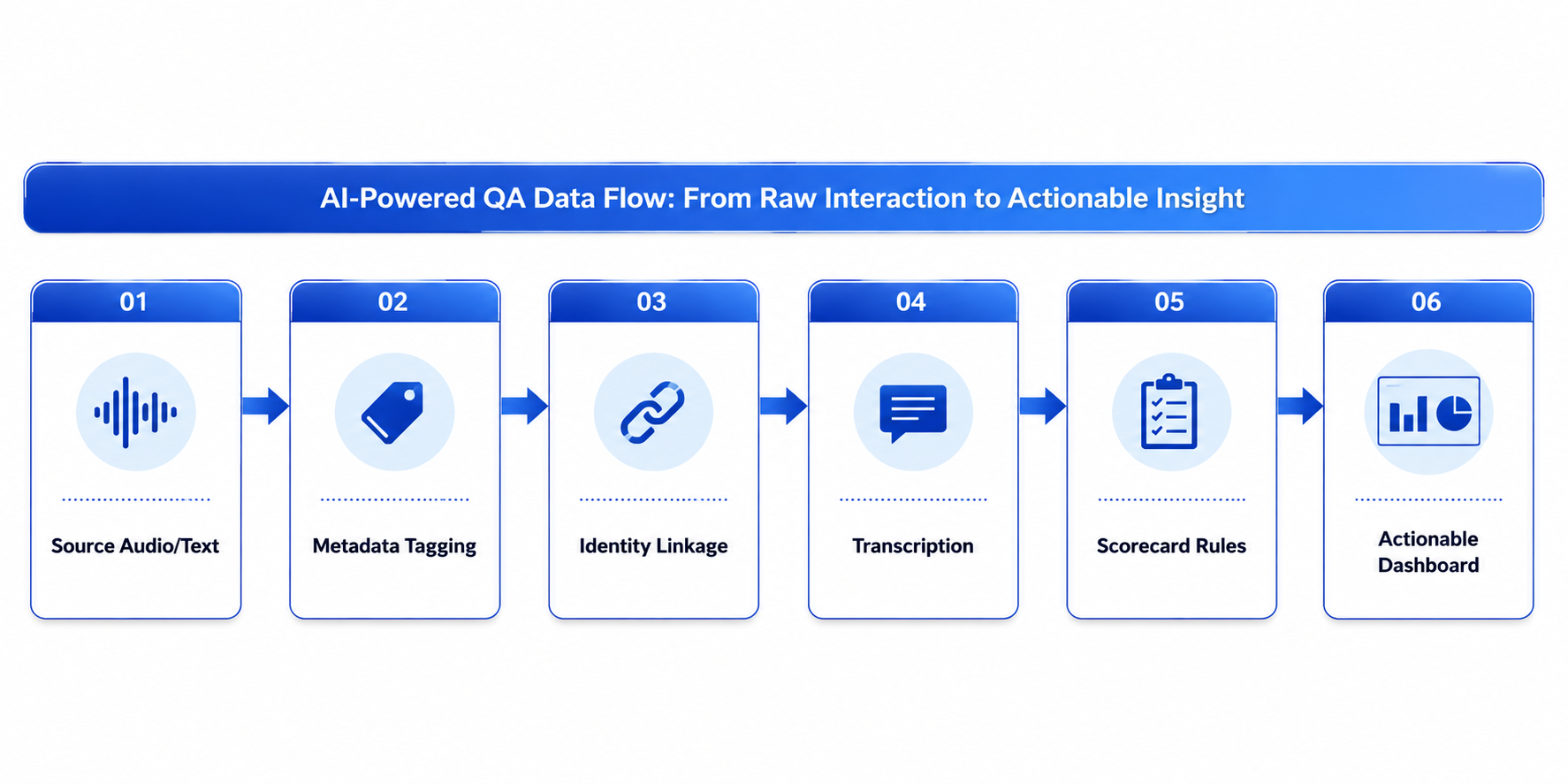
- **Classify Variance by Operational Risk:** A minor scoring error on a greeting protocol is low risk; a missed financial disclosure is critical. Prioritize calibration efforts around regulatory and high-friction interactions.
- **Establish Audit Safeguards:** Implement human-in-the-loop workflows for disputed scores, low-confidence automated evaluations, and edge-case reviews.
### Data Readiness Enables Scale
Deploying [call center quality monitoring software](/okf/page/home.md) on top of messy interaction data, ambiguous scorecards, and disconnected agent identities simply scale operational errors. Before deploying real-time AI tools, the platforms must structure their forms to support [automated call evaluation rules and NLU models](/okf/article/automated-call-scoring-software-ai-qms.md). When interaction data is complete, metadata is structured, and scorecard logic is calibrated, automated evaluation transforms quality management from a retrospective sampling process into a strategic operational advantage. ### Is Your Contact Center Data Truly Ready for AI Scoring?
Avoid scaling operational errors, flawed agent identities, and miscalculated scores. Get a comprehensive evaluation of your interaction data, ASR accuracy, and metadata schemas before taking automated scoring live. [Schedule Your Free QA Data Readiness Audit](/okf/page/schedule-a-demo.md)
---
## Measuring Chat Agent Productivity Across Volume, Response, and Quality
Agent A handles 45% more chat conversations than Agent B while maintaining a low first-response time. On standard contact center dashboards, Agent A appears significantly more productive. However, operational data across the entire lifecycle of those interactions often reveals a different reality:
- Extended gaps between mid-conversation replies
- Higher transfer and escalation rates
- Lower first-contact resolution
- Sub-par quality assurance (QA) scores
- A spike in repeat customer contacts within 48 hours
When high volume creates downstream operational friction, apparent productivity becomes a liability. The article addresses productivity measurements for human customer service agents handling live chat. Useful chat agent productivity metrics cover [workload context, throughput, responsiveness, resolution](/okf/article/call-center-agent-performance-metrics-ai-quality-management.md), and interaction quality. ## Which Chat Agent Productivity Metrics Should You Measure?
To evaluate live chat performance effectively, contact center leaders must track operational and experience metrics alongside their key blind spots. Contact Center Operational & CX Metrics Analysis Metric What It Helps Measure What It Cannot Tell You Alone Chats handled Raw volume processed by the agent Whether customer issues were resolved Chats per productive hour Work throughput relative to active agent time Interaction complexity, accuracy, or quality Concurrent chats Parallel workload assigned to an agent Whether that workload is operationally sustainable First Response Time (FRT) Speed of initial engagement after routing Responsiveness or delay after the initial reply Average / subsequent response time Ongoing response cadence throughout the chat Whether the agent provided accurate information Chat duration Total elapsed time of the conversation Whether a short interaction was efficient or rushed Resolution / closure rate Share of chats marked closed under operational rules Whether system closure represents true issue resolution Transfer / escalation rate Volume of work moved to another tier or team Whether the transfer was necessary or premature Repeat-contact rate Customers reconnecting within a set window The exact root cause driving the follow-up contact QA score Adherence to process, accuracy, and soft skills Operational speed or workforce throughput CSAT Direct customer sentiment and perception Operational efficiency or agent cost-to-serve Measuring digital channel performance requires looking past surface volume metrics. Teams leverage [contact center AI observability](/okf/article/contact-center-ai-observability.md) to identify false containment and underlying resolution failures. Primary Calculation Frameworks
Chats per Productive Hour
Completed Chats ÷ Productive Agent Hours
Transfer Rate
(Transferred Chats ÷ Handled Chats) × 100
Repeat-Contact Rate
(Repeat Customers ÷ Resolved Customers) × 100
## What Chat Productivity Measures?
Evaluating chat performance requires a strict distinction between effort and outcome. > Chat agent productivity measures how effectively available agent capacity is converted into completed customer work while maintaining acceptable responsiveness and interaction quality.
Operations management requires separating three distinct operational concepts: Agent's Activity, Productivity & Performance Concept Question It Answers Primary Operational Indicator Activity How busy was the agent? - Concurrency level
- Active typing time
- Logged-in status
Productivity How effectively did capacity become completed work? - Resolved chats per productive hour
- Low repeat contact rate
Performance How well did the agent meet organizational standards? - Throughput vs. target
- Automated QA & compliance scores
- CSAT / sentiment trends
High activity does not equal high productivity. An agent maintaining maximum concurrency may generate high raw throughput while leaving customer problems partially solved. Conversely, high productivity on a single metric does not represent total agent performance. ## Concurrency Changes How Chat Agent Productivity Must Be Interpretations
Concurrency is the fundamental difference between voice and live chat operations. ### Chat Workload vs. Voice Workload
In voice channels, agents handle interactions sequentially. One call occupies total agent capacity. Live chat allows agents to handle multiple parallel conversations. Consequently, raw interaction counts fail as a proxy for actual workload. Two agents completing ten chats per hour may be working under completely different operational pressures based on concurrent session overlap. ### Capacity vs. Cognitive Load
Parallel conversations allow agents to utilize idle waiting time while a customer types. However, concurrency introduces heavy context-switching costs: - One chat may sit idle awaiting customer input.
- A second chat requires real-time account research in enterprise CRM.
- A third chat demands rapid, back-and-forth troubleshooting.
Concurrency represents **workload context**, not proof of productivity. ### Determining Sustainable Concurrency
As concurrency rises beyond a workload an agent can sustain, response delays, context-switching errors, transfers, or quality problems may begin to appear. Operations teams must monitor specific failure points: Operational Friction: Concurrency to Defection Higher Concurrency
→
Extended Response Gaps
→
Premature Closures
→
High Repeat Contacts
The useful concurrency target is not the maximum number of sessions an agent can technically open. It is the parallel workload an agent can sustain without triggering delays, transfers, or [compliance failures](/okf/article/automated-policy-monitoring-contact-center.md). ## Why Can Individual Chat Productivity Metrics Give the Wrong Answer?
Evaluating chat metrics in isolation routinely leads to incorrect operational conclusions. Every efficiency signal requires an outcome or quality counter-metric. Contact Center Metrics for Improvement If This Metric Improves Check It Against Operational Risk / Fallacy Chats handled rises Resolution + QA score Higher volume may be masking incomplete resolution and low compliance. Concurrency rises Subsequent response time + QA Parallel capacity may be exceeding cognitive limits, delaying replies. First response gets faster Average response time Fast initial pickup hides severe response delays later in the chat. Chat duration falls Repeat-contact rate + Resolution Agents may be forcing premature closures to inflate handle-time metrics. Transfer rate falls QA score + Process compliance Agents may be holding complex issues they lack the skill to resolve. Occupancy / Utilization rises Response delays + Agent burnout Queue capacity is overloaded, risking severe service-level spikes. Closure rate rises Repeat contact within 48h System closures are being logged without solving underlying root causes. Agent Profile Performance Evaluation Agent A
- **Volume:** 35 chats per shift
- **Concurrency:** 4-session concurrency
- **Speed:** 20-second FRT (First Response Time)
- **Repeat Contact Rate:** 28%
- **QA Score:** 82%
Agent B
- **Volume:** 24 chats per shift
- **Concurrency:** 2-session concurrency
- **Speed:** 45-second FRT (First Response Time)
- **Repeat Contact Rate:** 6%
- **QA Score:** 96%
Evaluating raw volume singles out Agent A as the superior performer. Factoring in [repeat contact and interaction quality](/okf/article/customer-retention-metrics-limitations.md) reveals that Agent A is pushing unresolved work back into the queue, directly inflating operating costs. ## Use Five Questions to Investigate a Change in Chat Productivity
When evaluating shifts in agent throughput or team performance, use this five-step diagnostic framework before adjusting operational targets or shift patterns: ### 1. Did throughput change?
Verify total chats handled, completed sessions, and chats per productive hour. Confirm whether output changes or if logging hours shifts. ### 2. Did the underlying workload change?
Analyze concurrent chat levels, incoming contact reasons, and interaction complexity. A drop in chats per hour often reflects a spike in complex technical queries rather than declining agent effort. ### 3. Did responsiveness degrade across the chat lifecycle?
Compare First Response Time against subsequent reply to intervals and total chat duration. Identify whether response gaps occurred early or escalated mid-conversation. ### 4. Did resolution behavior shift?
Examine closure rates alongside transfer volume, escalation rates, and [48-hour repeat contacts](/okf/article/first-call-resolution-improvement-software.md). Ensure higher output is not driving artificially high closure tagging. ### 5. Did interaction quality remain stable?
Cross-reference volume changes with QA evaluation scores, process compliance metrics, and conversational accuracy. A productivity gain is validated only when higher throughput occurs without material degradation in responsiveness, first-contact resolution, or QA compliance. ## When Productivity Data Needs Conversation-level Quality Evidence?
Operational dashboards from CCaaS and workforce management (WFM) platforms effectively measure system activity: logging concurrency, queue time, availability, and session duration. Operational systems can show that throughput fell, response gaps widened, or repeat contact increased. Those signals identify where to investigate. They do not always explain what occurred inside the conversations. Conversation-level quality analysis adds that missing evidence by examining behaviors such as skipped verification, inaccurate guidance, premature closure, or unnecessary escalation. However, when metrics indicate an operational issue—such as a sudden drop in throughput alongside rising repeat contacts. Queue, routing, and workforce metrics alone do not explain what occurred inside the customer conversations. Uncovering the root cause of metric shifts requires interaction-level evidence: - Agents skipping required identity verification or diagnostic steps to lower handle time
- Inaccurate product information supplied under high concurrency stress
- Premature chat closure before confirming customer issue resolution
- Unnecessary escalations triggered to clear active concurrent queues
- Systematic soft-skill degradation during volume spikes
Traditional manual QA teams sample only 1% to 2% of total interactions, leaving 98% of chat data unanalyzed. [AI-driven quality management systems](/okf/page/home.md) automatically audit up to 100% of interactions across compliance and process adherence. System platforms manage routing, staffing, and queue concurrency. Automated QA complements operational systems by analyzing interaction-level behavior, giving teams evidence to investigate why productivity metrics changed. ## Measure Productive Work, Not Maximum Throughput
Maximizing raw volume of conversation or pushing concurrency to technical limits does not equal operational efficiency. Unmanaged volume gains frequently inflate repeat contact rates, drive up transfers, and compromise interaction quality. Contact center leaders must evaluate chat agent productivity by balancing throughput metrics with sustained responsiveness, resolution accuracy, and QA compliance. ### Uncover True Chat Agent Productivity
High conversation volume and maximum concurrency mean nothing if agents are pushing unresolved issues back into your queue. [Omind AIQMS](/okf/article/ai-powered-quality-management-system.md) evaluates up to 100% of interactions, giving evidence-based performance insights. [Schedule Your AIQMS Demo](/okf/page/schedule-a-demo.md) | [Explore AIQMS Features](/okf/page/features.md)
---
## Modern Call Center Quality Management System Tools: Software, Methods, and Best Practices
Quality management in call centers has changed fundamentally. What once relied on manual scorecards, limited call sampling, and periodic audits now demands continuous visibility across every customer interaction. As contact centers scale, diversify channels, and face higher compliance and customer experience expectations, **quality management system tools** have evolved from static techniques into intelligent, software-driven systems. This guide explores how modern call centers should think about call center quality management software.
## What Are Quality Management System Tools? (Then vs. Now)
Quality management system tools have evolved significantly, shifting from standalone analytical techniques to intelligent systems designed for scale and continuity. In call center environments, traditional quality techniques struggled to keep pace with interaction volume, complexity, and compliance demands. ### Traditional Quality Management Tools
Historically, quality management relied on structured techniques designed to identify defects and process gaps. Common examples include: - Cause-and-effect (fishbone) analysis
- Pareto analysis
- Control charts
- Process flowcharts
These tools helped teams understand *why* quality issues occurred, but they were manual, retrospective, and difficult to apply consistently across high-volume environments like call centers. ### Modern Quality Management System Tools
[Advanced quality management systems](https://www.omind.ai/blog/qms/ai-qms-trends-the-future-of-quality-management-system/) operate the following concepts on a scale. Instead of isolated analysis, modern tools enable: - Continuous monitoring of interactions
- Automated evaluation and scoring
- Pattern detection across thousands of conversations
- Data-driven feedback and improvement cycles
In short, modern QMS tools identify quality issues and help organizations manage, predict, and improve continuously. ## Why Do Call Centers Need Specialized Quality Management System Tools?
Call centers operate under conditions that generic quality frameworks were never designed for: - High interaction volumes
- Multiple communication channels
- Diverse agent skill levels and accents
- Regulatory and compliance obligations
- Direct impact on customer experience metrics
[Manual or sampled QA](/okf/article/ai-qms-agent-performance-improvement.md) approaches struggle in this environment. They miss systemic issues, delay corrective action, and often disconnect quality insights from coaching and performance management. [Modern QA tools for contact centers](/okf/article/the-staffing-strategist-your-guide-to-talent-acquisition-3.md) analyze every interaction, surface patterns early, and connect quality insights directly to agent improvement and CX outcomes. ## Core Categories of Quality Management System Tools
[Advanced quality monitoring tools](https://www.omind.ai/blog/qms/automated-call-quality-monitoring-software-omind/) support continuous quality measurement, insight, and action. Their core categories include: ### Automated Quality Coverage Tools
These tools replace limited call sampling with full or near-full interaction analysis. They ensure that quality evaluation is consistent, unbiased, and scalable across teams. **Key capabilities:**- Automated call and interaction evaluation
- Configurable quality criteria
- Reduced reliance on manual reviews
### AI-Driven Quality Intelligence and Analytics
Beyond scoring, [AI QMS](/okf/page/home.md) provide intelligence—identifying trends, recurring issues, and emerging risks that human reviewers may miss. **Key capabilities:**- Pattern detection across conversations
- Quality trend analysis
- Early identification of systemic issues
### Compliance and Risk Management Tools
For regulated industries, quality management system tools play a critical role in compliance assurance. **Key capabilities:**- Script and disclosure adherence tracking
- Audit-ready quality records
- Risk signal detection before escalations
## Coaching and Performance Enablement Systems
Quality insights only matter if they drive improvement. Modern tools close the loop between evaluation and agent development. Key capabilities: - Actionable feedback tied to quality insights
- Targeted coaching recommendations
- Performance improvement tracking
## Mapping Traditional Quality Tools to Modern QMS Software
One reason legacy content still ranks for “quality management system tools” is that traditional techniques remain conceptually valid. The difference is *how they are executed*. Traditional Tools vs Modern QMS Software Equivalents Traditional Tool Modern QMS Software Equivalent Fishbone analysis AI-driven root cause identification Pareto charts Automated defect clustering dashboards Control charts Real-time quality score monitoring Flowcharts Workflow-based QA and coaching systems Modern quality management system tools operate these principles on a scale. ## Key Features to Look for in Quality Management System Tools
Choosing modern tools requires establishing clear threshold metrics and running a controlled [QA software pilot evaluation](/okf/article/best-call-center-qa-software.md) using blind, representative call batches. When evaluating tools for a modern call center, prioritize features that support long-term quality maturity: 1. **Full-coverage quality analysis** – Beyond sampling
2. **AI-driven pattern and risk detection** – Not just static scores
3. **Actionable insights** – Clear guidance on what to fix and why
4. **Integrated coaching workflows** – Quality tied directly to performance
5. **Compliance visibility** – Built-in audit and risk management
6. **Scalability and integration** – Works across channels and systems
Tools that lack these capabilities often reinforce reactive QA rather than continuous improvement. ## Best Practices for Implementing QMS Tools in Call Centers
The success of any quality management system depends on how thoughtfully it is implemented across standards, workflows, and teams. Here are some best QA practices that can help you: ### Start with Quality Standards, Not Software
Define what “quality” means for your organization before configuring tools. Clear standards ensure consistency and relevance. ### Combine AI Automation with Human Oversight
Automation accelerates coverage and insight, while human judgment provides context and empathy. Effective systems balance both. ### Shift from Lagging to Leading Indicators
Move beyond [historical QA scores](https://www.omind.ai/blog/qms/quality-management-in-the-call-center/) to predict risks indicators before they impact customers. ### Connect Quality Insights to Coaching and CX Metrics
Quality management should influence agent development, customer satisfaction, and operational performance—not exist in isolation. ## Measuring the Impact of Quality Management System Tools
To assess effectiveness, track outcomes that reflect real improvement: - Consistency of quality scores across teams
- Reduction in repeat contacts and escalations
- Compliance risk reduction
- Coaching effectiveness and skill uplift
- Correlation between quality trends and CSAT or FCR
Quality management system tools deliver measurable improvement and better reporting. ## Future of Quality Management System Tools in Call Centers
Quality management is moving toward intelligence-led systems that are: - Predictive rather than reactive
- Real-time rather than retrospective
- Integrated with agent workflows
- Focused on continuous improvement
As expectations rise, call centers will increasingly rely on AI-driven quality management systems that anticipate issues, guide performance, and align quality with customer experience outcomes. ## Conclusion
Traditional quality tools laid the foundation for process improvement, but modern call centers require more than isolated techniques. Quality management system tools continuously analyze interactions, surface insights, and drive improvement at scale. For organizations focused on delivering consistent, compliant, and high-quality customer experiences, the shift from manual QA to AI-led quality management is essential. ### Move from Sampled QA to Continuous Quality Intelligence
Manual reviews and sampled QA limit visibility into real quality trends. Modern call centers are adopting AI-led quality management systems to analyze every interaction, detect risks early, and connect quality insights directly to agent coaching and compliance workflows. Learn how an AI-first QMS approach supports continuous improvement across your contact center. **[Explore AI-Led Quality Management for Call Centers](/okf/page/schedule-a-demo.md)**
---
## Omni Channel Quality Monitoring Consolidate Service Quality Breaksdown as Customer Channels Multiply
Contact centers no longer operate through a single voice stream. Support organizations routinely handle concurrent customer interactions across voice, email, chat, SMS, WhatsApp, and social messaging channels. Managing these operational streams is not the bottleneck. The operational failure point is maintaining consistent quality criteria across all active channels. As support environments expand, traditional quality management fractures. Operations leaders lose visibility into systemic performance failures, regulatory compliance risks, and rising customer effort before those issues degrade top-line retention metrics.
## What Is Omni Channel Quality Monitoring?
Omni channel quality monitoring evaluates customer interactions across voice, chat, email, and messaging platforms using a single, unified quality standard. Traditional QA vs. Omnichannel Quality Monitoring Evaluation Dimension Traditional QA Omnichannel Quality Monitoring Core Channel Focus Voice-centric focus Unified cross-channel scoring Scoring Standardization Isolated scorecards per channel Normalized criteria across text & voice streams Sampling & Coverage Manual 1–2% random sampling Broad-scale automated triage (100% coverage) Risk & Friction Detection Reactive risk identification Proactive friction & trend detection The primary objective is not channel routing. The primary objective is establishing continuous, normalized performance metrics regardless of where a conversation takes place. ## Why Omni Channel Quality Monitoring Grew Difficult as Customer Channels Expanded?
Establishing normalized service quality across modern contact center infrastructures presents distinct structural friction points. ### Customer Conversations No Longer Stay in One Channel
A single customer query often spans three distinct operational platforms. A user initiates a session on a web chatbot, transitions to email for escalation, and finishes the resolution via inbound phone support. ### Digital Interaction Volumes Grew Faster Than QA Capacity
Support teams added digital messaging options to reduce operational costs. Consequently, interaction volume expanded exponentially while QA staffing remained static. ### Quality Programs Were Built for Voice-Centric Operations
Traditional QA scorecards originated in legacy voice call centers. Applying call-duration and verbal etiquette rubrics directly to asynchronous chat or WhatsApp messaging breaks operational auditing logic. ## Why Traditional Quality Monitoring Breaks in Omnichannel Contact Centers?
As interaction channels multiply across chat, voice, and email, evaluating isolated subsets exposes contact centers to high-impact [call sampling risks](/okf/article/call-sampling-risk-contact-center-performance.md). Legacy QA models operate on three structural assumptions: - Centralized, single-channel interaction paths.
- Low overall daily message volumes.
- Manual audit capacity is sufficient for random sampling.
These assumptions fail in modern enterprise contact centers. Evaluating isolated interactions creates structural blind spots. When audit criteria differ between voice and digital teams, leadership receives distorted quality metrics that hide core operational issues. ## The Five Visibility Gaps Created by Channel Fragmentation
Channel expansion without centralized oversight creates critical operational visibility gaps. The Five Visibility Gaps in Operational Workflow
Gap 01
Journey Disconnect
Isolated ticket tracking during channel switches.
Impact: AHT Spikes
→
Gap 02
Standards Mismatch
Structured voice rubrics vs ad-hoc chat reviews.
Impact: Uneven Quality
→
Gap 03
Compliance Blindness
Chat payloads bypass regulatory audits.
Impact: Legal Liability
→
Gap 04
Silent Friction
Unseen text churn precedes CSAT drops.
Impact: Unseen Churn
→
Gap 05
Root-Cause Blur
Siloed data obscures defect ownership.
Impact: Broken Coaching
1. **Customers Change Channels but QA Does Not Follow Them:** When a customer transitions from live chat to phone, the interaction context is split across two siloed platforms. The QA evaluator sees two distinct, average tickets instead of one degraded customer journey.
2. **Voice Has Scorecards. Messaging Often Does Not:** Voice interactions undergo strict evaluations for script compliance and tone. Messaging channels are frequently subjected to informal spot-checks, yielding inconsistent operational execution.
3. **Compliance Risks Appear Across Multiple Channels:** Strict regulatory mandates, such as HIPAA, require continuous monitoring across every channel. Non-compliant data exposure often bypasses legacy auditing in text-based payloads while voice lines remain heavily monitored.
4. **Customer Friction Appears Before Performance Metrics Change:** Customers report friction inside chat logs long before escalations spike or CSAT surveys drop. Disconnected review processes mask these recurring indicators.
5. **Root Causes Become Harder to Isolate:** When support channels operate independently, operations teams cannot pinpoint whether broken workflow rules, missing agent training, or technical API bugs caused a service breakdown.
## Customer Journey Complexity Creating New Quality Monitoring Challenges
Customers experience a single brand journey. Operations teams monitor disconnected ticket logs. Customer Journey vs. Internal QA Silo Analysis Touchpoint Step Customer Path Internal View (Siloed Ticket) QA Assessment Step 1 Chatbot Query Ticket #1 Passed QA Step 2 Email Escalation Ticket #2 Passed QA Step 3 Voice Call Ticket #3 Failed QA Real Outcome Failed Journey — High Customer Effort, Fragmented Experience & Escalation Risk When customers switch channels, they repeatedly re-explain their issue. Different agents provide conflicting resolutions because knowledge management systems are disconnected. Evaluating interactions in isolation masks journey-level operational failure. ## What High-performing Contact Centers Monitor Across Every Channel?
Leading operations move away from channel-specific vanity metrics, auditing baseline quality indicators instead: - **Resolution Quality:** Was the underlying problem systematically resolved, or did the interaction merely close the active ticket?
- **Policy and Compliance Adherence:** Did the agent verify identity and handle sensitive information in accordance with enterprise regulatory mandates?
- **Customer Effort:** How many touches, transfers, and channel shifts were required to reach a resolution?
- **Escalation Risk:** Which behavioral or phrase patterns directly predict incoming formal escalations?
- **Coaching Opportunities:** Which specific agent workflow habits consistently drive sub-par interaction outcomes?
## Why Sampling Becomes Less Reliable in Omnichannel Environments?
Traditional contact centers manually evaluate a 1% to 2% random sample of total call volume. In a multi-channel environment processing 500,000 interactions monthly across five platforms, auditing 5,000 isolated interactions leaves 495,000 interactions completely unexamined. Contact Center QA Blindspot Analysis Category Interaction Volume Percentage of Total Total Monthly Interactions 500,000 100% Manual Sample Reviewed 10,000 2% Operational Blindspot 490,000 98% (Unexamined) This statistical blind spot exposes the business to systemic compliance failures and unmanaged operational risks. Deploying **[automated call quality monitoring](/okf/article/automated-call-quality-monitoring-evaluation-coverage.md)** software transitions quality teams from manual sampling to broader automated interaction analysis. ## How Omni Channel Quality Monitoring Software Creates a Unified View?
Modern **[contact center quality monitoring software](/okf/article/how-contact-center-quality-monitoring-systems-turn-every-interaction-into-actionable-insight.md)** replaces fragmented review workflows with a standardized evaluation architecture. Unified AI Auditing Engine: Architectural Pipeline Raw Interaction Data Unified AI Auditing Engine Unified Operational Impact - Voice Audio (Sub-50ms latency)
- Live Chat Logs
- Email & WhatsApp Threads
- Native API Ingestion
- Normalized Scoring Model
- Real-Time Webhook Triage
- Unified QA Visibility across all channels
- HIPAA Compliance Auditing automated
- 42% Ticket Volume Reduction
Platforms like Omind deploy an [AI QMS for contact centers with unified QA compliance](/okf/article/ai-qms-contact-centers-unified-qa-compliance.md) built on a decoupled microservices architecture utilizing native API hooks. Omind AI QMS Architecture and Stream Processing Voice Processing Engine Text Processing Engine - **Sub-50ms Stream Latency:** Zero-delay voice streaming architecture built for live call intervention.
- **Real-Time Accent Harmonization:** Dynamic phonetic alignment bridging regional voice gaps instantly.
- **Instant Edge Case Routing:** Live anomaly detection triggering immediate escalation for complex interactions.
- **Automated Webhook Payload Triage:** Immediate event-driven parsing across chat, email, and ticketing channels.
- **HIPAA Data Encryption:** Inherent PHI/PII masking built directly into the real-time processing layer.
- **Regional Residency Rules:** Geo-fenced data pipeline execution ensuring strict local compliance.
For voice channels, [real-time accent harmonization](https://www.accentharmonizer.ai/) operating with sub-50ms latency ensures high transcription accuracy. For text-based communication, automated triage parses incoming webhook payloads to maintain HIPAA compliance and regional data residency constraints. This automated infrastructure routinely cuts manual ticketing volume by 42% through early triage, routing complex edge cases directly to specialized ops teams. Implementing [QA automation for contact centers](/okf/article/qa-automation-cost-strategy-contact-centers.md) ensures compliance policies apply consistently across both voice and digital streams. ## Questions to Ask Before Choosing an Omni Channel Quality Monitoring Platform
Procurement and operations leaders evaluating [customer service QA software beyond call monitoring](/okf/article/customer-service-qa-software-beyond-call-monitoring.md) must evaluate platforms using these technical parameters: 1. **Framework Standardization:** Can the engine evaluate voice, chat, email, and messaging using normalized rubric?
2. **Cross-Channel Analytics:** Can the software link disconnected interactions into a single customer journey audit?
3. **Regulatory Coverage:** Does the platform parse text payloads and voice streams for HIPAA compliance rules simultaneously?
4. **Targeted Coverage:** Does the system replace manual 2% sampling with automated triage across all incoming streams?
5. **System Integrations:** Does the software ingest data via native API hooks without requiring custom middleware rebuilds?
## Final Thoughts
Most organizations successfully expand customer communication channels. Far fewer successfully expand their quality monitoring workflows alongside them. Multi-channel operations present an operational visibility problem, not just a channel management challenge. Deploying unified [contact center quality management software](/okf/page/home.md) restores operational control, ensuring service standards and compliance rules remain intact across every customer touchpoint. ### Stop Operational Quality Breakdown Across Channels
Evaluating isolated voice calls while interaction logs go unexamined exposes your enterprise to compliance risks and degraded CSAT. **Omind AI QMS** unifies your multi-channel quality monitoring under a single architecture. - **Eliminate Quality Blindspots:** Standardize scorecards across voice and digital streams natively.
- **Reduce Ticketing Burden:** Cut manual QA workload by up to 42% through automated payload triage.
- **Guarantee Compliance:** Automatically flag HIPAA and regulatory violations across every touchpoint.
**[Book a Technical Demo with Our QMS Engineers](/okf/page/schedule-a-demo.md)**
---
## Omnichannel Quality Management: Call Center Growth Strategies
Most contact centers treat omnichannel success as a technical "piping" problem—simply connecting voice to chat to email. However, this approach ignores a brutal reality: adding more channels without a unified omnichannel quality management strategy is just [scaling your chaos](/okf/article/qa-for-call-centers-at-scale.md). While your IT team celebrates "seamless" connectivity, your customer experience is likely fracturing in the 97% of interactions that currently go unmonitored. Traditional QA is broken because it evaluates in silos. An agent might ace a voice call while providing a disastrous, unmonitored experience on web chat. Consequently, customers are left trapped in inconsistent loops that drive up handle times and destroy [First Call Resolution (FCR) rates](/okf/article/first-call-resolution-improvement-software.md). You cannot fix a journey-level problem with interaction-level tools. In this post, you'll learn how to bridge the coverage gap using a unified evaluation framework and AI-powered analysis. We will break down the five pillars of a modern omnichannel quality management system and provide a realistic roadmap to move your center from reactive scoring to predictive, real-time coaching.
## Importance of Omnichannel Quality Management in Modern Call Centers
Adding more channels doesn't automatically improve the customer experience. In fact, for most contact centers, it does the opposite. It multiplies the surface area where quality can break down — and typically does. Voice QA, chat QA, and email QA are evaluated differently, scored differently, and coached differently. An agent who scores well on call evaluations may be completely unmonitored on chat. A customer who starts on email and escalates to a call encounters two entirely different quality standards, neither of which knows the other exists. The result is inconsistent tone, inconsistent resolution quality, and broken CX journeys that generate more repeat contacts, higher handle time, and declining FCR. The problem here is the absence of a quality layer that spans all of them. ## What Is Omnichannel Quality Management in a Call Center?
An omnichannel quality management system (QMS) isn't a rebrand of traditional call QA. It's a structural shift from interaction-level evaluation to journey-level evaluation — one that treats a conversation not as a single voice call or chat session, but as a continuous customer experience that may touch five channels before it's resolved. Where traditional QA asks "how did this agent handle this call?", an omnichannel QMS asks "how consistently did we perform across every touchpoint in this customer's journey?" That distinction changes everything: the scoring model, the coaching triggers, the dashboards, and the outcomes you can actually tie to quality improvements. ## Why Omnichannel Quality Management Is Critical for CX Performance?
The fundamental issue with legacy QA in a multi-channel environment is fragmentation. Each channel runs its own evaluation process — often with different scorecards, different supervisors, and different cadences. There's no unified view of agent performance, no way to detect cross-channel failures, and no correlation drawn between QA scores and actual CX outcomes. Compounding this, manual QA reviews typically cover 1–3% of all interactions. In a voice-only center, that's already a small sample. Spread across voice, chat, email, and messaging, it's statistically meaningless. Supervisors are making coaching decisions based on a fragment of a fragment — and they have no idea what's happening in real time. > **The Coverage Gap** Traditional QA reviews 1–3% of interactions. In an omnichannel environment with voice, chat, email, and messaging, that leaves [over 97% of the customer experience completely unmonitored](/okf/article/ai-qms-contact-center-audit-prevent-percent-review-problem.md).
## Key Features of an Effective Omnichannel Quality Management Call Center
Building a functioning omnichannel QMS means addressing five distinct capability areas. Miss any one of them and the system develops blind spots. 1. Unified evaluation framework
2. Cross-channel context tracking
3. AI-powered interaction analysis
4. [Real-time quality monitoring](/okf/article/real-time-qa-performance-intelligence.md)
5. Performance-to-outcome mapping
The first pillar — a unified evaluation framework — means standardizing scorecards so the same core criteria apply regardless of channel, with channel-appropriate weighting on top. Cross-channel context tracking ensures that when a customer escalates from chat to voice, the agent and the QA system both understand what came before. AI-powered analysis replaces the 1–3% manual sample with full-coverage speech and text analytics. Real-time monitoring converts QA from a retrospective exercise into a live coaching signal. And performance-to-outcome mapping is what turns QA scores into business metrics: FCR, CSAT, handle time, and cost per resolution. ## How Omnichannel Quality Management Software Actually Works?
Modern omnichannel QMS platforms follow a consistent workflow that differs fundamentally from bolt-on QA tools. Data is ingested from every channel — voice recordings, chat transcripts, email threads, messaging logs — and normalized into a unified format. AI transcription handles voice; natural language processing handles text. From there, a unified scoring engine applies your QA framework consistently across all interaction types, with sentiment analysis and intent detection layered in to flag emerging issues before they become patterns. Agent performance scores aggregate across channels and feed directly into supervisor dashboards, coaching queues, and automated alerts. The system doesn't wait for a weekly QA review — it surfaces issues within the interaction window, when coaching can actually change the outcome. ## Omnichannel QA Improvement Looks Like in Practice
The measurable impact of a well-deployed [omnichannel QMS](/okf/page/home.md) shows up in three places: FCR, CSAT, and cost. First-call resolution improves because agents are coached consistently across channels, reducing the variance that causes customers to call back. CSAT improves because customers receive a coherent experience regardless of which channel they use. And cost efficiency improves because repeat contacts fall — which is one of the [highest-cost line items](/okf/article/why-cfos-need-call-center-qa-software-to-drive-roi.md) in any contact center operation. Centers that have moved from fragmented manual QA to unified AI-driven evaluation typically see FCR gains within 90 days of deployment, driven primarily by the shift from retrospective coaching to real-time intervention. ### A Realistic Implementation Roadmap
#### **1. Phase 01: The QA Gap Audit**
- **The Action:** Map your current evaluation methods against actual channel usage.
- **The Goal:** Identify exactly where quality is currently "invisible" (e.g., chat or email).
#### **2. Phase 02: Unified Framework Design**
- **The Action:** Build standardized scorecards with channel-specific weighting.
- **The Goal:** Ensure a "Great" score in voice carries the same weight as a "Great" score in messaging.
#### **3. Phase 03: Data & Pipeline Integration**
- **The Action:** Connect your CCaaS, CRM, and messaging logs into one ingestion engine.
- **The Goal:** Move from fragmented data to a single source of truth.
#### **4. Phase 04: AI Deployment & Training**
- **The Action:** Layer AI analysis over the data and train supervisors on real-time coaching.
- **The Goal:** Shift from manual 1% sampling to 100% automated coverage.
#### **5. Phase 05: Continuous Optimization**
- **The Action:** Refine scoring models based on actual CX outcomes (CSAT/FCR).
- **The Goal:** Create a closed-loop system where QA data improves agent performance daily.
> **The Implementation Trap:** Most contact centers rush to "Phase 3: Integration" because it feels like progress. However, skipping the "Unified Framework" means you are simply automating bad measurements. Tooling without a standardized scorecard is just faster chaos.
## Conclusion
Standardizing CX across every channel is no longer a technical "nice-to-have"; it is a operational necessity. As we have explored, simply adding more digital touchpoints without a unified omnichannel quality management layer only serves to multiply the surface area for failure. If your QA process remains fragmented and manual, you are effectively flying blind across 97% of your customer journeys.
Consequently, the organizations that will thrive in 2026 are those that move beyond interaction-level scoring and embrace journey-level visibility. By implementing a unified framework and leveraging AI-powered analysis, you can finally close the coverage gap. This shift transforms QA from a back-office administrative task into a front-line strategic asset that directly improves FCR and customer loyalty.
However, technology alone is not a silver bullet. True standardization requires the discipline to define what "good" looks like across every channel before you automate the measurement of it.
**See how AI-powered omnichannel quality management works in real time** [Request a demo](/okf/page/schedule-a-demo.md)
---
## Predictive QA Analytics for Contact Centers Forecast Risks Before Escalations Happen
Most contact center quality assurance programs explain failures after the damage occurs. A customer escalates an issue. Compliance guidelines fail. CSAT scores drop. An agent develops poor call behaviors for weeks before coaching catches the trend. By the time supervisors identify the pattern, the operational impact has already spread across thousands of customer interactions. Legacy systems cannot meet modern enterprise demands. However, implementing predictive QA analytics in your contact center changes the role of quality assurance entirely. Instead of treating QA as historical scorekeeping, AI-driven predictive systems identify escalation risks, coaching gaps, regulatory exposure, and customer dissatisfaction patterns early. They uncover these issues before they become severe operational problems. Traditional QA measures what already failed in your customer operations. Conversely, predictive systems forecast where failure is likely to happen next.
## Why Cannot Traditional QA Predict Operational Risk?
Traditional QA relies on random sampling, which leaves massive operational blind spots. [Reviewing a tiny 2% sample of calls](/okf/article/ai-qms-contact-center-audit-prevent-percent-review-problem.md) means your supervisors miss critical issues in the remaining 98% of interactions. Consequently, delayed QA cycles create a [structural lag between error identification and agent remediatio](/okf/article/contact-center-quality-assurance-software.md)n. Supervisor reviewed bottlenecks further compound this delay. When supervisors spend hours manually listening to calls, coaching lag becomes inevitable. Static scorecards only grade past performance against fixed metrics. Therefore, they fail to flag emerging customer frustration or reactive compliance detection issues. ### Traditional vs. Predictive Operational View
- **Traditional QA:** Evaluates lagging indicators from historical call samples.
- **Predictive QA:** Analyzes 100% of interactions in real time to calculate forward-looking risk probabilities.
Legacy systems completely miss hidden escalation patterns across multiple channels. If an agent struggles with a new product update, manual audits might not catch the trend for two weeks. By then, customer churn had spiked. The predictive engine processes transcripts generated by the baseline [call center analytics platform](/okf/article/call-center-analytics-platform.md) to calculate immediate escalation risk probabilities. ## What Predictive QA Analytics Actually Predicts?
Predictive platforms do not offer vague sentiment scores. Instead, they forecast specific operational events based on exact behavioral triggers. - **Escalation Probability:** The system flags repeated interruption patterns between the customer and the agent. It monitors unresolved sentiment trajectories and identifies transfer-risk indicators to prevent escalations.
- **Compliance Failure Risk:** Predictive models identify specific disclosure omission patterns. They track script deviation trends that expose the enterprise to legal risk.
- **Agent Performance Decline:** The platform detects behavioral drift, such as an agent suddenly deviating from approved soft skills. It tracks rising silence patterns and increasing negative sentiment scores across an agent's daily shift.
- **Customer Churn Signals:** The software calculates risk by [monitoring repeat contact frequency for the same case number](/okf/article/first-call-resolution-improvement-software.md). Furthermore, it flags unresolved issue recurrence, warning teams that a customer is ready to cancel their subscription.
- **Coaching Priority Scores:** Instead of auditing agents at random, the system generates targeted intervention scores. Supervisors immediately see which agents require training first based on the severity of their performance dips.
## The Hidden Dependency Between QA Calibration & Predictive Accuracy
Predictive models are only as good as the data they ingest. Inconsistent human scorecards corrupt predictive models quickly. When two supervisors grade the exact same customer interaction differently, they create highly noisy training data. Inconsistent Human Scoring Leads To **Inconsistent Human Scorecards**
→
**Noisy Training Data**
→
**Model Calibration Drift**
→
**False Escalation Alerts**
Calibration drift reduces prediction reliability over time. If your manual QA process lacks alignment, your predictive systems inherit those exact QA inconsistencies. Enterprise-grade accuracy requires rigorous, programmatic calibration of human scorecards before training the predictive engine. ## How Predictive QA Analytics Works Operationally?
Predictive systems operate via automated data pipelines rather than manual oversight. ### Predictive Models Learn from Historical QA Patterns
The system ingests months of past scorecard data alongside final call outcomes. By correlating specific conversational patterns with historical customer churn, the model learns which behaviors reliably predict future escalations. ### Real-Time Risk Scoring Prioritizes Calls for Supervisors
As an interaction occurs, the engine processes the text and audio features. If a call crosses a specific risk threshold, it instantly routes to the supervisor dashboard. This mechanism allows live intervention before the customer hangs up. ### Escalation Signals Are Identified Across Conversations
The [system tracks customer interactions across chanels](/okf/article/ai-qa-platform-for-omnichannel-support.md) . For instance, if a customer complains on chat and then calls the support line, the system connects the data points. It updates the escalation risk score across all channels simultaneously. ## Why does Prediction Confidence Scores Matter?
Every automated prediction includes a confidence metric, such as a 92% probability of escalation. This scoring helps supervisors focus their energy. They can prioritize high-confidence, high-severity risks over marginal flags. ### How QA Teams Operationalize 100% Interaction Analysis
Instead of searching for needles in haystacks, analysts review auto-flagged interactions. The system handles the bulk evaluation of millions of words. Consequently, human auditors can focus entirely on root-cause analysis and targeted coaching. ## Predictive QA vs. Traditional QA Reporting
Operational decision-making looks completely different when you move away from legacy reporting models. Traditional QA vs Predictive QA Approach Operational Area Traditional QA Approach Predictive QA Approach Operational Focus Static reporting on past events Live risk prioritization and alerts Coaching Cadence Historical coaching after bi-weekly audits Intervention forecasting before habits form Compliance Management Post-audit compliance checking Predictive compliance monitoring and mitigation Data Scope Reactive sampling of 2% of calls Continuous risk analysis of 100% of data ## Why Most Predictive QA Implementations Fail
Many enterprise deployments stumble due to predictable operational traps. Alert fatigue is the primary cause of system abandonment. When a system generates hundreds of false escalation signals daily, supervisors simply stop checking the dashboard. Low-quality audio transcripts also ruin predictive accuracy. Background noise, multilingual prediction problems, and [offshore accent interpretation issues](https://www.accentharmonizer.ai/blog/ai-accent-translation-for-contact-centers/) can distort text outputs. If the transcription engine misinterprets technical terms, the predictive model flags non-existent compliance errors. “ Predictive analytics fails when it operates in a silo. If your risk alerts do not inject themselves directly into the daily workflow of your team leads, you are just generating expensive noise. ”— VP of Contact Center Operations
Overreliance on basic sentiment scoring also causes implementation failure. Sentiment alone does not equal escalation risk; a polite customer can still be highly likely to churn. Finally, disconnected QA workflows and low supervisor adoption will stall any deployment. ## Predictive QA Analytics for Compliance Monitoring
Highly regulated industries use predictive monitoring to [prevent catastrophic compliance failures](/okf/article/ai-call-center-compliance-auditing-best-practices.md). - **BFSI Compliance Forecasting:** Systems track loan disclosure adherence and flag potential lending violations before audits occur.
- **Healthcare Disclosure Prediction:** Platforms ensure agents read full privacy notices during medical verification calls.
- **Telecom Escalation Risk:** Engines detect contract terms misunderstandings that could lead to consumer protection complaints.
- **Script Adherence Forecasting:** Machine learning models predict which new hires are likely to drop critical legal disclaimers.
## Predictive Agent Coaching & Performance Forecasting
Predictive tools allow managers to support their frontline workforce effectively. By identifying performance decline early, managers can stop negative habits before they impact the agent's quarterly scorecard. Coaching prioritization models rank agents by their specific skill gaps. The software detects burnout indicators, such as sudden drops in energy or rising speech-rate volatility. By analyzing behavioral drift over time, leadership can [predict repeat QA failures and offer targeted training modules](/okf/article/ai-coaching-platform-call-centers.md). ## Metrics That Actually Matter in Predictive QA
To measure success, move past average handle time and focus on forward-looking indicators. - **Escalation Probability Score:** The statistical likelihood that an interaction will require management intervention.
- **Predicted CSAT Decline:** A leading metric showing which accounts are heading toward poor satisfaction scores.
- **Compliance Exposure Trend:** The total volume of unmitigated compliance risks across the floor.
- **Coaching Urgency Index:** A priority rank for agents showing the highest rate of behavioral drift.
- **Sentiment Volatility:** The frequency of sharp emotional swings within a single customer interaction.
## How Contact Centers Should Implement Predictive QA Analytics?
Successful deployment requires a phased execution plan. First, establish strict QA data standardization across all existing scorecards. Next, execute a comprehensive calibration alignment phase to remove supervisor bias from your training data. Validate your transcript quality across different accents and equipment types. Implement a phased deployment by testing the predictive engine on a single team first. Finally, continuously perform prediction threshold tuning to eliminate alert fatigue before scaling across the entire enterprise. ## Final Thoughts
Predictive QA with [AI quality management software call center](/okf/page/home.md) is not simply a better analytics layer for your dashboard. It represents a fundamental operational shift from retrospective quality scoring to active operational forecasting. Contact centers that embrace this predictive model eliminate systemic compliance risks and protect customer retention before damage occurs. ### Ready to move to predictive risk forecasting?
Do not let hidden compliance gaps and rising customer frustration damage your brand equity. Contact our enterprise technology team today to schedule a live technical demonstration of our predictive QA platform. Discover how analyzing 100% of your interactions can optimize your agent coaching workflow and eliminate escalations. [Request a Predictive QA Demo](/okf/page/schedule-a-demo.md)
---
## Quality Assessment in Contact Centers: Frameworks, Scorecards, and Modern QA Strategies
Many contact centers evaluate only a small percentage of customer interactions through manual reviews. The limited quality assessment for contact center makes it difficult to identify service gaps, compliance issues, or coaching opportunities. As interaction volumes grow, the gap widens. A structured quality assessment program changes that equation.
## What Is Quality Assessment in a Contact Center?
Quality assessment in a contact center is the structured evaluation of customer interactions against predefined service and compliance standards. Its core objectives are to ensure service consistency, monitor regulatory compliance, identify agent performance gaps, and generate insights that improve the overall customer experience. It sits within the broader [contact center quality management process](/okf/article/quality-management-system-software-guide.md) — but it is not the same as quality monitoring. The distinction matters operationally: Quality Monitoring vs Quality Assessment Quality Monitoring Quality Assessment Observing interactions as they happen or after they occur — listening, watching, logging. Structured evaluation of those interactions using defined scorecards and criteria — measuring, scoring, acting. Most organizations do both but conflating the two leads to QA programs that observe a great deal and act on very little. A mature quality assessment program treats evaluation as a structured operational discipline — not a passive monitoring function. ## Why Quality Assessment Is Critical for Contact Center Operations
Quality assessment connects directly to operational outcomes — not just customer satisfaction scores. Organizations that invest in structured QA programs consistently outperform those relying on informal observation, particularly as interaction volumes scale and agent teams grow. - **Customer Experience:** Ensures consistent service quality and improves issue resolution across every agent and channel.
- **Agent Development:** Provides structured, evidence-based feedback that accelerates skill development and performance improvement.
- **Operational Efficiency:** Reduces repeat contacts and improves first-contact resolution by identifying and addressing root causes.
- **Compliance & Risk:** Verifies that required disclosures are made and that regulatory obligations are consistently met.
## The 5-Layer Quality Assessment Framework
Most competitor articles describe individual QA activities in isolation. What enterprise QA leaders need is a model that explains how quality assessment functions as an end-to-end operational lifecycle. 1. **Interaction Capture:** Customer interactions are captured across voice, live chat, messaging, and email. Recordings and transcripts are stored as the raw material for assessment.
2. **Interaction Analysis:** Interactions are analyzed to identify conversation intent, customer sentiment, and resolution effectiveness. Metadata and transcripts are generated for evaluation.
3. **Quality Evaluation:** Interactions are [scored against QA scorecards](/okf/article/call-center-quality-assurance-checklist.md) covering communication quality, information accuracy, compliance adherence, and problem resolution.
4. **Insight Generation:** QA results surface performance trends, recurring customer issues, and training gaps. Supervisors access dashboards that translate evaluation data into operational visibility.
5. **Coaching and Process Improvement:** Assessment insights drive targeted agent coaching, knowledge base updates, and workflow refinements that close the quality loop over time.
## Key Metrics Used in Call Center Quality Assessment
- **Interaction Quality Score:** Composite score from scorecard evaluations, reflecting overall interaction performance.
- **First Contact Resolution:** Percentage of issues resolved without a repeat contact — a primary driver of CX and efficiency.
- **Compliance Adherence Rate:** Frequency with which agents follow required disclosures and regulatory obligations.
- **Communication Clarity:** Assessment of how clearly and empathetically agents convey information during interactions.
- **Resolution Accuracy:** Whether the solution provided was correct and complete — directly linked to repeat contact rates.
- **Sentiment Score:** Tracks customer emotional tone across the interaction to identify escalation patterns.
## Common Challenges in Traditional Contact Center Quality Assessment
These challenges are significantly amplified in large BPO operations and enterprise contact centers managing thousands of agents across multiple geographies and languages: - **Limited interaction sampling** — [manual QA teams typically review 1–3%](/okf/article/ai-call-center-auditing-vs-call-sampling.md) of all interactions, leaving the vast majority unassessed.
- **Manual evaluation workload** — QA analysts spend the majority of their time on repetitive review tasks rather than strategic coaching and improvement work.
- **Delayed feedback cycles** — agents often wait two to three weeks for coaching on a specific interaction, well past the point where feedback drives behavioral change.
- **Inconsistent scoring** — different QA analysts applying the same scorecard to the same call frequently produce different scores, undermining benchmark reliability.
- **Systemic issues go undetected** — with only a fraction of interactions reviewed, recurring problems in scripts, processes, or products rarely surface through manual QA alone.
## Maturity Model of QA for Contact Center
Most enterprise contact centers currently operate between the Structured QA and Analytics-Assisted stages. The gap between where most organizations are and the Continuous Intelligence stage represents a significant operational and competitive opportunity. Evolution of QA Programs in Contact Centers Stage QA Program Characteristics Manual QA Random call sampling, manual reviews, no standardized scoring criteria. Structured QA Defined scorecards, evaluation guidelines, and calibration sessions between analysts. Analytics-Assisted Speech analytics flags high-priority interactions for review; sample quality improves. AI-Assisted QA Automated evaluation at scale; QA teams shift from reviewing to coaching and analysis. [Continuous Intelligence](/okf/article/real-time-qa-performance-intelligence.md) Real-time insights, predictive coaching, and proactive compliance monitoring across 100% of interactions. ## How AI Improves Quality Assessment for Contact Center?
AI transforms quality assessment from a retrospective audit function into a continuous performance monitoring system. The core capabilities that make this shift possible include large-scale interaction analysis, automated quality scoring, real-time compliance flagging, and [generative AI-powered coaching](/okf/article/ai-qms-signals-coaching-intelligence.md) recommendations. Where a manual QA team can review hundreds of interactions per month, an AI-powered QA system evaluates every interaction across every channel — generating consistent scores, surfacing anomalies, and producing coaching insights without the bottleneck of analyst capacity. The QA team's role shifts from data collection to strategic interpretation and action. ## Best Practices for Building an Effective QA Program
- Define clear, weighted scorecards aligned to your specific service standards, industry regulations, and channel requirements.
- Standardize evaluation criteria through regular calibration sessions to reduce scoring inconsistency between analysts.
- Deliver structured, timely coaching — feedback closest to the interaction drives the strongest behavioral change.
- Use analytics to surface systemic issues — look for patterns across hundreds of interactions, not just individual call failures.
- Combine human expertise with automation — QA analysts add the most value when focused on coaching and strategic insight, not repetitive review work.
## The Future of AI Contact Center Quality Assessment
[AI Quality assessment programs](/okf/page/home.md) help contact centers maintain service standards, improve agent performance, and ensure regulatory compliance. As customer interaction volumes grow, organizations that invest in structured QA frameworks gain a compounding operational advantage over those still relying on manual sampling. Modern quality assessment strategies combine structured scorecards, operational frameworks, and advanced interaction analytics to help contact centers continuously improve — not just evaluate. The Future of AI Contact Center Quality Assessment Conversation Intelligence AI understands context and nuance across entire conversations, not just isolated phrases. Predictive Coaching Models identify performance risks before they surface in customer interactions. Real-Time Guidance Agents receive live suggestions and compliance prompts during the interaction itself. Automated Compliance Every interaction is checked for regulatory adherence instantly, without analyst review. ### Improve Contact Center Quality Monitoring
Explore how modern quality assessment solutions help contact centers evaluate interactions, generate operational insights, and strengthen customer service performance at scale. [Explore QA Solutions with AI QMS](/okf/page/schedule-a-demo.md)
---
## Quality Assurance in Contact Centers: How AI QMS Redefines Quality at Scale
For decades, contact center quality assurance ran on a simple premise: listen to a sample of calls, score them against a rubric, coach the agent, and repeat. It was imperfect but manageable. Today, that premise is collapsing. Contact centers have grown in volume, channel complexity, and regulatory exposure at a pace that manual QA simply cannot match. Many organizations discover too late that [traditional call center QA breaks under scale](/okf/article/qa-for-call-centers-at-scale.md), creating blind spots in both customer experience and compliance. The result is a widening gap between the quality organizations think they're delivering, and the quality customers experience. This article breaks down what's driving that breakdown, how leading organizations are responding, and why a new category — AI Quality Management Systems (AI QMS) — is emerging as the answer not just to do QA faster, but to transform quality assurance from a backward-looking function into a forward-looking governance layer.
## What Is Contact Center Quality Assurance (And What It Is Not)?
At its core, [call center quality assurance](/okf/article/the-staffing-strategist-your-guide-to-talent-acquisition-3.md) focuses on evaluating interactions against predefined standards to ensure consistency and service quality.: - Selecting sample calls, chats, or emails for review
- Scoring them against a defined rubric (tone, compliance language, resolution quality)
- Delivering coaching and feedback to agents
- Tracking performance trends over time via dashboards
However, reliance on manual reviews and limited samples exposes the well-documented [limitations of call sampling in QA programs](/okf/article/ai-call-center-auditing-vs-call-sampling.md). It's also important to be precise about terminology, because the industry often uses these terms interchangeably when they mean very different things: Quality Assurance vs Quality Management vs AI Quality Management System Term What It Covers Primary Focus Quality Assurance (QA) Monitoring and evaluating interactions Compliance with standards Quality Management (QM) System-level quality processes and culture Continuous improvement AI Quality Management System (AI QMS) Automated, predictive quality governance across all interactions Prevention and systemic risk control Most organizations today are running QA. A smaller number have moved toward structured QM. AI QMS represents a third stage — one that most contact centers are only beginning to understand. ## What Makes an AI QMS Fundamentally Different
The distinction between AI-assisted QA and an [AI Quality Management System](/okf/page/home.md) is a matter of architecture. AI-assisted QA adds intelligence to the existing QA workflow with better transcription, faster scoring, smarter dashboards. An AI QMS replaces the workflow itself with a continuous quality governance loop. ### Continuous Interaction Analysis
Rather than sampling 3–5% of interactions for human review, an AI QMS analyzes 100% of interactions across every channel — voice, chat, email, social — in real time. This eliminates sampling bias entirely and creates a complete quality record. ### Real-Time Quality Risk Detection
Traditional QA catches problems after the fact. AI QMS detects quality risk signals as interactions unfold, enabling intervention before damage is done. This includes detecting sentiment deterioration mid-call, flagging compliance language failures in real time, and alerting supervisors to at-risk conversations. ### Predictive Signals, Not Just Historical Dashboards
An AI QMS doesn't just report what happened — it projects what is likely to happen. Predictive quality scoring identifies agents or cohorts at elevated risk of quality failures before those failures occur, enabling targeted coaching and preventive action. ### Closed-Loop Governance
The defining characteristic of a true AI QMS is the governance loop: detect a quality signal, generate a recommended action, trigger an intervention, measure the outcome, and feed that result back into the model. This transforms quality from a review function into a self-improving system. > The shift from AI-assisted QA to AI QMS is not about better tools. It's about a fundamentally different theory of how quality should work — from retrospective audit to continuous governance.
## Core Capabilities of an AI-Driven Contact Center Quality System
Unlike manual programs, AI QMS enables [full QA coverage beyond sampled audits](/okf/article/qa-coverage-for-contact-centers.md), eliminating blind spots caused by partial reviews. A well-implemented AI QMS integrates five capabilities that work together as a system, not as separate features: 1. **Predictive Quality Scoring:** Every interaction receives a quality score in real time, built from acoustic signals, linguistic patterns, resolution indicators, and behavioral benchmarks. Crucially, the system identifies not just current quality but future risk — which agents, queues, or time windows are trending toward degradation.
2. **Automated Compliance Intelligence:** Compliance failures are among the most costly quality events in regulated industries. AI QMS applies continuous compliance risk scoring — flagging policy drift, missing required disclosures, and language anomalies — across 100% of interactions, not the fraction a human reviewer could cover.
3. **Real-Time Agent Guidance:** When a quality risk signal is detected mid-interaction, the system can push guidance directly to the agent — a prompt, a suggested response, a reminder of required language — without requiring supervisor involvement. Real impact comes when teams act on [real-time QA intelligence](/okf/article/real-time-qa-performance-intelligence.md) rather than waiting for post-call scorecards. This moves intervention from after the call to during the call.
5. **Calibration and Bias Control:** One of the least-discussed problems in traditional QA is calibration debt: the accumulated inconsistency that builds up when multiple reviewers score the same types of interactions differently over time. AI QMS enforces consistent scoring criteria across the entire interaction corpus and surfaces calibration gaps when they emerge.
6. **Executive-Grade Quality Insights:** AI QMS produces quality intelligence at a strategic level — not just agent-level scorecards, but operational quality trends, compliance risk probability surfaces, and experience degradation signals that CX leadership can act on with confidence.
## Quality Metrics That Actually Matter in an AI QMS World
Traditional QA relies heavily on lagging indicators: CSAT scores, Average Handle Time, First Call Resolution. These metrics matter, but they tell you about quality events that have already occurred. Modern QA leaders rely on [agent performance metrics designed for AI-driven quality management](/okf/article/call-center-agent-performance-metrics-ai-quality-management.md), not just CSAT or handle time. AI QMS introduces a parallel layer of leading indicators that signal quality risk before it surfaces in customer experience data. Metric Types in Quality Management Metric Type Examples What It Tells You Lagging Indicators CSAT, AHT, FCR, NPS What quality delivered after the fact Leading Indicators Sentiment velocity, escalation probability, silence ratio Where quality is trending before failure AI QMS-Native Metrics Quality Volatility Index, Compliance Risk Score, Behavioral Consistency Score Systemic risk and governance health ## How AI Changes QA Operations From Coaching to Governance?
In a traditional QA model, supervisors and QA specialists spend the majority of their time in the mechanics of review: listening to calls, completing scorecards, scheduling coaching sessions. The work is intensive, but it's also inherently narrow — a supervisor can only review so much, coach so many people, and track so many trends manually. AI QMS transforms coaching by enabling [AI-driven agent development](/okf/article/ai-qms-for-agent-coaching.md) rooted in behavioral signals, not isolated call reviews. Supervisors move from listening to calls toward interpreting quality signals, managing governance exceptions, and making consequential decisions that the system flags for human judgment. QA specialists move from completing scorecards toward designing evaluation logic, auditing model behavior, and ensuring the governance system remains calibrated and fair. This is not downsizing the QA function — it's elevating it. Quality leaders in an AI QMS environment operate more like risk governance officers than call reviewers. Their expertise shapes the system, rather than being consumed by the system's most repetitive tasks. > The QA specialist of tomorrow isn't someone who reviews more calls. They're someone who governs the system that reviews all calls — and knows when to override it.
## Building Trust, Transparency, and Accountability in AI QA
Any quality system that operates at scale without explainability is not a governance system — it's a black box. AI QMS implementations must address three non-negotiable requirements to earn organizational trust: ### Explainability in Scoring
Every quality score an AI QMS produces should be traceable to specific, interpretable signals. An agent or supervisor who receives a low score should be able to understand exactly what drove it — not simply receive a number from an opaque model. Explainability is not just good practice; it's a prerequisite for the coaching and development that quality scores are meant to enable. ### Audit Trails for Compliance
Regulatory environments increasingly require organizations to demonstrate not just that they monitor interactions, but how, and with what controls. An AI QMS should produce a complete, auditable record of quality events, scoring decisions, and intervention triggers — a record that can withstand regulatory scrutiny. ### Human-in-the-Loop Safeguards
Automation should not mean abdication. A well-designed AI QMS defines clear thresholds at which human judgment is required — high-stakes compliance decisions, edge cases outside the model's confident range, appeals from agents who dispute their scores. These human-in-the-loop checkpoints are not workarounds; they're structural features of a trustworthy governance system. ## When Should a Contact Center Move to AI QMS?
The business case for AI QMS becomes compelling when one or more of the following conditions is present: ### Scale Has Outpaced Manual Coverage
If your contact center handles more than 10,000 interactions per month across multiple channels, manual QA sampling is statistically inadequate. You are making quality decisions based on a fraction of a percent of your actual interaction data. The risk exposure this creates is not theoretical — it's a matter of when, not whether, a significant quality failure slips through undetected. ### Regulatory Pressure Is Intensifying
In financial services, healthcare, insurance, and other regulated industries, the compliance monitoring requirements placed on contact centers have expanded significantly. Manual review cannot provide the continuous coverage these environments require. AI QMS enables continuous compliance monitoring as a standard operating capability, not a periodic audit function. ### Common Failure Signs of Legacy QA
- Quality scores are high, but CSAT and complaint rates are not improving
- Compliance incidents continue despite coaching programs
- Different supervisors score the same interactions differently
- QA teams spend more time on administration than on insight generation
- Quality data is siloed by channel, team, or region
## Conclusion
The era of contact center QA as a sampling exercise is ending. Not because sampling was a bad idea, but because the environment in which it was designed to operate no longer exists. Modern contact centers are too large, too complex, and too consequential for quality to be governed by what a team of reviewers can cover in a workweek. Compliance exposure is too significant. The customer experience stakes are too high. The expectation of consistency across channels is too demanding. AI Quality Management Systems do not replace human judgment at the heart of quality management. They extend it across interaction and direct it toward the decisions and interventions where it has the greatest impact. The question for contact center leaders is no longer whether AI will transform quality assurance. It is whether your organization will build that transformation deliberately or discover it reactively when the costs of the old model become undeniable. **Ready to see AI QMS in action?** [Book a demo](/okf/page/schedule-a-demo.md) and learn how your contact center can move from reactive QA to continuous quality governance.
---
## Quality Governance Meets the Standard of Care with AI QMS for Healthcare Contact Centers
Achieving clinical-grade communication requires more than a manual checklist; it demands a scalable AI QMS for healthcare contact centers. As patient expectations and regulatory scrutiny intensify, the ability to monitor 100% of interactions becomes the only defensible strategy for quality governance. By leveraging AI-driven quality assurance, healthcare leaders can move beyond retrospective audits to proactive, real-time coaching that protects both patient data and the organization’s reputation.
## The Quality and Compliance Imperative in Healthcare Contact Centers
Healthcare contact centers handle interactions where communication quality is a clinical and regulatory necessity. Agents fielding calls about prescription authorizations, benefits verification, claims status, appointment coordination, and care navigation must communicate with precision. The agent interaction must meet regulatory standards and patient expectations. HIPAA governs every interaction involving protected health information. State insurance regulations dictate disclosure requirements for benefits communications. CMS guidelines impose standards for Medicare and Medicaid servicing. The [2026 HIPAA Security Rule](https://www.hipaajournal.com/hipaa-security-rule/) update introduces mandatory encryptions for all ePHI and new vulnerability scanning requirements that extend to AI systems processing patient data. Non-compliance penalties reach up to 50,000 dollars per violation, with criminal penalties for knowing violations ranging from imprisonment to fines of 250,000 dollars. Traditional quality assurance in healthcare contact centers reviews 1 to 3 percent of interactions. At this coverage level, a systematic HIPAA disclosure failure, an agent consistently misrepresenting benefits, or a recurring authentication shortcut can persist undetected for weeks within many unreviewed interactions. **[AI QMS fixes the audit problem in modern contact centers](/okf/article/ai-qms-contact-center-audit-prevent-percent-review-problem.md)** highlights why this is an active compliance risk for healthcare organizations. ## How AI QMS Delivers Healthcare-Grade Quality Governance?
AI QMS removes sampling limitations by analyzing 100% of healthcare interactions. Interactions are transcribed, scored against healthcare-specific quality standards, and checked for compliance using NLP tuned to clinical and regulatory language. This ensures **[AI-powered call auditing](/okf/article/ai-call-auditing-contact-center-quality.md)** becomes the new standard for patient safety. The system provides: - **Total Interaction Coverage:** Automates the analysis of 100% of calls, chats, and secure messages, eliminating the blind spots inherent in 1–3% manual sampling.
- **[Automated HIPAA Checkpoints](/okf/article/ai-qms-hipaa-compliant-call-monitoring.md):** Instantly verify identity protocols, "minimum necessary" standards, and required benefit disclosures for every patient touchpoint.
- **Real-Time Compliance Interventions:** Triggers immediate supervisor alerts when an agent is at risk of disclosing PHI without verification, stopping a breach before it occurs.
- **Audit-Ready Documentation:** Generates comprehensive, time-stamped compliance logs that satisfy regulatory requirements for HIPAA, CMS, and state-level insurance audits.
- **Dynamic Framework Management:** Automatically switches evaluation criteria based on the plan type—applying CMS marketing rules for Medicare calls while shifting to state-specific codes for Medicaid interactions.
- **Active Compliance Safeguard:** Shifts quality management from a "look-back" audit function to a proactive shield that protects the organization during live patient care decisions.
Strategic Regulatory Insight: 2026 Compliance Standard “In a 2026 regulatory environment, a 3% manual audit isn't a quality strategy—it’s a **97% compliance blind spot**. When penalties are measured in six figures, 'sampling' is no longer a defensible standard of care. ” ## **Clinical Communication Quality Beyond Compliance**
Patient interactions are emotionally charged. Healthcare contact center [quality management software](/okf/article/ai-qms-for-healthcare-contact-centers-clarity.md) analyzes the "soft" metrics that directly impact CAHPS and NPS scores by monitoring: - **Empathy & Sentiment Tracking:** Detects escalating patient distress in real-time, allowing supervisors to intervene in sensitive care coordination calls.
- **Clarity of Explanation:** Evaluates how effectively agents explain complex medical terminology and insurance formularies to ensure patient comprehension.
- **Pacing & Tone:** Measures whether agents are rushing through treatment authorizations or maintaining a pace appropriate for the patient’s emotional state.
- **Process Intelligence:** Identifies specific policy explanations (e.g., "Prior Auth" hurdles) that consistently cause patient confusion, highlighting areas for process improvement.
## **Coaching Intelligence for Healthcare Agent Development**
Healthcare agents must manage immense knowledge loads. [AI-powered quality management system](/okf/page/home.md) transforms quality data into a targeted training roadmap: - **Risk-Weighted Prioritization:** Automatically ranks coaching needs—prioritizing agents who struggle with high-risk HIPAA disclosures over those with minor greeting errors.
- **[Full-History Trend Analysis](/okf/article/ai-powered-quality-management-system.md):** Moves beyond random samples to identify patterns, such as an agent consistently skipping required disclosures during peak high-volume periods.
- **L&D Feedback Loop:** Provides Learning & Development teams with hard data on which training modules (e.g., "New Medicare Advantage Plan Updates") are changing agent behavior.
- **[Accelerated Onboarding](/okf/article/ai-qms-for-agent-coaching.md):** Reduces "time-to-proficiency" for new hires by providing immediate, automated feedback on their first week of live interactions.
## **AI QMS as Healthcare Quality Infrastructure**
The healthcare regulatory landscape is not becoming simpler. Expanding HIPAA requirements and increasing scrutiny of AI systems in healthcare environments ensure that compliance obligations will continue to grow. Healthcare organizations and BPOs add AI QMS into their quality infrastructure to establish a scalable governance capability. [AI QMS for BPOs](/okf/article/ai-qms-for-bpo.md) uses technology for continuous learning. Its capability for new compliance requirements are incorporated into evaluation frameworks without rebuilding the system. AI QMS by Omind delivers 100 percent interaction coverage along with HIPAA-compliant quality governance for healthcare contact center environments. [Schedule a demo](/okf/page/schedule-a-demo.md) to see how AI QMS for Healthcare Contact Centers transforms your BPO operations.
---
## Quality Management Software Built for Multi-client BPO Operations
BPO quality management is fundamentally different from internal contact center QA because quality is not one universal standard. A single BPO vendor operates as an execution engine for multiple clients, each maintaining distinct operational boundaries, scorecards, compliance mandates, and service level agreements. The primary operational challenge is not simply evaluating more interactions on a scale. It is [maintaining the correct definition of quality](/okf/article/call-center-quality-governance-framework.md) for every program without losing consistency, auditability, or operational control. Quality management software for a BPO should be judged by how well it controls that multi-client complexity, not by the sheer number of dashboards or surface-level AI features it offers.
## What Is Quality Management Software for a BPO?
Quality management software for a BPO governs how customer interactions across voice and digital channels are evaluated, scored, calibrated, acted upon, and reported. Rather than just capturing data, it enforces the administrative rules used to judge performance across diverse client accounts. It is distinct from adjacent contact center technologies: - **Call monitoring software** captures and stores audio or screen recordings for review.
- **Speech analytics** identifies recurring themes and linguistic patterns within transcripts.
- **Workforce management (WFM)** forecasts interaction volume and schedules agent capacity.
- **Quality management software** governs how quality standards are [configured, evaluated, calibrated, and proven](/okf/article/bpo-performance-management-qa-platform.md) across programs.
## Why Quality Gets Harder Across Multiple BPO Programs?
In-house contact centers enforce a single set of quality parameters. BPOs, by contrast, must run multiple competing quality models simultaneously across a layered hierarchy: Operational requirements shift at every tier of this structure: Contact Center Governance Matrix by Hierarchical Level Hierarchical Level Operational Variables Quality Governance Requirement Client Commercial SLAs, regulatory mandates, audit schedules Isolated data access, client-level reporting, regulatory compliance Program Scorecards, scripting, interaction weighting Configurable evaluation criteria, failure logic Team / Delivery Site Supervisory oversight, shift patterns, site leadership Cross-site calibration, evaluator alignment Agent Performance history, coaching loops, tenure Program-specific targeted development plans Interaction Audio/text evidence, dispute notes, score overrides Immutable audit trail, clear failure flags Consider three client programs managed inside the same delivery facility: 1. **Client A (Financial Services):** Prioritizes rigid regulatory disclosures, mandatory verification steps, and severe critical-fail penalties for compliance breaches.
2. **Client B (E-commerce):** Weighting heavily favors First Contact Resolution (FCR), brand sentiment, and empathetic problem-solving over strict script adherence.
3. **Client C (B2B Telecom Sales):** Focuses on structured objection handling, mandatory product positioning statements, and conversion velocity.
Applying a uniform quality evaluation model across these accounts degrades operational control. The quality management system must preserve the distinct quality logic required for each program without cross-contamination. ## What BPO Quality Management Software Must Control?
### Client-specific Scorecards and Quality Rules
A BPO platform must support multiple, coexisting evaluation frameworks. The platform needs to enforce program-specific evaluation criteria, custom section weightings, [conditional failure logic](/okf/article/automated-policy-monitoring-contact-center.md) (where a single missed disclosure zeros out an evaluation), and channel-specific rubrics (voice vs. chat vs. email). Generic software that forces a standardized evaluation rubric across all campaigns introduces operational risk and fails to meet client-specific QA commitments. ### Scorecard Changes and Version History
Clients frequently adjust campaign requirements, updating mandatory scripts, altering compliance disclosures, changing evaluation weights, or shifting escalation flows. When these updates occur, the platform must archive historical evaluation rules while deploying new criteria. If a client audits an interaction evaluated two months ago, the BPO must prove which scorecard version, compliance criteria, and scoring weights were active at the precise moment the interaction occurred. Overwriting historical scorecard logic destroys auditability. ### Evaluation Consistency and Calibration
Evaluator drift occurs when QA analysts, supervisors, or automated scoring engines interpret criteria differently across shifts or delivery sites. Software must maintain evaluation consistency through: - Structured calibration workflows that compare multi-evaluator scoring variance on identical interactions.
- QA Calibration Frameworks that [measure variance between evaluator scores and target benchmarks](/okf/article/call-center-qa-calibration.md).
- Alignment tracking between [automated scoring outputs and human supervisor overrides](/okf/article/automated-qa-scoring-accuracy.md).
### Client and Program-level Access
Multi-client environments demand strict administrative segmentation. The platform must enforce role-based access control (RBAC) so that: - Client-side auditors view only their specific account data.
- Program supervisors access only the teams and campaigns they manage.
- BPO executive leadership receives aggregated performance roll-ups without exposing restricted client data across program lines.
### Evaluation Evidence and Dispute History
A quality score should never exist as an isolated number. When an agent, supervisor, or client auditor disputes an evaluation, the software must provide an immutable record containing: - Exact transcript or audio timestamp linked to the deduction.
- Specific rubric rule applied.
- Identity of the evaluator (human or automated model).
- Complete history of overrides, including supervisor notes, adjustments, and timestamps.
## How Quality Findings Become Operational Action?
Identifying a quality defect is useless if the finding remains trapped in a QA dashboard. Quality evaluations must trigger immediate operational workflows without breaching program boundaries. Closed-Loop Quality & Compliance Workflow Stage 1
Interaction Evaluated
▼
Stage 2
Quality / Compliance Gap Identified
▼
Stage 3
Program-Specific Action Triggered
▼
Critical Failure
Escalation to Compliance / Client Lead
Skill Deficiency
Targeted Coaching Card Assigned to Supervisor
▼
Resolution
Closed-loop Verification in Subsequent Interactions
Coaching must inherit the specific client's quality rules. An agent cross-trained to handle both Client A (Financial) and Client B (E-commerce) cannot receive coaching based on the wrong scorecard criteria. Quality findings must route directly into [program-aligned coaching workflows](/okf/article/ai-qms-for-agent-coaching.md), tracking behavior remediation over time. ## Integration Should Follow the Existing BPO Workflow
Adding a quality platform should not require rebuilding established contact center operations. Quality software must fit directly into the BPO execution pipeline: Enterprise AI QMS Workflow Step 1
**CCaaS / Telephony Source**
→
Step 2
**Quality Evaluation Engine**
→
Step 3
**Scoring & Findings**
→
Step 4
**Supervisor / Coaching Workflow**
→
Step 5
**Client Governance Reporting**
Before deploying a platform, operations teams must verify six integration requirements: 1. **Metadata Ingestion:** Does the system automatically capture account IDs, agent groups, queue identifiers, and interaction tags from the CCaaS?
2. **Processing Latency:** How rapidly are completed interactions [processed and made available for evaluation](/okf/article/contact-center-qa-software-integration.md) and supervisor review?
3. **Scorecard Migration:** Can legacy evaluation forms and historical scoring data be imported without custom software engineering?
4. **API Flexibility:** Are REST APIs available to push quality metrics into internal BPO reporting warehouses or client-facing dashboards?
5. **Authentication Controls:** Does the system support Single Sign-On (SSO) mapped to client-specific permission groups?
6. **Workflow Export:** Can coaching assignments and critical compliance flags feed directly into existing CRM or ticketing platforms?
## Six Questions to Ask Before Choosing BPO Quality Management Software
1. Can different client programs run completely isolated quality frameworks, failure logic, and workflows simultaneously?
2. Can every evaluation score be traced directly to exact audio/text timestamps, active rubric criteria, and evaluator logs?
3. How does the platform handle scorecard updates without corrupting or altering historical evaluation data?
4. What mechanisms measure, track, and reduce variance between different QA reviewers and automated evaluation engines?
5. Does the platform enforce role-based data isolation, so client representatives see only their proprietary program data?
6. Can quality findings automatically trigger closed-loop coaching workflows without requiring manual spreadsheet exports?
## How Quality Management Software Supports Client Governance?
In a BPO, quality management is a [commercial defense mechanism](/okf/article/why-cross-vendor-quality-management-fails-brand-standards.md). Quality data is actively used during Quarterly Business Reviews (QBRs), SLA reconciliation meetings, compliance audits, and contract renewal discussions. CLIENT GOVERNANCE & AUDIT TRAIL ARCHITECTURE **CLIENT GOVERNANCE & AUDIT TRAIL**
▼
**SLA Defense**Direct evidence behind metrics
**Compliance Logs**Version-stamped audit history
**Corrective Action**Closed-loop coaching proof
When clients challenge performance, the platform must provide clear answers: - Which specific failure patterns are recurring, and in which delivery sites?
- Was corrective coaching delivered to the agent within the SLA window following a failed interaction?
- Can the BPO prove that the active scorecard rules were applied correctly at the time of the call?
Quality management software should help a BPO prove control, not merely calculate QA scores. ### Where AIQMS Fits?
**[AIQMS by Omind](/okf/page/home.md)** provides an enterprise framework designed for multi-client BPO operations, centralizing interaction evaluation, configurable quality scoring, compliance tracking, and coaching workflows within a unified governance layer. BPO Operational Requirements and AI QMS Capabilities BPO Operational Requirement Relevant AI QMS Capability Multi-program Scoring [Automated interaction scoring](/okf/article/automated-call-scoring-software-ai-qms.md) configured to distinguish client rubrics and weighting models. Custom Rule Enforcement Configurable evaluation criteria supporting critical-fail logic and program-specific compliance rules. Operational Visibility Role-based dashboards isolating metrics across clients, delivery programs, and supervisor groups. Closed-loop Action [Automated agent coaching](/okf/article/call-center-agent-coaching-software.md) workflows triggered directly by quality and compliance findings. ## Conclusion
Evaluating quality management software for a BPO should not depend on superficial feature counts or generic dashboard design. The true test is whether the platform can maintain distinct, changing quality standards across multiple client programs while keeping evaluations consistent, explainable, and audit ready. [See how AIQMS supports configurable quality evaluation, multi-program scoring, and complete quality governance across complex BPO operations.](/okf/page/schedule-a-demo.md)
---
## Quality Management System Software Frameworks for Consistency, Compliance, and Continuous Improvement
Organizations across industries are abandoning manual quality processes in favor of digital quality management system (QMS) software to meet rising compliance standards and evolving customer expectations. The platform runs centralized operations for automated workflows, track performance metrics, and much more. Digital quality management system for contact center operations ensures consistent agent performance, regulatory compliance, and continuous improvement. As businesses scale and regulatory frameworks become standard requirements. The integration of AI-driven analytics and real-time monitoring enables organizations to identify quality gaps. In quality assurance in call center environments manages the gap between human performance and operational excellence.## What Is Quality Management System Software (QMS)?
QMS software is a centralized digital platform designed to plan, execute, and monitor all quality-related processes within an organization. A comprehensive QMS software integrates multiple modules including document control, corrective and preventive action (CAPA) management, audit tracking, training administration, and compliance dashboards. These systems create a unified source of truth for quality data, allowing teams to standardize procedures, maintain audit trails, and generate real-time reports for stakeholders. The QMS software can improves quality assurance through automation, predictive analytics, and systematic process improvement. Modern platforms also offer cloud-based deployment, mobile accessibility, and integration capabilities with existing ERP and CRM systems.## The Four Components of QMS
Maintaining operational consistency across distributed teams requires more than static process frameworks. [Quality management system software for contact center](/okf/page/contact-centers.md) rests on four foundational components and seven guiding principles that shape how organizations approach quality. The four components create a systematic cycle: 1. **Quality Planning** establishes objectives and processes needed to deliver results aligned with customer requirements
2. **Quality Assurance** provides confidence that quality requirements will be fulfilled through process discipline
3. **Quality Control** identifies defects and variations through monitoring and measurement
4. **Quality Improvement** drives continuous enhancement through data analysis and corrective actions.
Modern QMS software operationalizes these principles through configurable workflows, automated compliance checks, and analytics dashboards.## How Modern QMS Software Works?
Modern QMS software builds centralized and automated platforms for systematic improvement cycles. The typical workflow follows a logical progression: - Policy definition establishes quality standards and compliance requirements
- Process design translates policies into executable workflows with clear ownership and checkpoints
- Performance monitoring captures real-time data on quality metrics through automated collection and manual audits
- Audit management verifies adherence to established processes through scheduled and ad-hoc reviews
- Continuous Improvement closes the loop by analyzing performance data to identify enhancement opportunities.
In [quality assurance call center](/okf/article/the-staffing-strategist-your-guide-to-talent-acquisition-3.md) settings, the framework operates through agent evaluation scorecards, interaction monitoring, compliance scoring algorithms, and coaching workflows. They eliminate delays and inconsistencies. Managers can access real-time dashboards for quality trends, compliance gaps, and improvement opportunities. ## Industry Applications and QMS Software Examples
Enterprise operations teams must establish a rigorous [call center quality governance program to retain control at scale](/okf/article/call-center-quality-governance-contact-centers.md). Industry Example QMS Solutions Core Focus / Critical Functionality QMS Primary Objective Manufacturing MasterControl, QT9, TrackWise Process control, supplier quality management, production traceability. Defect Reduction and maintaining consistency across high-volume operations. Food Industry SafetyChain, ComplianceMate HACCP compliance, temperature monitoring, and supply chain traceability. Ensuring Food Safety from farm to table. Pharmaceutical Veeva, MasterControl FDA compliance, clinical trial management, and batch record tracking. Adherence to Strict Regulatory Oversight (e.g., FDA validation). Contact Centers Omind AI QMS Automating interaction scoring, tracking sentiment/compliance, and real-time coaching. Ensuring Customer Experience Consistency and high-quality service delivery. ### The Constant Core of QMS
While the objectives differ greatly by industry—from defect reduction in manufacturing to safety compliance in food, and customer experience in contact centers—the fundamental [QMS framework](https://www.omind.ai/blog/qms/quality-management-system-software-call-centers/) remains constant. This underlying framework involves four consistent phases across all applications: - Planning
- Assurance
- Control
- Improvement
## Benefits of Implementing QMS Software
Implementing a robust Quality Management System (QMS) software delivers measurable benefits across all critical dimensions of a business. 1. **Operational & Efficiency Gains:** Standardization and consistency of quality management system (QMS) software uniformly executed processes. They accelerated workflows and eliminated the need for manual data entry. Moreover, the automated systems reduce approval cycles for faster execution.
2. **Compliance and Risk Management:** The most QMS platforms have built-in compliance frameworks map organizational processes to certification requirements, making it easier to achieve and maintain standards. Its audit-ready documentation ensures all records and documentation are maintained systematically and are instantly available for internal and external audits.
3. **Strategic, Financial, and Customer Focus:** The popular QMS creates a continuous improvement environment. Here data drives decisions and fosters incremental enhancements for competitive advantage. These strategies for enhanced customer experience provides consistent product reliability (defect-free) and service interactions (meeting brand standards).
## How to Choose the Best QMS Software for Your Business?
Selecting the ideal QMS platform requires a balanced evaluation of universal criteria (what every business needs) and your unique industry-specific requirements. Here are the key criteria to guide your evaluation process: 1. **ISO Certification Support:** Verify the system's ability to align with international standards (like ISO 9001) and fully facilitate your internal and external audit processes.
2. **Custom Workflow Capabilities:** The platform must adapt to your unique organizational processes. Avoid systems that force your business to conform to rigid, pre-set templates.
3. **Scalability:** For growing organizations, the system must be capable of seamless expansion across departments, geographic locations, and product lines without requiring a costly replacement.
4. **Integration Capabilities:** Look for easy integration with your existing business systems (ERP, CRM, etc.) to prevent data silos and ensure quality information flows freely across the entire organization.
5. **Audit and Reporting Functionality:** The software should provide robust capabilities for both scheduled compliance reports and flexible, ad-hoc analysis to support swift management decisions.
6. **Real-Time Analytics:** Modern platforms should offer real-time data insights, shifting your quality management from reactive problem-solving to proactive prevention.
## Conclusion
Quality Management System software turns compliance tool into a strategic asset. An [AI-based QMS](/okf/page/home.md) provides the data visibility and process discipline necessary to meet rigorous quality expectations across industries. The QMS identifies risks before they materialize, moving organizations far beyond reactive problem-solving. Ultimately, QMS software is the essential infrastructure for any organization serious about building customer trust and achieving sustainable growth. Ready to find the right system to build your quality culture? Explore our comprehensive AI QMS platform that delivers proactive quality management for your business. [Schedule a demo](/okf/page/schedule-a-demo.md) to know more about.
---
## Real-Time Agent Performance Intelligence to Predict Performance Changes in BPOs
It is Monday morning, and the leadership dashboard delivers grim news. Over the weekend, customer satisfaction (CSAT) plummeted, first-call resolution (FCR) declined sharply, and manager escalations spiked. Executive leadership immediately asks a straightforward question: what is causing this sudden slide? Most customer experience operations can spot *that* performance shifted. However, very few can immediately explain *why* it changed. Without that context, operational updates become an expensive game of guesswork, leaving supervisors to deploy generalized training that misses the mark. It is performance explanation gap, showcasing critical delay between [tracking a negative metric shift and identifying the specific frontline behaviors](/okf/article/agent-performance-scorecard-software.md). Relying on reactive analytics widens this gap, forcing contact centers to manage customer experience through a rearview mirror. Real-time agent performance intelligence is the only way to close this gap and regain operational control.
## Why Do Contact Centers Often Discover Performance Problems Late?
In a standard customer care infrastructure, identifying operational execution errors follows a highly reactive path. The customer experiences friction, which eventually manifests as a negative data point on an operational dashboard weeks later. Traditional Reactive QA Workflow Customer Experience Drops
→Metric Declines on Dashboard
→QA Teams Manually Review Calls
→Behavioral Patterns Identified
→Supervisor Coaching Occurs
While leadership waits for manual reviews to conclude, multiple performance issues compound simultaneously across the floor: - **Rising Customer Frustration:** Unaddressed system issues or poor phrasing choices anger your user base daily.
- **Longer Call Handling Times:** Confused agents struggle through poorly understood workflows, driving up average handle time (AHT).
- **Increased Transfers:** Staff route complex calls across departments instead of resolving them at the first interaction.
- **Compliance Deviations:** Unmonitored teams omit required disclosures to hit aggressive volume targets.
- **[Lower First-Call Resolution](/okf/article/first-call-resolution-improvement-software.md):** Buyers must call back multiple times to get a single, definitive answer to their problem.
## The Performance Explanation Gap Revealing Symptoms, Not Causes
Standard contact center dashboards are filled with lagging indicators. They are historical scorecards that document past failures rather than uncovering current process vulnerabilities. Why Lagging Metrics Fall Short Lagging Metric What It Actually Shows What It Completely Fails to Explain CSAT (Customer Satisfaction) Confirms customer dissatisfaction occurred The specific phrases or agent behaviors that caused the frustration AHT (Average Handle Time) Documents that an interaction ran over budget Whether the delay was driven by a system lag or an agent training gap FCR (First-Call Resolution) Highlights that a customer needed a repeat call The specific piece of information the first agent omitted Enterprise leaders do not need a higher volume of data points or denser spreadsheets. They require actionable explanations. A metric simply tells you *what* happened on the floor; true agent performance intelligence explains exactly *why* it happened. ## Why QA Teams Often End Up Coaching Symptoms Instead of Causes?
When quality assurance departments rely on sparse manual samples, they inadvertently construct ineffective training loops. They address visible outcomes rather than treating the underlying operational deficiencies. Symptom-Level vs Behavioral Intervention **Symptom-Level Coaching**Long Calls ↓ **"Talk faster"**Low CSAT ↓ **"Be nicer"**Repeat Contacts ↓ **"Follow the script"**
**Behavioral-Root-Cause Intervention**Long Calls ↓ **Knowledge Gaps**Low CSAT ↓ **Escalation Mismanagement**Repeat Contacts ↓ **Incomplete Resolution Steps**
The diagnostic failure plays out across three common scenarios: - **Long Calls (The Symptom):** Management demands that agents lower their talking duration. However, the *root cause* is often a critical knowledge gap, forcing staff to search for internal knowledge bases mid-interaction.
- **Low CSAT (The Symptom):** Leadership scolds an employee for a low score. Yet, the *root cause* is frequently an escalation handling failure, where the agent lacked the phrasing necessary to de-escalate an angry buyer.
- **Repeat Contacts (The Symptom):** Supervisors push for immediate resolutions. Meanwhile, the *root cause* stems from an incomplete resolution process, where staff rush callers off the line to hit volume quotas.
## The Performance Signals Hidden Inside Customer Conversations
Before an operational failure alters an executive dashboard, the early warning signs ripple through your daily voice and chat channels. Advanced [speech analytics for contact centers](/okf/article/speech-analytics-in-call-centers-the-key-to-smarter-quality-management.md) reveal that performance shifts register in dialogue weeks before they impact macro reports. “ Conversations are the ultimate leading indicators. Every breakdown, system friction point, and agent knowledge gap leaves a distinct linguistic footprint in your interaction data. ” Legacy quality assurance sampling models consistently miss these subtle behavioral markers, which include: - **Repeated Customer Objections:** Buyers explicitly identify structural barriers, such as complex refund steps or hidden account fees.
- **Escalation Requests:** Subtle verbal cues like *"Can I speak to someone else?"* or *"Who is your manager?"* indicating a broken interaction.
- **Compliance Deviations:** Agents subtly edit mandatory verification protocols to speed up call wraps.
- **Agent Hesitation:** Extended, silent pauses that reveal an employee is confused by a system update or a product change.
- **Declining Empathy Indicators:** Personnel adopting mechanical, detached tones when handling sensitive billing complaints.
Linguistic behavior shifts always surface inside live customer interactions long before they show up in aggregate performance reports. ## What Real-time Agent Performance Intelligence Looks Like?
True performance intelligence is not just a collection of visual wallboards or color-coded charts. It is an active, four-part infrastructure that connects frontline behavior directly to predictable business outcomes. ### Four Pillars of Performance Intelligence
1. **Detection:** The continuous parsing of up to 100% interactions to identify precisely which language patterns, script deviations, or customer sentiments are changing across the center.
2. **Explanation:** The automated cross-referencing of conversation data to uncover the exact root causes those performance shifts.
3. **Prioritization:** The algorithmic ranking of identified floor issues based on their financial risk, compliance impact, and overall threat to customer retention.
4. **Intervention:** The immediate routing of specific, contextual **real-time coaching insights** to supervisors, allowing them to correct bad habits within the same shift.
## What Changes When Supervisors Can See Root Causes in Real Time?
Transitioning to automated [real-time agent monitoring](/okf/article/real-time-call-center-monitoring-systems.md) redefines the day-to-day workflow for contact center leadership. Legacy QA vs. Intelligent Architecture Operational Dimension The Legacy Reactive Approach The Modern Intelligent Approach Supervisor Focus Managers spend hours listening to audio files hunting for problems. Platforms surface specific behavioral issues automatically. Quality Evaluation Quality metrics rely on random, non-statistical call sampling. Insights are driven by 100% continuous conversation parsing. Coaching Quality Training focuses on isolated mistakes from three weeks ago. Training targets recurring, systemic behavioral trends. Incident Response Dashboard changes trigger lengthy, manual investigations. Behavioral changes trigger immediate, targeted interventions. By automating the diagnostic stage, supervisors stop digging through data and spend their time actively fixing performance bottlenecks. ## Conclusion
Contact centers rarely suffer from a lack of raw data. Instead, they struggle with a lack of clear explanation. Standard metrics can easily reveal that your customer experience is changing, but without an understanding of the specific behaviors driving those shifts, supervisors are left chasing symptoms. Real-time agent performance intelligence with [AI call auditing tools](/okf/page/home.md) fixes Performance Explanation Gap. By [tracking live behaviors](/okf/article/ai-powered-call-evaluation-tools.md), uncovering root causes, and initiating targeted coaching before metrics drop, your operation can prevent floor deviations from turning into costly business liabilities. ### Stop Guessing Why Your Contact Center Metrics Are Shifting
Eliminate the performance explanation gap today. Request an operational review with our team to see how our agent performance analytics platform delivers 100% conversation visibility and pushes real-time coaching insights directly to your supervisors. [Schedule Your Performance Intelligence Demonstration](/okf/page/schedule-a-demo.md)
---
## Real-Time QA in Contact Centers: The Shift From Reactive Monitoring to Instant Performance Intelligence
Customer expectations have fundamentally changed. When an issue arises, resolution needs to happen immediately—not after a supervisor reviews a call three days later. Yet most contact centers still operate with a significant blind spot: traditional QA programs review fewer than 5% of interactions, and only after they've concluded. By the time feedback reaches an agent, the customer experience has already been delivered. **Real-time QA contact center** systems eliminate this delay. They deliver instant visibility into performance, compliance adherence, and customer sentiment as interactions unfold. For operations leaders navigating rising expectations and tightening compliance requirements, the shift from reactive monitoring to proactive intelligence isn't optional—it's operational necessity.## What Real-Time QA Actually Means
Real-time QA goes beyond traditional post-call evaluations. It combines [**real-time call monitoring**](/okf/article/how-contact-center-quality-monitoring-systems-turn-every-interaction-into-actionable-insight.md) with live QA automation to analyze 100% of interactions as they happen. Instead of waiting for manual reviews, supervisors receive continuous **agent performance insights** that enable immediate coaching and intervention. This distinction matters: Legacy QA Real-Time QA Contact Center Reviews <5% of calls Monitors 100% of live interactions After-call scoring Live auto-scoring with instant alerts Delayed coaching cycles Immediate coaching opportunities Manual, labor-intensive Automated workflows The result is a quality program that scales with interaction volume while maintaining precision—something manual approaches simply cannot achieve. **Market Forces Driving Real-Time Adoption** Leading QA platforms have recognized this shift. NICE emphasizes real-time AI assistance for agents during calls. Observe.AI focuses on continuous auto-QA monitoring. Level.ai highlights AI-driven accuracy across interactions. The pattern is clear: automation, instant visibility, and agent-assist technologies are converging into a unified approach. This convergence reflects a broader industry truth—speed to insight has become the new competitive advantage in customer experience. Organizations that can identify and resolve quality gaps in real time consistently outperform those relying on retrospective analysis.## Why Real-Time Call Monitoring Is Non-Negotiable
**Eliminate Blind Spots** When QA reviews only a fraction of calls, patterns go undetected. Compliance violations slip through. Exceptional agent behaviors aren't recognized. Real-time call monitoring enables [**100% visibility**](https://www.omind.ai/blog/qms/why-every-contact-center-needs-ai-qms-in-2025/), transforming quality from a sampling exercise into comprehensive performance intelligence. **Improve Compliance and Reduce Risk Immediately** Regulatory requirements aren't suggestions—they're mandates. Real-time monitoring identifies risky language, missing disclosures, or inappropriate handling during the interaction itself. Supervisors can intervene before a compliance violation becomes a regulatory incident. **Enhance Agent Confidence and Performance** Live coaching prompts help agents navigate complex interactions with confidence. When an agent receives real-time guidance on empathy cues, hold procedures, or objection handling, performance improves immediately. These [**agent performance insights**](/okf/article/call-center-agent-performance-metrics-ai-quality-management.md) create a continuous learning environment rather than periodic correction cycles. **Optimize Operations in Hybrid Environments** With distributed teams, supervisors can't rely on physical proximity to monitor performance. Real-time dashboards provide visibility into live queues, behavioral patterns, and sentiment trends regardless of location—a critical capability for modern contact center operations.## How Live QA Automation Works?
**Live QA automation** follows a straightforward workflow: 1. **Capture** – System records interaction in real time
2. **Transcribe** – Speech-to-text conversion happens instantly
3. **Analyze** – AI evaluates sentiment, compliance markers, and intent
4. **Score** – [Automated scoring](https://www.omind.ai/blog/qms/call-center-quality-assurance-scorecard-creation/) against defined criteria
5. **Alert** – Supervisors receive notifications for coaching or intervention
This process runs continuously across all interactions, creating a performance intelligence layer that scales effortlessly.## AI-QMS Approach to Real-Time Quality
AI-QMS delivers real-time QA through four integrated capabilities: **Automated 100% Live Monitoring** – Every ongoing interaction is observed and analyzed without manual effort. **Instant Scoring + Compliance Detection** – The system identifies mandatory statements, regulatory red flags, and quality gaps as they occur. **Agent Performance Insights Dashboard** – Supervisors access behavioral cues, sentiment trends, skill-gap analysis, and performance heatmaps in a unified view. **Unified QA + Coaching Workspace** – Actions happen during or immediately after interactions, not days later when context has faded.## Implementing Real-Time QA: A Practical Roadmap
1. **Connect Telephony + CRM** – Integrate data sources for complete interaction context
2. **Define Real-Time KPIs** – Establish compliance cues, empathy markers, and procedural requirements
3. **Configure Live Alerts** – Set triggers for risk scenarios and coaching moments
4. **Deploy Real-Time Dashboards** – Give supervisors actionable visibility
5. **Launch Rapid Coaching Cycles** – Use automated insights to accelerate development
6. **Review Trend Data Weekly** – Update workflows based on aggregate performance patterns
Real-Time Metric Why It Matters Silence patterns Detect confusion or escalation risk Sentiment shifts Spot dissatisfaction before it escalates First-call behavior Benchmark new agent performance ## Real-Time QA Is the New Standard
The contact center industry has moved beyond the question of whether to adopt real-time QA. The question now is how quickly organizations can implement it. Faster insights drive better customer experiences, stronger compliance posture, and more empowered agents. **Real-time QA contact center** systems transform quality from a reactive function into a proactive intelligence layer that continuously improves operations. For organizations ready to make this shift, platforms like [**AI-QMS**](/okf/page/home.md) provide the infrastructure to monitor, analyze, and act on 100% of interactions in real time. [**Ready to explore** ](/okf/page/schedule-a-demo.md)real-time QA for your contact center? Discover how AI-QMS delivers instant performance intelligence across every interaction.
---
## Reconstruct a Disputed Customer Interaction with Your AI Agent Audit Trail
Customer contacts support to dispute a recent change to their account. They state that during a previous session, an autonomous AI agent modified their payment schedule, altered their service tier, or canceled an upcoming appointment without explicit authorization. Operations pull the transcript. The transcript shows what the customer typed and what the AI replied. But when operations attempt to determine why the change occurred, the conversation log yields nothing actionable. It does not reveal:
- Which specific AI agent or deployed prompt version processed the request
- What account state or customer profile parameters were passed to the model
- Which knowledge base version or document chunk influenced the reasoning
- Which backend tool or API endpoint was invoked
- What payload parameters were sent to that tool
- Whether the external system modification actually succeeded or silently failed
- Which guardrails, authorization policies, or approval thresholds were evaluated
- Whether the agent should have escalated to a human supervisor
- What state changes persisted in downstream systems of record
> A transcript records the conversation. An AI agent audit trail must let you reconstruct the execution. An AI agent audit trail is a linked, time-ordered record of the context, configuration, actions, controls, handoffs, and outcomes associated with a specific AI-agent interaction.
Auditability tells you whether an event can be reconstructed after the fact. It does **not** prove that the event was correct, compliant, safe, or high quality. Establishing this boundary early is critical: execution evidence explains what occurred, while downstream evaluation determines if the outcome was acceptable. ## An AI Agent Audit Trail Reconstructs More Than the Conversation
Treating a chat transcript as an audit log introduces operational failure points into contact center investigations. High-volume customer operations rely on multiple discrete record types, each designed to answer a distinct operational question: Contact Center & AI Audit Data Types Record What it answers Conversation transcript What did the customer and AI say? System/application log What technical system event or API call occurred? QA score Did the interaction meet defined quality criteria? Observability trace How did the AI system behave technically (e.g., latency, token usage)? AI agent audit trail What did this agent do, under which context and controls, and what resulted? ### Auditability is Not Observability
- **Observability** provides real-time telemetry of the call. It contains latency records, error rates, token consumption, and model drift to help teams monitor, maintain, and debug system performance.
- **Auditability** provides immutable, deterministic evidence that allows a non-engineering reviewer to reconstruct a specific historical interaction end-to-end.
### AI Agent Audit Trail is Not AI Call Auditing
Maintaining semantic clarity between these two capabilities ensures proper operational ownership across QA and engineering teams: - **[AI Call Auditing](/okf/article/ai-call-auditing-contact-center-quality.md):** Automated software that uses AI to evaluate human or virtual agent interactions against predefined quality and compliance scorecards. It evaluates *what was said and whether it met quality standards*.
- **AI Agent Audit Trail:** Technical execution logs that record every tool call, RAG retrieval, API payload, and system decision during an interaction. It proves *what the system did behind the scenes*.
- **AI agent audit trail:** The underlying execution log that allows human reviewers to evaluate what an autonomous AI agent itself did.
When reconstructing disputed customer interactions, teams must combine quality evaluations with [contact center AI observability](/okf/article/contact-center-ai-observability.md) to trace failures end-to-end. ## What Evidence Is Required to Reconstruct an AI Interaction?
Reconstructing an autonomous AI interaction requires capturing evidence across six core execution layers. Every piece of telemetry must serve a direct purpose during a post-incident investigation. ### **1. Who or What Handled the Interaction?**
The audit trail capture: - Unique AI agent identity and session IDs
- Deployed prompt, model, and orchestration version numbers
- Configuration snapshot flags
- Time, channel, and routing metadata
**Investigation consequence:** If prompt instructions or tool definitions changed between the incident and the investigation, attempting to reproduce the behavior on the current system version yields inaccurate results. You must be able to audit the system state that acted, not the system state that exists today. ### 2. What Did the AI Know at the Time?
The audit trail capture: - Customer and account context injected into the context window
- Session state variables at the time of inference
- Knowledge base identifiers, vector database chunk IDs, and source versions
- Exact retrieved content segments passed to the model
**Investigation consequence:** Incorrect agent decisions stem from multiple sources: model hallucination, retrieval failure, stale documentation, or corrupted customer data payloads. Without retrieval provenance, these distinct failure modes appear identical. ### 3. What Did the AI Actually Do?
The audit trail capture: - Specific tool or function calls invoked
- Workflows triggered in external systems
- Request parameters and payloads submitted
- Execution status, response codes, and return payloads
When an AI agent states, "Your refund has been processed," the investigation cannot stop at verifying the text in the transcript. The audit trail verify whether the agent [executed the refund API call](/okf/article/automated-policy-monitoring-contact-center.md), whether the gateway accepted the payload, and whether the primary financial system updated accordingly. ### 4. Which Controls Constrained the Action?
The audit trail capture: - Evaluated policy rules and system permissions
- Runtime guardrail executions and filter outcomes
- Programmatic approval triggers
- Intercepted, blocked, or refused actions
- Explicit control exceptions
**Investigation consequence:** When an unauthorized action occurs, auditors must determine whether the failure stemmed from an omitted policy rule (a design flaw) or an [unexecuted safety check](/okf/article/contact-center-compliance-risk-management.md) (a runtime failure). ### 5. Where Did the Human Enter the Process?
The audit trail capture: - Escalation triggers and threshold values
- Handoff event timestamps and target queues
- Human approval or override inputs
- Transferred context payloads and summaries
**Investigation consequence:** High containment numbers can mask poor handoff execution. The audit trail must confirm whether the human agent received the complete, accurate session history needed to resolve the issue. ### 6. What Actually Happened in the End?
The audit trail capture: - Final source-system state confirmation
- Customer-facing confirmation output
- Action success or failure status
- Downstream database mutations
The evidence chain closes only when system-of-record updates match what was communicated to the customer. ## Follow One AI Interaction from Customer Request to Downstream Action
Consider a routine operational scenario: a customer contacts support to reschedule an appointment. **Scenario Breakdown**1. Customer requests an appointment change via digital chat.
2. AI agent authenticates the customer identity.
3. Agent reads account details and existing appointment records.
4. The person checks rescheduling policy rules and eligibility windows.
5. Agent queries the scheduling system for open time slots.
6. AI-powered system returns a limited set of available dates
7. Agent selects and books an alternative slot.
8. Customer objects to the new time.
9. Escalation rules dictate transferring the session to a human representative.
10. The escalation fails to trigger, and the agent ends the interaction.
When the customer files a complaint, an investigator uses the audit trail to address five specific operational questions: Customer Request Execution & Diagnostics Workflow **Trigger** Customer Request
▼
1. Identity & Config Was the correct agent version deployed?
▼
2. Knowledge & Context Did it read active rescheduling rules?
▼
3. Tool Call & Payload Did it execute the scheduling API?
▼
4. Policy & Control Why did escalation fail to fire?
▼
5. Downstream Outcome Did the CRM show a confirmed change?
### Investigation Framework
- **Question 1: Was the wrong knowledge used?**
*Audit Check:* [Examine the retrieval log to confirm which policy version was injected](/okf/article/ai-call-center-compliance-auditing-best-practices.md). Determine if the model evaluated outdated cancellation terms or invalid window limits. - **Question 2: Did the AI take the wrong action?**
*Audit Check:* Inspect the API request payload. Verify whether the agent passed incorrect date parameters or targeted the wrong customer account ID in the booking tool. - **Question 3: Did the control fail?**
*Audit Check:* Evaluate the guardrail log. Determine if the rule checking customer sentiment or explicit rejection was evaluated and why its execution threshold did not trigger an escalation signal. - **Question 4: Did the AI report an outcome that never occurred?**
*Audit Check:* Compare the transcript output against the API status response. Determine if the model outputs a success confirmation despite receiving a 400-level error from the scheduling endpoint. - **Question 5: Was the handoff failure operational or technical?**
*Audit Check:* Review the event bus log. Determine whether the agent failed to generate the routing payload or if the message broker dropped the handoff request before it reached the agent queue. ## What Weak AI Agent Auditability Looks Like?
Organizations often discover gaps in their audit strategy only during high-stakes compliance reviews or customer disputes. Common indicators of weak operational auditability include: - **Transcript-only records:** Operations has access to complete conversation logs but lacks any corresponding record of backend tool calls or parameter payloads.
- **Unlinked system logs:** Tool actions are logged in application databases, but they lack session IDs to map them back to specific customer interactions.
- **Overwritten configurations:** Prompts and system instructions are modified directly in production, making it impossible to retrieve historical system configurations.
- **Unversioned knowledge bases:** Vector stores and documentation sources update dynamically without maintaining historical versioning or retrieval tracking.
- **Unstructured handoffs:** Session transfers occur without logging explicit reason codes or verifying payload delivery to human queues.
- **Discrepancies in execution:** The chat interface confirms a successful transaction, while CRM system logs reflect a failed database write.
- **Siloed quality data:** [QA scores and compliance flags are stored separately](/okf/article/contact-center-qa-software-integration.md) from execution logs, requiring manual cross-referencing across tools.
- **Manual log alignment:** Operations must rely on engineering teams to manually align timestamps across disconnected server logs to investigate a single dispute.
If reconstructing one incident requires engineering to manually stitch together five systems, you have logs. You do not have strong operational auditability. ## The Five-Question AI Agent Auditability Test
To evaluate whether your operational environment maintains audit-ready AI agent tracking, subject any disputed interaction to this five-point framework: 1. **Identity:** Can you identify the exact AI agent, [deployed configuration, prompt version, and session instance](/okf/article/ai-qms-software-buyers-guide.md) that executed the action?
2. **Evidence:** Can you isolate the specific customer context, dynamic data, and knowledge base chunks passed to the model inference call?
3. **Action:** Can you inspect the exact tool invocation, API request payload, response status, and system mutation attempted by the agent?
4. **Control:** Can you prove which security permissions, business policies, guardrails, and escalation logic ran during the session, along with their evaluation outputs?
5. **Outcome:** Can you verify the final state change across all downstream systems of record against what was communicated to the customer?
If an independent reviewer cannot answer these five questions without submitting engineering tickets, current logging mechanisms are insufficient for autonomous agent deployment. ## Test Reconstruction Before You Increase Autonomy
Before expanding the operational scope or transactional authority of your AI agents, run a practical production audit: 1. Select a random AI-handled interaction involving a backend system change.
2. Assign the interaction record to an investigator who was not involved in building or deploying the agent.
3. Instruct the investigator to reconstruct the execution chain using available logs: agent identity, injected context, executed tool calls, evaluated controls, and verified system outcomes.
If the reviewer cannot reconstruct the event end-to-end without technical support or manual log alignment, the risk lies not in a lack of data, but in a lack of operational auditability. > Before expanding what, an AI agent is allowed to do, make sure you can reconstruct what it already does.
### Can Your Teams Reconstruct Actions End-to-End?
When a customer disputes an account change made by an autonomous AI agent, a simple transcript isn't enough. You need complete execution telemetry—from prompt versions and retrieved context to API parameters and backend system states. **[Omind AIQMS](/okf/page/home.md)** unifies conversation logs, tool call execution traces, and compliance guardrails into an audit-ready framework. It gives risk and operations leaders complete visibility into every decision. [Request Your AIQMS Auditability Demo](/okf/page/schedule-a-demo.md) | [Explore the Enterprise Governance Framework](/okf/page/enterprises.md)
---
## Reinventing Contact Center Coaching with Generative AI Scripts
Agent coaching has always been at the heart of contact center performance. It shapes how conversations unfold, how customers feel, and how effectively agents handle complex or sensitive situations. But the coaching process itself has become increasingly difficult to manage. Supervisors face rising call volumes, diverse issue types, and growing expectations around compliance, empathy, and accuracy. According to [**McKinsey** reports](https://www.mckinsey.com/capabilities/tech-and-ai/our-insights/superagency-in-the-workplace-empowering-people-to-unlock-ais-full-potential-at-work) that integrating Generative AI into customer service can drive productivity gains of **30–45%**, largely by automating the synthesis of complex information for agents. Platforms with AI coaching scripts for call centers makes things easier for these executives. Generative AI , instead of relying on selective call sampling or subjective evaluations, uses data-driven insights for coaching agents. The AI-powered agent training tools provide structured, consistent, and personalized guidance impossible through manual processes alone.
## What Are AI Coaching Scripts and How Do They Work?
AI coaching scripts are automatically generated feedback outputs derived from real call data. They distill the essential insights from an interaction—communication style, accuracy, tone, empathy, compliance adherence, and problem resolution—and convert them into a structured script that agents can understand and act on. The [automated call auditing](/okf/article/ai-call-auditing-contact-center-quality.md) workflow usually follows these steps: 1. **Call ingestion:** The system analyzes audio or text interactions.
2. **Pattern detection:** It identifies successful behaviors, potential risks, sentiment shifts, and missed opportunities.
3. **Contextual mapping:** The model matches these patterns to pre-defined quality frameworks, business rules, or communication guidelines.
4. **Script generation:** Generative AI produces a coaching script tailored to the agent’s specific needs.
Instead of generic guidance, agents receive scripts framed around their actual performance, where improvement is needed, and what alternative phrasing or behavioral cues would strengthen future conversations. The result is a repeatable coaching framework with minimal manual intervention. This systematic approach addresses the 'training bottleneck' identified in workforce development research. According to the [**American Institutes for Research**](https://www.air.org/sites/default/files/2023-11/Role-of-Artificial-Intelligence-Workforce-Development-Nov-2023-508.pdf), personalized feedback loops in intelligent tutoring systems are significantly more effective at accelerating skill acquisition than traditional, one-size-fits-all training. ## Generative AI Trends Shaping Modern Coaching
Generative AI is influencing coaching in multiple ways, but four trends stand out for contact center leaders evaluating the next stage of performance management. 1. **Context-aware script creation**
Scripts are no longer “static templates.” AI adapts them to: - customer sentiment
- call type
- agent skill level
- historical performance
- urgency and complexity
This ensures the feedback feels relevant rather than generic. 2. **Real-time coaching prompts**
Some systems now assist agents during live interactions. Instead of waiting for a post-call review, agents receive immediate cues: - alternative phrasing suggestions
- compliance nudges
- reminders to express empathy
- tonal adjustment prompts
These real-time nudges reduce repeated errors and help agents build good habits faster. 3. **Personalized micro-learning modules**
Generative AI can convert coaching gaps into micro-learning modules—short, targeted exercises that match the agent’s performance. Instead of a long monthly training session, agents receive: - short video simulations
- targeted quizzes
- role-play scripts
- scenario-based challenges
These micro-modules improve retention and reduce cognitive overload. 4. [**Predictive coaching based on audit patterns**](/okf/article/predictive-analytics-ai-qms-call-volume.md)
Generative models can surface early warning signs. If an agent shows repeated difficulty with compliance wording or empathy cues, AI predicts these future risks and generates scripts before issues escalate. It shifts coaching from reactive to proactive. ## How Automated Call Auditing Enables Better Coaching Scripts?
Automated call auditing is the foundation that makes AI coaching scripts possible. Manual auditing typically covers only a fraction of calls, leading to blind spots and inconsistent feedback. Automated auditing expands visibility across all interactions. Key capabilities include: - identifying recurring behavioral patterns
- detecting compliance risks
- flagging deviations from scripts or SOPs
- analyzing tone, empathy, and clarity
- evaluating product knowledge accuracy
Once these insights are captured, generative AI transforms them into coaching scripts with clear recommendations. The integration of automated call auditing ensures that coaching remains grounded in complete interaction data instead of selective sampling. The shift to 100% visibility is becoming the industry mandate. It t enhances fairness, reduces supervisor workload, and ensures every agent receives guidance based on the full scope of their interactions. Recent findings from [**CMP Research**](https://www.cmpresearch.com/cmp-research-prism) indicate that 'Auto QA' and automated quality management are now the dominant standard for 2025, as leaders move away from the blind spots inherent in manual sampling. ## AI-powered Agent Training Tools for Complete Coaching
AI-powered agent training tools support supervisors by turning coaching insights into structured learning experiences. Instead of static training decks, these tools help create adaptive learning environments that evolve as performance changes. They support workflows such as: - automatically built training paths
- simulation-based exercises generated from real cases
- instant feedback on practice sessions
- targeted reinforcement exercises
- progress tracking to measure improvement over time
For agents, this means training becomes more relevant and less overwhelming. For supervisors, it ensures every coaching conversation is backed by structured and consistent training reinforcement. AI-powered agent training tools help reinforce good habits quickly and reduce the chance of repeated errors. ## Role of AI QMS by Omind
AI QMS by Omind integrates automated call auditing, evaluation, and coaching within a single ecosystem. It analyzes conversations, identifies risks or opportunities, and generates AI coaching scripts aligned with each agent’s unique profile. Supervisors can review, refine, and deliver feedback without the typical manual burden. This integration is critical for ROI.Data from the [**Bassetti Group (2025)**](https://www.bassetti-group.com/en/ai-in-quality-management-continuous-improvement/) shows that organizations using AI-integrated quality systems see a **25% reduction in quality-related incidents** and a significant boost in operational compliance. The platform also supports ongoing training by converting audit insights into skill-based learning paths. With one consolidated view of performance, teams can move from siloed evaluations to continuous improvement cycles. The emphasis remains on enabling supervisors and agents with consistent insights—not promoting a product but recognizing how unified workflows support better performance outcomes. ## Benefits for Modern Contact Centers
When automated call auditing becomes part of coaching and training workflows, contact centers experience several operational and experiential benefits: - **More efficient coaching cycles** — Scripts reduce supervisory preparation time.
- **Greater consistency in quality** — All agents receive feedback tied to the same evaluation framework.
- **Improved compliance alignment** — Automated auditing catches risks early, enabling faster correction.
- **Stronger agent confidence** — Personalized scripts create a sense of clarity and direction.
- **Reduced training fatigue** — Micro-learning keeps training manageable.
- **Predictive improvement models** — Teams can correct issues before they affect KPIs.
Beyond just operational ease, the shift to AI-driven coaching is backed by industry data. According to [**McKinsey**](https://www.mckinsey.com/capabilities/tech-and-ai/our-insights/the-economic-potential-of-generative-ai-the-next-productivity-frontier#:~:text=Key%20insights,prompts%2C%20among%20many%20other%20tasks.), generative AI can boost customer service productivity by up to 45% ## Implementation Considerations
While AI-powered agent training tools simplify coaching, their implementation requires thoughtful planning: 1. **Data quality:** Accurate transcripts and consistent tagging improve script relevance.
2. **Supervisor enablement:** Leaders need clarity on how to interpret AI outputs and when to use manual judgment.
3. **Workflow fit:** Coaching scripts should integrate into existing QA or performance processes.
4. **Ongoing refinement:** AI outputs improve when organizations regularly review and adjust quality frameworks.
These steps help teams achieve long-term value rather than short-term automation. ## Conclusion
Generative AI is reshaping how contact centers approach coaching, training, and performance management. Automated coaching scripts—supported by automated call auditing and AI-powered agent training tools—create a structured, scalable, and continuous improvement loop that benefits agents, supervisors, and customers alike. Teams exploring how next-generation coaching can fit into their quality ecosystem can [**book a demo**](/okf/page/schedule-a-demo.md) to see how AI QMS by Omind supports these workflows end-to-end. Our advanced AI platform with audit and coaching scripts freatures can help call centers manage their workflow better.
---
## Root Cause Analysis in Call Centers to Identify Performance Problems
On a Monday morning, an enterprise contact center executive dashboard presents a familiar crisis:
- CSAT dropped 7%
- Repeat calls increased 14%
- Average Handle Time (AHT) is climbing
- Escalation rates doubled week-over-week
Within minutes of the morning operational review, leadership forms immediate conclusions: > *QA recommends coaching on handling times. Operations blame understaffing in the primary queue. IT suspects latency following last week’s CRM release. Training points to onboarding gaps in the newest agent cohort.*
Everyone has an explanation. Almost nobody has evidence. Root cause analysis in a call center lets teams identify the exact operational condition that consistently creates the same failure for customers and agents. They help isolate whether performance dips stem from agent skill gaps or reveal [where your contact center workflow is breaking](/okf/article/call-center-process-management.md) at the system level. ## What Is Root Cause Analysis in a Call Center?
Root Cause Analysis (RCA) is a structured problem-solving methodology used to identify the core operational break behind service disruptions, metric degradation, or customer dissatisfaction. THE INCIDENT CASCADE SYMPTOM
**CSAT Drops**
(What shows up)
➜
IMMEDIATE CAUSE
**Long Hold Times**
(What happens first)
➜
ROOT CAUSE
**Broken CRM Workflow**
(What created it)
In customer operations, the distinction between a symptom and a root cause is critical: - **Symptom:** A measurable outcome or surface-level metric shift (e.g., elevated AHT or high repeat call volume).
- **Root Cause:** The fundamental operational flaw—whether a policy constraint, broken software integration, ambiguous knowledge article, or backend process delay—that repeatedly forces that outcome.
Most contact centers understand the basic concept of root cause analysis. Far fewer consistently reach the correct conclusion. They require a solution that pinpoints systemic issues and act as an [operational decision system for quality management](/okf/article/best-call-center-qa-software.md) rather than simple numerical scoring engines. ## Why Contact Centers Keep Solving the Wrong Problem?
When operations leaders attempt to diagnose performance drops, they typically rely on four inputs: - Sampled manual QA scorecards (typically 1–2% of total call volume)
- Isolated customer complaints or social media escalations
- Anecdotal supervisor observations
- Disconnected metric spreadsheets across channels
Investigations built on a fraction of overall interaction volume inherently rely on guesswork. When an investigation team reviews only 10 or 20 calls out of a 100,000-call spike, they are not conducting a forensic operational audit—they are picking individual calls to validate existing biases. Eliminating subjective evaluator bias across multi-site BPOs requires an enterprise-grade [call center quality governance](/okf/article/call-center-quality-governance-framework.md) model to standardize scoring logic. ## Symptoms Create Fast Assumptions
When metrics drop, pressure from leadership pushes managers toward rapid solutions rather than thorough investigations. This rush creates a cycle of superficial assumptions: - **High AHT** *"Agents are taking too long on calls; launch handle-time coaching."*
- **Repeat calls spike** *"Agents are rushing off the phone; enforce First Contact Resolution (FCR) checklists."*
- **Low CSAT** *"Customer service quality has declined; mandate soft-skills retraining."*
When an operational investigation stops at the immediate behavior of the agent, it treats human performance as the root cause rather than examining the environment driving that performance. Operational Friction & Escalation Workflow Stage 1: Symptom
**Performance Decline** (High AHT / Low CSAT)
Fast Assumption Triggered🡻
Stage 2: Misdiagnosis
**"Agents need coaching / retraining"**
Operational Friction Escalates🡻
Stage 3: Escalation
**Departmental Silos Blame Systems, Staffing, & Training**
Root Cause Left Unaddressed🡻
Final Impact
**Repeated Failure at Scale**
## The Cost of Solving the Wrong Problem
Operations executives rarely focus on RCA methodology for its own sake. They focus on it because misdiagnosing performance failures carries direct financial, operational, and organizational costs. Consider the operational chain reaction of a misdiagnosis: 1. **The Misdiagnosis:** A spike in repeat calls is attributed to low agent effort, leading management to deploy mandatory FCR coaching across a 500-agent organization.
2. **The Wasted Resources:** Hundreds of hours of productive capacity are diverted to training sessions, while managers spend weeks auditing compliance against new call handling checklists.
3. **The Persistent Reality:** The repeat calls continue because the underlying issue was a silent backend system failure that prevented order updates from processing in real time.
4. **The Escalation:** Unresolved customer friction increases inbound call volume. Operations respond by authorizing expensive overtime and raising hiring targets to cover the workload.
5. **The Strategic Fallout:** Operational expenditure rises, agent morale drops due to ineffective coaching on factors outside their control, and executive leadership loses confidence in management's ability to stabilize key metrics.
Misdiagnosing an operational issue converts a manageable process glitch into an expensive, multi-departmental failure. ## Symptom vs. Root Cause: An Investigation Matrix
When investigating metric shifts, operational leaders can reference this matrix to move past surface assumptions and ask targeted diagnostic questions: Operational Pattern Auditing Architecture **Product Updates**
**System Latency**
**Segment Trends**
➝
Core Audit Engine
**RECURRING PATTERNS** Continuous Operations Synthesis
➜
**Policy Changes**
**Channel Hand-offs**
**Journey Breaks**
- **Cross-Channel Hand-Off Failures:** Customers attempt a transaction on a mobile app, encounter an error, and transition to phone or chat. The root cause lies in the failed digital hand-off rather than the live channel conversation.
- **Knowledge Article Discrepancies:** Multiple agents handle similar complex queries using different procedures because two active knowledge base articles provide conflicting guidance.
- **System Latency Cascades:** CRM updates introduce minor system lag per screen load. Multiplied across thousands of daily calls, this infrastructure issue inflates handling times enterprise wide.
- **Post-Release Operational Drift:** Software releases or product updates often introduce edge cases that were never communicated to frontline operations, leaving agents to diagnose issue causes live on customer calls.
- **Policy Constraints vs. Customer Intent:** Company policy forces agents to follow complex scripts or multi-step approval paths for simple requests, generating friction and inflating handle times.
Uncovering these patterns requires moving beyond isolated sampling to examine operational trends at scale. ## Investigation Coverage Matters for Root Cause Analysis in Call Center
Traditional root cause analysis assumes that contact centers already possess sufficient operational visibility to accurately diagnose issues. In practice, most organizations operate with significant evidence blind spots. When quality assurance teams manually audit a small fraction of interactions across voice, chat, email, and messaging, subtle patterns get missed. A process failure that impacts 3% of your daily call volume can cost millions of dollars annually, yet it remains almost invisible inside a small, manual QA sample. Traditional Manual QA vs. Enterprise Operational Visibility Operational Metric Traditional Manual QA Enterprise Operational Visibility Interaction Coverage 1–2% sample size 100% interaction analysis Data Integrity & Depth Blind spots, subjective scoring, and unverified assumptions Full visibility, objective scoring, and clear evidence trails Operational Impact Reactive feedback; critical compliance breaches easily missed Proactive real-time alerts and automated workflow triggers Modern customer operations leaders leverage comprehensive contact center analytics and [conversation intelligence](/okf/article/conversation-intelligence-software-call-centers.md) to monitor 100% of customer interactions automatically. Modern [AI Quality Management Software](/okf/article/ai-quality-management-tool.md) surfaces systemic friction points across every channel as they occur. Instead of theories, operations leaders can use full interaction visibility via [automated call auditing](/okf/article/ai-call-auditing-contact-center-quality.md) to base their decisions on clear operational evidence: - Identifying exact keywords, phrases, and technical errors driving repeat contacts
- Mapping customer friction points across multi-channel journeys automatically
- Correlating customer sentiment with backend platform latency using customer experience analytics
- Validating hypothesis test results with comprehensive interaction data rather than anecdotal samples
Expanding visibility across all channels helps contact centers move away from opinion-based debates, leading to faster, more accurate operational decisions. Aligning team workflows around modern quality monitoring best practices turns raw conversation data into clear, actionable operational improvements. ## Operational Decisiveness Requires Operational Evidence
Root cause analysis is not an administrative checklist or a theoretical framework reserved for quality analysts. It is the operational mechanism that enables executives to make confident, high-ROI business decisions. When metrics decline, market-leading organizations do not rush to deploy generic coaching or assign immediate blame. They gather complete interaction evidence, separate surface symptoms from underlying operational causes, and resolve the core issue. By building investigations on comprehensive visibility rather than isolated assumptions, enterprise contact centers save operational resources, resolve customer friction, and protect operational margins. ### Stop Coaching Symptoms, Fix Operational Root Cause
Misdiagnosing performance drops waste coaching hours, frustrate agents, and create customer churns. When you only review 1–2% of interactions, you're making enterprise decisions based on guesswork. [**Omind AI QMS**](/okf/page/home.md) brings complete evidence to your operational investigations. Analyze up to 100% of customer interactions to isolate broken backend workflows and policy confusion before CSAT drops. [Schedule a Technical Demo with Our AIQMS Engineers](/okf/page/schedule-a-demo.md)
---
## Scaling Excellence with First Call Resolution Improvement Software
Every minute a customer spends on hold for a second or third time represents a direct hit to your bottom line and a steady erosion of brand trust. Investing in first call resolution improvement software is [no longer a luxury for the contact center](/okf/article/ai-qms-software-buyers-guide.md). Now, it’s a fundamental requirement for any B2B organization tired of the churn cycle. However, many leaders mistake a new dashboard for a true solution. Consequently, they find themselves staring at the same mediocre KPIs while their agents struggle with fragmented data. In today’s market, speed is the only currency that doesn't devalue, and resolving issues on the first attempt is the ultimate gold standard for operational efficiency. Furthermore, getting this right requires a strategic blend of the right technology and refined internal processes. In this post, you’ll learn how to identify high-impact software features, audit your current resolution workflows, and implement a tech stack that empowers your agents to close tickets the first time.
## Why First Call Resolution Still Fails in Modern Contact Centers?
Industry benchmarks place acceptable FCR rates between 70–80%, yet most enterprise contact centers fall short. It is mostly because [legacy QA systems](/okf/article/ai-powered-qms-replacing-traditional-qa.md) around them are broken. The automated first call resolution improvement software processes gaps that agents can't bridge mid-call. Moreover, the platform repairs compliance lapses that go undetected until after the damage is done or miscommunication rooted. ## What Is First Call Resolution Improvement Software?
Traditional contact center tools (CRMs, QA dashboards, remote support platforms) were built to capture data, not drive outcomes. They deliver insights without action, have no enforcement layer, and depend entirely on post-call review to surface problems that already cost you a callback. ### FCR improvement software is something different
The first call resolution improvement software works as an operating system. It platform that detects resolution failures, enforces quality standards, and [improves agent behavior in real time](/okf/article/real-time-qa-performance-intelligence.md) — before the customer hangs up and calls back. Traditional QA Tools vs AI-Driven FCR Software Traditional QA Tools AI-Driven FCR Software Samples 2–5% of calls [Monitors 100% of interactions](/okf/article/qa-coverage-for-contact-centers.md) Post-call scoring only Real-time intervention Insights without action Closed-loop coaching Siloed from CX/FCR metrics Integrated quality-to-outcome engine ## The Missing Layer: Root Cause Intelligence at Scale
The traditional approach to root cause analysis relies on manual call sampling. A QA team listens to a fraction of calls, identifies patterns, and reports findings weeks later. By then, the pattern has compounded. AI-powered first call resolution improvement software changes this entirely. By analyzing 100% interactions, it identifies: - [**Script deviation patterns**](/okf/article/speech-analytics-in-call-centers-the-key-to-smarter-quality-management.md) driving incomplete issue resolution
- **Knowledge gaps** causing agents to give incorrect or partial information
- **Process bottlenecks** that force customers to call back for follow-through
## From Insight to Action: The Closed-Loop FCR Improvement Model
Knowing why FCR fails is only half the solution. The other half is fixing it — automatically, consistently, at scale. Here's the execution framework that separates high-performing contact centers from the rest. - **Step 1 – Audit Every Interaction.** AI-driven QA scores 100% of calls against compliance, performance, and resolution criteria. Nothing slips through.
- **Step 2 – Detect Resolution Failures Instantly.** The system flags missed disclosures, incomplete issue handling, and unresolved escalation triggers — in real time, not in a weekly report.
- **Step 3 – Trigger Real-Time Intervention.** When a failure pattern is detected mid-call, agents receive live prompts: guided resolution paths, escalation cues, or compliance reminders — without supervisor involvement.
- **Step 4 – Deliver Coaching Automatically.** Post-call agents receive personalized feedback tied to specific interactions. Not generic training. Targeted behavior correction based on what happened.
- **Step 5 – Track Resolution Outcomes.** FCR improvement is measured continuously, tied directly to QA performance. You see what's working, what isn't, and where to double down.
## Real-Time vs. Post-Call Improvement: Why Timing Changes Everything
Post-call coaching is valuable. It's also too late to prevent the repeat call that just happened. Real-time intervention changes the math. When an agent is prompted to have a mid-conversation to address an unresolved issue, the customer doesn't need to call back. The first call resolution improvement software metric improves not because you retrained an agent over two weeks — but because the system caught the gap and corrected it in the moment. Live compliance prompts, guided resolution paths, and escalation triggers don't replace agent skill. They amplify it — and they catch the edge cases that even experienced agents miss under pressure. ## The Role of AI QMS in Driving First Call Resolution
[AI Quality Management Systems](/okf/page/home.md) are the engine behind scalable FCR improvement. By automating interaction monitoring, QA scoring, and compliance enforcement, an AI QMS removes the bottleneck of manual review and replaces it with a continuous improvement loop. Better QA adherence means fewer compliance gaps and fewer repeat calls. Faster feedback cycles mean agents improve faster. The result: FCR gains that compound over time rather than plateau after a training sprint. Contact centers that automate QA consistently see measurable FCR improvement within the first 90 days — not because agents suddenly got better, but because the system started enforcing what good looks like every single time. ## Enterprise & BPO Challenges in Improving FCR
Standard FCR software supports single-site, single-client environments. [Enterprise contact centers and BPOs](/okf/article/ai-qms-for-bpo.md) operate in a different reality entirely. Multi-client complexity means QA standards vary by campaign. Offshore delivery introduces language and [accent variables](https://www.accentharmonizer.ai/blog/ai-accent-translation-for-contact-centers/) that generic scoring models can't handle. Compliance requirements shift by geography, vertical, and client SLA. These aren't edge cases — they're the baseline. AI-driven FCR software built for enterprise and BPO environments handles this variability by design: configurable scoring models by client, multilingual interaction analysis, and compliance frameworks that adapt to each campaign's specific requirements. ## The Future of FCR Is Engineered, Not Trained
First call resolution isn't a training problem. It's an execution problem — and execution requires systems, not seminars. The contact centers winning on FCR aren't the ones with the best training programs. They're the ones with the best feedback loops: platforms that catch failures in real time, enforce standards automatically, and improve agent behavior continuously. The shift is from reactive to proactive. From insight to action. From hoping agents remember their training to building systems that guide them through every call. See How AI QMS Improves First Call Resolution in Real Time. [Schedule a demo](/okf/page/schedule-a-demo.md) to know more.
---
## Scaling Quality Intelligence with an AI-Powered Quality Management System
lity leaders across industries are under pressure from two directions at once: reduce operational costs while consistently improving customer experience. Traditional quality programs—manual audits, delayed scorecards, reactive coaching—were never designed for today’s scale or complexity. They capture too little data, too late, and often after customer impact has already occurred. This is where an AI-powered quality management system is changing the equation. By embedding artificial intelligence into quality workflows, organizations can move from periodic quality checks to continuous, predictive, and automated quality intelligence—without increasing headcount or review overhead. According to recent industry analyses, the traditional reliance on manual quality control is a key driver of hidden operational waste, sometimes accounting for [up to 15% of total business costs](https://akridata.ai/blog/automated-vs-manual-inspection-quality-control/) across various sectors.
## What Is an AI-powered Quality Management System?
An AI-powered quality management system (AI QMS) uses machine learning, natural language processing, and pattern recognition to automate quality monitoring, predict defects and risks, and enforce compliance at scale. Unlike legacy QMS platforms—often designed primarily for documentation or ISO 9001 checklists—AI-driven systems actively analyze operational data in real time. This includes structured signals (process metrics, timestamps, outcomes) and unstructured inputs (voice calls, chat transcripts, inspection images, feedback logs). In practice, AI in quality management shifts QA from manual validation to continuous quality intelligence. ## Why Do Traditional Quality Programs Drive Up Costs?
Most quality frameworks still rely on sampling-based audits and retrospective analysis. In contact centers, only a small fraction of calls is manually reviewed. The approach creates three cost multipliers: - **Rework and defect leakage** caused by late detection
- **Overstaffed QA teams** are required to manually review interactions or records
- **Delayed corrective actions** that allow issues to repeat at scale
When looking at P&L friction, modern tools target underlying customer interaction leaks rather than trying to fix generic [operational cost drift](/okf/article/contact-center-operational-costs-hidden-drivers.md). AI does not replace quality teams. It reduces the operational drag caused by manual processes. AI-Powered QMS vs. Traditional Quality Assurance Feature Traditional QA (Legacy) AI-Powered QMS (Modern) Coverage 1-3% Sampled Calls or Records **100% of All Interactions** Detection Time Post-Facto (Reactive) **Real-Time (Proactive)** Role of QA Team Manual Scoring & Auditing **Root-Cause Analysis &** **Targeted Coaching** Cost Driver Manual Labor & Rework Costs **Automation & Predictive Savings** Learning Slow, based on small data sets **Continuous, based on Machine Learning** ## Automated Quality Monitoring for 100% Coverage
One of the most immediate cost benefits comes from automated quality monitoring. In contact centers, AI in call center quality assurance can automatically evaluate every interaction against predefined quality, compliance, and experience criteria. Instead of manually scoring 1–3% of calls, quality teams gain visibility into patterns across the full interaction volume. In manufacturing and quality control environments, AI-enabled visual inspection and sensor analytics can flag deviations instantly—rather than waiting for batch reviews or post-production audits. Platforms such as **[AI QMS by Omind](/okf/page/home.md)** show how modern AI-powered quality management systems are being applied in real-world contact center environments. By combining automated interaction analysis with predictive quality signals, these systems help quality teams move beyond sample-based audits toward continuous quality visibility—without disrupting existing QA frameworks or compliance workflows. This shift: - Reduces reliance on manual audits
- Improves consistency in quality scoring
- Enables earlier detection of systemic issues
The outcome is fewer escalations, fewer repeat defects, and lower operational waste. ## Predictive Quality Management Prevents Issues
A defining capability of AI-driven QMS platforms is **predictive quality management**. By analyzing historical quality data alongside live operational signals, AI models can identify patterns that typically precede failures—whether that’s rising compliance risk in agent behavior, equipment drift in manufacturing, or documentation gaps in regulated workflows. Instead of reacting to quality failures after customers are impacted, teams can: - Intervene earlier with targeted coaching or process adjustments
- Prioritize high-risk interactions or workflows
- Allocate QA resources more efficiently
One major financial institution utilized predictive quality management to identify and preemptively resolve high-risk compliance issues, resulting in a 35% reduction in critical compliance violations within the first nine months. This shift moves QA from a reactive shield to a proactive intelligence engine. Predictive insights do not eliminate quality issues—but they significantly reduce surprise failures and firefighting costs. ## Automating Call Auditing Processes Without Sacrificing Context
Manual call auditing is expensive not only because it requires people—but because it limits learning. Auditors spend time scoring calls instead of analyzing trends or coaching performance. When organizations **automate call auditing processes** using AI: - Calls are auto scored against consistent criteria
- Compliance checks run continuously in the background
- QA teams focus on root-cause analysis rather than scoring mechanics
Importantly, modern AI QMS platforms preserve conversational context. Rather than keyword spotting alone, AI evaluates tone, intent, process adherence, and outcome signals—supporting more accurate quality insights. ## AI in Quality Control Beyond Contact Centers
While AI in call center quality assurance is a common entry point, AI-powered QMS platforms extend across industries. ### Manufacturing and Quality Control
AI for quality control in manufacturing uses computer vision and sensor analytics to identify defects, predict equipment issues, and maintain process stability. This reduces scrap, rework, and unplanned downtime. ### Regulated Industries and ISO 9001 Environments
In ISO 9001-aligned quality management systems, AI helps automate evidence collection, document validation, and compliance monitoring. It reduces audit preparation effort and the risk of human error. This automation is crucial for maintaining compliance and accreditation, particularly as the latest updates to [ISO 9001](https://www.iso.org/standard/62085.html) emphasize risk-based thinking and continuous improvement over mere documentation. ### Pharma and Life Sciences
AI supports end-to-end quality tracking across supply chains, deviation management, and regulatory documentation, improving both compliance posture and operational efficiency. Across cases, the common thread is **automation with intelligence**, not just digitization. ## How AI QMS Software Improves Customer Experience?
Cost reduction alone does not justify quality transformation. The long-term value comes from CX impact. AI-driven quality insights enable: - Faster issue resolution before customer frustration escalates
- More consistent service delivery across teams and regions
- Targeted coaching that improves agent confidence and outcomes
When quality data flows continuously instead of quarterly, CX improvement becomes proactive rather than reactive. ## What to Look For in an AI-powered Quality Management System?
Not all AI tools for quality management deliver the same value. Effective platforms typically include: - End-to-end automated quality monitoring
- Predictive risk detection, not just reporting
- Explainable AI insights for managers and auditors
- Flexible rule engines for compliance and policy alignment
- Integration with operational systems (CRM, ERP, telephony)
Key Capabilities of Best-in-Class AI QMS Platforms Capability Business Value (Why It Matters) End-to-end Automated Monitoring Guarantees **100% coverage** and consistent quality scoring across all channels. Predictive Risk Detection Shifts teams from reactive firefighting to **proactive intervention** before customer impact. Explainable AI Insights (XAI) Ensures manager trust, facilitates root-cause analysis, and supports **audit compliance**. Flexible Rule Engines Allows quick, low-code adaptation to new compliance policies and evolving standards. Integration with Operational Systems Enables seamless data flow with CRM/ERP/telephony for a **holistic quality context**. ## Strategic Shift to Quality Intelligence Engine
An AI-powered quality management system does more than streamline audits—it changes how organizations think about quality. Instead of treating QA as a cost center or compliance obligation, quality becomes a real-time intelligence layer across operations. Organizations that adopt AI in quality management are better positioned to: - Scale without proportionally increasing QA costs
- Detect risk earlier across customer and operational journeys
- Improve CX while maintaining compliance and efficiency
Quality, when powered by AI, becomes a driver of both operational resilience and customer trust. ### See Predictive Quality in Action
If you’re evaluating how an AI-powered quality management system could reduce audit overhead while improving consistency and CX, explore how AI QMS by Omind supports automated quality monitoring and predictive quality insights. **[Book a demo](/okf/page/schedule-a-demo.md)** to understand how AI-driven quality intelligence can fit into your existing contact center or quality operations.
---
## Shift from Call Scoring to Revenue Intelligence with AI-Powered Call Evaluation Tools
Most contact centers still operate with a blind spot: [they review less than 5% of customer calls](/okf/article/ai-qms-contact-center-audit-prevent-percent-review-problem.md), rely on manual scorecards, and struggle to translate insights into action. That gap is exactly where AI-powered call evaluation tools are changing the game. But here’s the catch—most platforms promise “automation” while still delivering surface-level analytics. The real opportunity isn’t just evaluating calls faster. It’s transforming every interaction into a measurable, coachable, and revenue-impacting asset.
## The Evolution of AI Powered Call Evaluation Tools
Traditional call evaluation was built on sampling and subjectivity. AI flips that model entirely. ### What AI Evaluation Actually Does Differently
- Analyzes 100% of interactions (not just random samples)
- Understands context, not just keywords
- Applies consistent QA scoring automatically
- Surfaces patterns across thousands of conversations
- Links conversations to business outcomes (CSAT, revenue, churn)
This shift matters because the evaluation supports [strategic CX and revenue function](/okf/article/ai-call-center-quality-assurance-how-automation-transforms-cx-and-compliance.md). ## Why Traditional Call Scoring Falls Short in 2026?
Despite the promise, many tools in the market still operate like upgraded transcription engines. ### Common Limitations You’ll See
- Over-reliance on post-call analysis only
- Insights that don’t translate into coaching actions
- Lack of real-time intervention capability
- No clear connection between call quality and business impact
- Generic scorecards that don’t reflect actual compliance or CX standards
This creates a new problem: more data, but not more decisions. ## Core Features of Modern AI Powered Call Evaluation Tools
If you’re evaluating platforms in 2026, the benchmark has shifted. ### 1. Full-Funnel Call Intelligence (Not Just QA)
Modern tools should connect evaluation to outcomes: - Which calls lead to conversions?
- Which behaviors reduce churn?
- Which scripts drive higher CSAT?
Without this, QA remains a cost center instead of a growth lever. ### 2. Real-Time Evaluation and Coaching
Post-call feedback is too late. The best platforms now: - Detect compliance risks during the call
- [Provide live agent guidance](/okf/article/ai-qms-real-time-performance.md)
- Flag escalation triggers instantly
This is where AI moves from analysis to performance optimization. ### 3. Behavior-Level Insights (Beyond Transcripts)
Basic tools tell you *what was said*. Advanced tools tell you: - How top performers handle objections
- Talk-to-listen ratios
- Emotional tone shifts
- Conversation structure patterns
This is what drives coaching on a scale. ### **4. Automated, Custom QA Scorecards**
A modern system should: - Auto-score every interaction
- [Align with your internal QA framework](/okf/article/call-centre-qa-scorecard-template-for-cx.md)
- Highlight only the calls that need human review
This eliminates manual bottlenecks while improving consistency. ### **5. Compliance and Risk Detection at Scale**
For regulated industries, this is non-negotiable. AI tools should: - Detect script deviations
- Identify compliance violations
- Maintain audit-ready logs
- Flag high-risk conversations in real time
Anything [less creates operational and legal exposure](/okf/article/ai-qms-risk-management-contact-centers.md). ## Driving ROI with Automated Call Evaluation
The real value isn’t in “automation”—it’s in measurable business outcomes. 1. **Faster QA Cycles**
- - Evaluate 100% of calls instantly
- Eliminate manual review delays
- Focus QA teams on high-impact analysis
2. **Improved Agent Performance**
- - Data-driven coaching instead of guesswork
- Replication of top-performer behaviors
- Continuous feedback loops
3. **Higher Customer Satisfaction**
- - Early detection of friction points
- Better call-handling consistency
- Reduced Repeat Contacts
4. **Reduced Compliance Risk**
- - Real-time alerts for violations
- Complete audit trails
- Standardized adherence across teams
5. **Revenue Impact**
- - Identify winning sales behaviors
- Improve conversion rates
- Reduce lost opportunities due to poor call handling
## Implementing AI Powered Call Evaluation Tools for Your Team
Most deployments fail not because of technology—but because of poor rollout strategy. ### Phase 1: Define What “Good” Looks Like
- Standardize QA scorecards
- Align on compliance and CX metrics
- Identify top-performing behaviors
### Phase 2: Integrate the Right Systems
- Call recording platforms
- CRM and ticketing systems
- Workforce management tools
The goal: unified data, not siloed insights. ### Phase 3: Start with High-Impact Use Cases
- Compliance monitoring
- Sales call evaluation
- Customer churn detection
Avoid trying to “AI everything” at once. ### Phase 4: Build a Coaching Engine
- Translate insights into training
- Use data to guide 1:1 coaching
- Track improvement over time
### Phase 5: Scale with Governance
- Regular QA audits
- Continuous model tuning
- Clear ownership of insights
## Choosing the Right AI Call Evaluation Tool
Not all tools are built the same. Here’s how to evaluate effectively: Key Questions & Red Flags When Evaluating AI QMS Vendors Key Questions to Ask Vendors Red Flags to Watch For • Can you evaluate 100% of calls, not samples? • Do you provide real-time insights, not just post-call reports? • How do you connect evaluation to business outcomes? • Can scorecards be fully customized? • What level of compliance tracking is supported? • “AI” that is just keyword detection • No real-time capabilities • Generic dashboards with no actionable insights • Heavy reliance on manual configuration • No clear ROI measurement ## The Future: AI QA Becomes a Revenue Function
The role of call evaluation is evolving rapidly. It’s no longer just about: - Monitoring agents
- Ensuring compliance
- Maintaining quality
It’s about: - Driving conversions
- Improving customer experience
- Scaling performance across teams
[AI-powered call evaluation tools](/okf/page/home.md) are becoming a core operating layer for modern contact centers. ## Final Takeaway
Most companies think they need better call monitoring. However, they need a better system that: - Understands every conversation
- Evaluates performance objectively
- Guides agents in real time
- Connect insights to business results
That’s the difference between analyzing calls and transforming outcomes. If your team is still relying on manual QA or post-call insights, you're leaving performance and revenue on the table. **Explore how AI-powered call evaluation can help you**: - Automate QA at scale
- Improve agent performance in real time
- Turn every call into a measurable business outcome
[Book a demo today](/okf/page/schedule-a-demo.md)!!
---
## Smart AI Call Center Process Management Transforms Contact Center Operations
Most contact centers operate with fragmented processes — call routing handled by one system, quality monitoring performed manually, and agent coaching happening days after the interaction. AI call center process management changes this by creating a unified intelligence layer that monitors every interaction, automates operational workflows, and delivers real-time insights that help teams improve performance immediately.
## What Is AI Call Center Process Management?
AI call center process management refers to the use of artificial intelligence to orchestrate, monitor, and continuously optimize the operational workflows that govern how a contact center functions — from the moment a customer initiates contact to the post-interaction coaching cycle that follows. It is distinct from simply deploying AI tools in a contact center. Individual AI features — a chatbot here, a speech transcription engine there — address isolated tasks. AI-driven process management treats the entire [operational lifecycle as a connected system](/okf/article/ai-qms-modern-call-center-quality-management.md), with AI acting as the intelligence layer that links interaction intake, routing, real-time assistance, quality monitoring, and coaching into a single continuous workflow. The concept is grounded in process intelligence: the ability to collect structured data from every customer interaction and use it to make automated decisions, flag exceptions, and identify optimization opportunities across the operation. Enterprises that move from fragmented tools to unified process management gain a fundamentally different level of operational visibility — and control. ## Why Traditional Call Center Process Management Fails at Scale?
[Traditional call center operations](/okf/article/quality-governance-contact-centers-scale.md) are built on a set of structural assumptions that break down at enterprise scale. QA teams sample a small fraction of interactions — often 1 to 3% — which means many customer conversations are never reviewed. Compliance violations, service failures, and coaching opportunities accumulate in the dark. The problem is compounded by system fragmentation. A typical enterprise contact center operates separate platforms for call routing, quality assurance, CRM data, and workforce management. These systems rarely share data in real time, creating operational blind spots that make it impossible to manage performance holistically. When a routing decision is disconnected from QA data, and QA data is disconnected from coaching workflows, process failures don't just persist — they compound. The result is inconsistent service quality, delayed agent development, and measurable compliance risk exposure. These are not technology failures — they are process design failures. Fixing them requires rethinking the architecture of how contact center operations are managed, not just upgrading individual tools. The Hidden Costs of Traditional QA Programs 1–3% of calls reviewed in typical manual QA programs 97–99% of customer interactions go completely unevaluated → hidden compliance risks, missed coaching opportunities, and repeated errors. 2–3 weeks average delay before agents receive coaching feedback Behavior issues repeat across hundreds or thousands of calls before correction → higher AHT, lower FCR, and increased customer frustration. 4+ systems typically fragmented Routing, QA, CRM, and WFM platforms operate in silos → manual handoffs, duplicate data entry, inconsistent visibility, and slower decision-making. ## The AI-Driven Call Center Process Management Framework
A modern AI process management model has five-stage operational lifecycle. Each stage feeds the next, with AI providing the intelligence that makes the entire system self-improving over time. 1. **Intelligent Interaction Intake:** AI captures and processes interactions across voice, chat, messaging, and email. Speech-to-text conversion, intent detection, and sentiment analysis run in parallel from the first moment of contact.
2. **AI-Powered Routing and Workflow Orchestration:** AI determines optimal agent assignment based on skill matching, language preference, customer priority, and predicted handling complexity — replacing static rule-based routing with dynamic, data-driven decisions.
3. **Real-Time Agent Assistance:** During live interactions, AI surfaces relevant knowledge base articles, [flags compliance prompts](/okf/article/real-time-call-center-monitoring-systems.md), and automates after-call documentation — reducing handle time and improving accuracy simultaneously.
4. **Automated Quality Monitoring:** The platform scores every complete interaction against QA criteria — quality, empathy, compliance, and resolution quality — generating consistent evaluations at a scale no manual team can match.
5. **Continuous Coaching and Process Optimization:** AI-generated coaching recommendations, performance trend dashboards, and bottleneck detection create a feedback loop that continuously improves both individual agent performance and operational processes.
## Core Technologies Behind AI Call Center Process Management
An AI process management platform connects speech analytics output to routing decisions, feeds NLU data into QA scoring, and uses ML pattern detection to generate [generative AI coaching](/okf/article/generative-ai-coaching-scripts-call-centers.md) recommendations. The integration layer is what turns individual AI capabilities into genuine operational intelligence. - **Speech Analytics:** Converts unstructured voice conversations into structured, analyzable data on a scale.
- **Natural Language Understanding:** Identifies customer intent, topic, and emotional tone across both voice and text channels.
- **Machine Learning Models:** Detect patterns in interaction data to predict escalation risk, resolution likelihood, and agent performance trends.
- **Generative AI:** Produces call summaries, automated QA notes, and natural-language coaching recommendations without manual effort.
## AI Call Center Process Management vs Traditional QA Programs
Traditional Call Center QA vs AI Process Management Traditional Call Center QA AI Process Management Random 1–3% call sampling 100% interaction monitoring, every channel Manual evaluation by QA analysts Automated, consistent quality scoring Coaching delivered in days or weeks Real-time and near-real-time insights Fragmented systems with data silos Unified operational intelligence layer Reactive compliance detection Proactive flagging and automated alerts Limited cross-interaction visibility Full operational analytics and trend data Traditional QA is a retrospective audit function. AI process management turns quality monitoring into continuous process intelligence: a live operational capability that informs decisions in real time rather than validating them after the fact. ## How Enterprises Deploy AI for Process Management
Enterprise deployments rarely replace all manual processes overnight. The most successful implementations follow a phased approach that builds capability progressively and allows teams to validate outcomes at each stage before expanding scope. AI QMS Maturity Roadmap – Phased Implementation Phase Core Objective & Capabilities Unlocked Phase 1 – Interaction Analysis Automate speech-to-text and interaction data capture across all channels (voice, chat, email). Phase 2 – QA Automation Deploy [AI scoring models](/okf/article/ai-for-call-center-quality-assurance.md) and compliance monitoring at full interaction volume (100% coverage). Phase 3 – Real-Time Assistance Enable in-call agent support, knowledge surfacing, and live compliance prompts during active interactions. Phase 4 – Process Intelligence Activate operational dashboards, bottleneck detection, predictive coaching loops, and continuous improvement intelligence. ## Choosing the Right AI Call Center Process Management Platform
Evaluating platforms through process management outcomes gives enterprise buyers a more reliable framework for comparison. - **Interaction coverage** — Can the platform analyze 100% of interactions across voice, chat, and email?
- **QA automation depth** — Are scoring models configurable to your specific quality parameters and service standards?
- **Compliance monitoring** — Does the platform support rule-based and AI-driven detection for your regulatory environment?
- **Operational analytics** — Are real-time dashboards available at both agent and aggregate levels, with BI export capability?
- **Scalability** — How does platform performance and pricing hold up at 5× or 10× your current interaction volume?
- **Integration ecosystem** — Does it connect natively to your CRM, telephony, and workforce management platforms?
AI call center process management rebuilds and restructures contact center operations. By unifying interaction intake, routing, real-time assistance, quality monitoring, and coaching into a single AI-driven lifecycle, enterprises move from reactive auditing to continuous operational intelligence. For organizations managing high-volume customer service operations, this shift represents the difference between managing quality after the fact and building quality into every interaction as it happens. ### See How AI Can Transform Your Call Center Processes
Discover how AI-driven quality monitoring and operational intelligence can help your contact center analyze every interaction, automate performance evaluation, and deliver faster coaching insights. [Request a Demo](/okf/page/schedule-a-demo.md)
---
## Speech Analytics for Call Monitoring Finds the Calls QA Teams Actually Need to Review
Contact centers record thousands or millions of calls every month, yet quality assurance teams only have the capacity to evaluate a tiny fraction of them. The operational constraint facing modern contact centers is not access to voice recordings. Traditional random sampling forces QA teams to spend valuable hours reviewing routine, low-risk interactions while critical compliance failures and customer churn risks go completely unnoticed. Implementing speech analytics for call monitoring solves this needle-in-a-haystack problem by scanning 100% of interactions for specific conversation signals, allowing teams to isolate and prioritize the specific calls that require human intervention. The real question for operational leaders is straightforward: Can speech analytics reliably identify which calls deserve manual investigation, or does it simply generate a noisy queue of low-value alerts?
## Why Random Call Sampling Is a Poor Way to Find High-Risk Interactions?
Relying on random sampling to uncover high-risk interactions creates severe operational blind spots due to three structural weaknesses: - **Limited Coverage:** Reviewing [1% to 2% of calls](/okf/article/conversation-intelligence-software-call-centers.md) leaves 98% of total volume unmonitored.
- **Equal Treatment of Unequal Calls:** Random selection treats a standard balance inquiry with the exact same priority as an irate customer threatening legal action.
- **Disproportionate Risk from Rare Failures:** Critical errors occur unpredictably and are easily missed in small samples.
Legacy QA Random Sampling vs Real-World Failures Operational Failure Type Real-World Example Impact of Random Sampling Regulatory Non-Compliance Omitted mandatory financial disclosures or HIPAA privacy statements during verification. Uncaught until a regulatory audit triggers severe financial penalties or compliance sanctions. Escalation Mishandling Agent refusing or ignoring a explicit supervisor transfer request from an agitated caller. Escalates directly to public social media backlash, executive complaints, or legal action. Unresolved Churn Risk Customer repeatedly citing competitor pricing without the agent initiating a retention playbook. Missed retention opportunity leading directly to account cancellation and lost LTV. Random sampling can estimate overall average quality, but it is fundamentally incapable of target-hunting abnormal, high-risk calls. To understand how pattern detection changes evaluator workflows, read our comparison on [speech analytics vs traditional call monitoring](/okf/article/speech-analytics-vs-call-monitoring.md). ## What Speech Analytics Actually Changes in Call Monitoring
Moving from basic call capture to conversation intelligence requires understanding three distinct operational layers: 1. **Call Recording:** Captures and stores raw audio streams.
2. **Call Monitoring:** Allows supervisors to access and listen to specific interactions.
3. **Speech Analytics:** Transcribes audio and applies Natural Language Processing (NLP) to make conversation content searchable, measurable, and structured across 100% of calls.
Speech analytics automatically flag specific acoustic and conversational signals, including: - **Acoustic Indicators:** Long silences, frequent cross-talk, or sudden volume spikes.
- **Language & Syntax:** Required or prohibited phrases, cancellation language, and repeated customer objections.
- **Interaction Patterns:** High transfer frequency and agent script deviations.
Detecting a speech signal is only the first step. The true operational value lies in evaluating whether that signal represents a meaningful risk that warrants manual QA inspection. ## Which Calls Should Speech Analytics Prioritize for QA Review?
To optimize QA capacity, speech analytics must categorize and route calls based on operational risk rather than generic visual charts. AI QMS Processing Pipeline: Signal Detection & Automated Risk Routing **Step 1** Raw Interaction Stream
→
**Step 2** Signal Detection
→
**Step 3** Risk Classification
→
**Target** Target QA Queue
### Calls with Compliance Risk
Interactions with direct regulatory or legal exposure require immediate review. Analytics engines must flag: - Absence of mandatory initial disclosures or identity verification.
- Usage of prohibited statements, unauthorized promises, or misleading policy claims.
- Deviations from [regulated call scripts](/okf/article/ai-qms-banking-call-center-compliance.md) in sectors like healthcare, finance, or collections.
### Calls Showing Customer-Experience Breakdown
Customer friction leaves clear conversational footprints. QA queues should automatically prioritize interactions containing: - Repeated customer explanations caused by improper agent notes.
- Explicit requests for supervisors or phrases like "cancel my account."
- Unresolved objections paired with extended silences.
Isolating these indicators allows QA leads to intervene before customer friction turns into total account cancellation. ### Calls Showing Repeat Agent Behavior
Isolating isolated agent mistakes is far less valuable than catching recurring operational habits. Analytics tools track patterns across an agent's entire call log to highlight: - Chronic conversational interruptions or premature call closures.
- Over-reliance on transfers due to poor product knowledge.
- Systematic skipping of required upsell or policy confirmation steps.
Identified trends provide objective, undeniable evidence for targeted coaching sessions. ### Calls Suggesting a Process Failure
When identical conversation flags appear across dozens of top-performing agents, the root cause is rarely agent capability. It points directly to underlying system failures: Contact Center Operational Bottlenecks and Root Cause Mapping **Operational Symptom** Frequent Agent Hesitation
→
**Root Cause** Unclear Knowledge Base Article
**Operational Symptom** High Transfer Volume
→
**Root Cause** Flawed IVR Routing Logic
**Operational Symptom** Extended Hold Times
→
**Root Cause** Slow CRM System Performance
Effective automated call quality scoring distinguishes individual agent performance gaps from [systemic process failures](/okf/article/ai-qms-for-call-center-process-management-tool.md), preventing management from penalizing agents for broken workflows. ## A Speech Analytics Alert Is Not Automatically a QA Failure
Context determines whether a flag represents a real quality failure or normal conversation. Treating every detected keyword as an automatic score deduction creates mistrust and alert fatigue. - **Contextual False Positives:** An agent saying, *"I cannot guarantee that timeline,"* contains the flagged keyword "guarantee," but correctly enforces company policy.
- **External Sentiment Drivers:** A customer expressing extreme anger about a product defect does not mean the handling agent failed their empathy requirements.
- **System-Driven Silence:** Long times often stem from slow legacy databases rather than agent hesitation.
Contact centers must implement strict calibration controls to validate flags before escalating them: Technical Workflow Diagram: AI Voice Processing Logic **Step 1** Signal Flagged
→
**Step 2** Contextual Rules Engine
→
**Step 3** Confidence Threshold Check
→
**Step 4** QA Validation Queue
Speech analytics must reduce human workload by filtering noise, not replace random sampling with an unmanageable queue of false alarms. ## How Speech Analytics Becomes Part of an Automated QA Workflow
Speech analytics identifies what occurred in a call, whereas an automated Quality Management System (QMS) determines whether that occurrence met operational standards. AI QMS Processing Pipeline - Call Capture to Actionable QA Stage 1
Call Captured
→
Stage 2
Transcript & Diarization
→
Signal Detection
Speech Analytics
"What happened?"
→
Rule Engine
Automated QA
"Did it meet standards?"
→
Resolution
Scored / Routed / Sent to Coaching
Integrating signal detection directly into [automated QA rules](/okf/article/contact-center-quality-metrics.md) transforms raw data into structured operational actions: - **Signal:** Mandatory rebate disclosure missing from transcript.
- **QA Consequence:** Automatic deduction on compliance scorecard; call routed to compliance officer for review.
- **Signal:** Customer repeats billing question three times in four minutes.
- **QA Consequence:** First-Contact Resolution (FCR) flag triggered; scorecard prompts review of agent clarity.
- **Signal:** High frequency of transfer phrases across an entire team.
- **QA Consequence:** Systemic process flag generated; notification sent to Operations Director to review routing logic.
## What Buyers Should Test Before Using Speech Analytics for QA Decisions?
Evaluating vendor capabilities requires going beyond high-level feature lists and testing real-world accuracy under harsh contact center conditions. AI QMS Evaluation Criteria & Operational Testing Requirements Evaluation Criteria Operational Testing Requirement Transcription & Diarization Test accuracy against heavy accents, background noise, and overlapping agent/customer speech. Contextual Interpretation Verify if the platform distinguishes between a keyword used correctly versus a policy breach. False-Positive Management Evaluate how easily QA leads can refine rules and adjust confidence thresholds without developer help. Traceability & Auditability Ensure every score and flag links directly back to the timestamped transcript and raw audio clip. The ultimate buying question is simple: *When the platform flags an interaction, can our QA team immediately see the exact text and audio evidence behind the decision?* If the platform cannot provide transparent proof, it replaces manual review with unexplainable automation. ## 100% Call Analysis Is Not the Same as 100% Quality Visibility
Processing every single call recording is a basic technical capability—it does not mean your leadership team has gained meaningful operational control. Analyzing entire call volumes still leaves contact centers vulnerable if the system generates overwhelming alert noise, lacks contextual scoring, or fails to connect conversation evidence to coaching workflows. The goal of modern QA is to identify and act on the interactions that put your business at risk. [Omind AIQMS](/okf/page/home.md) provides the intelligence layer that bridges speech analytics signals with automated QA scorecards, compliance tracking, and targeted operational coaching. ### Turning Unstructured Voice Data into Targeted QA Precision
Stop wasting manual QA capacity on routine, low-risk interactions. Omind AIQMS connects speech analytics signal detection directly with automated QA scorecards, contextual rules engines, and targeted coaching workflows—allowing your team to focus strictly on the calls that carry operational risk. [See How AIQMS Automates Targeted Call Selection](/okf/page/schedule-a-demo.md)
---
## Speech Analytics for Insurance Call Centers Finding Compliance and Process Failures Manual QA Misses
An insurance contact center can handle tens of thousands of claims, servicing, billing, renewal, and complaint conversations every month, while QA reviews only a fraction of them. Leadership then uses that partial data to make decisions about compliance, agent performance, coaching, CSAT, repeat contacts, and process changes. Introducing speech analytics for insurance call centers provides a systematic way to identify critical operational patterns across a much larger interaction base. Manual QA provides judgment, while [speech analytics expands visibility](/okf/article/speech-analytics-in-call-centers-the-key-to-smarter-quality-management.md).
## What Does Speech Analytics Actually Find in an Insurance Call Center?
Speech analytics in an insurance call center examine customer conversations for recurring language, intent, compliance signals, customer friction, and agent behaviors. It helps teams identify patterns across claims, policy servicing, billing, sales, renewals, and complaints that may be missed when QA reviews only a small sample of calls. Operational findings naturally group into four distinct categories: 1. **Compliance risk**
2. **Customer friction**
3. **Agent behavior**
4. **Process failure**
These four categories form the foundation for diagnosing operational risk and performance gaps across call center queues. ## Why Manual QA Misses Important Insurance Call Patterns?
The primary limitation of traditional quality auditing is coverage. Insurance operations encompass vastly different interaction types, including claims intake, policy servicing, and much more. A small QA sample of two to five calls per agent each month leads to [call sampling risk](/okf/article/call-sampling-risk-contact-center-performance.md). It easily misses a systemic issue affecting hundreds of conversations. When structural problems remain hidden in unreviewed calls, mechanical consequences compound across the business: - Repeat contact rates increase as unresolved issues drive callbacks.
- CSAT and NPS decline without a clear, traceable [root cause analysis in call centers](/okf/article/root-cause-analysis-call-center.md).
- Escalations spike, placing unnecessary load on senior support teams.
- Regulatory compliance teams uncover systemic non-compliance during external audits.
- Supervisors deliver generalized coaching for the wrong agent behaviors.
However, this limitation is not unique to insurance industries. Similar quality-control challenges appear in highly regulated industries such as banking. Here structured [quality assurance support for banking](https://www.rccbpo.com/blog/what-is-quality-assurance-support-for-banking/) is used to monitor service quality, compliance, and agent performance across customer interactions. The problem is not that human reviewers are poor judges. The problem is asking a small number of reviews to represent an enormous interaction population. ## 4 Problems Speech Analytics Can Expose in Insurance Calls
### 1. Missing Disclosures and Policy Deviations
Manual audits frequently fail to catch subtle [compliance exposure across high call volumes](/okf/article/call-center-qa-insurance-claims.md). Speech analytics monitors specific regulatory risks, including missing state-mandated disclosures, incorrect policy language, skipped consent capture, prohibited coverage guarantees, incomplete identity verification, and script deviations. The underlying detection workflow follows a precise operational sequence: Automated QMS Review Pipeline **Step 1** Required Event
→
**Step 2** Expected Language
→
**Step 3** Transcript Evidence
→
**Step 4** Context Check
→
**Step 5** Flag
→
**Output** QA Review
Contextual analysis is essential for compliance monitoring. Keyword matching alone creates false alarms because a phrase can appear in a fully compliant context, or a regulatory requirement may be fulfilled through equivalent language. Context-aware models evaluate semantic meaning to surface true potential compliance exposure before random sampling or regulatory audits eventually discover it. ### 2. Customers Who Still Do Not Understand What Happens Next
Customer friction often manifests in explicit, recognizable phrasing during live calls: - *"What happens now?"*
- *"When will I hear back from the adjuster?"*
- *"Why isn't this rental coverage included?"*
- *"Do I need to call back tomorrow to check the status?"*
These indicators expose unclear claims explanations, poor next-step communication, policy ambiguity, workflow friction, and incomplete call resolution. Customer confusion must not be reduced to simple "negative sentiment." A customer can remain entirely calm on the phone while still leaving the interaction confused about their claim. Unclear expectations directly drive avoidable repeat contacts, [dips First Contact Resolution (FCR)](/okf/article/aht-vs-fcr.md), increase customer effort, and trigger unnecessary escalations. ### 3. Weak Empathy and Customer-Handling Behaviors
Speech analytics and QA models do not measure an abstract concept of empathy. Instead, they examine observable conversational behaviors associated with effective customer handling: - Active acknowledgment of customer distress
- Conversation interruptions and talk-over instances
- Ownership language versus defensive transfers
- Clarification and active probing techniques
- Reassurance during complex claims intake
- Explanation quality regarding policy limitations
- De-escalation techniques during billing disputes
- Response relevance to direct customer questions
Sentiment and empathy are not the same thing. A frustrated policyholder reporting severe property damage can remain negative throughout a call even when the agent demonstrates exceptional empathy and handles the conversation flawlessly. ### 4. Process Failures That Look Like Agent Failures
Distinguishing between individual performance issues and broader systemic failures is critical for operational leadership. If a single agent repeatedly mishandles a coverage explanation, the root cause is an isolated coaching requirement. However, if dozens of agents across multiple shifts face [contact center workflow bottlenecks](/okf/article/call-center-process-management.md), the root cause lies in broken processes, ambiguous policy documentation, or flawed content. Operational QA Failure Patterns & Root Cause Analysis Pattern Detected Likely Investigation One agent repeats the failure Individual coaching Many agents face the same confusion Process or policy clarity Calls repeat after one claims stage Workflow design gap Escalations rise after a policy change Implementation and training gap ## What Should Insurance Teams Measure Across Different Call Types?
Applying a single universal scorecard to every insurance interaction creates skewed performance data. Different [call center QA checklist](/okf/article/call-center-quality-assurance-checklist.md) maintain distinct customer objectives, compliance mandates, failure modes, and operational risks: Contact Center Interaction Types & Monitoring Signals Interaction Type Signals Worth Monitoring Claims - Claims status confusion
- Next-step clarity
- Adjuster handoff friction
- Repeat-contact signals
Policy Servicing - Coverage questions
- Policy change accuracy
- Explanation consistency
Billing - Payment disputes
- Premium increase confusion
- Billing cycle frustration
Renewals - Cancellation intent
- Premium objections
- Competitive inquiry signals
Sales - Mandatory disclosures
- Explicit consent
- Prohibited language
- Underwriting verification
Complaints - Escalation requests
- Ownership language
- Resolution behavior
- Regulatory threat signals
Configurable evaluation criteria ensure that scorecards reflect the specific operational realities of each queue. ## Speech Analytics Is Not the Same as Quality Management
Understanding the technical [distinction between interaction analytics and quality management](/okf/article/qa-software-vs-speech-analytics.md) prevents misaligned technology investments: - **Speech analytics answers:** What happened in the conversation?
- **Quality management answers:** Did it meet the required standard, who needs to act, what should change, and did performance improve afterward?
Speech analytics provides raw interaction intelligence. An integrated [quality governance framework](/okf/article/call-center-quality-governance-framework.md) converts that intelligence into structured operational governance through a closed loop: Closed-Loop Quality Management & Optimization Workflow **Step 1** Detect
→
**Step 2** Evaluate
→
**Step 3** Prioritize
→
**Step 4** Review
→
**Step 5** Coach / Fix
→
**Step 6** Verify
Analytics alone merely presents data on a dashboard. Operational value comes from connecting interaction evidence directly to supervisor workflows, targeted coaching, and verified performance improvement. ## What to Test Before Choosing Speech Analytics Software for Insurance?
Evaluating enterprise speech analytics platforms requires testing performance under complex, real-world operating conditions rather than relying on vendor product summaries. 1. **Accuracy on real insurance conversations:** Validate transcription and categorization accuracy against actual call audio containing complex claims terminology, regional accents, background noise, and natural conversational overlap.
2. **Speaker separation:** Ensure the platform reliably isolates agent and customer audio channels to attribute behaviors, interruptions, and statements to the correct speaker.
3. **Context-aware compliance detection:** Verify that the engine evaluates semantic intent and contextual meaning rather than relying on rigid keyword or keyphrase matching.
4. **Configurable policies and scorecards:** Confirm that evaluation criteria, compliance rules, and scoring logic can be customized by queue, line of business, geographic region, and call type.
5. **Explainable flags and scores:** Require that every automated score, flag, or compliance alert links directly to exact timestamped transcript evidence that supervisors can inspect.
6. **Human review and calibration:** Check that QA teams can easily review automated findings, override incorrect scores, and recalibrate system rules to maintain scoring precision.
7. **Auditability and integrations:** Ensure findings, audit logs, and performance metrics export smoothly into existing CCaaS, CRM, WFM, and enterprise reporting environments.
## The Goal Is Analyze Calls Correctly and Make Better Decisions
The ultimate value of speech analytics is to determine whether a declining KPI stems from individual agent execution, a compliance gap, or something else before those issues impact financial results. [AIQMS](/okf/page/home.md) connects conversation-level evidence with quality evaluation, targeted coaching, and operational follow-through across all customer interactions. ### Ready to eliminate blind spots in your insurance call center?
[See how AIQMS evaluates insurance customer interactions](/okf/page/schedule-a-demo.md)
---
## Speech Analytics Quality Management Software: Scaling AI QMS
*Most contact centers believe they have a quality assurance system in place. But when only a fraction of calls is reviewed—and feedback arrives days later—what you actually have is delayed visibility, not quality control.* AI-powered QMS changes that equation entirely. It shifts quality assurance from periodic sampling and hindsight toward real-time, 100% interaction intelligence—and more importantly, action. This is the foundation of a [modern call center quality management system](/okf/article/quality-management-system-tools-call-centers.md). ## What Is an AI-powered Quality Management System?
An AI QMS is not simply speech analytics with a dashboard. It's an end-to-end quality management infrastructure that monitors every customer interaction, scores them automatically against predefined parameters, surfaces real-time alerts, and feeds a continuous coaching loop—all without human reviewers manually pulling calls. Traditional QA relies on random sampling: a supervisor listens to perhaps 1–3% of calls, scores them subjectively, and delivers feedback days or weeks after the fact. By then, the moment has passed—the compliance risk has already materialized, the struggling agent has already repeated the [mistake hundreds of times](/okf/article/qa-software-for-contact-center-leaders.md). Quality Assurance Evolution: Traditional QA vs. AI QMS Capability Traditional QA AI QMS (Omind) Coverage 1–3% sampling 100% of interactions Feedback Speed Days or weeks Real-time Scoring Consistency Manual, subjective Automated, standardized Compliance Posture Reactive Proactive Coaching Cadence Periodic Continuous ## Why Speech Analytics Quality Management Software Beats Manual Sampling?
Many contact centers invest in speech analytics and believe they've solved their QA problem. They haven’t solved half of it. Speech analytics surfaces patterns and anomalies. It tells you *what happened*. But without a closed-loop system, there's no mechanism to act on those insights now they matter. Key distinction [Speech analytics in call center](/okf/article/speech-analytics-in-call-centers-the-key-to-smarter-quality-management.md) optimize visibility for smarter quality mangement. AI QMS optimizes outcomes. One describes the problem; the other addresses it. The gap between detection and execution is where quality slips. An agent who mishandles a compliance-sensitive interaction at 10am shouldn't receive corrective feedback at the next weekly coaching session. In a high-stakes environment—financial services, healthcare, collections—that lag is not just inefficient. It's a liability. ## Achieving 100% Coverage with AI-Driven Quality Management
AI QMS replaces the linear, human-dependent review process with a continuous loop. Every interaction—voice, chat, email—enters the same pipeline. The system monitors in real time scores against rule-based and AI-driven parameters simultaneously, and either triggers an alert for supervisor intervention or logs the interaction for aggregate reporting. 1. Monitor: 100% interactions captured live
2. Analyze: AI scoring + sentiment detection
3. Act: Alerts, escalations, coaching triggers
4. Improve: Continuous performance feedback
Automated scoring eliminates evaluator inconsistency—a chronic problem in traditional QA. By [moving beyond manual QA](/okf/article/call-center-quality-assurance-software.md), every agent is measured against the same standard, every time. It allows you to scale your operations without the systemic risk of missing critical interactions. ## Mitigating Risk Using Speech Analytics and Automated QA
Regulatory compliance is where the stakes of traditional QA become most concrete. A 2% sampling rate means 98% of interactions are never reviewed. Regulatory compliance is where the stakes of traditional QA become most concrete. In high-stakes sectors like finance or healthcare, [AI-driven compliance monitoring](/okf/article/ai-driven-compliance-monitoring-contact-centers.md) is no longer optional—it is a baseline requirement for risk management. AI QMS monitors for script adherence, required disclosures, prohibited language, and regulatory triggers across every single interaction. It builds automated audit trails and flags potential violations in real time—giving compliance teams documentation they can act on before an issue escalates, not after a regulator asks for it. ## Business Impact: QA as a Performance Engine
When quality management becomes continuous rather than periodic, it stops being a monitoring function and becomes a performance driver. This allows leaders to [reinvent contact center coaching](/okf/article/generative-ai-coaching-scripts-call-centers.md) using Generative AI and real-time insights, rather than relying on outdated weekly sessions. Agents receive feedback grounded in actual behavior, which accelerates ramp time and makes coaching conversations more precise and less anecdotal. Operationally, AI QMS breaks the linear relationship between call volume and QA headcount. You don't need more reviewers to handle more calls. The system scales without adding cost, and the insights it produces flow upstream: product teams learn what's causing customer confusion, CX leaders understand where the experience breaks down, and compliance teams have documentation on demand. ## Essential Features of Modern Speech Analytics Quality Management Software
Not every platform marketed as "AI-powered" delivers genuine end-to-end quality management. When evaluating options, prioritize these capabilities: - 100% interaction monitoring across channels
- Real-time alerts and escalation triggers
- Automated QA scorecards with configurable parameters
- Compliance tracking and audit trail generation
- CRM and WFM integration
- Multi-language and accent handling
- Customizable reporting dashboards
- Coaching workflow integration
## Conclusion
[AI call auditing software](/okf/page/home.md) is essential for high-performance contact centers. Traditional sampling methods leave too much to chance. They create blind spots that lead to compliance risks and inconsistent agent performance. By contrast, an AI-driven QMS turns every interaction into an opportunity for growth. Automating your QA process allows your team to move away from manual spreadsheets. Instead, managers can focus on high-impact coaching and strategic improvements. As AI technology continues to evolve, the gap between those using 100% monitoring and those relying on random samples will only widen. Therefore, implementing a robust quality management system is the most effective way to future-proof your operations. ### Take Control of Your Quality Management
Are you ready to eliminate the 98% blind spot in your call center? Move beyond simple reporting and start driving real-time performance. [**Schedule a Demo**](/okf/page/schedule-a-demo.md) to see how our speech analytics quality management software can automate 100% of your call scoring and safeguard your compliance posture today.
---
## Speech Analytics vs Traditional Call Monitoring: What Changes When You Stop Sampling Random Calls?
A QA team can review every selected call correctly and still give leadership an incomplete picture of customer experience. If 50 conversations are reviewed from 20,000 interactions, managers know what happened in those 50. They cannot confidently say whether the same behaviors exist in the other 19,950, [causing call sampling risk](/okf/article/call-sampling-risk-contact-center-performance.md). The real difference in speech analytics vs call monitoring lies in managing quality from individual examples and measurable interaction patterns.
Traditional Call Monitoring vs. Speech Analytics Capability Comparison Operational Question Traditional Call Monitoring Speech Analytics What gets reviewed? Selected interactions (1–5% sample) Much broader interaction sets (100% coverage) How are issues found? Reviewer encounters them manually Rules, search, models, and pattern detection Can prevalence be measured? Limited by sample size Patterns can be quantified across more conversations When do problems become visible? After selected calls are reviewed (delayed) Potentially earlier as patterns emerge (real-time) How is QA time used? Listening and scoring Investigating exceptions and higher-risk interactions Can teams or queues be compared? Requires more manual review Interactions can be segmented and compared Does human judgment disappear? No No; calibration and exception review still matter ## Five Signs Traditional Call Monitoring Systems Miss
### 1. QA coverage only grows when QA headcount grows
If reviewing more calls requires adding reviewers, the operating model scales linearly with interaction volume, forcing coverage percentages down as queues expand. ### 2. Recurring issues are discovered through escalations
Customers become the monitoring system when severe process breakdowns consistently skip past sampled audits and reach leadership via formal complaints. ### 3. Coaching decisions rely on only a handful of calls
A few sampled interactions may reflect isolated moments of pressure rather than representative, habitual agent behavior across entire shifts. ### 4. QA scores remain stable while CSAT, FCR, or complaints deteriorate
When internal compliance metrics remain green while customer outcomes drop, the evaluation sample fails to explain the operational outcome. ### 5. Leadership knows a problem exists but cannot quantify it
Managers observe isolated examples of script deviation or mispricing but cannot run [root cause analysis in their call center environment](/okf/article/root-cause-analysis-call-center.md). ## From Individual Calls to Operational Patterns
Consider an operation where a company introduces an updated billing policy. A QA reviewer listens to an interaction where an agent explains the new fee incorrectly. Traditional monitoring answers: - What did the agent say?
- Was the call handled correctly according to the scorecard?
- What coaching is appropriate for this specific agent?
Evaluating the interaction through speech analytics vs traditional call monitoring frameworks extends the investigation across the entire queue: - How many billing conversations contain this exact misconception?
- Is the knowledge gap concentrated within a specific tenure cohort or location?
- Did the pattern emerge immediately following the policy rollout?
- Is this communication error directly linked to rising repeat contact rates?
One reviewed call establishes an incident. [Speech analytics for call monitoring](/okf/article/speech-analytics-in-call-centers-the-key-to-smarter-quality-management.md) track pattern across interactions establishes an operational problem. ## Where Call Sampling Creates Blind Spots?
- **Low-frequency, high-risk events:** Critical compliance failures, regulatory disclosure omissions, or severe escalation triggers occurring in less than 1% of conversations routinely evade random sampling.
- **Habitual behavior:** Single-call evaluations mask performance baselines; one uncharacteristic call can unfairly penalize a consistent performer, while a habitual shortcut remains hidden.
- **[Cross-team and vendor comparisons](/okf/article/why-cross-vendor-quality-management-fails-brand-standards.md):** Evaluating small sample sizes produces statistically unreliable comparisons when benchmarking internal queues, supervisors, or third-party outsourcing partners.
- **Emerging process failures:** Unclear knowledge-based updates or broken workflow tools generate widespread customer friction across hundreds of calls long before a weekly sample surfaces the trend.
## Where Speech Analytics Still Gets It Wrong?
Speech analytics engines are not infallible systems. Operational environments present real-world failure conditions, including low-fidelity audio recordings, heavy background noise, overlapping speakers, regional accents, and domain-specific acronyms. Furthermore, automated models can misinterpret sarcasm, context-sensitive customer phrasing, or false-positive compliance rules. To maintain structural integrity, deployment frameworks rely on clear operating controls: AI QMS Calibration & Human Validation Framework **Phase 1** Confidence Thresholds
→
**Phase 2** Calibration Sessions
→
**Phase 3** Exception Audits
→
**Phase 4** Human Validation
Replacing limited human sampling with unreviewed machine scoring simply swaps one blind spot for another. Broad speech analytics should change where human judgment is spent, transferring manual effort away from routine administrative listening and toward exception handling, calibration, complex audits, and coaching execution. ## Why Speech Analytics Still Needs a Quality Management Layer?
Speech analytics tells you what is happening across interaction streams. Quality management determines what gets scored, reviewed, coached, escalated, and measured afterward. An effective operational quality loop relies on continuous coordination: Quality Improvement Loop for AI-based Speech Analytic Tool for Call Centres **Step 1** Analyze Interactions
→
**Step 2** Detect Patterns
→
**Step 3** Prioritize Risk
→
**Step 4** Review Exceptions
→
**Step 5** Coach or Fix
→
**Target** Verify Performance
Standalone speech analytics tools surface sentiment spikes, keywords, or rising escalation rates. However, an [enterprise-grade AI QMS](/okf/page/home.md) layer connects those signals to formal quality governance. The [call center quality governance layer](/okf/article/call-center-quality-governance-framework.md) determines whether an anomaly impacts a scorecard, allocates targeted reviews to analysts, assigns targeted coaching modules, and tracks whether agent behavior improves over time. Broad conversation analysis identifies operational risk; structured quality workflows resolve it. ## Conclusion
Traditional monitoring shows what happened in selected conversations. Speech analytics determines whether those conversations represent a systemic pattern. The core operational question is not: **"Should we automate call monitoring?"** It is: **"Do the calls we review today give us enough evidence to manage the operation confidently?"** If sampled audits leave critical operational blind spots, the solution is not listening to a few more calls—it is pairing broad interaction analysis with an automated quality management workflow. See what your QA sample is missing. Explore how [automated call quality scoring](/okf/page/schedule-a-demo.md) provides total operational visibility.
---
## Transitioning from Customer Service Quality Assurance Software for Call Centers to AI QMS
Most customer service quality assurance software was built for a different era—one where reviewing a small sample of interactions was the only practical option. That constraint shaped how QA works even today: partial visibility, delayed feedback, and decisions made after the fact. But call centers no longer operate on that scale. With thousands of interactions happening daily, the cost of missed insights, undetected compliance risks, and slow coaching cycles compounds quickly. This shift is forcing a fundamental rethink. Quality assurance is no longer just about evaluating past interactions, it’s about continuously monitoring, scoring, and improving performance in real time. That’s where [AI-powered Quality Management Systems (QMS)](/okf/article/ai-powered-quality-management-systems-cost-cx.md) change the equation entirely.
## Why Is Your Call Center’s QA Process Obsolete?
Most call center quality assurance programs are built on a comfortable fiction: that reviewing 2–4% of customer interactions tell you something meaningful about the other 96–98%. It doesn't. Traditional QA was designed for a world where monitoring at scale was impossible — so teams made peace with sampling. This creates a massive [coverage gap that often hides systemic risks](/okf/article/contact-center-qa-coverage-scaling-risk.md). A supervisor pulled a handful of calls, scored them against a rubric, and delivered feedback a week later. Agents improved slowly or didn't. Compliance violations slipped through. CSAT scores lagged and no one could pinpoint exactly why. ## QA Software vs. Quality Management Software — Distinction That Matters
Most vendors use these terms interchangeably. They shouldn't. [Understanding the overlap and differences](/okf/article/ai-qms-vs-ai-call-center-software.md) between basic QA tools and a full QMS is critical for operational success. - **Customer service QA software** handles evaluation: it gives supervisors tools to review interactions, apply scorecards, and log feedback. It digitizes the old process without transforming it.
- **Quality Management Software (QMS)** operates at the system level. It doesn't just review what happened — it monitors, scores, and triggers action continuously. A QMS treats quality as an operational control layer, not a retrospective audit.
The difference matters because evaluation and control produce different outcomes. Evaluation tells you what went wrong. Control prevents it from happening again — or catches it while it's still happening. AI-powered QMS is the logical endpoint of this distinction: full-coverage monitoring, automated scoring, real-time decisioning, and feedback loops that run without a supervisor having to initiate them. ### Traditional QA vs. AI QMS: A Direct Comparison
Traditional QA vs AI QMS Capability Traditional QA AI QMS Interaction coverage 1–5% sample 100% Feedback speed Days to weeks Real-time Scoring Manual, subjective Automated, consistent Compliance monitoring Reactive Continuous Insights Descriptive Predictive The coverage gap alone is disqualifying for any team with compliance obligations. One missed interaction isn't an edge case — at scale, it's a pattern. This is why many leaders are now [rebuilding their quality playbooks](/okf/article/ai-call-center-qms-rebuilding-qa-playbooks.md) around AI-driven visibility. ## How AI QMS Software Works?
Understanding architecture makes the capability concrete. - **Data captures** pull from every channel: inbound and outbound calls, chat sessions, emails, voice signals. Nothing is excluded based on volume.
- **[Speech and voice analytics](/okf/article/speech-analytics-in-call-centers-the-key-to-smarter-quality-management.md)** process the raw interaction data. This layer detects tone shifts, interruption frequency, silence duration, sentiment trajectory, and acoustic signals that indicate agent stress or customer frustration. It's not transcription — its behavioral analysis running on top of transcription.
- **The AI evaluation engine** applies scorecards, compliance rules, and intent detection against that behavioral data. It flags specific moments within calls, providing granularity that makes [automated call auditing](/okf/article/ai-call-auditing-contact-center-quality.md)
- **Real-time alerts and insights** surface escalation triggers and coaching prompts while the interaction is still live, or immediately after it closes. The feedback doesn't age.
- **The feedback loop** closes automatically: agent coaching queues populate, process improvement signals flow to team leads, and the system recalibrates based on what's working.
## The Cost of Delayed Feedback
### The Traditional QA Timeline – A Broken Loop
A customer interaction occurs on **Monday**. A supervisor reviews it on **Thursday**. The agent receives feedback on **Friday**, in a meeting they’ve already half-forgotten the context. By Friday, that agent had handled **hundreds more interactions** using the same patterns.
[Real-time feedback systems](/okf/article/real-time-qa-performance-intelligence.md) compress this cycle to near-zero. Instant detection means the agent gets a coaching prompt before the next call, not before the next review cycle. Improvement compounds because the feedback is timely enough to connect to behavior. The operational impact is measurable: faster agent ramp time, reduced average handle time, fewer repeat escalations, and CSAT scores that respond to coaching within days rather than quarters. ## Compliance Is a Control Problem, not a Checklist Item
In BFSI, healthcare, and BPO environments, compliance is a legal variable. A single unmonitored interaction that violates a disclosure requirement or mishandles sensitive data creates liability that no QA score can retroactively fix. Traditional QA treats compliance as a benefit of the review process. If a reviewed call happened to flag a violation, good. But sampled reviews can't monitor compliance. They can only document it after the fact. [Automated Call Quality Monitoring](/okf/page/home.md) checks compliance in real time across interactions. It applies rules — required disclosures, prohibited language, regulatory scripts — at the evaluation layer and triggers automatic escalation when violations occur. With [automated compliance monitoring](/okf/article/automated-compliance-monitoring-governance.md), risk gets tagged at the interaction level, not surfaced weeks later in an aggregate report. ## What to Look for When Choosing AI Call Auditing Tool?
Before committing to a platform, [run it against these criteria](/okf/article/ai-qms-software-buyers-guide.md): - **Does it analyze 100% of interactions**, or does it still rely on sampling?
- **Does it support real-time feedback**, or is the feedback loop measured in days?
- **Does it include speech and voice analytics**, or only transcription and text scoring?
- **Can it enforce compliance rules** automatically, with escalation built in?
- **Does it integrate with your existing CRM and contact center stack**, or does it require parallel infrastructure?
Any vendor that can't answer yes to all five is selling QA software and calling it a QMS. ## Conclusion
Predictive QA — surfacing which agents are likely to struggle before they do, based on early interaction signals — is already in production at leading contact centers. Autonomous coaching systems that deliver micro-training between calls, calibrated to an agent's specific gaps, are not far behind. The teams that treat QA as a function to automate will build compounding efficiency advantages over those still running weekly review cycles. The gap between those two groups is widening fast. Quality assurance was always supposed to drive improvement. Technology now exists to make that continuous rather than retrospective, but only if you replace the process. Ready to see what 100% interaction coverage looks like in your environment? [Book a demo](/okf/page/schedule-a-demo.md) for AI QMS in a live contact center context.
---
## Turning Agent Monitoring into Intelligence Framework for Call Center Leaders
Every call center leader is sitting on a mountain of data. Dashboards provide relevant metrics—Average Handle Time, First-Call Resolution, Adherence Rates. Yet, most contact centers cannot transfer this information into performance. Traditional **a**gent analytics for call centers are descriptive and permits [reactive monitoring](/okf/article/real-time-qa-performance-intelligence.md). However, for true business intelligence call centers need predictive measures and understand how to fix inconsistent CSAT scores. This proactive and sustainable performance boosts contact center operations. In this blog, we break down the critical flaws in current analytics workflows and show you exactly what is missing from your reports. ## Why Don’t Dashboards Capture Performance Reality?
Most call center analytics are stuck in a manual, reactive cycle. Supervisors spend hours exporting CSVs, building pivot tables, and trying to correlate data across disconnected systems. However, standard dashboards only track outcomes like call duration, transfers, escalations and miss the *behavioral drivers*. [**Intelligent QA systems for contact centers**](/okf/article/real-time-qa-performance-intelligence.md) can now account for complex nuance. They capture elements like sentiment, conversational friction, and tone. The systems ensure analytics focus on actual performance rather than background noise. Additionally, they help leaders optimize the wrong variables, improving numbers while customer sentiment declines.## 3-Layer Intelligence Framework for Agent Analytics for Call Centers
Meaningful transformation requires rethinking how data flows into decisions. Agent Intelligence Framework (AIF) operates across three integrated, action-oriented layers to convert raw conversational signals into measurable outcomes: ### Layer 1: Signal Capture
This layer moves beyond traditional KPIs to focus on granular **behavioral, linguistic, and contextual cues**. It captures the true drivers of performance, including: - Conversation pacing and phrase construction.
- Emotional markers and customer response indicators.
- Compliance language patterns.
### Layer 2: AI-powered Agent Performance Insights
AI-powered algorithms connect disparate signals into coherent patterns. This layer transforms isolated observations into actionable, predictive understanding: - Detecting how tone shifts correlate with resolution rates.
- Identifying specific phrasing that reduces escalations.
- Predicting customer satisfaction based on interaction sequences.
### Layer 3: Implementing Intelligent QA for Contact Centers
**Intelligence without activation is merely academic.** This layer ensures every pattern identified triggers a specific improvement action by routing insights directly into: - Targeted coaching workflows.
- [Automated Quality Assurance](/okf/page/home.md) (QA) processes.
- Performance development plans.
## Intelligent QA as the Execution Engine
Traditional Quality Assurance (QA) relies on random sampling. [Gartner research](https://www.gartner.com/en/customer-service-support/trends/customer-service-quality-assurance#:~:text=Customer%20Service%20Quality%20Assurance%3A%20Maximize%20the%20Value%20of%20Your%20Program&text=Traditional%20customer%20service%20quality%20assurance,experience%20and%20drive%20business%20success.) highlights that these manual processes typically review less than 2% of interactions, leaving most customer insights completely hidden. Intelligent QA for contact centersinverts this model**.** Instead of manually sampling to find issues, AI-driven systems analyze up to **100% of interaction volumes** to identify patterns and immediately surface representative examples for human verification and coaching. This shift delivers three critical operational advantages: - **Comprehensive Behavioral Visibility:** Coverage expands from statistically insignificant samples to [**100% visibility**](https://www.omind.ai/blog/qms/automated-call-quality-monitoring-software-omind/) of agent behavior.
- **Optimized Reviewer Time:** Reviewer time concentrates entirely on verification and coaching rather than the time-sink of manual discovery.
- **Consistent Quality Enforcement:** Standards are enforced through consistent pattern detection, eliminating the subjectivity that varies by human reviewer.
## A Practical Scenario: From Symptom to Root Cause
Problem: A mid-sized contact center faces a steady decline in CSAT scores, yet traditional metrics like Average Handle Time (AHT) and First-Call Resolution (FCR) remain stubbornly stable. Traditional reporting shows no clear anomaly—the system indicates performance is consistent. However, agent intelligence reveals the hidden story. Analysis immediately surfaced two key patterns: - inconsistent empathy markers and
- rushed phrase endings during peak hours
The system detected customers frequently requesting clarification on the same policy points. Solution: **Intelligent QA for contact centers** connected the dots: agents were racing to meet AHT targets by shortening explanations, creating downstream customer confusion that led directly to dissatisfaction. Targeted **agent analytics for call centers** helped direct coaching focused on specific language patterns. It improved clarity without extending duration. Result: CSAT recovered to target levels in less than three weeks. The insight was always hidden in the data; the Intelligence Framework made it visible, actionable, and rapidly successful.## What Leaders Gain by Moving to Intelligence?
The strategic transition from reactive monitoring to proactive intelligence delivers three tangible leadership advantages that redefine operational excellence: - **Accelerated Coaching Readiness:** Supervisors receive specific, actionable behavioral patterns, cutting down the time spent translating vague trends into training.
- **Predictable Performance Cycles:** Leading behavioral indicators surface *before* outcomes deteriorate, enabling managers to preemptively stabilize performance.
- **Improved Workforce Planning & Alignment:** Cause-and-effect visibility ensures skill development and staffing aligns precisely with actual customer needs, not assumed requirements.
## Performance Becomes a Replicable System
Intelligence identifies the precise behavioral difference between top and average performers (e.g., specific phrases, pacing patterns, empathy timing). These behaviors can then be systematically engineered and developed across entire teams, replacing reliance on individual talent with a scalable**, [predictable quality system](/okf/article/contact-center-monitoring-tools-ai-quality-management.md).** The future of contact center excellence belongs to the leaders who transform data into actionable understanding, and understanding into systematic, predictable improvement.## Conclusion
Operations leaders must separate raw activity from complete customer work when measuring [chat agent productivity in multi-channel environments](/okf/article/chat-agent-productivity-metrics.md). The core issue isn't the volume of data in call centers but lack of deep understanding. Trying to fix performance using descriptive metrics only leads to constant firefighting. This is why the Agent Intelligence Framework (AIF) is essential. It moves the business from tracking results to understanding root cause behaviors, using Intelligent QA. The feature drive evidence-based coaching for contact center agents. This fundamentally transforms performance from being reliant on a few stars into a system that works consistently across all teams. The next step is execution. Are you ready to stop reacting to problems and start engineering predictable success? Let’s book a demo to know more. Discover how **Omind** AI QMS can automate your quality assurance and turn every conversation into a strategic insight. ### Ready to Engineer Success?
See the Agent Intelligence Framework in action. [**Book a personalized demo**](/okf/page/schedule-a-demo.md) to discover how **AI QMS** by Omind automates Intelligent QA, turning conversations into strategic insights.
---
## Using AI-Driven QA in Contact Centers to Scale and Fix Quality
One BPO running 60+ seats turned on 100% AI monitoring. The AI driven QA insights for contact centers help supervisors get alerts when required and help agents manage operations. The platform was working. The organization wasn't ready for it. Full coverage is now a commodity feature. The harder problem — the only part that moves metrics — is building the decision infrastructure around it. Transforming QA data into C-suite business intelligence is impossible with static tables. Organizations must utilize interactive [contact center reporting platforms](/okf/article/contact-center-reporting-software-operational-visibility.md) to translate complex behavioral signals into clear operational directions.
## What AI QMS for Call Centers Actually Changes?
AI QMS shifts to a continuous performance system. It moves the needle by [transitioning from manual QA scorecards to AI-driven intelligence](/okf/article/call-center-quality-management.md) across three layers: AI QMS Core Layers & Business Impact Layer What It Does Business Impact Monitoring 100% interaction coverage Eliminates blind spots Intelligence Scoring, sentiment, compliance detection Surfaces performance patterns Action Coaching triggers, escalation workflows Drives measurable improvement ## The Value of Automated Quality Assurance
Coverage gives you the raw material. Intelligence turns it into signals. Action is the only layer that affects outcomes. Teams that invest heavily in the first two without building the third end up with a very expensive observation deck. This is why many [QA leaders are rebuilding quality playbooks](/okf/article/ai-call-center-qms-rebuilding-qa-playbooks.md) around AI-driven visibility rather than just automated "counting." ## What Happens to a Call Inside an AI QA System?
The vendor demo shows a smooth pipeline. Real deployment is messier, but understanding the mechanics is what separates teams that get value: - **Every call is ingested:** Voice transcribed, chat threaded, all of it evaluated. [Automated interaction analysis](/okf/article/automated-interaction-analysis-reducing-qa-workload.md) cuts the manual workload and eliminates the misclassification common in human sampling.
- **Rule-based checks run first:** For example, a [compliance auditing system](/okf/article/contact-center-compliance-auditing.md) flags if a required disclosure isn't delivered.
- **ML scoring layers on top:** This is where [AI coaching platforms](/okf/article/ai-coaching-platform-call-centers.md) turn interaction-level signals into coaching intelligence by detecting sentiment trajectory and escalation likelihood.
- **Flagged calls surface with context:** Not just a score, but a timestamped snippet.
## Implementing Advanced Analytics in Modern Contact Centers
An [AI call auditing software](/okf/article/ai-powered-call-auditing-conversation-accuracy.md) dashboard tells you what happened. An insight tells you what to do about it. The difference between data, insight, and action: From Data to Action: AI QMS Maturity Levels Level Example What it requires from a supervisor Data AHT up 18% in billing queue Interpretation, then diagnosis Insight AHT spike correlates with skipping Step 3 Verification, then action Action Coaching task auto assigned Just execute ## Where AI QMS Deployments Stall (And How to Get It Right)
AI QMS works—but deployments require operational alignment. This is especially true when [migrating to AI QMS from legacy systems](/okf/article/migrating-to-ai-qms-from-legacy-systems.md) without disrupting quality operations. 1. **Calibration Phase** Early deployments involve validating AI scoring and [aligning with internal QA standards](/okf/article/call-center-quality-assurance-checklist.md). What works is a defined calibration window (30–60 days).
2. **Alert Overload** Too many alerts reduce effectiveness. Use [predictive analytics](/okf/article/predictive-analytics-ai-qms-call-volume.md) and threshold tuning to prioritize high-severity violations.
3. **Workflow Gaps** QA insights often don’t connect to action systems. High-performing centers ensure [QA data turns into actionable agent improvement plans](/okf/article/ai-qms-agent-performance-improvement.md)
## AI QMS in Enterprise & BPO Environments
In complex BPO environments, [scaling contact center quality](/okf/article/ai-qms-for-bpo.md) without expanding the QA team is the primary goal. AI QMS enables: - Standardized evaluation across regions.
- Centralized visibility with local execution.
- [Reducing systemic risk](/okf/article/contact-center-qa-coverage-scaling-risk.md) by scaling coverage alongside growth.
## Business Impact: From Insights to Measurable Outcomes
For real business intelligence, companies need to turn passive observation into strategic action. When companies scale an AI Quality Management System (QMS), those[ abstract data points translate directly into bottom-line results](/okf/article/conversation-intelligence-call-center-visibility-gap.md): - Faster agent ramp-up
- Reduced compliance risk
- Lower QA costs
- [Significant operational cost reduction](/okf/article/ai-powered-quality-management-systems-cost-cx.md)
- Improved CSAT and consistency
### See how AI QMS works when deployed
Explore how reducing compliance risk and improving agent performance with AI driven QA insights for contact centers. [Book AI QMS demo](/okf/page/schedule-a-demo.md) to know more
---
## Using Predictive Analytics in AI QMS To Maintain Your Call Volume
Call centers now face more unpredictability, like sudden call spikes, shifts in customer behavior, and tougher compliance rules. [Traditional quality assurance](/okf/article/qa-software-for-contact-center-leaders.md), which reviews only a few past calls, often misses problems until it is too late. By the time a QA scorecard shows an issue, it has already affected many calls. Predictive analytics in call center changes this by [identifying quality and compliance risks](https://www.accentharmonizer.ai/blog/accent-harmonizer-software-agent-confidence/) as they happen. When built into an AI QMS, predictive analytics helps call centers shift from reacting to problems to making proactive, informed decisions. This approach can have a big impact on the key performance indicators that matter to executives.
## Why Traditional Call Center Quality Management Is Reactive?
Many contact centers still use quality management methods designed for a slower, more predictable environment. QA teams usually [review less than 2% of calls](https://www.gartner.com/en/documents/5491195) and deliver scorecards days or weeks later. Agents often receive coaching after the same issues have already happened in many calls. Compliance problems are found only after audits, and escalation depends on supervisors noticing patterns that may not yet show up in reports. When call volumes rise, these blind spots get bigger as QA teams struggle to keep up. This reactive approach makes it hard to catch new risks and delays action until problems have already spread. For example, a QA analyst faced with thousands of daily calls must choose just two to review in detail. Her decisions are based on time limits, not real insight. She finds out about customer dissatisfaction too late, after it has already started to damage trust and performance. This shows why a more proactive approach is needed. ## What Predictive Analytics Means in a Call Center Context?
[Predictive analytics](https://www.gartner.com/en/information-technology/glossary/predictive-analytics) in contact centers do more than just predict call volumes. While workforce management tools help with staffing, predictive analytics looks for risks in quality, compliance, and performance. It can spot early signs that an agent may be close to breaking policy, that customer sentiment is dropping, or that certain calls are leading to more escalations. Instead of only showing what already happened, predictive analytics highlight what is likely to happen next by analyzing past data. These models do not guarantee exact results, but they give risk indicators that help QA and operations leaders act before problems get worse. To make risk indicators easier to understand, here are some everyday examples: starting a script late, missing several policy disclaimers, or a two-point drop in sentiment. These examples show what predictive indicators look like in real situations. ## How Predictive Analytics Works Inside an AI QMS?
Predictive analytics in call centers relies on having complete interaction data, clear quality metrics, and behavioral signals. For predictive models to be effective, they need a unified data environment. Platforms like [**AI QMS by Omind**](/okf/page/home.md) act as this central intelligence hub, ingesting 100% of interaction data—from voice acoustics to text-based sentiment—to build the historical baseline required for accurate risk forecasting An [AI QMS brings these inputs together](/okf/article/ai-qms-software-buyers-guide.md) and uses pattern recognition to spot changes that could mean new risks. For example, a call is recorded, then turned into text. The transcript is analyzed to pull out key features and metrics. These are used to create a risk score, making it easier for non-technical managers to see how AI turns raw data into useful predictions. ### Data Signals Already Available in AI QMS
AI QMS platforms work with many types of data that traditional QA systems might miss or review separately. Call recordings and transcripts give a full record of conversations. QA scores show trends for agents, teams, and call types. Agent performance data, like call length, hold times, and script adherence, adds more detail. Customer sentiment, measured through language and tone, can reveal dissatisfaction before it becomes a complaint. By combining these signals, AI QMS can find risks that would not be clear from just one data source. Connecting sentiment analysis with financial data, like churn rates or refunds, can show the real cost of falling customer sentiment. For example, a drop in sentiment scores may match higher churn, pointing to possible lost revenue and showing the financial risks. ### Call Center Predictive Modeling for Quality Risk
Predictive models in an AI QMS look for patterns in past data and flag changes from what is expected. Instead of using fixed cutoffs, these models track changes over time. For example, if an agent who usually scores 90% drops to 85% in a few days, that is a different risk than someone who always scores 85%. The models create risk scores based on how quickly things change, the context, and past trends. These scores help QA teams know where to focus, rather than giving exact predictions. The urgency of a problem depends on how fast the agent's score drops, not just the size of the drop. A simple formula for this is: Risk = ΔScore / ΔTime. This shows why speed matters in spotting risks. ### From Retrospective Reports to Early Risk Indicators
Traditional QA reports tell teams what happened last week or month. Predictive analytics shifts the focus to what is happening right now. Imagine a dashboard with no surprises, where new risks appear as soon as they happen. How would your day change if you saw these risks right away? This idea moves teams from looking back to taking real-time action. Instead of waiting for monthly scorecards, QA leaders get early alerts about agents who may be heading toward quality issues, calls that could cause compliance problems, or patterns in customer sentiment that show growing dissatisfaction. These early signals do not replace post-call reviews, but they help teams act before risks spread. ## Practical Use Cases for Predictive Analytics in Contact Centers
When predictive analytics is built into quality management workflows, it brings clear operational benefits to contact centers: - **Predicting QA score drops before audits:** Models can spot agents whose performance is slipping, showing they might [fall below standards before audits](/okf/article/ai-call-center-auditing-vs-call-sampling.md) catch it. QA teams can then coach these agents sooner. For example, Maria, a new agent, fixed her script drift in just two shifts after predictive analytics flagged her early decline. Her quick improvement shows the real value of early action.
- **Identifying agents at risk of quality issues:** Instead of waiting for major problems, predictive indicators highlight [agents who exhibit early signs of policy drift](https://www.accentharmonizer.ai/blog/voice-harmonization-ai-supports-contact-center-agents/), poor script use, or increased customer friction. The automated alerting features within platforms like **AI QMS by Omind**, help QA managers no longer have to 'hunt' for problems.
- **Anticipating compliance risk during call spikes:** When call volumes jump, quality can drop as agents rush. Predictive models identify which teams or agents are most likely to experience compliance issues during busy periods, enabling targeted support.
- **Detecting sentiment shifts that affect quality:** Sentiment analysis shows when customer tone is getting worse for certain issues or products. Early detection lets contact centers adjust messaging, update scripts, or alert product teams before negative sentiment grows. Sharing these insights with product teams helps improve products and customer satisfaction and encourages innovation by using customer feedback to guide changes.
The table below shows how predictive analytics turn specific data signals into actions that help leaders take charge early. Use Cases for Predictive Analytics Use Case Signal Detected Predictive Action QA Score Preservation Rapid decline in script adherence or a sudden spike in silence gaps over a 48-hour period. Targeted 10-minute "pulse check" coaching before the weekly audit cycle begins. Compliance Risk Mitigation Increased use of "risky" keywords or omission of mandatory disclosures during high-volume surges. Real-time alerts to supervisors to provide floor support to the specific cohorts struggling with volume. Agent Burnout/Drift Subtle shifts in tone (sentiment) and increasing Average Handle Time (AHT) on routine inquiries. Early intervention/rotation to prevent a critical "failed" interaction or agent attrition. Sentiment-Driven Quality Cluster detection of negative customer sentiment regarding a specific product or policy change. Immediate script updates or FAQ adjustments to address the friction point at the source. ## Understanding the Business Impact Without Overpromising
Predictive analytics in AI QMS helps teams spot new risks sooner and act faster. QA teams can see where quality may drop and allocate their resources more effectively. Compliance leaders can fix possible violations before auditors find them. Operations managers can coach based on risk, not just after problems arise. While predictive analytics does not remove all risk, it can cut blind spots, giving teams better visibility. This means faster responses and better decisions, though not perfect prevention. Its main value is helping teams address trends before they turn into bigger problems. ## Where AI QMS Fits in a Predictive Contact Center Technology Stack?
Maintaining workforce equilibrium is impossible without anticipating operational bottlenecks. AI QMS plays a special role in the contact center technology stack. Workforce management tools handle staffing and schedules, while CRM systems manage customer data and track interactions. AI QMS acts like a quality radar between CRM and WFM, monitoring quality and guiding compliance. Its predictive QA analytics allows supervisors to see which queues are showing behavioral burnout indicators. The platform reviews call content and performance data to give insights on quality, compliance, and agent performance. [Predictive analytics in AI QMS](/okf/article/predictive-qa-analytics-contact-center-risk-forecasting.md) adds risk forecasting to quality management and clarifies where predictive analytics fits in the contact center setup. ## When Predictive Analytics Becomes a Priority for Call Centers
Not every contact center needs predictive analytics right away, but some situations make it more important. To see if your center is ready, ask yourself: - Do you handle more than 50,000 calls a month?
- Are you in a regulated industry?
- Do you have a QA backlog longer than a week?
QA teams struggling with high call volumes and falling behind on audits can benefit a lot from risk-based prioritization. Centers with complex compliance rules, especially in regulated industries, need to find possible violations sooner. Organizations growing across channels like voice, chat, email, and social media may have trouble keeping quality high without scalable tools. If quality results change even when processes and training stay the same, predictive analytics can help find the hidden causes. ## Conclusion
Predictive analytics is an advance in call center quality management, but it does not replace basic QA practices. When used in AI QMS platforms, predictive tools help call centers move from reacting to problems to spotting risks early. This shift does not guarantee results, but it allows QA teams, compliance leaders, and operations managers to address issues before they spread. As call centers get more complex, predictive analytics in AI QMS gives teams the visibility they need for proactive quality management. **Ready to move from reactive auditing to predictive quality?** Don't let operational blind spots impact your customer experience. [Schedule a demo](/okf/page/schedule-a-demo.md) with **AI QMS by Omind** can identify your contact center's hidden risks before they scale.
---
## Voice Analytics for Call Centers Assess Every Call, Not Just a QA Sample
Manual QA reviews a small slice of a contact center's call volume and treats that slice as representative. Voice analytics system [removes the sampling constraint](/okf/article/ai-qms-contact-center-audit-prevent-percent-review-problem.md). The platform evaluates every eligible recorded call against defined criteria instead of a handful per agent per month. However, the expansion in coverage raises a different question: once a system is scoring 100% of calls instead of 2%, can operations leadership trust its findings and act on it? This article provides a framework for the part that determines whether the technology is useful:
- What to measure?
- How to tell whether a flagged pattern is operationally significant?
- How to validate automated scoring before it drives coaching, compliance, or process decisions?
One terminology notes before moving ahead. "*Voice analytics*" and "*speech analytics*" get used inconsistently across the contact center software market. Some vendors reserve speech analytics for spoken content and transcripts, and voice analytics for acoustic signals like tone, pace, and silence. In practice, most platforms combine both, and for quality assessment purposes, both matters. ## What Full-call Analysis Changes in Contact Centers?
Sampled QA reviews a small subset of calls, produces isolated observations, and [struggles to distinguish a real pattern from a fluke](/okf/article/call-sampling-risk-contact-center-performance.md). A low frequency but high-risk compliance issue can pass through a QA program undetected for months simply because the calls where it occurred were never pulled for review. Full-call analysis evaluates every eligible recorded call against defined criteria. The complete call audit makes it possible to compare behavior across agents, teams, and contact reasons, to prioritize which interactions need a human reviewer's attention. That expanded coverage is the whole value proposition most vendors lead with. It's also an incomplete one. Full-call analysis removes the coverage limitation of manual sampling. It does not remove measurement error. A system that scores every call with a flawed rule produces a flawed score on a scale, not a corrected one. The rest of this article is about the gap between those two things. ## Three Categories of Signal Worth Scoring
A useful call-quality assessment is built from three distinct question types. Each one requires different evidence and supports a different kind of decision. ### Required-behavior Signals?
The question answers whether the agent did [what policy or process required](/okf/article/ai-call-center-compliance-auditing-best-practices.md). These are comparatively concrete to detect, but detection alone doesn't establish intent or severity. A missing disclosure phrase might indicate noncompliance, or it might indicate the agent said the same thing in different words that the detection rule wasn't built to recognize. ### Interaction-outcome Signals?
They answer whether the call showed evidence of resolution, friction, or escalation. These are indicators, not proof of cause. A frustrated customer doesn't automatically mean the agent mishandled the call. Or call transfer does not indicate poor handling. The interaction signal tells you something happened, not who or what caused it. ### Pattern Signals?
They answer whether a behavior is recurring enough, broadly enough, or consistently enough to justify intervention. The category turns individual flags into something actionable, and it's where full-call coverage earns its value over sampling: patterns are invisible in a ten-call sample and visible in a full population. Call Center Interaction Signals & Diagnostic Limitations Signal Type Example What It Can Indicate What It Cannot Prove Alone Compliance Missing disclosure Potential policy failure Intent, severity, or regulatory consequence Customer Friction Repeated objection Unresolved concern Root cause Agent Behavior Frequent interruption Handling issue Customer dissatisfaction by itself Resolution Repeat contact Possible unresolved issue Why the prior call failed ## Distinguishing an Isolated Call from a Systemic Pattern
Full-call analytics can surface hundreds of flagged calls in a single week. The number by itself says almost nothing. Two hundred disclosure failures sound serious until you know whether it came out of 2,000 calls or 200,000. Every flagged pattern needs to be run through five questions before it becomes an action item 5-Step Behavioral Pattern Audit Framework Question 1
**Frequency**
How often the behavior occurs
→
Question 2
**Denominator**
Out of how many relevant calls
→
Question 3
**Severity**
Minor handling vs. compliance exposure
→
Question 4
**Concentration**
Isolated agent vs. team/reason spread
→
Question 5
**Trend**
Stable, improving, or accelerating
Those five dimensions map onto a diagnostic pattern that's more useful to an operations leader. It determines whether voice analytics improves QA or just generates more noise for QA to sift through. ## Where Automated QA Scoring Breaks Down?
Automated scoring fails for identifiable reasons: - Transcription errors,
- Background noise or overlapping speech,
- [Accent and dialect variation](https://www.accentharmonizer.ai/blog/ai-accent-translation-for-contact-centers/),
- Ambiguous phrasing,
- Sarcasm and emotional nuance the model weren’t trained to catch,
- Poorly defined scoring criteria,
- Scoring rules that haven't been updated since the last policy change, and
- Edge-case call types of the model rarely see
Automated scoring is not a bias-elimination mechanism. It can reduce some forms of inconsistency between human reviewers while introducing a different category of measurement error. Vendor claims that suggest otherwise are worth treating skeptically. A defensible validation approach has four parts: - **Detection accuracy** asks whether the system correctly identified the behavior in question — did it accurately catch a missing disclosure, or was the disclosure present but phrased in a way the detection rule didn't recognize
- **Human scoring agreement** compares automated outcomes against calibrated human reviewers, and the question worth asking isn't whether the AI is accurate in the abstract, but specifically where machine scoring agrees with trusted QA judgment and where it systematically diverges
- **Exception testing** evaluates difficult calls separately from the aggregate because strong aggregate accuracy can mask weak performance on exactly the calls that carry the most risk
- **Recalibration** treats scoring criteria as something that needs revisiting whenever scripts, products, regulations, or contact reasons change, and whenever human reviewers consistently dispute the same category of finding
## From Detection to Corrective Action
A flagged pattern isn't a finished result. It's a starting point for a sequence: detect, quantify, segment, validate, assign, intervene, and remeasure. - Detection identifies behavior.
- Quantification establishes its frequency, denominator, severity, and trend.
- Segmentation breaks it down by agent, team, contact reason, process, or time.
- Validation means [reviewing actual interaction evidence](/okf/article/ai-powered-call-evaluation-software.md) before treating a score as fact.
- Assignment determines who owns the fix — an agent, a team lead, a process owner, or a policy or compliance team. Intervention could mean coaching, a knowledge base update, a workflow correction, a policy clarification, a compliance investigation, or a routing change, depending on what the segmentation step revealed.
- Remeasurement checks whether the targeted behavior declined after the intervention — the step most QA programs skip, and the one that turns analytics from a dashboard into a feedback loop.
The sequence changes what a coaching conversation can look like - QA Maturity Progression Transforming the Coaching Conversation Level 1: Baseline#### Sampled QA Program
- Identifies isolated errors on 2 reviewed calls.
- Leads to defensive agent responses and disputed evidence.
Outcome: Weak coaching defense
Level 2: Advanced#### Pattern-Based Analytics
- Detects systemic behaviors repeated across billing calls.
- Benchmarks agent error rates above team baseline.
Outcome: Contextualized data proof
Level 3: Enterprise Ai-powered Quality Management System#### Closed-Loop Accountability
- Tracks behavior persistence post-coaching session.
- Delivers objective, defensible performance trends.
Outcome: Defensible, action-oriented conversations
## What to Test Before Trusting the Output?
The useful evaluation questions for a voice analytics platform is whether the system's output can survive scrutiny. - Can every automated score be traced back to the specific interaction evidence behind it?
- Can a QA reviewer challenge or override a score, and does that override get tracked anywhere?
- Can the scoring logic be calibrated against the QA standards a team already uses, rather than replacing them with a black box?
- Can the system expose its own false positive and false negative rates, or does it only report aggregate accuracy?
- Can results be segmented by agent, team, contact reason, and time period without manual export work?
- Can scoring rules be updated when a policy or script changes, and how long does that take?
- Can leadership compare behavior before and after an intervention to see whether it worked?
A useful [call evaluation software like AIQMS](/okf/page/home.md) reports quality changes and patterns including: - Behavior changes
- Where it occurred
- How concentrated or widespread it is
- The necessary intervention required to move the number
## From Sampled Observation to Validated Evidence
The real shift full-call voice analytics offers isn't going from reviewing 2% of calls to reviewing 100% of them. It's going from sampled observations to quantified patterns to validated evidence to corrective action that gets remeasured. Coverage alone doesn't earn that shift — it just produces more flags. The systems worth deploying are the ones that let operations leaders trust the evidence enough to decide, with some confidence, whether a quality problem belongs to the agent, the team, the process, the policy, or the platform itself. ## Conclusion
Manual QA reviews a small sample of calls and treats it as representative of everything else. AI-powered voice analytics for call center removes that limitation. It scores every eligible call instead of a handful. But full coverage doesn't automatically mean trustworthy coverage. This post walks through the questions that matter: - What signals are worth scoring?
- How to tell an isolated bad call from a systemic pattern?
- How to validate an automated QA score before acting on it?
- How to turn a detected pattern into a corrective action that gets remeasured?
If your QA program is scaling past manual sampling, this is the framework for deciding what to trust. See how AIQMS traces up to 100% interactions, so QA teams can validate patterns instead of taking them on faith ### Validate up to 100% of Your Calls with AIQMS
Manual sampling leaves 98% of your contact center interactions unexamined, while raw automated scoring often generates false positives that erode leadership trust. AIQMS bridges the gap by connecting full-call voice analytics directly to root-cause validation, compliance tracking, and targeted agent coaching. Discover how AIQMS provides total interaction visibility, transparent scoring evidence, and actionable performance intelligence for enterprise contact centers. [Schedule a Demo with AIQMS](/okf/page/schedule-a-demo.md)
---
## What AI-powered Call Center QA Software Catches That Human QA Misses at Scale?
Call center quality assurance has always relied on human judgment. Experienced QA teams listen carefully, score consistently, and surface coaching opportunities. But as interaction volumes grow and customer expectations tighten, manual QA alone struggles to keep pace. In an environment where a single compliance breach can result in catastrophic fines, relying on a 2% sample is like trying to protect a fortress by only locking 2 out of every 100 doors. Modern contact centers generate thousands of customer interactions. Even the most disciplined QA programs are forced to sample, prioritize, and simplify. As a result, critical quality signals often go unseen. This is where AI-powered call center QA software changes the equation. The platform fixes the [2% audit problem](/okf/article/ai-qms-contact-center-audit-prevent-percent-review-problem.md) by delivering up to 100% coverage of interactions.
> **Data Insight:** Transitioning to 100% AI auditing typically uncovers 4x more "high-risk" interactions than standard human sampling. For a mid-size BPO, this visibility can prevent up to 95% of unidentified risk exposure in the first quarter.
## Why does Traditional Call Center QA Misses More Than Teams Realize?
Most QA leaders understand that not every interaction can be reviewed. What is less obvious is how this constraint quietly shapes performance decisions. Manual QA programs typically review a small fraction of total interactions. Sampling is necessary, but it introduces blind spots. Issues that occur infrequently or spread thinly across many calls—rarely surface in scorecards, even when their cumulative impact is significant. Over time, this creates a distorted picture of quality: teams optimize for what is reviewed, not for what happens. ### Lagging Indicators Hide Emerging Risks
Traditional QA relies on historical signals—post-call evaluations, delayed audits, and retrospective coaching. These indicators explain what went wrong after outcomes have already materialized, such as escalations, churn, or compliance breaches. By the time issues appear in reports, the opportunity for early intervention has often passed. Moving away from a legacy model is essential when your current [traditional quality management provides enough visibility](/okf/article/traditional-quality-management-limits.md) gaps begin impacting customer churn. ## Hidden Gaps Human QA Cannot Detect Consistently
Human reviewers excel at interpreting individual conversations. What they cannot do consistently is detect patterns that emerge only at scale. ### High-risk Interactions That Are Never Reviewed
Some of the most consequential calls—early churn conversations, subtle compliance deviations, unresolved dissatisfaction—may never enter the QA sample at all. When risk is distributed across thousands of interactions, isolated reviews struggle to capture it. ### Behavioral Patterns Spread Across Teams and Time
Customer frustration rarely presents the same way twice. It surfaces as hesitation, tone shifts, repeated clarifications, or disengagement. These signals are difficult to quantify manually, especially when they appear sporadically across agents, queues, or regions. ### Humans cannot compute
Manual QA evaluates interactions in isolation. It cannot easily connect behavioral cues with downstream outcomes such as handle time increases, repeat contacts, or declining CSAT. Without these correlations, root causes remain speculative. ## How AI-Powered Call Center QA Software Expands Quality Coverage?
AI-powered call center QA software does not replace human judgment, rather expands visibility. Instead of sampling interactions, AI systems can analyze a much broader portion—or all—of customer conversations. This shift fundamentally changes what quality teams can see. - **Moving sample reviews to comprehensive analysis:** By processing interactions at scale, AI removes the dependence on limited samples. Quality insights are drawn from patterns across the entire operation, not from isolated examples.
- **Continuous evaluation instead of periodic audits:** AI-driven QA operates continuously. Signals are identified as interactions occur, enabling earlier detection of emerging risks and performance drift.
- **Objective pattern detection:** Machine-driven analysis applies the same criteria consistently across agents and channels. This consistency helps surface issues that manual scoring may overlook due to fatigue, bias, or time constraints.
## Moving Beyond Basic Transcription to Detect Behavioral Risks
AI-powered call center QA software excels at identifying patterns that only emerge at scale. - **Repeated Micro-Failures:** Small, individually insignificant issues—unclear explanations or missed empathy cues—accumulate into negative CX. AI detects these patterns across thousands of calls where humans see only fragments.
- **Early Behavioral Signals:** Changes in customer tone or increased interruptions often precede formal dissatisfaction. AI systems can flag these shifts up to 14 days before CSAT scores or complaints reflect them.
- **The "Black Box" Problem:** Most voice data is unstructured and invisible. AI transforms this "Black Box" into actionable intelligence, ensuring no behavioral cue goes unrecorded.
### Automating Compliance Audits to Mitigate Legal and Regulatory Risk
In highly regulated sectors, to achieve true trustworthiness, QMS must move from "sampling" to Census Auditing. Here are some of the best practices for managing [auditing and compliance risk](/okf/article/ai-call-center-compliance-auditing-best-practices.md): - **Automated Disclosure Verification:** AI verifies the context of mandatory legal disclosures (HIPAA, PCI-DSS) to ensure they were delivered clearly and at the correct stage.
- **Real-Time Risk Mitigation:** Unlike traditional auditing, which identifies errors days later, AI can flag deviations in near real-time. This reduces "Time-to-Correction" from 7 days to under 4 hours, stopping systemic errors before they reach a regulatory threshold.
## Data-Driven Coaching for BPOs for Closing Performance Loop
Without action, insight is overhead. For BPOs, where the highest CTR is driven by "quality management software," the platform must serve as a performance engine. 1. **Prioritizing Coaching Based on Risk:** Instead of training to a random low score, [AI coaching platform for call centers](/okf/article/ai-coaching-platform-call-centers.md) directs supervisors to the behaviors that correlate most with churn or compliance failure.
2. **Micro-Coaching Workflows:** Close the loop between the "infraction" and the "instruction" within 24 hours. This reduces repeat violations by half.
> **Moving to Quality Governance** Elite contact centers use AI to audit the auditors. It uses "Blind Calibrations" to compare human scores against AI benchmarks. This eliminates internal bias and ensures your [quality management governance](/okf/article/quality-governance-contact-centers-scale.md) is consistent across multiple global sites.
## Where AI-Driven QA Fits Inside a Modern Quality Management System?
AI-powered QA is most effective when embedded within a broader quality management framework. Rather than operating as a standalone tool, it feeds insights into coaching workflows, compliance monitoring, and customer experience analysis. This integration ensures that quality improvements are sustained, not episodic. Within an AI-driven quality management system, QA insights become inputs for continuous performance management rather than isolated reports. ## Why More Data Alone Is Not Enough Without Context
AI does not eliminate the need for human expertise. Without context, even the most advanced analytics can mislead. Effective QA programs combine automated detection with informed interpretation. Behavioral signals must be understood within operational realities—customer intent, agent workload, and business objectives. The goal is not to replace judgment, but to inform it with a fuller picture. ## Seeing the Full Picture Requires More Than Manual QA
AI does not eliminate the need for human expertise; it informs it. Effective QA programs combine automated detection with informed interpretation. Behavioral signals understand operational realities like customer intent, agent workload, and business objectives. When QA insights are tied directly to coaching and compliance, quality management shifts from a reactive cost center to a proactive operational shield. Are you ready to eliminate your 98% blind spot? [Schedule your AI QMS Demo to see up to 100% coverage in action.](/okf/page/schedule-a-demo.md)
---
## What Customer Retention Metrics Miss in Customer Conversations?
Customer retention metrics are widely used to understand long-term customer health. Measures such as retention rate, churn, and repeat usage help organizations assess whether customers continue their relationship over time. However, these metrics describe outcomes rather than causes. By the time retention numbers change, the underlying experience issues have often been present for weeks or months. Many of those issues begin much earlier — inside everyday customer conversations. This article explores the limitations of customer retention metrics and explains why conversation-level insight is essential for understanding experience breakdown before customers disengage.
## What Are Customer Retention Metrics?
Customer retention metrics are designed to measure whether customers continue to do business with an organization over a defined period. Commonly, these metrics are used to: - track long-term customer loyalty
- identify churn trends
- evaluate overall experience health
[Retention metrics](https://www.omind.ai/blog/arya/optimizing-customer-retention-strategies-arya-ai-analytics/) are valuable because they connect customer behavior directly to business outcomes. When retention declines, the impact is measurable and visible. What they do not provide is insight into *how* customers arrived at that decision. ## Limitations of Customer Retention Metrics
While retention metrics are important, they have structural limitations when used to understand customer experience. - **First,** retention metrics are retrospective. They summarize behavior after decisions have already been made. When churn appears in reporting, the experience failure has already occurred.
- **Second,** they aggregate large volumes of customer activity into a single number. This aggregation removes context, making it difficult to trace outcomes back to specific interactions.
- **Finally,** retention metrics operate far from the actual moments where experience is formed. They reflect patterns over time, not what customers encountered during individual conversations.
Basic transactional tracking doesn't catch long-term friction. As a result, retention metrics can confirm that a problem exists — but not where it started. ## Why Retention Metrics Detect Problems Too Late?
Customers rarely disengage after a single poor interaction. More often, dissatisfaction builds gradually through small moments of friction: - unclear explanations
- repeated contacts for the same issue
- inconsistent information
- unresolved uncertainty
Each interaction may appear acceptable in isolation. Over time, however, the accumulated effort required from the customer increases. To uncover how process friction shifts onto the buyer, conduct a full [customer effort analysis](/okf/article/customer-effort-analysis-operational-work-transfer.md) to see where operational workflow breaks down. Retention metrics respond only when that accumulated friction crosses a threshold — when the customer reduces usage, stops renewing, or leaves entirely. By then, the opportunity to intervene has largely passed. Customer Retention Metrics vs Customer Conversation Insights Aspect Customer Retention Metrics Customer Conversation Insights What they show Long-term customer behavior Interaction-level experience Timing After disengagement occurs During early friction Level of detail Aggregated outcomes Individual interaction patterns Ability to explain causes Limited Stronger Usefulness for early intervention Low Higher ## What Happens Inside Customer Conversations Before Churn?
Before retention declines, experience breakdowns typically appear inside conversations. These early indicators are subtle and often go unnoticed: - customers needing repeated clarification
- agents rephrasing the same information multiple times
- hesitation or long pauses during decision points
- frustration that does not escalate into a complaint
- uncertainty about next steps
Individually, these moments may not trigger alarms. Collectively, they signal rising customer effort and declining confidence. These signals emerge well before churn — but only if someone is looking at the conversations themselves. ## Conversation-level Signals Retention Metrics Cannot Capture
Retention metrics cannot surface interaction-level signals because they are not designed to analyze conversations. Conversation-level insight includes patterns such as: - **Sentiment direction** whether interactions improve or deteriorate emotionally over time.
- [**Repetition and rephrasing** ](/okf/article/contact-center-quality-automation-operations.md)indicators that understanding has not been established.
- **Silence and hesitation** often associated with confusion or uncertainty.
- **Interruptions and overtalk** common in moments of frustration or misalignment.
- **Resolution confidence** whether customers leave conversations knowing what will happen next.
These signals do not appear in retention dashboards, yet they strongly influence whether customers remain engaged. ## Why Traditional Reporting Struggles to Surface These Signals?
Most organizations collect large volumes of conversation data, but accessing insight from it remains difficult. Conversation data is unstructured. Manual reviews cover only a [small fraction of interactions](/okf/article/qa-coverage-for-contact-centers.md). Feedback often arrives too late to influence outcomes, and identifying patterns across thousands of conversations is challenging without consistent analysis. As a result, many early warning signs remain invisible until they surface indirectly through retention metrics. By that point, experience issues have already been compounded. > **“When changes appear in retention metrics, underlying experience issues have often been present across multiple customer interactions.”**
## Gaining Earlier Visibility into Experience Breakdown
To understand customer experience earlier, organizations need visibility closer to where it forms — during customer conversations. Interaction-level analysis makes it possible to observe patterns across conversations rather than relying solely on downstream outcomes. When conversation signals are visible at scale, emerging friction can be identified long before it affects retention metrics. For example, platforms such as [Omind AI QMS](/okf/page/home.md) focus on expanding visibility into customer conversations, helping teams analyze interaction patterns related to sentiment, behavior, and compliance across large volumes of interactions. The objective is not to replace retention metrics, but to provide context that explains them. ## Reframing Retention as an Outcome of Conversation Quality
Customer retention should be viewed as the result of cumulative experiences, not as a standalone performance indicator. Retention metrics remain valuable for measuring outcomes. Conversation insights explain how those outcomes were shaped. When organizations understand what is happening inside interactions — where confusion arises, effort increases, or trust weakens — they gain the ability to intervene earlier in the customer journey. In this sense, retention is not managed directly. It is influenced through the quality and consistency of customer conversations. > **“Customer retention is typically influenced by cumulative interaction quality rather than isolated events.”**
## Conclusion
Customer retention metrics play an important role in understanding long-term outcomes. However, they offer limited insight into the experiences that lead customers to stay or leave. Those experiences are formed interaction by interaction — through clarity, effort, emotional tone, and resolution confidence. By complementing retention metrics with conversation-level visibility, organizations can identify experience breakdowns earlier and respond before disengagement becomes irreversible. **Want to explore how conversation-level visibility works in practice?** See how teams gain earlier insight into customer experience patterns across interactions. Let’s **[schedule a demo](/okf/page/schedule-a-demo.md)** to know more about AI QMS.
---
## What Enterprises Actually Need from AI QMS Software Beyond Compliance?
Enterprise adoption of QMS software has never been higher. Yet quality leaders across large organizations continue to face the same frustration: audits are passed, checklists are completed, and compliance requirements are met—while quality issues persist in daily operations. This gap is especially visible in high-volume environments like contact centers, where traditional quality management systems struggle to keep pace with scale, speed, and complexity. This is where the expectations from AI-based QMS software for enterprise begin to diverge sharply from what legacy QMS platforms were designed to deliver.
## Compliance Is Solved—Enterprise Quality Is Not
Most enterprise organizations already operate within defined regulatory frameworks. Documented processes, audit trails, and corrective actions exist on paper and inside systems. From a compliance standpoint, the minimum bar is often met. However, quality management system software built primarily for audit readiness tends to optimize periodic validation rather than continuous control. This distinction matters. In large enterprises, especially those running distributed contact center operations, quality issues rarely originate from missing documentation. They emerge from inconsistency, delayed visibility, and fragmented oversight. As a result, many enterprises now evaluate AI in QMS not as a compliance upgrade, but to close the operational quality gap that compliance-first systems leave behind. ## Why do Compliance-first QMS Models Fail in Enterprise Call Centers?
In enterprise call centers, compliance auditing and quality assurance are often treated as overlapping functions. In practice, they solve different problems. Call center compliance auditing focuses on whether required steps were followed. Contact center compliance monitoring checks adherence after interactions occur. Both approaches are retrospective by design. At enterprise scale, this creates several limitations: - Quality insights arrive too late to prevent repeat issues
- Manual call sampling covers only a fraction of total interactions
- Risk patterns across teams or geographies remain invisible
Traditional call center quality control frameworks assume that small samples represent system-wide performance. In modern enterprise environments, that assumption breaks down quickly. ## What Do Enterprises Actually Need from QMS Software?
When enterprises look beyond compliance, expectations from QMS software change fundamentally. ### Full Interaction Coverage, Not Sampled QA
Sampling worked when interaction volumes were lower. Today, enterprise contact centers generate thousands—or millions—of interactions monthly. Sampling introduces blind spots that enterprises can no longer afford. This is where automated quality management becomes operationally necessary, not optional. ### Continuous Quality Signals Across the Organization
Enterprise quality cannot live solely inside QA teams. Operations, compliance, risk, and leadership all require visibility into performance trends. AI QMS software is increasingly expected to surface consistent quality signals across teams, channels, and regions, rather than isolated scorecards. ### Real-time Risk Visibility
Enterprises are moving away from lagging indicators. They want early warnings that suggest risk escalation before incidents or customer complaints accumulate. This expectation underpins growing interest in AI-powered quality management systems that emphasize signal detection rather than documentation storage. ## What “Beyond Compliance” Looks Like in AI QMS?
In practice, AI QMS for call centers is less about replacing humans and more about changing how quality is measured. Instead of relying on periodic reviews, AI call center auditing systems analyze interactions continuously. This allows enterprises to: - Apply consistent evaluation criteria across all interactions
- Reduce subjectivity in scoring
- Identify recurring failure patterns across agents and processes
Importantly, most enterprise implementations still retain human oversight. AI call auditing solutions typically act as a first-pass measurement layer, flagging interactions that require review rather than making final judgments in isolation. ## The Role of Speech and Voice Analytics in Enterprise QMS
One reason enterprise QMS platforms historically struggled in call centers is that quality signals were locked inside unstructured conversations. Speech analytics in call centers changes that equation. By analyzing conversational patterns, speech analytics call center tools extract signals related to compliance language, customer sentiment, and agent behavior at scale. When integrated into QMS workflows, this data provides context that scorecards alone cannot capture. Similarly, voice analytics for call centers adds another dimension by identifying tone, pacing, and stress markers that often correlate with quality outcomes but are difficult to document manually. These technologies do not replace quality frameworks. They expand what enterprise QMS systems can observe. ## Contact Centers Shifting to Digital Quality Management Software for Quality Intelligence
Legacy QMS tools are optimized for record-keeping. Modern enterprises increasingly expect more. Call center quality monitoring systems are evolving toward quality intelligence platforms that focus on: - Pattern recognition instead of isolated scores
- Cross-team and cross-location benchmarking
- Continuous improvement feedback loops
This shift explains why many organizations reassess their [contact center quality management software](/okf/article/contact-center-quality-management-software-guesswork.md) as interaction volumes grow. Audit readiness alone does not generate insight. Intelligence does. ## How Should Enterprises Evaluate QMS Software?
Enterprise buyers evaluating how to choose QMS software increasingly focus on operational questions rather than feature lists. Key evaluation considerations include: - Can the system scale without increasing manual QA effort?
- Does it provide consistent measurement across channels and teams?
- Can quality data be understood by non-QA stakeholders?
- How adaptable is the system as processes and regulations change?
For organizations comparing options, [quality management system software](/okf/article/quality-management-system-software-guide.md) comparison exercises often reveal that the difference lies not in compliance coverage, but in how effectively quality insights travel across the enterprise. ## Enterprise Use Cases Where “Beyond Compliance” Matters Most
The gap between compliance and quality is most pronounced in environments with high interaction volume and regulatory exposure. Examples include: - [Automated Quality management software for BPO](/okf/page/home.md) manages multiple clients and standards
- Large contact centers handling financial, insurance, or healthcare interactions
- Global service organizations balancing centralized governance with local execution
In these contexts, [call centre quality management system](/okf/article/contact-center-monitoring-tools-ai-quality-management.md) requirements extend far beyond audit preparation. Enterprises need systems that support scale, consistency, and learning. ## Enterprise QMS Is No Longer About Passing Audits
Passing audits is necessary, but insufficient. Modern QMS software for enterprise buyers increasingly evaluate platforms based on whether they enable visibility, prevention, and learning at scale. In environments like contact centers, where quality directly impacts customer experience and operational risk, this distinction becomes critical. Compliance establishes a baseline. Enterprise quality management begins when compliance ends. See how enterprise teams apply AI QMS beyond compliance. Explore how AI-driven quality measurement works across real call center operations. [Schedule a demo to know more](/okf/page/schedule-a-demo.md).
---
## What Enterprises Should Look for in Call Center Experience Management Software?
Customer experience management system has become a board-level priority across industries. Yet inside the contact center “experience management” often turns vague, abstract, or disconnected from day-to-day operations. This gap has given rise to growing interest in call center experience management software. But for many enterprises, the category itself is still poorly defined. Is it about surveys? Analytics dashboards? Coaching tools? Or something else entirely? To evaluate this category effectively, leaders need to move past labels and focus on how experience is managed in live, high-volume customer interactions.
Key Evaluation Questions for Experience Management in Contact Centers Evaluation Question Why It Matters in Contact Centers Does the system analyze real conversations or only survey data? Experience issues often surface mid-call and never appear in post-interaction feedback. Can it detect experience friction as it happens? Lagging insights limit the ability to prevent repeat failures at scale. Does it connect experience insights to agent behavior? Experience improves only when agents know what to change and why. Can insights be operationalized without manual effort? Experience management must scale across thousands of interactions daily. Is experience managed continuously or reviewed retrospectively? Retrospective analysis explains failures but rarely prevents recurrence. ## Why “Experience Management” Becomes Vague Inside Contact Centers?
In most enterprises, experience is discussed at a macro level: customer journeys, brand perception, or post-interaction sentiment. These views are valuable—but they rarely capture what happens inside individual calls and chats. Contact centers operate under very different conditions: - Conversations are live and unpredictable
- Agents work within strict process, compliance, and time constraints
- Small interaction-level failures compound quickly at scale
As a result, experience in contact centers is not something that can be “measured later” and optimized in hindsight. It must be managed during execution. Generic experience tools often struggle here because they were not designed for the operational reality of agent-led conversations. > “In contact centers, experience does not fail because intent is unclear. It fails because execution is inconsistent at scale.”
## What Call Center Customer Experience Management Software Is Supposed to Do?
At its core, call center customer experience management software is meant to bridge a specific gap: Translating experience into consistent, repeatable interaction quality. In practical terms, that means enabling enterprises to: - Understand experience at the **conversation level**, not just through aggregated scores
- Detect friction as it happens, not weeks later
- Influence agent behavior and process design continuously
This is an important distinction. Measuring experience and managing experience are not the same thing. Measurement tells you *what happened*. Management determines *what changes next*. ## Core Capabilities Enterprises Should Expect
When evaluating infrastructure, leaders often confuse metrics because structural flaws mean [customer data and customer context are not the same thing](/okf/article/customer-context-in-contact-centers-visibility-gap.md) during live operations. Here are few core capabilities: ### Conversation-Level Visibility
Experience in contact centers lives inside conversations. Any software claiming to manage it must be able to: - Analyze real calls and chats
- Capture context, not just outcomes
- Identify where conversations break down
Without this depth, experience insights remain superficial. ### Experience Signals Beyond CSAT
Post-call surveys and CSAT scores are useful—but they are lagging indicators. They tell you how customers felt *after* the interaction, often based on a small sample. Operational experience signals go further: - Sentiment shifts during the call
- Interruptions, silence, or repeated clarification
- Compliance language that creates friction
These signals surface experience risk before it becomes visible in survey data. ### Operational Feedback Loops
Experience insights only matter if they lead to action. Effective systems ensure that: - Supervisors know where intervention is needed
- Agents receive specific, behavior-linked feedback
- Process owners can identify structural friction
Experience management breaks down when insights stay trapped in dashboards. > “In large contact centers, customer experience is not shaped by isolated moments—it is shaped by whether execution is consistent across thousands of conversations.”
## Where Most Customer Experience Management Software Falls Short in Call Centers?
Many tools marketed under the experience management umbrella were not built with contact centers as the primary operating environment. Common limitations include: - **Survey-heavy models** that miss silent dissatisfaction
- **Manual or sampled QA**, which leaves large experience blind spots
- **Descriptive analytics** that explain problems without preventing recurrence
While considering [assessing quality assurance in contact centers](/okf/article/why-cfos-need-call-center-qa-software-to-drive-roi.md), these gaps matter. When only a fraction of interactions is reviewed, experience management becomes probabilistic rather than systematic. ## Role of Quality Management in Call Center Experience Management
This is where quality management becomes central—not as a compliance exercise, but as an execution mechanism. In contact centers: - Experience standards are enforced through agent behavior
- Agent behavior is governed through quality frameworks
- Quality processes determine what gets coached, corrected, or escalated
In other words, experience management without quality management is incomplete. That does not mean every quality management system effectively manages experience. Traditional QA often focuses on checklists and after-the-fact scoring. But modern experience goals require something more dynamic. ## How AI-Driven QMS Enables Experience Management at Scale?
[AI-driven quality management](/okf/page/home.md) systems change how experience is operationalized inside contact centers. ### Sampled Reviews to 100% Conversation Coverage
By analyzing all interactions—not just a reviewed subset— [AI QMS for contact centers](/okf/article/contact-center-quality-assurance-ai-qms.md): - Removes experience blind spots
- Reduces evaluator bias
- Surfaces systemic patterns instead of isolated issues
This level of coverage is critical when experience consistency matters. ### Predictive Signals for Experience Breakdown
AI-driven customer experience management system can detect early indicators of experience risk, such as: - Escalation-prone conversations
- Compliance language that correlates with negative sentiment
- Repeated failure patterns across agents or queues
These insights allow teams to intervene before issues impact customer perception on a scale. ### Closing the Loop Between CX Intent and Agent Behavior
Most customer experience strategies fail at execution. AI QMS helps close this gap by: - Linking experience standards to observable behaviors
- Enabling targeted coaching instead of generic feedback
- Highlighting process or policy changes that reduce friction
Here, quality management becomes a *living system* rather than an audit function. ## How Enterprises Should Evaluate Call Center Experience Management Software?
Rather than asking whether a tool “does experience,” enterprises should ask deeper questions: - Does it operate at conversation depth or only at outcome level?
- Can it influence agent behavior, not just report metrics?
- Does it scale without adding manual effort?
- Can it integrate naturally with quality and workforce workflows?
The strongest experience management ecosystems are built around execution, not just instrumentation. ## Experience Management Is an Operating Model, Not a Tool
No single platform owns customer experience inside a contact center. Experience emerges from how policies, processes, technology, and people interact in real time. Therefore, customer experience management system should prioritize: - Continuous visibility
- Behavioral alignment
- Scalable correction mechanisms
Tools that support this model enable experience strategy to survive contact with reality. ## Conclusion
For contact centers, experience is not an abstract concept. Enterprises evaluating call center experience management software should focus less on labels and more on execution depth and [quality management workflows](/okf/article/qa-automation-cost-strategy-contact-centers.md). Systems that connect experience intent to daily agent behavior deliver for consistent outcomes. Experience management succeeds when it manages systems continuously. If you’re exploring how to operationalize experience goals through quality and performance workflows, see how AI-driven quality management supports experience execution in real contact center environments. **[Schedule a demo](/okf/page/schedule-a-demo.md)**
---
## What Should Call Centers Choose Between QA Software vs Speech Analytics?
Contact center leaders evaluating thousands of daily conversations face a confusing software landscape. Speech analytics platforms promise sentiment tracking, topic extraction, and trend identification. QA platforms offer automated evaluation, compliance monitoring, scorecard management, and structured coaching. Both categories process conversation data. However, they do not target the same operational problems. Speech analytics helps operations understand customer conversations on a scale. [Call center QA software](/okf/article/best-call-center-qa-software.md) helps operations evaluate whether those interactions meet defined quality, operational, and regulatory standards. Modern platforms increasingly combine both capabilities. Consequently, the buying decision is less about comparing generic feature lists and more about defining the precise workflow outputs your organization requires.
## QA Software vs Speech Analytics: The Short Answer
Speech analytics primarily find operational signals across conversation volumes. QA software applies business standards to those signals and governs the resulting execution. Speech Analytics vs QA Software Category Speech Analytics QA Software Operational Starting Point Unstructured conversation data Defined quality and compliance standards Primary Query What is occurring across conversations? Did the interaction meet operational expectations? Core Analysis Focus Keywords, sentiment, acoustics, topic clusters Criteria adherence, script compliance, pass/fail rules Main Output Conversation intelligence and trend reporting Evaluated scorecards, risk flags, performance metrics Operational Result Strategic insight Directed quality action and remediation Primary Users CX analysts, operations leaders, BI teams QA evaluators, supervisors, compliance officers ## The Fundamental Difference: Analyze vs Evaluate
Evaluating the distinction between these technologies requires looking beyond surface-level data processing to examine the underlying operational workflow. Speech Analytics vs. QA Software Workflows Speech Analytics Workflow
**Step 1** Conversation
→
**Step 2** Transcription
→
**Step 3** Keyword / Sentiment
→
**Step 4** Topic Clustering
→
**Output** Insight Report
QA Software Workflow
**Step 1** Conversation
→
**Step 2** Evidence Extraction
→
**Step 3** Evaluation Rules
→
**Step 4** Scorecard Gen
→
**Output** Remediation
Consider a high-volume scenario: a customer calls regarding a dispute over a cancellation fee. Speech analytics aggregates conversation data to surface structural patterns. It identifies that the phrase "cancellation fee" appeared in 1,400 calls this week, that negative sentiment spiked by 22% during those exchanges, and that hold times increased when fee waivers were requested. [QA software](https://www.omind.ai/products/ai-qms/) evaluates agent execution against operational policies during those specific moments. It determines whether the agent correctly read the mandatory fee disclosure, completed the required identity verification, offered the approved retention script, and logged the exception code accurately in the CRM. Feature overlap does not equal workflow equivalence. Speech analytics surfaces what occurred; QA software evaluates whether that occurrence satisfied organizational standards. ## How the Capabilities Differ in Practice?
Because vendor categories continue to converge, evaluating software based on simple binary checkmarks leads to poor procurement decisions. The functional distinction lies in how each platform handles core call center workflows. Speech Analytics vs. AI Quality Management System Capabilities Operational Capability Speech Analytics Approach AI QMS Approach Sentiment Analysis Tracks aggregate sentiment trends across queues and call drivers Connects sentiment drops directly to evaluated agent behaviors and scorecards Compliance Monitoring Detects phrase occurrences, keyword omissions, or talk-over events Scores compliance criteria, assigns severity, and [enforces failure logic](/okf/article/contact-center-compliance-risk-management.md) Agent Performance Identifies behavioral patterns, talk ratios, and phrase usage [Automated QA Scoring](/okf/article/automated-qa-scoring-for-customer-support.md) against structured, weighted scorecards Coaching Workflows Identifies broad skill gaps and topic-level coaching opportunities Triggers [targeted coaching cards](/okf/article/call-center-agent-coaching-software.md) directly from failed evaluation criteria Root Cause Analysis Surfaces emerging topics and customer friction trends Links quality failures directly to specific agents, teams, workflows, or BPOs Quality Governance Provides analytical visibility and broad dashboard reporting Manages [call center QA calibration](/okf/article/call-center-qa-calibration.md), disputes, and audit trails While some speech analytics tools offer basic scoring modules and some QA platforms feature built-in transcription engines, buyers must evaluate the primary operational center of gravity of each platform. ## Which Do You Actually Need?
Selecting the correct architecture depends directly on the core objective of your quality and customer experience strategy. ### Choose Speech Analytics When...
The operational goal centers on broad Voice of the Customer (VOC) discovery and unstructured trend identification. Speech analytics is the correct primary investment if leadership needs to: - Identify rising customer call drivers and unexpected volume spikes.
- Track sentiment shifts associated with product releases or policy updates.
- Feed raw [conversation intelligence](/okf/article/conversation-intelligence-software-call-centers.md) into enterprise Business Intelligence (BI) platforms.
- Map high-level customer friction without assigning individual agent accountability.
If the required output stops at strategic insight, standalone speech analytics satisfies the requirement. ### Choose QA Software When...
The primary requirement involves governing agent execution, maintaining regulatory compliance, and driving targeted performance management. QA software is necessary if the organization needs to: - Grade agent performance against defined scorecards and compliance policies.
- Automate evaluation workflows across 100% of interactions without increasing headcount.
- Enforce QA calibration across internal teams and BPO vendor networks.
- Maintain [auditable compliance logs for HIPAA](/okf/article/ai-qms-hipaa-compliant-call-monitoring.md), PCI-DSS, or FDCPA frameworks.
If the required output is a governed evaluation that drives direct operational remediation, QA software is the mandatory fit. ### Choose Both when...
Enterprise contact centers operating at high volume frequently require an integrated approach. Combining conversation intelligence with quality governance becomes necessary when managing: - Regulated environments where high interaction volumes prevent manual sampling.
- Multi-site BPO operations require standardized quality baselines.
- Complex service operations where customer sentiment signals must automatically trigger targeted agent coaching.
Rather than choosing isolated tools, understand how interaction intelligence replaces random discovery by evaluating [traditional call monitoring vs speech analytics](/okf/article/speech-analytics-vs-call-monitoring.md). ## Already Have Speech Analytics? What Does QA Software Add?
Enterprise operations often deploy speech analytics engines via legacy CCaaS environments, only to discover a persistent gap in operational execution. Speech analytics provides visibility into system-wide signals. It reveals that customers are frustrated, that specific competitor names are rising in frequency, or that hold times correlate with long silences. However, visibility alone does not alter agent behavior. QA software introduces an operational decision and governance layer over those conversation signals: AI QMS Operational Pipeline **Stage 1** Conversation Signal
→
**Stage 2** QA Criterion
→
**Stage 3** Governed Evaluation
→
**Output** Accountable Action
If speech analytics detects that an agent failed to speak a mandatory disclosure phrase, QA software processes that detection through operational logic. It determines whether the disclosure was legally required for that specific interaction type, deducts points according to scorecard weighting, flags a critical compliance failure, routes the interaction to a supervisor dashboard, and auto-assigns a compliance coaching module. Knowing what happened across conversations does not replace determining whether interactions met your operational standards. ## Use the Output Test Before You Buy Either Platform
To prevent category mismatch during procurement, run your operational requirements through the Output Decision Framework: Operational Questions Matched to Platform Category Desired Operational Outcome Primary Category Fit “What emerging topics are driving volume this week?” Speech Analytics “Where is customer sentiment dropping across our product lines?” Speech Analytics “Did the agent complete mandatory verification and disclosure steps?” QA Software “Which agents require targeted coaching on active listening this sprint?” QA Software “How do we automatically evaluate 100% of calls and route failures directly into coaching workflows?” Integrated [AI QMS](/okf/article/automated-qa-scoring-for-customer-support.md) ## Five Questions to Ask Before Choosing a Platform
Before finalizing software, specifications or issuing a [contact center QA RFP](/okf/article/contact-center-qa-rfp.md), evaluate prospective vendors against these core operational questions: 1. **Does the platform merely flag keyword hits, or can it evaluate complex logic against our specific QA rubrics?** Verify whether the system understands context and conditional rules or relies solely on static phrase matching.
2. **How does the system handle scorecard configuration, auditability, and evaluator calibration?** Ensure the platform supports multi-tier scorecard weighting, dispute workflows, and variance tracking across evaluators.
3. **Can AI-generated evaluations be traced directly back to timestamped conversation evidence?** Require vendors to demonstrate explainable scoring that allows supervisors to click directly from a scorecard deduction to the exact audio segment or transcript line.
4. **What exact operational workflow occurs immediately after a critical compliance failure is flagged?** Determine whether the platform simply updates a reporting dashboard or actively pushes notification cards to supervisors and coaching queues.
5. **How does this [platform integrate with our existing stack](/okf/article/contact-center-qa-software-integration.md) to prevent functional redundancy?** Confirm whether the solution complements existing CCaaS analytics via direct [contact center QA software](/okf/page/home.md) integration or replaces disparate point solutions.
## QA Software vs Speech Analytics: The Final Decision
Selecting speech analytics and QA software comes down to matching technology outputs to operational objectives. Choose speech analytics when the priority is understanding aggregate customer conversation trends. Choose QA software when the priority is evaluating interactions against defined quality, performance, and compliance standards. When enterprises require conversation intelligence to feed directly into automated evaluation, targeted coaching, and auditable governance at scale, an integrated quality management platform becomes essential. [AI QMS](/okf/page/home.md) sit directly at this operational intersection—converting raw interaction signals into structured quality decisions to eliminate coverage blind spots and drive continuous operational improvement. ### Bridge the Gap Between Speech Analytics and QA Execution
Don't settle for raw insights that fail to drive real operational change. AI QMS combines conversation intelligence with continuous 100% call evaluation, automated compliance scoring, and direct coaching workflows in one unified platform. [Schedule an AI QMS Platform Demo](/okf/page/schedule-a-demo.md)
---
## What to Fix in QA Score vs CSAT When the Metrics Disagree?
A contact center team posts a 92% internal Quality Assurance (QA) score while Customer Satisfaction (CSAT) drops to 71%. The standard operational response is to pull agents into coaching sessions to reinforce call scripts. That diagnosis is often wrong. When internal quality metrics look exceptional, but customer feedback degrades, forcing more agent coaching rarely resolves the baseline issue. QA measures whether an interaction meets internal operational standards. CSAT measures how the customer felt about the effort, timeline, and outcome. When those metrics diverge, neither metric is inherently wrong. The operational insight sits directly within the gap between them. To fix the issue, operations leaders must analyze what each metric captures, identify how the gap manifests, and run targeted diagnostics before altering coaching plans, policies, or scorecards.
## QA Score vs CSAT: The Short Answer
A high QA score confirms that an agent executed the process your organization defined. CSAT confirms whether that process delivered value to the customer. When internal compliance passes while customer sentiment drops, the operational friction lies in the design of the system itself. Quality Measurement: QA Score vs. CSAT Dimension QA Score CSAT Measures Performance against internal quality standards Customer perception of the interaction Source Quality evaluator, supervisor, or automated system (e.g., AI QMS) Post-interaction customer feedback survey Typical Focus Accuracy, compliance, script adherence, workflow execution Resolution, overall effort, speed, agent empathy Perspective Internal organization External customer Main Operational Use Diagnose execution consistency and procedural adherence Understand customer sentiment and outcome perception ## The Four Ways QA and CSAT Can Disagree
QA scores and customer feedback interact across four distinct operational patterns. QA vs CSAT Matrix: Operational Realities & Diagnostics Pattern Operational Reality Primary Diagnostic Question High QA / High CSAT Standards align directly with customer resolution. Which agent behaviors should be standardized across queues? High QA / Low CSAT Process executed successfully, but customer experience failed. Are internal scorecards measuring the wrong behaviors? Low QA / High CSAT Customer satisfied despite operational or policy misses. Is customer satisfaction masking underlying compliance risk? Low QA / Low CSAT Execution quality and customer outcome are both compromised. Is the primary failure driver coaching, system workflow, or training? The objective of quality management is not to force QA and CSAT to mirror each other perfectly. Because they evaluate different touchpoints of an interaction, baseline variances will always exist. The real diagnostic value comes from auditing the two asymmetric states: High QA / Low CSAT and Low QA / High CSAT. ## High QA + Low CSAT: Your Quality Program May Be Measuring the Wrong Things
Consider an enterprise support team tracking a **92% QA score alongside a 71% CSAT rating**. The instinct to assume agents need remedial training misdiagnoses the system. If agents consistently pass audits while customers report poor service, your QA scorecard is actively validating processes that frustrate customers. QA-CSAT Performance Friction Pathology **Metric Mismatch** High QA (92%) + Low CSAT (71%)
→
**Operational Driver** High Script Adherence
→
**Root Outcome** Unresolved Customer Friction
To diagnose a High QA / Low CSAT imbalance, audit the interaction against key operational indicators: - **True First-Contact Resolution (FCR):** Did the agent technically check every box on the call sheet without resolving the customer’s root issue?
- **Downstream Repeat Contacts:** Did strict adherence to handle-time parameters force the customer to call back two days later?
- **Policy Constraints:** Was the agent forced by mandatory policy to deny a basic customer request, resulting in a perfect compliance score but a negative customer survey?
- **Scorecard Weighting:** Is the [QA scorecard heavily weighted toward formal greetings](/okf/article/call-centre-qa-scorecard-template-for-cx.md) and verbiage compliance, while under-indexing on ownership, empathy, and effort reduction?
- **Transfer Friction:** Did the agent correctly execute a warm transfer per policy, yet subject to the customer to extended queue times?
If internal quality scores stay high while CSAT stagnates, the scorecard is rewarding compliance at the expense of outcome. Inspect whether scorecards prioritize procedural steps over resolution. Call center QA scorecard calibration can help [recalibrate metrics to track true outcome drivers](/okf/article/call-center-qa-calibration.md). ## Low QA + High CSAT: Customer Happiness Can Hide Operational Risk
The inverse pattern—Low QA combined with High CSAT—presents a subtle operational threat. In this scenario, customers mark surveys as satisfied, but internal audits flag significant procedural failures. This pattern typically emerges when: - Agents skip mandatory verification or disclosure steps to deliver faster resolutions.
- Experienced agents use unapproved, undocumented system workarounds to fix issues immediately.
- Scorecards heavily penalize minor behavioral infractions (such as call closing scripts) that customers care nothing about.
- The interaction feels effortless to the customer in the moment, but creates downstream compliance exposure or financial leakage.
High CSAT does not guarantee an interaction was accurate, legally compliant, or operationally sustainable. Low QA / High CSAT Risk Escalation **Operational Anomaly** Low QA / High CSAT
→
**Perceived Outcome** Customer Satisfied
→
**Business Exposure** Hidden Compliance & Financial Risk
When this mismatch occurs, operations leaders must ask two questions: First, is the missed QA criterion genuinely necessary for operational risk control? Second, if the step is mandatory, why are current workflows forcing agents to bypass it to satisfy the customer? If the penalized behavior consistently drives higher CSAT without creating true compliance exposure, the scorecard criterion itself may be obsolete. ## Why Is QA-CSAT Correlation Often Misread?
Operations teams frequently overlay aggregate monthly QA averages on top of aggregate CSAT trends, spot a mismatch, and assume quality monitoring has no impact on customer experience. This conclusion stems from sampling errors. Traditional quality operations compare two entirely different datasets: Contact Center Measurement Blindspots - Manual QA vs. CSAT Surveys Evaluation Vector Manual QA Sample CSAT Survey Sample Sample Size & Selection ~1–2% audited calls (Randomly selected by supervisors) ~3–5% response rate (Self-selected survey respondents) Primary Bias Exposure Supervisor Recency & Selection Bias Non-Response & Polarization Bias Data Reliability Impact - Misses 98%+ of total customer interactions
- Fails to capture systemic compliance or accent friction patterns
- Captures extreme emotional outliers (highly satisfied or extremely furious)
- Ignores the silent majority of neutral operational interactions
Strategic Fix (Omind AI QMS) Automates 100% call evaluation in real time—eliminating sampling bias, capturing compliance risks, and linking actual conversation sentiment to CSAT drivers. Comparing aggregate score averages across these isolated pools creates severe statistical distortion driven by underlying variables: - **Survey Response Bias:** CSAT surveys disproportionately attract highly satisfied or highly frustrated customers, completely ignoring the neutral majority.
- **Manual Sampling Gaps:** Manual QA teams typically evaluate a [tiny, randomized sample (often 1% to 2% of total volume)](/okf/article/call-sampling-risk-contact-center-performance.md), missing critical systemic behavior patterns.
- **Queue and Contact Complexity:** High-friction queues (like billing disputes or cancellations) naturally skew toward lower CSAT scores regardless of agent execution quality.
- **Channel and Timing Differences:** CSAT post-call IVR responses differ significantly from delayed email surveys sent three days after interaction closure.
Comparing inconsistent sample populations leads to flawed operational decisions. A rising QA average paired with falling CSAT does not prove quality is irrelevant—it proves aggregate dashboard comparisons mask interaction-level reality. ## How to Diagnose the Gap Properly?
To fix broken quality feedback loops, transition from high-level metric monitoring to [structured root-cause analysis](/okf/article/call-center-root-cause-analysis-performance.md). Operational Audit & Optimization Sequence **Step 1** Match Data
→
**Step 2** Segment
→
**Step 3** Isolate Outliers
→
**Step 4** Audit Verbatims
→
**Step 5** Adjust
### 1. Link QA and CSAT at the Interaction Level
Never evaluate aggregate monthly averages in isolation. Join datasets by unique Call ID or Ticket ID to directly compare the QA evaluation and CSAT response for the exact same customer interaction. ### 2. Segment by Operational Variables
Break matched interaction data down by specific operational layers: - Queue type and skill group
- Contact reason (e.g., billing vs. technical support)
- Channel (voice, chat, email)
- Agent tenure and team manager
- Case complexity tier
### 3. Isolate Asymmetric Quadrants
Filter your dataset to highlight the diagnostic outliers: **High QA / Low CSAT** and **Low QA / High CSAT**. These mismatched cases provide far more diagnostic signal than aligned interactions. ### 4. Audit Individual Criteria and Verbatims
Look past overall percentage scores. Analyze individual scorecard line items against verbatim customer survey feedback to isolate root friction. QA Audit Disconnect: Scorecard Compliance vs. Customer Experience Source Data Recorded Insight / Metric Root Cause Analysis Customer Survey Comment “Agent was polite, but I had to call 3 times to get this fixed.” High Effort / FCR Failure QA Audit Sheet 100% Compliance / Script Adherence Superficial Quality Masking Operational Blind Spots Diagnostic Result - Traditional scorecard completely ignores First-Contact Resolution (FCR).
- Lacks tracking for repeat contact history and customer effort metrics.
- Exposes why static checklists pass broken calls as "100% successful."
### 5. Execute Systemic Adjustments
Once the root cause is isolated, implement corrections across the appropriate functional area: - **Scorecard Weighting:** Shift points away from rigid scripting toward resolution and empathy.
- **Workflow Redesign:** Streamline complex approval paths that force agents to put customers on extended holds.
- **Policy Adjustments:** Empower agents to issue immediate credit or exemptions for recurring pain points.
- **Targeted Coaching:** Focus training strictly on resolution bottlenecks rather than generic soft skills. Call center QA metrics best practices provides additional frameworks for [auditing scorecard metrics against operational output](/okf/article/call-center-qa-metrics-best-practices.md).
## What Automated QA Changes?
The primary limitation of traditional quality management is volume. Manual evaluations restrict visibility to a small fraction of overall interactions, making it impossible to establish precise correlation between agent behavior and customer sentiment. Quality Assurance Evaluation Coverage & Diagnostic Precision Manual QA Evaluation AI QMS (Automated QA) 1–2% Evaluation Coverage
Limited sampling creates vast operational blind spots across customer interactions.
100% Evaluation Coverage
Captures complete behavioral data across all omnichannel voice and text interactions.
High Blind Spots ➔ Speculative Diagnosis
Root-cause analysis relies on anecdotal evidence and subjective supervisor assessments.
Precise Systemic Diagnosis
Identifies trend-level compliance failures and agent performance bottlenecks automatically.
[Automating conversation evaluations across 100% of interactions](/okf/article/automated-call-quality-monitoring-evaluation-coverage.md) via [AIQMS](/okf/page/home.md) fundamentally changes how quality teams analyze performance gaps: - **Complete Dataset Matching:** Systematically cross-reference every post-call survey with full interaction evaluations, eliminating sampling bias.
- **Behavioral Trend Identification:** Automatically map specific agent behaviors (such as extended dead air, interruption rates, or missing hold language) to low CSAT scores across thousands of calls.
- **Friction Separation:** Instantly differentiate between individual agent execution failures and broader operational friction like system lag or broken policy.
- **Scorecard Validation:** Test scorecard criteria against actual customer outcomes at scale, confirming whether specific metrics correlate with positive customer sentiment.
Full interaction visibility transforms quality management from a passive audit function into an active operational intelligence layer. ## Optimize the System, Not One Metric
QA scores measure process adherence; CSAT measures customer perception. When the metrics diverge, pulling agents into immediate coaching sessions often treats a symptom while ignoring the root cause. If quality scores remain high while customer satisfaction drops, move past basic metric tracking. Audit your scorecards, evaluate system workflows, examine policy constraints, and inspect the customer journey. Fixing the system behind the metrics turns quality management into a direct driver of operational efficiency and customer retention. ### Close the Gap Between Internal Quality and Customer Experience
When QA scores and CSAT tell two different stories, adding more agent scripting isn't the fix—realigning your evaluation system is. AIQMS automatically audits 100% of customer interactions, connecting procedural execution directly to true resolution and customer sentiment. Eliminate sampling blind spots, validate scorecard criteria at scale, and catch systemic friction before it hits your CSAT. **[Schedule a Demo with AIQMS](/okf/page/schedule-a-demo.md)** to turn call center quality monitoring into actionable customer intelligence.
---
## When Traditional Quality Management Stops Providing Enough Visibility?
For years, quality management programs relied on a straightforward, predictable model. Supervisors would review a small sample of customer interactions, score agent performance using standard spreadsheets, and provide structured coaching. This framework helped track quality trends across the floor quite well. Smaller contact centers found this approach sufficient for their daily needs. However, customer operations have changed drastically over the last few years. Today's enterprise contact centers manage massive interaction volumes, multiple communication channels, distributed hybrid teams, and outsourced operations. Yet, many quality programs still depend on [evaluation processes designed for a much simpler operating environment](/okf/article/ai-powered-qms-replacing-traditional-qa.md). The pressing issue today is not whether quality reviews are occurring. Instead, leaders must evaluate whether traditional quality management provides enough visibility to govern customer experience outcomes confidently.
## What Is Traditional Quality Management?
Traditional quality management relies primarily on manual interaction reviews, static QA scorecards, and sample-based monitoring. Manual audits create a false sense of security while hidden compliance breaches accumulate due to the inherent limitations of call sampling. Originally, these approaches were designed to help organizations [monitor basic service quality and maintain operational standards](/okf/article/quality-management-system-software-guide.md). The entire model was built around representative sampling rather than comprehensive visibility. For instance, a supervisor might check two or three calls per agent every month to satisfy standard corporate tracking. ### Where Traditional Quality Management Still Works Well?
Building a credible quality strategy requires recognizing that manual QA isn't completely obsolete. It continues to deliver value under specific, controlled parameters: - **Smaller Contact Centers:** Lower interaction volumes and smaller teams make manual oversight realistic.
- **Centralized Operations:** A single physical location guarantees a consistent management structure and shared oversight.
- **Lower-Risk Service Environments:** Limited compliance requirements and simple customer journeys reduce operational exposure.
- **Focused Support Functions:** Teams handling predictable workflows face fewer interaction types.
## Why Traditional Quality Management Becomes More Difficult to Scale?
The challenge emerges when operational complexity grows faster than manual review capacity. When an enterprise adds more agents, communication channels, and outsourcing partners, traditional metrics suffer. Specifically, human review capacity simply does not scale with rising interaction volume. The Scaling Visibility Gap **Growing Interaction Volume (100%)**
→
**Fixed Manual Review Capacity (1%)**
→
**99% Blind Spot Created**
→
**Decreased Statistical Confidence**
Consequently, [sampling coverage shrinks as operations expand](/okf/article/contact-center-qa-coverage-scaling-risk.md). Review bottlenecks form because QA staff can only listen to a fixed number of hours each day. This dynamic widens corporate blind spots, leaving most interactions completely unseen. Therefore, evaluator consistency drops, and maintaining uniform scoring standards across different teams becomes nearly impossible. ## Four Operational Questions Traditional QA Struggles to Answer
Traditional QA programs generate plenty of performance data. However, they frequently fail to generate enough hard evidence to support high-stakes operational decisions. ### 1. Why Are Customer Experience Problems Discovered After Escalations?
Complaint-driven discovery means your team remains reactive. Because [delayed issue detection keeps managers in the dark](/okf/article/conversation-intelligence-call-center-visibility-gap.md), you only uncover systemic broken processes after customers leave. Specifically, the escalation arrives long before the management signal. ### 2. Are Coaching Decisions Based on Representative Evidence?
Small interaction samples offer limited behavioral visibility. For example, [coaching an agent based on one poorly handled call](/okf/article/automated-call-coaching-vs-traditional-frameworks.md) creates an incomplete context. Consequently, teams address isolated symptoms rather than root causes, sparking friction with agents. ### 3. Can We Prove That Operational Changes Improved Outcomes?
When leadership introduces script modifications or training initiatives, validating those process improvements is difficult. Because manual scorecards lack data breadth, proving a direct correlation to business outcomes remains impossible. Therefore, you cannot prove what has changed. ### 4. Do We Actually Know What Is Happening Across Customer Experience?
Hidden service failures and emerging risks sit unreviewed inside thousands of hours of audio. Leadership lacks a complete picture of operational performance. Thus, something is breaking constantly, but teams don't know what or where the failure resides. When legacy monitoring frameworks hit a wall, organizations must embrace advanced analytics systems capable of [delivering deep AI-driven call insights](/okf/article/ai-driven-call-insights-operational-visibility.md). The data aids contact centers reduce operational blind spots before customer churn accelerates. ## The Hidden Cost of Limited Visibility
Many operational discussions focus strictly on evaluator productivity and manual scoring efficiency. However, the larger issue is decision quality. Limited operational visibility introduces severe business consequences that impact the bottom line. Delayed problem detection allows customer friction to spread before intervention occurs. Furthermore, uncertain coaching outcomes make it difficult to identify which training interventions drive retention. Consequently, executive risk escalates because leaders remain accountable for customer experience outcomes they cannot fully explain or defend. “ The true cost of a legacy QA model isn't the manual labor spent scoring forms. It is the enterprise liability of managing an operation based on a one-percent sample of customer data. ” When manual scorecards stop providing sufficient visibility into queue health, moving from [sampled call monitoring to speech analytics](/okf/article/speech-analytics-vs-call-monitoring.md) surfaces systemic friction. Operations leaders transition to [AI quality monitoring systems](/okf/article/ai-quality-monitoring-system-fixing-traditional-qa.md) to cover the 98% unreviewed interaction blind spot. ## When Traditional Quality Management Becomes a Governance Problem?
As organizations scale, quality management evolves into a core corporate governance requirement. It becomes less about checking an agent’s tone and more about governing customer experience systematically. Manual QA vs Advanced Quality Intelligence Governance Requirement Manual QA Capability Advanced Quality Intelligence Outsourced BPO Oversight Manual spot-checks Comprehensive vendor calibration Regulatory Compliance Fragmented audit trails 100% automated risk screening Performance Accountability Anecdotal feedback loops Systemic behavioral tracking Modern enterprises require absolute consistency across teams and real-time compliance monitoring. When managing third-party BPOs, leaders need clear performance data to [enforce service level agreements](/okf/article/why-cross-vendor-quality-management-fails-brand-standards.md). Traditional quality management processes cannot supply this level of evidence on a scale. ## A Practical Evaluation Framework
Organizations struggling to maintain operational control can use this quick five-pillar self-assessment framework: - **Coverage:** What precise percentage of your total customer interactions are reviewed by a human?
- **Detection Speed:** How quickly are emerging operational risks or compliance failures identified?
- **Coaching Confidence:** Is agent coaching supported by statistically significant behavioral data?
- **Governance Readiness:** Can leadership confidently defend operational choices during an audit?
- **Change Validation:** Can you measure the financial impact of customer service changes reliably?
## How AI-Driven Quality Management Expands Operational Visibility?
[AI-driven quality management addresses the structural gaps](/okf/article/ai-qms-modern-call-center-quality-management.md) emerged when traditional review models reach their practical limits. This shift represents an evolution, not a replacement of your core management values. AI-Powered Governance Engine **100% Multi-Channel Interactions**
→
**Automated Risk & Trend Detection**
→
**Targeted QA Workflows**
↓
**95%+ Coaching Confidence**
[Automated quality management systems](/okf/page/home.md) help organizations analyze more interactions while detecting emerging risks earlier. The framework surfaces coaching opportunities consistently across all teams. Ultimately, the goal is not simply reviewing more conversations. The goal is to improve executive confidence in operational decision-making. ### Determine Whether Your Quality Program Provides Enough Visibility
If critical operational decisions are being made using a small sample of customer interactions, you are likely missing vital performance signals. [Book our operational visibility audit](/okf/page/schedule-a-demo.md) to learn how automated quality intelligence expands visibility and mitigates compliance risks.
---
## Why AI Call Center Auditing Matters More Than Call Sampling for Contact Center?
Traditional quality assurance in contact centers continues to rely heavily on call sampling—reviewing a small fraction of customer interactions to assess agent performance. While this approach has been standard practice for years, it leaves significant gaps in understanding the full customer experience. When contact centers evaluate only 1-3% of calls, they inevitably miss patterns that could reveal systemic issues or opportunities for improvement. AI call center auditing represents a fundamental shift in how organizations approach quality management, offering the visibility and consistency that sampling alone cannot provide. This article examines why full-coverage analysis through AI matters more for [modern contact center operations](https://www.fusioncx.com/).## Limits of Traditional Call Sampling
Call sampling involves manual quality assurance teams reviewing a small percentage of customer interactions—typically between 1% and 3% of total call volume. While this method has been practical given resource constraints, it comes with inherent limitations that affect quality visibility. The primary challenge is the high risk of [**blind spots**](https://www.omind.ai/blog/qms/call-quality-monitoring-software/). When only a fraction of calls are reviewed, emerging behavioral patterns, compliance gaps, and customer sentiment trends can easily go undetected. Coaching cycles slow down because issues are identified weeks after they occur, making corrective action less effective. Additionally, the selection process itself introduces bias—which calls get reviewed can significantly influence what problems are discovered and which remain hidden. Traditional sampling cannot adequately reflect the complete picture of customer sentiment or identify compliance gaps that may appear sporadically across different teams, campaigns, or time periods. These limitations become increasingly problematic as [contact center quality auditing](/okf/article/ai-call-auditing-contact-center-quality.md) needs to keep pace with higher interaction volumes and more complex customer expectations.## What AI Call Center Auditing Does Differently
AI call center auditing fundamentally changes the scope and speed of quality evaluation. Rather than reviewing a small sample, AI-powered systems can analyze a much larger portion of interactions across voice, chat, email, and other digital channels. This expanded coverage provides a more representative view of actual customer experiences. These systems use automated tagging to identify specific behaviors and events within conversations—empathy cues, interruptions, missing compliance disclosures, dead air time, or sentiment signals that indicate customer frustration or satisfaction. By processing interactions at scale, AI auditing can detect friction points across different teams, campaigns, and customer segments much faster than manual review. It's important to clarify that this approach is about consistency and scale, not replacing human judgment in [quality assurance](/okf/article/ai-call-center-quality-assurance-how-automation-transforms-cx-and-compliance.md). AI call center auditing provides the data foundation that allows QA teams to focus their expertise where it matters most—interpreting patterns, coaching agents, and making strategic improvements based on comprehensive insights rather than limited samples.## How Call Center Audit Automation Improves Day-to-Day Operations
[Call center audit automation](/okf/article/how-ai-call-center-auditing-tools-are-redefining-quality-assurance-in-call-centers.md) delivers several operational advantages that directly affect how supervisors and QA teams work. By automating the initial review and scoring process, organizations can maintain more consistent evaluation standards across large agent populations. Every interaction is measured against the same criteria, reducing the variation that naturally occurs when different human reviewers assess performance. Real-time compliance visibility becomes achievable when systems can flag potential violations as they occur rather than discovering them weeks later during manual review. This allows supervisors to address issues before they become patterns, supporting both risk management and agent development. The structured insights generated through automation help supervisors move beyond chasing isolated call samples. Instead, they gain visibility into trends—which scripts generate confusion, where training gaps exist, which customer issues create the most friction, and how different agent cohorts perform across various scenarios. These insights enable earlier identification of coaching needs and reduce the delay between when customer issues occur and when internal teams can respond. These operational benefits are measurable but should be evaluated based on each organization's specific quality objectives rather than assumed as guaranteed outcomes. ## Why AI Auditing Matters More Than Sampling for Modern Contact Centers
Customer conversations in modern contact centers are too high-volume and complex to be adequately represented by small samples. A 2% sample might capture some issues, but it provides limited insight into the consistency of experiences across different customer segments, time zones, product lines, or agent tenure groups. AI-driven quality evaluation supports near-complete coverage, enabling organizations to understand communication patterns at a deeper level. It helps detect consistency gaps that only become visible when analyzing interactions at scale—for example, discovering that certain queues have lower empathy scores, that specific campaigns generate more compliance concerns, or that customer sentiment varies significantly by geography. This comprehensive visibility makes coaching cycles more accurate and timely. Rather than coaching based on a handful of randomly selected calls, supervisors can reference broader patterns and provide feedback that reflects an agent's overall [performance trends](/okf/article/how-call-center-agent-monitoring-software-drives-better-performance-through-intelligence.md). Contact center quality auditing becomes more diagnostic and less dependent on whether the "right" calls happened to be selected for review. Traditional sampling still has value—particularly for deep-dive reviews and calibration sessions. However, [**AI auditing**](https://www.omind.ai/blog/qms/call-audit-tool-and-processes/) provides the contextual depth and coverage that sampling cannot achieve, making it essential for organizations that need to understand and improve customer experiences at scale. [**AI-driven quality auditing**](/okf/article/ai-quality-auditing-software-call-sampling-risk.md) offers contact centers broader visibility and stronger operational insight than traditional call sampling can provide. As customer expectations continue to rise and interaction volumes grow, the limitations of reviewing only a small fraction of conversations become increasingly difficult to justify. Organizations exploring modern quality assurance workflows should evaluate AI-based auditing platforms, including solutions in the AIQMS category, to determine how full-coverage analysis can support their specific operational and customer experience goals - **[Schedule a demo](/okf/page/schedule-a-demo.md)**.
---
## Why AI Is Becoming Essential for Pharma Enterprise SOP Governance?
Pharmaceutical organizations operate within some of the most demanding regulatory frameworks in the world. As global supply chains expand, product portfolios widen, and documentation expectations rise, the foundational pillar of quality operations—the **Standard Operating Procedure (SOP)**is under unprecedented pressure. This intense environment is why solutions like **AI QMS for Pharma Enterprises** are becoming essential. **[Quality Management](/okf/article/ai-qms-modern-call-center-quality-management.md)** with automation enhances documentation accuracy, improves SOP governance, and reduces procedural risk. This is provided, of course, that they are implemented within validated, compliant environments. In this article, we will dissect the three critical ways compliant AI platforms are solving the SOP crisis—from automated version control to predictive risk analysis—showing regulated teams exactly how to incorporate AI capabilities without compromising oversight**.**## Why Pharma’s Document Control Systems Are Failing Under Scale?
The pharmaceutical industry’s document landscape is growing faster than most QA teams can keep up with. Multi-site operations, contract manufacturing partnerships, and evolving market authorizations are amplifying the sheer volume and diversity of SOPs required for safe and compliant operations. Manual methods can cause delay, inconsistency, and risk. For example, relying on file-naming conventions for version control often leads to using an obsolete SOP on the shop floor, a perennial and costly 483 observation from the FDA. Global regulatory bodies like the FDA, EMA, and WHO continue to elevate expectations around documentation integrity and lifecycle controls. This pressure centers specifically on principles like **ALCOA+** (Attributable, Legible, Contemporaneous, Original, Accurate, *Plus*), which manual systems inherently struggle to prove at the necessary speed and scale. The pressure for urgent adoption of [**quality management automation tools**](https://www.omind.ai/products/ai-qms/) support accuracy, governance, and proactive oversight. Modern solutions, such as Omind’s platform, are specifically engineered to guarantee **ALCOA+ adherence** and seamless validation for these complex global operations.## Regulatory Pressure and The Risks of Manual SOP Management
Meeting the stringent demands of ALCOA+, 21 CFR Part 11, and Annex 11 is no longer achievable through fragmented manual systems. The industry is now demanding engineered solutions that turn these regulatory hurdles into automated compliance mechanisms.### Documentation Volume, Variability & Governance Challenges
Pharma documentation spans manufacturing, QC, packaging, validation, engineering, and supply chain processes. Maintaining harmonized terminology, formatting, and procedural clarity across sites is difficult when managed manually. Advanced digital platforms are designed to offer multi-location visibility and governance, helping teams maintain alignment across distributed operations.### The “Red Flag” Audit Findings
Common audit observations often stem from outdated or conflicting SOPs, ambiguous instructions, inconsistent versioning, and uncontrolled document distribution. **Change control cycles slow down significantly** when workflows rely on human follow-up rather than system-enforced routing, increasing procedural vulnerability.### Foundational Regulatory Expectations Driving Change
Regulatory expectations from global authorities influence every aspect of SOP design and management, reinforcing the demand for control and transparency: - **21 CFR Part 211** governs documentation control requirements.
- **21 CFR Part 11** outlines expectations for electronic signatures and records (the foundation for a paperless system).
- **EU GMP Annex 11** emphasizes controls for computerized systems.
- **ALCOA+** continues to define the integrity standards for all procedural data.
- **ICH Q10** supports structured quality system lifecycle governance.
These frameworks collectively reinforce the need for reliable, controlled, and transparent SOP processes across the entire product lifecycle.## AI-Enabled SOP Lifecycle: Transforming from Draft to Disposition
Here is a validated framework for [**AI-based QMS platform for enterprises**](/okf/page/enterprises.md) necessary for pharmaceutical manufacturing audit. Let’s check them: ### Removing Ambiguity in Authoring
**NLP-driven clarity checks** help authors identify missing procedural elements, inconsistent phrasing, or ambiguous instructions. This ensures content consistency from the start. Real-time coaching tools, **such as the NLP functionality leveraged by AI QMS** assist teams in creating standardized drafts aligned with GMP expectations. ### Intelligent Workflows & Bias Reduction in Review Cycles
AI-enabled routing can automatically direct SOPs to appropriate Subject Matter Experts (SMEs**)** and QA reviewers, reducing delays. Some platforms, including **Omind’s AI QMS**, support **quality management automation** logic. It is designed to reduce reviewer bias and strengthen the objectivity of documentation reviews. ### Controlled Distribution, Access Management & Version Control
Centralized, AI-enhanced repositories support the principle of a **single source of truth, directly fulfilling ALCOA+ requirements**. Contextual indexing helps staff retrieve the correct SOP version quickly during audits, deviations, or investigations, improving traceability. ### Ensuring Competency with Training & Assessment
When SOP updates occur, downstream training needs can be automatically triggered. AI can assist in generating assessments that accurately reflect procedural changes, helping maintain competency alignment across the organization. ### Predictive Compliance for Identifying Risk
Monitoring regulatory updates from global authorities allows AI tools to signal when SOPs may require revision. [**Predictive quality analytics**](/okf/article/speech-analytics-in-call-centers-the-key-to-smarter-quality-management.md) like capabilities in **Omind’s AI QMS** can also help teams recognize patterns of deviation or **process drift** that may indicate procedural gaps.## Data Integrity and Audit Readiness for Compliance
AI QMS deployment reinforces compliance by demanding verifiable controls over procedural data. We begin with the critical technical controls that safeguard data quality. ### Data Integrity & Automated Audit Preparedness
Automated audit trails, metadata capture, and tamper-evident logs help reinforce **ALCOA+ principles**. Some AI-enabled systems, including Omind’s AI QMS, offer automated documentation checks that can assist teams in identifying discrepancies prior to regulatory inspections, **significantly reducing the probability of critical audit findings.** ### Insight-Driven Quality Oversight
AI-generated dashboards can provide visibility into SOP effectiveness, training completion, document status, and deviation trends. In platforms like Omind’s [**AI QMS**](/okf/page/home.md), these insights support a clearer understanding of multi-site documentation health. ### Continuous Monitoring, Trending & Preventive Action
[Risk indicators detected by AI](/okf/article/ai-quality-management-reduce-risk-variability.md) can guide preventive documentation updates. Emerging patterns linked to procedural gaps can feed directly into continuous improvement cycles. ### Validation Considerations for AI-Enabled QMS
Implementing AI within regulated environments requires structured validation: - **GAMP 5** offers principles for managing computerized system lifecycle risk.
- **CSV (Computer System Validation)** vs. **CSA (Computer Software Assurance)** frameworks shape verification expectations for AI-enabled functions.
- Ensuring explainability, traceability, and documented oversight remains essential for all AI-generated recommendations.
## Operational Value: Quantifying the ROI on AI QMS Investment
Pharmaceutical enterprises are moving to digitally informed decision-making. Digitally informed decision-making is largely an untapped opportunity for life science supply chains. According to [Gartner](https://www.gartner.com/en/supply-chain/topics/life-sciences-pharmaceuticals-supply-chain), fewer than half (44%) of life science supply chains use technology to assess different scenarios. [**AI-enabled QMS for enterprise**](/okf/article/ai-qms-software-for-enterprises.md) closes this gap immediately. Quality organizations may observe operational value in areas such as: - **Significantly reduced financial liability** associated with documentation-related audit findings and compliance failures.
- Faster SOP updates that remain aligned with GMP expectations.
- Improved multi-site document harmonization and governances supported by platforms that centralize visibility, such as Omind’s AI QMS.
- **Enhanced inspection readiness** through real-time insights and consistent lifecycle management.
## Conclusion
AI enhances accountability and judgment embedded in pharmaceutical quality systems. It adds to documentation reliability, reduces procedural variability, and supports inspection readiness. **Omind’s AI QMS** helps regulated organizations to uphold **GMP, GxP, and data-integrity expectations.** Don't wait for the next audit finding to transition your SOP governance. Explore the validated capabilities of the Omind AI QMS platform and [schedule a demo](/okf/page/schedule-a-demo.md) tailored to your multi-site operations.
---
## Why AI Quality Auditing Software Matters More Than Call Sampling for Contact Centers?
Your QA team reviews 3% of calls and declares performance excellent. The rest 97**%** of unexamined interactions can lead to a hidden compliance breach can trigger a regulatory investigation, costing your organization millions in fines and reputational damage. It's the hidden vulnerability of traditional call sampling that plagues contact centers. AI-powered quality auditing software fixes these blind spots. By analyzing up to 100% of customer interactions, it transforms modern [**call center quality management**](/okf/page/contact-centers.md) into a strategic intelligence engine.## The Limits of Call Sampling in Quality Assurance
Traditional QA practices typically audit just **1-5%** of customer interactions. It leaves **massive gaps in oversight** and creates inherent risks. The limited approach allows: - **Compliance violations** to slip through undetected.
- **Agent performance assessments** to become inconsistent due to limited data.
- **Critical customer experience issues** remain invisible until they escalate into crises.
These gaps can create existential threats for service providers handling sensitive data. Gartner finds that only [14% of customer service](https://www.gartner.com/en/newsroom/press-releases/2024-08-19-gartner-survey-finds-only-14-percent-of-customer-service-issues-are-fully-resolved-in-self-service) issues are fully resolved on self-service channels.## Modern Contact Centers Demand Full-Coverage, AI-Powered QA
Contact centers manage multichannel interactions at exceptional volumes. Regulatory requirements for [BFSI BPO services](https://www.rccbpo.com/services/consumer-lending-support/) have intensified, requiring compliance with data protection, fair lending, and consumer protection standards. Manual QA processes cannot scale to meet these demands. It requires urgent need for AI-powered **quality auditing software** that processes every single interaction in real time. Advanced [**AI QA platforms**](/okf/article/real-time-qa-performance-intelligence.md) can meet this demand with real time analysis. They: - Score calls and detects sentiment shifts
- Identify hidden compliance risks
- Surface actionable insights from customer conversations
## How AI-driven Quality Auditing Unlocks Hidden Value?
AI-driven quality auditing unlocks critical value by delivering capabilities that transform contact center performance: - **100% Coverage:** Automated monitoring of all interactions (calls, chats, and emails) eliminates every blind spot that leads to compliance and operational risks.
- **Intelligent Analytics:** Advanced [**speech analytics for call center**](/okf/article/speech-analytics-in-call-centers-the-key-to-smarter-quality-management.md) detect subtle emotional indicators and potential compliance deviations that human reviewers cannot catch at scale.
- **Dynamic Scoring:** Customizable scorecards adapt to specific compliance frameworks, performance metrics, and customer experience goals, providing consistent evaluation criteria across all interactions and channels.
- **Proactive Alerts:** Real-time monitoring systems flag high-risk interactions immediately, enabling supervisors to intervene before issues escalate, whether addressing an agitated customer or correcting a compliance misstep.
- **Targeted Coaching:** Data-driven insights identify specific skill gaps and training needs for individuals and teams, replacing generic programs with personalized development that maximizes agent performance.
## True Costs of Missing Hidden Insights (Without Call Center Compliance Monitoring AI)
The [risks of partial QA](https://www.omind.ai/blog/qms/hidden-costs-of-manual-qa/) sampling hit the balance sheet directly: - **Massive Fines & Legal Action:** Undetected policy breaches and regulatory violations lead to substantial fines, legal action, and license restrictions. This is devastating in highly regulated environments like BFSI.
- **Revenue-Killing CX Erosion:** Unresolved customer pain quickly undermines satisfaction, loyalty, and retention, directly impacting revenue and competitive positioning.
- **Systemic Inefficiency:** Reactive coaching (based on incomplete data) fails to address root causes, resulting in high Average Handle Time (AHT) and low First Call Resolution (FCR).
- **High Agent Turnover Cost:** Inconsistent and subjective QA is a major contributor to agent frustration and churn, leading to constant, expensive cycles of recruiting and training new staff.
- **Strategic Insight Loss:** Sampling misses valuable customer insights that could inform product development, service innovation, and major business decisions.
- **Scaling Vulnerability:** As call volumes rise, sampling percentages shrink, widening the gap between QA coverage and actual customer experience delivery.
## Embracing the AI-Powered Quality Revolution
The contact center industry is at a pivotal moment. The hidden costs and risks of partial QA coverage are no longer sustainable. [**AI-driven** ](/okf/article/how-ai-call-center-auditing-tools-are-redefining-quality-assurance-in-call-centers.md)**quality auditing** with **AI-QMS** by **Omind** helps manage comprehensive quality management. By auditing every interaction, it ensures compliance, accelerates agent development, and unlocks the intelligence required for continuous improvement. ### Ready to Transform Your Contact Center QA?
The shift from 3% sampling to 100% coverage is the step you can take to mitigate risk and drive continuous improvement. **[Book a demo](/okf/page/schedule-a-demo.md)** of Omind AI-QMS.
---
## Why AI-Powered Call Monitoring Tools Are Essential for Multi-Channel CX?
Customer expectations are rising faster than most contact centers can adapt. With voice, chat, email, and messaging channels all operating in parallel, leaders are managing more volume, more complexity, and more customer behavior variability than ever before. In this environment, **AI-powered call monitoring tools** are no longer a nice-to-have. They are becoming foundational to ensuring accuracy, consistency, and high-quality experiences across every touchpoint. Traditional call monitoring—built on manual sampling—worked when customer interactions were simpler and primarily voice-based. But today’s multi-channel CX landscape requires automation, full visibility, and intelligence on a scale. That’s where modern [**AI-driven monitoring**](/okf/article/how-call-center-agent-monitoring-software-drives-better-performance-through-intelligence.md) steps in. ## Why Traditional Monitoring Can’t Keep Up with Multi-Channel CX
Contact centers today handle fragmented conversations that shift from voice to chat to messaging within minutes. Supervisors can no longer rely on limited listening sessions to understand what’s happening. [Manual sampling](/okf/article/ai-call-center-auditing-vs-call-sampling.md) only reviews a tiny percentage of interactions, creating blind spots in performance and compliance. It also delays feedback for agents, slowing down improvement cycles. As conversation volumes grow, traditional QA methods fall further behind, creating uneven coaching, inconsistent scoring, and limited risk oversight. Leaders need unified intelligence across all channels—something manual monitoring simply isn’t built to deliver.## Why AI-Powered Call Monitoring Tools Make the Difference
[**AI monitoring tools**](/okf/article/contact-center-quality-monitoring-systems.md) address the limitations of traditional QA by bringing automation, objectivity, and real-time visibility into the quality process. 1. **Automated, 100% Call Coverage**
Instead of analyzing a handful of conversations, AI reviews every [customer interaction](/okf/article/call-center-quality-management-software-a-smarter-way-to-drive-cx-excellence.md). This means no missed compliance violations, no overlooked coaching opportunities, and no dependency on subjective sampling. 2. **AI Call Quality Monitoring With Objective Scoring**
AI models evaluate tone, language patterns, adherence cues, sentiment shifts, and behavior signals. This removes inconsistency and ensures fairness in how agent performance is assessed. 3. **Real-Time QA Monitoring Using AI**
One of the biggest breakthroughs is in-the-moment alerts. Supervisors can intervene proactively when a call is at risk, if a customer signals frustration, or if an agent misses a critical disclosure. AI transforms QA from reactive to predictive.## Speech & Text Analytics for Multi-Channel CX
The power of AI monitoring comes from its ability to analyze both spoken and written conversations. 1. **Unified Speech and Text Analytics**
AI unifies data across voice calls, chat transcripts, email threads, and messaging apps. This creates a full view of [**customer sentiment**](/okf/article/speech-analytics-in-call-centers-the-key-to-smarter-quality-management.md), intent, and recurring friction points—something that was impossible with siloed systems. 2. **Emotion and Sentiment Tracking**
AI detects confusion, dissatisfaction, urgency, or delight. This helps leaders identify early signals of churn or operational bottlenecks. 3. **Discovering Behavior and Trend Patterns**
By analyzing millions of data points, AI identifies themes such as recurring complaints, documentation confusion, or policy friction. These insights guide process improvement, product fixes, and training programs.## Automated Contact Center Quality Assurance at Enterprise Scale
AI-driven QA automates scoring across pre-defined [**scorecards**](https://www.omind.ai/blog/qms/call-center-quality-assurance-scorecard-creation/), ensuring every agent is evaluated fairly. It also flags risky or non-compliant conversations instantly, improving governance and reducing liability. This shift allows QA teams to spend less time listening and more time coaching. Supervisors transition from being evaluators to being performance strategists. At the [enterprise level](/okf/page/enterprises.md), automation supports consistent QA across multiple sites, geographies, or outsourced operations—something manual teams cannot scale.## Why AI Monitoring Is Now Essential?
Multi-channel CX is high stakes. Every missed signal, every inconsistency in scoring, and every compliance error has a downstream cost. AI monitoring reduces these risks by delivering accuracy, coverage, and real-time visibility. Beyond risk mitigation, AI helps organizations operate more efficiently, coach more effectively, and deliver consistent experiences across every interaction. In a world where customer loyalty depends on seamless engagement, **AI-powered call monitoring tools** are becoming the operational backbone of modern CX.### Unlocking the Full Potential of Your Multi-Channel CX with AI Monitoring
Discover how AI-powered call monitoring tools can [automate quality assurance](/okf/article/ai-call-center-quality-assurance-how-automation-transforms-cx-and-compliance.md), deliver real-time insights, and ensure every customer interaction drives value. Request a [**personalized demo today**](/okf/page/schedule-a-demo.md) and see how your contact center can achieve consistent, scalable, and high-quality experiences.
---
## Why Are Most Call Center Compliance Violations Are Found Too Late?
Most contact centers find regulatory violations weeks after they happen, allowing minor mistakes to turn into massive systemic liabilities. Discover how automating your risk detection process eliminates compliance debt and protects your operation from compounding regulatory fines. A customer complaint lands on a supervisor's desk, triggering a routine investigation. The team reviews the specific phone interaction and discovers a clear disclosure violation. Then comes the uncomfortable discovery. The same oversight occurred across hundreds of customer interactions for three weeks before anyone noticed. The gap is called *Compliance Detection Delay*. In high-volume environments, this lag creates regulatory and financial risk. Relying on outdated oversight methods expands this gap, leaving businesses exposed to compounding liabilities.
## The Hidden Cost of Compliance Detection Delay
When an agent misrepresents a contract term or skips a verification step, the immediate legal risk is real. However, the true danger lies in the time it takes to catch the error. If your team takes thirty days to identify a systemic script misunderstanding, your operation repeats *slip-up*, miltiple times turning it into liability. The failure accelerates by structural [communication drift and unapproved script workarounds](/okf/article/quality-compliance-monitoring-operational-drift.md) running completely unmonitored on the floor. During this blind spot, several risks compound simultaneously: - **Repeated Exposure:** Regulatory fines accumulate on a per-occurrence basis, turning a small mistake into a catastrophic financial penalty.
- **Repeated Customer Impact:** Hundreds of buyers receive incorrect information, which damages brand reputation and drives churn.
- **Entrenched Agent Behavior:** Frontline staff repeat bad habits daily, making retraining significantly harder later.
- **Escalation Accumulation:** Minor misunderstandings snowball into formal legal threats and executive escalations.
## Why Traditional Call Center Compliance Auditing Struggles to Detect Emerging Risks?
Most operations rely on traditional [call center compliance auditing](/okf/article/call-center-compliance-auditing.md) processes. In this legacy framework, quality assurance specialists manually review a tiny sample of interactions, usually between 2% and 5% of total volume per agent each month. Analysts fill out static scorecards, tally the results, and deliver a monthly report to leadership. While manual [contact center compliance auditing](/okf/article/contact-center-compliance-auditing.md) provides a useful historical baseline, it fails as an early warning system. Limited auditor capacity creates long review cycles. Because analysts are buried under massive volumes of audio, emerging risks remain hidden for weeks. ### Operational Blind spots
The structural sampling model creates severe operational blind spots, including: - **Missed Disclosure Statements:** Agents failing to read mandatory legal text at the point of sale.
- **Authentication Errors:** Staff skipping critical identity verification steps before sharing account details.
- **Policy Deviations:** Teams offering unapproved discounts or unauthorized payment workarounds.
- **Escalation Handling Failures:** Supervisors missing the early warning signs of an angry customer threatening regulatory action.
Random sampling can easily confirm known issues. However, it rarely discovers brand-new, emerging process deviations before they cause widespread damage. Systemic errors compound long before they hit an auditor's radar. Understanding why operations experience an [experience tracking and detection delay](/okf/article/conversation-intelligence-call-center-visibility-gap.md) is essential for leaders trying to shift from a reactive to a proactive posture. ## Compliance Debt Growing Inside Unreviewed Conversations
Contact centers require an [AI agent audit trail to reconstruct execution](/okf/article/ai-agent-audit-trail-contact-centers.md) for monitoring compliance violations in autonomous workflows. When contact centers leave 95% or more of their interactions unexamined, they accumulate Compliance Debt. Every unexamined hour of audio represents potential liability. Calculate Risk Quantification > To calculate this exposure, operational leaders use a straightforward formula: Compliance Debt = Unreviewed Interactions X Compliance Detection Delay
For a high-volume enterprise or [business process outsourcing (BPO)](/okf/article/ai-qms-for-bpo.md) provider, this debt grows exponentially. ## Customers Often Detect Compliance Problems Before QA Teams Do
Modern operational strategies reveal that buyers often signal process failures long before internal audits find them. When an agent leaves out a critical fee disclosure or explains a policy incorrectly, the customer experiences immediate friction during their next interaction. Expert Insight: The Real-Time QA Feedback Loop > "Your customer base acts as an unintentional, real-time QA department. When compliance failures happen, buyers don't wait for your monthly audit cycle to react—they voice their confusion immediately on the next call."
This friction surfaces as specific, highly predictable phrases during everyday customer conversations: - *"Nobody mentioned that hidden fee when I signed up yesterday."*
- *"The previous agent told me something completely different."*
- *"I have called three times this week, and nobody can explain this policy."*
- *"Why wasn't this requirement explained to me earlier in the process?"*
By tracking these Voice of the Customer (VoC) signals, leadership can identify recurring confusion, complaint clusters, and repeated objections. Customers frequently flag systemic compliance gaps weeks before a formal manual audit surfaces the root cause. ## Why Compliance Violations Spread Faster Than Most Leaders Realize
A single compliance error rarely stays isolated to a single agent. In busy operational environments, process deviations spread across entire teams like a contagion. When a metric or a handle-time target becomes difficult to hit, agents naturally collaborate to find unauthorized shortcuts. These patterns replicate across the floor through multiple informal channels: - **Script Workarounds:** Staff modify approved language to bypass customer objections quickly.
- **Informal Agent Shortcuts:** Experienced employees pass unapproved process workarounds to new hires during peer shadowing.
- **Training Gaps:** Ambiguous policy documentation forces agents to guess the correct procedure during live calls.
- **Knowledge Transfer:** Incorrect compliance habits spread through team chat channels without supervisor awareness.
## The Shift From Compliance Auditing to Compliance Detection
Managing regulatory risk effectively requires a fundamental shift in strategy. Organizations must move away from retrospective auditing and transition toward continuous risk detection. Comparative Framework: Legacy Auditing vs. AI QMS Real-Time Detection Operational Dimension Legacy Auditing Model Modern Detection Model Primary Core Focus Historical reporting and scorecard tracking Immediate risk identification and mitigation Data Evaluation Scope 2% to 5% random conversation sampling 100% continuous interaction visibility Operational Workflow Violation → Audit → Investigation Violation → Detection → Coaching → Prevention Turnaround Time Weeks or months after the call occurs Hours or minutes via automated parsing ## How AI Compliance Monitoring Compresses Detection Time in Contact Centers?
Advance [call quality and compliance tools](/okf/article/call-center-compliance-monitoring-software.md) limit liability and shrink gap between an error and its correction. Advanced systems use [AI call auditing](/okf/article/ai-call-auditing-contact-center-quality.md) to parse every conversation, eliminating traditional operational blind spots. Modern AI Detection Workflow Diagram Phase 1: Ingestion Phase 2: Evaluation Phase 3: Execution **Data Scope** 100% of Interaction Volume
→ **Processing Layer** Automated Compliance Auditing AI
→ **Real-Time Mitigation** Immediate Risk Alerting & Supervisor Coaching
AI in call center compliance alters risk management across four distinct areas: - **100% Interaction Coverage:** Algorithms check every voice call and text chat, ensuring zero unreviewed conversations.
- **Automated Risk Identification:** Natural language models flag missing disclosures, improper verification, and rising customer friction instantly.
- **Real-Time Alerting:** The system routes critical process deviations to supervisors immediately, preventing systemic issues from lasting through the shift.
- **Continuous Cross-Channel Monitoring:** Software tracks risk consistently across both voice and chat, stopping agent shortcuts regardless of the platform.
The primary operational outcome is clear: shorter detection windows, faster supervisor interventions, and vastly reduced regulatory exposure. ## Why Detection Without Coaching Still Leaves Risk on the Table?
Identifying a compliance failure solves only half of the operational problem. To permanently break the cycle, businesses must connect automated detection directly to targeted [agent performance improvement](/okf/article/ai-qms-agent-performance-improvement.md). ### The Targeted Correction Workflow
1. **Automated Flagging:** The software detects a specific disclosure deviation.
2. **Contextual Routing:** The system pushes the exact transcript segment to the supervisor's dashboard.
3. **Micro-Coaching:** The manager conducts a targeted five-minute skill correction session before the agent's next shift.
4. **Behavioral Reinforcement:** The supervisor monitors the agent's next ten calls automatically to confirm the behavior changes.
This closed-loop system reduces repeat violations over time. It turns compliance data into actionable training, ensuring that staff members build permanent complaints. ## Compliance Problems Rarely Start the Day They're Discovered
Organizations rarely face severe regulatory penalties because a single agent made a single mistake. They face penalties because that mistake stayed invisible long enough to become standard operating procedure. As interaction volumes scale, protecting an enterprise depends on how quickly your systems detect, investigate, and correct deviations. Legacy sampling models cannot keep pace with modern operational speed. Moving to an [automated quality management system](/okf/page/home.md) bridges gap between occurrence and action, ensuring your center stops systemic risks before they turn into institutional liabilities. ### Is Compliance Debt Building in Your Unreviewed Calls?
Stop relying on random 5% sampling that leaves your business exposed to hidden regulatory risks. [Schedule a direct operational review with our team](/okf/page/schedule-a-demo.md) to see how our automated compliance monitoring platform can deliver 100% interaction visibility.
---
## Why Are Retail Contact Centers Switching to Automated Call Quality Scoring?
Most retail contact centers do not have a coaching problem. Instead, they suffer from a severe coaching visibility problem. By the time a supervisor notices a recurring negative agent behavior, that specific behavior has already damaged hundreds of customer conversations. For retail customer service leaders, these missed coaching signals quickly create declining CSAT scores, higher repeat contacts, and lost revenue. To fix this issue, modern contact centers use automated call quality scoring to [identify agent performance issues before they ruin the customer experience](/okf/article/ai-qms-agent-performance-improvement.md). When agent behaviors drift undetected, your entire operation suffers. This subtle decline happens quietly. Specifically, small deviations in agent behavior gradually turn into major operational problems. We call this phenomenon performance drift.
## Why Do Agent Performance Problems Start as Performance Problems?
Most customer service leaders investigate performance only after their primary operational metrics decline. However, the actual breakdown began weeks earlier. ### Why Supervisors Rarely Notice Early Warning Signs
Supervisors miss these early warning signs because they face major manual QA bottlenecks. Because managers handle competing priorities, they struggle with limited visibility. Manual review cycles are naturally delayed, meaning feedback arrives weeks too late. Consequently, performance issues are usually just symptoms. Missed coaching signals are the actual cause. [Reinventing contact center coaching with generative AI scripts](/okf/article/generative-ai-coaching-scripts-call-centers.md) closes this visibility gap instantly. ## Why Sampling Creates Coaching Blind Spots?
Traditional quality assurance programs are designed to find isolated, extreme issues. Unfortunately, they cannot detect emerging team-wide behavior patterns. ### What Gets Missed Between Reviews?
Between manual reviews, critical processes break down completely. For example, script adherence decay goes unnoticed for weeks. Product knowledge gaps remain hidden until a crisis occurs. Furthermore, inconsistent refund handling and empathy failures pass through the cracks. Using automated call auditing and AI call center auditing ensures these gaps disappear. Implementing AI call auditing solutions protects your operational integrity. If your volume scales during peak retail seasons, you must understand [why scaling contact centers without scaling QA coverage creates systemic risk](/okf/article/contact-center-qa-coverage-scaling-risk.md). ## Retail Contact Centers Are Adding Automated Call Quality Scoring
Retail leaders are moving away from periodic manual evaluations. Instead, they favor continuous, machine-driven evaluation models. ### Evaluating Every Customer Interaction Instead of Selected Samples
Modern contact centers review every single conversation. By analyzing up to 100% interactions, managers get a true picture of performance. Discover the structural differences between [conversation intelligence software for call centers](/okf/article/conversation-intelligence-software-call-centers.md) from 2% audits to 100% QA visibility. ### Detecting Trends Before They Impact Customer Metrics
Automated systems spot behavioral shifts immediately. Because you see the data instantly, you can intervene before CSAT scores drop. Manual Sampling vs. Automated Call Quality Scoring Feature Manual QA Sampling Automated Call Quality Scoring Coverage Rate 1% to 5% of calls 100% of calls Feedback Delay 1 to 2 weeks Real-time / Same day Trend Detection Reactive (Post-incident) Proactive (Early Warning) Evaluation Bias High subjective variance Consistent machine criteria ### Identifying Hidden Agent Risks Earlier
Systems flag non-compliant language immediately. This automation stops compliance risks from becoming systemic liabilities. ### Monitoring Team-wide Behavioral Patterns
Managers can track behavioral trends across hundreds of agents simultaneously. The comprehensive visibility changes how teams scale. Implementing automated call quality scoring and AI call quality monitoring provides complete operational clarity. They assist automated call quality monitoring to understand [customer expectations on a scale](/okf/article/automated-call-quality-monitoring-key-to-understanding-customer-expectations.md). Consequently, automated call quality assurance has become the industry standard. ## Automated Call Quality Scoring as an Early-warning System
Automated scoring is not primarily about operational efficiency. Instead, it serves as an early-warning system for your leadership team. ### Finding Coaching Opportunities Before CSAT Drops
The platform identifies negative sentiment trends early. Supervisors receive alerts from coach agents before customers abandon the brand. ### Detecting Script-adherence Decay Across Teams
When a new promotion is launched, compliance must remain perfect. Automated tools track script adherence decay across teams instantly. ### Identifying Product Knowledge Gaps
During holiday seasons or major product launches, inventory disruptions cause chaos. The software flags product knowledge gaps before peak sales periods begin. ### Recognizing Escalation Patterns
The system monitors specific escalation triggers during intense promotional periods. Managers resolve these patterns before they overwhelm the queue. ## What High-performing Retail Contact Centers Monitor Beyond QA Scores?
Top-tier retail operations look past basic pass/fail metrics. They monitor advanced operational dynamics to maintain quality. ### Key Agent Performance Metrics to Track
Supervisors must evaluate specific behavioral metrics. Key metrics include: - **Consistency of Customer Experience:** Tracking variance between different agent tiers.
- **Coaching Response Time:** Measuring the days between drift detection and coaching.
- **Agent Behavior Trends:** Charting whether an agent improves after a feedback session.
- **Repeat Coaching Topics:** Identifying if the same issues keep appearing.
- **Customer Sentiment Shifts:** Spotting negative tone changes during billing conversations.
- **Escalation Triggers:** Isolating the exact phrases that cause customers to demand a supervisor.
Using advanced agent performance metrics and agent quality monitoring keeps teams accountable. [Call center agent performance metrics](/okf/article/call-center-agent-performance-metrics-ai-quality-management.md) for AI-driven quality management assists in building an operational benchmark. ## Moving From Delayed Coaching to Continuous Coaching
The traditional retail QA model follows a slow, linear path. An issue occurs, weeks pass, a QA review happens, and coaching finally begins. Traditional QA Model **Issue Occurs**
→
**QA Review** (Weeks Later)
→
**Delayed Coaching**
Modern contact centers use a continuous loop. Detection happens instantly, leading to immediate coaching and immediate correction. Modern AI-Powered Model **Issue Occurs**
→
**Machine Detection** (Instant)
→
**Real-Time Coaching**
Because feedback is immediate, you drastically reduce performance drift. This approach improves coaching effectiveness while reducing supervisor’s workload. AI-driven evaluations deliver automated coaching recommendations directly to the agent dashboard. ## What to Look for in Automated Call Quality Scoring Software?
When evaluating software vendors, ensure the platform includes these essential enterprise capabilities. - **100% Interaction Monitoring:** The software must process all audio data. Avoid platforms that rely on partial processing.
- **Custom Evaluation Scorecards:** Your business has unique compliance rules. The software must allow customizable scorecards for different product lines.
- **Real-time Coaching Insights:** Look for tools that provide immediate feedback. Agents need course corrections during or immediately after their shifts.
- **Compliance Monitoring and Sentiment Analysis:** The tool must track compliance risks. It should also analyze sentiment and emotion changes across both parties.
- **Multilingual Capabilities and Actionable Reporting:** Your software must support multilingual evaluation. Finally, the system must deliver actionable trend analysis dashboards.
## How AIQMS Helps Retail Contact Centers Detect Coaching Signals Earlier?
[Omind AIQMS](/okf/page/home.md) turns messy voice data into structured operational insights. We help retail enterprises eliminate performance drift. How AIQMS Solves Traditional QA Challenges? Operational Challenge AIQMS Capability Real-World Business Outcome Missed coaching signals 100% interaction monitoring Complete visibility into all active customer conversations. Inconsistent scoring Automated call scoring Uniform evaluation standards across every single queue. Delayed feedback Real-time coaching insights Supervisors intervene within hours of a flagged event. Hidden compliance risks Compliance alerts Instant notification of major legal or procedural deviations. Lack of customer insight Voice of Customer analytics Direct visibility into the root causes of customer frustration. ## Conclusion
The cost of a missed coaching signal is rarely visible in a single customer interaction. Instead, it becomes visible when small agent behaviors spread across thousands of customer conversations. These uncorrected habits eventually destroy customer experience, damage operational performance, and reduce revenue outcomes. Using automated call quality scoring helps retail contact centers identify those signals earlier. Consequently, supervisors intervene faster, protect their margins, and maintain consistent customer experiences on a scale. ### Is Performance Drift Hurting Your Retail CSAT?
Do not let minor agent deviations turn into expensive customer churn. Contact our team to [request a live demo of AIQMS](/okf/page/schedule-a-demo.md) and learn how our automated call quality scoring platform can analyze up to 100% of your customer interactions.
---
## Why Automated Call Coaching Is Replacing Traditional Call Coaching Frameworks?
Traditional call coaching frameworks were built for a very different contact center reality. They assumed lower interaction volumes, voice-only channels, and quality teams that could manually review a representative portion of calls without creating operational drag. In that context, periodic evaluations and scorecard-based feedback were sufficient to guide agent performance. That operating model is increasingly misaligned with modern contact centers. Interaction volumes now span voice, chat, and digital channels. At the same time, compliance expectations have tightened. Leadership teams are also expected to maintain consistent quality standards across distributed teams. Against this backdrop, automation is not emerging as a tool upgrade, but as a structural change in how coaching inputs are generated and applied. This shift is where **automated call coaching** begins to replace traditional frameworks.
## Structural Limits of Traditional Call Coaching Frameworks
Traditional coaching frameworks are tightly coupled with how quality assurance in contact centers has historically operated: manual review, predefined scorecards, and periodic feedback cycles. While these approaches provided a baseline level of oversight, they struggle to scale alongside today’s operational complexity. Manual call sampling captures only a small subset of total interactions. [Contact center quality assurance](https://www.salesforce.com/service/contact-center/quality-assurance/) systematically evaluates agent performance across interactions to improve consistency and customer outcomes. As a result, it becomes difficult to form an accurate view of agent performance patterns over time. Scorecard-driven evaluations introduce variability based on reviewer interpretation, even when calibration processes are in place. As a result, coaching feedback is often delayed, retrospective, and disconnected from the conditions under which agents are working. Traditional Coaching vs Automated Call Coaching Dimension Traditional Call Coaching Automated Call Coaching Evaluation coverage Small sampled subset of interactions Broad, automated interaction coverage Review method Manual scorecards and human interpretation System-generated evaluation signals Coaching cadence Periodic and retrospective More continuous and pattern-informed Consistency Reviewer-dependent Rule- and system-driven Scalability Limited by QA headcount Designed to scale with interaction volume These limitations become structural constraints inherent to frameworks designed around human review capacity. ## Why Manual QA Breaks Down as Contact Centers Scale?
As interaction volumes increase, manual QA processes encounter compounding issues. Sampling bias becomes more pronounced as a smaller percentage of total interactions are reviewed. QA teams shift from performance improvement to operational bottlenecks, constrained by time and reviewer availability. Coaching, in turn, becomes episodic based on isolated findings rather than continuous observation. As contact centers scale, manual QA models commonly surface the following constraints: - A shrinking percentage of total interactions reviewed
- Increased variance across evaluators despite calibration efforts
- Longer feedback cycles that reduce coaching relevance
- QA resources consumed by review volume rather than insight generation
In practice, this is the point at which call center QA automation enters the conversation. It functions less as a productivity enhancement and more as a governance requirement. Without automation, maintaining consistent evaluation standards across growing volumes becomes increasingly difficult, regardless of team size or process rigor. Platforms such as [**Omind AI QMS**](/okf/page/home.md) are positioned to address this scale gap by automating interaction evaluations, reducing reliance on small, manually reviewed samples. ## How Automated Call Coaching Changes the Model?
Automated call coaching reflects a fundamental shift in how coaching inputs are generated. Instead of relying on isolated reviews and periodic assessments, coaching signals are derived from patterns observed across interactions. The emphasis moves away from individual scorecards and toward recurring indicators that surface consistently over time. > **“When coaching depends on isolated reviews, feedback reflects exceptions.**
>
> **When coaching is informed by patterns, it reflects behavior.”**
In this model, feedback loops shorten. Coaching is no longer anchored to weekly or monthly review cycles. Instead, more immediate insights from ongoing evaluation inform feedback. Importantly, these insights are based on interaction data rather than reviewer interpretation, reducing variability introduced by subjective assessment. This does not eliminate human coaching judgment, but it changes the basis on which coaching decisions are made. ## Role of Automation in Modern Quality Assurance Systems
Within a modern [call center quality management system](/okf/article/contact-center-monitoring-tools-ai-quality-management.md), instead of replacing quality assurance automated coaching operates it. Evaluation, analytics, and coaching workflows are increasingly unified, allowing insights to move more directly from assessment into action. At a system level, automation changes how QA operates: - Evaluation criteria applied consistently across interactions
- Analytics and coaching workflows connected within the same system
- QA teams focused on interpreting trends rather than managing samples
Automation enables consistent application of evaluation criteria across interactions. It makes coverage and repeatability design characteristics. Quality teams can focus less on managing review throughput and more on [interpreting patterns and supporting performanc](/okf/article/ai-call-auditing-contact-center-quality.md)e improvement initiatives. ## Automated Coaching Aligns Better with How Agents Actually Work
Agent performance challenges rarely stem from single interactions. More often, they emerge as patterns that develop over time—repeated behaviors, recurring gaps, or consistent deviations from expected standards. Automated coaching models are better aligned with this reality because they emphasize continuity rather than isolated incidents. Continuous feedback reflects actual working conditions, where agents handle varied interactions across channels and contexts. Coaching becomes more contextual and repeatable, grounded in behavior-driven insights rather than anecdotal observations. This alignment allows feedback to be framed around trends agents can recognize and address, rather than one-off corrections. > **“Automation doesn’t remove coaching judgment,** **it changes what that judgment is based on.”**
## What This Shift Means for Contact Center Leaders?
For contact center leaders, the transition toward automated coaching has implications beyond tooling. Quality assurance begins to move from a primarily policing function toward an enablement role, focused on surfacing insights that support development rather than enforcement alone. Coaching can scale without requiring proportional increases in QA headcount, and governance standards can be applied more consistently without slowing operational throughput. The emphasis shifts from managing review volume to managing insight quality and follow-through. ## AI-driven Quality Management Fits In
AI-driven quality management platforms are increasingly being used to operationalize automated call coaching on a scale. By automating evaluation and surfacing consistent insights, these systems support more frequent and objective coaching cycles within existing QA structures. Rather than redefining coaching outright, they provide the infrastructure needed to sustain it under modern contact center conditions. ## Conclusion
Traditional call coaching frameworks were built for an era of lower volume, fewer channels, and manual oversight. As contact centers scale, those assumptions no longer hold. Automated call coaching reflects how quality assurance now operates—continuous, data-informed, and structurally embedded within QA systems. This shift is not incremental. It represents a reconfiguration of how coaching inputs are generated, prioritized, and applied—one that aligns more closely with the realities of today’s contact center environments. For teams evaluating how automated call coaching fits within a broader quality assurance approach, reviewing how platforms such as Omind AI QMS structure automated evaluations and coaching workflows can provide practical context for this shift. If you are seeking a closer look, you can explore a [product walkthrough](/okf/page/schedule-a-demo.md) here.
---
## Why Automated QA in Call Centers Replace Manual Reviews?
For years, quality assurance programs relied on a familiar process. Teams reviewed a sample of customer interactions. Then, evaluators scored agent performance. Managers delivered coaching based on those scores. Finally, leadership monitored overall service quality. This approach worked well when interaction volumes remained lower. Consequently, customer operations were easier to oversee. Contact centers operate at a very different scale. Organizations must manage thousands or millions of interactions across voice, chat, email, and messaging channels. Teams are frequently distributed or outsourced. Meanwhile, compliance expectations continue to rise. Because of this growth, many leaders notice a gap in their operations. They realize that [traditional methods struggle to keep pace](/okf/article/traditional-quality-management-limits.md). Therefore, implementing automated QA in call centers has become a primary focus for operations that need to maintain deep visibility. Organizations cannot manage what they do not see. When complexity grows, leaders must ask a critical question. Can manual QA still provide enough evidence to support major operational decisions?
## What Is Automated QA in Call Centers?
To address this question, we must first establish a clear definition. Automated QA in call centers uses analytics technologies to evaluate customer interactions on a scale. This approach analyzes data across multiple channels automatically. Therefore, it eliminates the need to manually listen to every single recording. Organizations typically deploy these systems to achieve specific operational goals. Specifically, teams use automation to: - Evaluate interactions across voice and digital channels.
- Detect quality issues and compliance infractions immediately.
- Identify targeted coaching opportunities for specific agents.
- Surface macro performance trends across the entire workforce.
However, this technology is not simply about reviewing more interactions. Instead, it [fundamentally changes how organizations collect operational evidence](/okf/article/ai-powered-quality-management-system.md). It shifts the QA function from a basic report card into a broad source of operational intelligence. Moving beyond automated scoring mechanisms requires a unified solution, transforming basic call transcripts into [clear AI-driven call insights](/okf/article/ai-driven-call-insights-operational-visibility.md). ## What Processes Are Typically Automated in Modern QA Programs?
Enterprise contact centers deploy [advanced AI quality monitoring systems](/okf/article/ai-quality-monitoring-system-fixing-traditional-qa.md) to parse raw data without subjective evaluator bias. Modern platforms automate repetitive tasks, such as: - **First,** systems automate interaction selection. The software identifies high-risk conversations that require immediate human attention.
- **Second,** technology applies basic quality scoring across every interaction. It checks for mandatory greetings and clear signoffs automatically.
- **Third,** [compliance monitoring runs constantly in the background](/okf/article/automated-compliance-monitoring-governance.md). The system detects missing disclosures, script deviations, and policy violations instantly.
- **Finally,** trend detection engines flag recurring keywords and customer friction patterns. This automation reduces dependence on manual workflows. Consequently, human evaluators can focus entirely on deep root-cause analysis.
## What Automated QA Changes Operationally?
When operations teams make decisions based on partial data, they face severe [call sampling risks](/okf/article/call-sampling-risk-contact-center-performance.md) that distort true performance metrics. Implementing automation alters the mechanics of a quality program. It expands the volume of evidence available to decision-makers. Consequently, leaders can shift from guessing to knowing. The most immediate change is broader interaction coverage. Because the system reviews every conversation, [visibility gaps disappear](/okf/article/qa-coverage-for-contact-centers.md). This complete coverage leads to earlier detection of emerging issues. For instance, if customers suddenly complain about a billing error, the system flags the pattern on day one. Managers can prevent escalations before they impact the broader customer base. Furthermore, compliance risk drops significantly. The platform monitors regulatory requirements across all interactions, ensuring constant audit readiness. Finally, supervisors gain better evidence for coaching decisions. They can analyze long-term behavioral patterns instead of isolated events. Therefore, coaching sessions become objective, productive, and data driven. ## Automated QA Is Not the Same as Operational Intelligence
Many category discussions stop at automation. They imply that reviewing more calls is the goal. However, generating more data does not automatically lead to better decisions. Automated QA typically focuses on scoring, categorization, and monitoring. These metrics tell you *what* happened during an interaction. In contrast, operational intelligence focuses on *why* it happened. It [analyzes root causes, identifies performance drivers](/okf/article/call-center-root-cause-analysis-performance.md), and validates organizational changes. Automated QA vs Operational Intelligence Metric Focus Automated QA Operational Intelligence Primary Goal Scale and Scoring Insight and Action Data Scope Interaction Metrics Root-Cause Drivers Outcome Automated Reports Confident Governance The goal of modernization is not simply to automate a manual checklist. The true goal is to achieve total confidence in your operational decision-making. ## A Practical Framework for Evaluating Your QA Needs
If you are unsure whether your organization requires an automated approach, evaluate your current program against these five core pillars: - **Coverage:** How much of your total customer experience remains completely unseen each month?
- **Detection Speed:** How quickly can your team identify a major quality or compliance issue?
- **Coaching Confidence:** Is your supervisor’s feedback supported by deep, representative evidence?
- **Compliance Exposure:** How reliably can you identify regulatory risks before an audit occurs?
- **Governance Readiness:** Can your leadership team confidently explain performance outcomes to stakeholders?
When organizations struggle with these pillars, they have reached the practical limits of manual QA. ## From QA Reviews to Operational Visibility
Many organizations begin exploring automation because [manual review stops scaling](/okf/article/qa-for-call-centers-at-scale.md). However, the more important shift happens after deployment. The core operational question changes completely. Leaders no longer need to worry about whether they are reviewing enough interactions. Instead, they can focus on a higher-level objective. They can use their data to understand, govern, and improve customer outcomes confidently. This is how [automated quality management system](/okf/page/home.md) evolves from a simple checklist into a core driver of operational intelligence. ### Assess Whether Your QA Program Provides Enough Evidence
If critical customer experience decisions rely on a small sample of interactions, important operational signals are likely to be missed. Discover how AIQMS helps contact center leaders expand visibility, identify emerging risks earlier, strengthen coaching decisions, and improve confidence in operational outcomes. [Request an Operational Visibility Review](/okf/page/schedule-a-demo.md)
---
## Why Call Center Performance Management Fails Without Behavioral Context?
Call center performance management is designed to bring structure, accountability, and improvement to customer operations. Metrics like average handle time (AHT), customer satisfaction (CSAT), and first call resolution (FCR) are widely used to evaluate agent performance and guide coaching decisions. Yet despite widespread adoption, many organizations struggle to see sustained improvements in customer experience or agent effectiveness. The issue is not a lack of data. It is that performance management systems often measure outcomes without understanding the behaviors that produced them. Without behavioral context, performance metrics become signals without explanations. This gap is where performance management begins to fail.
## What Call Center Performance Management Measures and Misses?
Call center performance management focuses on quantifiable indicators intended to reflect efficiency, effectiveness, and service quality. These metrics are necessary, but they are not sufficient on their own. ### Metrics Track Outcomes, Not Behaviors
Metrics such as AHT, CSAT, FCR, adherence, and service levels capture *what happened* during [customer interactions or agent performance](/okf/article/contact-center-quality-metrics.md). They indicate whether targets were met, exceeded, or missed. What they do not capture is *how* those outcomes were produced. Two agents can achieve the same AHT for entirely different reasons. [Speech analytics with behavioral insight](https://www.mckinsey.com/capabilities/operations/our-insights/from-speech-to-insights-the-value-of-the-human-voice/) produces measurable performance gains. Organizations using these tools often deliver 10% or more increases in customer satisfaction and realize 20–30% cost savings compared with peers that do not analyze interaction behavior. One may resolve issues efficiently through clear communication, while another may rush calls, defer problems, or transfer unnecessarily. The metric alone cannot distinguish between these behaviors. ### Why Can’t Scorecards Explain Agent Decisions?
Traditional evaluation metrics fall flat without qualitative data, making it imperative to implement deep [agent performance visibility to explain operational changes](/okf/article/agent-performance-visibility-operational-uncertainty.md) on the floor. Performance scorecards aggregate results across time periods and interactions. While useful for trend analysis, they lack the granularity needed to explain agent decision-making in individual conversations. As a result, supervisors often rely on assumptions to interpret performance data. Coaching is then based on inferred causes rather than observable behaviors, increasing the risk of misdiagnosis. Evaluating agent scorecards without operational context risks creating a scenario where high compliance hides low customer satisfaction. It requires leaders to analyze [what to fix when QA and CSAT metrics disagree](/okf/article/qa-score-vs-csat.md). ## Gap Between Performance Management and Quality Management
To address the limitations of metrics, many organizations deploy call center quality management software. However, quality management and performance management are often treated as parallel systems rather than integrated ones. ### How Call Center Quality Management Software Is Used Today
Traditional [call center quality management software](/okf/article/call-center-quality-management-software-a-smarter-way-to-drive-cx-excellence.md) focuses on evaluating a sampled subset of interactions against predefined criteria. These evaluations assess compliance, script adherence, and basic communication standards. While valuable, this approach provides limited visibility. Sampling captures only a fraction of interactions, and evaluations are often retrospective, arriving long after performance issues have already surfaced in metrics. ### **Why QMS Often Operates in Isolation from Performance Systems?**
Quality insights are frequently silo within QA teams and disconnected from day-to-day performance management workflows. Industry data shows that 78% of contact centers use analytics to improve service quality, and about 40% specifically apply speech analytics to understand call quality and sentiment — yet these analytics often remain separated from traditional performance dashboards. As a result, performance dashboards show trends without context, while quality evaluations offer detail without scale. To bridge this divide, teams must utilize [real-time agent performance intelligence to predict trends](/okf/article/real-time-agent-performance-intelligence-explanation-gap.md) before bad frontline habits entrench themselves. Managing agent efficiency requires balancing talk duration against resolution speed to prevent operational friction caused by [AHT vs FCR metric conflicts](/okf/article/aht-vs-fcr.md). The separation prevents organizations from understanding how interaction behaviors influence performance outcomes across the entire operation. ## Behavioral Context in Performance Management
Behavioral context bridges the gap between what performance metrics report and how customer interactions unfold. ### What Behavioral Context Means in Call Center Operations?
Behavioral context refers to observable patterns within conversations that explain agent actions and customer responses. This includes how agents open calls, handle objections, escalate issues, manage silence, or navigate compliance requirements. These behaviors directly influence performance outcomes, but they are rarely visible through metrics alone. ## Behavioral Checklist: 5 Signals That Metrics Miss
To move beyond surface-level scores, quality managers should monitor these specific behavioral patterns. AI-driven QMS can identify these across 100% of calls, which traditional sampling misses: - **Tone Shifts During Objection Handling:** Does the agent’s pitch or pace change when a customer pushes back? This is a primary indicator of confidence and product knowledge.
- **The "Compliance Hesitation":** A gap in speech before a mandatory legal disclosure often signals that the agent is searching for the script, which can impact the customer's trust.
- **Rapid Speech in Wrap-up:** If an agent accelerates their speaking rate at the end of a call, they may be "metric-chasing" to lower their AHT, often at the cost of First Call Resolution (FCR).
- **Acoustic Overlap (Over-talking):** Frequent interruptions are a behavioral signal of poor active listening, which is the leading cause of low CSAT scores.
- **Sentiment Recovery:** Does the agent turn a "Negative" opening into a "Neutral" or "Positive" closing? This behavior is more predictive of loyalty than the final resolution itself.
### Role of Speech Analytics in Call Center Performance Management
Voice and [speech analytics in call centers](/okf/article/speech-analytics-in-call-centers-the-key-to-smarter-quality-management.md) analyze interaction data at scale, identifying patterns that manual reviews and scorecards cannot surface consistently. Beyond voice streams, these analytics can also be extended to omni-channel environments. The platform allows managers to evaluate [chat agent productivity and concurrency](/okf/article/chat-agent-productivity-metrics.md) alongside spoken interactions when high handle volume drives customer drop-off.
By examining conversation flow, language use, and interaction dynamics across all channels, behavioral signals emerge that explain why certain performance trends appear. This level of visibility exposes blind spots that traditional performance management systems overlook.
## Why Performance Management Fails Without Behavioral Data?
When behavioral context is absent, performance management systems begin to misinterpret signals and reinforce ineffective practices. ### Misdiagnosed Performance Issues
A rise in AHT may indicate agent inefficiency, but it may also reflect increased issue complexity or policy friction. Without behavioral insight, performance management treats all deviations as performance problems, leading to incorrect interventions. ### Coaching Based on Symptoms, Not Causes
Metrics highlight symptoms, while behavioral data identifies causes. Coaching that relies solely on metrics often addresses surface-level outcomes rather than the behaviors driving them. Over time, turning [agent monitoring into actionable intelligence](/okf/article/agent-analytics-call-centers-intelligence-framework.md) reduces coaching effectiveness and agent trust. ### Metrics Optimization vs. Customer Outcomes
Agents adapt to what is measured. When metrics are emphasized without behavioral guidance, agents may optimize numbers rather than meaningful resolution. This creates a disconnect between reported performance and actual customer experience. ### BPO Use Case: Scaling Quality Without Increasing Headcount
For Business Process Outsourcers (BPOs), the challenge is often maintaining quality across massive, distributed teams while adhering to strict client SLAs. By focusing on behavioral context, quality management software for BPOs can: - **Automate Auditing:** Shift from auditing 2% of calls to 100%, identifying compliance risks in real-time.
- **Reduce Agent Churn:** Use behavioral data to provide "Coaching, not Catching." When agents feel their coaching is fair and context-aware, retention improves.
- **Client Transparency:** Instead of presenting a spreadsheet of AHT numbers, BPOs can show clients a "Behavioral Maturity Map," proving the human value they provide beyond just answering the phone.
## How AI-driven QMS Reconnects Performance, Quality, and Behavior?
Advances in [AI quality management software](/okf/page/home.md) have made it possible to analyze interaction behavior at scale rather than relying on limited samples. ### AI in Quality Management
AI-driven QMS extends quality analysis across a much larger portion of interactions, identifying recurring behavioral patterns that influence performance metrics. It shifts quality management from periodic evaluation to continuous insight. ### Predictive Signals for Performance Dashboards
When behavioral data is analyzed alongside performance metrics, predictive signals emerge. Patterns in [interaction-level behavioral signals](/okf/article/ai-qms-signals-coaching-intelligence.md) can indicate emerging risks before they appear in CSAT scores or escalation rates, enabling earlier intervention. In practice, these behavioral insights can also be surfaced alongside existing CRM or workforce systems, allowing teams to act on performance signals without changing how they manage agents or customer data. ## What Changes When Behavioral Context Is Added?
Integrating behavioral context into call center performance management changes both interpretation and action. ### More Accurate Coaching
Coaching conversations become grounded in observable behaviors rather than abstract scores. Agents receive feedback that is specific, actionable, and aligned with real interaction dynamics. ### Fewer Escalations
When root behaviors are addressed early, recurring issues are resolved before they escalate. This reduces repeat contacts and downstream operational strain. ### Performance Metrics That Reflect Reality
Metrics regain their intended purpose when interpreted through behavioral context. Instead of acting as blunt instruments, they become accurate indicators of both performance and experience quality. ## Conclusion
Call center performance management does not fail because metrics are flawed. It fails when metrics are treated as complete explanations rather than starting points for analysis. Behavioral context provides the missing layer that connects performance outcomes to interaction realities. By integrating behavioral insights into performance and quality management, organizations move from reactive measurement to informed improvement—closing the gap between what is measured and what truly matters. For teams looking to understand how behavioral context can be operationalized within call center performance management, AI-driven quality management systems offer a practical starting point. You can explore how AI QMS surfaces behavioral signals across customer interactions and connects them to performance outcomes by [scheduling a demo](/okf/page/schedule-a-demo.md).
---
## Why Call Center QA Software are Essential for CFOs to Turn Quality into ROI?
Contact centers have long viewed “quality” as a soft metric. It was something to be tracked for customer experience, not the balance sheet. But that perception is changing. Every unresolved complaint, compliance mistake, or churned customer has a direct financial consequence. As customer experience becomes a top differentiator, CFOs and CX leaders are rethinking how **call center QA software** like our AI QMS can align financial outcomes, compliance assurance, and customer trust. The platform can help link call quality to risk exposure, margin protection, and brand trust. The strategic importance of an [AI QMS Software contact center](/okf/page/contact-centers.md) deployment is becoming undeniable. ## What Is an AI QMS for Contact Centers?
Traditional quality assurance reviews less than 2% of total interactions. That means 98% of the voice data—where compliance issues and CX insights live—remain unexamined. An AI QMS eliminates that blind spot by automatically analyzing 100% of customer interactions using speech recognition, natural language processing, and predictive analytics. The system audits calls, identifies coaching opportunities for agents and detects compliance risks before they affect revenue.## Why Contact Center Quality Isn’t a Cost Center Anymore?
For decades, quality monitoring was viewed as a reactive cost: sampling calls, flagging errors, and filing reports. AI QMS turns that process into a *value engine*. - **Predictive insights:** Instead of waiting for monthly scorecards, leaders see real-time risk alerts and trend predictions.
- **Automated QA analytics:** Every call, chat, or email is automatically scored, removing sampling bias and human fatigue.
- **Compliance monitoring:** Intelligent detection models ensure every agent adheres to scripts, policies, and regulatory mandates.
By converting QA into a data-driven practice, contact centers can directly link customer experience [metrics with operational KPIs](https://www.omind.ai/blog/qms/call-center-performance-metrics/)—making “quality” measurable, defensible, and strategically valuable.## How AI QMS Turns Call Center QA Costs into Predictive ROI?
The **AI QMS software** for **contact center** analyzes up to 100% customer interaction. Its key capabilities include: - Auto-tagging critical behaviors (silence, interruptions, empathy cues)
- Scoring compliance adherence and sentiment
- Predicting performance deviations before they escalate
This level of insight makes modern **call center QA software** a financial asset. When deployed effectively, it transforms QA from a monthly evaluation process into an ongoing intelligence layer that drives both financial and CX outcomes. ## AI Quality Governance: The Bridge Between CX Risk and Financial Control
CFOs often face a disconnect between the compliance and finance teams. While one manages operational risk, other track cost efficiency. Our [call center quality assurance software ](/okf/article/ai-call-center-quality-assurance-how-automation-transforms-cx-and-compliance.md)bridges that gap by creating a governance intelligence layer. It - Detects high-risk behavior (policy violations, miscommunication, or data disclosure)
- Maps agent performance trends to potential compliance exposure
- Provides quantifiable insights for audit trails and executive reporting
For regulated industries such as healthcare, BFSI, and telecom, this governance is critical. It ensures that CX integrity aligns with financial and legal accountability. CFOs often look at the final line items, but they need to realize that [contact center operational costs rise long before leaders know why](/okf/article/contact-center-operational-cost-drivers.md) due to hidden conversational friction.## How AI QMS Software for Contact Center Promotes Growth?
AI QMS enables contact centers to: - Identify performance gaps and coaching needs instantly
- Create automated feedback loops for agents
- Prioritize high-value interactions for review
- Enable multilingual QA across diverse regions and markets
When scaled, these insights convert into measurable business impact. They lead to shorter handle times, improved first-call resolution, and higher retention. This is where quality shifts from a [*defensive metric* to a *growth lever*](https://www.omind.ai/blog/qms/quality-management-roi-unpacking-the-impact-of-ai-powered-auditing/).## Financial Imperative for AI QMS in Contact Centers
CFOs measure transformation through ROI, not technology adoption. The financial logic behind AI QMS is clear: - **Reduced rework and error cost** → fewer callbacks, fewer escalations
- **Higher compliance scores** → lower regulatory exposure
- **Better retention and CSAT** → improved lifetime value
- **Productivity uplift** → AI handles the analysis; humans focus on improvement
In effect, AI QMS redefines quality from an operational task into a predictive financial asset. Additionally, the **call center quality assurance software** platform is built for enterprise scalability. It supports data privacy mandates like GDPR, HIPAA, and PCI-DSS, and integrates with leading CCaaS and CRM ecosystems.## Conclusion: Quality Intelligence Is the New ROI Engine
Contact centers can no longer afford to treat quality as a reactive function. With an [AI-powered QMS](/okf/page/home.md), enterprises gain a **single intelligence layer** that unifies compliance, performance, and financial health. The future of contact center excellence is predictive, not corrective. It’s time to let AI redefine how you measure—and grow—quality. ### Ready to Quantify Your Quality ROI?
See how predictive quality management transforms compliance, CX, and profitability. **Let’s** [book a demo](/okf/page/schedule-a-demo.md) **to explore our AI QMS Platform.**
---
## Why Call Center Quality Control Defines Customer Experience?
Customer expectations require consistency across thousands of daily calls can make or break brand loyalty. **Call center quality control** has evolved from a simple compliance checkbox into a strategic discipline that directly impacts customer satisfaction, operational efficiency, and business outcomes. Quality control differs fundamentally from basic quality assurance. While QA traditionally focuses on reviewing a small sample of interactions after they occur, quality control represents a proactive, data-driven approach to maintaining service excellence. Modern contact center quality assurance solutions provide enterprise-grade frameworks that enable organizations to monitor, measure, and improve performance at scale. ## What Call Center Quality Control Really Means?
Call center quality control encompasses multiple [dimensions of service](https://www.omind.ai/blog/qms/five-dimensions-of-service-quality/) excellence: accuracy of information provided, regulatory compliance, behavioral quality during interactions, and consistency across channels and agents. It's about ensuring every customer receives the same high standard of service, regardless of when they call or which agent answers. Traditional checklist-based quality control approaches are becoming insufficient for high-volume contact center environments. Manual sampling methods typically evaluate only 1-3% of total interactions, leaving vast gaps in visibility. This limited coverage creates blind spots were compliance violations, training gaps, or customer experience issues can persist undetected for extended periods. The challenges are significant: manual sampling constraints prevent comprehensive oversight, evaluator bias can skew results, inconsistent scoring methodologies undermine reliability, and organizations lack full visibility into what's happening across their customer interactions.## Core Components of a Strong Quality Control Framework
An effective [**quality control framework**](https://www.omind.ai/blog/qms/building-an-effective-call-center-quality-control-program/) requires several integrated elements working in harmony. Call scoring frameworks provide structured evaluation criteria, while rubric design and calibration ensure consistent interpretation across evaluators. Compliance checks protect organizations from regulatory risk, and coaching workflows transform insights into actionable agent development. Real-time performance visibility allows managers to identify and address issues before they escalate. Integration with workforce management systems, CRM platforms, and call recording infrastructure creates a unified ecosystem where quality data informs broader operational decisions. A robust contact center quality assurance solution operationalizes these components by centralizing evaluation workflows, standardizing scoring methodologies, and providing dashboards that make quality trends visible to stakeholders at every level.## The Limitations of Manual QA in Modern Contact Centers
Manual quality assurance processes face inherent constraints that limit their effectiveness in contemporary contact centers. When evaluators can only review a small fraction of total calls, the risk of missing critical errors or compliance violations increases dramatically. A single problematic interaction that falls outside the sample set can result in customer churn, regulatory fines, or reputational damage. Time-consuming auditing cycles delay the delivery of coaching feedback to agents. By the time an evaluation is completed and shared, the context of the interaction has faded, reducing the developmental impact. Difficulty catching compliance deviations in real-time means violations may continue unchecked until the next evaluation cycle. Inconsistent evaluator scoring remains a persistent challenge. Different team leads may interpret evaluation criteria differently, resulting in agents receiving conflicting feedback. This inconsistency undermines trust in the quality program and creates confusion about performance expectations.## How AI Call Center Auditing Enhances Quality Control?
[**AI call center auditing**](/okf/article/how-ai-call-center-auditing-tools-are-redefining-quality-assurance-in-call-centers.md) for contact center operations represents an expansion of traditional quality control capabilities, not a replacement for human judgment. AI-driven technologies complement evaluator expertise by handling the volume and speed requirements that manual processes cannot match. Modern AI capabilities relevant to quality control include full-call auditing coverage that evaluates 100% of interactions rather than small samples. Automatic detection algorithms identify compliance risks, policy violations, and procedural errors in real-time. Behavioral and sentiment analysis reveals customer emotions and agent responses that impact satisfaction scores. Faster error identification enables immediate corrective action rather than waiting for monthly evaluation cycles. Real-time alerts for critical deviations allow supervisors to intervene during or immediately after problematic interactions. ## Key Features of an Effective Contact Center Quality Assurance Solution
The most effective quality assurance platforms share several critical features. Centralized scorecards provide consistent evaluation frameworks across all channels and teams. Automated call evaluations leverage AI to scale [quality monitoring](/okf/article/how-contact-center-quality-monitoring-systems-turn-every-interaction-into-actionable-insight.md) beyond manual sampling limitations. Speech analytics and insight tagging capabilities automatically categorize calls by topic, outcome, and quality dimensions. Compliance flagging systems identify potential regulatory violations before they result in penalties. Coaching triggers and workflows ensure evaluation insights translate directly into agent development activities. Trend dashboards visualize quality KPIs over time, making it easy to spot emerging issues or measure improvement initiatives. Role-based access and secure data handling protect sensitive customer information while enabling appropriate stakeholders to access relevant quality data. AI integration enhances each feature cluster by automating repetitive tasks, identifying patterns across large datasets, and providing predictive insights that help organizations stay ahead of quality issues.### Quality Control Examples for Practical Implementation
- **Compliance Monitoring:** Financial services contact centers use AI auditing to verify that agents provide required disclosures during sales calls. The system flags any call where mandatory language is absent, triggering immediate review and corrective action.
- **Voice-of-Customer Sentiment QC:** Retail support centers analyze customer emotion throughout interactions. Calls ending with negative sentiment despite issue resolution receive additional review to identify improvement opportunities in agent communication style.
- **Script Adherence and Information Accuracy:** Healthcare call centers verify that agents follow approved scripts when discussing medical information. Deviations are automatically detected and reviewed to ensure patient safety and regulatory compliance.
- **Agent Soft Skills Scoring:** Technology support centers evaluate empathy, active listening, and communication clarity. AI-assisted scoring provides consistent feedback on these subjective dimensions across thousands of daily interactions.
- **Real-Time Flag Escalation:** Insurance claims centers implement immediate alerts when agents deviate from fraud prevention protocols, enabling supervisors to join calls or provide instant coaching.
## Building a Scalable Quality Control Strategy
Creating an effective quality control program requires deliberate planning and phased implementation. When minor variations go unchecked, they create [unnoticed behavioral shortcuts in customer interactions](/okf/article/quality-compliance-monitoring-operational-drift.md) that damage retention. Begin by defining QC metrics linked directly to customer outcomes and business objectives. Metrics should be measurable, actionable, and aligned with organizational priorities. Establish a unified QA/QC framework across all teams to ensure consistency. Document evaluation criteria, create calibration processes, and train evaluators on standardized methodologies. Adopt technology that increases visibility into customer interactions. Modern platforms should support the volume and complexity of your operation while providing user-friendly interfaces for evaluators and agents. Introduce AI auditing gradually, starting with clearly defined use cases that address specific pain points. Begin with compliance monitoring or simple scoring tasks before expanding to more complex applications. Align QC insights with coaching and performance improvement initiatives. Quality programs deliver maximum value when evaluation data directly informs agent development and process improvement. Implement continuous calibration and governance processes. Regular calibration sessions ensure evaluators maintain consistent scoring standards. Governance frameworks adapt quality criteria as business needs evolve.## The Operational Impact of AI on Quality Control
Organizations implementing AI-enhanced quality control report substantial operational benefits. Faster resolution cycles result from immediate identification of quality issues rather than waiting weeks for evaluation feedback. Improved consistency in scoring eliminates evaluator bias and provides agents with reliable performance data. Stronger compliance posture reduces regulatory risk by catching violations in real-time rather than after the fact. Enhanced coaching quality stems from comprehensive data that highlights specific improvement areas with concrete examples. Better customer experience emerges through fewer preventable errors as organizations identify and address systemic quality issues more quickly. Higher agent engagement follows when team members receive clear, consistent, and timely insights into their performance. Agents appreciate knowing exactly where they excel and where they need to develop. ## Conclusion
Modern call center quality control requires more than periodic manual audits and checklist evaluations. The volume, complexity, and business criticality of customer interactions demand comprehensive visibility, consistent standards, and data-driven insights. Organizations adopting robust [contact center quality assurance solutions](https://www.omind.ai/blog/qms/contact-center-quality-assurance-solutions/) with AI-driven auditing capabilities gain significant competitive advantages. They identify quality issues faster, coach more effectively, maintain stronger compliance posture, and ultimately deliver better customer experiences. The path forward is clear: modernize quality control processes using automation, achieve full visibility into customer interactions, and embrace continuous quality improvement as a strategic discipline. The question isn't whether to evolve your quality control approach, but how quickly you can implement the technologies and frameworks that will define excellence in the contact center industry's next chapter.### Ready to Transform Your Quality Control Process?
Stop relying on manual sampling that covers less than 3% of your customer interactions. TheAIQMS delivers [**AI-powered quality management**](/okf/page/home.md) that audits 100% of your calls, identifies compliance risks in real-time, and provides actionable coaching insights that drive measurable improvement. **See the difference comprehensive quality control makes:** - Evaluate every customer interaction, not just a random sample
- Catch compliance violations before they become costly penalties
- Deliver consistent, unbiased scoring across all agents and teams
- Transform quality insights into targeted coaching within hours, not weeks
Let’s [**schedule your demo**](/okf/page/schedule-a-demo.md) and discover how leading contact centers are achieving 10x quality coverage while reducing evaluation time by 75%.
---
## Why Contact Center Operational Costs Rise Long Before Traditional Metrics Reveal the Problem?
*When contact center operational costs rise, traditional reports usually blame the budget. This article explains how hidden frontline behaviors create [operational cost drift](/okf/article/quality-compliance-monitoring-operational-drift.md) weeks before finance ever notices the impact.* Your staffing requirements are higher than projected, escalations are increasing, and overall operational expenditure is climbing. However, your internal performance reports show a completely different reality. Quality assurance scores remain stable. Average handle times sit within acceptable limits. Agent productivity levels look perfectly normal. This contradiction leaves leaders asking a difficult question: If operational performance looks healthy, why are our contact center operational costs rising? The answer is simple. Cost increases rarely begin in finance reports. Because of this lag, financial statements only show you the damage after it has already occurred. Instead, rising expenses begin at the frontline during customer interactions. This phenomenon is called **Operational Cost Drift**. It represents the slow accumulation of small inefficiencies, repeated thousands of times, until they finally break through as budget pressure. ## Why Contact Center Operational Costs Are Usually a Lagging Indicator?
Most operations leaders monitor expenses like cost per contact, staffing expenses, and technology spending. However, these financial metrics are trailing indicators. Consequently, [costs typically rise weeks after operational health has already started to decline](/okf/article/real-time-call-center-monitoring-systems.md). You will notice budget changes only after repeat contacts increase, escalations grow, and resolution quality drops. ### The Visibility Gap Between Behavior and Budget Impact
A distinct timeline exists between the moment an operational problem begins and the moment finance notices the bill. The Hidden Cost Cascade **Behavior Changes**
→
**Customer Impact Begins**
→
**Operational Workload Increases**
→
**Costs Rise**
→
**Finance Notices**
Because most organizations only react at the final stage of this timeline, they waste weeks paying for hidden inefficiencies. ### Why Cost Reports Rarely Explain Cost Growth
Financial reports are designed to answer one question: What happened? They tell you exactly how much money you spend. Therefore, they rarely answer the more important question: Why did it happen? ## The Five Hidden Behaviors Driving Contact Center Operational Costs
To stop budget drift, you must identify the specific customer interaction patterns that create unnecessary work. Five distinct frontline behaviors drive the majority of unexplained cost increases. Hidden Behaviors Driving Operational Costs Hidden Behavior Frontline Manifestation Financial Impact Resolution Avoidance Incomplete troubleshooting, premature call closure Multiplies call volume and repeat contacts Transfer Dependency Excessive routing, siloed team handoffs Inflates total handle time and resource use Escalation Inflation Premature supervisor involvement Consumes expensive management capacity Coaching Failure Loops Repeated agent errors, recurring QA issues Extends operational waste over time Compliance Rework Missed disclosures, documentation errors Creates massive remediation expenses ### 1. Resolution Avoidance Creates Repeat Contacts
This behavior occurs when agents use weak ownership language or close files prematurely. For instance, an agent might rush a caller off the phone to maintain a low average handle time. Consequently, one customer issue turns into multiple calls, multiple agents, and multiple queue entries. Your total interaction volume grows without any actual increase in customer demand. ### 2. Transfer Dependency Increases Work Without Increasing Value
When teams operate in silos, excessive call transfers become the norm. Every transfer extends total handling time. Furthermore, it forces multiple employees to process the exact same customer issue, which dramatically inflates resource consumption. ### 3. Escalation Inflation Consumes Supervisor Capacity
Frontline agents often pass complex issues to supervisors too quickly. Because of this avoidable escalation request pattern, high-cost resources spend their days solving frontline problems. Your management team becomes an expensive customer service tier. ### 4. Coaching Failure Loops Create Ongoing Waste
When quality assurance processes fail to fix recurring agent mistakes, coaching loops break. Problems persist because supervisors deliver interventions too late. As a result, agents continue making the same errors for weeks. ### 5. Compliance Rework Creates Hidden Operational Expenses
Missed disclosures and process deviations require extensive manual remediation. Fixes often require outbound follow-up calls and manual file reviews. Specifically, the effort required to fix a compliance mistake usually exceeds the effort needed to prevent it. ## Why Traditional Contact Center Reporting Misses Cost Creation?
Standard executive dashboards display higher expenditures clearly. However, they lack the behavioral context required to stop those trends. They show the symptoms rather than disease. ### Sample-based QA Cannot Detect Emerging Cost Drivers
Most contact centers audit only 1% to 2% of interactions per agent each month. Because this sample size is so small, cost-creating behaviors easily slip through unnoticed. You cannot [manage contact center performance management goals effectively](/okf/article/call-center-performance-management-software.md) when 98% of your data remains invisible. ### Operational Problems Spread Faster Than Reporting Cycles
When operational costs rise mysteriously, standard lagging charts fail to show why. Weekly and monthly performance reviews arrive too late. By the time a metric shows a dip, inefficiencies have already become established habits. Leaders must transition to [modern reporting software for contact centers](/okf/article/contact-center-reporting-software-operational-visibility.md) that exposes real-time workflow friction before it drains support resources. ## Tracing Operational Costs Back to Customer Interactions
To achieve [long-term contact center cost reduction](/okf/article/ai-powered-quality-management-systems-cost-cx.md), leaders must shift their focus from financial categories to behavioral causality. Every operational expense originates from an interaction, an agent behavior, or a process failure. Interaction Analytics Root Cause Workflow **Interaction Analytics**
→
**Identifies Repeat Contacts & Frustration**
→
**Reveals Root Cause Process Failure**
By analyzing interaction data, you can read early cost signals before they impact on the budget: - **Repeat Contacts:** Serves as an early signal that frontline resolution quality is dropping.
- **Escalations:** Measures exactly how expensive supervisor capacity your frontline is consuming.
- **Customer Frustration:** Acts as an accurate predictor of extended handle times and future repeat contacts.
## Building an Operational Cost Early-warning System
You can build a proactive framework to [manage call call center operational efficiency](/okf/article/contact-center-quality-automation-operations.md) by following five specific steps. **Step 1: Identify Cost Outcomes:** Look for early operational indicators. These include rising staffing requirements, increased aggregate workload, or growing escalation queues. **Step 2: Trace the Customer Behaviors Behind the Cost:** Do not run a financial analysis. Instead, execute an operational analysis using **contact center analytics** to find out why customers are calling back. **Step 3: Identify the Agent Behaviors Driving Those Outcomes:** Pinpoint the exact actions creating extra work. Look for patterns of high transfer rates, frequent callbacks, or incomplete resolutions. **Step 4: Prioritize High-Frequency Cost Drivers:** Focus your engineering and coaching resources on scale. Address the systematic behaviors that happen thousands of times daily, rather than isolated, complex incidents. **Step 5: Measure Cost Recovery:** Track your progress by monitoring operational metrics. Specifically, watch for a reduction in repeat contacts, fewer escalations, and improved first-contact resolution. ## How AIQMS Helps Identify Cost Drivers Before They Reach the Budget
Modern call center quality management platforms change how leaders manage operational expenses. Instead of reviewing past financial damage, an Automated Interaction Quality Management System (AIQMS) uncovers cost drivers in real time. “ Organizations that analyze 100% of interactions find that cost reduction processes eliminates the broken systems that force customers to call twice. ” [AIQMS](/okf/page/home.md) tracks behavior across every single conversation. Therefore, it detects cost-creating behaviors like resolution avoidance and transfer dependency immediately. This comprehensive data allows supervisors to deliver targeted coaching and process corrections within hours, preventing operational cost drift from reaching your financial ledger. ## Conclusion
Most contact center operational costs do not originate in budgets. They originate in small operational inefficiencies repeated across thousands of customer interactions. The challenge is that those inefficiencies become established long before they appear in financial reports. Organizations can identify the behaviors creating unnecessary work gain a significant advantage. They protect their budgets while improving agent performance and customer resilience. ### Is Operational Cost Drift Hiding in Your Contact Center?
Stop guessing why your operational costs are climbing. Request an operational assessment to analyze your interaction patterns and uncover the root causes of repeat contacts, unnecessary transfers, and escalation inflation. [Schedule Your Operational Assessment](/okf/page/schedule-a-demo.md)
---
## Why Contact Center Quality Automation Is Essential for Operations?
Modern contact centers are under immense pressure to deliver consistent customer experiences, maintain compliance, and optimize operational efficiency. Manual quality monitoring is no longer sufficient. An **AI-driven quality management system** enables organizations across industries to automate audits, monitor agent performance, and ensure consistent operational quality across teams and channels. By integrating AI for operational quality monitoring and call quality monitoring automation, businesses can proactively detect risks, optimize workflows, and free QA teams from repetitive manual tasks.
> **“Manual quality checks can no longer keep up with the speed and complexity of today’s contact center operations. Automation is the key to consistent performance and operational efficiency.”**
## Operational Challenges Contact Centers Face
Contact centers today handle thousands of calls, chats, and emails daily. Manual monitoring is time-consuming and prone to errors. Without automation, many interactions go unreviewed, leaving quality gaps and operational blind spots. While traditional manual monitoring only captures a 1–2% sample size, AI-driven automation allows for 100% interaction coverage, eliminating the 'quality gaps' that plague most operations ### Inconsistent Quality Across Agents and Teams
Human evaluators often score the same interaction differently, creating inconsistency in performance assessments. Agent performance management AI ensures standardized scoring and identifies coaching opportunities. Teams receive consistent feedback, improving overall service quality. ### Manual Processes Slow Decision-making
Reliance on manual audits delays issue detection and reduces agility. Predictive quality insights from [AI QMS](/okf/page/home.md) allow managers to identify trends and intervene proactively rather than reactively. Common Contact Center QA Challenges Challenge Impact Manual vs AI Solution High call/chat volumes Overlooked interactions, missed quality issues Manual audits miss ~20% of interactions; AI-driven system monitors 100% Agent performance inconsistencies Uneven customer experience AI monitors performance and identifies coaching opportunities Delayed risk identification Compliance and operational gaps Predictive insights from AI QMS flag issues in real-time ## How AI-driven Quality Management Systems Transform Operations?
Manual quality assurance tasks are repetitive and time-consuming. An AI-driven quality management system automates these processes, significantly reducing manual workload. Tasks like call scoring, compliance checks, and report generation are handled automatically. QA teams spend 40% less time reviewing calls, focusing instead on strategic improvements. ### Predictive Insights for Proactive Management
Predictive analytics allow managers to identify patterns and potential issues before they escalate. Quality insights enable proactive coaching, early intervention, and better operational decision-making. > **“With predictive insights, contact centers can move from reactive corrections to proactive coaching and operational optimization.”**
### Consistency Across Channels and Teams
AI ensures uniform evaluation criteria across teams and channels, eliminating discrepancies. Whether agents handle calls, chats, or emails, their performance is assessed consistently. ## Real-world Impact Across Industries
Here are some of the real-world impacts of automated quality assurance for operations across industries: ### Improved Agent Performance and Customer Experience
With agent performance management AI, contact centers can deliver targeted coaching, reduce errors, and improve CSAT scores. For example, a telecom center saw a 20% improvement in first-call resolution after implementing AI-driven QA. According to [Forrester’s 2024 Index](https://investor.forrester.com/news-releases/news-release-details/forresters-2024-us-customer-experience-index-brands-cx-quality/), companies that prioritize high-quality customer experience see 41% faster revenue growth and 51% better retention than their competitors ### Faster Issue Detection and Resolution
AI identifies potential risks early, allowing managers to take corrective action before problems escalate. [Call quality monitoring](https://www.omind.ai/blog/qms/automated-call-quality-monitoring-software-omind/) automation ensures that every interaction is evaluated, and potential compliance or service issues are flagged immediately. ### Quantifiable Efficiency Gains
Across industries, organizations report measurable efficiency gains: - 30–50% reduction in manual review hours
- Faster audit cycles with standardized evaluation
- Early detection of high-risk interactions using [AI for operational quality monitoring](https://www.omind.ai/products/ai-qms/)
## Conclusion
Adopting an AI-driven quality management system allows contact centers to: - Automate repetitive QA tasks
- Deliver consistent evaluations across agents and channels
- Provide predictive insights for proactive decision-making
- Optimize workflows and improve operational efficiency
Discover how an AI-driven quality management system can streamline audits, improve agent performance, and deliver predictive operational insights. [Explore AI QA solutions](/okf/page/schedule-a-demo.md) to optimize your contact center operations today.
---
## Why Contact Center Quality Management Software Still Relies on Guesswork?
Contact centers are the frontline of customer experience, yet despite investments in contact center quality management software, many organizations are still making decisions based on incomplete or inconsistent data. Managers often rely on small call samples, subjective scoring, or delayed reports, leaving a critical function—quality assurance—vulnerable to guesswork. Even sophisticated QA software doesn’t automatically solve these problems. Understanding why traditional systems fall short is key to building a more reliable, data-driven approach to contact center quality.
## The Hidden Limitations of Traditional QA Software
While legacy call center quality management software promises standardized evaluations, its workflows inadvertently perpetuate uncertainty. ### Sampling Bias and Incomplete Coverage
Most conventional QA systems evaluate only a fraction of interactions. Industry research shows that [only 3–5% of customer interactions](https://www.gartner.com/en/newsroom/press-releases/2022-01-19-gartner-identifies-three-important-ways-ai-can-benefi#:~:text=Customer%20Service%20and%20Support%20Leaders,which%20solutions%20to%20invest%20in.%E2%80%9D) are typically reviewed manually. This limited visibility means recurring issues—like miscommunication, policy non-compliance, or customer frustration—can go unnoticed for weeks. ### Human Subjectivity in Scoring
Even when calls are reviewed, human evaluators introduce variability. Two QA analysts may interpret the same call differently, scoring tone, empathy, or policy adherence inconsistently. These subjective variations distort metrics and can mislead coaching priorities. ### Reactive, Not Predictive
Traditional analytics suites show high-level drops in satisfaction but leave supervisors searching for root causes. Managers often learn about mistakes only after they affect customer experience, rather than proactively preventing them. The technical gap stops you from [discovering customer experience problems too late](/okf/article/conversation-intelligence-call-center-visibility-gap.md) due to passive reporting tools. Such reactive approach limits the ability to reduce errors before they escalate into compliance issues or dissatisfied customers. ## Why Guesswork Persists in Contact Center QA?
Several operational factors keep guesswork alive, even with modern QA tools: - **Limited visibility:** Only a small portion of interactions are monitored, giving an incomplete picture of agent performance.
- **Manual interpretation:** Evaluations depend on human judgment, introducing variability and bias.
- **Resource constraints:** Full-scale monitoring of every interaction is costly and labor-intensive, reinforcing reliance on sampling and estimates.
These limitations create a culture of approximation, where managers make assumptions rather than decisions based on full, objective data. Relying on two calls per agent monthly means decision-makers must question if their legacy [infrastructure provides enough visibility to govern customer experience outcomes](/okf/article/traditional-quality-management-limits.md) with statistical certainty. Instead of using random sampling to guess why metrics drop, modern QA strategies focus directly on systemic failures. It allows teams to identify when internal execution gaps are causing a severe [high customer effort](/okf/article/customer-effort-analysis-operational-work-transfer.md) spike. ## How Customer Service Quality Management Systems Close the Gap?
Modern AI-driven contact center quality management software addresses the shortcomings of traditional systems without overcomplicating workflows. ### Automated Call Analysis
AI enables 100% interaction coverage, analyzing every call, chat, email, or social message. Patterns, anomalies, and compliance risks are detected automatically—without relying on small samples or human intuition. *Example:* Sentiment shifts across multiple channels can be flagged in real-time, allowing immediate intervention rather than waiting for periodic QA reviews. ### Consistent, Objective Scoring
Machine-based evaluations apply standardized criteria across all interactions, eliminating human subjectivity. This ensures fair and consistent agent feedback and trustworthy quality metrics. *Example:* An agent’s tone, compliance adherence, and handling efficiency are measured uniformly across thousands of interactions, producing reliable performance trends. ### Predictive Insights
AI-based [quality management tools](/okf/article/quality-management-system-tools-call-centers.md) can forecast performance trends, compliance risks, and customer satisfaction dips before they happen. This transforms QA from a reactive process into a proactive, decision-enabling function. *Example:* Predictive alerts can identify agents at risk of falling below quality thresholds, enabling targeted coaching before customer experience suffers. For modern service vendors, standardizing client service delivery demands the comprehensive safeguards framework outlined in modern [BPO performance management QA platforms](/okf/article/bpo-performance-management-qa-platform.md). ## Operational Benefits of Call Review and Performance Software
[Quality assurance software for contact centers](/okf/article/real-time-qa-insights-compliance-audit-readiness.md) minimizes guesswork and provides measurable improvements: 1. **Improved Customer Experience**
- Consistent monitoring ensures all interactions meet quality standards.
- Customers receive reliable, empathetic service every time.
2. **Enhanced Agent Performance**
- Objective feedback allows tailored coaching.
- Agents gain clarity on expectations, reducing frustration and turnover.
3. **Operational Efficiency**
- Automated analysis reduces manual QA workload.
- Managers can focus on strategic initiatives rather than chasing incomplete data.
4. **Compliance Assurance**
- Continuous monitoring flags regulatory breaches immediately.
- Reduces legal and financial risk.
5. **Scalability**
- [Agent performance management software](/okf/article/call-center-agent-performance-metrics-ai-quality-management.md) can handle growing call volumes without proportional increases in QA staff.
- Supports multi-location or omnichannel operations.
## Conclusion
Even with sophisticated [AI-powered QA platforms](/okf/page/home.md), gaps persist when organizations rely on sampling, subjective scoring, or post-event reviews. This guesswork compromises customer experience, operational efficiency, and compliance. AI-powered tools offer a data-driven alternative: full interaction coverage, objective scoring, predictive insights, and actionable analytics. Leaders who embrace this approach can move from assumption-based decision-making to confidence-backed performance management. ### Eliminate Guesswork in QA
Relying on incomplete QA processes is no longer acceptable in the customer-first world. Modern contact center quality management software equipped with AI analytics provides precise, consistent, and predictive insights, enabling proactive coaching and operational excellence. [Explore how AI-powered QA can eliminate guesswork—schedule a demo.](/okf/page/schedule-a-demo.md)
---
## Why Contact Center Quality Monitoring Systems Matters More Than Ever?
Consumers expect fast, accurate, and empathetic support across every channel. When those expectations aren't met, they don't hesitate to switch providers or share negative experiences online. This shift has made contact center quality monitoring essential for any team serious about delivering consistent customer experiences. Performance gaps that once went unnoticed for weeks now become visible within hours through social media, online reviews, and customer feedback channels. Manual quality assurance processes, while valuable, simply can't keep pace with the volume and velocity of [modern customer interactions](https://www.omind.ai/blog/qms/beyond-compliance-using-omind-ai-s-qms-to-drive-customer-centric-communication/). Teams sampling 2-3% of calls miss critical patterns, compliance risks, and coaching opportunities that could prevent customer churn and operational inefficiencies. This is why the right quality monitoring processes are a competitive necessity.## What Contact Center Quality Monitoring Really Means?
Contact center quality monitoring is the systematic process of evaluating customer interactions to ensure they meet defined standards for service excellence, compliance, and business outcomes. It goes beyond traditional quality assurance by continuously assessing performance rather than conducting periodic spot checks. While QA typically focuses on scoring completed interactions against real-time oversight, trend analysis, and proactive identification of issues before they escalate. Reliable quality monitoring process captures three essential dimensions: - agent behavior and communication effectiveness,
- customer experience signals like frustration or satisfaction
- adherence to compliance requirements and company policies.
### The Hidden Risks of Weak Quality Monitoring
Organizations with inadequate monitoring face predictable but costly consequences. Quality drift occurs gradually, causing deviations from standards compound over time until they become systemic problems. High escalation volumes signal that front-line agents aren't resolving issues effectively, forcing supervisor intervention that could have been prevented with better coaching. Standard validation architecture ignores behavioral tracking, failing to explain [why customers still repeat themselves after CRM investments](/okf/article/customer-context-in-contact-centers-visibility-gap.md) and multi-channel upgrades. Compliance exposure increases when teams can't verify that regulatory requirements are consistently met across all interactions. Perhaps most damaging, coaching becomes purely reactive. Instead of identifying skill gaps proactively and providing targeted development, managers spend time firefighting problems that surface through customer complaints or failed audits. ## How AI Enhances Quality Monitoring?
Artificial intelligence has transformed [contact center quality monitoring](/okf/article/how-contact-center-quality-monitoring-systems-turn-every-interaction-into-actionable-insight.md) from a sampling exercise into comprehensive oversight. These smart systems analyze 100% of interactions across all channels. It’s a dramatic shift from the industry standard of manually reviewing only [2% to 5%](https://mihup.ai/achieving-100-call-analysis-transforming-quality-assurance-in-contact-centers/#:~:text=By%20getting%20real%2Dtime%20insights,and%20compliance%20issues%20by%2085%25.) of interactions. The complete coverage reveals patterns and outliers that random sampling inevitably misses. AI-driven quality monitoring systems are the core of modern automated call center software. They use uniform criteria to analyze interactions, eliminating human bias and variability. Real-time insights allow supervisors to intervene during problematic interactions rather than discovering issues days later during QA reviews. AI consistently applies scoring criteria across all agents and interactions, eliminating the subjectivity and variability inherent in manual evaluation. Perhaps most valuably, machine learning algorithms detect subtle behavioral patterns and risk indicators that human reviewers might overlook, from compliance vulnerabilities to emerging customer pain points.## Benefits of Strong Monitoring for Improving CX and Ops
Strong, comprehensive [quality monitoring processes](https://www.omind.ai/blog/qms/call-quality-monitoring/) deliver measurable improvements across four key areas: - **Improved Agent Performance**: It enables the delivery of specific, data-driven coaching that addresses concrete skill gaps, moving beyond generic feedback.
- **Accelerated Issue Resolution:** Teams can quickly identify and eliminate common failure points in processes, leading to faster problem-solving.
- **Reduced Operational Costs:** Costs decrease naturally as First-Contact Resolution (FCR) improves and the volume of escalations declines.
- **Enhanced Customer Experience (CX) and Retention:** [Customer satisfaction scores](https://www.omind.ai/blog/qms/improve-csat-score-contact-centers/) (CSAT) rise due to consistently high-quality interactions. Lower churn rates follow when customers receive reliably excellent service. These benefits compound over time, creating a competitive advantage that directly impacts revenue.
## Final Thoughts
Contact center quality monitoring has evolved from a compliance checkbox to a strategic imperative. In an era where one negative experience can cost a customer relationship, organizations can't afford the blind spots created by limited sampling and delayed feedback. Strong oversight protects customer experience quality, safeguards revenue streams, and ensures compliance with increasing regulatory requirements. Modern CX teams need real-time, consistent monitoring across 100% of interactions to compete effectively. The technology exists to make comprehensive quality monitoring processes work as practical and affordable solution. The only question is whether your organization will adopt it proactively or reactively—after preventable issues have already damaged customer relationships and business outcomes.### Stop settling for 5% visibility.
The cost of missing critical compliance risks or losing key customers due to unmonitored interactions is too high. [Book a personalized consultation](/okf/page/schedule-a-demo.md) to see how automated call center software can eliminate your blind spots with [AI QMS](/okf/page/home.md) by Omind.
---
## Why Customer Effort Analysis Is Essential for Contact Center Operational Works?
Most business leaders review customer experience metrics with a specific assumption. They believe that a poor metric indicates a communication breakdown. Specifically, organizations deploy tools to measure how hard a customer works during interaction. The metric of choice is usually the Customer Effort Score (CES). The logic seems simple because higher effort typically equals lower loyalty. However, standard [customer experience metrics](/okf/article/contact-center-quality-metrics.md) rarely tell the whole story. When you run a traditional customer effort analysis, you find out that friction exists. Yet, you miss the actual root cause. Customers routinely experience friction because they are forced to do work that your business should have completed internally. They repeat account numbers, chase project updates, and bridge the gaps between your internal departments. Consequently, high customer effort is not a support problem. It is the visible symptom of an operational failure that forces the customer to absorb your unfinished tasks.
## What Is Customer Effort Analysis?
To fix this friction, you must first understand how companies track it. A standard customer effort analysis evaluates how much physical or mental energy a buyer expends to resolve an issue. ### How Customer Effort Analysis Measures Customer Effort?
Organizations typically capture this data through post-interaction surveys. The standard survey asks a customer to rate a simple statement: "The company made it easy for me to handle my issue." Customers respond using a numerical scale. Therefore, a customer effort score analysis gives you a snapshot of transactional friction. ### Why Organizations Use Customer Effort Analysis
Operations leaders rely on a customer effort score because it correlates with [customer retention](/okf/article/customer-retention-metrics-limitations.md). For instance, customers who experience low-effort resolutions are far more likely to renew their contracts. Because of this trend, contact centers use customer experience metrics to monitor service health and flag failing channels. ### What Customer Effort Analysis Can and Cannot Reveal
A standard customer effort score (CES) tells you *that* a customer struggled. It shows you the exact moment the interaction turned sour. However, it cannot tell you *why* the struggle happened. It identifies the presence of pain, but it completely hides the operational breakdown that caused it. ## Customers End Up Sharing the Organizational Workload
When internal processes break down, the work does not disappear. Instead, the operational tasks shift directly onto the buyer during the [customer journey analysis](/okf/article/call-center-workflow-management-execution-gap.md). - **Repeating Information Across Interactions:** Customers frequently become the human bridge between your disconnected technology platforms. Because your systems do not share data, the customer must repeat their account numbers, problem history, and validation details to every new agent.
- **Chasing Status Updates:** When a B2B vendor fails to provide clear timelines, the buyer must compensate for that lack of visibility. Consequently, the customer sends follow-up emails just to confirm that a project or support ticket is moving forward.
- **Navigating Internal Silos:** Large enterprises often force buyers to coordinate between internal departments. If software implementation requires both a network engineer and a billing specialist, the customer ends up managing communication between them.
- **Correcting Process Failures:** When an automated shipping or billing process breaks, the customer becomes the quality assurance checker. They must identify the error, open a ticket, and track down the correction. This occurs because the company's internal alerts failed to catch the glitch. This is exactly why contact centers keep solving complaints without fixing causes.
## The Customer Work Transfer Model
Redundant authentication and unnecessary transfers increase customer effort, serving as primary indicators of [where your contact center workflow is breaking](/okf/article/call-center-process-management.md). To eliminate this waste, you must understand the mechanical cycle of the Customer Work Transfer Model. This framework shows how internal failures turn into customer labor. The Customer Effort Transfer Cycle Stage What Happens Internally What the Customer Experiences 1. Expected Work The business is supposed to handle communication, routing, and resolution. Smooth onboarding or purchase. 2. Execution Failure Systems crash, handoffs fail, or context is dropped between teams. Silence or mixed messages from the company. 3. Work Transfer The uncompleted operational task moves to the external user. The customer has to call, email, or investigate. 4. Effort Spike The customer expends time and energy to solve the business's problem. High **customer effort score** feedback. 5. CES Decline The dashboard flags a poor score, but operational root causes remain hidden. Drop in customer retention and brand loyalty. ## Why Customer Effort Scores Rarely Reveal Where Customer Work Originated?
Relying solely on a survey score makes it impossible to fix the source of the problem. This is because standard [operational cost attribution content](/okf/article/contact-center-operational-costs-hidden-drivers.md) is missing from basic surveys. ### Same Effort Score, Different Operational Conditions
A poor score of "2 out of 7" can look identical across fifty different accounts. However, one customer scored it low because of a software bug, while another scored it low due to a slow finance department approval. The score flattens distinct operational realities into a single number. ### Customer Effort Accumulates Across Multiple Interactions
Friction rarely happens in a single phone call. It builds up over weeks of missed deadlines and broken handoffs. Because surveys are transactional, they fail to track this compounding weight across the entire lifecycle. This hidden drag is explored in our analysis of [why process failures hide inside successful interactions](/okf/article/automated-call-quality-monitoring-evaluation-coverage.md). ## Four Signals That Customer Effort Is Actually an Operational Visibility Problem
You do not need to wait for a quarterly survey to find these issues. Look for these four operational warning signs within your daily [contact center analytics](/okf/article/call-center-analytics-platform.md). 1. **Customers Repeatedly Explain the Same Issue:** If your transcripts show buyers saying "like I told the last person," your operational context is dead. Your team lacks the tools to pass critical interaction history across departments.
2. **Resolution Depends on Escalation:** When issues only get resolved after a customer asks for a supervisor, your frontline lacks execution visibility. Your standard workflows are broken, forcing the buyer to use brute force to get results.
3. **Customers Must Follow Up Repeatedly:** If your inbound queue is flooded with "just checking in" messages, your team is failing to manage expectations. The customer is doing the work of a project manager. You can monitor these trends using advanced [voice analytics for call centers](/okf/article/voice-analytics-call-centers-operational-failures.md) and modern [AI call auditing systems](/okf/page/home.md).
4. **Effort Appears Before Traditional Metrics Change:** Customer work accumulates long before a buyer cancels a subscription. If you watch customer behavior instead of just survey responses, you will spot these visibility failures before they turn into churn.
## Customer Effort Analysis Should Focus on Customer Work, Not Just Customer Scores
Customer effort is rarely random. It happens because your internal operational tasks have been shifted to the buyer. “ The organizations that achieve true customer effort reduction are not the ones that send more surveys. They are the ones that identify where customer work is being created and destroy it at the source. ” Stop treating your customer’s experience analytics as a scorecard for your support agents. True customer effort analysis is an operational intelligence discipline. When you find and eliminate transferred work, your service metrics will improve naturally. ### Ready to stop making your customers do your internal work?
Transform your customer effort analysis from a basic survey exercise into an operational powerhouse. Discover how our [Contact Center Quality Management Software](/okf/page/schedule-a-demo.md) uncover hidden process failures automatically.
---
## Why Do Contact Centers Still Discover Customer Experience Problems Too Late?
Contact centers record millions of hours of audio every single month. Yet, operational leaders still routinely discover severe customer experience failures only after customers complain publicly. The gap creates massive financial risk. Leaders mistakenly believe that installing a standard conversation intelligence call center platform will automatically surface every critical operational defect. To protect revenue and reduce churn, [enterprises must rethink customer interaction analyzes](/okf/article/conversation-intelligence-software-call-centers.md). We need to move away from passive observation. True operational resilience requires turning conversational signals into immediate, automated corrective workflows across the entire enterprise.
## Why Conversation Intelligence Often Stops at Observation?
Many legacy platforms focus exclusively on generating colorful dashboards. They tell you that customer sentiment dropped by 12% on Tuesday morning. However, they fail to explain exactly why that drop occurred or how to fix it. Identifying a trend is only half the battle. If your management team must spend days manually reviewing audio files to diagnose the root cause, your technology has failed you. Discovery without immediate, automated action provides very little operational value. ### Why Dashboards Alone Cannot Fix Broken Customer Journeys?
When leaders look at lagging indicators, they see the drop but miss the mechanics. To solve this, teams must deploy a structured [call center root cause analysis](/okf/article/call-center-root-cause-analysis-performance.md) framework to catch shifts early. Relying on high-level analytics charts creates a dangerous sense of false security. For instance, supervisors might see that script adherence looks perfect across the floor. Meanwhile, a major billing confusion issue is quietly spreading across thousands of [unverified calls](/okf/article/automated-call-quality-monitoring-evaluation-coverage.md). Standard analytics tools observe errors but do not stop them. Because these tools lack automated evaluation frameworks, systemic operational flaws continue to alienate buyers for weeks. ## The Four Delays That Keep Contact Centers Reactive
To build a high-performing conversation intelligence call center environment, you must eliminate the four operational delays that destroy customer loyalty. Cost of Delayed Quality Intelligence Operational Delay Type Core Business Impact Real-Time Mitigation Status Signal Delay Critical interaction anomalies and systemic process issues fester undetected for weeks before hitting historical dashboards. No Diagnosis Delay Operational teams acknowledge sharp metric drops (CSAT/NPS) but fail to isolate the root cause due to fragmented data pools. Partial Coaching Delay Agents repeatedly apply incorrect processes or negative behavioral habits on live lines without mid-flight course correction. No Escalation Delay Enterprise clients flag regulatory and critical compliance failures before internal QA workflows even identify the breach. No ### Delay #1: Signal Delay
The first breakdown occurs right when an operational issue emerges. For example, a hidden pricing bug might confuse callers on a Monday. However, because [manual sampling](/okf/article/ai-call-center-auditing-vs-call-sampling.md) only checks 1% of calls, supervisors do not spot the pattern until Friday. ### Delay #2: Diagnosis Delay
Once leaders realize a metric is dropping, the search for the root cause begins. Analysts must manually audit hundreds of interactions to isolate the specific failure point. This manual deep dive consumes precious time while frustration continues to grow across your customer base. ### Delay #3: Coaching Delay
When a supervisor finally diagnoses an agent performance issue, the behavior has already become an ingrained habit. The [delayed feedback loop](/okf/article/real-time-qa-performance-intelligence.md) means reps continue using incorrect scripts for weeks. Consequently, your cost-to-serve skyrockets while team performance remains completely stagnant. ### Delay #4: Escalation Delay
The final delay impacts your bottom line directly. Because internal tracking is slow, enterprise clients frequently uncover compliance violations or broken processes before your internal QA team does. This forces your leadership into a highly defensive position during critical revenue renewals. Despite high-end software suites, platforms struggle to reconcile customer journeys, causing a severe [breakdown of customer context during channel shifts](/okf/article/customer-context-in-contact-centers-visibility-gap.md) that angers users. Executives now prefer [AI-driven call insights to analyze large volumes of interactions](/okf/article/ai-driven-call-insights-operational-visibility.md) and extract root-cause drivers. ## What Do High-Maturity Contact Centers Do Differently?
Enterprise leaders demand lower repeat-call rates, fewer compliance penalties, and predictable customer retention. While low-maturity operations still rely on random 1–2% manual sampling to measure these outcomes—leaving a massive blind spot regarding actual performance—high-maturity contact centers establish complete operational visibility. By implementing automated quality evaluation frameworks capable of [evaluating 100% of interactions](/okf/article/ai-call-evaluation-software.md) across all channels, they replace guesswork with comprehensive performance data.
This total visibility is especially critical as service delivery splits between human teams and autonomous systems. Sophisticated operations do not isolate their digital channels; instead, they explicitly audit how effectively automated tiers resolve inquiries without introducing downstream friction. They use objective post-call analysis to validate complex containment paths and accurately [track AI agent call resolution quality](/okf/article/ai-agent-call-resolution-quality-metrics.md) alongside traditional agent performance metrics.
### Transforming Voice of Customer Signals into Immediate Action
Once an organization captures 100% of its interaction data, it can move from reactive monitoring to proactive course correction. High-maturity frameworks leverage enterprise-grade [customer interaction analytics platforms](/okf/article/customer-interaction-analytics-platform-explained.md) to identify immediate anomalies in customer sentiment, intent, and keyword spikes. For instance, if an abrupt surge in negative sentiment points to an identical billing complaint across multiple queues, the platform instantly flags the anomaly. This allows operations managers to rapidly locate and patch the underlying systemic process failure before it triggers a broader wave of customer churn.
## From Conversation Intelligence to Operational Intelligence
The modern marketplace has evolved past basic speech-to-text tools. Knowing what a customer said is valuable but knowing how that interaction impacts your entire operational pipeline is critical. The next major competitive battleground is operational intelligence. Contact Center Quality Management Maturity Curve Maturity Dimension Phase 1: Conversation Intelligence (Passive Observation) Phase 2: Operational Intelligence (Active Intervention) Operational Focus Reactive review framework that treats interactions as static historical records rather than active operational data points. Proactive, live intervention ecosystem powered by an enterprise AI QMS to correct errors as they manifest on live lines. Core Artifacts - Post-call text transcripts
- Delayed sentiment scoring
- Historical metadata queries
- Automated real-time scoring matrices
- Streaming acoustic telemetry
- Instant cross-channel behavioral alerts
Interaction Coverage 1% – 5% Random Sampling 100% Automated Monitoring Coaching & Feedback Delayed post-mortem reviews conducted days or weeks after contact center call completion. Instant, data-triggered coaching alerts delivered directly to agent dashboards mid-interaction. ### Turning Conversation Signals into Executive Decisions
Operational intelligence utilizes [AI-powered call quality analytics](/okf/page/home.md) to drive immediate business changes. Instead of providing passive data, it routes automated coaching insights straight to supervisors' dashboards the moment an agent struggles. This allows your team to transition from a reactive posture to proactive operational management. ## Stop Observing Problems and Start Fixing Operations
Contact centers accumulate massive databases of call recordings. However, reviewing a fraction of the information provides zero protection to the businesses. Relying on passive observation leaves your enterprise vulnerable to [compliance drift](/okf/article/quality-compliance-monitoring-operational-drift.md), slow coaching loops, and unexpected customer churn. Upgrading to a comprehensive conversation intelligence call center framework ensures that you evaluate every single conversation. By turning conversational data into immediate and structured interventions, brands can - Protect their reputation,
- Empower management teams, and
- Secure long-term client retention
### Close Your Visibility Gap Today
Stop allowing critical customer experience failures to hide inside unreviewed call audio. [Request an Operational Intervention Demo](/okf/page/schedule-a-demo.md) with our team today. See how 100% automated quality monitoring can transform your passive conversation data into actionable coaching insights.
---
## Why Experience Management Software Struggles to Explain Customer Behavior?
Organizations invest heavily in experience management software to understand customer sentiment and optimize interactions. Dashboards are filled with NPS scores, CSAT trends, and effort metrics. On paper, everything seems measurable and controllable. Yet in practice, escalations, churn, and repeated complaints still surprise teams. Leadership may feel informed, but frontline staff encounter confusion and friction that no dashboard captures. This paradox highlights a structural limitation: experience management software tracks signals but rarely explains behavior. Scores move, but the reasons behind those movements remain hidden. Understanding *why* customers act the way they do requires insight into the sequences, context, and operational nuances that shape behavior. Organizations that rely solely on dashboards and metrics often encounter [limitations of relying solely on dashboards and metrics](/okf/article/contact-center-quality-management-software-guesswork.md), while structured QA systems. This blog explores why conventional experience management platforms struggle to provide explanatory intelligence, and what organizations must consider moving from measurement to understanding.
## The CX Measurement Paradox: More Data, Less Clarity
Contact center deploy customer experience management software expecting that more data will lead to better decisions. Traditional systems tell you that a customer is unhappy, but they can't trace the root operational cause. Dashboards display trends, sentiment shifts, and effort scores. In theory, CX becomes measurable and actionable. It often describe [outcomes without explaining the underlying customer](/okf/article/customer-experience-management-systems-for-cx-strategy.md) and agent behaviors that caused them. In practice, the opposite often occurs: - Teams observe anomalies but cannot determine the underlying cause.
- Escalations feel sudden, and churn catches leadership by surprise.
- CX reviews often turn into debates over interpretation rather than informed action.
- Customer experience software measures outcomes, not causes; scores indicate *what* changed, but not *why*.
- Teams fill gaps with assumptions and anecdotal evidence, highlighting [how surveys and metrics often fail to capture true behavior](/okf/article/customer-retention-metrics-limitations.md).
- More data clarifies *what happened*, but understanding behavior requires contextual and sequence-aware analysis beyond surveys and aggregated metrics.
Traditional systems aggregate ticket categories, whereas true [customer complaint analysis measures operational health](/okf/article/customer-complaint-analysis-systemic-failures.md) by looking into the spoken word. To fix this, look beyond surface scores and evaluate the underlying metrics using an operational [customer effort score analysis](/okf/article/customer-effort-analysis-operational-work-transfer.md) framework. ## What Experience Management Software Is Built to Do?
Experience management software captures customer feedback and converts it into measurable metrics. It aggregates survey responses, visualizes trends, and segments experiences by touchpoint. These tools excel at identifying where experiences succeed or fail, but they rarely uncover the underlying factors driving customer behavior. ### Where Its Responsibility Traditionally Ends?
By design, these platforms report patterns without diagnosing causes. They highlight correlations but cannot establish causality, leaving organizations with descriptive insights. The system shows that a problem exists but cannot explain why it occurred, or what sequences and interactions led to customer decisions. Behavior remains opaque despite abundant data. ## Correlation Without Causality: The Core Limitation
Experience management software identifies patterns in customer data—drops in satisfaction after policy changes, higher effort scores on specific channels, or improved sentiment after process updates. These correlations are informative, but they do not explain why behavior changes. What Experience Management Software Does vs What It Cannot Do What It Does What It Cannot Do Tracks satisfaction, effort, and sentiment scores Pinpoint which interaction or context triggered behavior Highlights correlations between actions and outcomes Establish causality or identify behavioral drivers Aggregates survey and feedback data across touchpoints Reveal sequence-level insights or subtle contextual cues Generates trends and dashboards for CX teams Explain why customers escalate, disengage, or churn CX teams often fill these gaps manually—through meetings, discussions, and anecdotal evidence. This limitation is structural, not technical. Experience data describes outcomes but cannot explain them. Understanding customer behavior requires interaction-level intelligence, contextual analysis, and a focus on drivers and sequences—beyond what surveys and dashboards provide. ## Customer Behavior Is Harder Than Customer Feedback
### Behavior Unfolds Across Interactions
Customer behavior emerges across sequences of interactions, not isolated touchpoints. A single bad experience, repeated handoffs, or inconsistent responses can shape long-term engagement. Experience management software typically analyzes individual touchpoints, missing these sequences. Patterns appear in aggregate, but the impact of specific interactions is often hidden. ### Context is Invisible to Most Experience Tools
Contextual factor policy constraints, agent communication style, environmental pressures—are rarely captured by standard experience management platforms. Silence, hesitation, or subtle cues in conversation can strongly influence behavior, yet dashboards and survey scores cannot track them. Without this context, organizations see what but cannot explain why. Understanding behavior requires integrating operational nuances with experience data, which goes beyond the scope of conventional platforms. ## Structural Problem with Survey-led Insight
Surveys form the backbone of most experience management software, but they capture perception, not decision-making. Responses arrive after the interaction, shaped by memory, emotion, and individual framing. Neutral or ambivalent customers often remain silent, while extremes dominate the dataset. This creates two problems. First, survey data provides an incomplete view of the customer base. Second, it describes *how customers felt* rather than *why they acted*. Escalations, repeat calls, or churn are rarely explained by survey metrics alone. ## What Happens Inside Customer Conversations?
Much of customer behavior is determined during live interactions. Tone, phrasing, pauses, and agent empathy influence engagement and outcomes. Customer experience software rarely analyzes these interactions at scale, leaving a critical explanatory layer invisible. ### **Why Standard Platforms Fall Short**
Structured metrics and surveys do not capture these nuances. Only interaction-level analysis can reveal subtle behavioral drivers, such as recovery attempts after mistakes or the influence of contextual cues. Without these insights, teams rely on sampling or anecdotal observations, which limit understanding. Behavioral signals in conversations are missed, preventing organizations from linking experience patterns to actual customer actions. Using tools like [AI QMS helps contact centers reduce operational costs without hurting CX](/okf/article/ai-powered-quality-management-systems-cost-cx.md). They integrate interaction and context to explain behavior. ## Why CX Teams Still End Up Guessing?
Even with extensive dashboards and survey results, CX teams frequently interpret data subjectively. QA sampling is limited, anecdotal evidence is emphasized, and assumptions fill gaps where measurement fails. Experience management software identifies trends, but it does not explain the underlying forces shaping customer decisions. This leaves teams in a reactive position, making decisions based on incomplete insights. Without understanding causality and context, organizations struggle to anticipate escalation points or churn triggers, relying on interpretation rather than predictive knowledge. ## What Explaining Customer Behavior Actually Requires
Behavioral explanation requires data beyond aggregated scores. Tracking every interaction, analyzing sequences, and capturing context provide insight into the *drivers* of decisions. Only then can organizations move from describing outcomes to understanding behavior. ### From Descriptive to Diagnostic Intelligence
Descriptive analytics reveal patterns. Diagnostic intelligence seeks causality. Understanding behavior demands integration of operational context, interaction signals, and sequence-aware metrics. It is not enough to know that a customer is dissatisfied; organizations must discover why dissatisfaction occurs and how interactions contribute to it. This approach moves beyond dashboards and surveys into actionable insight. Tools like [real-time feedback systems in contact centers](/okf/article/real-time-qa-performance-intelligence.md) convert experience data into actionable insight. ## Conclusion
Understanding customer behavior requires more than dashboards, scores, or surveys. Experience management software captures signals and trends, but it cannot explain why customers act as they do. Contact centers can move beyond descriptive [CX metrics with AI QMS](/okf/page/home.md). The platform converts interaction data into actionable insights for informed decision-making. Diagnostic intelligence allows teams to identify behavioral drivers, anticipate escalations, and align interventions with real customer needs. Measurement is a starting point, but actionable understanding comes from analyzing interactions, context, and patterns holistically. ### Moving with Advanced Interaction Intelligence
See how analyzing conversations, sequences, and context in real time can transform insights into actionable CX decisions with AI QMS. Lets [book a demo](/okf/page/schedule-a-demo.md) to know more.
---
## Why QA Leaders Are Rebuilding Quality Playbooks Around AI-Driven Visibility?
Imagine this: your QA team just reviewed 47 calls this week and gave your contact center a passing grade. Meanwhile, 2,353 other calls happened in those same five days. Nobody knows what was said in them, creating the 2% problem. Manual QA teams typically monitor between 1-2% of total customer interactions. For every call your team evaluates, scores, and learns from, ninety-eight others remain unheard and unanalyzed. **AI**-driven **call center QMS** systems help organizations to get over this gap. It shifts from fragmented oversight to a data-rich understanding of every agent’s interaction. [Generative AI](https://www.mckinsey.com/capabilities/operations/our-insights/operations-blog/ai-mastery-in-customer-care-raising-the-bar-for-quality-assurance?utm_source=chatgpt.com) and automated quality analytics could transform QA in contact centers. It assists them achieving high accuracy, significant cost savings, and improved agent performance compared to manual methods. In this blog, we discuss how QA leaders are managing operations with AI-driven visibility.
## Why Manual QA Falls Short?
"Manual Sample" is a standard process for quality assurance. However, hyper-scale digital interactions and tightening regulations make [traditional QA a liability](/okf/article/ai-powered-qms-replacing-traditional-qa.md). As contact centers scale, the gaps in legacy QA processes become more visible and costly. ### Limited Visibility from Manual Sampling
Most enterprises operate at 1-2% manual sample rate. It is a statistically insignificant sample size that fails to represent the true performance of a workforce. Issues that occur infrequently or outside the small sample set may never be detected, which limits a QA leader’s ability to confidently assess service consistency. The missed opportunities lead to massive regulatory fines that far outweigh the cost of a QMS upgrade. ### QA Bottlenecks Created by Human-heavy Processes
When quality functions depend heavily on manual listening, scoring, and documentation, leaders are forced to choose between speed and accuracy. As workloads increase, QA teams face more operational pressure, delaying insights that supervisors need to coach agents in a timely manner. ### Bias, Inconsistency, and Delayed Feedback Loops
Human scoring can vary from person to person. Without scalable mechanisms for calibration, teams may unintentionally introduce inconsistencies into evaluations, creating uncertainty and slowing improvement cycles. ### Traditional QA vs AI QMS
Traditional QA vs AI QMS Feature Traditional QA AI QMS Interaction Coverage 1–2% sampled 100% continuous Scoring Consistency Varies by evaluator Standardized, automated Feedback Speed Delayed Real-time Bias Risk High Low, data-driven Coaching Support Limited Actionable insights per interaction ## Why Has Visibility Become the New QA Priority?
As customer expectations rise and regulatory oversight expands, the need for accurate, continuous visibility is becoming non-negotiable. - **Rising CX Expectations:** Customers expect fast, unified, and empathetic support. Meanwhile, industries such as BFSI, healthcare, and telecom face strict compliance requirements. Limited visibility makes it harder for supervisors to spot where expectations are not being met.
- **Volume Growth Exposing QA Gaps:** When interaction volumes increase, small inefficiencies become magnified. Without comprehensive oversight, problems that were once manageable turn into systemic issues.
- **Data-validated Performance Management:** Leadership teams increasingly expect performance reports backed by reliable data. Small-sample insights no longer provide the confidence needed for strategic decisions.
Modernizing quality operations requires eliminating parallel tracking systems. Discover [why teams fall back to spreadsheets after contact center QA software adoption](/okf/article/contact-center-qa-software-adoption.md) to ensure supervisors rely fully on automated findings. ## How does an AI Call Center QMS Redefines Visibility at Scale?
Unlike traditional QA frameworks, an AI call center QMS offers constant, automated visibility across the full interaction landscape. The upgraded system uses modern operational playbooks for: - **100% Interaction Coverage:** [Continuous auditing](/okf/article/qa-automation-cost-strategy-contact-centers.md) allows QA teams to analyze nearly all interactions instead of a limited sample. This reduces blind spots and broadens the available data for performance evaluation
- **Real-Time Compliance, Quality, and Sentiment Signals:** AI systems can surface potential risks or deviations quicker, enabling faster intervention and helping teams resolve issues before they escalate
- **Apply Automated Pattern Detection:** The platform rely on AI-based models to detect patterns and perform [root cause analysis in call centers](/okf/article/root-cause-analysis-call-center.md), preventing misdirected coaching investments
## AI QMS Transforms QA Playbooks
Once QA leaders introduced [AI quality management](/okf/page/home.md), the structure of the playbook evolved. - **Proactive Coaching Instead of Reactive Correction:** With continuous insights, supervisors can coach agents on emerging issues rather than waiting for scheduled audits. This reduces lag time between performance dips and corrective guidance.
- **Consistent Scoring Through Automated QA for Contact Centers:** Automation helps reduce inconsistency in evaluation criteria. Scoring becomes more uniform, which can support fairer and more predictable assessments.
- **Objective, Bias-Free Quality Evaluation at Every Interaction:** By grounding quality measurement in standardized criteria, teams can reduce the impact of subjective interpretation.
## Why QA Leaders Choose AI?
Multiple operational pressures are accelerating the shift toward AI-driven visibility. - **Workforce Variability and High Agent Turnover:** Training and coaching require visibility. As agent turnover increases, the need for reliable performance data grows.
- **Pressure to Improve QA Efficiency:** Leaders often need to scale QA operations without proportionally increasing team size. Automation supports this scenario.
- **Governance and Evidence-based Reporting:** Organizations increasingly require evidence-supported reporting for quality and compliance functions.
## Conclusion
QA teams are moving beyond traditional, sample-based review and embracing a new model where visibility is continuous, structured, and accessible. An AI QMS platform for call center supports this shift by offering broader oversight, consistent scoring, and data-driven insights that strengthen performance and compliance. Leading operations teams deploy [automated QM in call center software](/okf/article/automated-qm-call-center-software.md) to eliminate blind spots across non-sampled interactions and prevent revenue leakage. As leaders adopt AI-enabled playbooks, they gain tools to manage quality more effectively and respond to rising expectations with confidence. ### Ready to strengthen your QA strategy with continuous visibility
Explore how an AI call center QMS can support scalable, consistent, and insight-driven quality operations. If you want a deeper look into how AI-enabled auditing and automation can help your team, you can [request a walkthrough](/okf/page/schedule-a-demo.md) directly from the product team.
---
## Why Quality Governance Becomes Harder as Contact Centers Scale?
As contact centers grow, quality challenges often become more visible—but governance challenges tend to surface more quietly. What once worked for a small or mid-sized operation can begin to fracture as teams expand, channels multiply, and oversight responsibilities become distributed. Scalling contact centers are highly susceptible to [losing control of operational standards](/okf/article/quality-compliance-monitoring-operational-drift.md) because tracking shifts across multiple silos becomes impossible. It is a problem of quality governance and how quality standards are defined, applied, reviewed, and sustained across a growing organization. Understanding why quality governance becomes harder at scale is essential for contact center leaders who want growth without loss of control.
## **Understanding Quality Governance in Contact Centers**
Quality governance in contact centers is often confused with quality assurance itself, but the two serve different purposes. ### **What Quality Governance Means in a Contact Center Context?**
Quality governance refers to the structures, rules, and decision frameworks that guide how quality is assessed and acted upon. It defines who owns quality standards, how decisions are escalated, and how consistency is maintained across teams. Governance is not about reviewing individual calls. It is about ensuring that reviews follow shared principles and that outcomes are comparable across time, teams, and locations. ### **How quality governance differs from QA execution?**
QA execution focuses on applying standards—scoring interactions, identifying gaps, and providing feedback. Governance determines whether those standards are aligned, consistently interpreted, and trusted across the organization. When governance is weak, QA execution may still happen, but results vary widely and confidence in outcomes erodes. As customer touchpoints scale across multiple channels, knowing who owns which part of the process gets messy. True alignment demands a framework built around clear [workflow intelligence to make definitive operational decisions](/okf/article/contact-center-workflow-management-data-reveals-about-operational-ownership.md). ## **Why Scaling Contact Centers Exposes Governance Weaknesses**
Scaling an enterprise operation introduces massive variation across teams, widening structural blind spots and fracturing your [agent performance visibility frameworks](/okf/article/agent-performance-visibility-operational-uncertainty.md). It amplifies complexity, and adds pressure on governance structures that were never designed for size. The systemic vulnerabilities created due to blindly scaling a program, [forces compliance executives to assess their process](/okf/article/traditional-quality-management-limits.md). ### **Growth introduces variability across teams and locations**
As contact centers expand, new teams often develop localized practices. Supervisors adapt scorecards, reviewers interpret criteria differently, and operational priorities diverge. Operational drift happens naturally under extreme queue pressure, showing that [workflow design is only half the problem](/okf/article/call-center-workflow-management-execution-gap.md) when human agents look for performance shortcuts. Over time, these small variations accumulate, creating inconsistent quality outcomes. ### **Distributed teams complicate contact center quality oversight**
Geographic distribution and hybrid work models make oversight more challenging. Leaders lose direct visibility into how quality decisions are made day to day, while reporting becomes layered and delayed. Without centralized reference points, governance weakens even when individual teams perform well. Scaling a program blindly creates systemic vulnerabilities, forcing compliance executives to assess if their manual \[evaluation processes designed for a much simpler operating environment\] are actively introducing regulatory risk. ## **Common QA Governance Challenges at Scale**
As organizations grow, several governance challenges tend to emerge repeatedly. **Inconsistent evaluation frameworks** Scorecards and evaluation criteria often evolve unevenly. One team may emphasize compliance checks, while another prioritizes soft skills. Over time, these differences undermine comparability and make it difficult to assess quality performance holistically. Without shared evaluation logic, quality discussions become subjective rather than evidence-based. **Lack of centralized quality accountability** When governance roles are unclear, accountability becomes diffuse. QA teams, operations leaders, and CX stakeholders may each influence quality decisions without a clear escalation or arbitration structure. This can slow resolution and reduce confidence in outcomes. ## **Why Scaling Quality Management Is More Than Adding Review Capacity?**
A common response to growth is to add more reviewers or supervisors. While [this may address workload, it does not resolve governance gaps](/okf/article/call-center-quality-management.md). ### **More reviewers don’t guarantee better governance**
Adding people increases review capacity but also increases interpretive variability. Each additional reviewer brings their own judgment, which can compound inconsistency if governance frameworks are not tightly defined. Scale magnifies subjectivity unless processes are designed to absorb it. ### **Governance breaks when processes don’t scale with operations**
Informal coordination works at small scale, but it becomes brittle as operations grow. Decisions rely on tribal knowledge, exceptions multiply, and alignment depends on constant manual effort. Without scalable governance structures, quality management becomes reactive. ## **The Role of Structure in Sustaining Quality Governance**
Strong quality governance is less about control and more about **structure**. ### **Standardized frameworks as governance anchors**
Shared definitions of quality help anchor decision-making. When teams use the same evaluation frameworks, discussions shift from opinion to alignment. Standardization does not eliminate judgment—it ensures judgment is applied consistently. [AI QMS by Omind](/okf/page/home.md) is designed to support this structural layer by centralizing quality frameworks and enabling consistent oversight as contact center operations expand. ### **Centralized oversight with local execution**
Effective governance balances consistency with flexibility. Central oversight provides shared standards and visibility, while local teams retain the ability to apply those standards within their operational context. This balance supports scale without micromanagement. ## **Where Quality Management Systems Fit into Governance Conversations?**
Quality management systems often enter the discussion when organizations seek to restore structure. - **Quality management systems as governance enablers:** Rather than acting as decision-makers, these systems support governance by centralizing frameworks, standardizing processes, and improving visibility. They help reduce fragmentation by providing a shared reference for how quality is evaluated and reported.
- **Infrastructure, not authority:** Importantly, quality management systems do not replace human judgment or organizational decision-making. They provide infrastructure that helps governance scale, allowing leaders to apply standards more predictably as operations grow.
## **Long-Term Implications of Weak Quality Governance**
Governance gaps may seem manageable at first, but their impact compounds over time. ### **Governance gaps increase operational and compliance risk**
Small inconsistencies in how quality is interpreted can escalate into systemic issues. As volume increases, so does the cost of misalignment—both operationally and reputationally. Managing compliance becomes exponentially complex when outsourcing, making it vital to dismantle internal silos with [cross-vendor quality management to verify brand standards](/okf/article/why-cross-vendor-quality-management-fails-brand-standards.md). ### **Strong governance enables sustainable growth**
Organizations that invest in governance early are better positioned to grow. Clear structures make quality outcomes more predictable, support accountability, and reduce the friction that often accompanies scale. ## **Conclusion**
As contact centers scale, quality challenges shift from execution to governance. The question is no longer whether interactions are reviewed, but whether quality standards remain consistent, trusted, and actionable across a growing organization. Quality governance in contact centers becomes harder at scale because complexity increases faster than structure. Addressing this challenge requires intentional frameworks, centralized oversight, and systems that support consistency without constraining operations. Growth does not have to come at the expense of quality—but only if governance scales alongside it. For contact center leaders evaluating how quality governance can remain consistent as operations scale, reviewing how AI QMS by Omind works within real QA environments. [Book a demo](/okf/page/schedule-a-demo.md) to know more.
---
## Why Scaling Contact Centers Without Scaling QA Coverage Creates Systemic Risk?
Contact centers rarely scale in a straight line. Volumes spike, teams expand, new workflows get added, and operational complexity grows—often faster than expected. But while most leaders invest heavily in hiring, routing, training, and technology, one function consistently lags: quality assurance. When a contact center grows without expanding its QA capabilities, it forms a structural imbalance. Interactions multiply, but the number of audited calls does not. Over time, this gap becomes a hidden operational risk that affects customer experience, compliance exposure, and agent performance outcomes. Scaling operations without linear headcount expansion requires [automated QM software to replace manual QA drops for high performance](/okf/article/automated-qm-call-center-software.md). Call center AI QMS platform ensures quality remains consistent across high interaction volumes. It introduces continuous, automated audit coverage, AI eliminates the blind spots that manual QA teams simply cannot keep up with at scale.
## Why Manual QA Fails at Scale?
When you scale without a **Call Center AI QMS**, you aren’t missing coaching opportunities. - **Sampling Fallacy:** If an agent handles 40 calls a day and you audit one per week, you have zero visibility into **97.5%** of their performance.
- **Multi-Channel Tax:** [Gartner](https://www.gartner.com/en/newsroom/press-releases/2022-08-31-gartner-predicts-conversational-ai-will-reduce-contac) predicts that by 2026, 1 in 10 agent interactions will be automated, up from 1.6% in 2022. This shift to digital channels increases the surface area for errors. Manual teams typically ignore 90% of digital transcripts, leaving compliance (like PCI-DSS or GDPR) unchecked.
## Scaling Contact Centers Without QA Expansion Leads to Systemic Risk
Most QA teams operate with fixed capacity: a set number of specialists evaluating a limited sample of interactions each week. When interaction volume grows by 30%, 50%, or even 100%, the QA team’s coverage often remains unchanged. That mismatch compounds every month, creating vulnerabilities that eventually surface such as customer complaints, compliance failures, or even regulatory scrutiny. Before diving deeper into the consequences of under-scaled QA, it helps to examine the underlying forces that widen this risk gap. ## Inconsistent Service Quality Across Expanding Teams
When QA coverage is limited, performance variability goes unnoticed. Some agents develop strong habits, while others drift into non-compliant or inefficient behavior without timely intervention. Over time, this creates widespread inconsistency across the contact center. 1. **Delayed Detection of Policy or Compliance Violations**
Limited audits mean compliance lapses may only be identified weeks—or months—after they occur. By the time someone notices, dozens or hundreds of interactions might already be impacted. 2. **Reduced Accuracy in Performance Management Data**
Supervisors must rely on incomplete performance insights when quality monitoring doesn’t scale. This leads to coaching outreach that is reactive, generalized, and disconnected from real behavior patterns. ## How AI-Powered QMS Eliminates the Coverage Gap?
An **automated quality monitoring system** shifts the paradigm from "sampling" to "census." By analyzing **100% of interactions**, AI removes the blind spots inherent in human-led audits. ### Real-time Risk Mitigation
Unlike manual reviews that happen 3–5 days after the fact, [AI QMS](/okf/page/home.md) identifies high-risk language or missing disclosures instantly. - **Operational Efficiency:** Industry studies show AI-driven QA reduces manual review time by nearly 50% while boosting overall agent performance by 20%.
- **Sentiment Analysis:** 45.7% of contact centers still do not track customer emotion. AI QMS bridges this gap by flagging "frustration spikes" across thousands of calls simultaneously.
### Transforming Coaching to Predictive Measure
[**Forrester** predicts that by 2026](https://www.forrester.com/blogs/2026-the-year-ai-gets-real-for-customer-service-but-its-not-glamorous-work/#:~:text=We%20expect%20daily%20agent%20workloads,that%20mirror%20human%20service%20roles.), 30% of enterprises will create specific AI functions to "coach" and optimize both human and AI agents. - **Behavioral Trends:** AI identifies if an entire cohort is struggling with a new product launch, allowing for targeted, mass-re-training.
- **Objective Scoring:** Every agent is measured against the same criteria, ensuring that "top performers" are truly your most consistent assets.
## Automated Quality Monitoring System Expands Audit Capacity Effortlessly
With an **automated quality monitoring system**, every interaction becomes auditable. AI listens, transcribes, classifies, and scores conversations at scale—something impossible with manual QA processes. This eliminates the coverage gap created when contact centers expand faster than QA headcount. 1. **AI for Call Center Compliance Auditing Identifies High-Risk Interactions:** AI models detect compliance violations, risky language, missing disclosures, and process deviations as soon as they occur. Supervisors no longer wait weeks for reports, risk surfaces in real time.
2. **AI QMS Creates Bias-free Scoring Across Growing Teams:** As organizations add more agents, maintaining uniform evaluation becomes challenging. AI ensures every interaction is scored using consistent criteria, reducing subjectivity and ensuring fairness across the team.
## Impact of 100% Audit Coverage During Scaling
Once AI fills the audit gap, contact centers experience a shift from reactive, sample-based quality management to proactive operational intelligence. Instead of discovering issues late, leaders gain visibility into patterns early—before they escalate. To understand the downstream benefits, it helps to examine how continuous coverage reshapes day-to-day operations. ## Targeted Coaching Based on Behavior Trends
With complete visibility into agent performance, coaching becomes specific, personalized, and timely. Supervisors can prioritize the behaviors that have the largest impact on outcomes rather than relying on small samples. 1. **Faster Root-Cause Analysis Across High-Volume Teams**
AI surfaces trends at scale—whether it’s a surge in policy deviations, frequent handle-time overruns, or recurring customer frustration indicators. This accelerates problem resolution and reduces the operational drag caused by repeated errors. 2. **Reduced Operational Variability, Even as Teams Grow**
Continuous audits ensure every agent receives feedback aligned with organizational standards. As volume grows, quality remains consistent instead of drifting. ## Scaling QA Coverage Must Be Non-negotiable
Contact centers can scale rapidly, but QA functions cannot rely on traditional sampling-based workflows. Without an AI-supported framework, QA teams lose visibility, supervisors lose coaching precision, and leadership loses confidence in service consistency. To future-proof operations, organizations need a QA model capable of expanding with volume—not falling behind it. ## AI QMS Balances Growth with Control
By integrating continuous audits, contact centers ensure that expansion never compromises accuracy, compliance, or customer experience. Leaders get a scalable system of records that strengthens operational control rather than weakening it. ### Transform Your QA Function into a Risk-proof System
If your contact center is scaling but your QA coverage isn’t, you may already be accumulating systemic risk beneath the surface. An AI-driven quality management system gives you complete visibility, real-time compliance monitoring, and the precision insights needed to strengthen agent performance at scale. Book a [personalized demo](/okf/page/schedule-a-demo.md) to see how AI QMS helps you scale with control, consistency, and confidence.
---
## Why Scaling Contact Centers Without Scaling QA Coverage Creates Systemic Risk?
As contact centers grow, expansion usually appears in obvious ways—more agents, more queues, more channels, and higher interaction volumes. What is less visible is whether quality oversight is growing at the same pace. In many organizations, quality assurance (QA) programs remain largely unchanged even as operations scale. Teams audit roughly the same number of interactions each week, using the same sampling logic, while total call and chat volumes increase significantly. On paper, QA still exists. In practice, contact center QA coverage quietly shrinks. This imbalance introduces systemic risk. Not because agents suddenly perform worse, but because leadership loses reliable visibility into frontline reality. When QA coverage does not scale with operations, blind spots widen—and problems surface later, louder, and at a higher operational cost.
## What “QA Coverage” Really Means in Modern Contact Centers?
QA coverage refers to the proportion of total customer interactions that are reviewed and evaluated within a given time frame. Historically, this meant random sampling—reviewing a small subset of calls per agent per month. That approach was workable when interaction volumes were lower and channels were limited. Today’s contact centers manage voice, chat, email, social messaging, and asynchronous conversations, often across distributed teams and geographies. In this context, contact center QA coverage is no longer a tactical metric. It is a structural indicator of how much operational reality an organization can observe. Low coverage does not automatically imply poor quality, but it does increase uncertainty as scale grows. This uncertainty is often referred to as the '2% problem.' Modern [AI QMS fixes the 2% audit problem](/okf/article/ai-qms-contact-center-audit-prevent-percent-review-problem.md) in modern environments. ## Why QA Cannot Scaling with Rising Volume?
Operational growth is rarely linear. Adding agents, extending hours, or launching new channels often increases interaction volume faster than QA capacity can realistically expand. Manual QA programs face practical limits: - Each audit requires time, context, and reviewer attention
- QA headcount grows slowly due to training and cost constraints
- There is a ceiling to how many interactions a reviewer can assess meaningfully
Leaving massive volumes unreviewed creates a systemic risk widening [call quality evaluation coverage](/okf/article/automated-call-quality-monitoring-evaluation-coverage.md) across all agent interactions. As a result, even well-run QA teams experience declining proportional coverage over time. It causes [QA coverage gap](/okf/article/qa-best-practices-call-center-success-scalable-processes.md) widening difference between what is happening operationally and what is being reviewed. How Scaling Creates a QA Coverage Gap? Operational Dimension As Contact Centers Scale Effect on QA Coverage Interaction volume Increases rapidly across channels Total audits represent a smaller percentage Agent headcount Grows incrementally QA-to-agent ratio often declines QA team capacity Expands slowly due to training and cost Manual review bandwidth plateaus Channel complexity Voice + chat + email + async Audits spread thinner across touchpoints Review methodology Random sampling remains unchanged Lower probability of detecting edge cases ## Systemic Risks Created by Low QA Coverage
Low QA coverage rarely triggers immediate alarms. Its risks accumulate quietly and are often recognized only after escalation. ### Compliance exposure
When fewer interactions are reviewed, policy deviations and regulatory misses are less likely to be identified promptly. Issues may persist across many interactions before intervention occurs. To mitigate this, many leaders are now utilizing [AI QMS as a risk management engine](/okf/article/ai-qms-risk-management-contact-centers.md) to reduce exposure in highly regulated sectors. ### Undiagnosed process failures
Script confusion, tool friction, or policy misunderstandings often appear as isolated errors in small samples. Without sufficient coverage, these issues are not recognized as patterns. ### Performance misalignment
Scorecards built on limited datasets can create false confidence. Managers may assume stability because reviewed interactions look clean, while unreviewed volume tells a different story. ### Customer experience volatility
CX problems often begin as weak signals. Without adequate coverage, early indicators are missing and dissatisfaction surfaces later as complaints or churn. How Low QA Coverage Creates Systemic Risk? Risk Area What Low QA Coverage Misses Operational Consequence Compliance Policy deviations in unreviewed interactions Delayed detection and audit exposure Process adherence Repeated workflow or script errors Persistent inefficiencies Performance alignment Team-wide behavioral drift Misleading scorecards Customer experience Early dissatisfaction signals Escalations and complaints Each risk stems not from intent or effort, but from insufficient visibility. ## Why Random Sampling Fails at Scale?
Random sampling still has value for targeted evaluation, but it becomes operationally fragile as volumes grow. When only a small percentage of interactions are reviewed while total volume increases, the probability of capturing rare but high-impact events declines. Outliers—such as severe compliance lapses or emotionally charged failures—are precisely the interactions organizations most need to detect, yet they are statistically unlikely to appear in small samples. The structural issue is straightforward: more interactions without proportional audit expansion reduces detection probability, regardless of auditor expertise. It leads to the [hidden cost of missing insights](/okf/article/ai-call-center-auditing-vs-call-sampling.md) where high-impact failures remain undetected in the vast sea of unreviewed data. ## Operational Cost of the QA Coverage Gap
As QA coverage declines, organizations tend to shift from prevention to reaction. Common downstream effects include: - Rising escalations and repeat complaints
- Errors that persist across teams before correction
- Supervisors spend more time firefighting than coaching
- Delayed feedback loops between policy changes and agent behavior
Over time, operational energy is consumed by response rather than improvement. Bridging this gap is essential for maintaining margins; learn [how AI QMS helps reduce operational costs without hurting CX](/okf/article/ai-powered-quality-management-systems-cost-cx.md) by shifting from reactive to proactive monitoring. The organization becomes reactive not by choice, but by constraint. It has a direct impact on the bottom line. According to [PwC](https://www.pwc.com/us/en/services/consulting/library/consumer-intelligence-series/future-of-customer-experience.html), one in three customers will walk away from a brand after a single poor interaction, making the cost of 'missing' a performance dip much higher than the cost of the QA itself. ## Automated QA Auditing: A Practical Response to Scale
Scaling QA solely through additional headcount is rarely sustainable. This is where **automated QA auditing** becomes operationally relevant—not as a replacement for human judgment, but to expand observational reach. [Gartner](https://www.gartner.com/en/experts/top-tech-trends-unpacked-series/harness-democratized-generative-ai-transform-your-business) reports that by 2026, more than 80% of enterprises will have tested or deployed GenAI-enabled applications**.** It is a massive jump from less than 5% in 2023. This rapid democratization of AI means that scaling QA coverage is no longer just a goal, but an immediate operational standard. Automation allows contact centers to: - Review a far larger share of interactions
- Apply consistent evaluation logic across channels
- Surface recurring patterns that are impractical to detect manually
By expanding the observable dataset, automation supports scaling QA in contact centers without proportional increases in staffing, helping narrow the QA coverage gap. ## How Do Call Center QA Automation Improves Risk Visibility?
Larger audit volumes generate richer operational signals. With broader coverage: - Trends become visible earlier
- Compliance deviations surface closer to their origin
- Behavioral shifts are detected before they spread across teams
Some organizations address this visibility challenge by adopting AI-supported Quality Management Systems that combine large-scale interaction monitoring with analytics and dashboards. Platforms such as [AI QMS by Omind](/okf/page/home.md) are designed to extend audit coverage across calls and chats, apply system-led scoring, and highlight patterns that would be difficult to surface through manual reviews alone. In this model, automation supports QA teams by widening visibility rather than replacing expert review. ## Conclusion
Contact centers do not struggle because they grow. They struggle when oversight fails to grow with them. Low QA coverage introduces systemic risk by narrowing operational visibility. Issues persist longer, corrective actions arrive later, and customer experience becomes more volatile as scale increases. As contact centers scale, relying on limited QA coverage introduces significant guesswork in performance evaluation. [Contact center quality management software](/okf/article/contact-center-quality-management-software-guesswork.md) often fails to eliminate these gaps. Automation and AI-supported QA offer a sustainable way to expand coverage and reduce blind spots. For contact centers aiming to scale responsibly, expanding QA coverage is a structural requirement, not a discretionary upgrade. Exploring AI-supported QA platforms—such as AI QMS by Omind—can help organizations assess whether their current oversight model is keeping pace with operational growth, without adding unsustainable manual burden. ### **Stop Scaling in the Dark**
Don't let your QA coverage shrink as your volume grows. See how Omind’s AI QMS restores visibility across every channel, turning systemic risk into operational intelligence. *See AI QMS in Action Today. [Book Your Demo](/okf/page/schedule-a-demo.md) Now.*
---
## Why Small Businesses Need Simpler Quality Management Systems Instead of Lighter Ones?
When small businesses search for *quality management system software for small business*, they are often steered toward tools described as “lightweight,” “basic,” or “pared down.” The logic seems intuitive: fewer employees must mean fewer quality requirements. Small businesses do not need *less* quality control. They need systems that are easier to operate without weakening quality discipline. A lighter system removes capability. A simpler system removes friction. Those two outcomes are not the same — and confusing them can create real operational risk.
## Problem With Legacy QMS Tools
Many QMS tools marketed to small businesses achieve ease of use by removing structure. Features related to corrective actions, audit trails, or document control are reduced or oversimplified to lower onboarding friction. Common consequences include: - Incomplete corrective and preventive action (CAPA) tracking
- Weak or inconsistent document version control
- Limited traceability during audits or investigations
- Manual workarounds replacing system-driven workflows
These gaps are often invisible at first. They surface later, when an issue needs to be investigated or repeated errors require root-cause analysis. For small businesses, the impact is amplified because there are fewer people, fewer buffers, and less tolerance for quality failures. Lightweight vs Simple Quality Management Systems Aspect Lightweight QMS Tools Simple (Not Light) QMS Feature depth Reduced to minimize setup Complete, but streamlined Quality controls Often partial or manual Fully enforced workflows Document control Basic storage, limited governance Versioned, approved, traceable CAPA handling Simplified or optional Structured and auditable Audit readiness Reactive Continuous Scalability Requires replacement as teams grow Designed to scale without rework Operational risk Increases over time Reduced through consistency ## Simpler Does Not Mean Less Rigorous
A **simpler quality management system** preserves the full intent of quality management while reducing unnecessary operational burden. That means: - Fewer steps, not fewer controls
- Clear ownership, not informal responsibility
- Guided workflows, not reliance on memory
- Standardization without bureaucratic overhead
> **Key distinction:** A lighter QMS removes controls to feel easy. A simpler QMS keeps controls intact and removes friction from using them.
## Why Small Businesses Benefit from Stronger Quality Discipline?
Small businesses often operate with lean teams and overlapping roles. In these environments, informal processes scale poorly. What works with five people breaks at fifteen. Without a structured system: - Errors repeat because learning is not captured
- Accountability becomes unclear under pressure
- Quality depends on individuals rather than processes
This is why quality management system software for small businesses must emphasize *consistency and visibility*, not just ease of setup. A well-designed system reduces rework, decision fatigue, and operational uncertainty — even when resources are limited. ## What “Simple but Complete” QMS Software Looks Like?
A simpler QMS focuses on how work happens day to day. The key characteristics include: - **Clear, Enforced Workflows:** Processes such as non-conformance handling, approvals, and audits follow predefined paths automatically, rather than relying on reminders or follow-ups.
- **Centralized Document Control:** Procedures, records, and policies are versioned, approved, and traceable. Outdated documents cannot circulate informally.
- **Built-In Accountability:** Every action has a visible owner and status. Transparency replaces micromanagement.
- **Scales Without Rework:** The system supports growth without forcing a migration or redesign once the business expands.
> Simplicity in quality systems comes from design choices — not from removing requirements.
## How AI-Driven QMS Fits the “Simple, Not Light” Approach?
Small businesses are addressing complexity without weakening quality controls is through AI-assisted quality management systems. AI QMS systems maintain core quality functions — including document control, CAPA management, audits, and traceability — while reducing the operational effort required to run them. Rather than stripping features, [AI-enabled QMS platforms](/okf/page/home.md) focus on: - Guiding users through workflows instead of relying on training recall
- Reducing manual coordination through automated task tracking
- Standardizing execution so quality actions are performed consistently
The objective is not to replace quality discipline, but to make it easier to apply across small teams without added administrative weight. ## The Cost of Choosing “Easy” Over “Effective”
Tools that feel easy during onboarding can become fragile in real-world use. Over time, this shows up as: - Missed or delayed corrective actions
- Inconsistent customer outcomes
- Audit preparation becoming reactive rather than routine
- Repeated issues with no clear learning loop
These operational risks directly affect customer trust and business continuity. ## Choosing the Right Quality Management System Software for Small Business
The real question is not: “How little quality management can we get away with?” Instead, it is: “How clearly can our system support quality without slowing us down?” Small businesses benefit most from systems that make correct processes easy to follow and hard to bypass. Simplicity is not about fewer controls. It is about controls that are usable, visible, and consistently applied. ### Want to See a Simple QMS in Action?
If you are evaluating quality management system software for small business, it can be useful to see how a modern AI-assisted QMS handles documentation, audits, and corrective actions without introducing unnecessary complexity. If you want to assess whether a *simpler — not lighter* approach fits your operations, you can explore a live walkthrough. [Schedule a demo of AI QMS](/okf/page/schedule-a-demo.md) to know more.
---
## Why Teams Fall Back to Spreadsheets after Contact Center QA Software Adoption?
The platform is deployed, historical call recordings are connected, and leadership dashboards display automated quality trends. Yet QA analysts still manually re-check automated scores, supervisors maintain private spreadsheets to track agent performance, coaching sessions rely on manually picked calls, and agents dispute evaluation logic. Technical go-live is complete, but the operating model has not changed. When legacy workflows survive launch, the software has not been adopted; it has simply been layered on top of existing operational drag.
## The Best Adoption Metric Is Whether Old Work Disappears
Standard adoption metrics measure system access rather than operational change. Tracking logins, active licenses, dashboard views, and training module completions confirms that users can access the [agent performance scorecard software](/okf/article/agent-performance-scorecard-software.md). But it does not guarantee that these professionals rely on the platform. [AI-based QMS platform](/okf/page/home.md) is measured by the elimination of legacy processes. Executives evaluating rollout success must monitor operating behavior through targeted operational checks: - Are supervisors still maintaining local tracking spreadsheets?
- Are QA analysts manually auditing automated scores to verify accuracy?
- Are team leaders exporting raw data to build custom reports?
- Is coaching still scheduled and tracked in external tools?
- Are teams spending time reconciling discrepancies between systems?
Adoption is not measured by whether people can use the system. It is measured by whether the old work it was supposed to replace still exists. ## Six Reasons Contact Center QA Software Adoption Breaks
When QA software implementation failure occurs, organizations often attribute it to generic user resistance. Adoption failure stems from specific operational alignment breakdowns during deployment. Contact Center QA Failure Mechanisms Failure Mechanism What It Looks Like in Practice What Actually Went Wrong Scoring is not trusted Analysts re-check automated evaluations manually. Calibration and evidence were not strong enough to earn confidence. Supervisors cannot act on findings Managers view dashboards, but coaching stays manual. The platform was not built into the supervisor's daily workflow. Legacy scorecards were copied forward Automated scores feel inconsistent or irrelevant. Manual, subjective criteria were automated without redesign. Integration leaves manual work intact Teams still export, reconcile, and re-enter data. Technical connectivity did not remove operational friction. Ownership ends at go-live IT closes the project while Operations struggle with utility. Nobody owns post-launch workflow replacement. The system creates more noise than action Supervisors ignore automated findings and risk alerts. Coverage expanded without prioritization or action rules. ## Do Not Automate a Scorecard Nobody Trusts
Attempting to scale contact center QA adoption with ambiguous evaluation criteria degrades operational trust. When subjective human scorecards are converted directly into automated rules without refinement, [call center QA calibration](/okf/article/call-center-qa-calibration.md) and scoring divergence escalates disputes and forces analysts back to manual checks. Automation does not fix an ambiguous scorecard. It scales the ambiguity. Building confidence in automated evaluation requires a systematic calibration sequence: 1. Define binary, objective criteria that eliminate evaluator subjectivity.
2. Establish a human-reviewed benchmark set of interactions.
3. Run parallel scoring to compare human and automated evaluations.
4. Investigate and resolve root causes of recurring scoring disagreement.
5. Publish clear override and dispute-handling protocols for supervisors and agents.
6. Integrate automated scores into formal coaching and performance management.
Calibration is not a one-time setup step; it is an ongoing trust mechanism required to phase out manual re-auditing. ## Supervisors Need a Different Morning, Not Another Dashboard
Adoption fails when software provides data without altering the supervisor's daily operating rhythm. If a supervisor begins their shift by reviewing high-level charts and then switches to an external spreadsheet to assign coaching tasks, the platform functions as an administrative tax rather than an enabler. Sustainable QA platform adoption requires embedding findings directly into a closed-loop management sequence: finding evidence priority action follow-up. If findings are unprioritized, single policy deviations look identical to systemic compliance risks. Supervisors facing an unorganized stream of alerts inevitably ignore the system. ## Technical Integration Is Not Workflow Integration
Establishing API connectivity between CCaaS platforms, CRMs, and QA software is often mistaken for operational readiness. Data flowing between databases does not guarantee that manual effort has been removed from the daily process. To evaluate real integration depth, organizations must distinguish data movement from process elimination. The [contact center QA software integration](/okf/article/contact-center-qa-software-integration.md) must include: - **Technical Integration Test:** Is call audio and metadata flowing successfully into the platform?
- **Workflow Integration Test:** Has the integration eliminated manual data extraction, identity mapping, or manual logging of coaching outcomes?
## Failed Adoption Creates Duplicate Operating Cost
Unsuccessful software transitions do not simply fail to deliver ROI; they inflate operational overhead. The financial impact of poor adoption manifests as an explicit QA [software adoption cost driven](/okf/article/contact-center-operational-cost-drivers.md) by duplicate workflows. Organizations in this state incur parallel operational expenses: - Fixed annual software licensing and maintenance fees.
- Sunk implementation, professional services, and integration costs.
- Fully loaded labor costs for analysts performing duplicate manual scoring.
- Management hours spent manually exporting, cleaning, and reconciling reports.
- Reduced supervisor coaching capacity due to administrative overhead.
### Measure Adoption by Workflow Replacement at 30, 60, and 90 Days
Evaluating post-go-live progress requires tracking the retirement of old processes rather than vanity usage statistics. Structured post-go-live QA software adoption benchmarks map operational transition across three distinct phases: ## Adoption Is Real When the Old Process Can Die
Effective enterprise QA software adoption is not achieved through user training sessions or completed technical integration milestone signoffs. It occurs when automated evaluations are trusted, supervisors act on prioritized insights, exceptions follow structured workflows, and legacy workarounds are systematically decommissioned. The diagnostic test for leadership is simple: If the new QA platform were turned off tomorrow, what daily operations would break? If manual reporting, local spreadsheets, and parallel audits mean the operation continues without disruption, adoption is incomplete. [Review Your QA Adoption Gaps](/okf/page/schedule-a-demo.md)
---
## Why Traditional Customer Experience Management Software Fails Without AI-based QA?
Customer experience has become the primary battleground for differentiation. Customers expect fast, accurate, and consistent support across voice, chat, email, and messaging—without repeating themselves or tolerating mistakes. To meet these expectations, many organizations invest in customer experience management software to measure satisfaction, track journeys, and analyze feedback. Yet despite sophisticated CX dashboards, experience scores often stagnate or decline. The reason is structural. Customer experience rarely breaks at the measurement level. It breaks during execution—inside conversations, during moments where agents hesitate, policies are missing, or expectations are misaligned. Traditional CX tools are designed to observe outcomes, not control how those outcomes are produced. This is where AI-driven call center quality assurance software becomes critical. It acts as the operational layer that ensures customer experience strategies are executed consistently, compliantly, and on scale.
## Customer Experience Management Software No Longer Delivers Results
Customer expectations are rising across every service channel. Speed is assumed. Accuracy is expected. Personalization is no longer optional. Most customer experience management platforms help organizations understand *what* customers feel after interactions. They surface trends in CSAT, NPS, sentiment, and effort. But they stop short of explaining *why* those outcomes occurred—or how to prevent negative experiences before they happen. Experience issues typically originate inside conversations: - Incomplete explanations
- Missed compliance disclosures
- Inconsistent tone or empathy
- Unresolved confusion that leads to repeat calls
Dashboards cannot correct these issues in real time. Surveys cannot govern agent behavior during live interactions. As a result, organizations end up reacting to poor CX outcomes instead of preventing them. [AI-driven quality assurance](/okf/article/ai-call-center-quality-assurance-how-automation-transforms-cx-and-compliance.md) fills this execution gap by monitoring, evaluating, and improving how experiences are delivered. ## What Is Customer Experience Management and Where Does it Fits?
Customer experience management in the contact center focuses on understanding, measuring, and improving interactions across customer touchpoints. This typically includes: - Voice calls
- Chat and messaging conversations
- Emails and support tickets
CXM platforms aggregate feedback, map journeys, and analyze sentiment to help leaders identify friction points across the customer lifecycle. However, CXM primarily operates at the *outcome level*. It tells organizations what customers experienced, often after the interaction is complete. ### Missing Layer in Traditional CXM Platforms
Surveys and feedback are retrospective by design. They rely on customer recall and voluntary participation, which introduces delays and bias. Quality assurance, by contrast, governs *how* experience is delivered: - Are agents following approved processes?
- Are disclosures communicated clearly?
- Is customer effort minimized during the interaction?
[AI-driven quality assurance software](/okf/article/contact-center-quality-monitoring-systems.md) introduces real-time and post-interaction oversight that ensures experience standards are upheld consistently, making it a foundational layer beneath CX measurement tools. ## What Modern Customer Experience Management Software Must Be Able to Do?
When customer experience management is powered by AI-driven QA, it moves from observation to control. ### Unified Omnichannel Interaction Visibility
Modern CX strategies require visibility beyond surveys. Quality assurance depends on analyzing the actual conversations customers have with agents. AI-based QA platforms are designed to: - Analyze voice, chat, and text interactions directly
- Move beyond small QA samples to full interaction coverage
- Provide consistent evaluation across channels
Full-coverage interaction analysis reduces blind spots that often exist in sampled QA programs. ### Conversation Intelligence Beyond Sentiment
Sentiment alone does not explain experience quality. Two conversations may both register as “neutral” while one contains compliance risk and the other resolves the issue cleanly. AI-driven QA evaluates: - Language patterns and clarity
- Compliance adherence
- Escalation signals
- Customer effort and confusion markers
- Agent tone and interruption behavior
This deeper layer of conversation intelligence turns raw interactions into actionable QA insights. ### Real-time Experience Monitoring and Alerts
Traditional QA reviews happen days or weeks after interactions occur. By then, experience damage is already done. AI-enabled QA introduces real-time monitoring that can: - Detect experience risk during live calls
- Flag deviations from approved scripts or policies
- Alert supervisors before issues escalate
In this model, QA becomes a proactive safeguard rather than a post-mortem exercise. ## The Role of AI in Transforming Call Center Quality Assurance
Manual QA audits rely on limited samples and human reviewers, which introduces inconsistency and scale limitations. [AI QMS platforms](/okf/page/home.md) replace this with: - Continuous analysis of all interactions
- Objective evaluation criteria
- Faster insight generation across large volumes
Continuous QA models tend to surface systemic issues earlier than periodic manual audits. ### AI-Driven Scoring for Experience, Compliance, and Performance
AI-based scoring applies consistent quality standards across every interaction. Instead of subjective scorecards, evaluations are based on observed behaviors and conversation data. This enables organizations to: - Maintain consistent experience standards
- Identify compliance risks at scale
- Compare performance fairly across teams
AI scoring does not replace human judgment—but it standardizes the foundation on which coaching and decisions are made. ### Turning QA Insights into Agent Coaching and CX Improvement
Quality insights only matter if they lead to action. Modern AI QA platforms are designed to: - Tie coaching feedback to real customer conversations
- Highlight specific moments that impacted experience
- Enable targeted skill development rather than generic feedback
This closes the loop between quality evaluation and experience improvement. ## Choosing Customer Experience Management Software Starts With QA Capabilities
Effective experience governance requires: - Omnichannel interaction coverage
- Voice-first analysis, given the complexity of spoken conversations
- Support for large interaction volumes
Without full interaction visibility, experience insights remain incomplete. ### Does It Integrate with Your Contact Center Stack?
Quality assurance does not operate in isolation. It must work with: - CRM systems
- Workforce management tools
- Ticketing platforms
- Telephony infrastructure
When QA becomes the system of record for interaction quality, it strengthens CX decision-making across the organization. ### Can It Scale with Interaction Volume and Business Growth?
Rule-based QA systems often struggle as interaction volumes grow. AI-driven systems scale across: - High call volumes
- Multiple regions and languages
- Complex regulatory environments
Scalability is essential for sustaining experience consistency. ## AI QMS vs Traditional Customer Experience Management (CXM)
Many contact center leaders wonder if their existing CXM platform already handles "quality." While traditional tools are excellent for broad sentiment and survey data, an AI QMS provides the surgical precision required for performance and compliance. - **Traditional CXM:** Primarily focuses on *customer perception*. It tracks metrics like NPS (Net Promoter Score) or CSAT (Customer Satisfaction Score) based on surveys. It tells you what the customer felt, but often misses **why** the agent triggered that feeling.
- **AI QMS:** Focuses on *operational performance*. It analyzes 100% of the actual interaction to identify script adherence, technical accuracy, and specific behavioral cues. It tells you exactly how to fix the process to improve the CXM scores.
Traditional CXM vs Modern AI QMS Feature Traditional CXM Modern AI QMS Data Source Post-call surveys & structured CRM data Unstructured voice/text from 100% of calls Primary Goal Measure customer sentiment/loyalty Improve agent behavior & ensure compliance Compliance Minimal; relies on manual "check-the-box" Automated detection of legal & script risks Feedback Loop Reactive (based on customer complaints) Proactive (alerts managers to issues instantly) Technical Depth Keyword spotting & basic metadata Semantic understanding of intent and emotion ## Business Impact of AI-driven Quality Assurance on Customer Experience
Organizations adopting [AI-driven QA](/okf/article/contact-center-quality-assurance-ai-qms.md) commonly associate it with: - Improved first-contact resolution
- Reduced repeat calls and escalations
- More consistent experience delivery across agents
- Stronger compliance oversight and risk control
[Call center compliance and quality management tools](/okf/article/ai-qms-modern-call-center-quality-management.md) support better execution without additional measurement layers. ## Conclusion
AI-led quality assurance is not a replacement for customer experience management software. It is the layer that makes CX strategies work in practice. By anchoring experience initiatives, organizations move from measuring customer experience to actively shaping it—one conversation at a time. ### Turn Customer Experience Strategy into Consistent Execution
Customer experience management succeeds when insights translate into consistent action across every customer interaction. To achieve this consistency at scale, it is essential to understand the functional differences between broad CX strategy and specialized quality management. AI-driven quality assurance provides an operational foundation that helps teams monitor conversations, uphold experience standards, and continuously improve service delivery at scale. If you’re exploring how AI-led quality management can support your CX goals, understanding how modern AI QMS platforms work in real contact center environments is a useful next step. [Learn more](/okf/page/schedule-a-demo.md) about AI-driven quality assurance for customer experience management.
---
## Why Traditional QA for Call Centers Breaks Under High Interaction Volumes?
Quality assurance (QA) has always been positioned as the backbone of contact center performance. In theory, it protects customer experience, ensures compliance, and improves agent effectiveness. However, many QA programs struggle to keep up once interaction volumes cross a certain threshold. As call centers scale, traditional QA models—manual reviews, limited sampling, delayed feedback—begin to fail in predictable ways. Leadership must recognize [when traditional quality management stops providing enough visibility](/okf/article/traditional-quality-management-limits.md) over daily frontline conversations. This article examines why QA for call centers breaks under high interaction volumes, what causes the breakdown, and how AI-driven quality management systems (AI QMS) change the operating model without replacing human judgment.
## The Original Promise of QA for Call Centers
At its core, QA for call centers was designed to answer three questions: 1. Are agents following defined processes and compliance rules?
2. Are customers receiving a consistent, acceptable experience?
3. Are performance issues being identified early enough to correct them?
Early-stage or low-volume contact centers can often answer these questions with: - Manual call sampling
- Human scorecards
- Periodic coaching sessions
This model works until volume and complexity increase. ## Where Traditional QA Begins to Break?
Here some instances where legacy QA breaksdown: ### Sampling Stops Representing Reality
Most traditional QA programs review only a fraction of total interactions. As volumes grow, this fraction often shrinks rather than expands. The result is structural blind spots: - A small sample is used to infer overall quality
- Rare but high-risk failures may never be reviewed
- Systemic issues surface only after escalation or customer churn
At scale, QA becomes statistically fragile. Decisions are made with incomplete visibility. ### Human Review Capacity Does Not Scale Linearly
QA analysts do not scale the same way interactions do. As interaction volumes rise: - Review backlogs grow
- Hiring additional QA staff increases costs and onboarding complexity
- Score consistency becomes harder to maintain across reviewers
Even well-run QA teams face diminishing returns. More reviewers often introduce more variability, not more clarity. ### Feedback Loops Become Too Slow to Matter
Traditional QA is retrospective by design. By the time: - Calls are reviewed,
- Scores are compiled,
- Feedback is delivered,
the agent may have repeated the same behavior dozens of times. Under high volume, QA shifts from *preventive* to *post-mortem*. Coaching becomes corrective rather than developmental. ### Calibration Drift Becomes Inevitable
As QA teams grow: - Interpretations of scorecards diverge.
- Calibration sessions become longer and less effective.
- Agents perceive QA as subjective or inconsistent.
This erodes trust in the QA process and reduces agent buy-in—ironically weakening the very outcomes QA is meant to improve. ### Compliance Risk Scales Faster Than QA Coverage
In regulated environments, QA is often the first line of defense against compliance failures. Under volume pressure: - Manual audits lag behind live interactions.
- Risk patterns are discovered after exposure, not before.
- Compliance becomes incident-driven rather than continuously monitored.
This is not a failure of intent. It is a limitation of manual review models. ## The Scale Threshold: When QA Stops Being a Control System
Most contact centers experience a tipping point. Common signals include: - Reviewing less than 3–5% of interactions.
- QA feedback delayed by days or weeks.
- Growing variance between QA scores and customer outcomes.
- Escalations revealing issues QA never flagged.
At this point, QA still exists—but it no longer functions as a reliable control system. It becomes a reporting function with limited influence on outcomes. ## What Changes with AI-Driven QA Models?
[AI-driven quality management systems](/okf/article/qa-coverage-for-contact-centers.md) do not “fix” QA by replacing people. They change what is automated and what remains human-led. Instead of using humans to search for issues, AI systems are used to surface patterns at scale—allowing humans to focus on judgment, context, and improvement. ### Interaction Coverage Shifts from Sampled to Comprehensive
AI-based speech and text analytics can process all interactions, not just a subset. Operationally, this means: - No interaction is invisible by default.
- Risk detection is no longer sample-dependent.
- Trends emerge from complete datasets rather than partial views.
Coverage does not imply perfect understanding, but it materially reduces blind spots compared to sampling-based QA. ### QA Becomes Continuous Instead of Periodic
Traditional QA runs in batches. AI-driven QA operates continuously: - Interactions are analyzed as they occur or shortly after.
- Quality signals are available without waiting for reviews.
- Supervisors gain earlier visibility into emerging issues.
### Consistency Improves Through Standardized Scoring Logic
While human judgment varies, algorithmic scoring applies the same rules consistently across interactions. In practice: - Baseline evaluations become more uniform.
- Human reviewers focus on edge cases and nuanced assessments.
- Calibration shifts from arguing scores to refining standards.
### Coaching Shifts from Reactive to Targeted
With large-scale pattern detection: - Coaching can focus on repeat behaviors, not isolated calls.
- [Agents receive feedback](/okf/article/call-center-performance-management-behavioral-context.md) tied to trends rather than anecdotes.
- Training priorities align more closely with observed gaps.
### Compliance Monitoring Becomes Proactive
AI systems can flag across all interactions: - [Risk phrases](/okf/article/ai-qms-risk-management-contact-centers.md),
- Process deviations,
- Escalation signals,
This allows compliance teams to: - Investigate earlier,
- Prioritize reviews,
- Reduce reliance on post-incident audits.
## Where an AI QMS Fits Operationally?
An [AI-driven QMS](/okf/page/home.md) is designed around this shift in responsibility. Rather than positioning QA as a manual gatekeeping function, the system: - Ingests high interaction volumes,
- Applies consistent analysis logic,
- Surfaces patterns and exceptions,
- Enables human reviewers to intervene with context.
The value lies less in automation itself and more in reallocating human effort to higher-impact decisions. ### Human Judgment Still Matters—Just in a Different Role
A common misconception is that AI-driven QA removes the need for human evaluators. In practice: - AI handles scale, consistency, and detection
- [Humans handle interpretation, ethics, and coaching nuance](/okf/article/ai-powered-call-center-qa-software-scale.md)
Complex scenarios—empathy, intent, situational judgment—remain human-led. AI narrows the field, so those skills are applied where they matter most. ## Signs Your QA Model Is Already Under Strain
Organizations often adopt AI-driven QA after symptoms appear. Typical indicators include: - QA findings that rarely surprise frontline managers.
- Growing [gaps between QA scores and CSAT or NPS](/okf/article/customer-service-and-customer-experience.md).
- Increasing time spent calibrating reviewers rather than improving outcomes.
- Compliance issues discovered outside QA workflows.
## Reframing QA for Call Centers at Scale
On the scale, QA must do more than score calls. It must: - Detect risk early,
- Guide coaching priorities,
- Provide reliable performance signals,
- Support compliance proactively.
Traditional QA struggles to meet these demands under high interaction volumes—not because teams are ineffective, but because the model itself does not scale. [AI-driven QA](/okf/article/ai-qms-software-buyers-guide.md) changes the economics and timing of quality assurance. It does not guarantee outcomes, eliminate human oversight, or remove the need for governance. It does, however, restore QA’s ability to function as a control system rather than a reporting artifact. ## Final Thought
QA for call centers is not failing because teams lack discipline or intent. It fails when interaction volume, channel complexity, and compliance pressure exceed what manual review models can reasonably support. The shift toward AI QMS is less about technology adoption and more about acknowledging scale realities. Organizations that recognize this early tend to use QA as a lever for performance improvement. Those that delay often find QA reacting to problems rather than preventing them. ### A Practical Next Step
If your QA program is struggling to keep pace with interaction volume, the issue may be with the underlying model. AIQMS for contact centers need full interaction visibility and consistent QA signals, without replacing human judgment. For teams evaluating how AI-driven QA could fit into their existing workflows, reviewing a real system in context can be more useful than abstract best practices. **[Explore how AI QMS supports scalable QA for high-volume call centers](/okf/page/home.md)**
---
## Why Traditional QA Is Being Overtaken by AI-powered QMS for Manual Monitoring and Intelligent Insights?
For contact centers, every customer interaction is critical. But the **traditional QA systems** rely on small samples and manual scorecards. However, they can't handle the sheer volume and speed of modern business. These programs are struggling to keep your customers happy and your operations efficient. The **AI-powered QMS** — intelligent systems designed to deliver consistent, real-time, actionable insights that align CX, operations and business strategy. In this article we'll explore why the shift matters, what [**modern quality management**](https://www.omind.ai/blog/qms/call-center-quality-management-software-ai-qms/) entails, how you can harness it, and what comes next. ## The Limitations of Traditional QA
We know listening to a handful of calls and scoring them with a checklist offer valuable insight. But that approach is fundamentally too slow for modern business. Quality teams are caught in a **time lag**: they manually review an interaction, but by the time the feedback reaches the agent, that agent has already handled hundreds more calls. This slow coaching loop creates an inconsistent experience for both your team and your customers. The fundamental problem is that quality teams typically evaluate only **1-2% of total interactions**, leaving the vast majority completely unchecked. When critical issues or compliance risks slip through this manual net, the consequences—from poor customer satisfaction scores (CSAT) to regulatory exposure—hit hard. For contact centers handling thousands of interactions daily, traditional QA simply cannot provide the coverage or speed modern operations demand. ## What is a QMS and How AI Disrupts It?
A Quality Management System (QMS) is a structured framework that documents an organisation's processes, procedures and responsibilities for achieving quality objectives. Within contact centres and CX operations, QMS ensures service consistency, regulatory compliance and continuous improvement across teams and locations. But today, the term is increasingly paired with "AI-powered" or "**AI QMS**" — systems that leverage machine learning, natural-language processing and interaction analytics to automate key quality functions. These **AI-powered Quality Management Systems (QMS)** modern systems use AI and machine learning to provide powerful tools for enhancing efficiency in quality management. Rather than replacing human judgment, they amplify it by processing vast datasets that would be impossible to review manually, surfacing patterns and insights that drive better decision-making. ## Key Capabilities of AI-powered QMS
Traditional Quality Assurance (**QA**) relies on small, subjective samples, making quality an inconsistent "spot-check" exercise. Modern **AI-powered Quality Management Systems (QMS)** revolutionize this process by turning QA into a complete operational intelligence layer. By leveraging sophisticated algorithms and deep integration, an AI QMS provides an unparalleled, objective view of every customer interaction ### Key Advantages of an AI-Powered QMS
Here are the critical ways AI transforms quality management from a reactive chore into a proactive business driver: 1. **Comprehensive Coverage (100% Evaluation)**: Unlike human QA, which only evaluates a tiny sample, an AI-powered QMS can analyze **up to 100%** of all voice, chat, and email interactions. This complete coverage eliminates blind spots and ensures that every customer touchpoint contributes to a holistic understanding of operational quality.
2. **Objective, Automated Scoring**: These systems utilize sophisticated algorithms to automatically detect critical metrics like **sentiment shifts**, **customer effort levels**, compliance breaches, and agent behavior patterns. The scoring is **consistent** and **objective**, removing the variability and bias inherent in human evaluation.
3. **Real-time Intervention:** The practical impact is immediate. Instead of waiting for weekly scorecards, supervisors receive real-time alerts when high-risk interactions occur, or agents require immediate assistance. Quality management shifts from reactive retrospection to proactive intervention.
4. **Targeted Coaching and Development:** With real-time data and precise scoring, coaching becomes **targeted and timely**. Supervisors can use the data from AI-powered quality management systems (QMS) focus their resources exactly where they will have the greatest impact, leading to faster agent development and better overall customer outcomes.
5. **Unified Quality View (Seamless Integration):** Modern AI QMS platforms are built for connectivity. They integrate seamlessly with key business tools—including **telephony systems**, CRM platforms, transcript engines, and reporting dashboards—to produce a single, **unified view of quality** across your entire customer service ecosystem.
## Implementation & Best Practices
Transitioning your [**Quality Assurance**](/okf/article/ai-call-center-quality-assurance-how-automation-transforms-cx-and-compliance.md) (QA) from traditional, manual processes to an intelligent, AI-powered Quality Management System (QMS) requires thoughtful strategy and careful change management. Follow these steps to ensure a smooth, value-driven implementation: **1. Establish Your Baseline and Define Success** Before implementation, you must know where you stand. This step ensures you can clearly demonstrate the AI platform's return on investment (ROI). - **Conduct a Baseline Audit:** Measure your current operational metrics. Key areas include **current coverage percentages** (how much data is reviewed), **feedback turnaround times**, and the business impact of your existing quality process.
- **Establish Clear Comparisons:** This baseline data is essential for ‘before-and-after’ evaluations, as it provides tangible proof of progress, value, and success once the AI QMS is fully implemented.
**2. Strategic Platform Selection and Phased Rollout** A successful transition is built on choosing the right platform and implementing it incrementally. - **Ensure Seamless Integration:** Select a platform designed for connectivity. It must integrate cleanly with your existing technology stack, including **telephony systems, CRM, workforce management** tools, and transcript solutions, to create a unified data flow.
- **Start with a Focused Pilot:** Do not deploy company-wide immediately. Begin with a high-impact, high-volume, or complex area (like a multilingual queue). This allows you to **monitor results closely**, **refine evaluation criteria**, and build internal expertise before expanding gradually.
**3. Master the Change Management Process** The human element is the most critical part of this transition. Automation should be viewed as an enhancement, not a replacement. - **Redefine the Human Role:** Agents and quality professionals need to understand that automation **amplifies, rather than replaces, human expertise**. The focus shifts from repetitive scoring to high-value tasks like root-cause analysis and complex coaching.
- **Foster Transparency and Trust:** Build agent trust by being transparent about the new system. Clearly communicate **how AI evaluations work**, **what metrics they measure**, and exactly **how the results inform coaching** and development.
- **Maintain Meaningful Human Oversight:** The technology must serve your strategy, not dictate it. Quality leaders must actively **review AI-generated insights regularly**, **validate scoring accuracy**, and ensure the system aligns with your overarching Customer Experience (CX) goals.
## Conclusion
The era when **traditional QA** sufficed is ending. In its place, [**AI-powered QMS** ](/okf/page/home.md)platforms are emerging as the new standard for organisations committed to consistent, high-quality customer experiences and operational excellence. If your contact centre or CX team still relies primarily on manual audits and periodic sampling, the time to evaluate next-generation quality management is now. Consider launching a pilot programme, build a transition roadmap and align your quality strategy with broader customer experience and business objectives. The technology is mature, the business case is compelling, and the competitive advantage awaits organizations ready to make the leap from manual monitoring to intelligent insights. Don't let your team be caught in the manual time lag any longer. [**Book a consultation**](/okf/page/schedule-a-demo.md) with our QMS experts to move from manual review to real-time action.
---
## Why Your New Agent Onboarding QA Is Broken — And How AI Fixes It
Manual sampling reviews 2–5% of calls. That means 95% of your newest agents' conversations go unexamined until problems become habits. AI QMS changes that math entirely. Most contact centers don't discover their onboarding is failing until the damage is visible — compliance scores drop, escalations climb, and customers start repeating themselves across calls. By the time supervisors have manually reviewed enough recordings to detect a pattern, the bad behaviors are already calcified into habits. The culprit isn't a lack of effort. It's a structural problem: traditional quality assurance was built for a world where reviewing every interaction was physically impossible. That world no longer exists.
## Why Do Traditional QA Fails New Agents?
Conventional onboarding QA works like this: supervisors or QA analysts pull a random sample of calls — typically 2 to 5 percent of total volume — score them against a static evaluation form and schedule a feedback session sometime in the following week. The intent is sound. Execution, on a scale, is a liability. During a high-volume hiring wave, a seasonal ramp-up, or an offshore expansion, the math breaks down completely. A team of 50 new agents generating 400 calls per day produces 20,000 interactions in a single work week. Reviewing 5% of those means 1,000 calls — an impossible manual workload for any QA team, let alone one already stretched thin. “ **The Blind Spot Problem** Reviewing 2–5% of calls doesn't just mean missing most interactions. It means having statistically false confidence that problems surfacing in reviewed calls represent the broader picture. They almost never do. ” What supervisors miss in that gap: first-call script deviations that go uncorrected, mandatory compliance disclosures skipped under call pressure, escalation language adopted from veteran agents who've developed their own workarounds, and dead air patterns that signal deeper confidence or knowledge gaps. By Week 4, what started as a correctable habit in Week 1 is now how that agent handles calls. The onboarding window — the highest-leverage moment for behavioral correction — has closed. ## What AI QMS Actually Does During Onboarding
AI-powered quality management systems replace random sampling with continuous, automated evaluation across 100% of new agent interactions. Every call, every chat, every email gets scored — not by a human analyst working through a spreadsheet, but by a system trained to detect the specific behaviors that matter: script adherence, compliance language, empathy signals, escalation risk, silence patterns, and resolution behavior. ### What Gets Analyzed
The depth of AI evaluation goes well beyond "did the agent follow the script." Modern AI QMS platforms parse conversations for mandatory disclosure completion, emotional tone shifts in both the agent and customer, interruption frequency, hold time and dead air, and specific escalation keywords that historically precede complaints or transfers. Sentiment analysis flags interactions where something is going wrong before the customer explicitly says so. Scorecards are predefined against QA frameworks — but unlike a static form, they can be customized by cohort, role, or compliance environment. A new agent handling healthcare calls gets evaluated against different benchmarks than one handling billing disputes. “ **The problem isn't that supervisors aren't reviewing enough calls. The problem is that they're reviewing the wrong ones — and finding out too late.** ” AI Scorecards vs. Traditional Evaluation Forms Dimension Traditional QA AI QMS Coverage 2–5% random sample 100% of interactions Feedback timing Days to weeks post-call Near real-time Evaluator consistency Varies by analyst Standardized scoring Coaching prioritization Manual, ad hoc Auto-ranked by risk Compliance detection Reactive Proactive, flagged automatically ## The Real Cost of Delayed Feedback
There's a counterintuitive reality in contact center onboarding: the longer it takes to surface a performance issue, the harder it becomes to correct. A new agent who skips the required disclosure on Day 3 and receives feedback on Day 21 has completed roughly 300 more calls with the same gap. The neural pathway is set. More QA reviews don't solve this. Doubling review volume from 5% to 10% still leaves 90% of interactions invisible — and still doesn't deliver feedback faster. The bottleneck isn't coverage; it's latency. AI QMS collapses that latency to hours or less, surfing coaching opportunities while the interaction is still contextually fresh for both the agent and supervisor. ## How AI Call Auditing Improves Coaching?
The coaching workflow changes fundamentally when AI handles evaluation. Instead of supervisors spending time reviewing and scoring calls, they spend time coaching — because the system has already done the triage. Automated quality management system generates prioritized coaching queues that rank new agents by urgency: who has recurring compliance gaps, who shows consistent script deviation, who is struggling with empathy language under pressure. ### Compliance Detection Specifics
For regulated industries, AI call auditing provides something manual QA structurally cannot: reliable compliance monitoring at scale. The system detects whether mandatory disclosures were delivered, flags PCI-scope violations in payment conversations, identifies escalation language that signals a complaint in formation, and catches silence anomalies that often indicate agents are improvising in high-stakes moments. These detections happen on every interaction — not the 3% that happened to get reviewed this week. ## Enterprise and BPO-Specific Challenges
Offshore and distributed operations amplify every onboarding QA weakness. Inconsistent calibration across regional evaluators, time-zone delays between coaching and interaction, multilingual complexity, and high-velocity hiring cycles combine to create environments where random sampling effectively tells you nothing reliable about population-level quality. AI QMS standardizes the evaluation layer regardless of geography. Shared scorecards, centralized QA dashboards, and AI-driven prioritization ensure that a new agent gets evaluated against the same criteria, with supervisors in either location seeing the same risk signals. Onboarding governance becomes a system, not a person. ## What to Look for in an AI QMS Platform?
When evaluating AI quality management software for new agent onboarding, prioritize transparency over sophistication. Platforms that can't explain why an interaction was flagged create more problems than they solve. The practical checklist: full interaction monitoring across voice, chat, and email; customizable QA scorecards by cohort or role; near-real-time scoring with coaching prioritization; compliance-specific detection rules; calibration controls for supervisor alignment; and audit reporting that supports regulatory review. For BPO environments, multi-region deployment and cross-team visibility are non-negotiable. ## From Quality Monitoring to Quality Intelligence
The most significant shift [AI call auditing solutions](/okf/page/home.md) enable predictive capability. As the system accumulates interaction data across an onboarding cohort. It begins identifying behavioral signals that historically precede performance problems: agents who are polite but systematically avoid resolution language, agents whose empathy scores look fine in Week 1 but deteriorate under volume pressure by Week 3. This is the difference between quality monitoring — knowing what happened — and quality intelligence: anticipating what will happen and intervening before it does. Onboarding programs with quality intelligence improve ramp-to-proficiency and reduce compliance incidents. Onboarding failures are often happen due to lack of visibility and delayed intervention. AI QMS closes both gaps — converting evaluation from a periodic audit into a continuous operational signal that supervisors can act on. ### Stop Discovering Onboarding Problems Weeks Too Late
AIQMS helps enterprise contact centers monitor 100% new agent interactions, automate QA scoring, and raise coaching risks early. [Book an AIQMS Demo](/okf/page/schedule-a-demo.md)
---
## Your Call Center Quality Assurance Checklist Is Probably Measuring the Wrong Things
A call center quality assurance checklist is supposed to define what good performance looks like. In practice, many QA checklists reward agents for completing the expected call flow rather than delivering an accurate, compliant, and useful customer outcome. An agent can use the approved greeting, sound professional, follow the script, and close the call correctly—while still misunderstanding the customer’s problem or providing the wrong resolution. If that interaction receives a strong score, the checklist is not measuring quality. It is measuring compliance with the form. A useful checklist must distinguish between routine etiquette, critical compliance requirements, process accuracy, customer-handling behavior, and actual resolution. It must also determine which criteria deserve greater weight, which failures should override the total score, and which checks can be evaluated reliably through automation.
## **Why Most Call Center QA Checklists Produce Weak Scores?**
Most quality checklists fail for three reasons: 1. **Vague criteria create evaluator disagreement:** Criteria such as “showed empathy,” “communicated professionally,” and “took ownership” sound reasonable, but they are difficult to score consistently. One evaluator may consider a polite tone empathetic. Another may expect the agent to explicitly acknowledge the customer’s concern. Both can defend their interpretation.
2. **Equal weighting hides serious failures:** A weak greeting should not carry the same consequence as failed identity verification, inaccurate information, or an omitted mandatory disclosure. Yet many scorecards assign one point to every item and calculate a simple average. Consider an agent who passes the greeting, tone, hold procedure, documentation, and closing criteria but fails identity verification. If every item has equal weight, the agent may still receive an acceptable overall score. The number looks respectable. The operational risk has been buried inside the average.
3. **Script adherence does not prove resolution:** A checklist often measures what the agent did without measuring what happened to the customer. The agent may have followed the correct process but left the customer confused. The required disclosure may have been delivered, but the explanation may have been inaccurate. The call may have closed politely, but the issue may remain unresolved. A useful checklist must score both the interaction behavior and the outcome.
## **Build the Checklist Around Four Types of Criteria**
A stronger call center quality assurance checklist begins by separating criteria according to their business purpose. ### **Critical compliance criteria**
These are non-negotiable requirements tied to regulatory obligations, contractual rules, customer safety, or serious business risk. Examples include: - Completing identity verification
- Delivering a mandatory disclosure
- Capturing required consent
- Handling sensitive information correctly
- Avoiding prohibited claims
- Preventing unauthorized commitments
These criteria are usually better suited to binary scoring: pass or fail. Some should trigger an automatic failure regardless of the rest of the score. A missed greeting may be coachable. A serious verification or data-handling failure may not be. Automatic-fail rules should reflect the actual risks of the operation. They should not be copied blindly from a generic template. ### **Process and accuracy criteria**
They measure whether the agent understood the issue, followed the correct workflow, and provided reliable information. Examples include: - Correctly identifying the customer’s need
- Asking relevant questions
- Following the required process
- Providing accurate product or policy information
- Escalating appropriately
- Setting realistic expectations
- Completing required documentation
These criteria usually deserve weighted scoring because not every process failure has the same consequence. Information accuracy and correct problem identification should normally carry more weight than routine call-flow steps. ### **Customer-handling criteria**
These measure the quality of the interaction itself. Examples include: - Active listening
- Clear language
- Appropriate tone
- Interruption control
- Relevant questioning
- Acknowledgment of concern
- Ownership of the next step
These behaviors are rarely captured well by simple yes-or-no scoring. A behaviorally anchored scale is more useful: - **0:** Behavior was absent or harmful
- **1:** Behavior was partially demonstrated
- **2:** Behavior was consistently demonstrated
The criterion must still describe observable behavior. “Professional communication” is too vague. “Explained the next step without jargon and confirmed customer understanding” is more defensible. ## **Practical Call Center Quality Assurance Checklist**
The operationally [useful quality management system](/okf/article/call-center-quality-management-software-a-smarter-way-to-drive-cx-excellence.md) will vary by industry, queue, call type, and risk profile. The following matrix is a starting point rather than a universal template. Contact Center QA Checklist Evaluation Framework Checklist Criterion Criterion Type Recommended Scoring Suggested Weight Automation Suitability Correct opening and identification Process Pass/fail Low High Customer identity verification Compliance Critical pass/fail Automatic fail High Mandatory disclosures Compliance Critical pass/fail Automatic fail High Customer need correctly identified Process/contextual 0–2 scale High Medium Relevant questions asked Customer handling 0–2 scale Medium Medium Information provided was accurate Accuracy 0–2 or critical Very high Medium Communication was clear Customer handling 0–2 scale Medium Medium Customer concern was acknowledged Customer handling 0–2 scale Medium Medium Correct process was followed Process Pass/fail or weighted High High Avoidable transfer was prevented Process/outcome Pass/fail Medium Medium Resolution was confirmed Outcome 0–2 scale High Medium to high Next steps were explained Process/outcome Pass/fail Medium High Required CRM documentation was completed Process Pass/fail Medium High with integration Sensitive information was handled correctly Compliance Critical pass/fail Automatic fail High Interaction was closed appropriately Process Pass/fail Low High The weights should change according to the operation. A healthcare support team, financial-services contact center, technical help desk, collections operation, and sales process should not use identical scoring logic. The checklist should contain a stable core, but queue-specific and risk-specific criteria will still be necessary. ## **Five Rules for Weighting the Checklist**
1. **Risk outranks etiquette:** Compliance, accuracy, and customer harm should normally carry more weight than greetings, tone, or closing language.
2. **Do not bury critical failures inside an average:** Some failures require an automatic fail or a separate risk flag. Otherwise, strong performance on minor criteria can conceal a serious breakdown.
3. **Define observable behavior:** Avoid criteria that depend on evaluator preference. Write the behavior so that two trained evaluators can inspect the same evidence.
4. **Separate agent behavior from the outcome:** The agent may follow the correct process while a broken system or policy prevents resolution. Score what the agent did, but also track what happened to the customer.
5. **Review disputed criteria:** Frequent evaluator disagreement or repeated score overrides may indicate that the criterion is unclear. The checklist may be the problem—not the agent.
### **What Should Be Automated—and What Still Needs Human Review?**
Automation is suitable for clearly defined and supports identifiable interaction or workflow evidence. Strong candidates include: - Required greetings
- Verification steps
- Mandatory disclosures
- Prohibited language
- Hold and transfer events
- Required documentation
- Workflow completion
- Resolution-confirmation language
More caution is essential for: - Empathy
- Ownership
- Customer effort
- Appropriateness of the resolution
- Policy exceptions
- Sarcasm
- Mixed-language conversations
- Emotional nuance
- Justified process deviations
AI may help surface language and behavior patterns, but real operational edge cases must validate those results. Do not test automated QA using only clean, curated interactions. Include negation, interrupted statements, poor audio, policy exceptions, correct language used in the wrong context, and failed calls conducted in a polite tone. ## **How Omind AIQMS Supports Checklist-based Quality Evaluation?**
[Omind AIQMS](/okf/page/home.md) helps contact center quality and operations teams apply business-specific evaluation criteria across voice and digital interactions. Instead of depending only on a small manual sample, teams can use broader interaction evidence to identify repeated compliance failures, coaching gaps, customer-handling problems, and emerging service risks. AIQMS can support teams in connecting quality findings to the underlying interaction evidence, comparing patterns across agents and teams, and using those findings to guide coaching and follow-up analysis. ### **A Good Checklist Measures Consequence, Not Just Completion**
A call center quality assurance checklist should show more than whether the agent followed the expected script. It should distinguish between: - A missed courtesy
- A failed process
- An inaccurate answer
- A compliance breach
- A customer left without a resolution
If all five failures collapse into the same average score, the checklist is not protecting the customer or the business. The strongest QA checklists are specific enough to score consistently, weighted according to actual risk, and designed around the operational consequences of each interaction. See how Omind AIQMS helps contact center teams apply quality criteria across customer interactions and identify repeated compliance, coaching, and service risks. [**Request an AIQMS Demo**](/okf/page/schedule-a-demo.md)
---
## Awards and Recognitions
Our Awards# Awards and Recognitions
At Omind, innovation isn’t just a buzzword —it’s in our DNA

#### Best Innovation in CX
8th Edition Smart CX Summit and Awards 2025 in Dubai

#### [ Best AI Solution for Contact Centers](#)
7th Edition Smart CX Summit and Awards 2025 in Bengaluru

#### [ Best AI Consulting for Customer Experience](#)
2nd Edition Middle East Gen AI & Analytics Summit & Awards 2025 in Dubai

#### [ Best AI Innovation in CX](#)
6th Edition Smart CX Summit and Awards 2024 in Dubai

#### [ AI Excellence Award](#)
4th International Edition of CACES (Conversational AI & Customer Experience Summit) in Bengaluru
---
## Blog
Blog# Smarter Insights. Sharper Quality. Stronger CX.
Explore ideas, stories, and strategies shaping the future of AI-powered quality management, where data meets empathy and every conversation drives growth.
[Schedule a Demo ](/okf/page/schedule-a-demo.md)
[
](/okf/article/qa-best-practices-call-center-success-scalable-processes.md)### [ Call Center Quality Assurance Best Practices That Improve QA Results ](/okf/article/qa-best-practices-call-center-success-scalable-processes.md)
October 12, 2026
[ Read More » ](/okf/article/qa-best-practices-call-center-success-scalable-processes.md)
[
](/okf/article/ai-call-center-quality-assurance-software.md)### [ Call Center Quality Assurance Software for Accurate and Actionable QA ](/okf/article/ai-call-center-quality-assurance-software.md)
October 9, 2026
[ Read More » ](/okf/article/ai-call-center-quality-assurance-software.md)
[
](/okf/article/qms-management-software-bpo.md)### [ Quality Management Software Built for Multi-client BPO Operations ](/okf/article/qms-management-software-bpo.md)
October 6, 2026
[ Read More » ](/okf/article/qms-management-software-bpo.md)
[
](/okf/article/contact-center-ai-observability.md)### [ Contact Center AI Observability for Finding the Source of AI Agent Failures ](/okf/article/contact-center-ai-observability.md)
October 3, 2026
[ Read More » ](/okf/article/contact-center-ai-observability.md)
[
](/okf/article/call-center-compliance-monitoring-software.md)### [ Evaluating Call Center Compliance Monitoring Software ](/okf/article/call-center-compliance-monitoring-software.md)
October 1, 2026
[ Read More » ](/okf/article/call-center-compliance-monitoring-software.md)
[
](/okf/article/chat-agent-productivity-metrics.md)### [ Measuring Chat Agent Productivity Across Volume, Response, and Quality ](/okf/article/chat-agent-productivity-metrics.md)
September 29, 2026
[ Read More » ](/okf/article/chat-agent-productivity-metrics.md)
[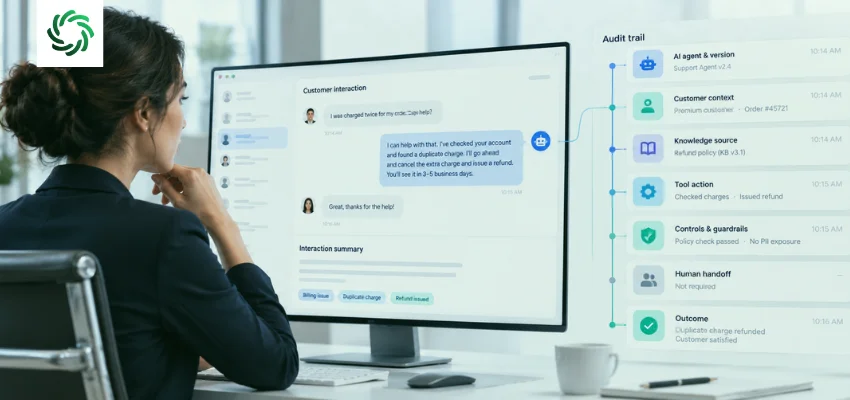
](/okf/article/ai-agent-audit-trail-contact-centers.md)### [ Reconstruct a Disputed Customer Interaction with Your AI Agent Audit Trail ](/okf/article/ai-agent-audit-trail-contact-centers.md)
September 28, 2026
[ Read More » ](/okf/article/ai-agent-audit-trail-contact-centers.md)
[
](/okf/article/automated-call-scoring-software-ai-qms.md)### [ How Automated Call Scoring for Contact Centers Works and Where It Fits? ](/okf/article/automated-call-scoring-software-ai-qms.md)
September 25, 2026
[ Read More » ](/okf/article/automated-call-scoring-software-ai-qms.md)
[
](/okf/article/ai-agent-call-resolution-quality-metrics.md)### [ How to Measure AI Agent Resolution Quality in Customer Service? ](/okf/article/ai-agent-call-resolution-quality-metrics.md)
September 21, 2026
[ Read More » ](/okf/article/ai-agent-call-resolution-quality-metrics.md)
« Previous[Next »](https://www.theaiqms.com/wp-cron.php/page/2/?doing_wp_cron=1792045217.0146169662475585937500)
---
## Company
About Us# Smarter Quality. Trusted Innovation. Real Impact.
Built on 20+ years of contact center expertise, AIQMS by Omind.AI transforms how global teams measure, manage, and improve performance.
[Schedule a Demo ](/okf/page/schedule-a-demo.md)
## Redefining Quality Assurance Through
Human-Centered Intelligence
At Omind.AI, our mission is to transform how organizations measure, manage, and improve customer interactions through intelligence that understands people — not just processes. Our vision is simple yet ambitious: to bring empathy, accuracy, and human connection back to every quality touchpoint in a digital-first world.
### 100%
Interactions Auto-Scored
### 1.5×
QA Productivity Gain
### +20%
CX Score Improvement

Built on the belief that traditional QA often misses the human element, Omind.AI developed AIQMS, an intelligent quality management platform that unifies auditing, analytics, and coaching in one system. Powered by AI, machine learning, and automation, it ensures every conversation is reviewed with both precision and understanding — blending technology with emotional awareness.
We believe true innovation lies in balance — where automation amplifies empathy and analytics strengthen relationships. AIQMS by Omind.AI helps contact centers, BPOs, and global enterprises deliver AI-powered quality assurance that’s not only data-driven but deeply human, turning every interaction into an opportunity for connection, trust, and measurable growth.
-

#### Our Mission
To harness the full potential of Al to empower businesses of all sizes to thrive in the rapidly evolving digital landscape.

#### Our Mission
To be the leading Al provider, driving positive transformation in industries worldwide. We envision a future where intelligent technologies are seamlessly integrated into business operations, enhancing efficiency, fostering innovation, and contributing to the overall betterment of society.

## Core Value That Drive Us
Our principles define how we innovate, collaborate, and support the businesses that trust us. They shape every product, every decision, and every experience we deliver.

#### [ Innovation](#)
We believe progress begins with curiosity. Our teams constantly explore new ideas, tools, and techniques to deliver cutting-edge AIQMS software that evolves with our customers’ needs.

#### [ Ethical AI](#)
We build responsible technology. Every solution we create prioritizes fairness, transparency, and accountability, ensuring that AI works ethically for every organization and every user.

#### [ Collaboration](#)
Our clients are partners, not projects. We listen deeply, understand challenges, and deliver AI call center QA solutions that create measurable impact and long-term value.

#### [ Customer-centricity](#)
We thrive on teamwork. By fostering an inclusive, diverse culture, we bring together brilliant minds who work collectively to achieve meaningful innovation.

#### [ Agility](#)
In a fast-changing market, adaptability matters. We stay nimble, responding quickly to emerging technologies, evolving needs, and new opportunities to serve our customers better.
## Our Business Principles
Every product we design and every service we deliver reflects our unwavering commitment to quality, integrity, and responsibility.

## [User-Centric Design](#)
Our solutions start with the user in mind. From intuitive dashboards to seamless workflows, every feature in AIQMS is designed for ease, efficiency, and real-world usability.

## [Data Security & Privacy](#)
We protect what matters most. Omind.AI follows the highest data protection standards — including SOC 2, ISO 27001, and PCI-DSS — ensuring that your data remains safe, compliant, and confidential.

## [Continuous Learning](#)
We never stop evolving. Our teams stay ahead of AI innovation through ongoing research, experimentation, and collaboration — keeping AIQMS at the forefront of contact center quality management software.

## [Environmental Responsibility](#)
Sustainability is part of our mission. From energy-efficient systems to eco-conscious operations, we minimize our footprint while maximizing positive impact.

## [Community Engagement](#)
We believe in giving back. Through education, mentorship, and philanthropic initiatives, we invest in communities, helping build a more inclusive and technologically empowered future.

[](https://www.linkedin.com/in/brad-call-1400b5a/)
#### [Bradley Call](https://www.linkedin.com/in/brad-call-1400b5a/)
CEO
Operations

[](https://www.linkedin.com/in/tom-berg-367134167/)
#### [Tom Berg](https://www.linkedin.com/in/tom-berg-367134167/)
Director
Sales & Business Development

[](https://www.linkedin.com/in/tucker-toolson-9967ab111/)
#### [Tucker Toolson](https://www.linkedin.com/in/tucker-toolson-9967ab111/)
Director
Client Services

[](https://www.linkedin.com/in/manash-kundu/)
#### [Manash Kundu](https://www.linkedin.com/in/manash-kundu/)
Automation Practice Lead
Transformation
## The AIQMS Promise
We’re not just redefining quality assurance — we’re redefining trust. Every innovation in AIQMS by Omind.AI strengthens the connection between technology and humanity. Our goal is simple: to make AI-powered quality management more empathetic, more intelligent, and more impactful. With every audit, insight, and improvement, we move closer to a world where AI amplifies human understanding and transforms how organizations deliver exceptional customer experiences.
[Book a Free Demo ](/okf/page/schedule-a-demo.md)
---
## Contact Centers
100% Call Audits# Smarter Quality. Sharper Insights. Higher Revenue.
Turn every customer interaction into measurable growth with AI-driven auditing, analytics, and coaching designed for modern contact centers.
[Schedule a Demo ](/okf/page/schedule-a-demo.md)
## AIQMS for Contact Centers - Automate Quality, Accelerate Performance, Increase ROI
AIQMS by Omind.AI helps contact centers or BPOs replace manual reviews with intelligent automation that delivers measurable impact. This AI-powered call center quality management software automates audits, improves accuracy, and ensures compliance with every customer interaction. Through intuitive dashboards, real-time analytics, and actionable insights, it empowers leaders to make data-driven decisions that improve both CX and ROI. By auto-scoring 100% of calls and chats and enabling continuous coaching and feedback, AIQMS transforms quality assurance into a powerful performance and revenue engine—scaling consistency and growth across every team.
## Proven Business Impact:
Measurable Gains in Weeks
AIQMS delivers quantifiable improvements in performance, compliance, and CX
—fast enough to feel, big enough to measure.

### 77+
Clients
### 100+
Happy Employees


##### Transfer Rate Surge
Over 216% improvement through consistent feedback and targeted coaching.

##### Sales Productivity Lift
210% increase in sales per hour, proving QA automation drives revenue efficiency.

##### QA Sampling Efficiency
115% rise in weekly audits, expanding coverage without increasing QA headcount.

##### Audit-Productivity Link
Higher audit frequency directly tied to stronger agent output and better business outcomes.
## Why You’ll Love It: Accuracy That Drives Action
Experience automation that does more than audit—it builds confidence, consistency, and measurable performance.

#### Comprehensive Audit Intelligence
Capture, evaluate, and optimize every customer touchpoint for reliable, unbiased QA coverage.

#### Dynamic Dashboards & Analytics
See real-time
performance trends and decision-ready insights in one unified view.

#### Continuous Coaching & Training
Deliver in-the-moment feedback that reinforces soft skills and ensures compliance.

#### Fair, Randomized Evaluations
Randomized, balanced evaluations that promote transparency and trust across QA programs.
## Benefits That Redefine Contact Center QA
AIQMS replaces outdated manual processes with smart automation, helping teams build scalable, data-driven quality systems.

#### [ Enhanced Compliance Precision ](#)
AI-driven checks
ensure every interaction aligns with policy and service standards.

#### [ Improved Agent Performance](#)
Real-time analytics pinpoint improvement areas, while coaching boosts skill mastery and morale.

#### [ Optimized
Process Flow ](#)
Automated workflows
remove redundancy, saving time and enhancing audit accuracy.

#### [ Actionable Insights That Matter ](#)
Transform raw
QA data into clear, actionable next steps that improve CX daily.


## Unlock Consistent Quality. Transform Your Contact Center with AI QMS
See how AIQMS by Omind.AI automates audits, improves agent performance, and delivers measurable CX gains across every customer interaction.
[Schedule a Demo ](/okf/page/schedule-a-demo.md)
## Insights That Power Better CX
Read expert opinions and practical guides on AI QA for contact centers, automation trends, QA reporting, and real-time agent coaching that redefine modern customer experience.

[ October 12, 2026](#)#### [Call Center Quality Assurance Best Practices That Improve QA Results](/okf/article/qa-best-practices-call-center-success-scalable-processes.md)

[ October 9, 2026](#)#### [Call Center Quality Assurance Software for Accurate and Actionable QA](/okf/article/ai-call-center-quality-assurance-software.md)

[ October 6, 2026](#)#### [Quality Management Software Built for Multi-client BPO Operations](/okf/article/qms-management-software-bpo.md)
[Explore the blog ](/okf/page/blog.md)
## Frequently Asked Questions (FAQs)
We’ve gathered the top questions from contact center leaders exploring automation, compliance, and AI-powered QA transformation.
#### What is AIQMS for contact centers?
AIQMS by Omind.AI is an AI-powered contact center quality management platform that automates audits, ensures compliance, and enhances agent performance. It transforms manual QA into a data-driven system that boosts customer satisfaction, accuracy, and operational efficiency.
#### How does AIQMS improve auditing accuracy?
The platform replaces random sampling with automated, full-scale auditing across every channel. It uses speech analytics, sentiment detection, and dynamic scorecards to improve consistency, remove bias, and ensure every interaction is scored fairly and accurately.
#### Can AIQMS enhance agent performance?
Yes. AIQMS provides real-time coaching insights and automated feedback that help agents refine tone, empathy, and communication quality. Continuous monitoring and training improve productivity, sales performance, and compliance within weeks of deployment.
#### How secure and compliant is AIQMS?
AIQMS adheres to global compliance standards, including SOC 2, PCI-DSS, and ISO frameworks. It maintains end-to-end encryption, detailed audit logs, and permission-based access—ensuring full data security and accountability for contact centers of any size.
#### What measurable improvements can contact centers expect?
Typical outcomes include **1.5× QA efficiency**, **+20% CX improvement**, and **60% fewer escalations** within the first month. Teams also achieve higher compliance scores and more accurate audit reporting through automated, bias-free quality management.
---
## Enterprises
Enterprise-wide Industry Coverage# Smarter Quality. Global Consistency. Proven Results.
Power enterprise-wide visibility with AI-driven auditing, analytics, and coaching that strengthen compliance, performance, and customer experience at scale.
[Schedule a Demo ](/okf/page/schedule-a-demo.md)
## AIQMS for Enterprises: Automate Quality, Drive Performance, and Ensure Compliance
AIQMS by Omind.AI helps enterprises unify quality management across global operations. It automates audits, ensures compliance, and delivers actionable insights for leaders managing multiple teams, geographies, and languages. As an AIQMS software built for enterprise-scale performance, it integrates seamlessly with CRMs, contact center platforms, and compliance systems. From auto-scoring 100% interactions to tracking QA workflows and agent coaching, AIQMS enables organizations to make data-driven decisions that enhance CX, governance, and operational precision worldwide. Trusted by enterprises across industries — including Retail & Ecommerce, BFSI, Healthcare, Travel & Hospitality, Telecom, Utilities, and more.
## Measured Business Impact: Enterprise Results
That Speak in Numbers
AIQMS delivers quantifiable impact for enterprise CX and quality operations—turning QA into a growth driver.

### 77+
Clients
### 100+
Happy Employees


##### QA Efficiency Gains
115% higher audit throughput with automated workflows and data-driven evaluations.

##### CX Score Growth
+20% improvement in customer experience across global service channels.

##### Compliance Accuracy
85%+ accuracy improvement through AI-powered checks and smart scorecards.

##### Performance Lift
210% boost in productivity and sales outcomes within 8 weeks of deployment.
## Why You’ll Love It: Smarter QA,
Global Scale, Real Results
AIQMS simplifies complexity—bringing automation, analytics, and accountability together for organizations that demand precision, performance, and measurable outcomes.

#### Centralized Audit Intelligence
Manage global QA from one unified system with real-time visibility and control.

#### Predictive Dashboards & Insights
Identify compliance gaps and performance trends before they affect outcomes.

#### Continuous Coaching Enablement
Empower teams with consistent feedback and structured learning at scale.

#### Randomized Audit Allocation
Ensure unbiased evaluation & balanced audit distribution across multiple regions.
## Key Advantages: Transforming Enterprise Quality and Compliance at Scale
AIQMS helps large organizations simplify quality operations, enforce consistency, and scale compliance across every customer touchpoint.

#### [ Unified Governance Model ](#)
Standardize processes and enforce consistent QA frameworks across multiple business units.

#### [ Enhanced Transparency & Accuracy ](#)
Access real-time reports, ensuring full visibility for auditors and stakeholders.

#### [ Faster Global
Rollouts ](#)
Implement quickly across regions with plug-and-play integrations and cloud-based scalability.

#### [ Actionable Insights Engine ](#)
Use predictive analytics to align quality outcomes with business KPIs and revenue.


## Experience Scalable Quality. Schedule Your AIQMS Demo Today
Discover how AIQMS by Omind.AI empowers enterprises to automate audits, improve compliance, and deliver measurable CX excellence across industries and global teams.
[Schedule a Demo ](/okf/page/schedule-a-demo.md)
## Insight That Fuels Enterprise Innovation
Stay ahead of emerging trends in AI call center QA, automation, and compliance management. Learn how enterprise leaders use AIQMS for CX to improve customer loyalty and service outcomes.

[ October 12, 2026](#)#### [Call Center Quality Assurance Best Practices That Improve QA Results](/okf/article/qa-best-practices-call-center-success-scalable-processes.md)

[ October 9, 2026](#)#### [Call Center Quality Assurance Software for Accurate and Actionable QA](/okf/article/ai-call-center-quality-assurance-software.md)

[ October 6, 2026](#)#### [Quality Management Software Built for Multi-client BPO Operations](/okf/article/qms-management-software-bpo.md)
## Frequently Asked Questions (FAQs)
We’ve compiled the most common questions from enterprise QA and CX leaders considering AI-powered quality management.
#### What is AIQMS for enterprises?
AIQMS by Omind.AI is an enterprise-grade AI-powered quality management system that automates audits, enhances compliance accuracy, and centralizes reporting. It helps large organizations unify QA operations across regions, teams, and platforms while improving performance and customer satisfaction.
#### How does AIQMS improve compliance and accuracy?
AIQMS applies advanced algorithms to detect policy deviations, track agent adherence, and deliver consistent evaluations. Enterprises achieve higher audit accuracy and accountability while reducing manual bias and compliance risk through real-time monitoring and reporting dashboards.
#### Can AIQMS scale across multiple regions and teams?
Yes. AIQMS is designed for enterprise scalability. Its cloud-native architecture supports multilingual, multi-region environments, offering centralized dashboards, role-based access, and integration flexibility—ensuring consistent governance across global operations.
#### How long does enterprise implementation take?
Deployment is fast and secure. Most enterprise teams onboard within a few weeks, integrating with CRM and contact center systems like Salesforce, Zendesk, and Five9. AIQMS offers dedicated onboarding support to ensure seamless adoption.
#### What business outcomes can enterprises expect?
Enterprises using AIQMS report an **average 20% improvement in CX**, **1.5× faster QA efficiency**, and **60% fewer escalations** within the first 60 days. Its automation and analytics enable measurable ROI, improved compliance, and stronger customer trust.
---
## Features
Features# Smarter Audits. Clearer Insights. Better Quality.
Empower your teams with AI-driven auditing, analytics, and coaching tools that deliver consistency, accuracy, and actionable insights across every customer interaction.
[Schedule a Demo ](/okf/page/schedule-a-demo.md)
## Explore AIQMS Features: Automate Audits,
Coach Smarter, and Improve CX
AIQMS by Omind.AI transforms traditional call center quality assurance into a fully automated, data-driven experience. Built for contact centers and enterprises, this platform combines machine learning, analytics, and coaching to ensure accuracy, compliance, and performance at scale. From auto-scoring 100% interactions to real-time agent coaching and QA reporting, AIQMS simplifies complex QA workflows. It’s the most comprehensive contact center quality management software built for measurable improvement and smarter decision-making.
## Features of AI-Powered Quality Management Software

#### [ 100% Interaction
Monitoring ](#)
Review every
call, chat, and email automatically for total visibility and reliability.

#### [ Automated
Call Scoring ](#)
Replace manual sampling with AI-driven evaluations that deliver consistent and bias-free results.

#### [ Sentiment and
Emotion Detection ](#)
Analyze tone and emotion to improve empathy, engagement, and customer satisfaction.

#### [ Custom Evaluation
Criteria ](#)
Build flexible QA
scorecards that reflect your business goals and compliance standards.

#### [ Real-Time
Agent Coaching ](#)
Offer in-the-moment performance feedback to boost productivity and CX outcomes instantly.

#### [ Compliance
Risk Alerts ](#)
Detect deviations and compliance risks before they become major issues or escalations.

#### [ Robust Reporting
and SLAs ](#)
Track KPIs, SLAs, and QA workflows with dynamic dashboards and analytics tools.

#### [ Multilingual Analytics
Support ](#)
Enable AI QMS for CX across regions with multilingual transcription and evaluation capabilities.

#### [ Voice of Customer
-AI-Powered Insights](#)
Turn every audited call into structured customer intelligence. AIQMS's Voice of Customer engine creates theme-level insights from audit data & bulk-uploaded interactions.


## Advantages of AI-QMS: Real Impact You Can Measure
AIQMS delivers measurable improvements in efficiency, compliance, and customer satisfaction for contact centers and enterprises alike.

#### Scalable QA Automation
115% faster audit throughput through automation and AI-driven workflows.

#### Faster Issue Resolution
60% reduction in escalations with predictive QA alerts and real-time analysis.

#### Improved Compliance Monitoring
85% higher compliance accuracy achieved through smart scoring and alerts.

#### Consistent Agent Evaluation
100% unbiased assessments with AI-calibrated quality benchmarks.

#### Deeper Customer Insights
25% richer sentiment analytics for proactive CX optimization.

#### Enhanced Training Programs
30% improvement in agent learning outcomes with personalized feedback.

#### Boosted CSAT and NPS Scores
+20% rise in customer satisfaction through faster, smarter interventions.

#### Superior Decision-Making Capabilities
Real-time QA data accelerates strategic business and CX improvements.
## Experience Intelligent QA Automation - See It in Action
AIQMS simplifies complexity. Automate quality, empower teams, and deliver measurable performance improvements. Schedule a personalized demo and discover how AIQMS by Omind.AI transforms quality into your next competitive advantage.
[Book a Free Demo ](/okf/page/schedule-a-demo.md)

## [For Contact Centers](/okf/page/contact-centers.md)
Automate QA operations, monitor 100% of calls, and empower supervisors with **real-time agent coaching**. Build trust, accuracy, and better customer outcomes without increasing QA headcount.

## [For Enterprises](/okf/page/enterprises.md)
Unify quality operations across global teams. Ensure consistency, compliance, and scalability for Retail & Ecommerce, BFSI, Healthcare, Travel & Hospitality, Telecom, Utilities, and more.
## Insights That Shape Smarter Quality
Explore expert insights on AI call center QA, QA reporting, auto-scoring calls & chats, and agent coaching — designed to help teams deliver better customer experiences every day.

[ October 12, 2026](#)#### [Call Center Quality Assurance Best Practices That Improve QA Results](/okf/article/qa-best-practices-call-center-success-scalable-processes.md)

[ October 9, 2026](#)#### [Call Center Quality Assurance Software for Accurate and Actionable QA](/okf/article/ai-call-center-quality-assurance-software.md)

[ October 6, 2026](#)#### [Quality Management Software Built for Multi-client BPO Operations](/okf/article/qms-management-software-bpo.md)
[Explore the blog ](/okf/page/blog.md)
## Frequently Asked Questions (FAQs)
Find answers to the most common questions about AI-powered quality
management, automation, and auditing.
#### What is AIQMS, and how does it work?
AIQMS by Omind.AI is an intelligent AIQMS software that automates audits, measures compliance, and coaches agents in real time. It evaluates 100% of customer interactions, ensuring consistent accuracy and actionable insights across voice and digital channels.
#### How accurate is AIQMS compared to manual QA?
AIQMS ensures over 85% accuracy through calibrated AI models, random sampling validation, and continuous learning. Unlike manual QA, it eliminates human bias and delivers consistent, data-backed results across teams and channels.
#### Can AIQMS support multiple languages and regions?
Yes. AIQMS offers multilingual analytics support for global operations, making it ideal for AIQMS contact centers serving diverse markets in English, Spanish, Hindi, French, and more.
#### What results can I expect after implementing AIQMS?
Most clients achieve 1.5× QA efficiency, 60% fewer escalations, and 20% higher CX scores within eight weeks. The platform automates repetitive tasks while improving compliance, accuracy, and agent engagement.
#### Is AIQMS secure and compliant with industry standards?
Absolutely. AIQMS follows SOC 2, PCI-DSS, and ISO 27001 standards. It includes encryption, audit trails, and access control, ensuring enterprise-grade security and regulatory compliance for contact centers and enterprises.
---
## Home
AI-powered Quality Assurance# Empower Quality. Boost Performance. Transform CX.
Redefine performance with AI Call Center Quality Management Software that automates auditing, delivers precision analytics, and provides real-time coaching insights to improve compliance, agent productivity, and customer satisfaction at scale.
[ Explore Features ](/okf/page/features.md) [ Schedule a Demo ](/okf/page/schedule-a-demo.md)


### 100%
Interactions Auto-Scored
### 1.5×
QA Productivity Gain
### +20%
CX Score Improvement

## AI-powered Quality Management - Automate Audits, Improve Accuracy, and Drive Results
AIQMS by Omind.AI is an AI quality management software built for contact centers, BPOs, and enterprises that need faster, smarter, and more accurate quality assurance. It replaces manual QA processes with AI-driven automation, real-time analytics, and actionable coaching insights. As an AI quality management software for call centers, it auto-scores 100% of customer interactions, generates intelligent QA scorecards, & helps teams improve compliance, agent performance, and customer experience at scale. From reducing audit workloads to delivering consistent evaluations and operational visibility, AIQMS empowers businesses to drive measurable quality improvements across every customer conversation.
-
## Trusted by Contact Centers &
Enterprises Worldwide
AIQMS powers quality management for BPOs, enterprises, and contact centers across industries.


## Built for QA Leaders Who Demand
Precision at Scale
AIQMS brings together automation, analytics, and agent coaching into a single ecosystem—helping teams reduce manual effort, improve decision-making, and accelerate CX transformation.

#### Automated 100% Auditing
Score every call
and chat instantly for full transparency and consistent quality.

#### Intelligent Dashboards & Insights
Visualize performance
data and compliance metrics in one smart, intuitive interface.

#### Real-Time Coaching Tools
Identify gaps mid-conversation and empower agents with timely, actionable guidance.

#### Fair, Randomized Evaluations
Ensure unbiased assessments that strengthen trust and drive continuous improvement.
## Manual QA misses 98% of what matters.
AIQMS misses nothing.
Every conversation scored. Every compliance risk surfaced. Every coaching moment captured
— the AI-powered quality management system built for enterprise scale.
## What QA & Operations Leaders Say
About AI-QMS
Real outcomes from contact centers and BPOs that replaced manual QA with AIQMS.
### Revamped our QA approach
AIQMS has enabled us to identify areas requiring focus and determine the best methods to address them.
#### — Caroline Loor
President - Flinsco
### 100% call coverage from day one
We went from sampling 5% of calls to auditing 100% overnight. The coaching dashboard alone cut our QA team’s reporting workload in half.
#### — Head of Quality Assurance
Mid-Market BPO, 800-seat contact center
### Compliance gaps caught in 30 days
AI-QMS identified compliance gaps our manual process was missing entirely. Within 30 days we saw a measurable improvement in agent scoring consistency across all shifts.
#### — VP of Contact Center Operations
Enterprise Telecom Client
## Measurable Impact That Drives
Real Business Results
AIQMS turns quality management into a measurable performance engine
—tracking results, trends, and ROI in real time.


#### QA Productivity Gains
1.5× increase in completed audits through automation and streamlined QA workflows.

#### [CX Score Growth](#)
+20% boost in customer satisfaction with data-led coaching and engagement insights.

#### [Escalation Reduction](#)
60% fewer complaints due to early detection and proactive performance management.

#### [Faster Compliance Reviews](#)
+115% audit accuracy improvement with automated QA scorecards and dashboards.
## Who AI-QMS Is Built For
From QA managers to C-suite leaders, AIQMS gives every stakeholder the visibility and control they need.

#### [ QA Managers Automate audit workflows](#)
Eliminate sampling bias, and score 100% of interactions with consistent, configurable scorecards.

#### [ Contact Center Supervisors Spot](#)
Coaching opportunities in real time, track agent improvement over time, and reduce escalations before they reach the customer.

#### [ Operations Leaders Reduce QA overhead](#)
Standardize processes across teams and locations, and get consistent audit outcomes at any scale.

#### [ CX and C-Suite Leaders Connect](#)
QA scores to CSAT, NPS, and revenue data. Get board-ready reporting that ties quality investment to business outcomes.

## [For Contact Centers](/okf/page/contact-centers.md)
Empower QA, operations, and CX leaders with contact center quality management software that enhances consistency, accountability, and real-time coaching—driving measurable improvements in every interaction.

## [For Enterprises](/okf/page/enterprises.md)
Achieve organization-wide visibility, accuracy, and governance with AIQMS for CX. Standardize auditing, streamline reporting, and maintain compliance across teams, languages, and global operations effortlessly.
## Insights That Power Better CX
Read expert opinions and practical guides on AI QA for contact centers, automation trends, QA reporting, and real-time agent coaching that redefine modern customer experience.

[ October 12, 2026](#)#### [Call Center Quality Assurance Best Practices That Improve QA Results](/okf/article/qa-best-practices-call-center-success-scalable-processes.md)

[ October 9, 2026](#)#### [Call Center Quality Assurance Software for Accurate and Actionable QA](/okf/article/ai-call-center-quality-assurance-software.md)

[ October 6, 2026](#)#### [Quality Management Software Built for Multi-client BPO Operations](/okf/article/qms-management-software-bpo.md)
[Explore the blog ](/okf/page/blog.md)
## Frequently Asked Questions (FAQs)
Explore the most common questions teams ask about AI-powered quality management and how AI-QMS by Omind.AI helps improve accuracy, compliance, and customer experience.
#### What is AIQMS?
AIQMS is an AI-powered quality management software for call centers, BPOs, and enterprise support teams. It automates QA workflows by auto-scoring 100% of customer interactions and helps organizations improve agent performance, monitor compliance, reduce manual audits, and enhance customer experience through real-time analytics and intelligent coaching insights.
#### What makes AIQMS different from traditional QA tools?
Traditional QA systems depend on manual sampling. AIQMS auto-scores 100% of calls and chats, providing consistent accuracy and deeper insights. It combines automation with human validation, ensuring fairness, transparency, and measurable impact across your QA workflows.
#### How does AIQMS enhance agent performance?
Through real-time agent coaching, AIQMS identifies key skill gaps and delivers contextual feedback during conversations. This accelerates learning, increases confidence, and improves empathy—helping agents perform better and deliver superior customer experiences consistently.
#### How secure and compliant is AIQMS?
AIQMS follows global compliance frameworks, including SOC 2, PCI-DSS, and ISO standards. It provides full audit trails, encryption, and data governance—ensuring all customer interactions are analyzed securely within your organization’s compliance boundaries.
#### How accurate is AI-powered call scoring in AIQMS?
AIQMS enables up to 100% interaction auditing across voice and chat channels, helping contact centers move beyond limited manual call sampling. Teams gain broader visibility into agent performance, compliance risks, and customer experience trends at scale. Since scoring requirements vary by business, booking a [personalized demo](/okf/page/schedule-a-demo.md) is the best way to see how AIQMS fits your QA process.
---
## Privacy Policy
Committed to the Best Data Security Practices
Omind is a brand name for Omind Technologies Pvt Ltd and takes special care of data security and privacy for subscribers and visitors to our website. We are focused and implementing the same data privacy protection on any of our future digital platforms, applications, subdomains, etc.
This Privacy Policy notice describes the privacy and data security practices that Omind Technologies implements in regard to its services and visitor confidentiality. It also elaborates on the privacy principles, data collection, compliance, clients’ data, etc.
## Privacy Principles
Omind has strict adherence to the following principles of data privacy.
- We collect ‘as much personal information as required to offer our services.
- We do not use any personal information other than the ones we specify in this Privacy Policy, unless you (the client, visitor, or user) agree.
- We do not store any personal information once we no longer need them.
- We do not share any personal information with third parties, except the ones specified in this Privacy policy.
### What Information Do We Collect?
#### Visitors
Our collection of data depends on how the visitors use our website.
- In case of registration for any event or obtaining content or information, we collect only the contact information (including emails), which allows us to fulfill the visitors’ requests.
- We may also use cookies, or other related technologies to collect or/and manage information directly from the visitors’ computer and store it in log files. Such information may include the visitors’ IP address, ISP (internet service provider), referring and exit pages, browser, operating system, clickstream data, and date/time stamp. We use such information to manage and enhance our website, analyze customer/market trends, gather demographic information that is non-identifiable, and also track the movement of the visitors around the website.
#### Users
- At the time of registering with Omind, we need/collect information, including the name of the user, name, and size of the concerned organization, job, title, type of business, email address, and contact number.
- We also collect billing addresses and credit card information if the user signs up for our product
### How Do We Use the Information?
#### Visitors
- We collect the information from visitors and use it for various purposes, which may include market research.
- We may share the information with third parties for various business and marketing purposes.
- We collect/store information from job applicants for recruitment purposes. We may also store/retain your data for a considerable period of time, which allows us to consider the applicant for any future openings with us.
- Omind does not share visitor information/data with any other parties, other than the ones mentioned in our Privacy Policy. We will not sell or exchange any of the visitors’ information with any third parties without the consent of the visitor concerned.
- In case of registration for any event or conference co-hosted by Omind and any of our partners/sponsors/vendors/clients, we may share the visitor information with the partners/sponsors/vendors/clients.
- Please check the privacy notice of our partners/sponsors/vendors/clients to know more about they collect/share/use the information. Omind is not liable for any data breach from the side of the partners/sponsors/vendors/clients.
- We will share your personal information/data stored with us to respond to any legal proceedings, investigations, court orders, or to investigate suspected fraud, illegal activities, or any situation that may lead to physical, mental, or intellectual property harm to any person/organization.
- In case Omind is ordered to disclose visitors’ personal information by any competent court of law, we will notify the same to you (if the concerned jurisdiction permits us), so that you may practice your rights (if applicable) to data protection and privacy.
### Users
- Omind collects information related to availing our products/services to process and fulfill such orders, create billing data, improve services, do market research, and for certain other general purposes.
- We may share the collected information with third parties for marketing purposes.
- We will not make your information public, or share the same with any third parties except for the purposes specified in our privacy policy. We also do not sell, rent, or exchange user data with third parties without the consent of the concerned user.
- We will share your personal information/data stored with us to respond to any legal proceedings, investigations, court orders, or to investigate suspected fraud, illegal activities, or any situation that may lead to physical, mental, or intellectual property harm to any person/organization.
- In case Omind is ordered to disclose visitors’ personal information by any competent court of law, we will notify the same to you (if the concerned jurisdiction permits us), so that you may practice your rights (if applicable) to data protection and privacy.
### How May We Contact You?
Omind has strict adherence to the following principles of data privacy.
- Omind may send a welcome email once the visitor/user opts for our products/services.
- We may also send, in the form of email communications, any product/service-related announcements, newsletters, account updates, or privacy policy updates. However, consent is taken at the time of opting for our services.
- Visitors/users may choose to stop receiving product/service-related announcements, newsletters, account updates, and privacy policy updates by simply unsubscribing to our email newsletters.
### Retaining Personal Information
- Notwithstanding anything mentioned in our privacy policy, we retain visitor/user information for as long as the account is active or as much needed to fulfill the purpose of fulfilling the service for which the information has been collected or as long as applicable by law.
- We will also retain your information as and when needed to comply with legal obligations, enforce agreements, or resolve disputes.
### Cookies
We use cookies to the extent of the definition, that is, a small amount of session-based data collected by sending anonymous unique identifiers into the visitors’/users’ computer hard disk. We use both session ID and persistent cookies to fulfill the purpose each of them is for.
### Privacy Policy Updates
We may make changes and updates to our privacy policy and will intimate the same to the visitors/visitors on the email address registered with us.
Omind encourages all our visitors/users/clients/vendors/partners/sponsors to review this page periodically to be updated with our privacy and data policies
---
## Schedule a Demo
BOOK A DEMO# Schedule a Demo of AIQMS
Today for Free
Experience the future of AI quality management software. See how AIQMS software helps contact centers and enterprises automate audits, ensure compliance, and coach agents in real time to deliver measurable CX improvement.
## Book My Free Demo
Share a few quick details, and we’ll get back to you within 24 hours to schedule your personalized demo.
Your Industry \*Retail and E-commerceTravel, Hospitality and TransportBFSIHealthcareUtilityOther
No. of Employees \*1 – 500501 – 10001001 – 1000010001 +
Please leave this field empty.
Your information will be securely sent to and stored in Google Sheets for the purpose of processing your form submission.