
Why Your New Agent Onboarding QA Is Broken — And How AI Fixes It
Manual sampling reviews 2–5% of calls. That means 95% of your newest agents’ conversations go unexamined until problems become habits. AI QMS changes that math entirely.
Most contact centers don’t discover their onboarding is failing until the damage is visible — compliance scores drop, escalations climb, and customers start repeating themselves across calls. By the time supervisors have manually reviewed enough recordings to detect a pattern, the bad behaviors are already calcified into habits.
The culprit isn’t a lack of effort. It’s a structural problem: traditional quality assurance was built for a world where reviewing every interaction was physically impossible. That world no longer exists.
Why Do Traditional QA Fails New Agents?
Conventional onboarding QA works like this: supervisors or QA analysts pull a random sample of calls — typically 2 to 5 percent of total volume — score them against a static evaluation form and schedule a feedback session sometime in the following week. The intent is sound. Execution, on a scale, is a liability.
During a high-volume hiring wave, a seasonal ramp-up, or an offshore expansion, the math breaks down completely. A team of 50 new agents generating 400 calls per day produces 20,000 interactions in a single work week. Reviewing 5% of those means 1,000 calls — an impossible manual workload for any QA team, let alone one already stretched thin.
What supervisors miss in that gap: first-call script deviations that go uncorrected, mandatory compliance disclosures skipped under call pressure, escalation language adopted from veteran agents who’ve developed their own workarounds, and dead air patterns that signal deeper confidence or knowledge gaps.
By Week 4, what started as a correctable habit in Week 1 is now how that agent handles calls. The onboarding window — the highest-leverage moment for behavioral correction — has closed.
What AI QMS Actually Does During Onboarding
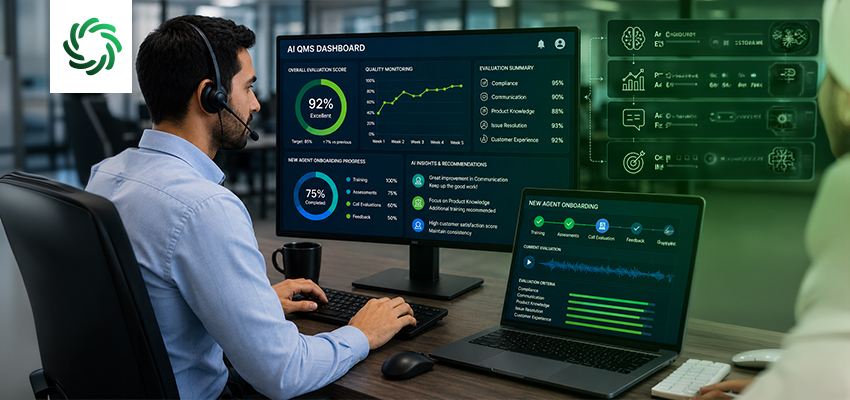
AI-powered quality management systems replace random sampling with continuous, automated evaluation across 100% of new agent interactions. Every call, every chat, every email gets scored — not by a human analyst working through a spreadsheet, but by a system trained to detect the specific behaviors that matter: script adherence, compliance language, empathy signals, escalation risk, silence patterns, and resolution behavior.
What Gets Analyzed
The depth of AI evaluation goes well beyond “did the agent follow the script.” Modern AI QMS platforms parse conversations for mandatory disclosure completion, emotional tone shifts in both the agent and customer, interruption frequency, hold time and dead air, and specific escalation keywords that historically precede complaints or transfers. Sentiment analysis flags interactions where something is going wrong before the customer explicitly says so.
Scorecards are predefined against QA frameworks — but unlike a static form, they can be customized by cohort, role, or compliance environment. A new agent handling healthcare calls gets evaluated against different benchmarks than one handling billing disputes.
The Real Cost of Delayed Feedback
There’s a counterintuitive reality in contact center onboarding: the longer it takes to surface a performance issue, the harder it becomes to correct. A new agent who skips the required disclosure on Day 3 and receives feedback on Day 21 has completed roughly 300 more calls with the same gap. The neural pathway is set.
More QA reviews don’t solve this. Doubling review volume from 5% to 10% still leaves 90% of interactions invisible — and still doesn’t deliver feedback faster. The bottleneck isn’t coverage; it’s latency. AI QMS collapses that latency to hours or less, surfing coaching opportunities while the interaction is still contextually fresh for both the agent and supervisor.
How AI Call Auditing Improves Coaching?
The coaching workflow changes fundamentally when AI handles evaluation. Instead of supervisors spending time reviewing and scoring calls, they spend time coaching — because the system has already done the triage. Automated quality management system generates prioritized coaching queues that rank new agents by urgency: who has recurring compliance gaps, who shows consistent script deviation, who is struggling with empathy language under pressure.
Compliance Detection Specifics
For regulated industries, AI call auditing provides something manual QA structurally cannot: reliable compliance monitoring at scale. The system detects whether mandatory disclosures were delivered, flags PCI-scope violations in payment conversations, identifies escalation language that signals a complaint in formation, and catches silence anomalies that often indicate agents are improvising in high-stakes moments.
These detections happen on every interaction — not the 3% that happened to get reviewed this week.
Enterprise and BPO-Specific Challenges
Offshore and distributed operations amplify every onboarding QA weakness. Inconsistent calibration across regional evaluators, time-zone delays between coaching and interaction, multilingual complexity, and high-velocity hiring cycles combine to create environments where random sampling effectively tells you nothing reliable about population-level quality.
AI QMS standardizes the evaluation layer regardless of geography. Shared scorecards, centralized QA dashboards, and AI-driven prioritization ensure that a new agent gets evaluated against the same criteria, with supervisors in either location seeing the same risk signals. Onboarding governance becomes a system, not a person.
What to Look for in an AI QMS Platform?
When evaluating AI quality management software for new agent onboarding, prioritize transparency over sophistication. Platforms that can’t explain why an interaction was flagged create more problems than they solve.
The practical checklist: full interaction monitoring across voice, chat, and email; customizable QA scorecards by cohort or role; near-real-time scoring with coaching prioritization; compliance-specific detection rules; calibration controls for supervisor alignment; and audit reporting that supports regulatory review. For BPO environments, multi-region deployment and cross-team visibility are non-negotiable.
From Quality Monitoring to Quality Intelligence
The most significant shift AI call auditing solutions enable predictive capability. As the system accumulates interaction data across an onboarding cohort. It begins identifying behavioral signals that historically precede performance problems: agents who are polite but systematically avoid resolution language, agents whose empathy scores look fine in Week 1 but deteriorate under volume pressure by Week 3.
This is the difference between quality monitoring — knowing what happened — and quality intelligence: anticipating what will happen and intervening before it does. Onboarding programs with quality intelligence improve ramp-to-proficiency and reduce compliance incidents.
Onboarding failures are often happen due to lack of visibility and delayed intervention. AI QMS closes both gaps — converting evaluation from a periodic audit into a continuous operational signal that supervisors can act on.
Stop Discovering Onboarding Problems Weeks Too Late
AIQMS helps enterprise contact centers monitor 100% new agent interactions, automate QA scoring, and raise coaching risks early.