


Is Your Contact Center QA Data Ready for AI? 9 Problems to Fix Before Automated Scoring
Contact centers usually ask the wrong question before introducing automated quality assurance. They ask: Can the platform score all our customer interactions? The harder question is: Can our contact center QA data support scores we would trust?
An AI quality-management platform can collect millions of calls, chats, emails, and messages and still produce weak operational results if the underlying interaction data is incomplete, agent identities cannot be reconciled, transcripts distort critical language, scorecard criteria are subjective, or QA findings cannot be linked to business outcomes.
Contact center QA data readiness ensures interaction data, metadata, evaluation criteria, and validation processes are complete, traceable, and reliable to support quality decisions. Before automated scoring goes live, inspect these nine failure points.
1. You Do Not Know How Much of Your Interaction Population Is Missing
Automated QA cannot evaluate interactions it never receives. In production environments, contact centers face coverage gaps caused by recording misconfigurations, failed ingestion pipeline triggers, channel exclusions, complex transfer behavior, retention rules, vendor-specific siloing, or platform migrations.
How This Breaks QA Mechanically?
Assume a contact center handles 500,000 interactions each month. The QA platform receives 465,000 and evaluates all of them, reporting 100% coverage of available interactions. However, 35,000 conversations are absent.
If those missing interactions are concentrated in a specific BPO vendor, transfer type, or high-risk workflow, the resulting QA metrics are systematically biased. Operations may believe a team has zero compliance issues simply because the non-compliant interactions were dropped before ingestion.
Readiness Test
Calculate the exact data flow across every segment:
Run this calculation across voice, chat, email, queue, site, vendor, and language parameters. If your team cannot quantify the missing population, true QA coverage across contact center interactions remains unknown.
2. The Same Agent Has Different Identities Across Your Systems
Automated QA fails when the system cannot reliably link an interaction to the specific agent who handled it. The issue is rarely a lack of identifiers, but rather an excess of disconnected ones:
- Telephony extension numbers
- CRM email handles
- Workforce Management (WFM) employee IDs
- Quality management system usernames
- Vendor-specific BPO tracking codes
How This Breaks QA Mechanically
If an agent handles 800 interactions, but incomplete identity mapping assigns 520 to their primary profile, 180 to a retired ID, 60 to a shared ID, and leaves 40 unmapped, the QA platform will still output a score. However, that score misrepresents the agent’s real performance. Building targeted coaching plans or performance incentives on this distorted data turns a technical mapping error into an operational dispute.
Readiness Test
Audit your identity pipeline against these criteria:
- Can every handling agent be uniquely identified and reconciled across QA, CRM, and WFM systems?
- Are historical identifier changes preserved during platform updates?
- Do multi-agent transfers accurately attribute specific segments to the correct individual?
3. Your Metadata Is Too Incomplete to Explain Why Quality Changed
While transcripts record the dialogue, metadata provides the operational context. Without reliable metadata, teams can detect quality spikes or dips but cannot isolate the root cause.
How This Breaks QA Mechanically
When automated QA flags a sudden spike in identity verification failures, leadership needs to know where the failure is occurring. If the metadata layer lacks structural tags for vendors, queue, or policy version, operations must manually review recordings to reconstruct the context—nullifying the efficiency gain of automation.
Readiness Test
Select ten historical operational incidents (e.g., a drop in first-contact resolution) and verify whether your existing metadata allows you to segment the affected population by team, policy version, or product type without manual intervention.
4. Transcripts Are Readable but Not Reliable Enough for the Criteria Being Scored
A transcript does not need to be completely garbled to wreck automated scoring; it only needs to fail on high-stakes terms. A single misheard word—such as transcribing “I can waive that fee” instead of “I can’t waive that fee”—completely inverted the operational truth of an interaction.
Do Not Rely on Generic Accuracy Metrics
An overall Word Error Rate (WER) of 95% is misleading if the missing 5% contains critical business logic:
- Negations (can vs. cannot)
- Financial values and fee structures
- Mandatory regulatory disclosures
- Customer account numbers
- Speaker attribution tags
Readiness Test
Assemble a representative validation test set containing noisy audio, diverse regional accents, crosstalk, transfers, and technical product terms. Test whether speech-to-text errors materially alter pass/fail outcomes on critical scorecard items.
5. Your QA Scorecard Was Written for Humans, Not Repeatable Evaluation
Legacy scorecards are filled with subjective criteria such as “demonstrated empathy,” “took ownership,” or “maintained a professional tone.” Human reviewers rely on implicit context to score these items, often arriving at different conclusions. Automating vague language scales that inconsistency across 100% of your interactions.
Convert Subjective Criteria into Observable Evaluation Logic
Replace subjective terms with explicit, observable indicators:
- Legacy Criterion: “Agent showed ownership.”
- Structured Evaluation Logic: “When the customer reports an unresolved issue, the agent confirms responsibility for the next action, states explicit clear resolution steps, and refrains from redirecting the customer without a warm handoff.”
Readiness Test
Review your primary scorecard questions. If three experienced QA evaluators cannot independently agree on the exact evidence required to pass or fail a line item, rewrite the criterion before feeding it into an automated engine.
6. Voice, Chat, Email, and Messaging Do Not Share the Same Data Model
Omnichannel QA fails when platforms attempt to force non-voice interactions into a voice-centric data structure. Each interaction channel operates under distinct mechanics:
- Voice: Dependent on continuous audio, speaker turn-taking, acoustic pauses, silence, and overtalk.
- Chat: Defined by discrete message timestamps, concurrent session handling, agent response latency, and bot-to-human handoffs.
- Email & Messaging: Asynchronous payloads requiring multi-thread linking and extended response windows.
How This Breaks QA Mechanically
Applying a unified criterion like “responded promptly” across all channels distorts performance metrics. Promptness on a voice call is measured in seconds, live chat in tens of seconds, and email in hours. Scoring logic must account for channel-specific context rather than applying rigid baseline assumptions.
Readiness Test
Audit your scorecards to verify that every evaluation rule is explicitly tagged as channel-independent or channel-specific. Ensure the ingestion pipeline preserves message sequencing and latency metadata for asynchronous digital channels.
7. QA Scores Cannot Be Connected to Customer or Business Outcomes
A quality score is an intermediate operational metric. If an agent’s score drops from 92 to 86, operations must understand the downstream business impact.
How This Breaks QA Mechanically
If QA detects widespread failure on a criterion like “confirmed caller mailing address,” and the team spends hundreds of coaching hours correcting it without tracking downstream metrics, they cannot verify if the effort reduced repeat calls or costly re-shipped orders. QA becomes an isolated score-generating engine rather than an operational improvement driver.
Readiness Test
Map your top five evaluated QA behaviors directly to downstream operational metrics:
- Disclosure compliance Regulatory exposure / Fine risk
- First-contact resolution behavior 30-day repeat contact rate
- Clear next steps Escalation & transfer rate
If your QA platform cannot join interaction data with CRM or operational outcome records, establish these data linkages before deploying automated scoring.
8. You Do Not Have a Representative Validation Set for Calibration
Testing an AI QA system on a small sample of clean, ideal calls yields false confidence. Production environments present complex edge cases that routinely degrade automated model performance.
Building a Robust Validation Set
A production-ready validation dataset must intentionally include difficult edge cases:
- High-risk regulatory interactions and compliance disclosures
- Code-switching and heavy background noise
- Over-talk, frequent transfers, and long hold times
- Historical QA cases that triggered agent disputes or calibration disagreements
Readiness Test
Compare automated evaluations against calibrated human reviews across a dataset of at least 1,000 to 2,000 diverse interactions. Document the exact variance:
Do not settle for a high-level agreement percentage. Identify precisely where the system failed, why it failed (e.g., transcript error, vague rule, model misinterpretation), and the operational risk if that error reaches production.
9. Nobody Has Defined What “Ready for Production” Actually Means
Without predefined performance gates, pilot deployments stall in perpetual testing or launch prematurely, exposing the organization to operational friction.
Defining Production-Readiness Gates
Set hard numerical thresholds across critical operational parameters before running a pilot:
Readiness Test
Draft a formal acceptance matrix with your QA, Operations, and Compliance leaders. Require explicit sign-off on the exact conditions that permit automated scores to drive coaching, performance metrics, or vendor governance.
Contact Center QA Data Readiness Framework
Use this evaluation matrix to categorize your organization’s current data posture:
How to Execute a QA Data Readiness Audit?
- Focus on One High-Value Use Case: Begin with a defined scope, such as AI QMS for HIPAA-Compliant Call Monitoring, rather than attempting to automate all operational workflows simultaneously.
- Trace the Full Data Lineage: Audit the complete technical path:
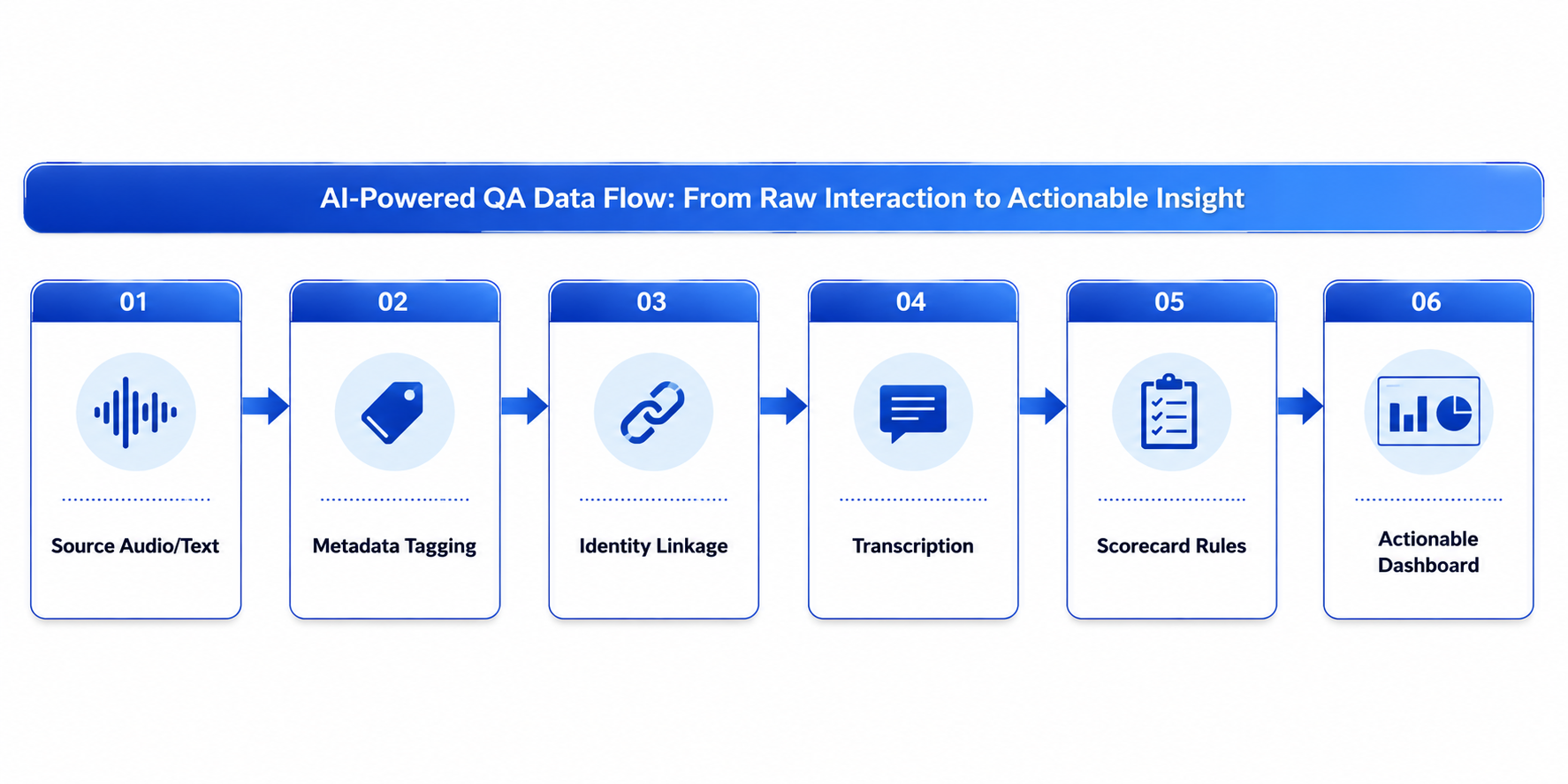
- Classify Variance by Operational Risk: A minor scoring error on a greeting protocol is low risk; a missed financial disclosure is critical. Prioritize calibration efforts around regulatory and high-friction interactions.
- Establish Audit Safeguards: Implement human-in-the-loop workflows for disputed scores, low-confidence automated evaluations, and edge-case reviews.
Data Readiness Enables Scale
Deploying call center quality monitoring software on top of messy interaction data, ambiguous scorecards, and disconnected agent identities simply scale operational errors. Before deploying real-time AI tools, the platforms must structure their forms to support automated call evaluation rules and NLU models.
When interaction data is complete, metadata is structured, and scorecard logic is calibrated, automated evaluation transforms quality management from a retrospective sampling process into a strategic operational advantage.
Is Your Contact Center Data Truly Ready for AI Scoring?
Avoid scaling operational errors, flawed agent identities, and miscalculated scores. Get a comprehensive evaluation of your interaction data, ASR accuracy, and metadata schemas before taking automated scoring live.