


Contact Center Quality Assurance Software That Turns QA Data into Real Operational Change
Most contact center quality assurance tools are built to measure—not to change. They generate dashboards packed with scores, trends, and heat maps, but leave operations teams with the same question they started with: what do we actually do about this? The gap between QA insight and corrective action is costing contact centers time, money, and compliance exposure every single day.
This guide is for quality leaders, BPO operators, and contact center executives who are done collecting data and ready to act on it. We’ll cover what modern contact center quality assurance software must do—not just in theory, but in real operations where consistency, compliance, and coaching speed are non-negotiable.
Here’s the reality: the best QA software doesn’t just track scores. It closes the loop between insight and corrective action—automatically, at scale, across every interaction your agents handle.
What Contact Center Quality Assurance Software Truly Means?
Contact center QA has moved past manual scorecards. In a high-volume environment, the old model of random sampling is a failure; reviewing 1–2% of calls means you are flying blind 98% of the time. This “luck of the draw” approach leads to inconsistent scoring and missed compliance risks.
Modern QA software uses AI to automate the audit of up to 100% of interactions. It replaces human bias and gut feelings with standardized data.
To be effective, the software must solve three specific problems:
Subjectivity: Eliminating inconsistent scores between different reviewers.
Scale: Removing manual bottlenecks that prevent total coverage.
Risk: Identifying compliance violations in real-time before they escalate.
The Core Problems With Traditional QA in Contact Centers
Before evaluating any software solution, it helps to name the failures clearly. Traditional QA systems don’t just have inefficiencies—they have structural flaws that compound over time.
Random Sampling Creates Blind Spots
When your QA process only reviews 2–5% of interactions, the other 95–98% are invisible. High-risk conversations—a compliance breach, a threatening customer, a script deviation on a regulated disclosure—can go entirely undetected. You’re not managing quality; you’re sampling it and hoping for the best.
Subjective Scoring Undermines Coaching
Human evaluators bring bias, fatigue, and interpretation variance to every scorecard. Two analysts reviewing the same call will often disagree—and when agents are coached based on inconsistent scores, trust in the QA process erodes. Coaching loses credibility before it even begins.
Fragmented Data Creates Disconnected Insights
Most legacy QA systems don’t connect to CRM, WFM, or compliance platforms. QA lives in a silo—separate from performance data, separate from HR workflows, separate from the systems where corrective action actually happens. Insights don’t travel. Problems persist.
Manual Workflows Slow Corrective Action
From review to coaching to follow-up, traditional QA involves multiple manual steps, handoffs, and approvals. By the time an agent receives feedback, the behavior in question may have happened hundreds more times. The lag between detection and correction is where performance loss—and compliance risk—compounds.
AI-powered Quality Assurance Software: What Works and Why
AI-powered contact center quality assurance software is defined by what it can change. Here are the capabilities that drive real operational impact:
- Automated Full-Coverage Scoring: The shift from sampling to full-coverage scoring is perhaps the most significant capability in modern QA software. AI can evaluate every call, chat, and email against your defined criteria—consistently, simultaneously, at scale. Nothing is invisible. Every interaction becomes a data point, and every risk is surfaced.
- Conversational Summarization and Tagging: Effective AI QA systems don’t just score—they comprehend. Natural language processing extracts key topics, sentiment, intent, and outcomes from each interaction. Tagging and summarization make it possible to surface patterns across thousands of conversations without manual review.
- Real-Time Compliance Auditing and Alerts: Instead of catching compliance failures in a weekly batch audit, real-time monitoring flags deviations as they happen. Supervisors receive alerts. Agents receive immediate guidance. Compliance risks are addressed before they become incidents—or regulatory findings.
- Role-Based Dashboards That Drive Action: The best QA platforms surface the right information to the right person. Agents see their own coaching recommendations. Supervisors see team performance patterns. Leadership sees compliance trends and operational KPIs. Dashboards that are designed for action—not just observation—are what separate modern QA software from legacy tools.
- Automatically Generated Coaching Actions: Perhaps the most operationally transformative feature: coaching workflows that are triggered by QA findings, not by manual review queues. When a QA score drops below threshold or a compliance flag is raised, the system can automatically generate a coaching task, assign it to the relevant supervisor, and track completion. This closes the loop between insight and action without relying on human memory or manual follow-through.
Call Center Compliance Auditing and Risk Detection
Compliance is not a background function—it’s a frontline risk. In regulated industries, a single non-compliant call can trigger a regulatory investigation, a customer dispute, or significant financial liability. Contact center quality assurance software must treat compliance as a first-class concern, not an afterthought.
Real-Time Compliance Scoring vs. Batch Audits
Traditional batch auditing reviews calls after the fact—often days after the interaction occurred. This means compliance failures are discovered after the damage is done. Real-time compliance scoring evaluates interactions as they happen, giving supervisors the ability to intervene during live calls or immediately after.
Automatic Detection of Risky Conversations
AI can be trained to recognize compliance triggers: specific disclosures not made, prohibited language used, script deviations on regulated scripts, or sentiment patterns that signal a customer dispute. These interactions are automatically flagged for human review, with the relevant section of the call surfaced for the evaluator.
Audit Trails for Internal and External Reviews
Regulatory reviews require documentation. QA software that maintains a complete, searchable audit trail—showing what was reviewed, when, by whom, and what action was taken—provides the evidentiary foundation that compliance and legal teams need during audits or disputes.
How AI QA Software Helps BPOs and Global Contact Centers
For global BPOs and multi-site contact centers, quality assurance introduces a unique challenge: how do you maintain consistent quality standards across teams in different countries, time zones, and cultures—without either over-standardizing or losing local nuance?
AI-powered QA software is particularly powerful in this context because consistency is built into the model, not dependent on individual evaluators.
Multi-Language Scoring Consistency
Modern AI QA platforms support multilingual scoring—evaluating call quality in Spanish, Tagalog, Portuguese, Hindi, and other languages used across global delivery centers. This means quality standards are no longer limited to English-speaking markets or dependent on bilingual QA staff.
Uniformity Across Hubs
Whether you run delivery centers in the Philippines, LatAm, India, or Eastern Europe, AI QA software applies the same scoring rubric everywhere. Leadership gets a single, unified view of quality performance across the enterprise—making it possible to identify site-level or team-level gaps and intervene proactively.
Coaching Effectiveness Across Cultures
Effective coaching isn’t one-size-fits-all. The best QA platforms allow regional customization of coaching templates and communication norms while maintaining consistency in the underlying performance criteria. This makes coaching feel locally relevant and globally consistent at the same time.
Operational KPIs Improved by Automation
BPOs implementing AI QA automation typically see measurable improvements across key metrics: reduced QA analyst workload (time redirected from scoring to coaching), faster time-to-feedback for agents, reduced repeat errors, improved CSAT scores, and lower compliance escalation rates. The ROI case for AI QA is operational, not hypothetical.
Must-Have Features Checklist for Contact Center QA Software
When evaluating contact center quality assurance software, feature lists can be misleading. The right question isn’t “does this software have AI?”—it’s “does this software do what we operationally need?”
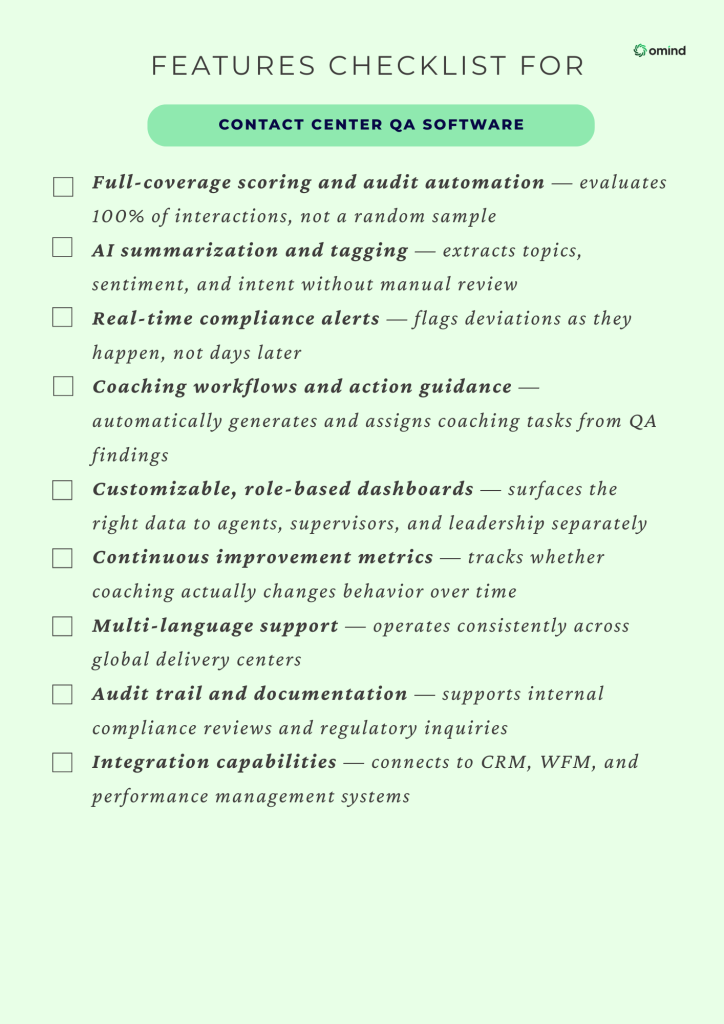
If a platform you’re evaluating can’t demonstrate each of these capabilities with specific feature documentation or live demos, push harder. These aren’t wish-list items—they’re functional requirements for operating a modern contact center.
Implementation Best Practices: Getting QA Software Right From Day One
Even the best contact center QA software fails if implementation is rushed. Adoption challenges and legacy system entanglement are the two most common reasons QA transformations stall. Here’s a practical path that avoids both.
Week 1–2: Foundation and Data Audit
Before going live, map your existing QA criteria to the new platform’s scoring framework. Identify which compliance rules need to be configured. Audit your current data sources and integration points—CRM, telephony platform, workforce management—and establish what will feed into the QA system. Resist the temptation to go live before these foundations are in place.
Week 3–6: Pilot and Calibration
Run a controlled pilot with a representative subset of agents and interactions. Compare AI scores against human evaluator scores on the same calls—this calibration step surfaces where scoring criteria need refinement and where the AI model needs adjustment. Don’t skip this phase; it’s where trust in the system is built or lost.
Month 2–3: Coaching Workflow Integration
Begin connecting QA findings to coaching workflows. Train supervisors to act on system-generated coaching tasks rather than building their own review queues. This is the operational shift that separates QA automation from QA transformation: the system tells you who needs coaching, on what, and when.
Why Modern QA Software Must Do More Than Score Calls
The contact center quality assurance software market is full of platforms that promise insight. Fewer deliver change. The distinction matters because insight without action is just expensive data storage.
The shift to AI-powered QA is no longer a future consideration—it’s a competitive necessity. Centers that continue operating with random sampling, manual scoring, and disconnected workflows will fall further behind on compliance, coaching speed, and operational consistency. The gap between visibility and action is where performance loss lives.
Intelligent QA software changes this equation. By auditing every interaction and flagging compliance risks in real time, QA becomes a system that improves the operation.
See How AI-Driven Contact Center Quality Assurance Works