

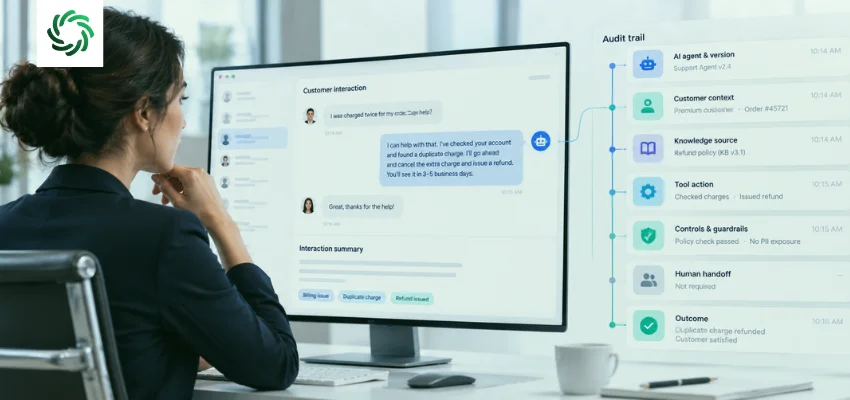
Reconstruct a Disputed Customer Interaction with Your AI Agent Audit Trail
Customer contacts support to dispute a recent change to their account. They state that during a previous session, an autonomous AI agent modified their payment schedule, altered their service tier, or canceled an upcoming appointment without explicit authorization.
Operations pull the transcript.
The transcript shows what the customer typed and what the AI replied. But when operations attempt to determine why the change occurred, the conversation log yields nothing actionable.
It does not reveal:
- Which specific AI agent or deployed prompt version processed the request
- What account state or customer profile parameters were passed to the model
- Which knowledge base version or document chunk influenced the reasoning
- Which backend tool or API endpoint was invoked
- What payload parameters were sent to that tool
- Whether the external system modification actually succeeded or silently failed
- Which guardrails, authorization policies, or approval thresholds were evaluated
- Whether the agent should have escalated to a human supervisor
- What state changes persisted in downstream systems of record
A transcript records the conversation. An AI agent audit trail must let you reconstruct the execution.
An AI agent audit trail is a linked, time-ordered record of the context, configuration, actions, controls, handoffs, and outcomes associated with a specific AI-agent interaction.
Auditability tells you whether an event can be reconstructed after the fact. It does not prove that the event was correct, compliant, safe, or high quality. Establishing this boundary early is critical: execution evidence explains what occurred, while downstream evaluation determines if the outcome was acceptable.
An AI Agent Audit Trail Reconstructs More Than the Conversation
Treating a chat transcript as an audit log introduces operational failure points into contact center investigations. High-volume customer operations rely on multiple discrete record types, each designed to answer a distinct operational question:
Auditability is Not Observability
- Observability provides real-time telemetry of the call. It contains latency records, error rates, token consumption, and model drift to help teams monitor, maintain, and debug system performance.
- Auditability provides immutable, deterministic evidence that allows a non-engineering reviewer to reconstruct a specific historical interaction end-to-end.
AI Agent Audit Trail is Not AI Call Auditing
Maintaining semantic clarity around these terms protects operational ownership:
- AI call auditing: Automated software using AI to evaluate human or bot interactions against quality scorecards.
- AI agent audit trail: The underlying execution log that allows human reviewers to evaluate what an autonomous AI agent itself did.
What Evidence Is Required to Reconstruct an AI Interaction?
Reconstructing an autonomous AI interaction requires capturing evidence across six core execution layers. Every piece of telemetry must serve a direct purpose during a post-incident investigation.
1. Who or What Handled the Interaction?
The audit trail capture:
- Unique AI agent identity and session IDs
- Deployed prompt, model, and orchestration version numbers
- Configuration snapshot flags
- Time, channel, and routing metadata
Investigation consequence: If prompt instructions or tool definitions changed between the incident and the investigation, attempting to reproduce the behavior on the current system version yields inaccurate results. You must be able to audit the system state that acted, not the system state that exists today.
2. What Did the AI Know at the Time?
The audit trail capture:
- Customer and account context injected into the context window
- Session state variables at the time of inference
- Knowledge base identifiers, vector database chunk IDs, and source versions
- Exact retrieved content segments passed to the model
Investigation consequence: Incorrect agent decisions stem from multiple sources: model hallucination, retrieval failure, stale documentation, or corrupted customer data payloads. Without retrieval provenance, these distinct failure modes appear identical.
3. What Did the AI Actually Do?
The audit trail capture:
- Specific tool or function calls invoked
- Workflows triggered in external systems
- Request parameters and payloads submitted
- Execution status, response codes, and return payloads
When an AI agent states, “Your refund has been processed,” the investigation cannot stop at verifying the text in the transcript. The audit trail verify whether the agent executed the refund API call, whether the gateway accepted the payload, and whether the primary financial system updated accordingly.
4. Which Controls Constrained the Action?
The audit trail capture:
- Evaluated policy rules and system permissions
- Runtime guardrail executions and filter outcomes
- Programmatic approval triggers
- Intercepted, blocked, or refused actions
- Explicit control exceptions
Investigation consequence: When an unauthorized action occurs, auditors must determine whether the failure stemmed from an omitted policy rule (a design flaw) or an unexecuted safety check (a runtime failure).
5. Where Did the Human Enter the Process?
The audit trail capture:
- Escalation triggers and threshold values
- Handoff event timestamps and target queues
- Human approval or override inputs
- Transferred context payloads and summaries
Investigation consequence: High containment numbers can mask poor handoff execution. The audit trail must confirm whether the human agent received the complete, accurate session history needed to resolve the issue.
6. What Actually Happened in the End?
The audit trail capture:
- Final source-system state confirmation
- Customer-facing confirmation output
- Action success or failure status
- Downstream database mutations
The evidence chain closes only when system-of-record updates match what was communicated to the customer.
Follow One AI Interaction from Customer Request to Downstream Action
Consider a routine operational scenario: a customer contacts support to reschedule an appointment.
Scenario Breakdown
- Customer requests an appointment change via digital chat.
- AI agent authenticates the customer identity.
- Agent reads account details and existing appointment records.
- The person checks rescheduling policy rules and eligibility windows.
- Agent queries the scheduling system for open time slots.
- AI-powered system returns a limited set of available dates
- Agent selects and books an alternative slot.
- Customer objects to the new time.
- Escalation rules dictate transferring the session to a human representative.
- The escalation fails to trigger, and the agent ends the interaction.
When the customer files a complaint, an investigator uses the audit trail to address five specific operational questions:
Investigation Framework
- Question 1: Was the wrong knowledge used?
Audit Check: Examine the retrieval log to confirm which policy version was injected. Determine if the model evaluated outdated cancellation terms or invalid window limits.
- Question 2: Did the AI take the wrong action?
Audit Check: Inspect the API request payload. Verify whether the agent passed incorrect date parameters or targeted the wrong customer account ID in the booking tool.
- Question 3: Did the control fail?
Audit Check: Evaluate the guardrail log. Determine if the rule checking customer sentiment or explicit rejection was evaluated and why its execution threshold did not trigger an escalation signal.
- Question 4: Did the AI report an outcome that never occurred?
Audit Check: Compare the transcript output against the API status response. Determine if the model outputs a success confirmation despite receiving a 400-level error from the scheduling endpoint.
- Question 5: Was the handoff failure operational or technical?
Audit Check: Review the event bus log. Determine whether the agent failed to generate the routing payload or if the message broker dropped the handoff request before it reached the agent queue.
What Weak AI Agent Auditability Looks Like?
Organizations often discover gaps in their audit strategy only during high-stakes compliance reviews or customer disputes. Common indicators of weak operational auditability include:
- Transcript-only records: Operations has access to complete conversation logs but lacks any corresponding record of backend tool calls or parameter payloads.
- Unlinked system logs: Tool actions are logged in application databases, but they lack session IDs to map them back to specific customer interactions.
- Overwritten configurations: Prompts and system instructions are modified directly in production, making it impossible to retrieve historical system configurations.
- Unversioned knowledge bases: Vector stores and documentation sources update dynamically without maintaining historical versioning or retrieval tracking.
- Unstructured handoffs: Session transfers occur without logging explicit reason codes or verifying payload delivery to human queues.
- Discrepancies in execution: The chat interface confirms a successful transaction, while CRM system logs reflect a failed database write.
- Siloed quality data: QA scores and compliance flags are stored separately from execution logs, requiring manual cross-referencing across tools.
- Manual log alignment: Operations must rely on engineering teams to manually align timestamps across disconnected server logs to investigate a single dispute.
If reconstructing one incident requires engineering to manually stitch together five systems, you have logs. You do not have strong operational auditability.
The Five-Question AI Agent Auditability Test
To evaluate whether your operational environment maintains audit-ready AI agent tracking, subject any disputed interaction to this five-point framework:
- Identity: Can you identify the exact AI agent, deployed configuration, prompt version, and session instance that executed the action?
- Evidence: Can you isolate the specific customer context, dynamic data, and knowledge base chunks passed to the model inference call?
- Action: Can you inspect the exact tool invocation, API request payload, response status, and system mutation attempted by the agent?
- Control: Can you prove which security permissions, business policies, guardrails, and escalation logic ran during the session, along with their evaluation outputs?
- Outcome: Can you verify the final state change across all downstream systems of record against what was communicated to the customer?
If an independent reviewer cannot answer these five questions without submitting engineering tickets, current logging mechanisms are insufficient for autonomous agent deployment.
Test Reconstruction Before You Increase Autonomy
Before expanding the operational scope or transactional authority of your AI agents, run a practical production audit:
- Select a random AI-handled interaction involving a backend system change.
- Assign the interaction record to an investigator who was not involved in building or deploying the agent.
- Instruct the investigator to reconstruct the execution chain using available logs: agent identity, injected context, executed tool calls, evaluated controls, and verified system outcomes.
If the reviewer cannot reconstruct the event end-to-end without technical support or manual log alignment, the risk lies not in a lack of data, but in a lack of operational auditability.
Before expanding what, an AI agent is allowed to do, make sure you can reconstruct what it already does.
Can Your Teams Reconstruct Actions End-to-End?
When a customer disputes an account change made by an autonomous AI agent, a simple transcript isn’t enough. You need complete execution telemetry—from prompt versions and retrieved context to API parameters and backend system states.
Omind AIQMS unifies conversation logs, tool call execution traces, and compliance guardrails into an audit-ready framework. It gives risk and operations leaders complete visibility into every decision.
Request Your AIQMS Auditability Demo | Explore the Enterprise Governance Framework