

Reducing QA Score Disputes in Contact Centers Using Evidence-based AI Evaluations
An agent disputes a score deduction on a quality call. When the supervisor and QA analyst review the call, they cannot locate the precise transcript section or timestamp that justified the penalty. Coaching stalls, trust degrades, and the appeal drags on.
Unresolved scorecard disputes do more than trigger tense one-on-one conversations. Frequent appeals pull supervisors away from high-impact coaching, distort monthly QA accuracy reporting, and delay corrective training.
Contact centers need clear evaluation criteria, verifiable interaction evidence, and an accountable process for reviewing contested decisions. AI-supported quality management platforms can make that evidence easier to find and use.
Why QA Score Disputes Become an Operational Problem?
A QA dispute becomes costly when the organization cannot distinguish a legitimate challenge from a misunderstanding. Instead of conducting targeted coaching, supervisors spend hours replaying calls, parsing transcripts, and debating policy interpretations.
Inconsistent scoring also distorts sitewide performance metrics. For example, if Team A penalizes a call transfer strategy while Team B excuses it, identical agent behaviors generate divergent QA scores. Operations leaders lose visibility into true operational risks and genuine skill gaps.
3 Root Causes of QA Score Disputes
To resolve disputes efficiently, operations teams must separate challenges into three distinct categories rather than treating every appeal as a general calibration issue:
How to Prevent Avoidable QA Score Disputes Before Scores Are Published?
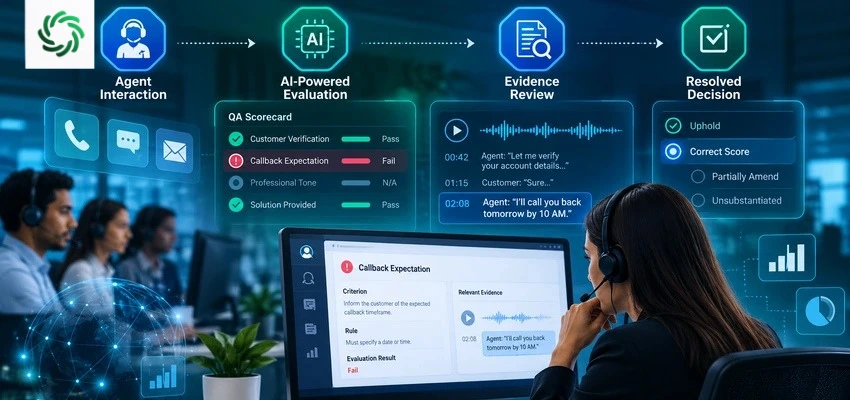
Before a score affects coaching or performance decisions, an authorized reviewer or an automated QA system should be able to reconstruct it from:
- The exact criterion: Which behavior or required step was assessed?
- The applicable rule: What rubric version and approved exception were in force at the time?
- The scoring rationale: Why did the criterion pass, fail, or receive partial credit?
- The interaction evidence: Which relevant passage, audio segment, or authorized system record supports the result?
- The context: Did a transfer, system limitation, or earlier action change what the agent was expected to do?
4-stage Framework for Resolving Contact Center QA Score Disputes
To maintain trust and operational efficiency, contact centers need a structured, transparent process for handling contested evaluations. Following a standardized four-stage workflow ensures every appeal is handled objectively and resolved with verifiable evidence.
Stage 1: Capture the Precise Scoring Challenge
Generic claims like “My score is unfair” waste reviewer time. An actionable dispute submission must capture explicit parameters to allow efficient investigation:
- Interaction Identifier: Unique Call ID, Chat ID, or ticket reference.
- Disputed Criterion: The specific line-item or rubric parameter being challenged.
- Reason for Disagreement: A specific factual claim (e.g., “Identity verification was completed prior to the transfer at 02:14 in the audio track”).
- Dispute Categorization: Tagging the appeal as a factual dispute, rule-interpretation query, or evidence-availability issue.
Assigning a dedicated review SLA (e.g., 48 to 72 hours) and an accountable owner keeps appeals moving without disrupting regular coaching schedules.
Stage 2: Preserve and Verify the Original Evidence
Reviewers must inspect the evaluation in its original state without overwriting underlying records during the review process:
- Inspect Multi-Channel Data: For voice interactions, cross-reference transcript lines directly with raw audio when speaker attribution or keyword detection is ambiguous. For text channels, evaluate full conversation threads including customer-side messaging.
- Verify Active Rubric Versions: Confirm which exact policy version, compliance exception, or client-specific guideline was active at the time of the interaction.
- Prevent Evaluator Bias: For high-impact or auto-fail deductions, ensure an independent secondary QA reviewer or supervisor—rather than the original evaluator—handles the dispute.
Stage 3: Render Decisions Against Rubric, Not the Person
The reviewer compares documented interaction evidence directly against formal rubric. Every appeal must conclude with one of four structured outcomes:
Stage 4: Close the Case and Reconcile Performance Records
Once a decision is made, complete the resolution loop across all system records:
- Transparent Agent Feedback: Send the final decision, supporting evidence clips, and clear rationale directly to the agent and team supervisor.
- Audit-Proof Record Retention: Retain the original QA evaluation, the secondary reviewer’s rationale, and the final score for compliance auditing.
- Reporting Reconciliation: Verify reporting dashboards, monthly agent scorecards, and coaching records automatically update to reflect approved adjustments.
- Root-Cause Aggregation: Group resolved disputes by criterion and root cause monthly to identify recurring policy vagueness, transcription inaccuracies, or evaluator calibration gaps.
Case Study: Evidence-based Dispute Resolution in Practice
To see how an evidence-based review works in practice, consider a complex customer interaction involving a multi-agent transfer and a contested QA scorecard.
The Scenario
An agent receives a low QA score following an escalated account-transfer call. The scorecard flags two severe deductions:
- Deduction A: Incomplete customer identity verification.
- Deduction B: Failure to set mandatory callback expectations.
The agent submits a dispute, stating that identity verification was completed prior to the warm transfer and that standard callback protocols were followed.
The Evidence-based Review
A QA reviewer re-evaluates the interaction by examining the complete audio log, automated transcript, and active account-transfer rubric:
The Operational Result
This mixed resolution highlights why evidence-based dispute reviews are essential:
- Restores Agent Trust: Correcting the unjust verification penalty proves that the evaluation system is fair and data driven.
- Enables Targeted Coaching: Because the agent sees objective proof regarding the missing callback timeframe, the supervisor can lead a constructive coaching session without getting stuck in a debate over whether the entire call was judged fairly.
How to Measure QA Score Dispute Management Effectiveness?
Counting fewer disputes is a misleading indicator of QA health. A drop in appeals may signal that explanations have improved, or it could mean the dispute process is too cumbersome, discouraging agents from challenging unfair scores.
To accurately evaluate the effectiveness of your dispute management workflow, operations leaders must analyze a balanced scorecard of complementary metrics:
Where AIQMS Fits into Evidence-based Quality Evaluations?
Omind AIQMS supports automated evaluation against configurable audit criteria, analysis of voice and non-voice interactions, performance reporting, and coaching insights. Its published product information also describes scores traceable to the conversation moments that informed them. These capabilities support evidence-backed quality reviews.
These tests connect software capabilities to decisions managers must defend. Explore AIQMS for evidence-backed scoring and quality reporting could fit your contact center’s review process.
Reduce Unnecessary Disputes Without Removing Accountability
A strong QA program is not one in which agents never challenge a score. It is one in which the scoring standard is clear, the evidence can be inspected, and legitimate disagreements reach a documented decision. AI can help teams evaluate interactions consistently and locate relevant signals; accountable reviewers must still interpret exceptions and resolve contested outcomes. That makes performance data more defensible and useful for coaching.
Fix Subjective QA Appeals with 100% Traceable Call Evidence
Stop losing supervisor hours to inconclusive scorecard debates and transcript replays. Omind AIQMS links every automated evaluation directly to exact transcript timestamps, audio clips, and compliance rubrics.